Quotulatiousness

September 2, 2009

Canadian troops acting badly . . . in WW2

Filed under: Britain, Cancon, History, WW2 — Nicholas @ 13:02

Jon sent me an interesting anecdote from The Telegraph. According to this (as far as I know uncorroborated) story, the Canadian soldiers stationed in Britain during the Second World War were far from being boy scouts:

Apparently the manoeuvres had got completely out of hand and some of the people living in the Forest Hill and Shotover areas of the county and adjoining Wheatley were being terrorised by tanks, driven utterly without care and thought through the area.

They ploughed up gardens, ruined hedges and flattened walls and carefully cultivated vegetable plots. Concrete pavements were smashed and local roads were apparently chewed up like ploughed fields.

One woman out for a walk with her children was terrorised by a madman in a tank and had her pram damaged.

Stories of the causes of this irresponsibility abounded and the memory of that awful Sunday lived on for years.

The Canadians had the dubious distinction of having inflicted more damage and fear on the civilian population that the Germans!

I’d not be surprised to hear that there’d been some incidents, but I hadn’t heard of anything of quite this magnitude. Has anyone else heard about it before?

Speaking of historical revisionism, here’s Pat Buchanan!

Filed under: Europe, Germany, History, WW2 — Tags: , , , — Nicholas @ 12:47

Pat Buchanan recently published a book called Churchill, Hitler and ‘The Unnecessary War. From the title, you can probably pick up the notion that he feels that Hitler was misunderstood and didn’t really want to go to war. If you aren’t busy retching already, try this on for size:

Did Hitler Want War?

Well, from the title alone, we’re off into cloud-cookoo land already. Yes, Hitler did want war. He was pretty emphatic about it too, and not just in 1939. His written-in-prison Mein Kampf was not a particularly pacific and conciliatory little homily.

The German-Polish war had come out of a quarrel over a town the size of Ocean City, Md., in summer. Danzig, 95 percent German, had been severed from Germany at Versailles in violation of Woodrow Wilson’s principle of self-determination. Even British leaders thought Danzig should be returned.

Why did Warsaw not negotiate with Berlin, which was hinting at an offer of compensatory territory in Slovakia? Because the Poles had a war guarantee from Britain that, should Germany attack, Britain and her empire would come to Poland’s rescue.

Danzig was an excuse, not a reason. The plebiscite had shown that the inhabitants wanted to be part of Germany again, which is probably not surprising as the pre-war Polish government was anti-German and were actively trying to suppress the German language and culture in former German areas of Poland. The Polish government was authoritarian, not democratic, and were not the innocents that some later portrayals might try to indicate. Few of the governments of central or eastern Europe would pass muster as democracies in the 1930s.

Poland did not trust the German government to negotiate in good faith, with plenty of reason, so trying to blame them for the outbreak of the war is ludicrous.

But where is the evidence that Adolf Hitler, whose victims as of March 1939 were a fraction of Gen. Pinochet’s, or Fidel Castro’s, was out to conquer the world?

Um. There’s a tiny little bit of evidence. His book. His speeches. The war plans he had his military leaders draw up. The re-armament program, far in excess of what a peaceful nation with nearby enemies might need as a deterrent.

But yeah, aside from that, he didn’t — so far as we know — conduct a secret pinky-swear session with Mussolini and Hirohito at midnight in the Chancellery basement to conquer the world or else. I mean that’d be the smoking gun, wouldn’t it?

But if Hitler was out to conquer the world — Britain, Africa, the Middle East, the United States, Canada, South America, India, Asia, Australia — why did he spend three years building that hugely expensive Siegfried Line to protect Germany from France? Why did he start the war with no surface fleet, no troop transports and only 29 oceangoing submarines? How do you conquer the world with a navy that can’t get out of the Baltic Sea?

Why did he build the Westwall (aka “Siegfried Line“)? Well, perhaps it was because the French had already constructed large sections of the Maginot Line? This — at least as far as generals on both sides thought — provided a dual purpose: to prevent a German attack into France, and to provide a safe starting point for a French attack into Germany. The fact that the line failed to prevent an attack which came from beyond the flank of the line is hindsight. The Westwall was also multi-purpose, in this case it had three goals: prevent the French attacking, provide a base for an attack on France, and (borrowing the modern term) infrastructure. The Nazi party came to power partly because of the unemployment situation in Germany in the early 1930s. A vast construction project like the Westwall offered chances to soak up lots of “excess” labour . . . and to provide money to the “right” kind of private firms (those who supported the Nazis or those which the Nazis needed to curry favour with).

Go read the whole thing if you’re interested, but I’m feeling that there’s little point in going on . . . I’m certainly not going to persuade Mr. Buchanan or his followers of anything.


September 1, 2009

Woodstock: not so much remembered, as hallucinated

Filed under: History — Tags: , , — Nicholas @ 12:05

I wasn’t at Woodstock. I didn’t want to be at Woodstock. I wasn’t even consciously aware of Woodstock until long after it happened. I have my excuses: I was not quite nine years old at the time, for a start. I point this out not because of any wanna-be-boomer longings, but because Jon (my former virtual landlord) frequently accuses me of being a hippie, or at least wanting to be one.

P.J. O’Rourke, however, has a different excuse:

I was slightly disappointed to be missing Woodstock until the nightly news reported that it had turned into a catastrophic, drug-addled, rain-drenched disaster area lacking food, water, shelter, and Port-A-Potties. Then I was furious to be missing Woodstock.

What this says about 21-year-old boys I needn’t tell anyone who has been, dated, or raised one. Furthermore, Sunflower’s suicide attempt was the result of a fight with her mother about a department store charge plate bill for a $128 peasant blouse and had nothing to do with Sunflower’s desperate romantic feelings for me.

To top it off, a few years later I became a Republican.

What with one thing and another, I was always touchy on the subject of Woodstock. I’m over it now, thanks to various books celebrating the 40th anniversary of too many people in bad haircuts going to an upstate New York dairy farm for no good reason. I’ve counted three of these books so far. Since counting to three was as much as most Woodstock attendees could manage on goof butts and silly pills, three is where I stop.

This is actually from a review of three books about the Woodstock phenomenon (or cultural disaster, take your pick):

The Road to Woodstock is “by” Michael Lang, one of the two original promoters, “with” Holly George-Warren who is coeditor of The Rolling Stone Encyclopedia of Rock and Roll and thus, presumably, knows the alphabet. I have no idea how much of the book Lang wrote, but he doesn’t seem to have read it. He is described therein by a pair of ex-business partners as having “a face that is, by turns, evil, wanton, fey, impish, and innocent.” This is more than I would let ex-business partners of mine say about me in my book.

And yet, if you reverse the order of the adjectives, you get the progress of the sixties, perfectly delineated.

It was not, by the way, a decade: The sixties were a strange episode of about 80 months’ duration that started when the Baby Boom had fully infested academia (roughly the 1966-67 school year) and came to a screeching halt in 1973 when conscription ended and herpes began.

70 years on, Poland remembers

Filed under: Europe, Germany, History, WW2 — Tags: — Nicholas @ 07:46

Seventy years ago today, German troops crossed the Polish frontier, starting the Second World War in Europe. Poland held a memorial to that event this morning:

The first ceremony took place at dawn on Westerplatte peninsula near Gdansk, where a German battleship fired the first shots on a Polish fort in 1939.

Poland’s president and prime minister led a sombre ceremony at the fort.

President Lech Kaczynski added to a row with Russia over responsibility for the war, saying his country had received a “stab in the back”.

Foreign leaders from 20 countries including Germany and Russia are expected in Gdansk during the day as ceremonies continue.

August 22, 2009

Right wing nutbars, observed

Filed under: Health, History, Liberty, USA — Tags: , , , — Nicholas @ 08:23

P.J. O’Rourke tries to save readers the effort of reading the Washington Post coverage of recent town hall protests:

So there was Rick Perlstein calling everyone to the right of Nikita Khrushchev a candidate for the state psychiatric ward with Alec MacGillis playing his KGB Bozo sidekick, firing blanks and honking his “End-of-life care eats up a huge slice of spending” airhorn. Then, to add idiocy to insult, the Post sent Robin Givhan to observe the Americans who are taking exception to various expansions of government powers and prerogatives and to make fun of their clothes.

Givhan writes a column called “On Culture,” and this is what passes for culture at the Post: “Of the hundreds of thousands of style guides currently for sale on Amazon, not one . . . was prescient enough to outline the appropriate attire for those public occasions when good citizens decided to behave like raving lunatics and turn lawmakers into punching bags.” Meeting with Givhan’s scorn were “T-shirts, baseball caps, promotional polo shirts and sundresses with bra straps sliding down their arm.”

I’ve never seen Robin Givhan. For all I know she dolls herself up like Jackie O. But I have seen other employees of the Washington Post and — with the exception of the elegant and, I dare say, cultured, Roxanne Roberts — they look as if they got dressed in the unlit confines of a Planet Aid clothing-donation bin.

Perlstein, for all the highness of his dudgeon, doesn’t catch the nuts saying anything very nutty. The closest he gets to a lunatic quote is from a “libertarian” wearing a holstered pistol who declares that the “tree of liberty must be refreshed from time to time by the blood of tyrants and patriots.” And those are the words of lefty icon Thomas Jefferson. I myself could point out the absurdity of protestors’ concerns about government euthanasia committees. Federal bureaucracy has never moved fast enough to get to the ill and elderly before natural causes do. And what’s with those “birthers”? Why their obsession with a nonentity like Obama? How about John Adams with his Alien and Sedition Acts choke-hold on the First Amendment? Or Jefferson? He could tell his Monica Lewinsky, “I own you,” and he wasn’t kidding. Or John Quincy Adams, pulling the original Blagojevich, buying the presidency from Henry Clay? Or that backwoods Bolshevik Andrew Jackson? Or William Henry Harrison, too dumb to come in out of the rain? Not one of these scallywags was born in the United States of America — look it up.

August 19, 2009

QotD: The annual Beloit College Mindset List

Filed under: Education, History, Humour, Quotations — Nicholas @ 12:12

If the entering college class of 2013 had been more alert back in 1991 when most of them were born, they would now be experiencing a severe case of déjà vu. The headlines that year railed about government interventions, bailouts, bad loans, unemployment and greater regulation of the finance industry. The Tonight Show changed hosts for the first time in decades, and the nation asked “was Iraq worth a war?”

Beloit College, 2009-08-18

August 15, 2009

Would-be assassins

Filed under: History, USA — Tags: , , , — Nicholas @ 10:42

In honour of this news item, I felt it appropriate to buy this (actually, I downloaded it from iTunes).

I always thought it’d have been more appropriate if she’d tried to do this at the Lincoln Centre, just for the symmetry . . .

(more…)

August 11, 2009

Another way of unconsciously offending

Filed under: History, Religion — Tags: , , , , — Nicholas @ 09:59

I’ve apparently been offending Muslims for years by referring to their places of worship as “mosques”. If Ibraheem Wilson is correct, the word mosque is a French term, invented by Spanish monarchs to associate Muslims with mosquitoes. Who knew?

We are supposed to use the term “masjid” instead of “mosque”. I have no idea of the preferrred pronunciation . . . MAS-dzhid? MAS-yid? mas-DZHEED? But I suspect that whichever one I try to use will be wrong.

Update: Whoops, forgot the H/T to Ghost of a Flea.

August 7, 2009

No more manned fighters? This is not a repost from 1957

Filed under: Britain, History, Military — Tags: , , — Nicholas @ 08:01

Back in the depths of the cold war, the British Minister of Defence proclaimed that the end was in sight for manned fighter aircraft, and that automation was rapidly making humans obsolete in the cockpit. A few generations on, another British minister is saying the same thing, with a bit more chance of being proven correct:

In a bizarre repeat of history, a British defence minister has given it as his opinion that we are currently witnessing development of the final generation of manned combat aircraft. The comments made last week by Quentin Davies MP echo those made in a 1957 government white paper by the then Defence minister, Duncan Sandys.

Mr Davies, minister for Defence Equipment and Support, made his new “last of the manned fighters” comments at an Unmanned Air Systems exhibition held on Friday at the London headquarters of the Ministry of Defence (MoD).

“My own working assumption is that although we certainly need the manned combat aircraft, and are investing in some very good ones at the moment… that will take us through to the 2030s, but beyond that I think the name of the game will be UAVs [Unmanned Aerial Vehicles],” he said.

To be fair, the view from 1957 was not as dazed and confused as it might appear to be in hindsight. It was only 13 years after the start of the first widespread and successful cruise missile attacks (Nazi Germany’s V-1 “buzz bombs”), and in the middle of the nuclear arms race. Strategic bombing was still the way wars were expected to be won . . . and with thermonuclear warheads, it was likely to be a final war for all concerned. Flying fighter aircraft was seen to be a relic of the second world war, and an expensive relic at that.

August 3, 2009

Looking for your criminal ancestors?

Filed under: Britain, History, Law — Tags: , — Nicholas @ 10:50

A wide selection of criminal case records from 19th century England and Wales have been made available online:

The records of more than 1.4m criminal trials held in England and Wales in the 19th century, including the most celebrated cases of the Victorian era, have been posted online for family historians to trace their more nefarious ancestors.

Among those whose names are listed are Roderick Maclean, one of several would-be assassins of Queen Victoria, who was declared “not guilty, but insane” after he threatened the monarch with a pistol outside Windsor Castle in 1882, and Isaac “Ikey” Solomon, the fence of stolen property and model for Charles Dickens’s Fagin, who was sentenced to transportation — not execution as in Oliver Twist — in 1830, six years before the novel was written.

Others include notorious murderers such as William Palmer, publicly hanged outside Stafford jail in 1856 after being found guilty of poisoning a horse-racing friend, and Dr Thomas Neill Cream, one of the Jack the Ripper suspects, also hanged as a poisoner in 1892.

July 29, 2009

Another lost WW2 combat aircraft discovered

Filed under: History, Military — Tags: , , , — Nicholas @ 20:28

This time it’s a US Navy carrier plane:

On May 28, 1945, the SB2C-4 Helldiver was on a practice bombing run from a nearby aircraft carrier. The crew members survived the emergency landing.

At the time, the Navy opted not to recover the plane.

Yesterday, Raia said she couldn’t comment on how long it will take Navy officials to decide whether to salvage the plane. Typically, the Naval Aviation Museum in Pensacola, Fla., plays a major role in the evaluation process.

One of the pilots is believed to be 90 years old and living in Michigan, but the Navy hasn’t provided his name.

“Wouldn’t that be something to fly him out here and have him standing on the shoreline when they lift the plane out?” Manville said.

That’d be cool . . . as long as they don’t make him pay for the recovery of the plane.

July 26, 2009

I’ll take his word for it

Filed under: Britain, Cancon, History, Technology — Tags: , , , — Nicholas @ 00:14

. . . but it looks like a random collection of bits to me:

Fairey_Swordfish_wreck

It may not look like much to the untrained eye, but to those of us who are Warbird afficionados, it is incredibly complete. There have been rebuilds to fly from wrecks recently dragged out of the Russian wilderness which were found in worse condition that this.

July 25, 2009

A blast from my past

Filed under: History, Technology — Tags: , , , — Nicholas @ 20:08

I was reading Charles Stross’s blog the other day, and noticed that he’d nicely compiled all his “How I got here in the end” blog entries into a single post. I’d not read the whole thing, so a quick bookmark and I was off to other things. Today, while going back to the bookmark, I discovered that we may have crossed paths in our respective previous lives:

I spent nearly three and a half years working on technical documentation for a UNIX vendor during the early 90s. Along the way, I learned Perl (against orders), accidentally provoked the invention of the robots.txt file, was the token Departmental Hippie, and finally jumped ship when the company ran aground on the jagged rocky reefs of the Dilbert Continent. At one time, that particular company was an extremely cool place to work. But today, it lingers on in popular memories only because of the hideous legacy of it’s initials … SCO.

SCO was not then the brain-eating zombie of the UNIX world, odd though this may seem to young ‘uns who’ve grown up with Linux. Back in the late eighties and early nineties, SCO (then known more commonly as the Santa Cruz Operation) was a real UNIX company. Started by a father-son team, Larry and Doug Michels, SCO initially did UNIX device driver work. Then, around 1985, Microsoft made a huge mistake. Back in those days, MS developed code for multiple operating systems. Some time before then, they’d acquired the rights to Xenix, a fork of AT&T UNIX Version 7. SCO did most of the heavy lifting on porting Xenix to new platforms; and so, when Microsoft decided Xenix wasn’t central to their business any more, SCO bought the rights (in return for a minority shareholding).

SCO is one of the stops on my resumé that I rarely call attention to, as it was an unhappy and eventually unpleasant stop along the way. Charles says “late 1991”, so perhaps we didn’t actually meet . . . I visited the SCO Watford office in August.

Still, I’d like to think that I met one of my favourite authors before he became famous . . .

Later on in that mega-post he says:

During this process I discovered several things about myself. I do not respond well to micro-managing. I especially do not respond well to being micro-managed on a highly technical task by a journalism graduate. Also, I’m a lousy proofreader. Did I say lousy? I meant lousy.

Dude. You want to talk micro-managed? My (Toronto-based) manager wanted twice-daily meetings where I needed to show my progress since the last meeting. I got so paranoid about “showing progress” that I stopped writing altogether, just showing a list of emails I’d been involved in since the last 4-hourly meeting occurred . . .

Do I need to say that my employment at SCO didn’t last much more than a few months after my visit to the Watford office?

Reading further in Charlie’s memoirs:

Here is an example of a Terminally Bad Sign for any organization in the computer business:

… When you discover that your line manager’s recreational reading is the 1980 edition of the IBM Staff Handbook.

Oddly enough, I had a few co-op work terms with IBM in the mid-to-late 1980’s. There were few books that could strike fear in the hearts of technology sector workers like official IBM publications. My very first official IBM staff meeting had the head of R&D in IBM Canada saying things like “There is business out there that we’re not getting. Business that GOD HIMSELF wanted us to have!” For some reason, I thought he was making a joke. I laughed out loud. My IBM career didn’t exactly go upwards from there . . .

July 24, 2009

Photo tour of the USS Hornet

Filed under: History, Military — Tags: , , , , — Nicholas @ 10:06

I’ve been onboard several retired battleships, but so far I’ve not managed to get onto an aircraft carrier. This will have to do for the time being:

The USS Hornet was on hand 40 years ago to pick up the Apollo 11 astronauts after their Columbia Command Module splashed down in the Pacific Ocean on July 24, 1969.

Today, the aircraft carrier is preserved as a museum in Alameda, California. Its main deck is littered with historic warplanes and space artifacts including an Apollo command module and Mobile Quarantine Facility from subsequent missions, pictured below. The first footsteps the Apollo 11 crew took on Earth after walking on the moon are traced on the deck.

USS Hornet CIC

USS Hornet CIC

Above: The USS Hornet’s Crisis Information Center is pictured. While engaged in active warfare, crewmembers would stand behind transparent, hanging boards and write information backwards to keep from getting in the way of the officers who needed to read it.

I think it was actually the “Combat” Information Center, but I could be mistaken. Lots of cool images, but I’d like to see more . . .

July 20, 2009

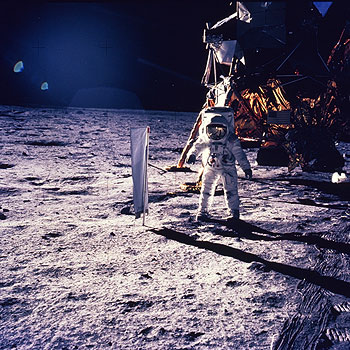
That’s one small miscue for a man, one giant leap for Mankind

Filed under: History, Space — Tags: , , , — Nicholas @ 07:44

It was 40 years ago:

Armstrong and fellow astronaut Buzz Aldrin left the Apollo 11 command module (piloted by Michael Collins) in orbit and performed a landing in the lunar module Eagle. At 4:18 p.m. EDT, Armstrong announced to a watching and waiting world that “The Eagle has landed.”

Six-and-a-half hours later, he stepped onto the powdery surface with the words, “That’s one small step for man, one giant leap for mankind.” Aldrin soon followed Armstrong down the ladder to become the second man to stand on the moon.

One_Small_Step

The mission was by no means a slam dunk. There was real fear that once on the lunar surface the astronauts might end up marooned and beyond rescue. In fact, President Nixon had a condolence speech ready to go in the event things turned out badly.

Nostalgia is an interesting phenomenon . . . the very term “President Nixon” is pried out of deep archaeological layers of memory, yet the first moon landing still seems fresh and no-longer-new but still somehow “recent”.

If you’re still eager for more, Wired has a convenient round-up of Apollo 11-related sites and events.

« Newer PostsOlder Posts »

Powered by WordPress