Quotulatiousness

May 14, 2013

Peter Worthington’s final column

Filed under: Cancon, History, Media — Tags: , , — Nicholas @ 10:00

It was suggested that Peter Worthington write his own obituary:

If you are reading this, I am dead.

How’s that for a lead?

Guarantees you read on, at least for a bit.

When the Sun’s George Gross died suddenly in March 2008, at age 85, there were few of his contemporaries left alive to recall the old days, when he was in his prime and his world was young. I was one of the few who knew him then.

After attending his funeral I half-facetiously remarked to the Toronto Sun’s deputy managing editor, Al Parker, that I had been around so long that no one was left who knew me back then, and I had better write my own obituary.

“Good idea!” said Parker with more enthusiasm than I appreciated.

I mentioned it to my wife, Yvonne, who approved.

So here it is, not exactly an obit but a reflection back on a life and a career that I had never planned, but which unfolded in a way that I’ve never regretted.

May 9, 2013

Delingpole: Ferguson shouldn’t have apologized

Filed under: Economics, History, Media — Tags: , , , , — Nicholas @ 08:47

Although James Delingpole concedes that Ferguson pretty much had to apologize for his off-the-cuff remarks on Keynes, he still thinks it was the wrong thing to do:

I don’t think there’s much doubt about Keynes’s latent gayness: not without reason was he known as the ‘Queen of King’s’. And I’m not really sure that the fact that he later married and attempted (unsuccessfully) to have children proves anything very much. Unless, of course, you’re a modern, professional-offence-taking gay activist, in which case it’s the final clincher in your compelling argument that Ferguson is totally evil and really should lose his Lawrence A. Tisch professorship at Harvard right this second for — as one angry commentator put it — taking ‘gay-bashing to new heights’.

New heights? Really? As Jonah Goldberg has noted, it’s not like there’s anything particularly new or controversial in Ferguson’s theory, tossed off lightly in response to a question at an economics conference. ‘He was childless and his philosophy of life was essentially a short-run philosophy,’ wrote Schumpeter in his obituary of Keynes.

[. . .]

Which is why, of course, Niall Ferguson was forced to issue an apology. Not, I suspect — or rather, I hope — because he thought he’d done anything wrong, but because all too easily it could have become the chink in the armour into which his many enemies were able to insert their fatal stilettos. (I know whereof I speak here, you may recall.)

Here’s how it works: lots of liberal-lefties utterly loathe Ferguson for having committed the unforgivable crime of being an articulate and prominent exponent of right-wing views. Unfortunately, we don’t (yet) live in an era where voicing right-wing views is an indictable offence; so the way to get at such dangerously outspoken defenders of free markets, liberty and small government is through the back door, a bit like Al Capone eventually being done for tax evasion. Racism would have been the ideal charge (except Ferguson’s marriage to Ayaan Hirsi Ali scuppered that option); as too would perceived sexism (which did for Harvard president Larry Summers, remember); but the homophobia charge — had not Ferguson nipped it in the bud — would have surely worked its poison just as well in the end.

I perfectly understand why Ferguson apologised but I wish he hadn’t and I’m sure in his heart he knows he shouldn’t have done. As an economic historian, he’ll be familiar with Danegeld: the more you concede to the enemy, the more they’ll demand next time round.

May 8, 2013

Winnipeg’s Museum for Human Rights

Filed under: Cancon, Germany, History — Tags: , , , , — Nicholas @ 10:03

Mark Steyn talks about the spectacle of “bickering genocides” as the Canadian Museum for Human Rights attempts to pay equal attention to all victims of genocide:

My sometime boss the late Izzy Asper was a media magnate whose lifelong dream was a world-class Holocaust memorial in his home town of Winnipeg. For the usual diversity-celebrating reasons, it evolved into a more general “Canadian Museum for Human Rights,” and is now lumbering toward its opening date under the aegis of Izzy’s daughter, Gail. Having been put through the mill by Canada’s “Human Rights” Commissions, I naturally despise any juxtaposition of the words “Canadian” and “human rights.” But if you have to yoke them, this is the place: To paraphrase Justin’s fellow musician Joni Mitchell, they took all the rights and put ’em in a rights museum, and they charged the people a dollar-and-a-half just to see ’em.

But I’ve warmed up to what the blogger Scaramouche calls the Canadian Mausoleum for Human Rights. It could have been just the usual sucking maw of public monies had it not descended into an hilarious, er, urinating match of competing victimhoods. For those who thought “human rights” had something to do with freedom of speech, freedom of religion, and so forth, it turns out to be about which guy’s genocide is bigger. The Ukrainian-Canadian Congress was wary of the mausoleum from the get-go, suspicious that it would downplay the Holodomor, Stalin’s enforced famine in the Ukraine 80 years ago. The mausoleum assured them that they were going to go big on the Holodomor, but to guarantee the UCC came onboard offered to throw in a bonus exhibit of Canada’s internment of Ukrainian immigrants during World War I. This would be part of “Canada’s Journey,” a heartwarming historical pageant illustrating how the blood-soaked Canadian state has perpetrated one atrocity after another on native children, Chinese coolies, Japanese internees, Jews, gays, the transgendered, you name it. And, of course, the Ukrainians. Per Izzy’s wishes, the Holocaust would have pride of place in a separate exhibit, because, its dark bloody history notwithstanding, Canada apparently played a minimal role in the murder of six million Jews. However, the Holodomor would be included as a permanent featured genocide in the museum’s “Mass Atrocity Zone.”

Oh, you can laugh at the idea of a “Mass Atrocity Zone” tourist attraction in Winnipeg, but there isn’t an ethnic lobby group that doesn’t want in. The Polish-Canadian Congress complained that lumping all the non-Jew genocides in one Mass Atrocity Zone meant they’d have to be on a rotating schedule, like revolving pies on the lunch counter. The Armenian genocide was felt to be getting short shrift, considering it was the prototype 20th-century genocide. On the other hand, the Rwandan genocide, the last big 20th-century genocide, and the Congolese civil war don’t appear to have got a look-in at all. The Poles wanted room made for the Germans’ ill treatment of the Poles, which did not seem to be a priority of the mausoleum.

May 5, 2013

Niall Ferguson apologizes for inappropriate comments about Keynes

Filed under: Economics, History, Media — Tags: , , — Nicholas @ 09:47

Historian and Harvard professor Niall Ferguson has issued an apology for some remarks he made about John Maynard Keynes at a conference in California:

I had been asked to comment on Keynes’s famous observation “In the long run we are all dead.” The point I had made in my presentation was that in the long run our children, grandchildren and great-grandchildren are alive, and will have to deal with the consequences of our economic actions.

But I should not have suggested — in an off-the-cuff response that was not part of my presentation — that Keynes was indifferent to the long run because he had no children, nor that he had no children because he was gay. This was doubly stupid. First, it is obvious that people who do not have children also care about future generations. Second, I had forgotten that Keynes’s wife Lydia miscarried.

My disagreements with Keynes’s economic philosophy have never had anything to do with his sexual orientation. It is simply false to suggest, as I did, that his approach to economic policy was inspired by any aspect of his personal life. As those who know me and my work are well aware, I detest all prejudice, sexual or otherwise.

May 3, 2013

Orwell’s Homage to Catalonia at 75

Filed under: Books, History, Media, Politics — Tags: , , , , , , — Nicholas @ 10:05

In the sp!ked review of books, Mick Hume looks at the book that got Orwell tossed out of the inner circle of leftist writers, not because it was bad, but because it was honest (and made Stalinism look too similar to Hitlerism):

George Orwell could have been killed twice in the Spanish Civil War. Once when he was shot in the throat by General Franco’s fascist forces; then when he was hunted by official Communist agents who, with the backing of Stalin’s Soviet Union, stabbed the revolution in the back and imprisoned, tortured and killed leading leftists and anarchists who were ostensibly on the same Republican side. Orwell learned the hardest way that the war against fascism in Spain was also a civil war against Stalinism.

Homage to Catalonia, Orwell’s famous account of his time in Spain from his arrival in Barcelona on Boxing Day 1936 to his escape in June 1937, has just reached its seventy-fifth anniversary. Like its author, the book almost didn’t make it either. The radical journalist and author’s usual publisher, Victor Gollancz, turned the book down without even seeing the manuscript, insisting that he would not publish anything ‘which could harm the fight against fascism’ by criticising the Communists.

Most of those from Britain and Europe who went to write about and fight in the Spanish Civil War took a similarly one-eyed view and followed the pro-Soviet line. What was unique about Orwell was that he hated fascism, but also stood apart from the official Stalinist-dominated left of his time. The radical maverick wrote about what he saw in Spain, rather than simply what he was told was true — although he also warned his readers to ‘beware my partisanship’ when seeking an objective account. He questioned the ‘official’ Stalinist-dictated account of events in Barcelona and elsewhere that was accepted around the world. This heresy made him the subject of a hate campaign when Homage to Catalonia was finally published in 1938, a campaign which continued well into the 1980s.

[. . .]

Orwell’s brilliant firsthand account of the conflict stands apart from and well above the I-was-there school of emotive, narcissistic war reporting we witness too often today. He also attempts to put his personal experiences into some proper political context, in two chapters now removed (at his request) from the narrative text and published at the end as appendices.

Here, Orwell closely interrogates and challenges the ‘official version’ of events in Barcelona, put about by the Communists and their many international apologists to justify their brutal repression of the non-Stalinist left. As he unravels the twisting of truth by propaganda organs such as the CPGB’s Daily Worker, you can almost see the ideas he was soon to express in his novels Animal Farm and Nineteen Eighty-Four. He is also cutting about the way that the Communists simply branded their opponents as ‘Social-fascists’ and ‘Trotsky-Fascists’ to avoid engaging in important political arguments. Many who express their admiration for Orwell today have yet to absorb his point that screaming ‘Fascists!’ in the faces of those you disagree with is not the same thing as making your case. ‘Libel’, as he concludes, ‘settles nothing’.

April 27, 2013

“Nazi” is a word that leads to intellectual laziness and misunderstanding

Filed under: Germany, History, Media, WW2 — Tags: , , — Nicholas @ 09:00

In History Today, Richard Overy explains why the word “Nazi” has been over-used and has become an obstacle to historical understanding:

Few words in regular use in historical writing can have been abused as much as the word ‘Nazi’. At the very least it has proved a persistent grammatical challenge for generations of students who fall into the trap of writing ‘Nazi’s’ or ‘Nazis’ ‘ as the plural of Nazi and ‘Nazis’ as the possessive without an apostrophe, when it should be the other way around. This has become so widespread a practice that the mistake profits from a growing linguistic inertia. Soon it will be designated as an anomaly we can all live with, like the misuse of ‘impact’ as if it were a verb — as in ‘the Nazi’s impacted the German political system’.

In truth this is the least of the problems. The real issue is the indiscriminate use of the term ‘Nazi’ to describe anything to do with German institutions or behaviour in the years of the dictatorship between 1933 and 1945. It is common practice to talk of the ‘Nazi Army’, or the ‘Nazi Air Forces’, or ‘Nazi atrocities’, or ‘the Nazi economy’ as if everything in Germany under Hitler was uniquely and unambiguously National Socialist. The result is a complete lack of historical precision. ‘Nazi’ becomes a shorthand term that obscures more than it explains. Historians who write about the Soviet Union under Stalin do not usually describe its features as ‘Commie this’ or ‘Commie that’, any more than historians of British party politics in the interwar years talk about ‘Tories’ and ‘lefties’ rather than the Conservative Party and the Labour Party.

The term originated in the 1920s when contemporaries searched for some way of getting round the long-winded title of the party — the National Socialist German Workers Party (NSDAP). It was used chiefly by the enemies of the party and never by the regime itself. The term ‘Nazi’ or ‘the Nazis’ had strongly negative associations; it was employed as a quick way of describing a movement popularly associated in the mind of left-wing critics outside Germany with authoritarian rule, state terror, concentration camps and an assault on the cultural values of the West. Psychologists even suggested that there was such a thing as a ‘Nazi mind’ to explain why members of the party were so brutal, aggressive and mendacious. The term then, and now, was loaded.

The last Beguine

Filed under: Europe, History, Religion — Tags: , , , — Nicholas @ 08:53

An obituary (and short history lesson) in The Economist:

AT THE heart of several cities in Belgium lies an unexpected treasure. A gate in a high brick wall creaks open, to reveal a cluster of small, whitewashed, steep-roofed houses round a church. Cobbled alleyways run between them and tiny lawns, thickly planted with flowers, grow in front of them. The cosiness, the neatness and the quiet suggest a hortus conclusus, a medieval metaphor both for virginal women and the walled garden of paradise.

Any veiled women seen there now, however, processing to Mass or tying up hollyhocks in their dark habits and white wimples, are ghosts. Marcella Pattyn was the last of them, ending a way of life that had endured for 800 years.

These places were not convents, but beguinages, and the women in them were not nuns, but Beguines. In these communities, which sprang up spontaneously in and around the cities of the Low Countries from the early 13th century, women led lives of prayer, chastity and service, but were not bound by vows. They could leave; they made their own rules, without male guidance; they were encouraged to study and read, and they were expected to earn their keep by working, especially in the booming cloth trade. They existed somewhere between the world and the cloister, in a state of autonomy which was highly unusual for medieval women and highly disturbing to medieval men.

Nor, to be honest, was it the first thing Juffrouw Marcella thought of when, as a girl, she realised that her dearest wish was to serve her Lord. But she was blind, or almost so, and no other community would accept her. She wanted to work, too, and was not sure she could in an ordinary convent. The beguinages had originally been famous for taking the “spare” or “surplus” women who crowded into 13th-century cities in search of jobs. Even so, the first community she tried sent her back after a week, unable to find a use for her. (In old age she still wept at the thought of all the rejections, dabbing with a handkerchief at her blue unseeing eyes.) A rich aunt intervened with a donation to keep her there, and from the age of 21 she was a Beguine.

April 22, 2013

QotD: The long-term dangers of chronic unemployment

Filed under: Economics, History, Quotations, USA — Tags: , , — Nicholas @ 12:20

One of the most pernicious aspects of the chronic unemployment rampant during the Great Depression was that it took many people (mostly men) out of the workforce permanently. Many men simply became unsuited for making a living, and this in turn prevented them from forming families or even becoming a part of normal society. The same pattern is appearing now, and it is a cause for grave concern. Chronic unemployment isn’t just a hit to the economy; it attacks the very fabric of society.

The simplistic approach to this problem is to demand that the government create jobs ex nihilo, but this almost never works in practice. Besides being wasteful of tax dollars and of limited use in actually reducing unemployment, these types of programs also tend to cultivate a sense of cynicism in the workers themselves. FDR’s various make-work schemes were a perfect example of this. (The old joke about the WPA was that it stood for “We Piddle Around”.)

Monty, “DOOM: It’s not the fall that kills you, it’s the sudden stop”, Ace of Spades H.Q., 2013-04-22

April 15, 2013

When will the US embargo of Cuba achieve its purpose?

Filed under: Americas, Economics, History, Politics, USA — Tags: , , , — Nicholas @ 10:28

In Reason, Steve Chapman wonders if the US embargo has actually propped up the very regime it was intended to topple:

The U.S. embargo of Cuba has been in effect since 1962, with no end in sight. Fidel Castro’s government has somehow managed to outlast the Soviet Union, Montgomery Ward, rotary-dial telephones and 10 American presidents.

The boycott adheres to the stubborn logic of governmental action. It was created to solve a problem: the existence of a communist government 90 miles off our shores. It failed to solve that problem. But its failure is taken as proof of its everlasting necessity.

If there is any lesson to be drawn from this dismal experience, though, it’s that the economic quarantine has been either 1) grossly ineffectual or 2) positively helpful to the regime.

The first would not be surprising, if only because economic sanctions almost never work. Iraq under Saddam Hussein? Nope. Iran? Still waiting. North Korea? Don’t make me laugh.

What makes this embargo even less promising is that we have so little help in trying to apply the squeeze. Nearly 200 countries allow trade with Cuba. Tourists from Canada and Europe flock there in search of beaches, nightlife and Havana cigars, bringing hard currency with them. So even if starving the country into submission could work, Cuba hasn’t starved and won’t anytime soon.

Nor is it implausible to suspect that the boycott has been the best thing that ever happened to the Castro brothers, providing them a scapegoat for the nation’s many economic ills. The implacable hostility of the Yankee imperialists also serves to align Cuban nationalism with Cuban communism. Even Cubans who don’t like Castro may not relish being told what to do by the superpower next door.

April 14, 2013

An alternative Britain would be “Cuba without the sunshine”

Filed under: Britain, History, Media — Tags: , , , — Nicholas @ 10:06

Dominic Sandbrook recounts the history of a slightly different Britain: one where Margaret Thatcher lost to Jim Callaghan in 1978:

As historians now agree, Mrs Thatcher never really stood a chance: Britain was not ready for a woman prime minister. As she herself had remarked only eight years earlier: ‘There will not be a woman prime minister in my lifetime — the male population is too prejudiced.’

In her place, the Tories turned to the bumbling figure of Willie Whitelaw, an old-fashioned patrician Wet whom they decided would connect better with the British electorate.

In the meantime, the country was reeling from crisis to crisis. Scarcely had Callaghan returned to No 10 than his premiership was consumed in the notorious Winter of Discontent. As one group of workers after another — lorry drivers, railwaymen, bus drivers, ambulance drivers, caretakers, cleaners, even grave-diggers — walked out on strike for higher wages, the country ground to a halt.

Buoyed by his election victory, Callaghan was in no mood to compromise. Rather than break his declared 5 per cent national pay limit and risk higher inflation, he declared a State of Emergency and summoned the Army to drive Britain’s petrol tankers.

It was a catastrophic mistake. On February 12, 1979, a date that has gone down in history as Black Monday, fighting broke out between pickets and soldiers at one depot outside Hull.

In the chaos, one soldier — carrying live rounds, in contravention of orders — opened fire and killed five people. It was one of the most shocking moments in modern British history.

Callaghan resigned the next day, the last honourable act of a decent man overwhelmed by events. But contrary to his expectations, the Labour Party did not turn to his Chancellor, the bushy-browed Denis Healey.

Instead, they lurched to the Left and elected as their new Prime Minister Michael Foot, with his flowing white locks, walking stick and impassioned socialist rhetoric. The real power in the land, however, was Foot’s colleague Tony Benn, who replaced the disgruntled Healey as Chancellor. And in the next few years, it was Benn who presided over the most sweeping socialist measures any Western country had seen in living memory.

To the horror of many in industry, Benn insisted that Britain’s declining economy needed a dose of shock therapy. The top rate of income tax went up to 98 per cent, and the government announced a one-off 5 per cent ‘equality levy’ on households with income over £50,000 a year.

As frightened investors began to withdraw their money from the City of London, Benn introduced sweeping exchange controls. He also, in an attempt to shore up Britain’s crumbling manufacturing base, introduced the most stringent import tariffs in the Western world.

The reaction was pandemonium. As inflation shot over 25 per cent and unemployment went above two million, horrified European leaders insisted that Britain’s new policies were incompatible with membership of the Common Market.

But Benn was adamant. ‘You turn if you want to,’ he told his party conference in 1980. ‘Labour’s not for turning.’

The following year, as the economic picture continued to worsen, the Government introduced controls to stop people taking sterling out of the country. As a result, the foreign package holiday market collapsed — although landladies in Blackpool said they had never seen more business.

There were rumours that Foot was planning to move his turbulent Chancellor, but they were blown away when, in April 1982, Argentine forces landed in the Falklands.

H/T to Roger Henry for the link.

April 11, 2013

QotD: An underclass that’s too rich

Filed under: Britain, Economics, History, Quotations — Tags: , , , — Nicholas @ 10:05

I hear quite a bit of that these days — almost like a local version of East German “ostalgie“. Old British friends say to me, well, say what you like about the 1970s — nothing worked; if you wanted to buy a new car, it was as if post-war rationing was still in effect — but all the same life in the village seemed a lot more pleasant back then. There’s something to this: the benign side of oppressive statism is often a kind of public restraint. And more than a few folks seem to feel, with the benefit of hindsight, that it’s better to have unionised thugs nutting scabs on the picket line than freelance yobs in hideous leisurewear infesting ersatz-American high streets catering to their every frightful whim from one end to the other. For the modern liberal, this is a new dilemma: an underclass that’s too rich.

Mark Steyn, “The Unfinished Revolution”, Daily Telegraph, 2004-05-04 (link goes to Steyn’s own site)

April 10, 2013

If there’s a “Bitcoin bubble”, it doesn’t predict long term success or failure for the currency

Filed under: Economics, History, Technology — Tags: , , , , , — Nicholas @ 12:55

In Forbes, Tim Worstall explains that calling the current rise in Bitcoin value a bubble does not actually pass a judgement on whether Bitcoin will be a long term success:

And yes, I’m still of the opinion that Bitcoin is in a bubble. You know the walks like a duck, quacks like a duck idea? If it does those then it’s a duck. And the price changes that we’re seeing in Bitcoin make me and many other observers think that Bitcoin really is in a bubble. Indeed, there’s some nice work here showing that many of the Bitcoins in existence are being hoarded and that in itself is bubble behaviour.

However, do let me make one more thing clear: whether or not Bitcoin is in a bubble or not doesn’t mean that Bitcoin will succeed or not. They are entirely different questions, as different as is your wife Welsh or is your dog female? They really have no connection with each other at all.

Let us take the standard bubble example always used, the Dutch tulipmania. We could use others, the South Sea Bubble, the dot com boom, or we could even use an entirely different set of examples, say the introduction of the automobile. That last being when a new technology arrived without a speculative bubble around it.

The point of the first three, and let’s stick with tulips, is that there really was a quite obvious bubble in the prices of them. Most of the participants in the bubble (as with the other two) knew quite well that it was a bubble too. Prices were way out of line with any sort of “true value”. However, do note this very well: the tulip did indeed go on to become an important part of the Dutch economy. Indeed, it’s still there right now. Vast fields of tulips are grown there every year to supply cut flowers and bulbs for replanting that are shipped all over Europe. It’s actually become so important that other flowers, grown outside Europe, are still marketed through Holland as that’s where all the skill and infrastructure is.

ESR asks “What if it really was like that?”

Filed under: History — Tags: , , , , , — Nicholas @ 10:10

An interesting jaunt along the byways of human perception and social organization:

I think the book that taught me to ask “What if it really was like that?” systematically might have been Julian Jaynes’s The Origin of Consciousness in the Breakdown of the Bicameral Mind. Jaynes observed that Bronze Age literary sources take for granted the routine presence of god-voices in peoples’ heads. Instead of dismissing this as fantasy, he developed a theory that until around 1000BC it really was like that — humans had a bicameral consciousness in which one chamber or operating subsystem, programmed by culture, manifested to the other as the voice of God or some dominant authority figure (“my ka is the ka of the king”). Jaynes’s ideas were long dismissed as brilliant but speculative and untestable; however, some of his predictions are now being borne out by neuroimaging techniques not available when he was writing.

A recent comment on this blog pointed out that many cultures — including our own until around the time of the Industrial Revolution — constructed many of their customs around the belief that women are nigh-uncontrollably lustful creatures whose sexuality has to be restrained by strict social controls and even the amputation of the clitoris (still routine in large parts of the Islamic world). Of course today our reflex is to dismiss this as pure fantasy with no other function than keeping half the human species in perpetual subjection. But some years ago I found myself asking “What if it really was like that?”

Let’s be explicit about the underlying assumptions here and their consequences. It used to be believed (and still is over much of the planet) that a woman in her fertile period left alone with any remotely presentable man not a close relative would probably (as my commenter put it) be banging him like a barn door in five minutes. Thus, as one consequence, the extremely high value traditionally placed on physical evidence of virginity at time of marriage.

Could it really have been like that? Could it still be like that in the Islamic world and elsewhere today? One reason I think this question demands some attention is that the costs of the customs required to restrain female sexuality under this model are quite high on many levels. At minimum you have to prevent sex mixing, which is not merely unpleasant for both men and women but requires everybody to invest lots of effort in the system of control (wives and daughters cannot travel or in extreme cases even go outside without male escort, homes have to be built with zenanahs). At the extreme you find yourself mutilating the genitalia of your own daughters as they scream under the knife.

In British political circles, the term “Thatcherism” conceals at least as much as it reveals

In sp!ked, Tim Black explains why the term “Thatcherism” is not actually a useful descriptor of Margaret Thatcher’s political ideology, but it helps hide the weaknesses of her political and ideological foes:

… for many of those who today preen themselves as left-wing, the idea of Thatcher is arguably even more important. And that’s because she can be blamed for everything that is wrong today. She may have left office nearly a quarter of a century ago, but so potent was the ideology she apparently promulgated — Thatcherism — that we as a nation continue to be in thrall to it. As one prominent left-wing columnist stated yesterday: ‘Thatcherism lives on. Nothing to celebrate.’ Ex-London mayor ‘Red’ Ken Livingstone agreed: ‘In actual fact, every real problem we face today is the legacy of the fact she was fundamentally wrong.’

Elsewhere, Johnathan Freedland at the liberalish-leftish Guardian joined the Thatcherism Lives chorus: ‘The country we live in remains Thatcher’s Britain. We still live in the land Margaret built.’ At the much-reported-upon, little-attended street parties in Brixton and Glasgow, staged in ironic honour of Thatcher’s passing, the belief that her ideas still walk among us was palpable. In the words of one 28-year-old student: ‘It is important to remember that Thatcherism isn’t dead and it is important that people get out on the street and not allow the government to whitewash what she did.’

[. . .]

And here is where reality stops and myth begins. Because that’s not what the left saw. They saw something more ideological than brutally pragmatic. They saw, in the words of Marxism Today editor Martin Jacques in 1985, ‘a novel and exceptional force’. They saw, in short, Thatcherism.

Given the fact that Thatcher herself never had an actual ideological project to which ‘Thatcherism’ might actually refer, it is unsurprising that a recent book on the subject admitted that ‘talk of “Thatcherism” obscures as much as it reveals’. Instead, the idea of Thatcherism always revealed far more about the left than it did about some perpetually elusive right-wing ideology. That is why the concept, first used by academic Stuart Hall in 1979, gained intellectual traction on the left in 1983, the year Labour, under the leadership of Michael Foot, suffered a devastating defeat at the General Election: it shifted the responsibility for failure from the Labour Party, and its complicity with so-called Thatcherite economics, to the working class, a social constituency supposedly seduced away from the Labour Party by Thatcher’s advocacy of social mobility and aspiration. The idea of ‘Thatcherism’ let Labour off the hook.

So the legacy of Thatcherism may indeed live on, as some sunk on the left insist. But not because of anything Thatcher herself did. It will live on because too many are more comfortable attacking a phantasm from the past than reckoning with political reality today.

April 9, 2013

Britain’s wartime rationing was the actual start of the modern welfare state

Filed under: Britain, Bureaucracy, Food, Government, History, WW2 — Tags: , , , — Nicholas @ 08:31

In the Telegraph, Daniel Hannan shows that the wartime coalition government led by Winston Churchill actually laid the groundwork for the post-war “creation” of the welfare state:

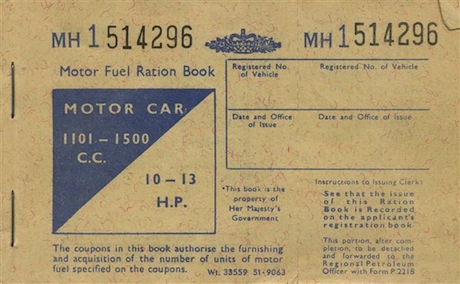
British WW2 Fuel ration book cover

It wasn’t the 1945 Labour Government that created the welfare state, that Saturn which now devours its children. The real power-grab came in 1940.

With Britain’s manpower and economy commandeered for the war effort, it seemed only natural that ministers should extend their control over healthcare, education and social security. Hayek chronicled the process at first hand: his Road to Serfdom was published when Winston Churchill was still in Downing Street.

Churchill had become prime minister because he was the Conservative politician most acceptable to Labour. In essence, the wartime coalition involved a grand bargain. Churchill was allowed to prosecute the war with all the nation’s resources while Labour was given a free hand to run domestic policy.

The social-democratic dispensation which was to last, ruinously, for the next four decades — and chunks of which are rusting away even today — was created in an era of ration-books, conscription, expropriations and unprecedented spending. The state education system, the NHS, the Beveridge settlement — all were conceived at a time when it was thought unpatriotic to question an official, and when almost any complaint against the state bureaucracy could be answered with “Don’t you know there’s a war on?”

All quite true, and all quite necessary at the time. Without significant amounts of imported food, Britain could not feed its people. Even with imports, the amount of available food was subject to unpredictable fluctuations as losses at sea interrupted supply and left empty shelves in grocery stores. Although losses were relatively low early in the war (early U boats were unable to stay at sea for long periods, and German bases were a long way from most British trade routes), the writing was on the wall if the war continued for years.

To fight a totalitarian regime, Britain had to emulate some of its methods (ironically, full rationing wasn’t introduced in Germany until much later in the war). For the middle classes, this was an unwelcome intrusion of the state into private affairs, but generally accepted due to the war. For the working classes, in many cases it was actively welcomed. While the rations were small, there was the promise — and generally a fulfilled promise — that some would be made available even in the poorest areas of the country. My mother was nine when the war began, and she remembers seeing more food in the stores of Middlesbrough after rationing was introduced. After the deprivations of the Great Depression, many people in the north and in Scotland were better fed and clothed during the rationing period than they had been for nearly a decade.

Given that information, it should not be surprising that so many people voted for Labour in the 1945 elections: they’d had what they believed to be a live demonstration of the benefits of socialism for six years of war, and didn’t want to go back to the pre-1940 status quo.

« Newer PostsOlder Posts »

Powered by WordPress