
The most basic kind of transport is often small-scale overland transport, either to and from the nearest city, or in small (compared to what we’ll discuss in a moment) caravans moving up and down a region […]. The Talmud, for instance, seems to suggest that much of the overland grain trade in Palestine under the Romans was performed with itinerant donkey-drivers in small caravans – and I do mean small. Egyptian tax evidence suggests that most caravans were small; Erdkamp notes that 90% of donkey caravans and 75% of camel caravans consisted of three or less animals. These sorts of small caravans don’t usually specialize in any particular good but instead function like land-based cabotage traders, buying whatever seems likely to turn a profit at each stop and stopping in each town and market along the way. Some farmers might even do this during the off season; in Spain, peasants often worked as muleteers during the slow farming season, moving rents and taxes into town or to points of export for their wealthy landlords and neighbors.
Truly long-distance bulk grain transport overland wasn’t viable for reasons we’ve actually already discussed. There is simply nothing available in the pre-modern period to carry the grain overland that doesn’t also eat it. While moving grain short distances (especially to simply fill capacity while the main profit is in other, lower-bulk, higher value goods) can be efficient enough, at long distance, all of the grain ends up eaten by the animals or people moving it.
The seaborne version of this sort of itinerant, short-distance trade is called cabotage. Now today cabotage has a particular, technical legal meaning, but when we use this word in the past, it refers not to the legal status of a ship but a style of shipping using small boats to move mixed cargo up and down the coast. In essence, cabotage works much the same as the small caravans – the merchant buys in each port whatever looks likely to turn a profit and sells whatever [is] in demand. By keeping a mixed cargo of many different sorts of things, he protects against risk – he’s always likely to be able to sell something in his boat for a profit. Such traders generally work on very short distances, often connecting smaller ports which simply cannot accommodate larger, deeper-draft long-distance traders. Such cabotage trading was the background “hum” of commerce on many pre-modern coastlines and might serve to move grain up or down the coast, although not very much of it. Remember that grain is a bulk commodity, and cabotage traders, by definition, are moving small volumes.
But when it comes to moving large volumes, the sea changes everything. The fundamental problem with transporting food on land is that the energy to transport the food must come from food, either processed into muscle power by porters or animals. But at sea, that energy can come from the wind. So while the crew of a ship eats the food, the ship can be scaled up without scaling up the food requirements of the crew or the crew itself. At the same time, sea-transit is much faster than land transit and that speed is obtained from the wind without further inputs of food. It is hard to overstate how tremendous a change in context this is. Using the figures from the Price Edict of Diocletian, we tend to estimate that river transport was five times cheaper than land transport, and sea-transport was twenty times cheaper than land transport. So while the transport of bulk goods like grain on land was limited to fairly small amounts moving over short distances – say from the farm to the nearest town or port – grain could be moved long distances en masse by sea.
Now the scale and character of long-distance transport is heavily impacted by the political realities of the local waterways. If the seas are politically divided, or full of pirates, it is going to be hard to operate big, slow vulnerable grain-freighters and still make a profit after some of them get seized, pirated or sunk. But when we have periods of political unity and relatively safe seas, we see that this sort of transport can reach quite impressive scale. For instance the port regulations of late Hellenistic and Roman Thasos – itself a decent sized, but by no means massive port – divided its harbor into two areas, one for ships carrying 80-130 tons of cargo and one for ships 130+ tons (those regulations are SEG XVII 417). A brief bit of math indicates that the distribution of free grain in the city of Rome – likely less than a third of the total grain demands of the city – required the import, by sea of some 630 tons of grain per day through the sailing season. The scale of grain shipment in the back half of the Middle Ages (post-1000 or so) was also on a vast scale, with trade-oriented Italian cities exploding in population as they imported grain (Genoa being particularly well known for this, but by no means alone in it); with that came the reemergence of truly large grain-freighters.
Bret Devereaux, “Collections: Bread, How Did They Make It? Part IV: Markets, Merchants and the Tax Man”, A Collection of Unmitigated Pedantry, 2020-08-21.
August 27, 2023
QotD: Getting food to market in pre-modern societies
August 12, 2023
Churchill and India
Andreas Koureas posted an extremely long thread on Twitter, outlining the complex situation he and his government faced during the Bengal Famine of 1943, along with more biographical details of Churchill’s views of India as a whole (edits and reformats as needed):
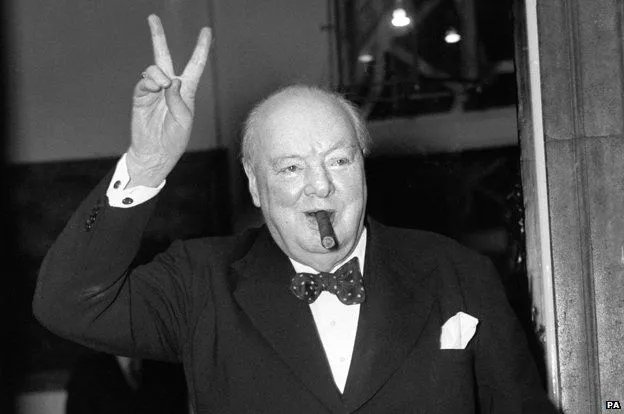
The most misunderstood part of Sir Winston Churchill’s life is his relationship with India. He neither hated Indians nor did he cause/contribute to the Bengal Famine. After reading through thousands of pages of primary sources, here’s what really happened.
A thread 🧵
I’ve covered this topic before, but in a recent poll my followers wanted a more in-depth thread. Sources are cited at the end. I’m also currently co-authoring a paper for a peer reviewed journal on the subject of the Bengal Famine, which should hopefully be out later this year.
I’ll first address the Bengal Famine (as that is the most serious accusation) and then Churchill’s general views on India. It goes without saying that there will be political activists who will completely ignore what I have to say, as well as the primary sources I’ll cite. I have no doubt, that just like in the past, there will be those who accuse me of only using “British sources”.
This is not true. I have primary sources written by Indians as well as papers by Indian academics.
Moreover, I have no doubt that such activists will, choose to “cite” the ahistorical journalistic articles from The Guardian or conspiratorial books like Churchill’s Secret War by Mukerjee — a debunked book that ignores most of what I’m about to write about, and is really what sparked the conspiracy of Churchill and the Bengal Famine. For everyone else, I hope you find this thread useful.
(more…)
August 11, 2023
QotD: Subsistence versus market-oriented farming in pre-modern societies
Remember: in most pre-modern societies, the small farmers are largely self-sufficient. They don’t need very many of the products of the big cities and so – at least initially – the market is a poor mechanism to induce them to produce more. There simply aren’t many things at the market worth the hours of labor necessary to get them – not no things, but just not very many (I do want to stress that; the self-sufficiency of subsistence farmers is often overstated in older scholarship; Erdkamp (2005) is a valuable corrective here). Consequently, doing anything that isn’t farming means somehow forcing subsistence farmers to work more and harder in order to generate the surplus to provide for those people who do the activities which in turn the subsistence farmers might benefit from not at all. But of course we are most often interested in exactly all of those tasks which are not farming (they include, among other things, literacy and the writing of history, along with functionally all of the events that history will commemorate until quite recently) and so the mechanisms by which that surplus is generated matter a great deal.
First, the large landholder’s farm itself existed to support the landholder’s lifestyle rather than his actual subsistence, which meant its production had to be directed towards what we might broadly call “markets” (very broadly understood). Now many ancient and even medieval agricultural writers will extol the value of a big farm that is still self-supporting, with enough basic cereal crops to subsist the labor force, enough grazing area for animals to provide manure and then the rest of the land turned over to intensive cash-cropping. But this was as much for limiting expenses to maximize profits (a sort of mercantilistic maximum-exports/minimum-imports style of thinking) as it was for developing self-sufficiency in a crisis. Note that we (particularly in the United States) tend to think of cash crops as being things other than food – poppies, cotton, tobacco especially. But in many cases, wheat might be the cash crop for a region, especially for societies with lots of urbanism; good wheat land could bring in solid returns […]. The “cash” crop might be grapes (for wine) or olives (mostly for olive oil) or any number of other necessities, depending on what the local conditions best supported (and in some cases, it could be a cash herd too, particularly in areas well-suited to wool production, like parts of medieval Britain).
Second, the exploitation by the large landholder forces the smaller farmers around him to make more intensive use of their labor. Because they are almost always in debt to the fellow with the big farm and because they need to do labor to get access to plow teams, manure, tools, or mills and because the large landholder’s land-ready-for-sharecropping is right there, the large landholder both creates the conditions that impel small farmers to work more land (and thus work more days) than their own small farms do and also creates the conditions where they can farm more intensively (both their own lands and the big farm’s lands, via plow teams, manure, etc.). Of course the large landholder then generally immediately extracts that extra production for his own purposes. […] all of the folks who aren’t small farmers looking to try to get small farmers to work harder than is in their interest in order to generate surplus. In this case, all of that activity funnels back into sustaining the large landholder’s lifestyle (which often takes place in town rather than in the countryside), which in turn supports all sorts of artisans, domestics, crafters and so on.
And so the large landholder needs the small subsistence farmers to provide flexible labor and the small subsistence farmers (to a lesser but still quite real degree) need the large landholder to provide flexibility in capital and work availability and the interaction of both of these groups serves to direct more surplus into activities which are not farming.
Bret Devereaux, “Collections: Bread, How Did They Make It? Part II: Big Farms”, A Collection of Unmitigated Pedantry, 2020-07-31.
August 10, 2023
“Ultra-Processed Food” is so bad that we need extra scare-quotes!!
Christopher Snowden seems, for some inexplicable reason, to be skeptical about the hysterical warnings of people like Chris van Tulleken in his recent book Ultra-Processed People: Who Do We All Eat Stuff That Isn’t Food … and Why Can’t We Stop?
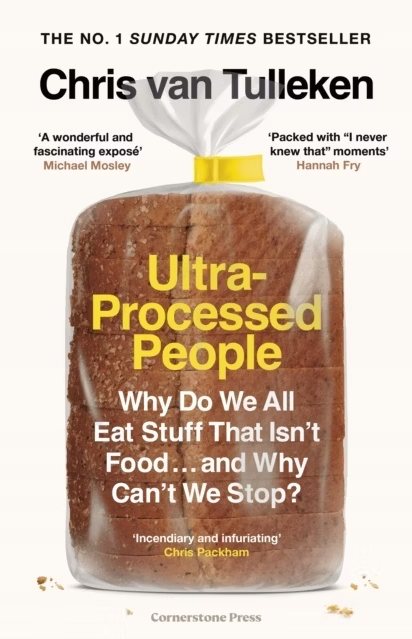
If Jamie Oliver is the fun police, Chris van Tulleken is the Taliban. The selling point of books like Ultra-Processed People is the idea that everything you know is wrong. Van Tulleken, an infectious diseases doctor and television presenter, takes this to extremes. In this book, almost everybody is wrong, many of them are corrupt and almost no one is to be trusted. Only Dr. van Tulleken, a handful of researchers and anyone who pays £25 to read this book knows the real truth. The problem is not sugar. The problem is not carbs. Artificial sweeteners don’t work. Exercise doesn’t work. Willpower doesn’t work. Every scientist who has published research contradicting his theory is in the pay of the food industry or — how’s this for an ad hominem argument? — has cited studies by people who are. The British Nutrition Foundation, the Academy of Nutrition and Dietetics, the British Dietetic Association, the Centre for Social Justice, the Institute of Economic Affairs, Tortoise Media, Diabetes UK, Cancer Research UK and the British Heart Foundation are all tainted by food industry funding. Even Jamie Oliver – Saint Jamie, the Sage of Essex — is guilty by his association with Tesco and Deliveroo, and because he makes ultra-processed food (“albeit fairly marginal items”).
It is this ultra-processed food (UPF), argues van Tulleken, that is the real cause of obesity and diet-related diseases in the world today. Food is classified as UPF if it is wrapped in plastic and contains an ingredient you don’t have in your kitchen. This includes everything from mustard to Magnums but, counter-intuitively, doesn’t include sugar, salt or fat. Van Tulleken doesn’t quite put it like this but, in effect, anything you make at home is healthy while nearly anything you buy in a supermarket, aside from raw ingredients, is bad for you.
The evidence for this striking proposition can be briefly outlined, and van Tulleken deals with it swiftly in a single chapter. Firstly, there are a number of studies using observational epidemiology which find a correlation between diets which are high in UPF and various ailments, including not only obesity, heart disease and type 2 diabetes, but also dementia, depression, cancer and more. Secondly, there is a randomised controlled trial which gave a small group of volunteers a two-week diet of either ultra-processed food or minimally processed food. The nutritional profile of each diet was similar (the same levels of salt, sugar, etc.) and the volunteers were offered twice as much as they needed to maintain a healthy weight. The people on the ultra-processed diet ended up eating 500 calories more than the people on the minimally processed diet and put on nearly a kilogram of weight.
The randomised controlled trial was published in 2019 and already has over 1,200 academic citations. Van Tulleken considers it to be extraordinarily robust, but it only really stands out because the general standard of dietary research is so poor. The volunteers were not given ultra-processed versions of the same meals. They were given totally different meals, plus very different snacks, and they could eat as much as they wanted for free. What does it actually demonstrate? Arguably, all it shows is that if you give people unlimited quantities of tasty food, they will eat more of it than if you give them blander food. Van Tulleken assures us that “the two diets were equally delicious”, but this would seem to contradict his claims elsewhere that UPF is “hyper-palatable”, delicious and irresistible.
As for the epidemiological correlations, what is it that actually correlates? UPF is an incredibly broad category encompassing most foods that are known as HFSS (high in fat, sugar or salt) and many more besides. People who eat a lot of UPF tend to have lower incomes, which correlates with all sorts of health conditions. In the study van Tulleken cites to demonstrate that UPF causes cancer, the people who ate the most UPF had the highest smoking rate and were least likely to be physically active. Epidemiologists attempt to control for such factors, but with so much going on in the data, it is an heroic assumption to think that the effect of food processing can be teased out from the effects of fat, sugar, salt, obesity, smoking, stress, exercise and numerous socio-economic influences.
July 24, 2023
Flattering our modern selves by throwing shade at our ancestors
David Friedman has encountered a lot of “just so stories” about the customs and practices of earlier cultures and points out that a lot of them are derived from ignorance and arrogance in roughly equal proportion:
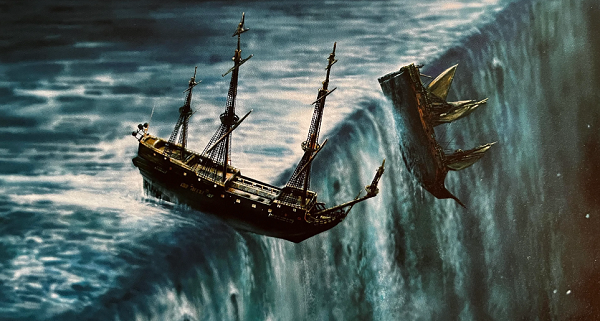
My favorite example is the Columbus myth, the idea that the people who argued against Columbus were ignorant flat-earthers who thought his ships would sail off the edge. That is almost the precise opposite of the truth. By the time Columbus set off, a spherical Earth had been the accepted scientific view for well over a thousand years. Columbus’s contemporaries not only knew that the Earth was round, they knew how big around it was, that having been calculated by Eratosthenes in the third century B.C.
By the fifteenth century they also had a reasonably accurate estimate of the width of Asia. Subtracting the one number from the other they could calculate the distance from where Columbus was starting to where Columbus claimed to be going and correctly conclude that it was much farther than his ships could go before running out of food and water. The scientific ignorance was on the side of Columbus and those who believed him; he was claiming a much smaller circumference for the Earth and a much larger width of Asia, hence a much shorter distance from Spain to the far end of Asia. We will probably never know whether he believed his own numbers or was deliberately misrepresenting the geographical facts in order to get funding for his trip in the hope that he would find land somewhere between Spain and Japan, as in fact he did.1
Another example of the same pattern shows up in discussions of medieval cooking, one of my hobbies. Quite a lot of people believe that medieval cooks over spiced their food in order to hide the taste of spoiled meat. A few minutes of thought should be enough to see the consequences for a cook of routinely giving his employer and the employer’s guests food poisoning. Also that, with meat available on the hoof, there was no need to keep it until it spoiled and that it made little sense to save on meat, a local product, at the cost of spices that had to be transported over thousands of miles.
I like to ask people who claim the food was overspiced how they know, given that medieval European recipes almost never give quantities. One possible source for the belief — the overspicing, not the reason for it — is a passage in the introduction to Two Fifteenth Century Cookery Books, a collection published by the Early English Text Society.
Our forefathers, possibly from having stronger stomachs, fortified by outdoor life, evidently liked their dishes strongly seasoned and piquant, as the Cinnamon Soup on p. 59 shews. Pepper, Ginger, Cloves, Garlic, Cinnamon, Galingale, Vinegar, Verjuice, and Wine, appear constantly in dishes where we should little expect them; and even Ale was frequently used in Cookery.
“The cinnamon soup on p. 59” is not a recipe but an entry in a menu, so what the editor is complaining about is not the amount of cinnamon but the fact that it is there at all, and similarly for the rest of his list. That tells us more about English cooking of the 19th century than that of the 15th.
As far as I can tell, there is no evidence that medieval food was overspiced, only that they used spices in different ways than modern European cuisine. I have twice come across evidence on the question. There is a recipe for Hippocras, a spiced wine, in Le Menagier de Paris, a household manual dated to 1490. It is one of the rare recipes with quantities, sugar and spices by the ounce, wine by “quarts of Paris measure”. When I first made it I found the result too sweet and too highly spiced, so cut sugar and spice in half to fit my taste.
Many years later, when I mentioned the recipe in an online discussion, someone asked me whether I had checked the units. I had not, just assumed that a quart was a quart and an ounce an ounce. I was wrong — the period ounce was about an ounce but the quart by Paris measure was about twice our quart. In adjusting the recipe to my taste, I had gotten back to about the original proportions.
1. There is disputed evidence that he visited Iceland and might have heard about the existence of North America there, also speculation that he might have gotten the information from European fishermen. There were European ships harvesting Cod off what is now Newfoundland not long after Columbus, but earlier dates are speculative.
July 14, 2023
Bread rationing in the United States during WW2
I haven’t studied the numbers, but I strongly suspect that most US government food rationing during the war was effectively theatre to encourage more support of the war effort: except in a very few areas, the US was more than self-sufficient in most foodstuffs. At the Foundation for Economic Education, Lawrence W. Reed recounts one of the least effective government moves in food rationing:
According to an old joke from the socialist and frequently underfed Soviet Union, Stalin goes to a local wheat farm to see how things are going. “We have so many bags of wheat that, if piled on top of each other, they could reach God himself!” the farmer told Comrade Stalin.
“But God does not exist,” the dictator angrily replied. “Exactly!” said the farmer. “And neither does the wheat.” Nobody knows what happened to the farmer, but at least Stalin died in 1953.
Soviet socialism, with its forced collectivism and ubiquitous bread lines, gave wheat a bad name. Indeed, it was lousy at agriculture in general. As journalist Hedrick Smith (author of The Russians) and many other authorities noted at the time, small privately owned plots comprised just three percent of the land but produced anywhere from a quarter to a half of all produce. Collectivized agriculture was a joke.
America is not joke-free when it comes to wheat. We are a country in which sliced bread was both invented and banned, and a country in which growing wheat for your own consumption was ruled to be an act of “interstate commerce” that distant bureaucrats could regulate. No kidding.
On this anniversary — July 7 — of both the birth in 1880 of sliced bread’s inventor and of the day in 1928 that the first sliced bread from his machine was sold, it’s fitting to recall these long-forgotten historical facts.
The Iowa-born jeweler and inventor Otto Rohwedder turned 48 on the very day the first consumer bought the product of his new slicing machine. The bread was advertised as “the greatest forward step in the baking industry since bread was wrapped” and it quickly gave rise to the popular phrase, “the greatest thing since sliced bread.” Before 1928, American housewives cut many a finger by having to slice off every piece of bread from the loaves they baked or bought. Sliced bread was an instant sensation.
Rohwedder earned seven patents for his invention. The original is proudly displayed at the Smithsonian Institution in Washington, D.C. He likely made a lot more money from the bread slicing machine than he ever did as a jeweler. He died in 1960 at the age of 80.
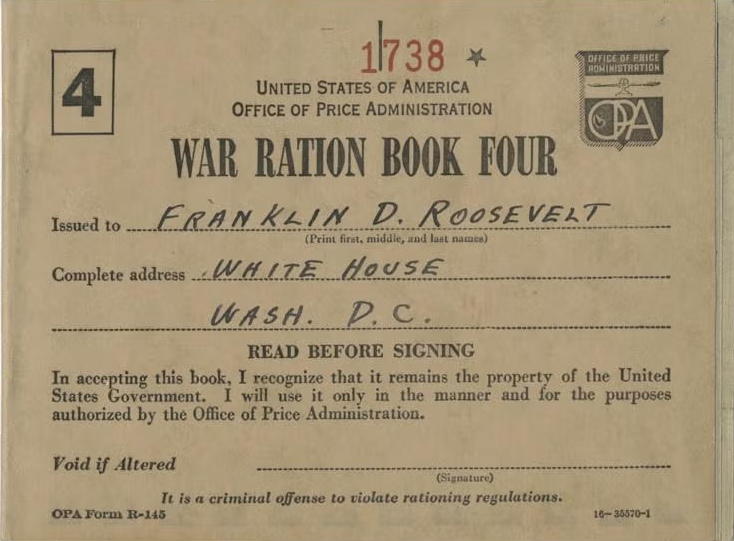
Enter Claude Wickard, Secretary of Agriculture under Franklin Roosevelt from 1940 to 1945. On January 18, 1943, he banned the sale of sliced bread. Exactly why seems to be in dispute but the most likely rationale was to save wax paper and other resources for war production. He rescinded the ban two months later, explaining then that “the savings are not as much as we expected.”
I’m sure Hitler and Hirohito were relieved.
July 11, 2023
The obesity crisis … fuelled by iatrogenic public health warnings about certain food groups
Here’s The Armchair General with another example of what he calls COGOs – Crisis of Government Origin:
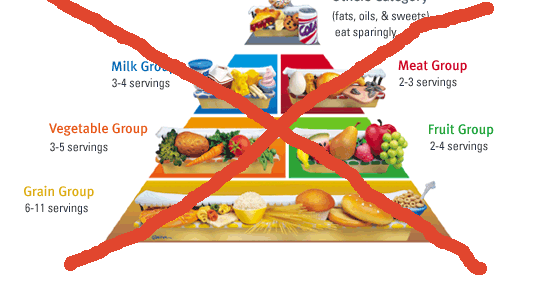
So, after the decades-long crusade against saturated fats, we have a population that has been repeatedly told that fat will kill us. So, many people eschewed fats in favour of salt and sugar. Which, apparently, are also bad for us.
But without saturated fats, remember, people are not going to feel sated. So, what is likely to happen? Well, just what did happen — never feeling full, people feel hungry throughout the day so eat continually through the day: a behaviour known as “snacking” …
Nutritionists believe many people are obese not because they binge on fatty main meals but because they indulge in constant grazing throughout the day without even realising it.
This pattern, dubbed “auto-eating”, involves resorting to snacks and treats at the slightest indication of hunger.
Or, rather, people always feel hungry because they have been told to avoid saturated fats. And they snack on chocolate bars and biscuits and small things that provide a pleasant sugary boost.
Combine this with an increasingly sedentary population — both at home and at work — and other comforts (such as central heating which leads to fewer calories being expended on maintaining body temperature), and…
BOOM! You have an obesity problem.
And now — nearly seventy years after some arrogant doctors used some extremely dodgy studies to enhance their reputations, we now know that what we were told about the harms associated with saturated fats was all absolute bollocks.
And so, once again, we can demonstrate another Crisis of Government Origin (COGO), ably assisted by the arrogant fuckers of the medical profession.
Unfortunately, the government legislation is already in place, and it will take at least three years for the fuck-nuggets in politics to catch up — if they ever do. After all, they are going to have to undo decades of medical advice, government food advice, leaflets, bus adverts, nutritionist training, and social conditioning.
Just another reason why governments should stay the hell out of our private lives. Such up — and fuck off.
July 9, 2023
Grain Elevator
NFB
Published 30 Sept 2015This documentary short is a visual portrait of “Prairie Sentinels”, the vertical grain elevators that once dotted the Canadian Prairies. Surveying an old diesel elevator’s day-to-day operations, this film is a simple, honest vignette on the distinctive wooden structures that would eventually become a symbol of the Prairie provinces.
(more…)
July 6, 2023
The Devilish History of Deviled Eggs
Tasting History with Max Miller
Published 4 Apr 2023
(more…)
June 16, 2023
Friday Foundlings
A few items that I didn’t feel required a full post of their own, but might be of interest:
- “Lunch of suffering”: plain “white people food” goes viral in China
- From a review of Njal’s Saga – “There are only about 40,000 people in medieval Iceland. The book focuses on the Southwest Quarter, so let’s say 10,000 there. Each of our characters is a large landowning farmer with many children, servants, tenants, etc; if he is patriarch of a 20 person household, then there must be about 500 such patriarchs. Each of these 500 relevant Icelanders is profiled in loving depth. And if there are 500 characters in Njal’s Saga, and n people can have n(n-1)/2 possible two-person feuds, that’s 124,750 possible feuds. Of these, about 124,749 actually take place over the course of the saga (Njal and his friend Gunnar are best buds, and refuse to feud for any reason).”
- The Canadian government continues to rack up the internet regulation wins – “The fallout from Bill C-11 has been the subject of several posts this week, including the demands from a wide range of services for exceptions to the law and warnings from streaming services such as PBS and AMC that they may block the Canadian market due to the regulatory burden imposed by the law. While those stories focus on the availability of services and content in Canada, a new Variety report points to another negative impact from the bill: less film and television production in Canada, at least in the short term. Throughout the Bill C-11 debate, there were concerns that the large streamers might pause their productions in Canada given the uncertainty over whether they would ‘count’ for the purposes of new CRTC imposed contribution requirements. In other words, the bill could initially lead to less investment in Canada.”
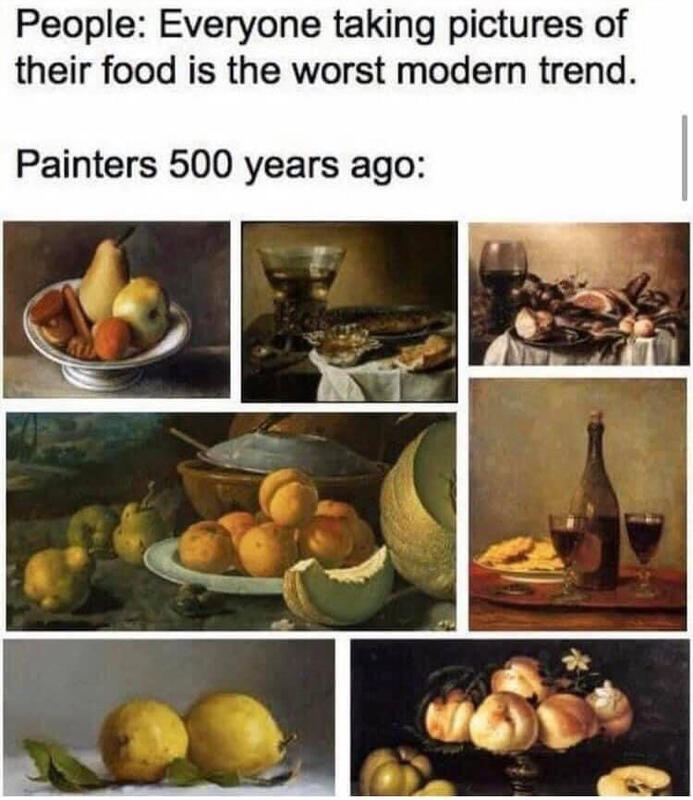
- Random meme of the day:
June 10, 2023
Feeding a Greek Hoplite – Ancient Rations
Tasting History with Max Miller
Published 6 Jun 2023
(more…)
June 8, 2023
1954: The END of RATIONING
BBC Archive
Published 5 Mar 2023“The ration book has done its job. It’s been a long job. Indeed, children up to school-leaving age have never known life without the ration book.”
On the fourth of July, the rationing of meat in Britain came to an end, the final step in dismantling Britain’s whole wartime system of food distribution. After fourteen long years, Britons can at last tear up their ration books.
Richard Baker looks back at some of the key moments in the story of rationing and de-rationing.
Originally broadcast 5 July, 1954.

June 3, 2023
Kids, obesity, and the woke agenda
Elizabeth Nickson isn’t a fan of the “healthy at any size” mantra, especially when it comes to kids:
If I were a kid today I’d be out scouting the neighborhood for a home school or church to take me in as long and teach me latin and math and give me a reading list as long as I didn’t have to have someone’s jiggly bits pushed in my face or be shown diagrams of sexual positions, and asked ceaselessly about my food intake, my BMI measured (25 states mandate this) and no doubt entirely invasive questions about my family and father and weird uncles and so on. It would be like living in a perpetual inquisition, danger everywhere, with no privacy in any area of one’s life, with every sentence and expression evaluated on whether I am being a good member of the inclusive collective and will step aside so someone less privileged can have a chance.
But I am not nine and therefore spared all that, but God in heaven I feel sorry for them. Schools have stepped up to take the place of the at-home mother who had a relationship with her kids strong enough so that their emotional needs were being met and they didn’t have to stuff food down their throats for a relief from the ceaseless pressure to conform, and severe emotional loneliness from the absence of a family system.
Instead of your mind, the dominant focus seems to be your body, and at the most vulnerable time in your life. I know they think they are raising good little socialist citizens, who are acutely aware of the struggles of the less fortunate, but add in the bullying of Middle School and little wonder 49% of kids are overweight or obese, and the rest stuffing their feelings 24/7. Great for the food pushers, sucks for the medical system.
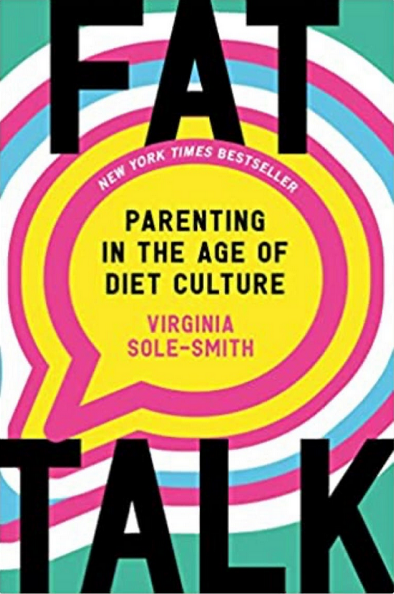
Virginia Sole-Smith who is the anointed high priestess of Fat Positivity Culture, has been pushing fat is AOK and in fact, possibly superior to thin-ness, which she never fails to excoriate, for the New York Times, Slate and Science and various other high-end publications for 20 years. Her latest book Fat Talk, which sits on the NYTimes bestseller list is about raising fat children, or not fat children, it’s kind of confusing. Ok, to be fat, but not obese, but you can’t put obese kids on a diet because that will make them fatter, and besides everyone is criticizing them and that has to stop.
Every leftie cliché is brought out of the barn and groomed within an inch of its life. White privilege, thin white privileged women, BIPOC exclusion, thin privilege in sport, entertainment, business, and so on, a system systematically prejudiced against fat people.
Basically, however, Sole-Smith is staking her ground and that is that “small fat”, which is how she defines herself, is normal and we should adjust our eyes to see pudgy tummies as “something to aim for” – as she states in her last chapter called “How to Have The Fat Talk”. We have to start “reclaiming (sic) fatness as a perfectly good way to have a body”.
May 31, 2023
The Original Mai Tai from 1944
Tasting History with Max Miller
Published 30 May 2023
(more…)
May 29, 2023
The high-water mark of the Vegan cult?
In Spiked, Patrick West celebrates the passing of peak food puritanism:
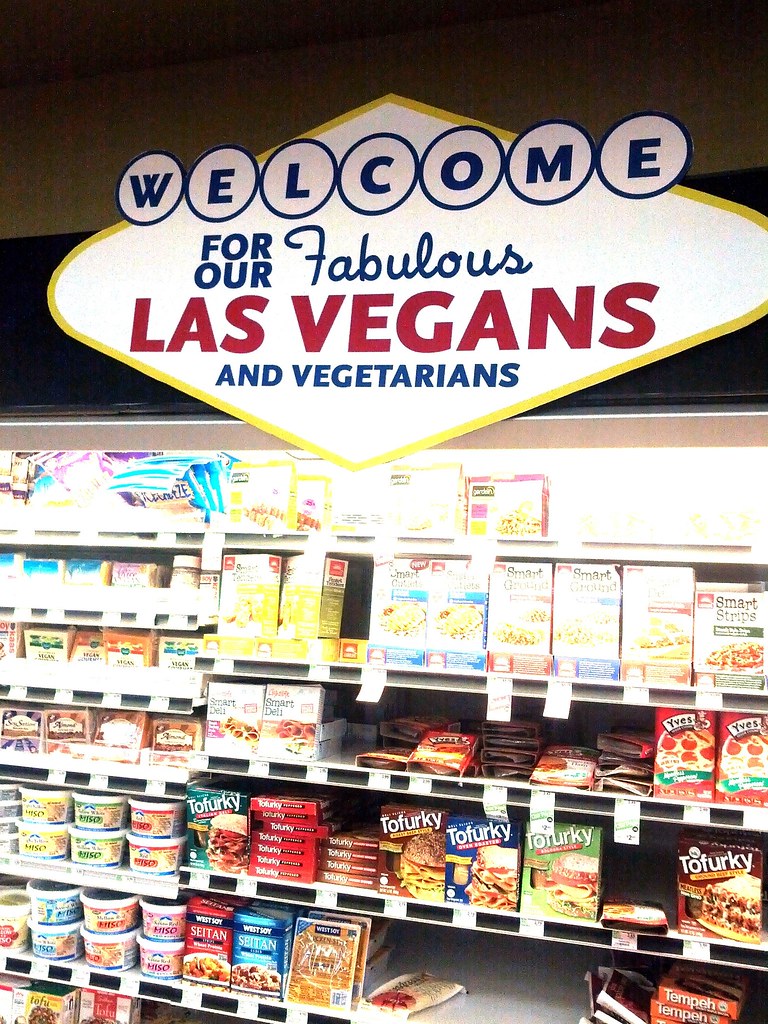
“Welcome to Las Vegans and Vegetarian, Whole Foods fake meat section, Las Vegas, NV, USA” by gruntzooki is licensed under CC BY-SA 2.0 

 .
.
Over the past few years, there has been an explosion of vegan processed food appearing in supermarkets. A growing number of the population also claims to be vegan. But there are signs this trend could be going into reverse. Demand for animal-free food and drink products has collapsed over the past year. One casualty is Swedish oat-milk firm Oatly, which has recently withdrawn its dairy-free ice cream in the UK. Another is the Yorkshire sausage-making company, Heck, which has scaled-down its vegan-friendly range from 10 products to two. Smoothie-maker Innocent discontinued its dairy-free range earlier this year. Supermarket sales of meat-free products fell by £37.3million between September 2021 and September 2022, according to the consumer intelligence firm NielsenIQ.
There seems to be two main reasons. Rising inflation has been cited as one cause, as consumers have scaled back on branded and luxury eatables. Plant-based processed foods are generally more costly than the meat and dairy products they purport to replace. Another explanation is that producers of vegan food may have overestimated the size of the market for veganism, and now they are having to readjust to reality.
Whatever the reasons, we should welcome the retreat of the cult of veganism. And I use the word cult deliberately, because veganism greatly resembles not so much a lifestyle choice, but a way of life itself. It’s a faith that resonates with today’s puritanical and conformist mood.
And I should know, as someone who became a vegetarian in 1996 and has not eaten meat since. Sure, my decision aroused some mockery and derision back then, but vegetarianism had mostly stopped being regarded as weird by the mid-1990s. Ever since then, most of the opprobrium and scolding we vegetarians face comes from vegans, largely because we continue to eat eggs, cheese and milk.
For vegans, nothing must be consumed or worn that derives from animals or insects – even if there is no killing or discernible harm involved. Anything else is a feeble cop-out. Their way of thinking is absolute. In this respect, the best exemplars of the vegan movement are the animal-rights fundamentalists, PETA, whose members are well-known for their shrill, exhibitionist narcissism. Their message is simple: they are better people than you.
It’s no surprise that veganism was turbo-charged in the mid-2010s, when wokery captured the minds of so many – when absolutist, extreme thinking, and the competition to be purer than the next man or woman, took over. The trans movement echoes this rush to extremes. It demands the transformation of your entire body. Indeed, bodily self-mutilation and mortification of the flesh have long been practised by religious fundamentalists.


