
Tasting History with Max Miller
Published 27 Mar 2024Medieval stew with meat, spices, and verjuice, and thickened with egg yolks
City/Region: England
Time Period: 15th CenturySome medieval taverns may have had what is called a perpetual stew bubbling away. The idea is basically what it sounds like: as stew was taken out, more ingredients would be added in so that the stew kept on stewing. In southern France, there was a perpetual stew that was served from the 15th century (around when this recipe was written) all the way up until WWII, when they couldn’t get the right ingredients.
I have opted to not make this stew perpetual, but it is delicious. The medieval flavor of super tender meat with spices and saffron is so interesting, especially with the added acidity and sweetness from the verjuice.
A note on thickening with egg yolks: if you need to reheat your stew after adding the egg yolks, like I did, they may scramble a bit. The stew is still delicious, it’s just the texture that changes a little and it won’t be quite as thick.
Vele, Kede, or Henne in bokenade
Take Vele, Kyde, or Henne, an boyle hem in fayre Water, or ellys in freysshe brothe, and smyte hem in pecys, and pyke hem clene; an than draw the same brothe thorwe a straynoure, an caste there-to Percely, Swag, Ysope, Maces, Clowys, an let boyle tyl the flesshe be y-now; than sette it from the fyre, and alye it up with raw yolkys of eyroun, and caste ther-to pouder Gyngere, Veriows, Safroun, and Salt, and thanne serve it forth for a gode mete.
— Harleian Manuscript 279, 15th Century
July 9, 2024
What it was like to visit a Medieval Tavern
June 30, 2024
The medieval salt trade in the Baltic
In the long-awaited third part of his series on salt, Anton Howes discusses how the extremely low salt level of water in the Baltic Sea helped create a vast salt trade dominated by the merchant cities of the Hanseatic League:
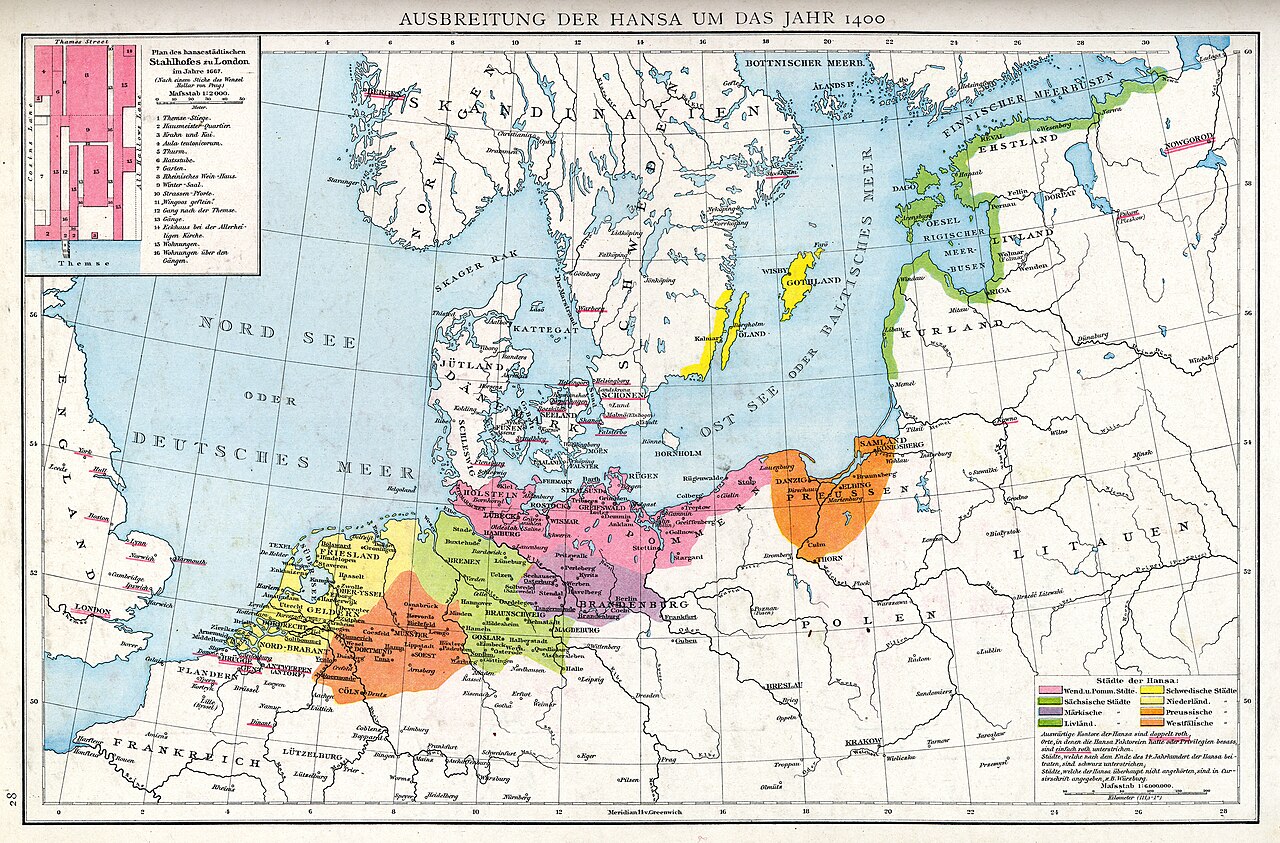
The extent of the Hanseatic League in 1400.
Plate 28 of Professor G. Droysen’s Allgemeiner Historischer Handatlas, published by R. Andrée, 1886, via Wikimedia Commons.
It’s difficult to appreciate salt’s historical significance because it’s now so abundant. Societies used to worry about salt supplies — for preparing and preserving food — as a matter of basic survival. Now we use the vast majority of it for making chemicals or chucking on our roads to keep them from getting icy, while many salt-making plants don’t even operate at full capacity. Yet the story of how we came to achieve salt superabundance is a long and complicated one.
In Part I of this series we looked at salt as a kind of general-purpose technology for the improvement of food, as well as a major revenue-raiser for empires — especially when salt-producing coastal areas could dominate salt-less places inland. In Part II we then looked at a couple of places that were all the more interesting for being both coastal and remarkably salt-less: the coast of Bengal and the Baltic Sea. One was to be exploited by the English East India Company, which needlessly propped up a Bengalese salt industry at great human cost. The other, however, was to prove a more contested prize — and ultimately the place that catalysed the emergence of salt superabundance.
It’s worth a brief recap of where we left the Baltic. Whereas the ocean is on average 3.5% salt, along the Baltic coast it’s at just 0.3% or lower, which would require about twelve times as much time and fuel to produce a given quantity of salt. Although there are a few salt springs near the coast, they were nowhere near large enough to supply the whole region. So from the thirteenth century the Baltic’s salt largely came from the inland salt springs at Lüneburg, supplied via the cities of Lübeck and Hamburg downstream. These two cities had a common interest against the kingdom of Denmark, which controlled the straits between the North and Baltic seas, and created a coalition of trading cities that came to be known as the Hanseatic League. The League resoundingly defeated the Danes in the 1360s and 1430s so that their trade in salt — and the fish they preserved with it — could remain free.
But Lüneburg salt — and by extension the League itself — was soon to face competition.
Lüneburg could simply not keep up with the growth of Baltic demand, as the region’s population became larger and wealthier. And so more and more salt had to come from farther afield, from the Bay of Biscay off France’s western coast, as well as from Setúbal in Portugal and from southern Spain.1 This “bay salt” — originally referring to just the Bay of Bourgneuf, but then extended to the entire Bay of Biscay, and often to all Atlantic solar-evaporated salt — was made by the sun and the wind slowly evaporated the seawater from a series of shallow coastal pools, with the salt forming in coarse, large-grained pieces that were skimmed off the top. Bay salt, however, inevitably ended up mixed with some of the sand and dirt from the bottoms of the pools in which it was held, while the seawater was never filtered, meaning that the salt was often brown, green, grey or black depending on the skill of the person doing the skimming — only the most skilled could create a bay salt that was white. And it often still contained lots of other chemicals found in seawater, like magnesium chloride and sulphate, calcium carbonate and sulphate, potassium chloride and so on, known as bitterns.2
Bay or “black” salt, made with the heat of the sun, was thus of a lower quality than the white salt boiled and refined from inland salt springs or mined as rock. Its dirt discoloured and adulterated food. Its large grains meant it dissolved slowly and unevenly, slowing the rate at which it started to penetrate and preserve the meat and fish — an especially big problem in warmer climates where flesh spoiled quickly. And its bitterns gave it a bitter, gall taste, affecting the texture of the flesh too. Bay salt, thanks to the bitterns, would “draw forth oil and moisture, leading to dryness and hardness”, as well as consuming “the goodness or nutrimental part of the meat, as moisture, gravy, etc.”3 The resulting meat or fish was often left shrunken and tough, while bitterns also slowed the rate at which salt penetrated them too. Bay-salted meat or fish could often end up rotten inside.
But for all these downsides, bay salt required little labour and no fuel. Its main advantage was that it was extremely cheap — as little as half the price of white Lüneburg salt in the Baltic, despite having to be brought from so much farther away.4 Its taste and colour made it unsuitable for use in butter, cheese, or on the table, which was largely reserved for the more expensive white salts. But bay salt’s downsides in terms of preserving meat and fish could be partially offset by simply applying it in excessive quantities — every three barrels of herring, for example, required about a barrel of bay salt to be properly preserved.5
By 1400, Hanseatic merchants were importing bay salt to the Baltic in large and growing quantities, quickly outgrowing the traditional supplies. No other commodity was as necessary or popular: over 70% of the ships arriving to Reval (modern-day Tallinn in Estonia) in the late fifteenth century carried salt, most of it from France. But Hanseatic ships alone proved insufficient to meet the demand. The Danes, Swedes, and even the Hanseatic towns of the eastern Baltic, having so long been under the thumb of Lübeck’s monopoly over salt from Lüneburg, were increasingly happy to accept bay salt brought by ships from the Low Countries — modern-day Belgium and the Netherlands. Indeed, when these interloping Dutch ships were attacked by Lübeck in 1438, most of the rest of the Hanseatic League refused Lübeck’s call to arms. When even the Hanseatic-installed king of Denmark sided with the Dutch as well, Lübeck decided to back down and save face. The 1441 peace treaty allowed the Dutch into the Baltic on equal terms.6 Hanseatic hegemony in the Baltic was officially over.
The Dutch, by the 1440s, had thus gained a share of the carrying trade, exchanging Atlantic bay salt for the Baltic’s grain, timber, and various naval stores like hemp for rope and pitch for caulking. But this was just the beginning.
1. Philippe Dollinger, The German Hansa, trans. D. S. Ault and S. H. Steinberg, The Emergence of International Business, 1200-1800 (Macmillan and Co Ltd, 1970), pp.219-220, 253-4.
2. L. Gittins, “Salt, Salt Making, and the Rise of Cheshire”, Transactions of the Newcomen Society 75, no. 1 (January 2005), pp.139–59; L. G. M. Bass-Becking, “Historical Notes on Salt and Salt-Manufacture”, The Scientific Monthly 32, no. 5 (1931), pp.434–46; A. R. Bridbury, England and the Salt Trade in the Later Middle Ages (Clarendon Press, 1955), pp.46-52. Incidentally, some historians, like Jonathan I. Israel, Dutch Primacy in World Trade, 1585-1740 (Clarendon Press, 1989) p.223, note occasional reports of French bay salt having been worse than the Portuguese or Spanish due to its high magnesium content, “which imparted an unattractive, blackish colour”. This must be based on a misunderstanding, however, as the salts would have been identical other than in terms of the amount of dirt taken up with the salt from the pans. At certain points in the seventeenth century the French workers skimming the salt must simply have been relatively careless compared to those of Iberia.
3. John Collins, Salt and fishery a discourse thereof (1682), pp.17, 54-5, 66-8.
4. Bridbury, pp.94-7 for estimates.
5. Karl-Gustaf Hildebrand, “Salt and Cloth in Swedish Economic History”, Scandinavian Economic History Review 2, no. 2 (1 July 1954), pp.81, 86, 91.
6. For this section see: Dollinger, pp.194-5, 201, 236, 254, 300.
June 29, 2024
Oh no! The filthy proles are getting too many calories! Let’s re-impose rationing!
Tim Worstall suggests that the regular “viewing with alarm” thumbsuckers about purchased meals having “too many calories” are actually an indication of a strong desire by the great and the good to stick their regulatory noses into the lives of ordinary people:

“Indian take away in Farrer Park” by Kai Hendry is licensed under CC BY 2.0 
 .
.
This headline is, of course, wrong.
Some takeaway meals contain more calories than daily limit, UK study finds
There is no daily limit. We do not have laws stating how much food we are allowed to eat. Of course, there are those who want there to be such laws but there aren’t, as yet. What there is is a series of recommendations about the limits we should impose upon ourselves:
Some takeaway meals contain more calories in one sitting than someone is advised to consume in an entire day, a study of British eating habits has revealed.
That’s better.
Cafes, fast-food outlets, restaurants, bakeries, pubs and supermarkets are fuelling the UK’s obesity crisis because so many meals they sell contain dangerously large numbers of calories, it found.
That’s not better. Because a plate of food containing a lot of calories is not a danger. Eating many of them might be but that the average household can get a gutbuster for some trivial portion of household earnings is a glory of modern civilisation, the very proof we require that we’re all as rich as Croesus.
And this is actually true too. That we are gloriously rich and it’s our food supply that proves this. As Brad Delong likes to point out back 200 years (yes, about right, 1820s is as it was really changing but 300 years would be better) it took a full day’s work to be able to gain 2,000 calories a day for a day labourer. There are 800 million out there still living at that standard of living. We can buy 2,000 calories — if we go boring stodge — for 30 minutes work now.
By history and by certain geographies we are foully rich these days. Which is the complaint of the wowsers of course. They’re a revival of the puritans and their sumptuary laws. How dare it be true that people fill their bellies with food they actually like?
Six out of 10 takeaway meals contain more than the 600-calorie maximum that the government recommends people should stick to for lunch and dinner in order to not gain weight, according to the research, which was carried out by the social innovation agency Nesta.
One in three contain at least 1,200 calories – double the recommended limit.
And? So, folk can buy lots of food for not much money. This is the very thing that makes having a civilisation possible — cheap food. My wife and I do indeed partake of an Indian occasionally — and find the takeout portions rather large. So, we have one amount for lunch or dinner and we’ve a refrigerator in which to keep the excess for a supper or snack another day. This is not beyond the wit of man to organise.
We don’t order in food very often, but when we do we usually manage to get both dinner on the night and lunch on the morrow from a typical order. If the nosey parkers have their way, they’d limit what we were allowed to buy — for our own good, of course — so we’d almost certainly still pay the same amount for less food. Such a deal!
June 25, 2024
In all places and at all times, the true minimum wage is zero
Tim Worstall explains why fast food restaurants like McDonalds and Burger King are reported to be introducing new low-priced value meals to try and attract and keep more customers in the current economy:
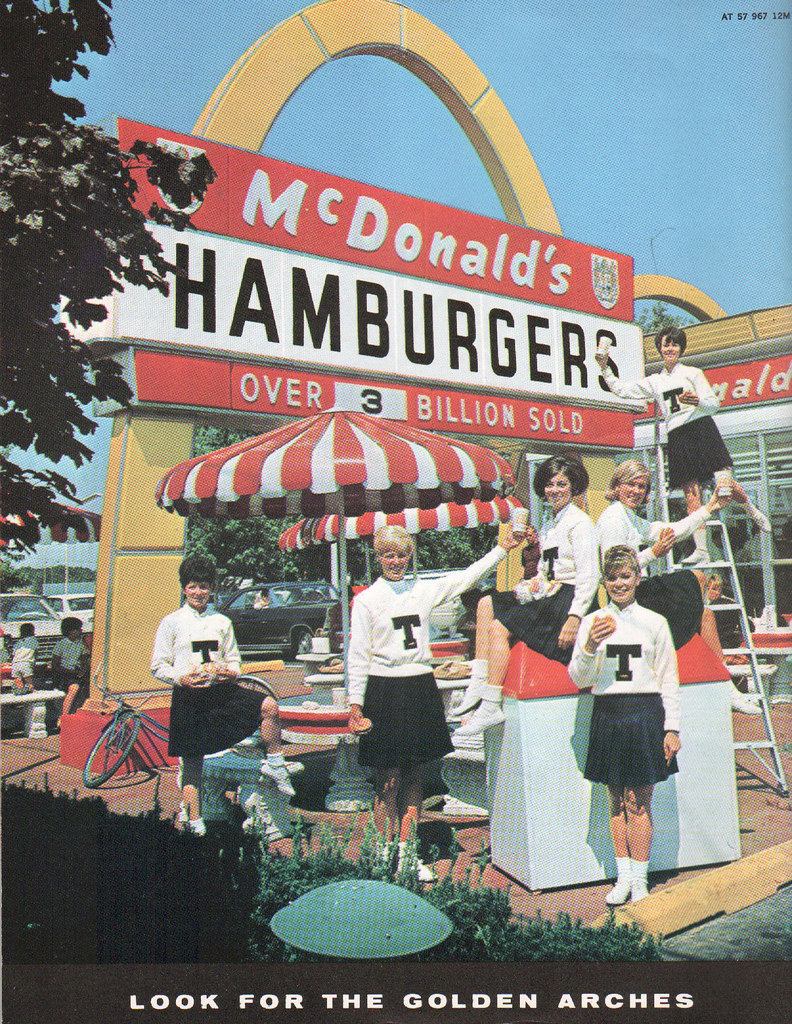
“McDonald’s restaurant, Toledo OH, 1967” by DBduo Photography is licensed under CC BY-SA 2.0  .
.
It’s terribly unfashionable to say that minimum wage rises have any effects — other than that the minimum wage workers earn more, of course. It’s supposed to be one of those areas where only good things can come from poking a stick in the market. The justification is that the only jobs these folks can get are slinging fries (If that is the case then I’d probably start with education system reform so that grievance studies graduates are skilled enough to do something else but maybe that’s just me), therefore MaccyD’s and the like have a monopoly on employing them (a “monopsony”) and so omniscient and caring politicians and bureaucrats can correct this market error without there being any side effects.
Hmm. Seems unlikely but that is the story.
[…]
The standard economics of a minimum wage rise is — well, was before the progressive smokeblowing about monopsony — that the money’s got to come from somewhere. It could be that profits fall and therefore there’s less investment — even a move away from having invested in — that activity and so employment falls. Or, wages are higher for those fewer people employed and some lose their jobs — also known as rising productivity and also known as fewer jobs. Or, customers get to pay higher prices, fewer now buy the item and so employment falls as the sector shrinks.
Hmm, well, we can get all serious about monopsony but that one doesn’t work to my mind either as even if profits were excessive a fall in them will still lead to less investment in the sector and we’re back at option 1) above. But, many have convinced themselves.
But here we’ve got a general agreement that Americans are eating fast food less. They’re eating at home more. The only thing that’s changed in the varied cost structures is the price of fast food labour. Sorry, the only thing that’s changed in the *relative* cost structures is that labour as the minimum wage is pushed up. Whatever food inflation has been it’s been no better or worse for MaccyD’s than it has been in Albertsons or King Super. It’s also true that US real incomes have been rising so it’s not a general retreat on the part of consumers. The price of fast food relative to home prepared has risen, people are buying less fast food. The only cost pressure causing this is the pushing up of the minimum wage in recent years (for chains, in California, it’s now $20 an hour).
Myself I take that as being proof of the original and base minimum wage argument in standard economics. Trying to recoup that fall in sales is what is leading to these special offers — and don’t forget they’re special, not for all time and so should be considered advertising, not a long term change in price levels.
As a larger lesson I take it to mean that we should be very wary indeed of those claiming that there’s some special little economic trick that makes what they want to do anyway such a good idea. Why, yes, that does include any special little tricks I might want to claim. But many really did convince themselves that fast food wages were different, that pushing them up would have only good, not ill, effects.
Seems it ain’t so.
Over the weekend, there were a few stories about a small fancy coffee chain whose employees had successfully unionized to get better wages, only for the owners to shut down all three stores because even before the workers unionized, they were losing money on the business. Rather than the higher wages the employees were expecting (while keeping their unusually generous benefits for such entry-level jobs), all their jobs were lost and nobody won. Small businesses like restaurants operate on a far smaller profit margin than most people believe … according to Statistics Canada, the average restaurant of all types made a 4.3% profit in 2022.
June 23, 2024
The Original Chef Boyardee Spaghetti Dinner
Tasting History with Max Miller
Published 13 Mar 2024Absolutely fantastic tomato and meat sauce served over spaghetti tossed with butter and parmesan
City/Region: Cleveland, Ohio
Time Period: 1930sChef Boyardee was not born in Cleveland (sorry, 30 Rock), but in Borganovo, just outside of Piacenza in Italy. And his name was not Hector Boyardee, but Ettore Boiardi (boy-AR-dee). He opened an Italian restaurant in Cleveland in 1924, where the food was so popular that he frequently sent patrons home with bottles of his spaghetti sauce.
We can’t know exactly what that original sauce was, but this is from a family recipe and is probably pretty close. And it’s phenomenal. It’s fairly simple, but so good. You get a lot of the fresh basil, and the creaminess from mixing the butter and parmesan directly with the pasta is delicious. I don’t often make dishes from the show again, but I can see myself making this any day of the week.
(more…)
June 18, 2024
Spice: King Of The Poor Man’s Kitchen
Townsends
Published Mar 3, 2024One of the questions we seek to answer on our channel is that of the plight of poor folks in American history. What did they eat? How did they dress? Did they have enjoyment in life? They didn’t have the best cuts of meat or the most sought after ingredients. What they did have was plenty of flavor! Spice is the king of the poor man’s kitchen.
(more…)
June 17, 2024
Farm Camp for city slickers
In The Free Press, Larissa Phillips explains the kind of things city children (and their parents) learn when they stay at her family’s small farm for a week or a weekend:

Here are some things I have taught the kids who visit my farm: animals don’t care about your feelings, and sometimes we kill them to eat them. It doesn’t matter how desperately you want to find more eggs, the hens don’t lay on demand. Tomatoes aren’t ripe in June. The stalls aren’t going to clean themselves. Cuts, scrapes, and stings aren’t really a big deal. And there will always be poop.
I’m often struck by what city kids don’t know when they turn up at the education program I run for families on our 15-acre hobby farm — Honey Hollow Farm — in the Upper Hudson Valley. As a longtime urbanite, I get it. I lived in Brooklyn for 15 years before my husband and I moved upstate in 2010 with our two young children and one goal: start a farm. We kept horses and ponies for fun and raised poultry and sheep — and sometimes pigs — for food.
It was hard. Slaughtering animals we’d raised since they were babies was wrenching. Breeding and birthing those babies was dicey, too. But these experiences toughened us up. Working with animals and the land and the seasons was grounding — and the best antidote to anxiety I’d ever found. And most of it was fun.
I wanted to share this outlook with other families, even if it was just for a weekend. So at the start of the pandemic, I opened our guest cottage — and set up an informal curriculum to teach escaping urbanites what I’d learned.
I called it farm camp.
We host one family at a time, all through the year, in a renovated barn apartment overlooking the pony pasture. Most come for a week, some for a weekend. Every morning I’ll take a handful of kids, sometimes as young as three, through a two-hour, hands-on class on animal care, life, death, poop. All of them have to do some real farmwork.
There is a lot to learn. I don’t expect a child to know how long it takes for a chick to hatch, or why the roosters are always jumping on top of the hens. But I am often surprised by some of the straightforward things they don’t know how to do. Like how to pull a wagon around a corner, hold a shovel, climb over a gate, make a braid, or tie a knot.
Don’t get me wrong — I love offering explicit instructions on the most mundane tasks, then standing back and cheering when a kid does it independently. But two generations ago, these skills would have been common knowledge. For most of human history, the proportion of the world’s population living in cities was below 5 percent. It’s at 56 percent now. By the time today’s toddlers reach adulthood, it is expected that 80 percent of humans will live in urban areas.
Overprotected as they are, a lot of city kids are missing out on so many important encounters with material reality: with death or danger or manual labor. These encounters can be unpleasant, even painful. It’s understandable that we want to save our children from them. But they lose something essential when we do.
Most urbanites have a very sanitized — in fact, Disneyfied — view of rural life and especially life on a farm. It can be traumatic to discover that all the animals aren’t like you saw in the cutesy cartoons as a preschooler …
5 Foods that Changed Fast Food Forever (ft. @mythicalkitchen)
Tasting History with Max Miller
Published Mar 8, 2024The Mythical Kitchen Cookbook by Josh Scherer: https://amzn.to/49Se1qZ
June 16, 2024
What People Ate on Ellis Island
Tasting History with Max Miller
Published Mar 5, 2024A complete Ellis Island meal: Tapioca Pudding, coffee, Beef and Barley Soup, and white bread.
City/Region: United States of America
Time Period: 1887The food on Ellis Island could be pretty good or pretty terrible depending on when you were there. The quality went up and down a lot, but the food was always free to those who were staying on the island. A menu for the midday meal on Tuesday, January 20, 1920 lists English Beef Soup with Barley, Lamb Stew with Vegetables, Bread and butter substitute, Tapioca Pudding, Coffee. This recipe doesn’t use a lot of meat, but the marrow melts into the broth and there are plenty of vegetables and flavor, making for a hearty soup.
Beef Soup
Select a small shin of beef of moderate size, crack the bone in small pieces, wash and place it in a kettle to boil, with five or six quarts of cold water. Let it boil about two hours, or until it begins to get tender, then season it with tablespoonful of salt, and a teaspoonful of pepper; boil it one hour longer, then add to it one carrot, two turnips, two tablespoonfuls of rice or pearl barley, one head of celery and a teaspoonful of summer savory powdered fine; the vegetables to be minced up in small pieces like dice. After these ingredients have boiled a quarter of an hour, put in two potatoes cut up in small pieces; let it boil half an hour longer, take the meat from the soup, and if intended to be served with it, take out the bones and lay it closely and neatly on a dish, and garnish with sprigs of parsley.
Serve made mustard and catsup with it. It is very nice pressed and eaten cold with mustard and vinegar, or catsup. Four hours are required for making this soup. Should any remain over the first day, it may be heated, with the addition of a little boiling water, and served again. Some fancy a glass of brown sherry added just before being served. Serve very hot.
— The White House Cook Book, 1887.
June 15, 2024
QotD: Is there more craziness these days or is it just the volume turned up to 11?
… Is there, in fact, more lunacy in the Current Year, or is it just louder? He argued that there’s more. I argue that there’s not. Victorians, for instance, were world-class eccentrics. Just to stick with the breakfast cereal theme, consider that Kellogg’s corn flakes were based on some weird theory of digestion that was designed to combat the scourge of masturbation. No, really — the Sylvester Graham referenced in that article is the guy behind graham crackers, which were designed for similar reasons. See also “Fletcherism”, which counted Thomas Edison among its adherents. And that’s just food! Water, electricity, magnetism, you name it, there’s some weird Victorian health fad attached to it. Throw in the peccadilloes, sexual and otherwise, of just the widespread missionary movements, and you’ve got all the crazy you can handle, and then some.
Contrast this to the Current Year, where, much like breakfast food, what seems to be a bewildering variety of lunacy can be boiled down to just a few basic types. “Wokeness” is a madlib with just two variables: ____ is either racist or sexist, pick one. (I suppose you can combine them, but you’ll notice that doesn’t happen nearly as often as you’d predict, because the blacks hate the gays and the feminists hate everyone, so going full retard ends up getting you in a lot of trouble with your coreligionists).
Severian, “Mail Bag / Grab Bag”, Rotten Chestnuts, 2021-06-11.
June 14, 2024
Chef John’s Cream of Mushroom Soup – Pure Liquid Moon-Soaked Earth
Food Wishes
Published Dec 30, 2009[NR: I kid you not, this is the best cream of mushroom soup I’ve ever tasted. And I made it!]
I can’t believe I haven’t posted a video recipe for cream of mushroom soup! It’s such a classic cool weather staple, and quite simple to make – as long as you have a few hours to spare. The secret to this deep rich potage is a long slow caramelization, the key to unlocking the mushroom’s magic. Oh, and by the way, I mean that literally. Mushrooms are by far the most mysterious and magical things we eat.
Scientists still don’t really understand how and why they grow like they do. While every other food you eat gets its energy from the sun, Agaricus bisporus, the common button mushroom, does not. Some believe mushrooms are powered by the moon, which I find fascinating to contemplate.
This is a very minimalist formula, and meant to transform the browned bits of fungus into pure earthy essence of mushroom. You can use whatever exotic mushrooms you can get a hold of, but it works quite well with the ubiquitous white button mushroom. Enjoy!
(more…)
June 10, 2024
QotD: The British sweet tooth
George Orwell, “British Cookery”, 1946. (Originally commissioned by the British Council, but refused by them and later published in abbreviated form.)
June 9, 2024
QotD: The biological importance of salt to humans
A population deprived of salt was thus one that was weaker and more prone to disease — and at a time when the vast majority of the economy’s energy supply came from the straining of muscle, both human and animal, that weakness in effect meant a severe energy shortage. Although the main fuels for muscle power were carb-heavy grains like wheat, rye, oats, and rice, the indispensable ingredient to getting the most out of these grains was salt — just as how nuclear power uses uranium as its fuel, but also requires a suitable neutron moderator. A population deprived of salt would quite literally be more lethargic and sluggish, making it less productive and poorer too.
Salt’s unique properties made it a serious tool of state. In 1633 king Charles I’s newly-appointed Lord Deputy for Ireland, Baron Wentworth, advised controlling its salt supply as a way to make the Irish utterly economically dependent on England. Given salt was “that which preserves and gives value to all their native staple commodities” — herrings, butter and beef — then “how can they depart from us without nakedness and beggary?” Salt would be a method of control, and a profitable one too, being “of so absolute necessity” that it could be sold to the Irish at inflated prices without much dampening demand: salt “must be had whether they will or no, and may at all times be raised in price”.2 Much like economists today, Wentworth saw revenue-raising potential in taxing goods with such unresponsive or “inelastic” demand.
Wentworth’s scheme to control the Irish never came to be. But a great many other countries did choose to tax it. Given a minimum amount of salt had to be consumed by absolutely everyone, monopolising its sale — and levying what was effectively a tax by inflating the price well above the costs of importing or producing it — could function as kind of indirect poll tax, levied more or less per head of both people and livestock, but without any of the administrative hassle of taking and maintaining an accurate census in order to impose such a tax directly.
When compared to other necessities like grain, salt did not need to be traded in especially large quantities either, meaning that its supply could be monopolised with relative ease. And it could not be produced everywhere. Salt tended to be lacking the further you got from the sea coast, unless there happened to be some relatively rare inland sources like salt lakes, brine springs, or rock salt mines. And it could even be lacking on the sea coast where it was either too humid or too cold to get salt cheaply by evaporating seawater using the sun, or where there was insufficient fuel for boiling the brine. These places were thus prone to being charged inflated prices, while the states that controlled places where the costs of production were low — in warmer and drier climes where the salty water of coastal marshes could cheaply be evaporated using only the heat of the summer sun — could extract especially large monopoly profits from the difference. The revenue from controlling solar salt thus became the basis of many kingdoms, some unusually powerful republics, and even empires.
Anton Howes, “The Second Soul”, Age of Invention, 2024-03-08.
1. Roy Moxham, “Salt Starvation in British India: Consequences of High Salt Taxation in Bengal Presidency, 1765 to 1878”, Economic and Political Weekly 36, no. 25 (2001): p.2270–74.
2. George O’Brien, The Economic History of Ireland in the Seventeenth Century (Maunsel and Company Limited, 1919), p.244, which has the transcription of Wentworth’s proposal
June 6, 2024
QotD: Herbert Hoover as Woodrow Wilson’s “Food Dictator”
Wilson is working on the greatest mobilization in American history. He realizes one of the US’ most important roles will be breadbasket for the Allied Powers, and names Hoover “food commissioner”, in charge of ensuring that there is enough food to support the troops, the home front, and the other Allies. His powers are absurdly vast – he can do anything at all related to the nation’s food supply, from fixing prices to confiscating shipments from telling families what to eat. The press affectionately dubs him “Food Dictator” (I assume today they would use “Food Czar”, but this is 1917 and it is Too Soon).
Hoover displays the same manic energy he showed in Belgium. His public relations blitz telling families to save food is so successful that the word “Hooverize” enters the language, meaning to ration or consume efficiently. But it turns out none of this is necessary. Hoover improves food production and distribution efficiency so much that no rationing is needed, America has lots of food to export to Europe, and his rationing agency makes an eight-digit profit selling all the extra food it has.
By 1918, Europe is in ruins. The warring powers have declared an Armistice, but their people are starving, and winter is coming on fast. Also, Herbert Hoover has so much food that he has to swim through amber waves of grain to get to work every morning. Mountains of uneaten pork bellies are starting to blot out the sky. Maybe one of these problems can solve the other? President Wilson dispatches Hoover to Europe as “special representative for relief and economic rehabilitation”. Hoover rises to the challenge:
Hoover accepted the assignment with the usual claim that he had no interest in the job, simultaneously seeking for himself the broadest possible mandate and absolute control. The broad mandate, he said, was essential, because he could not hope to deliver food without refurnishing Europe’s broken finance, trade, communications, and transportation systems …
Hoover had a hundred ships filled with food bound for neutral and newly liberated parts of the Continent before the peace conferences were even underway. He formalized his power in January 1919 by drafting for Wilson a post facto executive order authorizing the creation of the American Relief Administration (ARA), with Hoover as its executive director, authorized to feed Europe by practically any means he deemed necessary. He addressed the order to himself and passed it to the president for his signature …
The actual delivery of relief was ingeniously improvised. Only Hoover, with his keen grasp of the mechanics of civilization, could have made the logistics of rehabilitating a war-ravaged continent look easy. He arranged to extend the tours of thousands of US Army officers already on the scene and deployed them as ARA agents in 32 different countries. Finding Europe’s telegraph and telephone services a shambles, he used US Navy vessels and Army Signal Corps employees to devise the best-functioning and most secure wireless system on the continent. Needing transportation, Hoover took charge of ports and canals and rebuilt railroads in Central and Eastern Europe. The ARA was for a time the only agency that could reliably arrange shipping between nations …
The New York Times said it was only apparent in retrospect how much power Hoover wielded during the peace talks. “He has been the nearest approach Europe has had to a dictator since Napoleon.”
Once again, Hoover faces not only the inherent challenge of feeding millions, but opposition from the national governments he is trying to serve. Britain and France plan to let Germany starve, hoping this will decrease its bargaining power at Versailles. They ban Hoover from transporting any food to the defeated Central Powers. Hoover, “in a series of transactions so byzantine it was impossible for outsiders to see exactly what he was up to”, causes some kind of absurd logistics chain that results in 42% of the food getting to Germany in untraceable ways.
He is less able to stop the European powers’ controlled implosion at Versailles. He believes 100% in Woodrow Wilson’s vision of a fair peace treaty with no reparations for Germany and a League Of Nations powerful enough to prevent any future wars. But Wilson and Hoover famously fail. Hoover predicts a second World War in five years (later he lowers his estimate to “thirty days”), but takes comfort in what he has been able to accomplish thus far.
He returns to the US as some sort of super-double-war-hero. He is credited with saving tens of millions of lives, keeping Europe from fraying apart, and preventing the spread of Communism. He is not just a saint but a magician, accomplishing feats of logistics that everyone believed impossible. John Maynard Keynes:
Never was a nobler work of disinterested goodwill carried through with more tenacy and sincerity and skill, and with less thanks either asked or given. The ungrateful Governments of Europe owe much more to the statesmanship and insight of Mr. Hoover and his band of American workers than they have yet appreciated or will ever acknowledge. It was their efforts … often acting in the teeth of European obstruction, which not only saved an immense amount of human suffering, but averted a widespread breakdown of the European system.
Scott Alexander, “Book Review: Hoover”, Slate Star Codex, 2020-03-17.
June 5, 2024
What Troops Ate On D-Day – World War 2 Meals & Rations
Tasting History with Max Miller
Published May 21, 2024D-Day Scrambled Eggs and Bacon served with toast and D-Day Lemonade
City/Region: United States of America
Time Period: 1944The food in the final days leading up to D-Day was a definite improvement over the sad, dry sandwiches some soldiers had been getting. All-you-can-eat meals of steak, pork chops, sides, lemon meringue pie, ice cream, and even popcorn and candy during movie screenings kept the sequestered troops well fed. The last meal served before the landing was breakfast in the very early hours of the morning, said by many to be scrambled eggs and bacon.
This meal was made in the south of England, but the bacon was from the U.S., so American-style bacon is best here. The eggs don’t taste bad, but the texture is not like fresh scrambled eggs at all (more like tofu). The bacon is real, though, and that really saves the dish. Powdered eggs can be found online and at camping stores.
No. 749. Scrambled Eggs
Water, cold … 2 1/2 quarts (2 1/2 No. 56 dippers)
Eggs, powdered … 1 1/2 pounds (1/2 3-pound can)
Salt … To taste
Pepper … To taste
Lard or bacon fat … 1 pound (1/2 No. 56 dipper)Sift eggs. Pour 1/3 of the water into a utensil suitable for mixing eggs. Add powdered eggs. Stir vigorously with whip or slit spoon until mixture is absolutely smooth. Tip utensil while stirring.
Add salt, pepper, and remaining water slowly to eggs, stirring until eggs are completely dissolved.
Melt fat in baking pan. Pour liquid eggs into hot fat.
Stir as eggs begin to thicken. Continue stirring slowly until eggs are cooked slightly less than desired for serving.
Take eggs from fire while soft, as they will continue to thicken after being removed from heat.No. 750. Diced Ham (or Bacon) and Scrambled Eggs
Add 3 pounds of ham or bacon to basic recipe for scrambled eggs; omit lard. Fry ham or bacon until crisp and brown.
Pour egg solution over meat and fat. Stir and cook as in basic recipe. Additional fat may be needed if ham is used.
— TM 10-412 US Army Technical Manual. Army Recipes by the U.S. War Department, 1946


