
Tasting History with Max Miller
Published Jun 11, 2024Baked beans made with molasses and salt pork
City/Region: United States of America
Time Period: 1886One of the definitions for a saloon is a place that serves food and drink, but makes most of its money from drink. This certainly was the case in the Old West, where a lot of saloons served a free lunch as long as you bought a drink. Just because it was free, didn’t mean it was low quality food. In fact, many saloons, especially those in larger cities with more competition, served fancier and fancier meals to draw in patrons.
These beans aren’t the French cuisine that some saloons served, but they are delicious. Even without the onions and spices that some recipes used, they’re so flavorful and much better than canned versions.
Baked Pork and Beans
Wash and pick over a large heaping cupful of navy beans and steep them in water over night. Put them on next morning with fresh water to more than cover, and baking soda the size of a bean and let boil about an hour. Then carry them to the sink, pour all into a colander letting the water run away and put back into the saucepan with cold water enough to come up to a level. Boil again and in a few minutes they will be soft. Season with a little salt and tablespoon of molasses. Put them into four pint bowls or tin pans, lay an ounce slice of salt pork on each and bake half an hour.
— Cooking for Profit by Jessup Whitehead, 1886
September 23, 2024
What Food was Served at Wild West Saloons?
September 16, 2024
QotD: The origins of Marmite
The story of Marmite begins in the late 19th century when a German scientist, Justus Freiherr von Liebig, discovered that the waste product from yeast used in brewing beer could be made into a meaty-flavoured paste which was completely vegetarian. He also produced bouillon, a meat extract which kept well in jars without needing refrigeration. This eventually became the product known as Oxo.
In 1902 the Marmite Food Extract Company was formed in Burton upon Trent, two miles from the Bass brewery which had been there since 1777. Yeast is a single-cell fungus originally isolated from the skin of grapes, used in brewing, winemaking and baking since ancient times. I have read somewhere that the yeast Bass used was descended from the original batch employed since its inception, endlessly reproducing itself right up to the present time.
The waste product from brewing was transported to the Marmite factory, where salt, enzymes and water were added to the slurry before it was simmered for several hours then poured into vats ready for bottling.
The product was an instant hit and within five years a second factory had to be built in Camberwell Green, south London. Marmite was given a huge boost with the discovery of vitamins. It was found to be a rich source of vitamin B, deficiency of which was responsible for the condition beriberi which afflicted British troops during the Great War. They were subsequently issued with Marmite as part of their rations. In the 1930s the folic-acid-rich product was used to treat anaemia in Bombay mill workers, and malnutrition during a malaria epidemic in Ceylon, now Sri Lanka.
Alan Ashworth, “That Reminds Me: My mate Marmite”, The Conservative Woman, 2024-06-05.
September 13, 2024
Recreating the Last Meal of Ötzi the Iceman
Tasting History with Max Miller
Published Jun 4, 2024City/Region: Ötztal Alps
Time Period: c. 3230 B.C.Over 5,000 years ago, before the pyramids and Stonehenge, Ötzi the Iceman was killed in the Ötztal Alps near the border between modern day Austria and Italy. His body was soon covered with snow and ice, which helped preserve it for thousands of years until it was discovered in 1991.
There is a lot of speculation about what Ötzi’s life was like and what the circumstances surrounding his death were, but one thing that is known for sure is what his last meal was.
Researchers found red deer and ibex meat, einkorn, and ferns in Ötzi’s mummified stomach. This is just one version of what his last meal might have been, and while it’s plain compared to modern tastes, there’s a surprising amount of flavor in the meat and einkorn cakes, though I wouldn’t judge you if you added a bit of salt or seasoning.
(more…)
September 8, 2024
QotD: Life in pre-mechanical times
The thing you’ll notice right away if you read them is how utterly tedious life was pre-electricity. Actually, no, tedious is the wrong word, since in our usage it implies “mindless” and that’s exactly the opposite of Victorian and especially Tudor life. A much better word is “laborious”, maybe even just “hard”. Life was hard back then. Even the simplest tasks took hours, because everything had to be done by hand. You had a few simple machines, of course — simple in the mechanical sense, though nearly every page brings its “gosh, I never would’ve thought of that!” surprise — but mostly it’s muscle power. If you’re lucky, a horse’s or a donkey’s muscles do some of the heaviest work, but mostly it’s straight-up human effort.
And it’s far from mindless. How to be a Tudor has a long section on baking bread, for instance, and it’s fascinating. There’s a reason bakers had their own guild and were considered tradesmen; it takes a lot of well-honed skill to make anything but the coarsest peasant stuff. And of course that coarse peasant stuff takes a decent amount of skill itself, which is just one of a zillion little skills your average housewife would have. If you read the section on bread-baking and really try to imagine doing it, you’ll find yourself almost physically exhausted … and that’s just one minor chore among dozens, maybe hundreds, that everyday people had to do each and every day.
In other words, everyday Tudor people were “simple”, in the old sense that means “unsophisticated”, but they were never, ever bored. Even the relatively well-off, even when everything was peaceful and prosperous and functioning perfectly, were constantly mentally engaged with the world. They had to be. Imagine if getting your daily bread took not just two hours’ labor, but an actual plan. If you didn’t start your day figuring out how you were going to get fed that day, you wouldn’t eat. They had dozens, probably hundreds, more daily tasks than we ever have, and while any one of those tasks can probably be performed on autopilot if taken in isolation, they were never taken in isolation. Maybe the housewife could bake bread on autopilot, but while her hands were doing that seemingly of their own volition, her mind was lining up the zillion other things she had to do that day. Her mind was constantly engaged.
And “housewife” was a deeply meaningful term back then. The next thing that strikes you, after the sheer amount of effort everything took, is the necessity of communal life. Just the basics of day-to-day living pretty much requires a nuclear family — husband, wife, a few kids. And that’s your hardy yeoman type on the edge of starvation on the forest’s fringes. In any larger settlement, everyone knows everyone, intimately, because your very life depends on it — not only do you know the miller personally, you’ve got a major, indeed mortal, interest in how he lives his life, because if he’s shorting you, you die … or, at least, your already hard life gets a whole lot harder. There’s basically no such thing as privacy, because there can’t be.
Severian, “On Boredom”, Rotten Chestnuts, 2021-08-17.
September 4, 2024
The History of Barbecue
Tasting History with Max Miller
Published May 28, 2024Slow-cooked molasses barbecued pork with a vinegary sauce
City/Region: United States of America
Time Period: 1839 | 1879“Barbecue” the cooking technique has been around for a lot longer than “barbecue” the word, but it has always been a delicious way to prepare meat. This is the earliest recipe I could find for something called barbecue, and I paired it with a sauce from 40 years later that seems to me to be a precursor to vinegar-based Carolina style barbecue sauces.
The meat is super tender and falls apart. I ended up needing to cook mine for about 12 hours, but it was worth it. You really don’t need anything besides a bit of salt to go with it, but the sauce is a delicious pairing. It packs a spicy, flavorful punch, but it’s surprisingly not too vinegary.
To Barbecue Shoat.
Take either a hind or fore quarter, rub it well with salt, pepper, and a small portion of molasses, and if practicable, let it lie for a few hours; then rinse it clean, and wipe it dry with a cloth, and place it on a large gridiron, over a bed of clear coals. Do not barbecue it hastily, but let it cool slowly for several hours, turning it over occasionally, and basting it with nothing but a little salt-water and pepper, merely to season and moisten it a little. When it is well done, serve it without a garnish …”
— The Kentucky Housewife by Lettice Bryan, 1839.As the housekeeper is sometimes hurried in preparing a dish, it will save time and trouble for her to keep on hand a bottle of meat-flavoring compounded of the following ingredients.
2 chopped onions. 3 pods of red pepper (chopped). 2 tablespoonfuls brown sugar. 1 tablespoonful celery seed. 1 tablespoonful ground mustard. 1 teaspoonful turmeric. 1 teaspoonful black pepper. 1 teaspoonful salt. Put it all in a quart bottle and fill it up with cider vinegar.
— Housekeeping in Old Virginia edited by Marion Cabell Tyree, 1879.
September 1, 2024
The supermarket master plan to defeat the “far right” in Germany
There are elections ongoing in the German states of Thüringen and Saxony, and the polls show that the “far right” Alternative für Deutschland is potentially going to get 30% of the votes, which would give them more representation in those states than any of the other parties. Panic and hysteria have set in not only among the politicos and the mainstream media, but even among some businesses:
In Germany, all political parties have a colour. The Christian Democratic Union and the Christian Social Union are black, the Social Democratic Party is red, the liberal Free Democratic Party are yellow and the evil fascist Alternative für Deutschland are blue. This coming Sunday, Thüringen and Saxony will hold state elections, and the blue AfD are leading the polls in both states with about 30% support. This has a lot of people very, very upset. Most of them are merely upset with the AfD, but some psychologically unstable people have allowed their anger to embrace the colour blue more generally, because there can be no limits when it comes to resisting the evil antidemocratic forces of fascism.
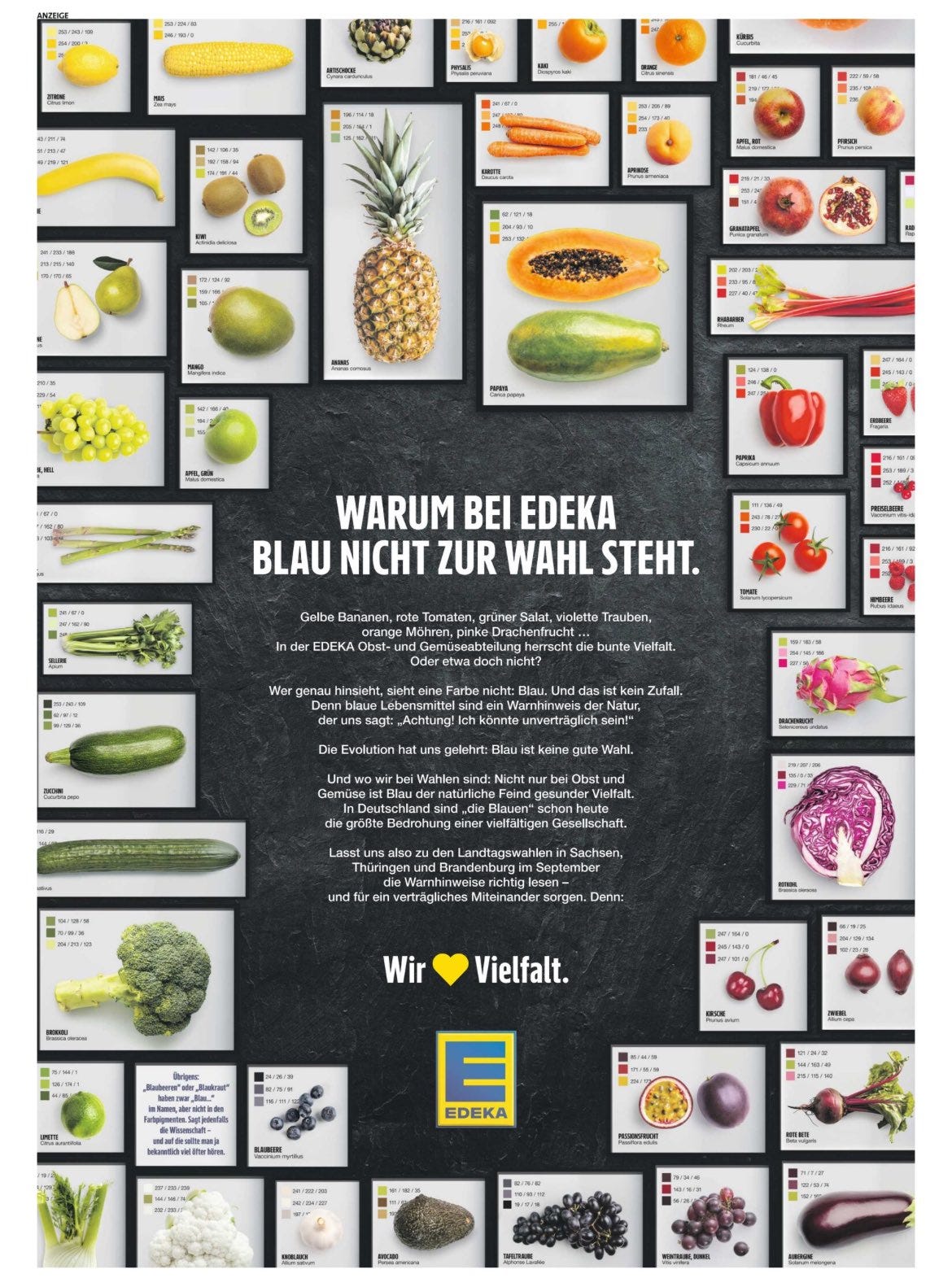
Among the new sworn enemies of the blue band of the visible electromagnetic spectrum are the marketing team at Germany’s largest supermarket corporation, the Edeka Group. A few days ago, this supermarket chain, whose own logo strangely enough is primarily blue …
… ran an ad in Die Zeit and the Frankfurter Allgemeine Zeitung explaining “WHY BLUE IS NOT ON OFFER AT EDEKA”.
That wall of text in the middle reads as follows:
Yellow bananas, red tomatoes, green lettuce, purple grapes, orange carrots, pink dragon fruit … EDEKA’s fruit and vegetable department is full of colourful diversity. Or is it?
If you look closely, there’s one colour you won’t see: blue. And that’s no coincidence. Because blue food is nature’s way of warning us: ‘Watch out! I could be harmful!”
Evolution has taught us that blue is not a good choice.
And speaking of choices: Blue is not only the natural enemy of a healthy diversity of fruit and vegetables. In Germany, “the blues” are also the biggest threat to our diverse society.
So let’s read the warning signs correctly ahead of the state elections in Saxony, Thüringen and Brandenburg in September – and ensure that we can live together in harmony. Because we love diversity.
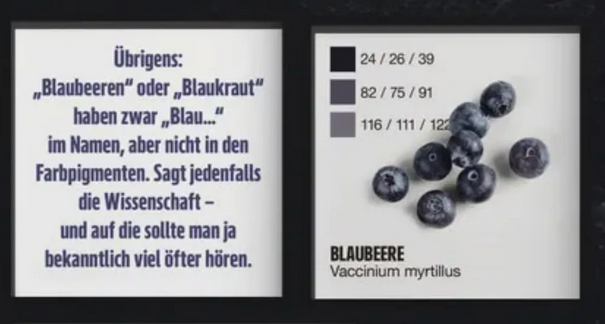
For those wondering whether Edeka have decided to cease selling fascist blue fruits like blueberries, there is a helpful note down in the corner:
There we learn that, while “‘Blueberries’ or ‘Blue cabbage'” may have “‘blue’ in their names”, their “colour pigments” are not blue. This is “at least what Science tells us – and as we know you should always listen to Science more”. Nothing about this is remotely obnoxious; indeed, if current-year Germany needs anything, it is more blind platitudinous calls to Follow the Science – particularly when it comes to exonerating innocent fruits and vegetables from suspicion of blue fascism.

August 27, 2024
Food at your regional end-of-summer fair/exhibition/extravaganza
For us in the Greater Toronto Area, it’s the Canadian National Exhibition but for a lot of Americans it’s their State Fair. James Lileks considers the sad fact that the interesting and exotic food choices at these shindigs is … overrated:
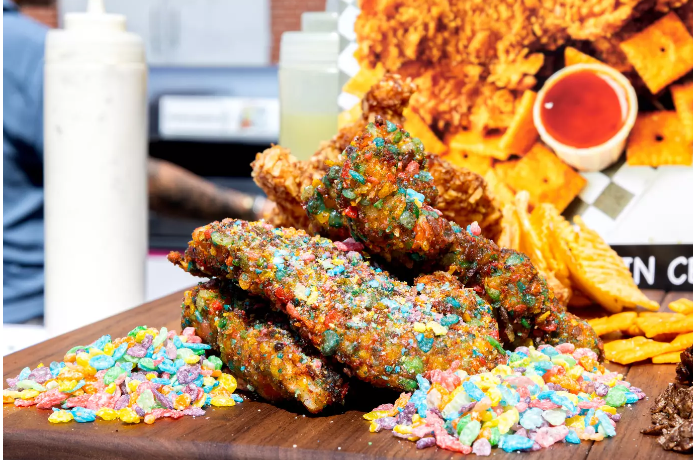
“Fruity Cereal Tenders”, one of the weird food offerings at the 2024 Canadian National Exhibition in Toronto.
Photo from blogTO, “Here’s all the outrageous food and drinks at the 2024 CNE”
I do not understand is why people go to the Fair and queue up at the hamburger stand. I often think this as I am in the queue at the hamburger stand.
After all, there’s so much more to eat. Corn dogs, for example. A low-flavor tube of minced abattoir sweepings, dipped in batter, plunged in oil, and served on a stick with a sharp point on the end. When you get to the last few bites, you either have to shimmy the butt of the corn dog up the skewer, or sword-swallow the thing so the sharp point spears your soft palate. Condiments? Why, yes — a smear of ketchup, or a smear of mustard, or, if you’re one of those people who believe in grabbing life by the lapels and shouting give me all you got, you have both.
Never in my life have I ever thought “I could go for a Corn Dog right about now,” but put me at the Fair and I have to eat one within five minutes of entering the grounds. It’s like the pistol shot that starts a race, and, like a bullet, goes through you just as fast.
It’s the same with mini-donuts. When I was doing the trivia contest at the newspaper stage, one of the questions was “how many mini-donuts can you eat before you are overcome with self-loathing?” The answer varies, I suppose, according to how much pre-existing self-loathing you bring to the job. Maybe you’re already hating yourself for eating a Sweet Martha’s bucket of cookies, a popular item at the fair. It has a handle so you can amble around as you eat. One of these years I expect it will come with a yoke and a spring-loaded tab that pops them in your you at present intervals, for hands-free consumption. My friends, a bucket of cookies is to personal girth management as a cup of quarters at a casino is to financial planning.
This year’s hot new item is “deep fried ranch dressing”, which seems impossible, like “sugar-dusted humidity on a stick”. How do they do that? Just pour the ranch in the roiling oil and and scoop out a globule?
“Well, first you shape the dressing into patties, then — ”
Wait, no, you cannot shape dressing. It defies your attempts to give it form, unless you’ve added a thickening element. (Of course, everything they serve at the Fair is a thickening element, in a sense.) It’s supposed to be delicious, but I wouldn’t eat one without first unbuttoning my shirt and smearing conducting gel on my chest, just to save time. Maybe even draw a dotted line on my sternum.
Updated to add the correct URL. Management would like to apologize for this error. The people responsible for it have been sacked.
August 24, 2024
Eating on a German U-Boat in WW1
Tasting History with Max Miller
Published May 7, 2024Sauerkraut soup served with German black bread, or schwarzbrot
City/Region: Germany
Time Period: 1915The food aboard a German U-boat could get really monotonous, especially after the first ten days or so, when all of the best and freshest ingredients would have gone bad. This simple soup uses ingredients that would have been available on board, and comes from a German cookbook from WWI. There are actually several variations of this soup in the cookbook, the only difference being swapping out the sauerkraut for other ingredients like pickles, cabbage, or beets.
You need to like sauerkraut in order to enjoy this soup, as there isn’t anything else going on to contribute other flavors. I highly recommend eating it with some schwarzbrot, or black bread. It balances the sourness of the soup and the two go together very nicely.
Sauerkrautsuppe
The fat and flour are whisked and the water is slowly added. When the soup has simmered, the sauerkraut is added. Salt and vinegar are added to the soup and seasoned.
— Kriegskochbuch, 1915.
August 16, 2024
Dining on the luxury liner RMS Lusitania
Rich, creamy banana ice cream with banana compote
City/Region: England
Time Period: 1894Today, the Lusitania is most remembered for being the target of a German torpedo on May 7, 1915, but when she sailed, she was known for being the height of speed and luxury. This ice cream dessert was served to second class passengers on October 9, 1913 on board the Lusitania, and the same dessert is on a menu from April 11, 1912 aboard the Titanic.
It’s not hard to see why Victoria Pudding was served to fancy passengers. The flavors are layered and delicious, the texture is luxurious and creamy, and the compote is undeniably fancy. At first you get the flavor of the banana, then the floral notes from the orange flower water come in, and nothing is overpowering. The banana compote is quite a bit of work, and as it doesn’t add any new flavors to the dish, I think it’d be okay to skip it. If you’re going for maximum opulence, though, then definitely make it.
Victoria Pudding
Pouding à la Victoria
Take one pint of vanilla custard (Book of Ices, p. 23), add to it the purée of six large or eight small raw ripe bananas that have been pounded with one ounce of castor sugar, the pulp of two oranges and one lemon, and a quarter-pound of raw ripe or cooked pineapple; mix these together, and colour with a little of Marshall’s Apricot Yellow, and rub through a fine hair sieve; flavour with a wineglassful of orange-flower water, a teaspoonful of vanilla essence, and a wineglassful of brandy; pour the mixture into the charged freezer and freeze it to the consistency of a thick batter; then add half a pint of whipped cream that is sweetened with half an ounce of castor sugar; refreeze it and put it into a fancy pudding mould, place this in the charged ice cave for three and a half to four hours, during which time turn it occasionally from side to side, so as to get the ice evenly frozen. When ready to serve turn out the pudding in the usual way on to a dish, and serve round it a compote of bananas (see recipe).
This is a nice dish for a dinner or luncheon sweet, and if the mould has a pipe the space made by it can be filled with the compote of fruit.Compote of Bananas
Put two tablespoonfuls of thick apricot jam into a basin with the pulp of two bananas, a wineglassful of Marshall’s Maraschino Syrup, a few drops of Marshall’s Carmine, a saltspoonful of Marshall’s Apricot Yellow, the juice of one lemon and of one orange; mix these together with this purée three or four raw ripe bananas that have been freed from skin and sliced about a quarter of an inch thick; set it on ice till quite cold, then use.
— Fancy Ices by Agnes B. Marshall, 1894
August 5, 2024
What the First Astronauts Ate – Food in Space
Tasting History with Max Miller
Published Apr 23, 2024Smooth, sweet, and sour Tang pie in a graham cracker crust
City/Region: United States of America
Time Period: 1960sContrary to popular belief, NASA did not invent Tang, but the company that did, General Foods, used the association in a lot of their marketing. They even developed this recipe for Tang pie, also called astronaut pie.
The texture of the pie is smooth and very nice, but it had too much of a sour zip in it, or “tang” if you will, for me. If you like sour notes like in lemon meringue or key lime pies, or if you just like Tang, then I think you’ll like this. You can use a ready-made graham cracker crust to make this pie even easier to put together.
Tang Pie. It’s the pie of the future. Here it goes space boys and girls:
TANG Pie
1 can sweetened condensed milk
3/4 C. Tang® powder drink mix
1/2 C. sour cream
1 (9 oz.) tub Cool Whip®
1 graham cracker pie crust.
Mix condensed milk and Tang. Add in sour cream until well blended. Then fold in tub of Cool Whip. Pour into pie crust and refrigerate for 4 hours or until set and cold.
August 3, 2024
“Multiculturalism is when yummy food”
Fortissax pours scorn on the defenders of multiculturalism-at-all-costs for one of the most common arguments in favour:

“Multiculturalism is when yummy food” is a real position people take. If you ask them what benefits of multiculturalism are, they’re going to say food and nothing else. Westerners don’t watch Bollywood films, they don’t listen to Desi music, they don’t watch cartoonishly bad Latin American dramas, usually for Hispanic abuelas still living in Mexico where every actor is suspiciously fairer-featured than everyone in their whole family. People can’t say “I love the food, the music, the culture” because they don’t engage in any of this. Salsa isn’t even popular; it hit its peak at the end of the 1990s because white boomer Americans approached an intensely Anglicised, sanitised form of Latin-American culture as introduced to them through the likes of Enrique Iglesias and other English-speaking Latin pop artists.
I don’t believe all leftists say this out of sincerity. It’s a knee-jerk reaction to any criticism of multiculturalism. They don’t put a lot of thought into it. The justification is usually related to how “bad” that “white people food” is. This follows the same thread of accusations that “white people can’t dance”, “white people can’t jump”, “white people can’t fight”, and “white people can’t fuck”. It’s another lib-coded tract to bash English-speaking white Americans over the head with, to justify demographic displacement by portraying them as boring, ugly, weird, or uncool. On some level, they probably know food isn’t worth human lives, but they have to reinforce their moral view or the whole thing collapses, and they have to admit fault for doing things and promoting ideas that are so destructive that people would want to unalive them. If they give up now, it’s over. It’s sunk cost fallacy.
For the rest who’re wholly sincere: it’s just straight up bullshit. Foreign restaurants serve you a Westernized version of their slop. Their bulk food suppliers are Western, the ingredients are Western-derived, but they sell it as “authentic” when it isn’t. That crab rangoon you just spent $40 on Doordash was bulk bought at Costco during a last ditch grocery run. They’re selling you the experience. A sampling of the real thing, deliberately fitted to your people’s general dietary preferences. All of these “ethnic”, “exotic” restaurants do this. Everyone knows about “secret menus” at Chinese or Indian restaurants. Anybody who works in culinary, hell, anybody whose watched the UK version of Hell’s Kitchen where Gordan Ramsay tries to rescue failing restaurants owned by small business owners can tell you most of these people aren’t using fresh or original ingredients. You go to any “Japanese” restaurant in North America, the staff are a random assortment of Asian, or sometimes Korean or Chinese, or maybe even Filipino but it doesn’t matter because they look Asian enough to boomers, correctly guessing people can’t tell the difference at a passing glance.
QotD: Grain farming and the rise of organized states
But you can tax grain farmers! You can assign them some land, and come back around harvest time, and there will be a bunch of grain just standing there for you to take ten percent of. If the grain farmer flees, you can take his grain without him. Then you can grind the grain up and have a nice homogenous, dense, easy-to-transport grain product that you can dole out in measured rations. Grain farming was a giant leap in oppressability.
In this model, the gradual drying-out of Sumeria in the 4th millennium BC caused a shift away from wetland foraging and toward grain farming. The advent of grain farming made oppression possible, and a new class of oppression-entrepreneurs arose to turn this possibility into a reality. They incentivized farmers to intensify grain production further at the expense of other foods, and this turned into a vicious cycle of stronger states = more grain = stronger states. Within a few centuries, Uruk and a few other cities developed the full model: tax collectors, to take the grain; scribes, to measure the grain; and priests, to write stories like The Debate Between Sheep And Grain, with immortal lines like:
From sunrise till sunset, may the name of Grain be praised. People should submit to the yoke of Grain. Whoever has silver, whoever has jewels, whoever has cattle, whoever has sheep shall take a seat at the gate of whoever has Grain, and pass his time there
And so the people were taught that growing grain was Correct and Right and The Will Of God and they shouldn’t do anything stupid like try to escape back to the very close and easily-escapable-to areas where everyone was still living in Edenic plenty.
… turns out lots of people in early states escaped to the very close and easily-escapable-to areas where everyone was still living in Edenic plenty. Early states were necessarily tiny; overland transportation of resources more than a few miles was cost-prohibitive; you could do a little better by having the state on a river and adding in water transport, but Uruk’s sphere of influence was still probably just a double-digit number of kilometers. Even in good times, peasants would be tempted to escape to the hills and wetlands; in bad times, it started seeming crazy not to try this. Scott suggests that ancient Uruk had a weaker distinction between “subject” and “slave” than we would expect. Although there were certainly literal slaves involved in mining and manufacturing, even the typical subject was a serf at best, bound to the land and monitored for flight risk.
Scott Alexander, “Book Review: Against The Grain“, Slate Star Codex, 2019-10-15.
July 27, 2024
Dining on the Orient Express
Tasting History with Max Miller
Published Apr 16, 2024Côtelettes d’Agneau à la Minute
Simple, delicious fried lamb cutlets with a lemon-butter sauce with swirls of Duchess PotatoesCity/Region: France
Time Period: 1903The food and dining cars of the Orient Express were a big part of the luxurious experience that drew in passengers. The chefs, who were brought in from top French institutions, prepared meals on moving train cars, sometimes themed to which countries the train was passing through.
These lamb cutlets are simple, tender, and delicious. The lemon-butter sauce has only two ingredients, and pairs perfectly with Duchess Potatoes for a wonderful meal (or more accurately, single course) aboard the Orient Express.
Côtelettes d’Agneau à la Minute
Cut the cutlets very thin, season them and shallow fry in very hot clarified butter. Arrange them in a circle on a dish, sprinkle with a little lemon juice and the cooking butter after adding a pinch of chopped parsley, Serve immediately.
— Le Guide Culinaire by Auguste Escoffier, 1903
July 19, 2024
Airline Food During the Golden Age of Air Travel
Tasting History with Max Miller
Published Apr 9, 2024Back before airlines could compete with lower prices, they competed with the quality of atmosphere, service, and, of course, food.
I’d be happy to have this pot roast on the ground, let alone on an airplane. The meat is so tender that it falls apart, the vegetables and herbs give it wonderful flavor, and you get the added bonus of it making your house smell awesome as it simmers.
(more…)
July 15, 2024
What Pioneers ate on the Oregon Trail
Tasting History with Max Miller
Published Apr 2, 2024Cornmeal cakes and the bacon in whose fat they were fried
City/Region: Oregon Trail
Time Period: 1856The Oregon Trail was tough. It was gruelling, food could become scarce, and even the drinking water was mostly unpalatable (not to mention the threat of dysentery). Emigrants packed well over 1,000 pounds of food into their wagons, staples like flour, bacon, coffee, sugar, rice, and hardtack (clack clack). They also relied on finding food like edible plants, fish, and game along the way.
These cornmeal cakes went by many names, including johnny cakes and hoe cakes. The ingredients are simple, but they’re surprisingly delicious. Without anything to leaven them, they’re a bit dense, but they taste great. The flavor is a combination of cornbread, sweet molasses, and bacon, kind of like a 19th century McGriddle. This is a great recipe to play around with. You could add some spices for a fancier version, swap out some of the water for milk, or use other fats or sweeteners.
(more…)


