
One afternoon [Wakeman] dropped by a local recording studio, where he spotted an odd little keyboard in the corner. The manager of the studio, Tony Visconti, told him it was a Mellotron, the spooky-sounding, electro-mechanical instrument made famous by the Beatles on “Strawberry Fields”. But it was so difficult to play that nobody in the studio could figure out how to use it. “Mind if I have a go?” asked Wakeman. Visconti and his recording crew watched in awe as the gawky kid made the mellotron sing.
“How’d you do that?” an engineer asked.
“Don’t tell him,” Visconti told Wakeman. “It’ll make you a fortune!”
Visconti asked Wakeman if he could come back to play mellotron for one of his artist’s recording sessions. After getting dropped off at the studio by his mother, Wakeman was greeted at the studio by a precocious young rocker whose eyes appeared to be two different colors. His name was David Bowie, and he wanted Wakeman to play mellotron on “Space Oddity”, the title track of his second album. “This will be a piece of cake for you,” he reassured Wakeman.
“Oh, okay,” Wakeman stammered.
“I take it you have played a piece of cake before?” Bowie replied. Wakeman, confused and nervous, offered no reply.
“Well,” Bowie went on, “maybe not then.”
The song launched a lifelong friendship with Bowie, and Wakeman’s career. He became rock’s go-to keyboardist, playing in countless sessions. In 1970, Melody Maker, at the time England’s most influential music publication, featured Wakeman on a cover story that anointed him “Tomorrow’s Superstar”. Bowie offered him a few key pieces of advice: get your own band, play with musicians who understand you, and, when it comes time to perform, “do what you want onstage, especially if you’re using your own money. Don’t let a promoter, agent, or manager tell you otherwise — they don’t have the imagination.”
Wakeman put the advice to use in the brashest of ways: He turned down Bowie’s offer to play in his sideband, the Spiders From Mars, and instead became the keyboardist for Yes. With its mystical lyrics, orchestral productions, Tolkienseque album art, and long, multipart songs, Yes exemplified progressive rock in all its technical breadth and portentous glory. Wakeman, who surrounded himself with keyboards and wore a cape to hide his arms after a critic said he moved like “a demented spider”, became prog rock’s most iconic star. “Here comes Rick, the caped crusader!” the band’s lead singer, Jon Anderson, recalls with a laugh. “He had a great sort of stance onstage, and very powerful energy. It really put him apart from any other keyboard player.” Or, as Wakeman deadpans, “I was Spinal Tap for real”.
David Kushner, “The Stranger-Than-Fiction Secret History of Prog-Rock Icon Rick Wakeman”, Vanity Fair, 2020-06-25.
August 12, 2025
QotD: Rick Wakeman – “I was Spinal Tap for real”
August 11, 2025
Stalin’s Death: The Day the USSR Changed Forever! – W2W 39
TimeGhost History
Published 10 Aug 2025March 1953: Stalin’s sudden death triggers a whirlwind of conspiracies, paranoia, and a deadly battle for control inside the Kremlin. As Beria, Khrushchev, and the Soviet elite scramble for power, the fate of the world’s largest superpower hangs in the balance. Was Stalin murdered by his inner circle, or did his own regime consume him? Discover the truth behind the downfall, the rise of Khrushchev, and the birth of the KGB in the Cold War’s most dramatic turning point.
(more…)
Speed vs Armour: The Unexpected History of Fast Tanks
The Tank Museum
Published 21 Mar 2025Would you rather go to war in a tank that was quick but lightly armoured – or heavily armoured but slow?
The concept of fast tanks has existed since the First World War, but making a tank fast is easier said than done. You can increase the speed, but only by compromising the other two sides of The Iron Triangle.
Whilst a good power to weigh ratio is key to making a tank go fast, there are other factors that need to be considered. J Walter Christie pioneered the innovative helicoil spring suspension system – an invention that allowed tanks to cope with travelling at high speeds across country. Although not picked up by the US Army, the brilliance of Christie’s suspension was recognised by the Soviets and soon made an appearance on the BT-Series of tanks – and most effectively on the T-34.
Back in the UK, the newly mechanised cavalry was making use of some brand-new Cruiser tanks. Whilst these were fast vehicles, this was coming at the cost of effective protection. Some military thinkers advocated for the concept of “speed as armour” but results were mixed – with the Crusader and Cromwell both proving to be capable tanks.
After the war, the British Army finally moved on from “speed as armour” and settled on sacrificing a bit of speed for the sake of better protection. This was incorporated first into the concept of Universal Tanks and remains a fixture in the modern Main Battle Tank.
So, we’ll ask again. Would you rather go to war in a tank that was quick but lightly armoured – or heavily armoured but slow?
00:00 | Introduction
00:51 | What Makes it a Fast Tank?
02:39 | What is a Fast Tank For?
04:39 | Suspension of Disbelief
06:34 | Speedy Soviets
08:29 | Cruisers Replace Cavalry
11:20 | The Second Wave
13:19 | Cruising in Europe
19:08 | One Tank to Do It All
(more…)
QotD: The job of the fuller
The cleaning agents for fulling wool varied by time and place. Roman fulleries generally used urine allowed to sit for a time (becoming “stale” – such urine is known as “wash”) because that concentrated the ammonium in the urine which acted as the cleansing agent. By the Middle Ages, we see the use of “fuller’s earth” (ammonia-rich clay), although urine continued to be used as well, presumably for its greater availability. As J.S. Lee notes (op. cit., 53), from the late twelfth century, we begin to see the use of water-power to replace the fullery worker as the treading agent, with the use of heavy wooden hammers driven by a water wheel to pummel the fabric.
Once this process was done the clothes or fabric were removed from the basin, scrubbed and wrung out fully, before being rinsed. In the Roman context – Roman fulleries (fullonicae) are fairly well archaeologically preserved and so give clues to the process at that time – the rinsing basins are set up to allow workers to walk in and out of them (some have working benches) which suggests that rinsing may have included additional scrubbing and wringing to make sure to remove both all of the impurities as well as all of the cleaning agents (Flohr, The World of the Fullo, 179-81). Fabrics would then have to be hung to be dried. In the Roman context, artwork tends to show clothes hung over high beams in the fullonica to dry; in the medieval context they were often hung to dry outdoors on long wooden frames called “tenters”.
Finally, the cloth would be “napped” (also called “raising the nap”, “rowing”, “teasing”, or polishing), which may have actually been the most labor intensive part of the process. Cloth would be brushed first, to raise the nap (the fuzzy, rough raised surface on woolen cloth), which would then be sheared to leave the cloth smooth. This stage also provided an opportunity for burling (and now you know why the coat factory is in Burlington), the inspection of the cloth and the manual removal of burrs, knots and other defects. Flohr (op. cit.) argues that this stage in the process consumed the bulk of the time and labor of fulling (a point on which J.S. Lee concurs for the Middle Ages). It is to a significant degree unfortunate that the sensational “they washed clothes in urine!” element of fulling has tended to eclipse the rest of the process in not only the popular imagination but occasionally in the scholarly discourse (the already cited Flohr, The World of the Fullo is a good antidote to this).
The position of fulling in the production chain of textiles seems to have varied a bit over time. In the medieval and early modern periods, fulling was generally done only once, as a final finishing stage in cloth production. By contrast, as Miko Flohr argues (op. cit., 57ff), the primary job of the Roman fuller was effectively as a laundry (though they may have treated freshly woven wool as well). Part of this probably has to do with differences in Roman clothing; Roman clothes were generally fairly simple in shape which must have made them easier to put through a fullery as a completed garment. Myself, I wonder if the changing role of fulling has to do with the introduction of soap during the later Roman Empire, which would have made it more possible for clothes to be laundered domestically (the Romans cleaned their bodies with oil, scraping it off with a strigil, which while perfectly good for cleaning skin would obviously not do for clothes, but soap and scubbing will work for both).
Fulling was generally a commercial (that is, not household) operation, done by professional fullers and we’ll talk about them (along with dyers and cloth merchants) in just a moment in terms of their place in society.
Bret Devereaux, “Collections: Clothing, How Did They Make It? Part IVa: Dyed in the Wool”, A Collection of Unmitigated Pedantry, 2021-04-02.
August 10, 2025
August 9, 2025
Alert the non-crime hate incident police: soccer star proclaims pride in being English!
In Spiked, Obadiah Mbatang discusses a recent disturbing incident of a member of the Lionesses (England’s female national soccer team) saying something completely unacceptable to the great and the good:

So the Lionesses were victorious in the UEFA Women’s Euros, holding the title they won in 2022. England forward Chloe Kelly, who scored the decisive penalty in the final against Spain, declared after the match: “I am so proud to be English”.
To hear a sports star make such a simple and patriotic statement was, for most of us, a pleasant breath of fresh air. Just as refreshing has been the muted response to her declaration of national pride. In the week or so since, there have been no online campaigns denouncing Kelly’s views as “problematic”. This raises the question: is it just the Lionesses who are allowed to be patriotic?
Compare the response to Kelly’s post-match comment with the recent treatment of Courtney Wright, a 12-year-old schoolgirl from the West Midlands. A few weeks ago, she wore a Union Jack dress inspired by the Spice Girls to her school’s “Culture Day”, in which pupils were encouraged to “proudly represent their heritage”. Courtney, who had also prepared a speech celebrating Shakespeare and fish and chips, was put into isolation by her school and then sent home. Essentially, she was told it was unacceptable to express pride in being British.
What followed next gave us a fascinating, if depressing, insight into the online left. Aaron Bastani, co-founder of Novara Media, came out in defence of Courtney. “A white British person being proud of their country and its accomplishments does not make them racist”, Bastani said on X. “Either all groups get to celebrate identity and culture, or none.” Yet for striking a fair-minded and consistent approach, he was attacked by his largely left-wing audience.
One notable assault came from Eleanora Folan, who runs the hugely popular “Stats for Lefties” X account. Folan said celebrating British culture “literally does” make someone racist because “the concept of white ‘identity’ is inherently exclusionary and racist”, adding that “all of Britain’s ‘accomplishments’ were built on racism and imperialism”.
Now, I suspect Eleanora and many on the left would never say that Nigerians should view their heritage as “evil” because of the Biafran War and the anti-Igbo pogroms of the 1960s and 1970s. Does anyone on the left talk about King Ghezo’s determined efforts in the 19th century to maintain slavery, even as the British tried to stamp it out in his West African kingdom? Would they say that British people of Arab descent should be ashamed because of Arab slavery of Africans, which still persists to some extent today? Should British people of Rwandan Hutu descent be ashamed because of the Rwandan genocide? Of course not.
Admittedly, there is no shortage of right-wing whataboutery that uses the histories of other countries to avoid discussing the darker aspects of Britain’s past. But that is not what is going on here. Courtney’s treatment by her school, and those online leftists blasting her as racist, reveals that self-loathing oikophobia remains one of the dominant prejudices of the left.
Erma EMP36: External Form Factor of the MP40
Forgotten Weapons
Published 26 Mar 2025The German military began looking for a new submachine gun design in secret in the mid 1930s. There is basically no surviving documentation, but the main contenders appear to have featured: Hugo Schmeisser’s MK-36,II and Erma’s EMP-36. Today we are taking a look at one of two known examples of the Erma design at the VHU in Prague. Designed by Heinrich Vollmer, this is a plain blowback open bolt system chambered for 9x19mm. It is massively more complicated than such a simple design has any right to be, though. Elements like the tiny set screw holding together the recoil spring assembly and the detachable bolt face are, frankly, nutty to include in a prospective military design.
However, Vollmer’s design had a number of external design features that were deemed very desirably by the German military. The pistol grip and very compact underfolding stock were both admirable, and the muzzle rest system was also of interest (in a simplified form). Ultimately, the result of testing of the Erma and Schmeisser prototypes was a combination of their features into a hybrid design. The Erma provided the external form factor, and the Schmeisser contributed the internal mechanics for the MP38 and in turn MP40.
(more…)
August 8, 2025
Debunking the idea that Japan was about to surrender anyway
Dr. Robert Lyman on the common misunderstanding of Japan’s situation in July and August of 1945 — no, they weren’t “on the brink of surrender so atomic bombing was unjustified” … instead, they were intending to make the assault on the Home Islands the biggest bloodbath ever:
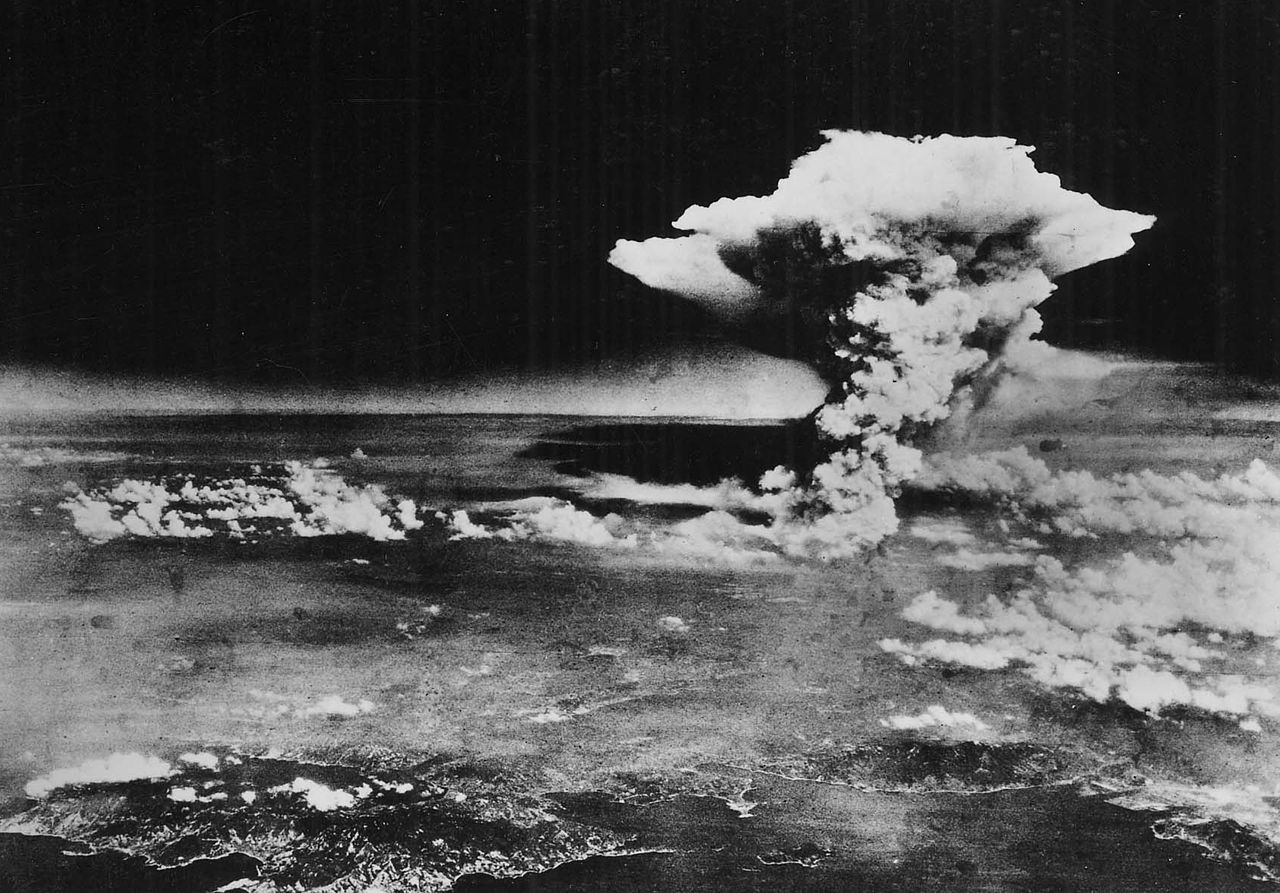
Atomic cloud over Hiroshima, taken from “Enola Gay” flying over Matsuyama, Shikoku, 6 August, 1945.
US Army Air Force photo via Wikimedia Commons.
It’s the anniversary of Hiroshima again today. I wasn’t going to write anything to mark the event (more coming next week on VJ Day), but I’ve been triggered already by nonsense on the radio which suggests that the atomic bombs on Hiroshima and Nagasaki were unnecessary, because Japan was about to surrender.
Nonsense. There is not a shred of real evidence to support this idea. In fact, the evidence that Japan wanted to keep on fighting is irrefutable. And yet this lie persists, despite the deluge of scholarly work demonstrating Japan’s commitment to the ritual suicide of its entire nation right until the end, when Hirohito pulled the plug. If you are in any doubt about the facts of the case, as opposed to the propaganda, read Toland’s Rising Sun (1970), Frank’s Downfall (2001), Spector’s In The Ruins of Empire (2007), Pike’s Hirohito’s War and, more recently, Stewart Binn’s Japan’s War (2025). All are excellent, clear, analytical and well researched. There are lots more, too.
Why does this canard keep on popping up? Is it because people don’t read? Or is it that they just don’t want to believe in the necessity of such a dramatic event to force Japan to surrender and thus bring about an end to the greatest man-made tragedy the world has ever suffered? The origins of this wishful myth in fact derives from hard right nationalist propaganda in post-war Japan (driven by Admiral Suzuki himself), quickly lapped up by the gullible and wishful thinkers in the West. Its one of the most enduring of the Hiroshima and Nagasaki myths, in part because it seems palatable to many, and because it is inherently anti-American.
What is the real story? In short, the Allies tried hard to persuade Japan to surrender. They demonstrated unequivocally to Japan that it was going to lose the war by defeating its armies and by beginning the long, slow and painful crawl towards the Japanese home islands. All the books I’ve mentioned note the extreme chaos of Japanese decision-making before and during the war. Who really was in charge? Who could one talk to, to secure a commitment to negotiate? In any case, the chaotic government under Koiso which replaced that of General Tojo following the fall to the Americans of Saipan in 1944, made not a single effort to engage with the Allies to seek terms. This government also collapsed on 5 April 1945. The replacement prime minister was Admiral Suzuki, and it was from this man that the myth seems to have arisen, after the war, that Japan was considering surrender and that the A-bombs were unnecessary. This is not true. During his entire time as Prime Minister he resolutely refused to do anything but continue to fight, unless the ending of the war could be secured on Japan’s terms. There were some initiatives to persuade the Suzuki government to surrender, but none of them amounted to much, because they didn’t engage directly with the government in Tokyo, and they didn’t derive from the Allied powers. The evidence that peace-feelers were being put out by various sources (such as the Vatican) in 1944 and 1945 is evidence only that the Japanese government ignored them. None were taken seriously in Tokyo.
Indeed, throughout the period of the Suzuki government, the war parties were dominant. In early June the military Supreme Command submitted a paper entitled The Fundamental Policy to be Followed Henceforth in the Conduct of the War, in which it demanded that the government confirmed that Japan would fight to the very last Japanese in an act of national suicide leading to the “honourable death of the hundred million”:
With a faith born of eternal loyalty as our inspiration, we shall – thanks to the advantages of our terrain and the unity of our nation, prosecute the war to the bitter end in order to uphold our national essence, protect the Imperial land and achieve our goals of conquest.
The proposition was passed, not unanimously, but overwhelmingly nonetheless.
There were some in the government – interestingly including Tojo himself – who saw that this was self-defeating, and that Japan must negotiate to secure acceptable peace terms. Naively, it was hoped that this would enable it to retain parts of its empire. Suzuki was part of this group who thought that Japan could negotiate favourable terms to end the war, in the form of a negotiated settlement such as that had brought about the end of the Russo-Japanese war in 1905, but when he suggested this in parliament on 13 June he was shouted down by the war mongers. Hirohito then endorsed an approach to the Soviets in late June. Bizarrely – though Moscow was neutral in the Far Eastern war at this point – Tokyo’s emissaries suggested that the USSR and Japan join forces to rule the world. It was yet more evidence of how Tokyo fundamentally misunderstood the world, and its enemies, and the way the war would have to end: complete and utter surrender by Japan.
Moscow, of course, scorned these “negotiations” as meaningless.
Germany’s Darkest Night Yet? – Rise of Hitler 21 – September 1931
World War Two
Published 7 Aug, 2025September 1931: Berlin descends into chaos as Nazis unleash a violent pogrom on Jewish New Year — while the police stand by. The scandal of the Kurfürstendamm riot rocks Germany, but the month’s headlines don’t stop there: Hitler’s niece is found dead under mysterious circumstances, France’s leaders visit Berlin to a frosty reception, and Japanese troops invade Manchuria. Extremists surge at the polls as democracy teeters — can the Republic survive?
(more…)
The Rise and Fall of Books in Ancient Rome
toldinstone
Published 21 Mar 2025This video explores how books were published and distributed in ancient Rome.
Chapters
0:00 Introduction
0:30 Literacy and texts
1:19 Libraries
2:09 Scrolls and codices
3:13 Bookstores and booksellers
4:07 Helix
5:13 Publication
6:17 Luxury and vintage books
7:14 Bestsellers
8:10 The end of the book trade
August 7, 2025
The Arctic, strategically speaking
CDR Salamander suggests we tilt our globes (you have a globe on your desk, don’t you?) 90 degrees and consider the Arctic Ocean:
First things first, as it is the focus of the report, let’s go to the chart room and properly define the, “Central Arctic Ocean”.
There it is, the horizontally shaded bit outside everyone’s EEZ.
The chart comes from the report in question by RAND: The Future of Maritime Presence in the Central Arctic Ocean.
Before we dive in — and the Front Porch knows exactly where I am going here — I need to point out again what we see at the very top where all the red, green, and blue lines intersect. You can’t miss it, and it should have you screaming to whatever direction The Pentagon is from where you sit.
Yes kiddies, that is the Bering Strait, half of which is ours, and the other side is Russia. As you move from the Arctic into the greater Pacific or from the Pacific to the Arctic, you have to pass through that strait, and before it the American Aleutian Islands.
As we’ve covered here before, we have criminally avoided leveraging the blessings of the geography bequeathed to our nation, that of controlling both the inner and outer gates to the Arctic Ocean from the Pacific.
I should not have to explain to you the importance of the Arctic shores of Alaska to anyone. Challengers to the security of our resources in the north, both old and new, are back on the scene. We are a decade late in building a base at Nome and reactivating Adak. I covered that in a previous Substack linked in the prior sentence. Read it and come back if you need to catch up.
A weakness of much of the RAND report is, it is mostly based on stale talking points about immediate climate change in the Arctic, and questionably alarmist assumptions about the Arctic climate for the rest of the century, which seem more suited to the first Obama Administration, but put this to the side.
Should the climate in the Arctic mid-century trend towards the more ice or less, the simple facts remain — the competition in the Arctic is only increasing and the time to act on this new reality is now.

War Rationing on the Italian Home Front during WWII
Tasting History with Max Miller
Published 4 Mar 2025Dry, dense wartime version of a traditional chestnut cake with lemon zest and no sugar
City/Region: Italy
Time Period: 1942Food shortages in Italy began years before WWII broke out, and cookbooks that focused on food scarcity had been published as early as 1935. They included recipes for things like soup made from vegetable peels and, like this recipe’s cookbook, instructions for cleaning when soap was rationed.
Castagnaccio is a traditional Tuscan chestnut cake, and this sugarless version is, I imagine, a far cry from what it should be. The cake is very dry, then turns gummy when you chew it, and I definitely recommend having something to wash it down (though you should probably just make a non-wartime version). The flavor isn’t bad, and the lemon really comes through, but it could really use some kind of sweetener.
Chestnut flour cake (without sugar).
What a sweet and lucky surprise to find in your pantry, still in its bag, some chestnut flour which you had completely forgotten about (an incredible thing, indeed, in these times!). Well, such a surprising and lucky circumstance happened to me, in these days, and since you must immediately take advantage of every piece of luck, I…measured 200 grams of the sweet flour; I poured it in a small bowl; I added half a tablespoon of oil, a pinch of salt and only the grated yellow part of a lemon zest; I mixed everything with as much milk as needed (I would have used water if I didn’t have milk at home); I added a whole sachet of yeast; I mixed everything well again; I poured everything in an oiled cake pan; I put the pan in the oven (not too hot); and…when I saw that the cake was swollen and baked…when I put it on the table in front of my family…insatiable gluttons…when the cake was celebrated…
“how lucky we were, mom, since you forgot about the flour” (the kids);
“today’s sweet cake is truly delicious” (the husband);
“what a pity the cake is so small” (the servant girl in her mind)
“it’s lucky that I was able to find such a good remedy for my unforgivable forgetfulness” (me, in my heart).”
— 200 Tips for…these times by Petronilla, 1942
August 6, 2025
Schmeisser MK-36,II – The Mechanics of the MP40
Forgotten Weapons
Published 24 Mar 2025The German military began looking for a new submachine gun design in secret in the mid 1930s. There is basically no surviving documentation, but the main contenders appear to have featured: Hugo Schmeisser’s MK-36,II and Erma’s EMP-36. Today we are taking a look at the two known examples of the Schmeisser design at the British Royal Armouries. It is a simple blowback design with a full wooden stock, and chambered for 9x19mm (although the second example, made for Hungarian trials, is in 9x25mm). It does have a quite strange magazine safety, which prevents the bolt from opening if a magazine is not present — the purpose of this is a mystery to me.
The Schmeisser gun was simple and effective mechanically (expect for that weird safety), and it ultimately contributed its magazine, bolt, and fire control system to the MP38 and MP40 design. In exchange, the Haenel company that Schmeisser works for was one of the two initial MP38 manufacturers.
Many thanks to the Royal Armouries for allowing me to film and disassemble this unique prototype! The NFC collection there — perhaps the best military small arms collection in Western Europe — is available by appointment to researchers: https://royalarmouries.org/research/n…
You can browse the various Armouries collections online here:
https://royalarmouries.org/collection/
(more…)
QotD: Modern English night life
Recently I stayed overnight in a charming small cathedral city in England, genteel by day and Gomorrah by night. It is a little like H.G. Wells’ story The Time Machine, set 3,000 years hence, when humanity has divided into two: the effete, gentle, vegetarian diurnal Eloi, and the ugly, vicious, carnivorous nocturnal Morlocks, who emerge from underground once the sun goes down and prey on the Eloi.
I had booked no place to stay until the last minute, and found only a room above a cavernous, darkened bar, for me an antechamber of Hell, where the Morlock youth of the cathedral city gathered to enjoy themselves — or at least to pretend to do so, for I have long thought that those who cannot enjoy themselves without shouting and screaming are really hysterics, trying to convince themselves that they are enjoying themselves when actually they do not really know how to do so.
Theodore Dalrymple, “Evening Above the Hell-Bar”, Taki’s Magazine, 2019-12-16.
August 5, 2025
Inside the CIA Coup That Changed Iran Forever! – W2W 38
TimeGhost History
Published 3 Aug 2025In 1953, a battle for Iran’s soul erupts on the streets of Tehran. Prime Minister Mosaddegh defies British oil interests, outwits Soviet intrigue, and faces down the Shah — but a secret Anglo-American plot changes history forever. As coups, street mobs, and betrayal plunge Iran into chaos, the nation’s fragile democracy is crushed and a brutal new order rises. This is the untold story of oil, espionage, and the coup that reshaped the Middle East.
(more…)


