
You’ve formed up in your fighting order and begun to advance and first a cloud of light enemies (the velites) move up against you. Behind them, you can vaguely see the main Roman body, but not in much detail yet. Instead, you are treated to shower of lighter javelins; these only mass around 250g or so, but some of them are bound to catch a face or an unarmored leg and bring someone down or get stuck in a shield. The damage is probably minimal, but what the velites are doing is already wearing you down: you are now, physically and mentally “in combat”, with weapons flying and adrenaline running (whereas the Roman heavy infantry are not!). The velites don’t need to inflict casualties at this stage to have an effect: they’re inflicting friction (in the Clausewitzian sense, drink!) and that is enough.
As you approach the velites, they scatter back to their lines and now the first real trial comes: when you are about twenty meters out from the enemy line, a storm of those heavy pila come in, thick and all at once. Each one masses around 1.3kg (just short of three pounds) so even if the tip doesn’t bite, one of these things clanging off of armor or a shield is going to hurt, the impacts stagger men near you as you struggle to keep formation (and for a Hellenistic army, get and keep those sarisa-points down). The impact of the massed volley, especially against close-order infantry with tight fighting-width, is going to be chaotic as some men are killed, others disabled, still more suddenly staggered. The volley is followed almost immediately by the on-rush of the hastati. These guys don’t have a long spear for keeping you at a distance, they’re all brandishing swords and aim to get in close, using their large body-shields to absorb any blows you might throw while they get right up in your face, where their swords can stab and slash viciously over or under your shield. These hastati are aggressive and they’re probably better armored than you are.
And of course an engagement in contact like this is unpredictable. Perhaps in some areas, your lines push forward, whereas in other places it bends back. For large maneuver units (like taxeis!) this can be a real problem, but Roman maniples are small, so one maniple can advance if it finds the opportunity while others hold position or are even forced back (we actually see a general give, essentially, an “advance at your own discretion” order at Pydna, Plut. Aem. 20.8).
After a short and terrifying experience – these moments of shock combat probably didn’t last all that long, perhaps as little as just a few minutes – the hastati fall back. The front of your line is already physically and mentally exhausted. Many men are wounded and certainly some have been killed or disabled. I don’t want to oversell the casualties aspect of this: armies don’t annihilate each other in stand-up engagements (instead more casualties happen in pursuit), but wounds and exhaustion matter. Latin has this phrase, of being confectus vulneribus, “exhausted by wounds” or perhaps “worn down by wounds” (Liv. 24.26.14, 31.17.11, Caes. BGall. 5.45) to describe how the accumulation of a lot of little wounds can sap soldiers of their ability to resist effectively, even if no one wound is lethal. And just as important, all of the emotional impetus of your initial attack is spent. And there’s a decent chance that, as you try to breath, you still have these light velites‘ javelins (the hasta velitaris) thudding into your line every few seconds, because – again – they carry seven of them. They’re not out.
And then, as you are getting your bearings, trying desperately to catch your breath, the principes come up. They’re not physically tired or emotionally exhausted, but eager (like you were a half an hour ago when you advanced), they’ve been waiting all this time. Worse yet, these are probably the most combat-effective soldiers the Romans have, in the prime of their life, with years of combat experience. Now the second volley of pila comes in, creating yet more chaos. And then more angry, heavily armored Romans, behind their big shields, stabbing and cutting with their deadly gladii.
Now the men at the back of your single line may be relatively fresh, but you have no real way to get them to the front, so the wrath of the principes falls on men who are already exhausted, already wounded, already tired and already out of fight. Your line isn’t advancing so stridently; the men in the back, if the formation is deep, don’t know why the advance is slowed, why the line seems to be wavering, only that it seems to be wavering. And meanwhile, everyone is hoping that, at any moment, the victorious cavalry on the flanks is going to show up and win the battle, but they can’t see it anywhere in the confusion. Maybe your cavalry has won and is moments away – or perhaps Antiochus III charged it off the field again and no help is coming. Or perhaps the enemy cavalry has tied it up or worse yet, the Romans’ highly skilled Numidian allies might have mastered the flanks. You have no idea, you only know that help isn’t here, you are tired and more Romans are upon you. And somewhere, the thin thread of human courage snaps, either from the exhausted men in front or the confused men behind and the formation begins to collapse.
As the collective defense of lapped shields or serried pikes gives way, the Romans are now truly in their element: their large shields function just fine in individual combat and their versatile swords do as well. Lead by their centurions, the principes, with practiced and experienced skill, are finding the gaps, cutting as they go. As the formation crumbles, the velites can pursue – lightly armored, but well enough armed, backed up by the equites if there are any left.
You can see thus how this is a formation designed to wear down an enemy’s main battle line. It isn’t that the Romans are set massively deeper than a Hellenistic army, either. Assuming a base-3 set of file-depths (which seems to me the most likely), the Roman ranks are probably six, six and three men deep (hastati, principes, triarii), for a total depth over each file of 15, one less than the normal Macedonian formation. And with the wider fighting intervals the Romans use, they won’t normally have much of a problem matching the fighting width of the enemy army, unless substantially outnumbered (as, for instance, at Magnesia).
It’s not the Roman formation is deeper, it’s that its successive battle lines avoid exposing the entire army to exhaustion, attrition and friction all at once. In effect, it uses the same principles as defense-in-depth, exploiting the effect of friction on the enemy line to wear it down, but does so on the offensive. I don’t think it is an accident that when the Romans do lose, it tends to be because this model battle was spoiled in some way, either because the army was ambushed, enveloped, something disrupted the triplex acies or because the enemy was able to carry the field with just the momentum of the first charge – the Roman lines essentially failing like a building undergoing controlled demolition, as each floor pancakes the next without slowing.
But an army that isn’t able to decisively win the battle either at the first onset or somewhere else on the line is going to find itself in quite a lot of trouble as the Romans almost inevitably sandpaper away the morale and stamina of the main line of resistance until it collapses.
Now many of you may already be realizing that this kind of force is going to present a Hellenistic army with a lot of problems, both because it is set up for a different kind of fight than they are, but also because it may end up matching much heavier troops against the lighter parts of a Hellenistic army. But before we jump into battles, we need to zoom up to the upper levels of military analysis – operations and strategy – and talk about the advantages the Romans have there.
Because if all the Romans had was an edge in their tactical system, we might expect them to win battles but sometimes lose wars. Instead, while the Romans sometimes lose battles, they seemingly always win the war.
Bret Devereaux, “Collections: Phalanx’s Twilight, Legion’s Triumph, Part IIa: How a Legion Fights”, A Collection of Unmitigated Pedantry, 2024-02-09.
August 5, 2025
QotD: Fighting a Middle Republic Legion
August 4, 2025
The EU still dominates in one key area – over-regulation
At the Foundation for Economic Education, Cláudia Ascensão Nunes identifies the one area that the EU has carved out a unique niche for itself … and it’s global in scope:

EU regulations delenda est
In a world where global power is measured by military strength, technological innovation, or cultural influence, it is striking that the European Union, without housing major tech giants or centers of disruptive innovation, has turned bureaucracy into a tool of global power. It shapes the behavior of global companies, including American big tech firms, which adapt their products to comply with European norms. This phenomenon is known as the “Brussels Effect” and has positioned the EU as the world’s regulatory superpower, fueling growing tensions, particularly with the United States following the re-election of Donald Trump.
The European market comprises 450 million consumers with significant purchasing power, making it an essential destination for global companies. However, access to this attractive market comes with detailed regulations based on the precautionary principle, ostensibly prioritizing consumer and environmental protection, and enforced by an efficient bureaucracy capable of implementing and enforcing rules with precision. This combination encourages companies to align their global operations with European standards, as maintaining different product versions for each region is costly and complex. In practice, this exports European standards worldwide.
American big tech companies such as Apple, Google, and Meta exemplify the impact of the “Brussels Effect,” as they face the requirements of legislations like the Digital Markets Act (DMA) and the Digital Services Act (DSA). These laws have forced companies to overhaul their business models, often at high cost and with significant implications. The DMA, for instance, forced Apple to allow alternative app stores and third-party payment systems on iOS, leading the company to announce, in 2024, global changes to its app policy affecting users even outside Europe, with cost estimates in the billions of dollars to restructure its infrastructure and address revenue losses from the App Store.
Google, under the same regulation, was required to offer alternatives to its search engine on Android and to unbundle services such as YouTube, impacting its global strategy and requiring significant investments in new operating systems and interfaces. The company faced potential fines of up to 10% of its global revenue for non-compliance.
Meanwhile, Meta, under the DSA, was required to invest billions in content moderation systems, a serious imposition that openly seeks to control freedom of expression on a global scale. Operational costs increased by around 20%, according to market analysts. These costly adjustments are ultimately coercive due to the weight of the European market, demonstrating how Brussels shapes corporate behavior on a global scale.
These successive impositions and forced adaptations illustrate precisely Friedrich Hayek’s warning about the dangers of central planning. By replacing spontaneous order with top-down, uniform rules imposed by a technocratic authority, the capacity for local adaptation and respect for market complexity is lost. In this scenario, the European Union increasingly takes on the features of a regulatory Leviathan, a body concentrating disproportionate power in the hands of bureaucrats far removed from citizens, reducing freedom of choice and stifling innovation.
Day Ten – German Victory in the Battle of France – Ten Days in Sedan
World War Two
Published 3 Aug 2025May 19, 1940. Ten days into Fall Gelb, Guderian’s panzers thunder toward the Channel, poised to slam a steel ring around nearly half a million Allied troops. In Paris, Paul Reynaud ousts Daladier and Gamelin, calling back Marshal Pétain and General Weygand as France’s last throw of the dice. The pocket is almost shut, yet the story is far from over. Is there time for one more twist? Keep watching as we follow the fight to its end and discuss the aftermath of this campaign.
(more…)
TERF Island
At Spiked, Jo Bartosch reviews Fiona McAnena’s TERF Island: How the UK Resisted Trans Ideology:

The truth is, before they are revered, history-makers are almost always reviled. From universal suffrage to the abolition of the slave trade, the freedoms we take for granted today began as the unpopular obsessions of the awkward and bloody-minded. Fiona McAnena’s TERF Island: How the UK Resisted Trans Ideology charts how just such a small group of determined women – mocked, maligned and misrepresented – dragged sex-based rights back from the brink, often at huge personal cost. It’s the story of how they were hated before they became feted.
Part battle manual and part whodunnit, TERF Island is an insider’s chronicle of how a scrappy, unfunded grassroots movement of mostly middle-aged women outmanoeuvred a lobby bankrolled by billionaires and cheered on by multinational corporations and well-intentioned human-resources departments.
I have been involved in the TERF wars for a decade, and I know McAnena herself is no bystander. Formerly a volunteer at Fair Play for Women and now director of campaigns at Sex Matters, she has done her time in the trenches, too. Each chapter is a vivid, accurate and compelling profile of a key figure in the movement, including Transgender Trend’s Stephanie Davies-Arai, Fair Play for Women’s Nicola Williams, Let Women Speak founder Kellie-Jay Keen and Maya Forstater, whose case against her employer established gender-critical beliefs as protected in UK law – all women I’m proud to know.
It’s almost hard to remember how recently it was considered heresy to say, to use the words popularised by Keen, that “a woman is an adult human female”. In April, the Supreme Court confirmed this truth in law. The BBC may still choke on it, but the legal precedent stands. Yet only a few years ago, saying this out loud could land you in a police station, on the dole queue or even in hospital.
McAnena captures the febrile atmosphere of those early days, when stating a biological fact was enough to have you smeared as a fascist. She takes us inside the campaigns that exposed the lunacy of housing violent male offenders in women’s prisons, the cruelty of sterilising confused children and the institutional capture of sporting organisations. Now, a decade after Davies-Arai launched Transgender Trend, barely a week passes without a professional body or council quietly reversing a discriminatory “trans inclusive” policy. That didn’t happen by accident.
What makes TERF Island so readable is that it doesn’t just document the headline moments. McAnena records the unglamorous grind: women lobbying MPs, poring over policy documents and calmly dismantling pseudoscience from stalls in the high streets of British towns. As McAnena puts it, the campaign against gender self-identification, which galvanised the resistance, brought “hundreds of women on to the streets and thousands more online to defend their sex-based rights”. “It was the catalyst for greater awareness, resistance and campaigning for the rights of women and children in the face of the demands of transgender ideology.”
HBO’s Rome – Ep 8 “Caesarion” – History and Story
Adrian Goldsworthy. Historian and Novelist
Published 19 Feb 2025Continuing series looking at the HBO/BBC co production drama series ROME. We will look at how they chose to tell the story, at what they changed and where they stuck closer to the history.
August 3, 2025
ZB37: Czechoslovakia’s Super-Heavy Machine Gun
Forgotten Weapons
Published 12 Mar 2025The ZB37 began in 1930 as a design by none other than classic Czech arms designer Vaclav Holek. The Czechoslovakian military was still using the Schwarzlose heavy MG, and wanted something to replace it. To fill all the roles intended, there would eventually be three different models of the ZB37 — one for infantry, one for fortresses, and one for vehicle mounting.
Note that the factory designation for this gun at Brno began as the ZB50, and iterated to the final version being the ZB50. However, it was identified by the military as the ZB37 (for 1937, the year of adoption).
After a series of redesigns, an early version of the gun is finally adopted in 1935 as the ZB35. A series of improvements leads to the final ZB37 model. About 500 of the early ZB35s were produced, and most of these were used to fill export sale contracts. By the time World War Two begins, the Czechoslovak military has about 5,000 of the guns in its possession.
Interestingly, the gun uses a hybrid recoil and gas operating system, with a tilting bolt. It has two rates of fire that can be chosen, and uses the rear spade grips as the charging handle. It is belt fed, using continuous 100- and 200-round metallic belts and chambered for the 8x57mm Mauser cartridge.
During the war, both German and British forces made substantial use of the ZB37. The Germans purchased ongoing production from Brno, and the British had actually purchased a production license before the war began. For the British, the gun was called the BESA and used in several armored vehicles (still in 8mm Mauser) — with about 57,000 being made during the war. A number of export sales were also made, including Romania, Persia, China, and several others. In 1946 another 3,000 were ordered and manufactured for fortress use in the Czech Republic, serving until the end of Communist control of the country.
Thanks to Sellier & Bellot for giving me access to this example to film for you!
(more…)
August 2, 2025
“[T]he United States is an imperial power … it does not give foreign nations free rides and unearned favours”
On Substack, eugyppius discusses the European situation in a time of seemingly random and capricious tariffs from the Trump administration:
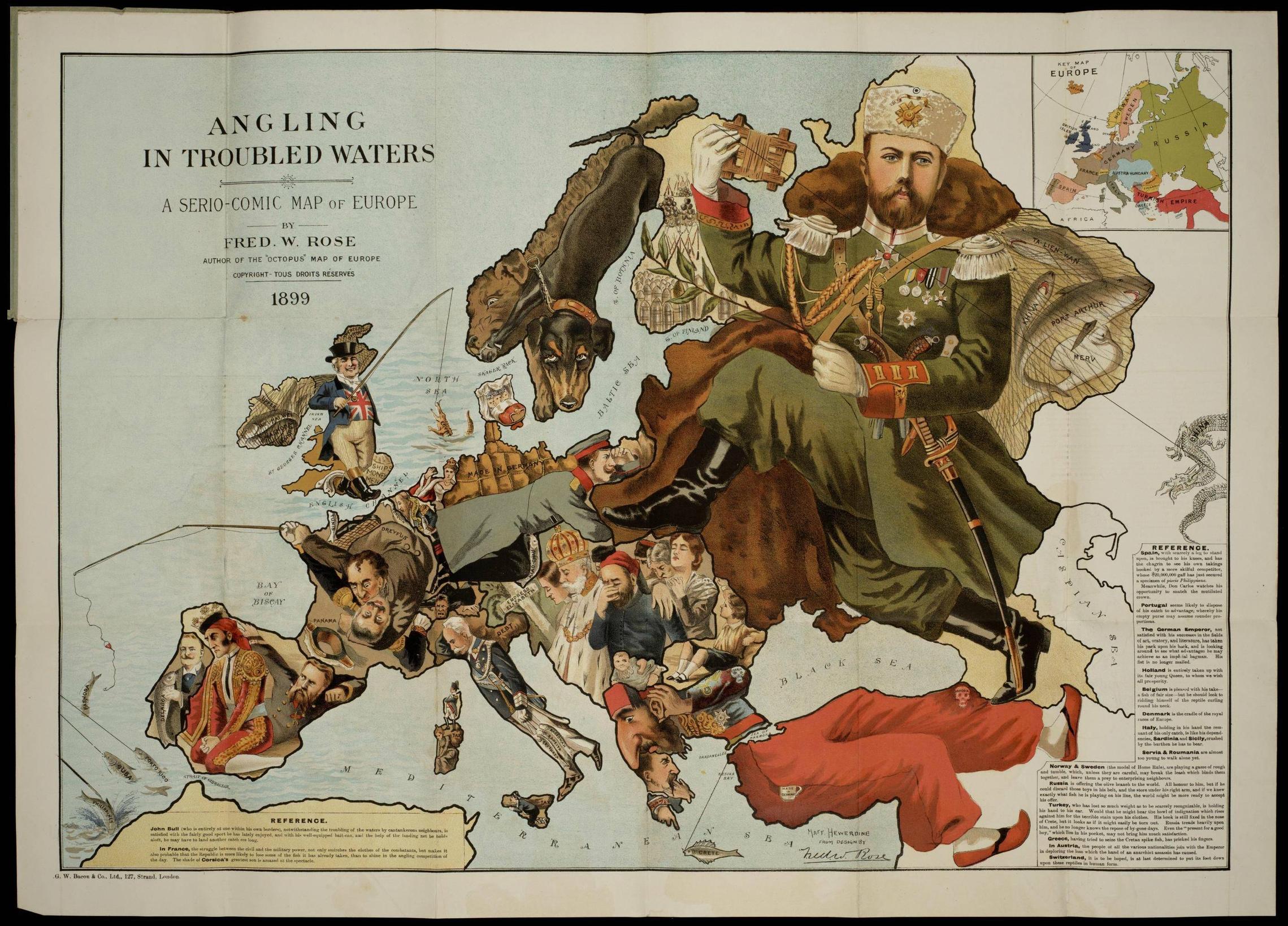
Europe in 1899, when the continent contained multiple world powers, before the rise of non-European power.
Whenever I talk about things like tariffs, Trump supporters appear in my comments to tell me that Europe has gotten a free ride for long enough and that it is time we learned to pay our way. I find it a little frustrating to read this, because in Europe it does not feel like we are getting a free ride at all. In fact it seems like the opposite: The most common complaint on the populist German right is that our political class refuses to represent our interests and will not stop carrying water for the Americans.
I recognise that I’ll never be able to put this right, but it’s worth trying, because it is important to understand the world as it is. The truth is that the United States is an imperial power. Generally speaking, it does not give foreign nations free rides and it does not hand out unearned favours. There is however a lot of confusion here, because hardly anybody bothers to describe honestly the geopolitical strategy pursued by the United States or the nature of the American empire. Western liberalism cannot conceptualise imperial politics, and while empire generally benefits political elites on both sides of the Atlantic, it is not necessarily or always in the interests of ordinary Americans or ordinary Europeans, which is yet another reason not to talk about it.
The Americans and the British before them expended enormous effort to preempt the emergence of a dominant power on the European Continent that might challenge their successive naval empires. They fought two world wars to stop Germany from becoming just such a power. This great struggle ended in 1945 with Western Europe as a fully subjugated imperial province. Since then, the Americans have coordinated the NATO alliance and guaranteed the security of European countries not out of charity, but because Europe is their provincial possession. As a rule, they have not wanted Europe to assume full responsibility for its own defence, because a world in which America no longer guarantees the security of Europe is a world in which Europe is no longer an American province. It’s that simple.
To fend off the Soviets, the Americans nevertheless rebuilt and rearmed the nations of Western Europe. Everyone involved in this project had to come up with a way to allow the Germans to become a dominant economic power again, without displacing the United States or provoking the hostilities of wary postwar neighbours like France. One solution here was the European Union, which promoted economic interdependency as a counterweight to nationalist concerns. Another solution came at the cultural level, where Germany sought to allay European anxieties over possible Teutonic aggression by developing a national cult of historical guilt for World War II, which steadily blossomed into a full-blown civic religion. This exercise in self-effacement has grown more and not less extreme over time, in part as a response to nervousness about the consequences of German reunification. Many voices on the right like to portray Germans as victims of an externally imposed guilt regime, but the truth is that we did most of this to ourselves. The German left in particular has profited from and encouraged this mindset from the beginning.
German political self-effacement had one unexpected feature, in that it proved to be contagious. Within a generation of 1945, many of the victorious allied powers were striving to develop their own historical guilt cults after the German example, in each case centred around a national original sin like slavery or colonialism. Just as the German political class found it expedient to foreground collective European concerns at the expense of a more narrowly construed German nationalism, so did the broader West develop an overarching obsession with global issues and the plight of the developing world. This has caused the proliferation of a lot of silly people in our political culture, a lot of profoundly stupid organisations, and at least two cancerous ideological systems in the form of climatism and migrationism. We have had a nearly incalculable gift in the form of 80 years of peace, which may yet be offset by the equally incalculable costs of the lunacies this peace has encouraged.
The Bloody Battle of Cannae | Animated(ish) Episode
The Rest Is History
Published 5 Jun 2025This is the final episode of our series on Hannibal, which is the second season on Carthage, the whole series is here: Rome Vs Cathage
Part 1 of our series on Hannibal is here: Hannibal: The Rise of Rome’s Greatest Nemesis
How did the Battle of Cannae — one of the most important battles of all time for Ancient Rome, with a whole Empire at stake, and a reputation that had reverberated across the centuries — in 216 BC, unfold? What brilliant tactics did Hannibal adopt in order to overcome the Roman killing machine, with its vast numbers and relentless soldiers? Why did so many men die in such horrific circumstances? And, what would be the outcome of that bloody, totemic day, for the future of both Carthage and Rome?
Join Tom and Dominic for the climax of their epic journey through the rise of Hannibal, and his world-shaking war against Rome, in one of the deadliest rivalries of all time.
00:00 Context to the battle
08:30 Prelude to the battle and their plans of attack
37:28 The battle
(more…)
August 1, 2025
When Stalin and Hitler Teamed Up – Prussia 1931 – Rise of Hitler 20, August 1931
World War Two
Published 31 Jul 2025August 1931: Prussia becomes the battleground as a bizarre alliance of Nazis, Communists (under Stalin’s orders), right-wing elites, and President Hindenburg tries to topple Germany’s last major democracy. With foreign meddling, political violence, and backroom deals, the fate of the Weimar Republic hangs by a thread. Against all odds, the democratic coalition prevails — at least for now. But with chaos spreading and the world watching, can democracy survive the next assault?
(more…)
QotD: The self-serving mythology of Britain’s NHS
The interesting question of why the NHS should continue to hold the affection of the British people, when it is at best mediocre in its performance and frequently unpleasant to deal with, is one that should be of interest to all political scientists. The answer is not pleasing to those who believe in human rationality.
The affection represents the triumph of rhetoric over reality. This rhetoric contains an implicit historiography, in which the pre-NHS era is akin to that of jahiliyya, the era of ignorance before the advent of Muhammad, in Islamic historiography: in short, that there was no healthcare for most of the population before the NHS. This historiography has for decades been continuously and successfully insinuated into the minds of the population. It has been Britain’s pale imitation of totalitarian propaganda. Intentionally or not, Boris Johnson recently reinforced the mythological status of the NHS. And when, in the present crisis, retired doctors such as I were asked to return to work if they were able, it was to help the NHS. This was like asking a soldier to lay down his life for the sake of the Ministry of Defence. It says something about the credulity of the public that the response to slogans like “protect the NHS” was dull compliance, rather than outraged demands as to why it wasn’t protecting us.
I suspect also that the sheer unpleasantness of the NHS is reassuring to the British population. It evokes the Dunkirk spirit: we are all stranded on the beach of illness together. And if we cannot all live in luxury, we can at least all die in squalor. Justice is served.
Theodore Dalrymple, “Empire of conformists”, The Critic, 2020-04-29.
July 31, 2025
The intent of Britain’s Online Safety Act … and the actual implementation
In The Conservative Woman, Dr. Frederick Attenborough discusses the gap between what the Online Safety Act was intended to do and how it’s actually being enforced now that it’s the law of the land:

X posts like this may not be visible to uses in the UK under the age verification rules of the Online Safety Act.
At the heart of the regime is a requirement to implement “highly effective” age checks. If a platform cannot establish with high confidence that a user is over 18, it must restrict access to a wide category of “sensitive” content, even when that content is entirely lawful. This has major implications for platforms where news footage and political commentary appear in real time.
Ofcom’s guidance makes clear that simple box-ticking exercises, such as declaring your age or agreeing to terms of service, will no longer suffice. Instead, platforms are expected to use tools such as facial age estimation, ID scans, open banking credentials and digital identity wallets.
The Act also pushes companies to filter harmful material before it appears in users’ feeds. Ofcom’s broader regulatory guidance warns that recommender systems can steer young users toward material they didn’t ask for. In response, platforms may now be expected to reconfigure their algorithms to filter out entire categories of lawful expression before it reaches underage or unverified users.
One platform already moving in this direction is X. Its approach offers a revealing – and potentially sobering – glimpse of where things may be heading. The company uses internal signals, including when an account was created, any prior verification, and behavioural data, to estimate a user’s age. If that process fails to confirm the user is over 18, he or she is automatically placed into a sensitive content filtering mode. As the platform’s Help Center explains: “Until we are able to determine if a user is 18 or over, they may be defaulted into sensitive media settings, and may not be able to access sensitive media”.
This system runs without user opt-in and applies at scale. Depending on how X classifies it, filtered material may include adult humour, graphic imagery, political commentary or footage of violence. Already there are signs that lawful content is quietly being screened out.
One example came on July 25, the day the Act’s age-verification duties took effect, during a protest outside the Britannia Hotel in Seacroft, Leeds, where asylum seekers are being housed. A video showing police officers restraining and arresting a protester was posted on X, but quickly became inaccessible to many UK-based users. Instead, viewers saw the message: “Due to local laws, we are temporarily restricting access to this content until X estimates your age”.
West Yorkshire Police denied any involvement in blocking the footage. X declined to comment, but its AI chatbot, Grok, indicated that the clip had been restricted under the Online Safety Act due to violent content. Though lawful and clearly newsworthy, the footage was likely flagged by automated systems intended to shield children from real-world violence.
In The Critic, Christopher Snowdon explains the breakdown of trust between the British public and their government that the implementation of the Online Safety Act only exacerbates:
People are right to be concerned about this slippery slope and yet it cannot be denied that it is pornography enthusiasts who have been hardest hit by the Online Safety Act in the short term. They must now verify themselves in one of three ways, each less appealing than the last. They can submit their credit card details, they can scan in proof of ID, such as a passport, or they can take a photo of their face and allow AI to judge how old they are. If they want to maximise their chances of being the victim of blackmail and identity theft, they could do all three.
While we might not think twice about submitting our credit card details to Amazon or posting our photos on Instagram, there is an understandable reluctance to hand over private data in order to access dubious websites for the purposes of sordid acts of self-pollution. The government assures us that the data will be kept confidential but it is only two weeks since we learned about a data breach that led to the names of 19,000 Afghans who wanted to flee the Taliban being given to the Taliban and it is less than two months since the names and addresses of 6.5 million Co-op customers were stolen in a cyber-attack. Rightly or wrongly, millions of British plank-spankers and rug-tuggers do not wish to identify themselves to anybody.
The result is a surge in interest in Virtual Private Networks (VPNs) which allow internet users to access websites as if they were in a less censorious country. Half of the top ten free apps in Apple’s app download charts yesterday were for VPNs. Google Trends data show that searches for “VPN” have gone through the roof since Friday. Readers can draw their own conclusions from the fact that these searches have been peaking between midnight and 2am.
Downloading random VPNs comes with risks of its own and opens up a whole new world of illicit online activity from free Premier League football to the Dark Web. But there is a deeper reason to feel uneasy about this unintended, albeit predictable, consequence of paternalistic regulation. By driving another wedge between the state and the individual, it further normalises rule-breaking in a country where casual lawlessness is becoming part of daily life. A law-abiding society cannot long endure if the median citizen thinks that the law is an ass.
The breakdown of trust can be seen most clearly when the ordinary man or woman does not share the moral certainties of the governing class. Among smokers, a collapse in tax morale — the intrinsic motivation to pay taxes — has led to a huge rise in the consumption of illegal tobacco in recent years. Smokers no longer feel any obligation to pay taxes that are designed to impoverish them to a government that vilifies them. Cannabis smokers learn from an early age to be suspicious of a police force that they might otherwise respect. Motorists who are faced with 20mph speed limits that were introduced by people who hate private transport have no scruples about flouting the law.
Stamm-Zeller 1902: A Swiss Straight-Pull Converted to Semiauto
Forgotten Weapons
Published 8 Mar 2025Today’s rifle was designed by a Swiss inventor named Hans Stamm while working for the Zeller et Cie company in Appenzell Switzerland. The company originally made embroidering machinery, but turned to military rifle parts subcontracting to bring in additional revenue in the early 1890s. Stamm had shown a good aptitude and interest for this work, and when the company decided to lean into the small arms business he was put in charge of its new weapons division.
There, Stamm spent several years developing a self-loading rifle for the Swiss military. It was not something specifically requested by the government, but rather an opportunistic risk by the company. Stamm’s resulting gun, the Model 1902, was expensive to produce, but quite elegant in design. It is a long-stroke gas pistol system with a rotating bolt, which was made from the ground up but could easily be adapted as a conversion of existing straight-pull bolt action rifles like the Swiss G96.
Unfortunately, the Swiss military declined the rifle, and Zeller was unable to find any other interested clients among the European states. By 1906, tired of dumping money into what is clearly a losing proposition, Zeller shuts down its weapons division. Stamm leaves the company, but he is not done with small arms design — we will see several more of his designs in future videos!
Many thanks to the Swiss Shooting Museum in Bern for giving me access to this visually one of a kind rifle to film for you! The museum is free to the public, and definitely worth visiting if you are in Bern — although it is closed for renovation until autumn 2025: https://www.schuetzenmuseum.ch/en/
(more…)
July 30, 2025
The Korean War Week 58 – The Empire Strikes Back – July 29, 1951
The Korean War by Indy Neidell
Published 29 Jul 2025The Kaesong peace talks drag on, with the main sticking point being the Communist refusal to consider any demarcation line other than the 38th Parallel. UN Commander Matt Ridgway is asking for more force from home, but at least he get some organized force from elsewhere — as various brigades are organized into the 1st Commonwealth Division.
Chapters
00:00 Hook
00:21 Intro
00:56 Recap
01:22 UN Perspective and UN Needs
04:40 US Reserves?
06:31 The Commonwealth Division
09:44 38th Parallel or Nothing
15:03 Summary
15:16 Conclusion
(more…)
History of Britain VI: Prime Roman Britain
Thersites the Historian
Published 13 Feb 2025Britain became a quietly productive part of the Roman Empire once the Celts of southern Britain were subjugated. This was the period when the Romans built cities, forts, and roads across the southern portion of the island. The good times corresponded with the Classical Optimum. However, after 150 or 200 CE, Britain was beginning to experience a decline in its material well-being.
QotD: Meetings of the Roman Republican Senate
We may begin with place: the Senate had no single fixed meeting spot, though the curia in the Forum was the most common location, however the place the Senate met had to be religiously prepared via inauguration (the taking of the auspices by the augurs) and by sacrifices in order to make sure the gods approved of the proceedings and its results. Consequently, the Senate always met in a templum in the sense of a consecrated space, but also it tended to meet literally in temples, with meetings in the temples of Jupiter Optimus Maximus, the temple of Fides, the temple of Concord, and so on. Notably, two locations, the temple of Bellona and the temple of Apollo were also used and these sat outside the pomerium, enabling the Senate to meet with magistrates who, because of their active command of an army, could not cross the pomerium; they were also sometimes used to meet with foreign dignitaries the Senate did not wish to let into the city. Later added to this number of sites outside the pomerium was Pompey’s theater, which included a temple of Venus Victrix and a curia as part of the overall complex.
In order to meet, the Senate had to be called or more correctly “driven together” (cogere, often translated adequately as “summoned”, but as Lintott notes, it has an element of compulsion to it) by a magistrate. There were a few standard dates on which this would effectively always happen, particularly the first day of the consular year, but beyond that it was expected that magistrates in Rome could call the Senate at any time to discuss any issue on relatively short notice. There was initially no requirement that Senators live in the city of Rome, but it was clearly assumed. Early on in the second century, we get regulations requiring Senators to stay close to Rome unless they had an official reason to be elsewhere, though Senators might be permitted to leave if they needed to fulfill a vow. In the Late Republic it seems to have been common also for Senators to leave the city during the spring res prolatae, a sort of recess from public business (literally “the deferring of business”), but these informal breaks did not mean the Senate was truly “out of session” and it could still be summoned by a magistrate.
Generally, meetings of the Senate began at dawn, though they could begin later, and they proceeded either until the business was concluded or to dusk. Because of the ritual preparations required, no meeting of the Senate could last more than a day, much like the assemblies, so if the business was not finished, a new meeting would need to be called and the process begun from scratch. While it seems that magistrates generally tried to avoid calling the Senate during festival days, dies nefandi (days unsuited for public business) and meetings of the popular assemblies, there was no requirement to do so and the Senate might be called for any day for most of the Republic, with laws restricting the Senate’s meeting days only coming midway through the first century.
Beyond this, Senators were expected to show up and we hear of threats of fines or other censure for failure to show up, but it also seems like no meeting of the senate was ever very close to the full body and quorums for the Senate were fairly low, 100 or 150. For the Sullan Senate, notionally of 600 members, the highest attendances we know of, as noted by Lintott, are 415, 417 and 392. Of course some significant number of Senators will, at any time, have been active magistrates overseas, or serving as military tribunes, or as senatorial legati, but it seems clear that even beyond this attendance was not universal even if it was in theory supposed to be.
Bret Devereaux, “Collections: How to Roman Republic 101, Part IV: The Senate”, A Collection of Unmitigated Pedantry, 2023-09-22.


