
The Rest Is History
Published 27 January 2025This is part 4 of our series on Suetonius and the Emperors of Rome.
00:00 The rebirth of the republic?
10:05 Who is Claudius
15:18 The relationship between Augustus and Claudius
16:20 The scholar emperor
21:12 Claudius’ relationship with Caligula
28:53 Claudius’ rule as emperor
45:50 The problem he had with his wives
56:40 The rise of Nero
58:40 Was he poisoned?
59:51 The lack of sources in Ancient historyProducer: Theo Young-Smith
Assistant Producer: Tabby Syrett
Executive Producers: Jack Davenport + Tony Pastor
July 28, 2025
Claudius: The Disabled Emperor Who Conquered Britain
Comments Off on Claudius: The Disabled Emperor Who Conquered Britain
July 27, 2025
Day Nine – Hitler’s Halt Order and Tragedy at La Ferté – Ten Days in Sedan
World War Two
Published 26 Jul 2025May 18, 1940. Our coverage of the German blitzkrieg in France continues. Today, we take a break from the panzers for a spot of old-fashioned siege warfare. At Ouvrage La Ferté, a small garrison of French troops makes a doomed last stand against overwhelming German firepower. We follow their final hours, the decisions that sealed their fate, and what their sacrifice meant for the collapsing French front.
(more…)
Comments Off on Day Nine – Hitler’s Halt Order and Tragedy at La Ferté – Ten Days in Sedan
QotD: London coffeehouses and Paris salons of the Ancien Régime
Marie Antoinette arrived in Paris at the end of this era of strict censorship, which helps explain why her honeymoon with French public opinion was short-lived. The official press, notably the Mercure and Gazette, continued churning out fawning snippets of society news about the royal couple. But the scandal-mongering libelles and pamphlets had their own paragraph men, called nouvellistes, who picked up “news” from well-informed sources posted on benches in the Tuileries, Luxembourg Gardens, and, of course, under the tree of Cracow. Police efforts to repress nouvellistes‘ gossip proved futile in the face of high demand. One famous libelle of the era, Le Gazetier cuirassé promised “scandalous anecdotes about the French court”. (It was printed in London, out of reach of official French censors.) Another publication printed in London starting in the 1760s was the famous Mémoires secrets, an anonymous chronicle of insider gossip and anecdotes from Parisian high society. A scurrilous book about Louis XV’s mistress, Madame du Barry, also appeared as a collection of gossip that nouvellistes had picked up around Paris.
Despite the libelles circulating in Paris, the Bourbon monarchy was still relatively protected compared with the hurly-burly across the channel in London, where coffeehouses buzzed with political innuendo and intrigue. Some French philosophes, it is true, attempted to replicate London’s coffeehouse culture at Parisian cafés, such as the Procope on the Left Bank. (Voltaire frequented the place, where he liked to add chocolate to his coffee.) Other regulars at the Procope — named after the Byzantine writer Procopius, famous for his Secret History — were Rousseau, Danton, and Robespierre, as well as Americans Benjamin Franklin and Thomas Jefferson.
The Parisian equivalent of the coffeehouse was the salon, which differed from London coffeehouses in both ambience and function. Whereas London coffeehouses were boisterously public, salons were essentially closed spaces, usually held in private homes. Most were by invitation only. Many were hosted by women, usually titled or wealthy ladies with an interest in culture and politics — such as Madame de Rambouillet, Madame Necker, Madame Geoffrin, and Mademoiselle Lespinasse. There was also the Marquise du Deffand, a friend to Voltaire and the English man of letters Horace Walpole, to whom she bequeathed not only her papers, but also her pet dog, Tonton.
As access to these rarefied spaces increasingly became a symbol of social success, admission got more tightly controlled. (Madame Geoffrin expelled Diderot from her salon because she found his conversation “quite beyond control”.) Still, those who frequented salons represented a great diversity within the elites — from rising young writers and established authors to powerful politicians and eccentric aristocrats. The tacit rule was, as in London coffeehouses, that wit was more important than rank. Many great French writers launched their careers thanks to their admittance. One was the philosopher Montesquieu, who found success at the salon of Madame Lambert.
Matthew Fraser, “Marie Antoinette: Figure of Myth, Magnet for Lies”, Quillette, 2020-06-24.
Comments Off on QotD: London coffeehouses and Paris salons of the Ancien Régime
July 26, 2025
The unaffordable luxury of a second-best army
At History Does You, Secretary of Defense Rock considers the downfall of Prussia’s vaunted army at the hands of Napoleon in a blink-of-the-eye campaign in 1806:
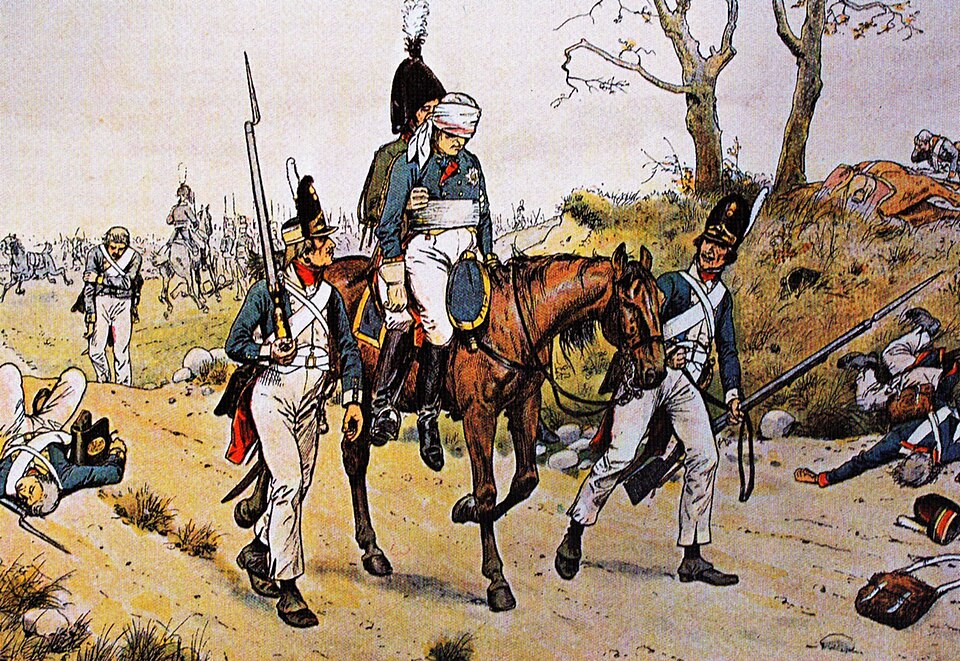
“Prussian wounded and stragglers leaving battle [after the battles of Jena and Auerstadt]. The mortally wounded Duke of Brunswick is the prominent figure in the painting.”
Painting by Richard Knötel (1857–1914) via Wikimedia Commons.
A vain, immoderate faith in these institutions made it possible to overlook the fact that their vitality was gone. The machine could still be heard clattering along, so no one asked if it was still doing its job.1
– Carl von Clausewitz on Prussia in 1806In the autumn of 1806, the Kingdom of Prussia, “The Iron Kingdom”, suffered one of the most rapid and humiliating military defeats in modern European history.2 The twin battles of Jena and Auerstedt shattered not only its army but the myth of invincibility that had surrounded the legacy of Frederick the Great. For the young Carl von Clausewitz, then a junior officer in the collapsing Prussian forces, this moment marked a personal and national catastrophe that would shape his life’s work. Clausewitz would come to see the defeat not simply as a failure of generalship or tactics, but as the exposure of a more profound institutional and societal crisis; one in which a state had grown complacent, a military rendered obsolete, and a society stripped of civic vitality falling apart during “the most decisive conflict in which they would ever have to fight”.3 In that collapse and Clausewitz’s later reflections, one finds an unsettling parallel to present-day America, a powerful nation outwardly strong, yet increasingly vulnerable to the same internal rot.
Prussia’s disaster in 1806 was the formative experience for the author of On War. How the armies of Frederick the Great and the state that he painstakingly built collapsed like a house of cards was a question that bothered Clausewitz for many years.4 It was a comprehensive disintegration of a system that had, since the mid-eighteenth century, claimed a position of prominence in European military affairs based on its discipline, linear tactics, and centralized command. Yet by the turn of the nineteenth century, these very strengths had calcified into weaknesses. Clausewitz foresaw disaster. Even as a young lieutenant, he was already warning of the Prussian army’s growing detachment from reality. In his early writings, he criticized military exercises as highly scripted performances, lacking genuine tactical challenge, unpredictability, and creativity.5 The number of steps marched in a minute of the cadence, what awards should be placed on a uniform, how a rifle should be cleaned for parade, all of this he feared, was cultivating a “lassitude of tradition and detail”.6 Clausewitz understood that rehearsing war under artificial constraints produced not readiness but ritual. Even though he later wrote, “no general can accustom an army to war”, he worried, presciently, that when confronted by a real enemy operating under real conditions, the army would collapse, and in 1806, it did.7
Whatever reservations he may have held, Clausewitz fulfilled his duty. He led a battalion of grenadiers at the battle of Auerstedt and managed to withdraw with most of his men intact in the chaotic aftermath of defeat. His escape was short-lived; however, he was captured on October 28, 1806, and subsequently marched into captivity in France, where he would spend the next year as a prisoner.8 Napoleon’s campaigns revealed that war had been transformed: faster, larger, and fundamentally political. Clausewitz wrote, “War was returned to the people, who to some extent had been separated from it by the professional standing armies; war cast off its shackles and crossed the bounds of what had once seemed possible”.9 The levée en masse and the corps system shattered the static paradigms of eighteenth-century warfare. Yet the Prussian high command, clinging to the geometries of the past, failed to respond with imagination or speed with any kind of seriousness.
Clausewitz’s later concept of friction — the unpredictable resistance that disrupts even the best plans — emerged directly from this experience.10 The Prussian army collapsed not for lack of courage, but because its institutional mindset could not withstand the volatility of an age that demanded adaptability, political intelligence, and creative command.
1. Carl von Clausewitz, Historical and Political Writings, ed. and trans. Peter Paret and Daniel Moran (Princeton, NJ: Princeton University Press, 1992), 32.
2. Christopher Clark, Iron Kingdom: The Rise and Downfall of Prussia, 1600–1947 (Cambridge: Belknap Press, 2006).
3. Clausewitz, Historical and Political Writings, 81.
4. Frederick the Great ruled from 1740-1786 and is usually credited as turning Prussia from a regional power to a continental power.
5. Peter Paret, Clausewitz and the State (Oxford: Oxford University Press, 1976), 92-93.
6. Clausewitz, Historical and Political Writings, 36.
7. Carl von Clausewitz, On War, trans. Michael Howard and Peter Paret (Princeton: Princeton University Press, 1984), 122.
8. Partet, 126.
9. Clausewitz, Historical and Political Writings, 287.
10. Clausewitz discusses this concept in Chapter 7 in On War, 119-121.
Comments Off on The unaffordable luxury of a second-best army
The Julio-Claudians – The Conquered and the Proud 15
Adrian Goldsworthy. Historian and Novelist
Published 26 Feb 2025This time we take a look at the reigns of Augustus’ successors — Tiberius, Gaius Caligula, Claudius and Nero, referred to collectively by scholars as the Julio-Claudian dynasty. We think about the whole question of the succession, and trace how each diverged from Augustus when it came to the style of governing.
Comments Off on The Julio-Claudians – The Conquered and the Proud 15
QotD: The accumulated friction of bureaucratic growth
[…] In the early Republic, raising a legion was as simple as a patrician calling his clients to service, or the Senate issuing a conscription decree. One task: the summoning of free men, with their own equipment, and there you go — Legio I Hypothetica.
By the late Empire, though, all those freeholds had been turned into slave-worked Latifundia, so the effort of raising a legion increased enormously. Now the bureaucracy had to go out and hire freemen (if it could even find them), equip them at State expense, train them (again at State expense), and so on. In itself, the number of tasks isn’t that large — we’ve identified three — and they only increase at the rate of n+1.
But the effort each task requires increases to the power of n, such that if you could somehow express the effort expended in physical terms — joules or kilowatts or whatever — you’d see that the creation of Legio I Hypothetica under Scipio Africanus took 10 kilowatts, while raising the same legion under Diocletian took 10,000,000.
This isn’t (just) corruption. Sure, everyone at every level of the Imperial Bureaucracy was getting his beak wet, that goes without saying, but it’s the nature of bureaucracy itself that’s most to blame.
Severian, “Collapse II”, Founding Questions, 2021-12-09.
Comments Off on QotD: The accumulated friction of bureaucratic growth
July 24, 2025
SNK – The Me210 – An Ode To the Best Fighter of the War*
HardThrasher
Published 23 Jul 2025* fighter may actually be rubbish
References
===========
1 https://en.wikipedia.org/wiki/Fisher_…
2 https://planehistoria.com/hawker-typh…
3 https://www.historynet.com/why-britai…
4 The Development of French Interwar Bombers…
5 The Bombing War, Overy, 2012, p.200
6 p1, Profile 161, The Messerschmitt Me210/410 Series, Smith
7 p.43, Chpt 6, The Me210/410 Story, Jan Forsgren, Fonthill Media, 2019
8 The B-29 Turret System: An Expensive, Effe… – Alexander OK’s B-29 Video
9 p.43 The Me210/410 Story, Jan Forsgren, Fonthill Media, 2019
10 Ibid p.74
11 Ibid p.53
12 Ibid p.58
13 Ibid p.65-67
14 Ibid P.78 -85
15 Ibid p.231
16 The Bomber War, Robert Overy, 2012 p.203
17 Inside the Third Reich, Albert Speer, 1970, Simon & Schauster (reprint Touchstone, 1997)
18 p. 175 The Me210/410 Story, Jan Forsgren, Fonthill Media, 2019Cars For Ukraine – https://car4ukraine.com/campaigns/sum…
Comments Off on SNK – The Me210 – An Ode To the Best Fighter of the War*
When tolerance becomes a fatal flaw
At The Crescent and the Guillotine, Paul Friesen explains why too much tolerance leads to the eventual collapse of social order and perhaps even the culture itself:

It is difficult to know what people are thinking when they endorse the importation of people who want to kill them for their lifestyle choices.
It was Karl Popper who warned that a tolerant society must be intolerant of intolerance, or it would cease to be tolerant at all.1 A delicious paradox, too often quoted and too rarely heeded. For we have taken the first half of the dictum — the imperative to tolerate — and chiseled it into law, into policy, into university mission statements and NGO pamphlets. But the second half — the requirement to draw a line, to say “no further” — has been treated like garlic in a vampire movie: an antique, anathema, unfashionable.
And so, the paradox has become pathology.
Our courts allow sharia arbitration councils to function in British cities, adjudicating matters of family and inheritance with standards that would make a 12th-century canon lawyer flinch. Our schools include faith-based curricula that require hijabs for seven-year-olds and teach that homosexuality is satanic filth. Our public broadcasters will air a documentary about the importance of free speech, followed immediately by a segment about why cartoons of Muhammad are “unhelpful”.
This is not multiculturalism. It is masochism. It is the belief that liberalism must be so open-minded that its own brains are spilled onto the prayer mat. It is the fetishization of identity at the expense of liberty. It is the ideological pacifism of a society too terrified to assert its own values, lest it be accused of “racism” by those who mistake ideology for ethnicity.
We have enshrined the rights of the theocrat while criminalizing the instincts of the secularist. The result is not harmony — it is humiliation.
[…]
The West’s greatest achievement is not democracy, nor capitalism, nor even the separation of powers. It is the separation of truth from tribalism — the idea that individuals are not to be judged by their creeds, but by their conduct. That women are not property. That speech is not violence. That blasphemy is a right, not a crime.
These are not Western values. They are universal values, discovered in the West by accident of history and preserved through blood, rebellion, and satire. They are the principles that allowed Jews, heretics, atheists, and apostates to live not just safely, but freely. And they are now under threat — from within.
The real problem is not Islam. It is the Western inability to demand anything of those who import their gods and their grievances into liberal society. We treat every imported superstition as sacrosanct and every local tradition as suspect. We require ex-Muslims to whisper their fears while we amplify the complaints of veiled Islamists who denounce our culture from our own podiums.
We are not being pluralistic. We are being duped.
And the cost of this self-deception is measured not just in freedoms surrendered, but in lives lost.
Lives like that of Yameen Rasheed, the secular Maldivian blogger who thought he could use satire to push back against theocracy — stabbed to death in his own hallway. Lives like that of Farkhunda Malikzada, beaten and burned in the streets of Kabul by a mob of men — because someone thought she burned a Qur’an. Lives like that of Samuel Paty, beheaded outside a French school by a refugee he welcomed — because he dared to show a cartoon in a civics class.
These are not random tragedies. They are the predictable outcomes of an ideological toxin given immunity in the bloodstream of liberal society.
What do all these victims have in common? They did not die at the hands of misunderstood minorities or “oppressed voices” who simply needed better integration programs. They died at the hands of men who were indoctrinated — sometimes abroad, often at home — with the idea that God’s honor is more valuable than human life, and that dissent is not to be debated but extinguished.
And more damning still: they died in environments that should have protected them. Environments that instead prioritized sensitivity over security, dialogue over clarity, understanding over justice. Environments where the ever-watchful eye of diversity officers and DEI consultants was trained, not on the assailants, but on the tone of the victims.
We have created a culture where courage is pathologized, clarity is punished, and moral equivalence is the new orthodoxy. When Islamist mobs swarm the streets chanting slogans that would make the Inquisition blush, we are told to “listen to their anger”. When feminists protest the veiling of children, they are told to “respect cultural differences”. When Jews complain about chants of “From the River to the Sea”, they are informed that they are “overreacting”, “weaponizing trauma”, or — most insultingly of all — “confusing Zionism with antisemitism”.
This is not inclusivity. It is assisted suicide.
1. I refer here to Karl Popper’s 1945 work The Open Society and Its Enemies, specifically in Volume 1: The Spell of Plato, Note 4 to Chapter 7. Here’s the relevant passage, paraphrased for clarity:
“Unlimited tolerance must lead to the disappearance of tolerance. If we extend unlimited tolerance even to those who are intolerant … then the tolerant will be destroyed, and tolerance with them.”
Popper argues that a tolerant society has the right — not to suppress opinions — but to defend itself against those who would destroy tolerance itself, especially if such groups refuse to engage in rational discourse and instead promote violence or coercion. It’s often called “the paradox of tolerance“.
Comments Off on When tolerance becomes a fatal flaw
Glock 18 & 18C Machine Pistols: How Do They Work?
Forgotten Weapons
Published 3 Mar 2025After the success of the Glock 17 in Austrian military trials, the company chose two specific markets to target for expansion. One was competition shooters, for whom the Glock 17L was released. The other was the international law enforcement and military market, for whom they decided to make a machine pistol — the Glock 18. The 18 was released in 1986, a model identical to the 17 except for the addition of a rotary selector switch on the slide.
In response to complaints about the controllability of the Glock 18, the 18C (Compensated) was released in 1996. This was a new model which added four barrel ports and a lightened slide to the 18. Neither has ever been really successful simply because machine pistols are by their very nature not very practical.
The question we are going to look at today is how the Glock 18 system works. As one would expect from Glock, it is a quite simply mechanical change to the semiauto lockwork.
(more…)
Comments Off on Glock 18 & 18C Machine Pistols: How Do They Work?
QotD: Migrant farm workers
It is certainly true that the fruit-pickers would not be well-paid. Moreover, their accommodation during their stay would almost certainly be uncomfortable and overcrowded. The work they would do would be hard and possibly back breaking. It is certainly not the kind of work I should want to do myself, though I might have thought of it as a bit of an adventure for a couple of weeks to earn some pocket money when I was nineteen. But the Romanian workers are not coming for a bit of youthful adventure: they are coming because they are poor and need the money to live.
The fruit season is short. If the fruit is not picked, it will rot where it grows. Prices are such that farmers cannot offer high wages, and it is surely a good thing that fruit is available at a price that everyone can afford. There have been appeals to the British unemployed (in whose numbers there has been a sudden and great increase) to do the work, but they have not responded. The wages are not such as to attract them, and their economic situation would probably have to be considerably worse before the wages did attract them — and if their situation were to worsen to such an extent, they might choose crime, riot, disorder and looting rather than fruit-picking as a means of getting by economically. As for coercing the unemployed to take the work that is theoretically available to them, for example by withdrawing their social security unless they agreed to do it, the political repercussions would be too terrible to contemplate. It is easy to see in the abstract how our system of social security distorts the labour market, such that we have to import labour to perform such unskilled tasks as fruit-picking, but now is not a propitious moment at which to try radical reform. In politics as in life, you are always starting out from where you are, not from where you should have been had your past conduct been wiser or more prudent.
Theodore Dalrymple, “Contradictions of Labor”, New English Review, 2020-05-05.
Update, 26 July: Original link replaced. Link rot is sadly real.
Comments Off on QotD: Migrant farm workers
July 23, 2025
Britain’s housing crisis has roots as far back as 1947
Tim Worstall on the deep reasons Britain can’t seem to build any new housing:

Homes Fit for Heroes – Dagenham
“These are typical examples of the housing on the Becontree Estate. Initially 25000 homes were built by the London County Council between 1921 and 1934. These homes fit for the heroes of WW1 had all mod cons gas, water and electricity with inside toilets and bathrooms. A further 2000 homes were built before WW2. The Becontree estate was the biggest council estate in the world.”
Image and description from geograph.uk. Photo by Glyn Baker – CC BY SA 2.0
The real problem Britain faces is that it’s no longer legal to build the housing we thought was the bare minimum acceptable a century ago.
The more apposite point is that a couple of hundred yards up the road are those post-WWI homes for heroes. Here. Semi detached, not huge to be fair. But kitchen, living room, parlour, 3 beds and indoor bathroom. They’re still highly desirable houses in fact. Note, they’ve front gardens. They’ve also back ones too.
Now, we’ve heard this, even heard it from someone on Bath City Council (who had heard it, we’re not quite old enough to know anyone who was on BCC in the 1920s), and never, quite tracked it down officially. But the statement was made that the Homes for Heroes needed to be on 1/4 acre gardens. The working man needed the space to grow vegetables for his family and to keep a pig. These houses, the 1920s ones, do have substantial gardens as the 1960s ones don’t.
As I pointed out:
But Homes for Heroes? We’ve done this before. And those Homes for Heroes? Right now, today, it’s illegal to build them. No, really. What was considered the basic minimum that the local council should provide to the working man is illegal to build now. Those decent sized houses were on those decent gardens d’ye see? You can get perhaps 9 dwellings with 1/4 acre gardens on a hectare of land. Last we saw the current insistence is that we must have no less than 30 dwellings per hectare in order to gain planning permission. Even though Englishcombe – as with so much other land – is there and ripe for the taking.
It’s actually illegal to build houses that were regarded as the proper minimum a century ago.
The reason we cannot is that Green Belt, itself stemming from the Town and Country Planning Act 1947. The point of which — no, really, the stated purpose — was to make sure that no one would ever be allowed to build housing for proles — sorry, stout Britons — anywhere anyone ever wanted to live.
Which is a bit of a problem. For, outside my own head, there’s no constituency for repealing the TCPA and abolishing the Green Belt.
However, there is a large constituency for plastering farmland with solar cells.
Waller-Barrett’s farm has been targeted for a massive solar plant, which will be called Glebe Farm, and now his landlord plans to take his land away, replacing potato crops with thousands of giant glass panels.
The decision, backed by edicts from Ed Miliband, the Energy Secretary, favouring solar farms over food production on UK farmland, means his flourishing food business will shrink – and staff will be out of work.
Meanwhile the distant landlord will be quids in, potentially quadrupling their rent with virtually no effort.
Oh.
And now one of those little wrinkles of the law. Those solar farms will last 20 years maximum. No, really, that’s tops. The wrinkle being that the land underneath them will be, in that 20 years’ time, defined as brownfield land. Been previously developed, see? And brownfield land to housing is usually pretty easy as a development path. Certainly wholly unlike greenfield (or even Green Belt) to housing.
The land area Ed wants to cover with these things is 2 to 3% of the land area of the country. Which, as it happens, is about the land area currently covered by housing — including their gardens.
So, therefore we can see that Ed is, in fact, playing the long game. He’s going to solve the housing problem by not having to take on the Campaign for the Preservation of Rural England and every LibDem middle-ager with too few grandchildren to occupy her time. He’s going to do an end run around that problem by building solar first.
Comments Off on Britain’s housing crisis has roots as far back as 1947
The Most Bitter Man In All Of Ancient Rome: Meet JUVENAL
MoAn Inc.
Published 27 Feb 2025
(more…)
Comments Off on The Most Bitter Man In All Of Ancient Rome: Meet JUVENAL
QotD: The legion of the Middle Republic
With that said, we reach the first and arguably most important thing to know about the legion: the Roman legion (and socii ala) of the Middle Republic is an integrated combined arms unit. That is to say, unlike a Hellenistic army, where different “arms” (light infantry, heavy infantry, cavalry, etc.) are split into different, largely homogeneous units, these are “organic” to the legion, that is to say they are part of its internal structure (we might say they are “brigaded together” into the legion as well). Consequently, whereas the Hellenistic army aims to have different arms on the battlefield in different places doing different things to produce victory, the Roman legion instead understands these different arms to be functioning in a fairly tightly integrated fashion with a single theory of victory all operating on the same “space” in the enemy’s line.
And you may well ask, before we get to organization, “What is that theory of victory?” As we saw, the Hellenistic army aims to fix the enemy with its heavy infantry center, hold the flanks with lighter, more mobile infantry (to protect that formation) and win the battle with a decisive cavalry-led hammer-blow on a flank. By contrast, the Romans seem to have decided that the quickest way to an enemy’s vulnerable rear was through their front. The legion is thus not built for flanking, its cavalry component – while ample in numbers – is distinctly secondary. Instead, the legion is built to sandpaper away the enemy’s main battle line in the center through attrition, in order to produce a rupture and thus victory.
To do that, you need to create a lot of attrition and this is what the manipular legion is built to do.
The legion of the Middle Republic is built out of five components: three lines of heavy infantry (hastati, principes and triariivelites), and a cavalry contingent (the equites). Specifically, a normal legion has 1200 each of velites, hastati and principes, 600 triarii and 300 equites, making a total combined unit of 4,500. Organizationally, the light infantry velites were packaged in with the heavy infantry (Polyb. 6.24.2-5) for things like marching and duties in camp, but in battle they typically function separately as a screening force thrown forward of the legion.
So to take the legion as an enemy would experience them, the first force were the velites. These seem to have been deployed in open order in front of the legion to screen its advance. These fellows had lighter javelins, the hasta velitaris (Livy notes they carried seven, Livy 39.21.13), no body armor and a “simple headcovering” (λιτός περικεφάλαιος, Polyb. 6.22.3), possibly hide or textile; they also carried a smaller round shield, the parma, and the gladius Hispaniensis for close-in defense (Livy 38.21.13). These are, all things considered, fairly typical ancient javelin troops, aiming to use the mobility their light equipment offers them to stay out of close-combat.
Behind the velites was the first line of the heavy infantry, the hastati. These fellows were organized into units called maniples (lit: “a handful”) of 120, which in turn are divided into centuries of 60 each. The maniples are their own semi-independent maneuvering units (note how much smaller they are than the equivalent taxeis in the phalanx, this is a more flexible fighting system), each with its own small standard (Polyb. 6.24.6) to enable it to maintain coherence as it maneuvers. That said, they normally form up in a quincunx (5/12ths, after a Roman coin with the symbol of five punches, like on dice) formation with the rear ranks, as you can see above.
The hastati (and the principes, who are equipped the same way) have the large Roman shield, the scutum, two heavy javelins (pila), the gladius Hispaniensis sword, a helmet (almost always a Montefortino-type in bronze in this period) and body armor. Poorer soldiers, we’re told, wore a pectoral, wealthier soldiers (probably post-225, though we cannot be certain) wore mail. That is, by the standards of antiquity, quite a lot of armor, actually – probably more armor per-man than any other infantry formation on their contemporary battlefield. That relatively higher degree of protection – big shield, stout helmet (Montefortino’s in this period range from 1.5-2.5kg, making them unusually robust), and lots of body armor – makes sense because these fellows are going to aim to grind the enemy down.
Note that a lot of popular treatments of this assume that the hastati were worse equipped than the principes; there’s no reason to assume this is actually true. The principes are older than the hastati, but the way to understand this formation is that the velites are young or poor, whereas for the upper-classes of the infantry (probably pedites I-IV) after maybe the first year or so, they serve in the heavy infantry (hastati, principes, triarii) based on age, not on wealth (and then the equites are the truly rich, regardless of what age they are; the relevant passage here is Polyb. 6.21.7-9, which is, admittedly, not entirely clear on what is an age distinction and what is a wealth distinction).
We’ve discussed the combat width these guys fight with already – somewhat wider spacing than most, so that each man covers the other’s flanks but they all have room to maneuver. It seems like the standard depth in the Middle Republic was either base-3 (so 3 deep on close order, 6 deep for “fighting” open order) or base-4 (so 4 and 8). Even in open-order with the maniples stretched wide (possibly by having rear centuries move forward), there would have been open intervals (10-20m) between maniples, which reinforces the role of a maniple as a potentially independent maneuvering unit – it has the space to move.2
Behind the hastati are the principes, with the same equipment and organization, slightly off-set to cover the intervals between the hastati, with a gap between the two lines (we do not know how large a gap). These men are slightly older, though not “old”. The whole field army generally consists of iuniores (men under 46) and given how the Romans seem to like to conscript, the vast majority of men will be in their late teens and 20s. So we might imagine the velites to be poorer men, or men in their late teens (17 being the age when one become liable for conscription) or so, while the hastati are early twenties, the principes mid-twenties and the handful of triarii being men in their late twenties or perhaps early 30s. The positioning of the principes isn’t to spare older men the rigors of combat, but rather to put more experienced veterans in a position where they can steady the less experienced hastati.3
Finally, behind them are the triarii, who trade the pila for a thrusting spear, the hasta, the Roman version of the Mediterranean omni-spear. These men are, as noted, the oldest and so likely the calmest under pressure and thus form a reserve in the rear. The three-line system here is what the Romans call a triplex acies (“three battle lines”). This wasn’t the only way these armies engaged and they could sometimes be formed up into a single solid line, but the triplex acies seems to have been the standard. We don’t know exactly how deep such a formation would run, but we have fairly good evidence that a legion might occupy a space around 400m wide (with some variation), meaning a whole Roman army’s core heavy infantry component (the two legions and two alae) might be some 1.6km (about a mile) across.
The equites, while organic to the legion organizationally, will be tactically grouped in battle to form cavalry screens on the edges of the army, not as a grand flanking cavalry “hammer”, but as flank-protection for the advancing infantry body (as a result, they tend to fight more cautiously). The equites in this period are heavy cavalry, with armored riders (after c. 225, that would be mail), using a shield and a hasta, along with a gladius as a backup weapon and thus serving as “shock” cavalry. Roman cavalry, if we look at their deployments, is generally ample in numbers, but the Romans seem to have been well aware it wasn’t very good, and sought allied cavalry (especially non-Italian allied cavalry) whenever they could get it. But the cavalry, Roman or not, was almost never the decisive part of the army.
Polybius tells us that the socii supplies more cavalry than the Romans and implies that there was a standard rule of three socii cavalrymen to every Roman equites, while socii infantry matched Roman infantry numbers (Polyb. 6.26.7). Looking at actual deployments though, we see that the socii tend to outnumber the Romans modestly, on about a 2:3 ratio, with socii cavalry only modestly outnumbering Roman cavalry.4 Consequently a normal Roman consular field army (of which the Romans generally had at least two every year) was 8,400 Roman infantry, around 12,600 socii infantry, 600 Roman cavalry and perhaps a thousand or so socii cavalry, for a combined force of 21,000 infantry (c. 5,000 light 16,000 heavy, so that’s a lot of heavy infantry) and 1,600 cavalry. That somewhat undersells the cavalry force the Romans might bring, as Roman armies also often move with auxilia externa (allied forces not part of the socii), which are very frequently cavalry-heavy (especially, after 203, that really good Numidian cavalry).5 By and large, it’s not that the Romans bring a lot less cavalry (as a percentage of army size), but that Italian cavalry tends to perform poorly and the as a result the Romans do not built their battle plans around their weakest combat arm.
Perhaps ironically, the Romans used their cavalry like Alexander and Hellenistic armies used their light infantry: holding forces designed to keep the flanks of the battlefield busy while the decisive action happened somewhere else.
Bret Devereaux, “Collections: Phalanx’s Twilight, Legion’s Triumph, Part IIa: How a Legion Fights”, A Collection of Unmitigated Pedantry, 2024-02-09.
1. On this, see Burns, M. T. “The Homogenisation of Military Equipment under the Roman Republic”. In Romanization? Digressus Supplement I. London: Institute of Archaeology, University College London, 2003.
2. On this, M.J. Taylor, “Roman Infantry Tactics in the Mid-Republic: A Reassessment”, Historia 63.3 (2014): 301-322.
3. To expound at some length on my own thoughts on how I think the wealth/age issue was probably managed, Dionysius (4.19.2) claims that the Romans recruited by centuries in the comitia centuriata such that the wealthy, divided into fewer voting blocks, served more often, and we know from Polybius that the maximum period of service for the infantry was sixteen years and from some math done by N. Rosenstein in Rome at War (2004) that the average service must have been around seven years. My suspicion, which I cannot prove is that the very poorest Roman assidui (men liable for conscription) might have only been serving fewer years on average and so it wasn’t a problem having them do all of their service as velites (the only role they can afford), whereas wealthier Romans (my guess is pedites IV and up) are the ones who age into the heavy infantry, with pedites I, whose members probably serve more than the seven-year average (perhaps around 10?) might make up close to 40% of the actual heavy infantry body (which is their balance in the comitia centuriata). The velites thus serves two important functions: a place to “blood” wealthier young Roman men to prepare them to stand firm in the heavy infantry line, as well as a place for poorer Romans to contribute militarily in a way they could afford. But I think that, once in the heavy infantry, the division between hastati, principes and triarii was – as Polybius says (6.21.7-9 and 6.23.1) – an age division, not a wealth division. Instead, the next wealth line is for the equites.
4. The data on this is compiled by Taylor, Soldiers & Silver (2020), 26-28.
5. Taylor, op. cit., 54-7 compiles examples.

Comments Off on QotD: The legion of the Middle Republic
July 22, 2025
Age verification schemes are just another attempt to control everyone’s internet usage
Marian Halcombe is specifically discussing the British age verification provisions of their Online Safety Act, but similar schemes are popping up all over the west, and they’re only pretending to be about protecting young people from online content:



The British State, in its infinite filth and hypocrisy, would like you to believe that it is deeply concerned about what you do with your penis. Or more precisely, what you look at while your hand is on it. The latest wheeze — part of the Online Safety Act — is mandatory age verification for all pornographic websites. We’re told it’s to stop children from seeing naughty videos. In reality, it’s a spyware regime disguised as child protection, devised by a ruling class that snorts coke with one hand while signing surveillance warrants with the other.
Let’s start with the pretence. No one in Westminster cares what children watch online. These are the same people who presided over the industrial-scale rape of working-class girls in Rotherham, Telford, Rochdale, and elsewhere — refusing to intervene for fear of “racism”. The idea that they now lie awake worrying about a Year Eight boy glimpsing a MILF thumbnail on Pornhub is an insult to the intelligence. They don’t care about children. They care about you.
The age-verification scheme isn’t just about proving you’re eighteen. It’s about linking your name and your age, and your IP address to your viewing habits. Whether it’s ID upload or facial recognition or some third-party database, the outcome is the same: a digital file that knows what you watch and when you watch it.
In a normal country, this would be recognised as deeply perverse. In ours, it’s dressed up as safety. The State that can’t fix the trains, that can’t keep the hospitals clean, now wants the power to log whether you’re big-enders or little-enders. And all under the banner of protecting the kiddies.
Yes, of course it’s technically possible to anonymise verification. But only if you believe that governments, regulators, and their corporate collaborators are incapable of abuse. That’s a belief I do not share. This is the same British government that let GCHQ harvest your webcam feeds and your phone calls under the TEMPORA programme. You didn’t vote for that. You weren’t told about it. You found out because Edward Snowden blew the whistle.
Do you really think the same regime won’t take an interest in which adult videos you watch? Anyone with an ounce of memory knows how this goes. Every intrusive policy begins with “think of the children”. The Video Recordings Act. The Dangerous Dogs Act. The Terrorism Act. And now the Online Safety Act. Once the infrastructure is in place, it never stays limited to its original purpose.
The definition of “harmful content” is vague for a reason. It can grow. It can stretch. Today it’s Pornhub. Tomorrow it’s Twitter. Then it’s dissident blogs, pro-life websites, or even a dodgy meme about immigration statistics. In the end, the target isn’t porn — it’s dissent.
Comments Off on Age verification schemes are just another attempt to control everyone’s internet usage
Battle for Gaza 1917: The Palestinian Campaign of WW1
The Great War
Published 14 Feb 2025The ongoing Israel-Palestine conflict has its roots in another war more than a century ago. When the First World War began in 1914, the territory of today’s Israel and Palestine was part of the Ottoman Empire. But in 1917 the British Empire began a campaign that would change history: there would be bitter fighting in Gaza, wild cavalry charges, even talk of a modern crusade. And it would lay the foundations for a century of violence.
(more…)
Comments Off on Battle for Gaza 1917: The Palestinian Campaign of WW1


