
The Rest Is History
Published 3 Feb 2025Enough of the Princeps, what remains to be described, is the monster …
The Roman emperor Caligula endures as one of the most notorious figures in not only Roman history, but the history of the world. Famed as a byword for sexual degeneracy, cruelty and corruption, the account of his life written by the Roman historian Suetonius has, above all, enshrined him as such for posterity. Throughout the biography there is a whiff of dark comedy, as Caligula is cast as the ultimate demented Caesar, corrupted absolutely by his absolute power and driven into depravity. Born of a sacred and illustrious bloodline to adored parents, his early life — initially so full of promise — was shadowed by tragedy, death, and danger, the members of his family picked off one by one by the emperor Tiberius. Nevertheless, Caligula succeeded, through his own cynical intelligence and cunning manipulation of public spectacle, to launch himself from the status of despised orphan, to that of master of Rome. Yet, before long his seemingly propitious reign, was spiralling into a nightmare of debauchery and terror …
Join Tom and Dominic as they discuss the most notorious emperor in Rome: Caligula, a man said to have slept with his sister, transformed his palace into a brothel, cruelly humiliated senators, and even made his horse into a consul. But what is the truth behind these horrific legends? Was Caligula really more monster than man …?
00:00 A mysterious emperor
05:18 Why are the stories about Caligula so bad?
08:40 Germanicus: the best man in Rome
16:20 Caligula is the heir
19:30 The death of Tiberius
20:55 Caligula’s cynical intelligence
22:50 Caligula’s skill playing to the gallery
28:39 Caligula’s turn to evil (according to Suetonius)…
31:35 Caligula as Suetonius’ monster
37:22 Caligula confronts the senate
45:10 The conspiracy against him moves
48:14 Did all this actually happen?
58:43 Did he make his horse a consul?Producer: Theo Young-Smith
Assistant Producer: Tabby Syrett
Video Editor: Jack Meek
Social Producer: Harry Balden
Executive Producers: Jack Davenport + Tony Pastor
July 21, 2025
Caligula: Was He Really Mad?
July 20, 2025
Day Eight – Can Charles de Gaulle Save France? – Ten Days in Sedan
World War Two
Published 19 Jul 2025Ten Days in Sedan continues as our WW2 Blitzkrieg documentary follows the first serious counterblow against the German spearhead. Colonel Charles de Gaulle leads the 4th Armoured Division in an attack against the German flank. De Gaulle’s units are understrength and his assault is improvised but he catches Heinz Guderian by complete surprise. Is this just a fleeting gesture of defiance, or a new kind of French resistance?
(more…)
July 19, 2025
Pineapples – The Most Expensive Fruit in History
Tasting History with Max Miller
Published 18 Feb 2025Mini tarts with a buttery crust and syrupy pineapple and wine filling
City/Region: England
Time Period: 1736For hundreds of years, the pineapple was a status symbol for the very wealthiest of European royalty and nobility. A single pineapple could cost $10,000 in today’s money, and pineapples turned up in architecture, tableware, paintings, clothing, and accessories. Many knew what pineapples looked like, but few had actually tasted one.
And that’s a real shame, because these tarts are absolutely delicious. The crust is good, but the real showstopper is the filling. Pineapple is the main flavor, but the wine gives it a wonderful complexity. You could even make just the filling and serve it with some whipped cream or ice cream and it would be amazing. If you have any leftover syrup, it would go great in some cocktails.
To make Paste. From Mrs. Peasly.
…If you would have a sweet Paste; then take half a Pound of Butter, and rub it into about a Pound of Flour, with two or three Ounces of double-refined Sugar powder’d, and make it a Paste, with cold Milk, some Sack and Brandy. This is a very good one.To make a Tart of Ananas, or Pine-Apple. From Barbadoes.
Take a Pine-Apple, and twist off its Crown: then pare it free from the Knots, and cut it in Slices about half an Inch thick; then stew it with a little Canary Wine, or Madera Wine, and some Sugar, till it is thoroughly hot, and it will distribute its Flavour to the Wine much better than any thing we can add to it. When it is as one would have it, take it from the Fire; and when it is cool, put it into a sweet Paste, with its Liquor, and bake it gently, a little while, and when it comes from the Oven, pour Cream over it, (if you have it) and serve it either hot or cold.
— The Country Housewife and Lady’s Director by R. Bradley (6th Edition), 1736
QotD: William Wilberforce and the anti-slavery movement
“What Wilberforce vanquished was something even worse than slavery,” says [Eric] Metaxas [in Amazing Grace], “something that was much more fundamental and can hardly be seen from where we stand today: he vanquished the very mindset that made slavery acceptable and allowed it to survive and thrive for millennia. He destroyed an entire way of seeing the world, one that had held sway from the beginning of history, and he replaced it with another way of seeing the world.” Ownership of existing slaves continued in the British West Indies for another quarter-century, and in the United States for another 60 years, and slave trading continued in Turkey until Atatürk abolished it in the Twenties and in Saudi Arabia until it was (officially) banned in the Sixties, and it persists in Africa and other pockets of the world to this day. But not as a broadly accepted “human good”.
There was some hard-muscle enforcement that accompanied the new law: the Royal Navy announced that it would regard all slave ships as pirates, and thus they were liable to sinking and their crews to execution. There had been some important court decisions: in the reign of William and Mary, Justice Holt had ruled that “one may be a villeyn in England, but not a slave,” and in 1803 William Osgoode, Chief Justice of Lower Canada, ruled that the institution was not compatible with the principles of British law. But what was decisive was the way Wilberforce “murdered” (in Metaxas’ word) the old acceptance of slavery by the wider society. As he wrote in 1787, “God almighty has set before me two great objects: the suppression of the slave trade and the reformation of manners”.
The latter goal we would now formulate as “changing the culture” — which is what he did. The film of Amazing Grace shows the Duke of Clarence and other effete toffs reeling under a lot of lame bromides hurled by Wilberforce on behalf of “the people”. But, in fact, “the people” were a large part of the problem. Then as now, citizens of advanced democracies are easily distracted. The 18th-century Church of England preached “a tepid kind of moralism” disconnected both from any serious faith and from the great questions facing the nation. It was a sensualist culture amusing itself to death: Wilberforce goes to a performance of Don Juan, is shocked by a provocative dance, and is then further shocked to discover the rest of the audience is too blasé even to be shocked. The Paris Hilton of the age, the Prince of Wales, was celebrated for having bedded 7,000 women and snipped from each a keepsake hair. Twenty-five per cent of all unmarried females in London were whores; the average age of a prostitute was 16; and many brothels prided themselves on offering only girls under the age of 14. Many of these features — weedy faint-hearted mainstream churches, skanky celebs, weary provocations for jaded debauchees — will strike a chord in our own time.
“There is a great deal of ruin in a nation,” remarked Adam Smith. England survived the 18th century, and maybe we will survive the 21st. But the life of William Wilberforce and the bicentennial of his extraordinary achievement remind us that great men don’t shirk things because the focus-group numbers look unpromising. What we think of as “the Victorian era” was, in large part, an invention of Wilberforce which he succeeded in selling to his compatriots. We, children of the 20th century, mock our 19th-century forebears as uptight prudes, moralists and do-gooders. If they were, it’s because of Wilberforce. His legacy includes the very notion of a “social conscience”: in the 1790s, a good man could stroll past an 11-year-old prostitute on a London street without feeling a twinge of disgust or outrage; he accepted her as merely a feature of the landscape, like an ugly hill. By the 1890s, there were still child prostitutes, but there were also charities and improvement societies and orphanages. It is amazing to read a letter from Wilberforce and realize that he is, in fact, articulating precisely 220 years ago what New Yorkers came to know in the Nineties as the “broken windows” theory: “The most effectual way to prevent greater crimes is by punishing the smaller.”
Mark Steyn, The [Un]documented Mark Steyn, 2014.
July 18, 2025
The Napoleonic-era Royal Navy
David Friedman on some of the aspects of Britain’s Royal Navy in the late eighteenth and early nineteenth century which may be incomprehensible to modern readers who encounter it in works of historical fiction (like the books of C.S. Forester or Patrick O’Brian):
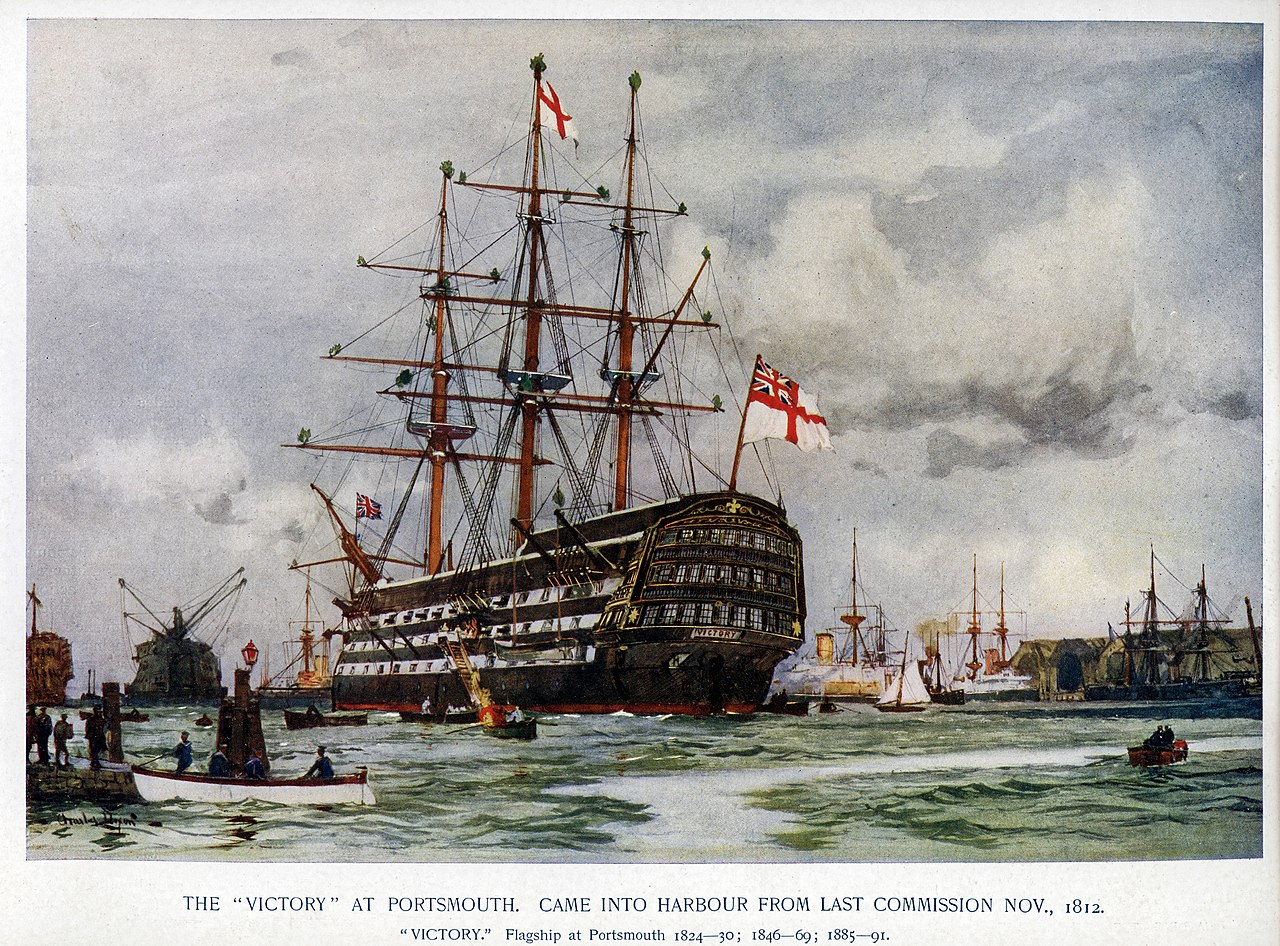
“HMS Victory in Portsmouth Harbour”
Painting by Charles Edward Dixon (1872-1934) via Wikimedia Commons.
I have read and enjoyed several series of novels set in the British navy during the Napoleonic wars, most recently one by Naomi Novik that departs a little further from history than its predecessors by providing the British and their enemies with dragons. The internal structure and the associated rules and customs of the navy seem very strange to a modern eye, yet it was a strikingly successful institution.
One feature likely to catch an economist’s eye was prize money. If a naval vessel captured a legitimate prize, an enemy warship or merchantman, and brought it back to port, the vessel and its contents were sold and the money distributed among those responsible. One large chunk went to the captain, another was distributed among his officers, a third among the crew, a fourth to the admiral under whose orders he was operating.
Another feature of the system was the role of patronage, political influence both within the navy and outside it in the career of an officer, especially a young officer. The critical step of promotion from lieutenant to captain depended in part on performance, in particular on the opinion of the captain under whom a lieutenant was serving. But it depended also on things that seem, to us, irrelevant.
One of Patrick O’Brien’s novels contains a conversation between Maturin, one of his protagonists, and a friend, a young officer of aristocratic birth. The officer has been having an affair with the separated wife of a high naval official and wants to know whether he should live openly with her. Maturin’s response is that, moral issues aside, it might be imprudent for him to offend a powerful official and so risk his future career. His friend replies that he has considered that matter but his family controls a significant number of seats in both houses of parliament and he thinks their influence will be sufficient to balance that of the man he will be offending.
Neither party sees anything strange in either the assumption that giving personal offense to someone within the bureaucracy will make it harder for a competent officer to be promoted or that having a politically influential family will make it easier; that is just part of how the system works. It was a system that produced extraordinarily successful results, a navy that, from the late 18th century to the early 20th won almost every ship to ship or fleet to fleet battle it fought at anything close to even odds.1
A third feature was the seniority system. Once a lieutenant was promoted to captain, his future rank depended only on how long he survived. His name was on the list of captains, the list was ordered by strict seniority, and the next captain to be promoted to admiral would be the one at the top of the list. When two or more captains were working together it was the senior who commanded. That provided an unambiguous rule for allocating command, since every captain knew where he was on the list and knew, or could readily find out, where any other captain was. But it was a rule that had nothing to do with the relative competence of two officers of the same nominal rank.
Promotion beyond captain was entirely determined by seniority; what the officer got to do with his rank was not. An insufficiently competent captain who made it to admiral would end up as an admiral of the yellow, an admiral without a fleet, effectively retired on half pay. A sufficiently competent captain could be assigned particularly important duties, including the command of a group of ships with the temporary position of commodore — provided none of the other captains in the squadron was senior to him. A sufficiently incompetent captain could end up without a ship, on half pay with no chance of prize money. In peacetime, when there was no shortage of competent captains, a minor failing might do it.
[…]
Consider the case of the pre-modern British navy. Prize money was a property solution. The admiralty wanted captains to have an incentive to capture enemy merchant ships, defeat and capture enemy warships, even at risk to their lives. Most of the relevant decisions were made by the captain, so he got the largest part of the reward, but other people, including the admiral whose orders determined what opportunities the captain had to earn prize money, got some of it. A pattern that shows up in the novels, and presumably in the real history, is an admiral who puts an unusually competent and aggressive captain in places where he is likely to encounter enemy warships not because he likes the captain but because he hopes to profit from successful encounters.
Allen argues that prize money was an imperfect property solution because capturing a warship was much riskier, more likely to get the captain killed, than capturing a merchant ship, but prize money was awarded for both. One puzzle he does not consider is why the navy did not solve the problem of misaligned incentives by lowering the prize money awarded for merchant ships or raising it for warships, which should have been easy enough to do.
Allen offers the imperfect alignment of incentives, such as the temptation for a captain in a fleet action to hang back and let other ships and their captains take the risk, as a reason why the property solution had to be supplemented with elements of the other two systems. The admiralty had detailed information on what a captain did through a system of three different logs, one by the captain, one by his first lieutenant, one by the sailing master, the ship’s senior warrant officer. A captain whose career showed him to be incompetent or too inclined to go after merchant ships and avoid warships might end up spending the rest of his career on shore with no ship, hence no opportunity for prize money. A captain who declined a clear opportunity for combat with a ship of the same class was subject to trial by court martial; one admiral ended up convicted and executed for failing to pursue the enemy fleet after an engagement.
1. With the possible exception of the War of 1812.
HMS Canada / Almirante Latorre – Guide 389
Drachinifel
Published 25 May 2024HMS Canada / Almirante Latorre, a single dreadnought battleship of the British Royal Navy and Chilean Navy, is today’s subject.
(more…)
QotD: Christianity destroyed the ancient Graeco-Roman culture
Consider celibacy: Fustel de Coulanges examines several ancient legal codes and finds that in all of them the deliberate refusal to procreate was a crime that carried severe punishments. This makes total sense in light of all you’ve said — a man does not belong to himself, he belongs to his family, a diachronic (or transtemporal?) entity that lives in and through and above individuals. Deliberate celibacy would be like your hand or your kidney refusing to perform its assigned function and trying to murder you instead. Cancer, in other words. And the solution to cancer is to cut it out and destroy it.
Now imagine a religion praising cancer and vaunting the tumor as the highest form of biological life, and maybe we can feel a sliver of the horror that the ancients must have felt towards Christianity. And it wasn’t just celibacy either — in area after area Christianity emancipated individuals from the dense, ancient web of obligations, loyalties, and client-patron relationships. Loyalty to the city and loyalty to the family were both such incomparably important qualities for the ancients that Sophocles got several tragedies out of the collisions when they came into conflict, but Christianity in its most radical form says that both are ephemeral and contingent, and must be subordinated to a higher loyalty — fidelity to the Truth. To the ancients I bet this didn’t just seem like antisocial behavior, I bet it seemed like the apocalypse. No wonder there were so many martyrs. No wonder so many of them were martyred by their closest relations.
I’m almost tempted to say that that old snake Gibbon was right, it was Christianity that destroyed the Roman Empire, destroyed the entire ancient Mediterranean civilization that had lasted for a millennium or more, first bit-by-bit then all at once. But of course that isn’t quite right either. By the time Pentecost occurred, the dissolution was already well underway. Christianity massively accelerated a process that was inexorable by then, and changed the shape of what was to come after it, but the collapse was baked in.
Read any of the Roman authors from either shortly before or shortly after the Lord’s birth — Virgil, Cicero, Pliny, Suetonius — all of them, in one way or another, are obsessed with the unraveling of the matrix of tribal and familial relationships that Fustel de Coulanges describes. There were a lot of reasons for it, including but not limited to: mass migration to the cities, economic rationalization that replaced freehold farming with massive latifundia (plantations), and just the accumulated stresses from centuries of continuous warfare and expansion. The cumulative effect of all this was that a society formerly governed by ritual, familial and civic piety, tribe, and clan was transformed into an ocean of atomized and deracinated individuals engaging in mass politics.1
One of my favorite passages in Gibbon’s Decline and Fall2 is in the intro to the chapter on Alaric’s invasion of Italy. Gibbon contrasts this with Hannibal’s invasion 700 years earlier, and goes on this beautiful riff about how on paper, the Rome of the 5th century AD looks incomparably stronger than that of the 3rd century BC — it had a massively larger population, greater wealth, a greater technological edge over its opponents, etc. And yet when it came to a responsibility as basic as that of defense against a foreign invasion, all the GDP and technology in the world wasn’t able to make up for a lack of asabiyyah. When Hannibal annihilated the legions at the Battle of Cannae, something like 20% of the entire adult male population of Rome was killed, including most of her military and political leadership, to which the Romans simply gritted their teeth and raised a few more armies. The descendants of those heroes, despite having a vastly larger population to draw from, weren’t able to muster a single legion or a single capable commander, and surrendered their city to the Visigoths almost without a fight.
Rome was a rocket that soared into the sky and then came crashing back down, and it’s easiest to see it right at the apogee, the point midway between the first and the last great invasions of Italy. The first century glory days of Rome, the time that we moderns consider the height of her power, were actually a moment of deep institutional and social decay. Like an exothermic reaction — a bonfire or an explosion or a fireworks display — what we notice immediately is the ebullient, magnificent blaze. But it’s easier to miss all the fuel that’s being consumed: solidarity, economic resilience, social technology, all of it woven through with the tight bands of ancient law and custom that Fustel de Coulanges documents. Just as the Greek philosophy we love was an uncharacteristic flash in the pan, an evanescent moment that subverted and destroyed the culture that had given rise to it; so too the Roman imperial achievement was an engine fueled by a society and a citizen-soldiery that it quickly burned to cinders.
I wonder if every civilizational golden age would turn out to have this unsustainable character if you inspected it closely. If so it would explain a historical mystery, which is why these epochs are rare, and why they never last long. From this angle history looks a bit like a 2-stage cyclic phenomenon wherein the long “dark ages” are actually epochs of patient stewardship of economic, cultural, and demographic resources, whilst the short “golden ages” are a kind of manic civilizational fire sale of the accumulated inheritance. Maybe we need a new historiography founded on the idea that what we have heretofore considered dark ages are the true golden ages, and vice versa. This transvaluation of values would be like a temporal version of James Scott’s attempted reversal of civilization and barbarism.
Alas, while peasants could vote with their feet and migrate across the imperial frontier, our options for time travel are a bit more limited. Would we prefer to live in the cozy but constricting deep prehistory of a civilization, or in the wild glory of its last days? No doubt it would depend a lot on who we imagine being in each of these phases, but at the end of the day it doesn’t matter, because we don’t have a choice. May as well sit back and enjoy watching the blaze. It will be beautiful and exhilarating while it lasts.
Jane and John Psmith, “JOINT REVIEW: The Ancient City, by Numa Denis Fustel de Coulanges”, Mr. and Mrs. Psmith’s Bookshelf, 2023-02-20.
1. If this sounds familiar, it should. Whenever I read about first century Rome I always come away with a weirdly twentieth century vibe.
2. Yes, I’ve read the whole thing cover-to-cover. What? Why are you looking at me like that? There was a pandemic happening, okay?
July 17, 2025
Afghan refugees and the British government
On Substack, Fergus Mason explains why the British government got deep into a secretive program to bring thousands of former Afghan soldiers and their families to Britain:
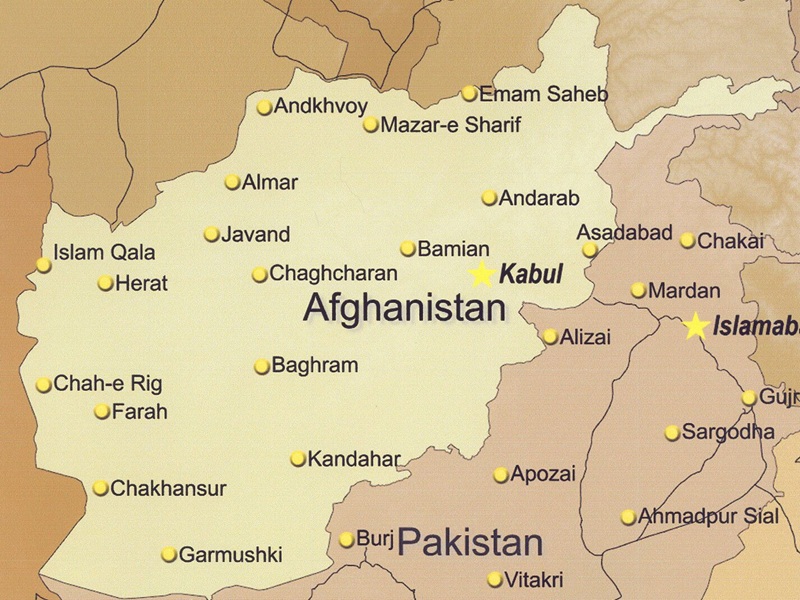
So here’s what we know so far. In February 2022 a Royal Marine officer, working for the Director of Special Forces, sent an email to several Afghans in Britain. These people were involved in the effort to rescue former interpreters and Afghan National Army special forces soldiers who were at risk of reprisals from the Taliban regime, and the Marine wanted to know whether some Afghans who claimed to be ex-special forces really were. The officer intended to attach a filtered list of around a hundred names from an Excel spreadsheet, but inadvertently attached the whole file — which contained around 25,000 names. One of the Afghans he sent the list to immediately passed it on to someone else – this time in Afghanistan. MoD sources are stressing that these were all trusted Afghans, but … well, we’ll get to that shortly.
And then nothing much happened for 18 months. The Taliban didn’t round up and shoot everyone on the list, even though they now claim to have had it since early 2022. But then, in August 2023, an Afghan man — a former soldier who had applied for asylum in Britain, but been rejected — popped up on Facebook. He promptly released part of the spreadsheet, then threatened to post all of it. At this point the government swung into action. First, it pressured Meta, which owns Facebook, to shut down the group the data was posted in and remove the user. Then the Ministry of Defence, under former defence secretary Ben Wallace, applied for a super-injunction to prevent the media from reporting anything about the leak, what the government planned to do about it, or what it was going to cost. It even banned anyone from revealing the existence of the injunction itself. That injunction was granted to Wallace’s successor, Grant Shapps, and the entire story was killed before it became public. The government was already drawing up a plan to bring tens of thousands more Afghans to Britain; the media and Parliament weren’t allowed to mention it; the British people, of course, were not to be allowed to know a thing. The degree of secrecy imposed was truly extraordinary.
And, over the last 18 months or so, the government has quietly been running a huge and very expensive operation to bring those identified as being at risk to Britain. From those listed on the spreadsheet, 23,900 former Afghan soldiers, policemen and intelligence officers were deemed to be in danger because of the leak. So, of course, were their families. How many people does the government plan to bring in under this scheme, in total? Nobody knows. Early estimates, according to court documents, were that 43,000 Afghans would be given asylum in Britain. Yesterday, officials insisted the real total was 6,900; even that dramatically lower number is a big addition to the 24,000 Afghans the government has admitted to bringing in under other, declared schemes. However, horrifyingly, last June three judges — Sir Geoffrey Vos, Lord Justice Singh and Lord Justice Warby — issued a written (but, of course, secret) ruling that up to a hundred thousand people could be at risk if the Taliban got their hands on the list.
Embarrassment for the British government, certainly, both for the initial cock-up and the ridiculous follow-up. It’s going to be expensive to resettle all those refugees and their often quite large families (guesstimates range from £850 million up to £6 billion), but not really a big deal, right? Well, about that …
I’ve already mentioned Afghan culture’s horrific misogyny. This leads to some truly dire attitudes towards women who don’t comply with Afghan society’s draconian rules of female behaviour (which boil down to having no rights and not being allowed to leave the house without a burqa and a male relative). One of the consequences of this is that Afghan men have unleashed a tidal wave of sexual assaults across Europe. At least one migration expert has noted that as well as their frequency, assaults by Afghans are remarkable for their brutality, audacity and often downright stupidity. Austrian political scientist Cheryl Benard wrote:
Can these men possibly expect that their attempts will be successful? Do they actually think they will be able to rape a woman on the main street of a town in the middle of the day? On a train filled with other passengers? In a frequented public park in the early afternoon? Are they incapable of logical thought — or is that not even their aim? Do they merely want to cause momentary female hysteria and touch some forbidden places of a stranger’s body? Is that so gratifying that it’s worth jeopardizing their future and being hauled off to jail by scornful and disgusted Europeans? What is going on here? And why, why, why the Afghans? According to Austrian police statistics, Syrian refugees cause fewer than 10 percent of sexual assault cases. Afghans, whose numbers are comparable, are responsible for a stunning half of all cases.
Type two words into Google — Afghane and Vergewaltigung — and a cornucopia of appalling incidents unfolds before you.
Incidentally, to all you lefties who’re undoubtedly sputtering with fury as you read this, don’t even think of writing Benard off as an anti-Afghan racist. Her husband is former US ambassador Zalmay Khalilzad, who is Afghan.
But surely, the “trusted” former Afghani soldiers, police and intelligence officers being brought in are bound to be much better able to adapt to British culture, right? Uh, well …
The government has been very reluctant to release — or even admit it possesses — statistics on the link between nationality and crime, but under pressure from independent MP Rupert Lowe it finally did so in March. This showed that among Afghans in Britain, 59 per 10,000 have been convicted of a sexual offence — 22.18 times higher than British men, at 2.66 per 10,000:
By the way, yes, I know the graph is from the Centre for Migration Control — but the data is from the Ministry of Justice and was obtained by a Freedom of Information request. I’ve checked the graph against the data, and it’s accurate.
[…]
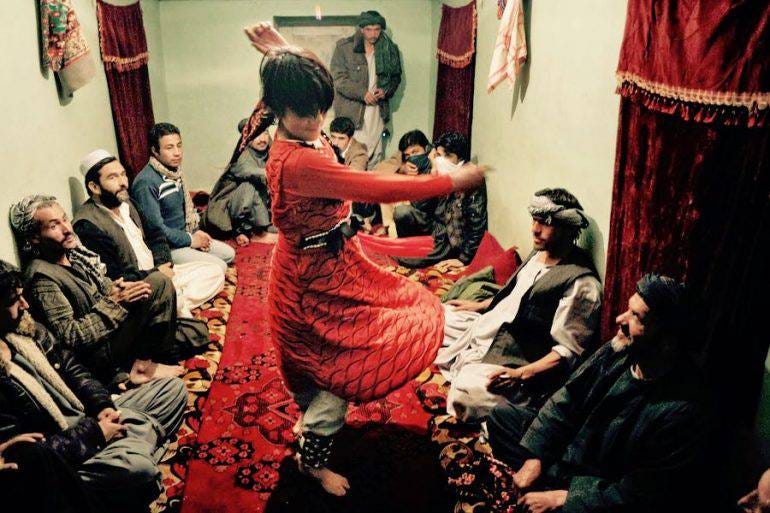
Does this photo of Afghan men watching a young boy dance give you the creeps? It should.
It’s not only women at risk, by the way. Afghan men aren’t averse to raping young boys, either. One of the most revolting aspects of Afghan culture — and that’s saying something — is the tradition of bacha bazi (Dari for “boy play”). Prepubescent boys are forced to dress up as girls then dance for, and “entertain”, men. This strain of paedophilia was common among anti-Taliban warlords and the Afghan security forces, particularly the police. The Taliban claim to be against the practice; their founder, the late Mullah Omar, actually was violently opposed to it. However, many prominent Taliban commanders also enjoy a spot of recreational pederasty.
Of course the obvious answer to this is “But most Afghan men aren’t rapists!” I agree; most of them aren’t. But an alarmingly high percentage of them are, and our governments clearly can’t keep the rapey ones out. The graph and its underlying statistics prove that beyond any possible doubt. And while it’s easy to downplay the statistics by saying it’s still “only” 77 sexual offences committed by Afghans over a two-year period, bear in mind that a) that’s 77 offences that wouldn’t have happened if we hadn’t let any Afghans in and b) this number is only convictions. In Britain just 3.1% of sexual offences reported to the police (around a third of which are rapes) lead to a conviction, which brings the potential number of Afghan suspects up to 2,484. The police estimate that only 10-15% of sexual offences are even reported; that could mean Afghans committed between 16,500 and 25,000 sexual offences across that same two-year period. Afghans would have to be bringing stupendous benefits to this country to make 25,000 sexual offences a worthwhile price to pay; indeed, many (emphatically including me) would argue that it wouldn’t be an acceptable price under any circumstances.

In Spiked, Tim Black on the government’s decision to hide everything for as long as they possibly could … for reasons:
Yet as catastrophic an error as this data leak was, the state has somehow managed to compound it with a series of decisions that made a terrible situation even worse. Successive Conservative and Labour governments effectively mounted a cover-up of both the data breach itself and the response. They slowly undertook a secret evacuation and relocation programme for the Afghans without telling even the Afghans affected about the data breach and the fact their lives were at risk. At the same time, they sought to hide all this from the British public, too, even while thousands of Afghan refugees were quietly being deposited in hotels and in military accommodation across the country. All with no explanation.
It is this de facto cover-up, this attempt on the part of ministers and senior officials to hide state errors and actions from public view, which is the most disturbing aspect of this whole sorry affair. They set about shielding a data breach followed by a costly, large-scale asylum scheme from any form of accountability, criticism or debate. And they did so by exploiting a legal tool that has never been used before by a British government – namely, the superinjunction.
This effective cover-up did not happen immediately. In fact, it wasn’t until early August 2023, a whole 18 months after the data breach took place, that the leak was finally brought to the attention of officials. A support worker responsible for settling Afghans in the UK emailed Luke Pollard, Labour MP for Plymouth, and James Heappey, the then Conservative defence minister, warning them that he’d seen the database circulating online. Days later, journalists also became aware of the leak. It was this that finally prompted the Ministry of Defence and the government to launch a covert mission, codenamed Operation Rubific, to shut down the leak and help Afghans put at risk get to the UK (after being vetted in Pakistan).
It was at this point that the authorities took the unprecedented step of applying for a superinjunction. This legal tool doesn’t only prevent journalists from reporting on the subject of the injunction. It also prevents anyone from acknowledging that the injunction even exists. Ministers argued that this extreme free-speech-defying measure was necessary to prevent the Taliban from becoming aware of the datasheet’s existence. Granted in September 2023, the superinjunction acted like a form of legal dark magic, rendering the data breach and the government response to it invisible. It insulated both from even the possibility of scrutiny.
Members of parliament could have still used their parliamentary privilege to speak up. But since all reporting had been prohibited, MPs found themselves in the same place as the wider public – in the dark. For nearly two years, then, we have all borne blind witness to the state’s conspiracy of silence. Until this week, that is, when defence secretary John Healey decided the superinjunction was no longer necessary.
It wasn’t just the British having issues with Afghan forces, as @InfantryDort recounts on the social media site formerly known as Twitter:
Among the Wildflowers @deaflibertarian
Did the high ranks really tell American soldiers to stand down and not interfere when children were being sexually assaulted in the Middle East region?TLDR, but you need to read it to get what I’m saying. I know it may be hard to understand how American Soldiers could witness horrors in Afghanistan and feel powerless to stop them. But let me try to explain. Fellow veterans, feel free to add on or correct me, because this rot ran deep.
1. We were forged to kill, then reprogrammed to hesitate. The warrior was replaced with a social worker in a helmet. Instead of rehearsing “react to contact,” we sat through PowerPoints on cultural sensitivity. Our edge dulled by doctrine that taught us empathy for the enemy and suspicion of ourselves.
2. We were ordered to practice “courageous restraint”. Sounds noble. It wasn’t. It meant ignoring your instincts. It meant second-guessing every shot, every step. The Army trained us to fight, then punished us for following that training. We were told killing the enemy might make things worse, as if leaving them alive made anything better.
3. Every success was credited to the Afghan army. Every failure pinned on us. We propped up a Potemkin military, full of cowards and thieves, and were ordered to salute the illusion. We whispered truths in smoke pits while speaking lies in briefings.
4. Under certain generals, aggressiveness was punished harshly. They’d clip the wings of the hawks and reward the peacocks. It’s like blaming a wolf for baring its teeth when surrounded by jackals.
5. “Green on Blue” attacks poisoned every partnership. The Taliban infiltrated Afghan ranks so deeply we stopped sleeping. Trust vanished. No one dared provoke them. Not over child rape, not over beatings, not over anything. Every Blue 1 report was a career landmine, so the truth stayed buried.This was the cocktail we drank every day:
• Restraint over reaction
• Illusion over integrity
• Shame over strengthWe were taught to see women as property, not to intervene. To accept children as sexual currency for Afghans, not to interfere. That the blame for every failure lay with us, not the corrupt warlords we empowered.
And was it non-consensual sexual currency? Because the culture was so backwards, we were told villagers would give their kids to powerful Afghans as tribute. And that the kids themselves understood the assignment. How f****d is that? How evil? How diametrically opposed to everything we believe?
And once you’re complicit in enough sin, it gets easier to stay silent. When you’ve spent years maintaining a lie, the truth becomes radioactive. Ripping off the bandage would mean admitting the whole war was infected.
We stood “shonna ba shonna” or shoulder to shoulder with some of the worst people humanity ever produced. And we called it partnership.
That’s how this happened.
A culture of confusion.
A doctrine of deceit.
A war that killed our ability to fight the very evil we were sent to destroy.There is a silver lining here. History has proven that our suspicions were right. And luckily, many of us are still in uniform or in charge of the DoD apparatus. We will NEVER let this happen again. And I will shout this from the rooftops to make sure that’s the case.
Infantry Dort, X.com, 2025-07-16.
A renewed push to ban AfD from contesting elections in Germany
eugyppius updates us on the state of play as the various smaller parties in Germany try to ban Alternative für Deutschland (AfD) which had risen from fringe status to being the most popular political party after the last federal election:

I’m far from a sensationalist, and I’ve repeatedly discounted the likelihood of an AfD ban – not least because the German establishment and the left in particular have good reasons to keep the AfD around. Lately, however, I’ve begun to appreciate that there are deeper, systemic forces working against the AfD in this case. These forces are beyond anybody’s control and if nobody does anything, they may well end in political catastrophe that is much bigger than any single party.
Since the end of the Merkel era, the German left has become thematically scattered, and so they have retreated to the only coordinating issue the German left has ever had, which is hating the right. As climatism started to fade, the social welfare state exceeded its limits and mass migration went sour, AfD bashing became the sole unifying principle for much of the SPD, Die Linke and the Greens. Hating the right is particularly important because it keeps leftist politicians and their activist class on the same page. Without a crusade against the right, a great chasm opens between the antifa thugs who want to smash the state and destroy capitalism on the one hand and the schoolmarm leftoid establishment functionaries in the Bundestag who want to mandate gender-neutral language for the civil service on the other hand. What is more, the firewall against the AfD splits the right and keeps the shrinking left in government. It is a win-win for leftoids everywhere.
Recent events, however, show why things cannot continue as they are now indefinitely. Over time, our Constitutional Court will begin to fill with leftist justices supported by the left parties, who like the rest of the left will also want to ban the AfD. Brosius-Gersdorf and Kaufhold are omens here. Right now the system is held in perfect balance; the left talks a big game about wanting to stamp out the AfD, but they can always justify their hesitation by saying the outcome of ban proceedings is too uncertain. When the necessary judicial majority for an AfD ban is finally secured in Karlsruhe, everything changes. At that point, there will be no excuse for not proceeding with a ban. The activists and the NGOs will take to the streets if their political masters in Berlin don’t begin the process. The CDU will be brought around by media smear campaigns and antifa intimidation.
Keep in mind that this is not about the AfD, but about imperatives within the left itself. No amount of moderation, polite messaging or triangulation on the part of the AfD can get the left to stop or pursue other goals. Unless some exogenous force introduces a new unifying obsession for the left parties and their activists, they will never stop gnawing on this particular chew toy.
Practically, this probably means that the AfD has an expiration date. If they can’t get into government at the federal level and if nothing else changes, they will find themselves facing ban proceedings before a court stacked with leftists who hate them in the next 10 or 15 years. The federal elections in 2029 seem like the last opportunity to normalise the AfD before this final escalation.
People in the CDU need to realise how serious this is, because their fate hangs in the balance as much as the fate of the populist opposition to the right of them. It is absolutely necessary that they break the firewall and enter some kind of arrangement with the AfD before it is too late. It doesn’t matter how much the press freaks out. It doesn’t matter how many violent antifa thugs take to the streets. It doesn’t matter how many party headquarters the leftists invade and vandalise. The firewall will fail in one direction or the other, and if it fails with an AfD ban, we are all in very deep shit.
HBO’s Rome – Ep 7 “Pharsalia” – History and Story
Adrian Goldsworthy. Historian and Novelist
Published 22 Jan 2025
Half way through the first season, we take a look at Episode 7, set during the summer of 48 BC amid the campaign between Pompey and Julius Caesar in Macedonia. For once, most of the action takes place away from Rome. Central is the Battle of Pharsalus, where in reality 80,000 or more men clashed in August and Caesar decisively defeated Pompey and his supporters. So today we talk about the reality of the campaign and battle, its political context, and then consider how this is presented for TV in a series where they did not have the option of vast numbers of extras and big set piece battle scenes.
July 16, 2025
Offensensitivity over a 12 year-old wearing a Union Jack dress to school
I’m not in the least bit surprised to hear that a 12 year-old girl has triggered the sensitive souls at her school for choosing to wear a Spice Girls style Union Jack dress to her school’s Cultural Diversity Day:

Photo from The Daily Sceptic
Another month, another glaring example of toxic activism sweeping through the British workplace, and this time, it’s no less than shocking.
On July 11th, 12 year-old Courtney Wright was sent home from Bilton School in Rugby, Warwickshire, simply for wearing a Union Flag dress and hat for the school’s Cultural Diversity Day. She had put effort into her costume, even writing a speech celebrating British culture: Shakespeare, fish and chips, tea, the Royal Family. Yet for what was a harmless celebration of her national culture, she was excluded.
The school’s response? A sanctimonious head of year, presumably with the support of management and colleagues, told her: “You get to celebrate your culture every day. This is for everyone else.” Then ordered her to remove her outfit and wear a second-hand uniform or go home. So she, rightly, called her father, who came to collect her.
Stuart Field, her father, a 47 year-old Marine Engineer, alleges she was not alone. A boy was reportedly sent home for wearing a farmer’s costume, illustrating a broader, troubling trend: the suppression of British symbols and pride in the name of “diversity”.
[…]
The aftermath saw the usual potted response from the school’s governing trust, the Stowe Valley Trust about how it values “diversity”, “respect” and so forth, yet its words ring hollow. It claims to regret “upset caused”, note, not the exclusion itself – only the distress that followed. It says it will “reflect on how this could have been handled better”. It then goes on to assure parents that it will be looking at the policies and training.
But what does that really mean? The trust refuses to admit that sending a girl home for celebrating her country was an appalling and divisive breach of common sense and, arguably, of law. Their language suggests an attempt to dodge accountability, to spin it as a mere mishandling rather than a fundamental failure.
At Spiked, Hugo Timms points out that this is merely a slightly more visible version of what British children learn in school … that there’s nothing at all to be proud about if you’re British:
British schoolkids have long been encouraged to be ashamed of their nationality and history. They’re taught “anti-racism” lessons and to constantly check their privilege as Brits. They study “decolonised” curricula, shorn of “triggering” British authors. Now, it seems, even dressing up as a Spice Girl and praising Shakespeare are being treated as beyond the pale.
[…]
You might say Courtney’s outfit was not exactly “traditional”, inspired by Geri Halliwel’s famous Union Jack dress from the 1997 Brit Awards. But that was clearly not the issue. What the school’s instructions really meant was that she should dress as any nationality or heritage, so long as it’s not British. According to Courtney’s father, Stuart Field, the school also turned several other pupils away at the gates on Culture Day, including a boy with a St George’s flag, a boy with a Welsh flag and a boy dressed as a farmer with a checked shirt and a traditional flat cap.
Courtney’s school also stopped her from giving a speech about what being British meant to her. “In Britain”, she would have said, “we have lots of traditions including drinking tea, our love for talking about the weather and we have the Royal Family”. “We have amazing history, like kings and queens, castles, and writers like Shakespeare.” It also praised British humour, “our values of fairness and politeness”, and fish and chips. Not exactly Enoch’s “Rivers of Blood“, is it?
German Sten Copy: MP-3008, aka Gerät Neumünster
Forgotten Weapons
Published 4 Feb 2016The MP 3008, aka Gerät Neumünster, was one of two German efforts to copy the British Sten gun. The first was the Gerät Potsdam (“gerät” meaning device or project; basically project code name), which was a direct copy of the Sten distinguishable only by a marking details and a few differences in manufacturing processes. While 10,000 of those were being manufactured by Mauser, R&D engineer Ludwig Vorgrimmler was simplifying the Sten design even farther, resulting in the MP-3008.
This simplified design did away with the Sten’s barrel shroud, and used a vertical magazine well instead of the Sten’s distinctive horizontal mounting. These were the significant changes, although there was also a sling loop placed on the front of the magazine well and a few minor simplifications to the fire control parts. Unlike the Potsdam, significant variation can be found in the MP-3008 in the details of stock and grip design.
In a masterpiece of insane optimism, German official placed an order for literally a million MP-3008 submachine guns, which of course was completely insane. Manufacture was undertaken at a wide scattering of small shops, with guns being assembled by larger manufacturers from supplied parts. The total made is not known, but is probably in the range of 3000-5000. Some are marked with manufacturing codes from recognized factories, some with codes unknown, and some have no marking at all. This particular example is dewat made by “TJK” — an unknown factory.
QotD: Slavery in history
It is pathetic but unsurprising how ignorant all these brave “anti-fascists” are. Yet there is a lesson here not just for Britain but for America, too: when a society loses its memory, it descends inevitably into dementia.
Mark Steyn, After America: Get Ready for Armageddon, 2011.
July 15, 2025
American (religious) exceptionalism
Christianity has been in retreat across the western world for decades, with the United States being the laggard in abandoning the faith. Canada is closer to the western European rate of secularization. On Substack, Fortissax explains why it has become uncommon to find a believing Christian outside the US in response to a query on X about people turning to various neopagan faiths:

First, I believe there are two factors at play. One is the divide between the United States and the rest of the Western world. The United States still has the highest percentage of weekly churchgoers in the West, at around 24 percent. In the U.S., Christianity remains a living tradition. Millions still attend church, or at least try to. Many people share a common faith, believe in God, and are familiar with Christian references in public life, politics, and law. In contrast, in countries like Canada and much of Europe, regular church attendance is closer to 5 percent. That number often includes recent immigrants who tend to be more socially conservative. Among native-born Canadians and Europeans, especially in urban areas, church attendance is even lower. Religion in these places is often kept alive only by older or rural populations. Among the youth, it has largely faded. Second, many Western countries have experienced secularization for much longer.
I believe this first one is not obvious to a majority of people. There are significant cultural differences and experiences within in the United States and outside of it. I believe it would be appropriate to say that the U.S. is still a Christian country, and not just nominally, regardless of whether or not it was established on Lockean principles and Greco-Romain inspiration (some would say revision), of the liberal enlightenment. Sure, the faith is not what it used to be, but probably the majority of Americans at least understand Christian references in common parlance.
I can share a personal anecdote that I believe is fairly typical.
I was born and raised in a region where Christianity had long disappeared from everyday life, following a slow process of state secularization. My great-grandfather was Catholic, but he changed denominations to marry my great-grandmother in the 1930s. It was a utilitarian choice. He believed in God but didn’t care for the petty tyrannies of ethnic and cultural association by denomination. His son, my grandfather, saw hypocrisy in both Catholic and Protestant institutions. As a boy, he was told he could not be friends with a Protestant by a the Catholic priest of his best friend, and he was kicked out of the house by his mother for attending Catholic mass with his girlfriend, even though his father had once been Catholic. My parents were irreligious agnostics. They were not hostile to Christianity, just indifferent, because they were not raised in it. As for me, I grew up in a post-liberal, post-Christian society. I believe in the divine and understand the importance of religion to civilization, but I have no living connection to what came before. In my country of Canada and among my people, Christianity is no longer part of the cultural fabric. I believe this to be the case in Western Europe as well.
There is a common joke that if someone likes paganism so much, they should try the most pagan tradition of all: converting to Christianity. But the unfortunate reality is that secular liberalism has exercised a longer and deeper influence in the modern West than many realize. In response, one could just as easily say that the most Christian tradition of all is converting to secular liberalism, which has formally shaped the cultural and institutional framework of the West for more than 275 years.
For people raised in multi-generational secularized liberal contexts, there is nothing to return to. Christianity is not a living tradition. They cannot come home to Jesus the way many Americans still can, and they cannot undo the liberal Enlightenment. They can only move forward through it. At best, something new might be reinterpreted or reformed from its remnants. But Christianity was never part of their lived experience. It was not seen, heard, or practiced. Churches were never attended. Christmas and Easter functioned as civic holidays focused on family rather than faith. Christianity resembled a historical artifact, something like a beautiful mantelpiece in an old house. It had aesthetic and historical value, but no emotional, cultural, or spiritual presence. This situation is common in much of the non-American West.
This is why many contemporary efforts at Christian revival often feel disconnected. They are built on the assumption that secular individuals are lapsed believers who simply need to be reminded of what they once knew. But these individuals are not returning exiles. They are cultural natives of a secular world. They did not lose the faith, it was never given to them. There were no prayers at the dinner table, no hymns embedded in childhood memory, no sacred calendar shaping the flow of life. Organized religion belonged to the past, replaced with secular civic cults they’re largely unaware of. It was something other people had, something no longer meant for them. This group is not necessarily hostile to Christianity. In many cases, they admire it. They recognize its role in shaping art, architecture, law, and moral tradition. When foreigners attack these, they defend them. They understand its civilizational significance. But the faith speaks a language they do not understand. Its metaphors do not resonate. Its moral claims appear without context. Its stories feel distant.
A useful comparison can be found in the Heliand, a ninth-century Old Saxon gospel poem that re-imagined the life of Christ using the language and imagination of Germanic warrior culture. In that version, Christ is not a wandering teacher from a distant land, but a noble chieftain surrounded by loyal retainers. His mission is framed in terms of honor, loyalty, kinship, fealty, and sacred duty. The gospel message is not altered in its substance, but it is reshaped so that it resonates with the values, social structures, and poetic traditions of a people for whom neither Scripture nor Roman religious order had any living relevance.
This work was part of a broader process of the Germanization of Christianity, a phenomenon that has been studied in detail by scholars like James C. Russell and Fr. G. Ronald Murphy, SJ. Russell, in The Germanization of Early Medieval Christianity, argues that the conversion of the Germanic peoples did not consist merely in the passive reception of Christian doctrine, but in a complex synthesis between Germanic folk-religious consciousness and Christian metaphysics. The resulting Christianities of the early medieval West were distinct, rooted in local mythic frameworks, and expressed through tribal loyalty, sacrificial kingship, and heroic virtue. Murphy, in works such as The Heliand: The Saxon Gospel, explores how the Heliand uses alliteration, formulaic verse, and martial imagery to make Christ intelligible to a newly converted warrior society. He shows how the gospel was not just translated into the Saxon tongue, but into the Saxon soul.
This is the historical precedent that today’s Church must study carefully. The peoples of early medieval Europe were not apostates. They were unbaptized, uncatechized, and culturally alien to Christianity. They were brought into the faith through through cultural immersion. Christianity did not ask them to surrender their world entirely. It entered their world, dignified their heroic values, and redirected them toward the divine. Only then did conversion become possible.
Even those outside the Church understand that this work is urgent. The crisis of meaning in secular liberal societies is visible. The desire for transcendence, rootedness, and spiritual structure has not disappeared. It has been redirected into political identity, consumer behavior, and digital escapism.
If Christianity is to succeed, the same kind of work is needed today. Christianity must once again become a missionary faith. This time, the mission field is not a remote foreign land, but the secularized cities and postmodern suburbs of the Western world. The people being addressed are cultural outsiders. Many were born into environments where the gospel was never lived, never spoken, never embodied. Christianity was not abandoned. It was never truly encountered.
A future for Christianity in the West will not be built on appeals to lost memory or civilizational guilt. It will not be recovered through progressive accommodation or through aesthetic traditionalism that treats churches, vestments, and relics as ornaments of cultural decline. It will only re-emerge through an act of deep cultural translation. That act must begin with an honest assessment of what has been lost, and a willingness to reframe the sacred in terms that can again be understood.
The alternative is a continued descent into spiritual confusion and civilizational forgetfulness. Christianity may continue to grow in the Global South. It may endure as a global religion. But in the West, it will only live again if it learns how to speak, once more, to those who were never taught how to listen.
Looking in from the outside, it seems to me that the majority of Christian priests and ministers have already made their peace with the inevitable extinction of their faith and far too many of them are actively working toward that end. Feminist and progressive currents move far more local Christian leaders than the message of the faith itself, hence any hopes of western Christianity reforging itself depend on a tiny minority of the clergy.
Why France Couldn’t Crush the Viet Minh – W2W 36
TimeGhost History
Published 13 Jul 2025Why couldn’t France crush the Viet Minh after war broke out in Vietnam? In this episode we dive into the brutal opening years of the First Indochina War, from the outbreak of violence in Hanoi in December 1946 to France’s failed military campaigns and the rise of Vietnamese resistance.
Despite having superior weapons, colonial experience, and Foreign Legion reinforcements, France failed to defeat Ho Chi Minh’s forces. We explore why early offensives like Operation Léa and Ceinture fell short, how the Viet Minh’s rural strategy kept them alive, and why French hopes of ending the war quickly vanished.
As Mao Zedong’s Communist China consolidates power just across the border, the Viet Minh gain strength, support, and a long-term advantage that France simply cannot match.
This video is part of War 2 War, our Cold War history series covering the decade after WW2, a time of seismic global transformation.
(more…)


