
World War Two
Published 13 Jul 2025May 16 1940: Our WW2 Blitzkrieg documentary, Ten Days in Sedan, continues as Winston Churchill arrives in Paris. The Prime Minister still has hope but he’s shocked to see the French burning documents and preparing to evacuate. Meanwhile French and German tanks slug it out in Stonne, Guderian reaches Montcornet, and Rommel leads his Ghost Division far behind French lines.
Chapters
00:00 Intro
00:58 Recap
01:38 Stonne
03:05 Panzers Drive West
07:02 New French Plan
12:23 Rundstedt’s Halt Order
16:06 Ghost Division
21:53 Churchill in Paris
(more…)
July 14, 2025
Day Seven – Ghost Division! – Ten Days in Sedan
Comments Off on Day Seven – Ghost Division! – Ten Days in Sedan
Emperor Hadrian and Antinous the God
Reginald Godwyn reviews a new monograph from Dr. Sean Gabb:
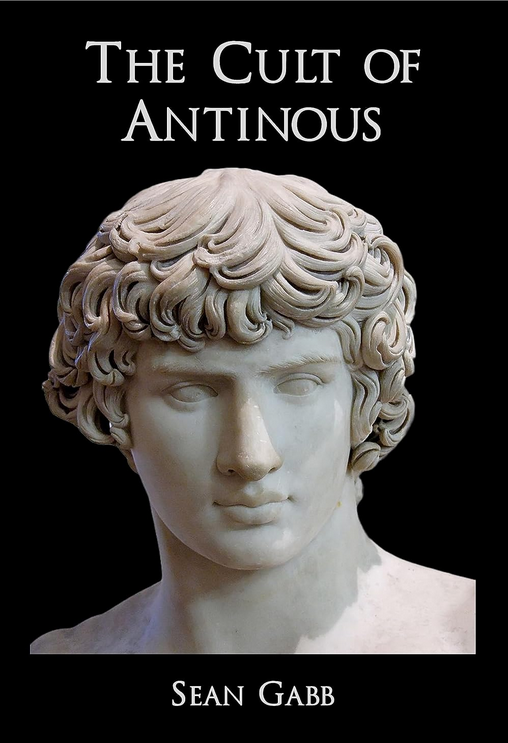
Sean Gabb’s The Cult of Antinous is not a hagiography. It is something better: a quiet, erudite demolition of pious lies from both the ancient and modern world. The lecture-turned-book is a brisk, sardonic tour through the most decadent cult of the Roman world, and one of its most effective. The boy died, yes — but what followed was a miracle of political opportunism and spiritual success. Gabb does not flinch from the disturbing parts. Nor does he genuflect before the fashionably uncritical idolatry now surrounding Antinous as gay icon. This is not a work of celebration. It is a work of historical thought, dressed as a lecture and sharpened with scepticism.
It begins, as it must, with a photograph of Hadrian and Antinous — stone fragments now housed in the British Museum, staring out from beneath museum glass and centuries of self-serving speculation. “Hadrian is on the left”, Gabb says, “Antinous on the right”. But from then on, it is the boy — not the emperor — who takes centre stage. The story is simple enough. Antinous was a Bithynian youth, met Hadrian at around age twelve, became his lover, travelled with him, and died in the Nile under suspicious circumstances. Hadrian made him a god. Cities were built. Statues were raised. Coins were minted. Shrines were erected. And the worship spread quickly and widely—and in ways that make some modern historians uncomfortable.
Gabb’s treatment of all this is not exactly kind, but it is always fair. He reminds us that, when it comes to Antinous, we know almost nothing. The written sources are sparse: Dio Cassius gives a few lines; the Historia Augusta offers rumour. Most of what we “know” is based on “could have”, “may have”, “might have”. And yet on this we have built dissertations, operas, novels, and now neopagan blogs filled with inverted pentagrams and airbrushed torsos. Gabb is not impressed. His repeated refrain is “castle of supposition”. And rightly so. Royston Lambert, he notes, was especially fond of these castles.
But for all that, there is a real story here. Gabb walks us through the ancient views of sex, pausing only to make the necessary disclaimer for his mixed audience of Chinese undergraduates and English middle class language students:
Please be aware that other civilisations frequently have or had views of sexual propriety different from our own. This lecture will discuss, and sometimes show depictions of, sexual relationships between adults and persons somewhat below the present age of consent. Some of these relationships involve disparities of legal status. Though not recommended for imitation in modern England, such relationships are nowhere explicitly condemned. The lecture will also not avoid language that many may consider indelicate or obscene.
What follows is a lesson in ancient sexual economics. Among Greeks, boy-love was structured: older men pursued beautiful adolescent boys, usually between 12 and 17, who were supposed to receive but not enjoy. The Romans were less sentimental: they cared only who did the penetrating. “To use was fine. To be used was shameful.” Gabb’s phrasing here is withering, but accurate. There is no anachronistic moralising — just the dry, clinical reconstruction of a culture with different priorities.
Comments Off on Emperor Hadrian and Antinous the God
Tiberius: Rome’s Most Underrated Emperor?
The Rest Is History
Published 31 Jan 2025The Roman historian Suetonius’ biography of the controversial Emperor Tiberius is one of his most shocking and salacious, condemning Tiberius to infamy. But was Tiberius really the perverted monster Suetonius would have us believe? Born of Rome’s most illustrious family and a sacred bloodline — the Claudians — Tiberius’ mother Livia was unceremoniously taken from his father while she carried him, to marry the great Emperor Augustus. So it was that Tiberius grew up in the very heart of imperial power, proving himself intelligent, and a superb military commander. But, following the unforeseen deaths of Augustus’ young heirs, he found himself primed to become the next Caesar of Rome. The reign that ensued would prove largely peaceful, prosperous and stable, though Tiberius himself was increasingly plagued by paranoia and fear. While the last of Augustus’ bloodline were wiped out one by one, he retired to Capri, much to the horror of the Roman people. Before long, rumours had begun percolating of the heinous deeds, sick proclivities, and vile abominations Tiberius was practicing on his pleasure island …
Join Tom and Dominic as they discuss Tiberius, the impressive though widely lambasted second emperor of Rome. What is the truth behind the sordid myths and mysteries of his reign …?
00:00 The bad emperor?
06:45 Was he depraved?
08:30 The Roman version of the Kennedys
13:29 How he became the heir
16:50 The greatest general of his generation
17:53 Tiberius is manoeuvred into the succession
21:23 Tiberius the emperor
(more…)
Comments Off on Tiberius: Rome’s Most Underrated Emperor?
July 13, 2025
Tiger II: What was the point?
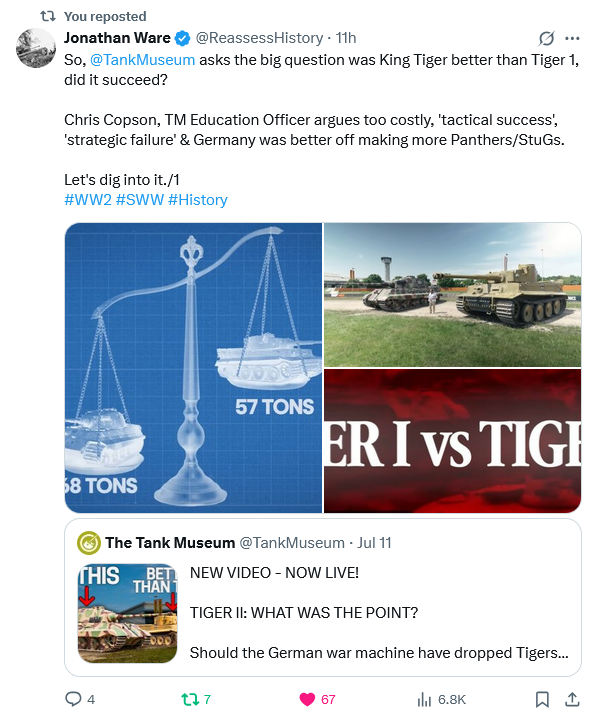
The folks at the Tank Museum at Bovington put together a video comparing the Tiger II to the earlier Tiger I and the typical allied tanks they faced on the battlefield. On the social media site formerly known as Twitter, historian Jonathan Ware posted a long thread about both the topics the Tank Museum’s video raised and where he feels they should have added more context:
And here’s the Tank Museum’s video itself:
FEATURING FOOTAGE OF TIGER I AND TIGER II RUNNING TOGETHER AT TANKFEST 2025 – with thanks to Musée des Blindés and World of Tanks.
It’s absurdly large, heavy, expensive, and difficult to build. So, you have to ask; what is the point of Tiger II when you already have the biggest, toughest and meanest beast on the block – Tiger I.
Whilst the Tiger I has maintained a legendary status since its appearance on the battlefield, there were many aspects of this tank’s design that were pretty much dead ends. The turret couldn’t be resized to fit a more powerful gun. And adding extra weight in the form of armour would put a huge amount of strain on the internal mechanics. So, a new tank was needed to ensure the German’s could maintain their edge against Allied armour.
Enter the Tiger II, otherwise known as the King Tiger. Heavily armed, the Tiger II could take on any Allied tanks that it faced, with its KwK 43 able to penetrate the frontal armour of a Sherman at 1,800m. Its thick sloped armour was incredibly dependable, and no Allied tank commander would willingly engage a Tiger II in a head-to-head fight.
The Tiger II’s battlefield presence came at a significant cost. A single Tiger II could take up to 400,000 hours to build at a price of RM 321,500 – up to 100,000 more hours than a Tiger I, and over twice the cost of a Panther. A while the Allies were churning out tanks that were “good enough”, the Germans were committed to quality and ensuring their tanks would always have the edge against enemy armour.
The Tiger II has often been described as a tactical success for its battlefield prowess, but a strategic failure for being so resource-hungry, expensive and relatively low in number. Given their cost, it forces us to question whether the German war machine should have dropped Tigers altogether in favour producing tanks that were cheaper and easier to build
00:00 | Introduction
00:55 | Durchbruchswagen
06:15 | Tiger I vs Tiger II
12:52 | The Numbers Game
17:34 | Was Tiger II a Success?This video features archive footage courtesy of British Pathé.
In this film, Chris Copson breaks down the differences between two legendary tanks – the Tiger I and Tiger II. Whilst Tiger I was an impressive tank, certain areas of its design were an evolutionary dead-end. Its boxy turret couldn’t be enlarged to fit a bigger gun, and the hull couldn’t be up armoured without adding stress to the drive train. So, Tiger II ordered in 1943, including even thicker, sloped armour and a much more destructive gun. With mixed success on the battlefield, difficulties in maintaining its complex mechanics and reliance on dwindling supply lines, the Tiger II ended up being a tactic success, but a strategic failure.
Want to learn more about the Tiger I and Tiger II? Here are some of the sources we used to make this film:
Panzer Tracts No.23 – Panzer Production from 1933 to 1945 by Thomas Jentz and Hilary Doyle, 2011
Germany’s Tiger Tanks, DW to Tiger I: Design, Production and Modifications by Thomas Jentz and Hilary Doyle, 2000
Germany’s Tiger Tanks, VK45.02 to Tiger II: Design, Production and Modifications by Thomas Jentz and Hilary Doyle, 1997
Encyclopedia of German Tanks of World War Two, Revised Edition by Peter Chamberlain and Hilary Doyle, 1993
Tigerfibel. English translation by The Tank Museum, 2022
Panther and its Variants by Walter Spielberger, 1978
Armored Champion: The Top Tanks of World War II by Steven Zaloga, 2015
www.tankarchives.com
www.forum.axishistory.com
www.achtungpanzer.com
www.feldgrau.net
Comments Off on Tiger II: What was the point?
Q&A: Finland and Finnish Small Arms (From Berdan to New Sako AR)
Forgotten Weapons
Published 19 Feb 2025Today’s Q&A is brought to you by the fine folks at Patreon!
I figured that Finland would be a good subject for this month’s Q&A, as I am visiting the country to shoot Finnish Brutality this month. In fact, this video was filmed during the trip (the match took place last weekend, and its video coverage will be coming soon!).
00:39 – Development of the Suomi and PPSh-41 submachine guns
03:24 – Oldest guns used in Finnish Independence War
04:40 – Biggest strength and weakness of the Suomi
06:43 – Soviet use of captured Suomis?
08:52 – Finnish Maxim guns
11:41 – Finnish alcohol
17:05 – Finnish small arms that could have been globally popular but weren’t?
20:04 – Benefits of a small invaded country using the same weapons as its invader?
23:07 – Favorite and least favorite Finnish customs?
25:57 – Finnish Mosin Nagant book by Matt DiRisio
27:26 – Sisu movie
28:28 – Are the Finns masters of improving other peoples’ guns?
30:08 – Pre-independence Finnish arms production
31:47 – Shower beer or sauna beer?
32:20 – Why so few RK95 rifles made, and RK95 vs RK62M?
35:35 – Swedish Mausers in Finland
37:54 – Commercial Sako rifles before and after Beretta bought Sako
39:19 – Finnish gun laws, specifically CCW
40:58 – Interlude: Finnish Brutality 2025 match update w/ Jari Laine
42:24 – Did Finland improve the PKM and SVD like they did the AK and Mosin?
44:57 – 7.62x54R vs 7.62x53R
47:56 – Thoughts on new Sako AR for Swedish and Finnish militaries
(more…)
Comments Off on Q&A: Finland and Finnish Small Arms (From Berdan to New Sako AR)
July 12, 2025
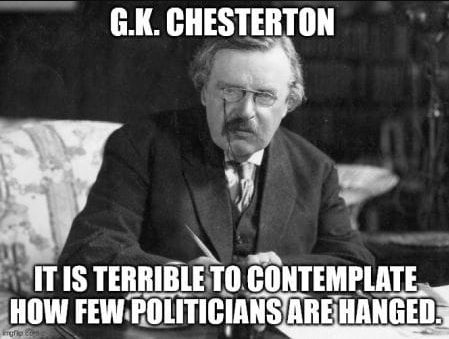
G.K. Chesterton on the dangers of cultural surrender
Andrew Doyle on Chesterton’s novel The Flying Inn (1914) which warned against the risks of unfettered immigration and what came to be known as “multiculturalism”:
The creed of multiculturalism has made it difficult to discuss the impact of unfettered immigration. The far right have always opposed it on the basis of racial prejudice and ethno-jingoism. Yet there are authentically liberal concerns to be raised about the problem of political Islam and how all discussions are stifled through accusations of “Islamophobia”. What happens when an essentially anti-democratic ideology is allowed to flourish within a society that otherwise depends upon democratic norms?
To help illuminate the troubles of our time, and in particular the perverted form of liberalism that ensures its own undoing, we might return to G. K. Chesterton’s The Flying Inn (1914), a whimsical novel about a future Islamic England. With today’s proliferation of sharia courts and the government’s determination to criminalise blasphemy against Islam by legislative stealth, one might call Chesterton’s novel prescient.
The key figure is Lord Ivywood, a politician who becomes enamoured of Misysra Ammon, an Islamic cleric who styles himself as the “Prophet of the Moon”. Ivywood is an exemplar of the zealotry of the progressive reformer, a prototype of the virtue-signaller, one who “did not care for dogs” but “cared for the Cause of Dogs”. He first introduces Ammon at a private event at the “Society of Simple Souls”, where he is able to preach his creed to the gullible bons vivants of the upper middle-class. The collective thrill of the crowd is pure orientalism, and they are easily mesmerised by Ivywood’s panegyrics.
Inevitably, Ivywood’s submission to Islam is framed in syncretic terms; not so much surrender as a beautiful fusion. “The East and the West are one”, Ivywood says. “The East is no longer East nor the West West; for a small isthmus has been broken, and the Atlantic and Pacific are a single sea.” Islam, he claims, is the “religion of progress”, a phrase that anticipates today’s oft-echoed slogan of Islam as the “religion of peace”.
This kind of doublespeak is ubiquitous among those activists who routinely strive to force the square peg of Islamic doctrine into the round hole of woke politics. This is exemplified by articles such as “Prophet Muhammed was an intersectional feminist” in Muslim Girl magazine, a piece that includes the inane claim that the founder of the religion “wanted to generate as much inclusivity as possible”. In similarly convoluted terms, Ammon in The Flying Inn argues that there is nothing more feminist than a harem. “What is the common objection our worthy enemies make against our polygamy?” he asks. “That it is disdainful of the womanhood. But how can this be so, my friends, when it allows the womanhood to be present in so large numbers?”
Today’s readers will recognise Chesterton’s depiction of the tendency of liberal politicians to kowtow to the demands of Islamic clerics in a bid to avoid causing offence. At one point, Ivywood explains that he has tabled the “Ballot Paper Amendment Act” in parliament to allow citizens to vote with a mark resembling a crescent rather than the traditional cross.
If we are to give Moslem Britain representative government, we must not make the mistake we made about the Hindoos and military organization — which led to the Mutiny. We must not ask them to make a cross on their ballot papers; for though it seems a small thing, it may offend them. So I brought in a little bill to make it optional between the old-fashioned cross and an upward curved mark that might stand for a crescent — and as it’s rather easier to make, I believe it will be generally adopted.
The main plot of The Flying Inn revolves around the innkeeper Humphrey Pump and the Irish sailor Captain Patrick Dalroy, who take it upon themselves to sell alcohol in spite of the new Islamic prohibitions in England. They find a loophole in the law that permits them to conduct their business so long as they first erect an official inn sign. And so we follow the pair as they dash from location to location, with their barrel of rum and a wheel of cheese on a donkey’s back, planting their portable sign wherever refreshment is needed.
Feeding Emperor Augustus Caesar – Handmade Roman Cheese
Tasting History with Max Miller
Published 11 Feb 2025Fresh handmade cheese as Augustus might have enjoyed it with some bread and figs
City/Region: Rome
Time Period: 1st CenturyAugustus, a man meticulous about his public image and about consolidating power as the first emperor of Rome, had rather simple tastes when it came to food. Suetonius, a Roman historian from the first and second centuries, wrote in The Lives of the Twelve Caesars that Augustus “preferred the food of the common people, particularly the coarse sort of bread, small fishes, fresh, moist, hand-pressed cheese, and green figs of the second crop”.
This recipe from the first century does indeed make a fresh, moist, hand-pressed cheese that is slightly nutty and is a clear predecessor to modern mozzarella. It’s just as historically accurate if you make it with goat, sheep, or cow milk, you just need to make sure that the milk is pasteurized, not ultra-pasteurized, and that it’s non-homogenized.
Note that this recipe is vegetarian if you use vegetable rennet.
Cheese should be made of pure milk which is as fresh as possible … It should usually be curdled with rennet obtained from a lamb or a kid … and equally well with fresh sap from a fig-tree … The least amount of rennet that a pail of milk requires weighs a silver denarius … It is sprinkled with pounded salt … Some crush green pine nuts and mix them with the milk and curdle it in this way … Their method of making what we call “hand-pressed” cheese is the best-known of all: when the milk is slightly congealed in the pail and still warm, it is broken up and hot water is poured over it, and then it is shaped by hand.
— De re rustica by Columella, 1st century
Comments Off on Feeding Emperor Augustus Caesar – Handmade Roman Cheese
July 11, 2025
The 1st Canadian Infantry Division in Operation Husky, 10 July 1943
For Project 44, Nathan Kehler describes the role of the 1st Canadian Infantry Division as the western-most part of Montgomery’s 8th Army landings on the southern tip of Sicily:
In the days leading up to Operation Husky, the Canadian contingent suffered two major losses – one in leadership and one in logistics. Though the landings would ultimately succeed, these events cast a shadow over the operation before a single boot touched Sicilian soil.
The Death of General Salmon
On July 2, 1943, Major-General G.G. Salmon, commander-designate of the 1st Canadian Infantry Division for the Sicily campaign, was tragically killed when his Hudson aircraft crashed near Barnstaple, Devonshire, shortly after takeoff from Hendon Airfield. Also on board were several senior officers, including Rear-Admiral P.J. Mack, the Canadian naval force commander, and Lt.-Col. C.J. Finlay, the newly appointed senior logistics officer for the division. All were killed.
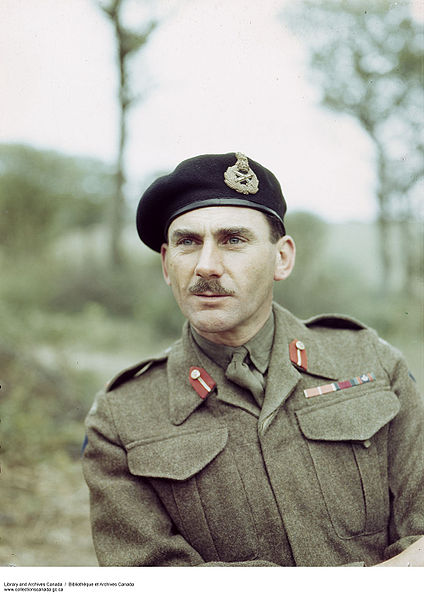
Major General Guy Simonds, commanding 1CID.
General Salmon had been hand-picked to lead Canada’s first major amphibious campaign. His death, just days before the invasion, shook the command structure. With no time to replace him formally, Major-General Guy Simonds was appointed in his place. Simonds was known for his drive, discipline, and tactical focus. The loss of Salmon meant an abrupt shift in leadership style and planning assumptions on the eve of battle.
Sinking of Canadian Troop Ships
Only days later, Canadian forces suffered another blow. Between 4–5 July, as convoys moved across the Mediterranean from North Africa toward Sicily, Axis submarines attacked Allied shipping near the Algerian coast. Three ships were torpedoed: the St. Essylt, City of Venice, and Devis.
While the first two sinkings resulted in relatively few casualties, the loss of the Devis was severe. Carrying 261 Canadian troops, the ship was hit and engulfed in fire. Fifty-two Canadians were killed, with many trapped in the holds below deck. In total, the convoy lost over 500 vehicles and 40 guns, along with critical headquarters and signals equipment. Divisional Headquarters suffered particularly heavy equipment losses, forcing last-minute improvisation in communications and command coordination.
Despite these losses, the Canadian Division adapted quickly, and the operation went forward as planned. These early setbacks, however, underscore the high cost and uncertainty of even reaching the battlefield in the Second World War.
Canadian Beaches
On 10 July 1943, the 1st Canadian Infantry Division landed in southeastern Sicily as part of Operation Husky – the Allied invasion of Europe’s “soft underbelly.” The division’s assault was split across two main beaches: “Roger” Beach to the east and “Sugar” Beach to the west of the village of Le Grotticelle. These beaches formed the right flank of the British Eighth Army’s landings.
General Simonds’ plan for the Canadians was a two-brigade front:
- The 1st Canadian Infantry Brigade would land on Roger Beach and push inland to destroy a coastal battery near Maucini, seize the Pachino airfield, and establish contact with nearby British forces around Pachino town.
- The 2nd Canadian Infantry Brigade would land on Sugar Beach, clear beach defences, support the adjacent British Special Service Brigade landing on the far left, and advance north past the Pantano Longarini marshes.
- The Special Service Brigade (British Commandos) would land west of Punta Castellazzo, eliminate enemy resistance in their zone, and cover the Canadians’ western flank from elevated ground north of the marshes.
The landings were scheduled for 2:45 a.m., with Commandos hitting the shore ten minutes earlier. Objectives were clear: knock out coastal defences, secure strategic positions, and quickly link up with Allied forces to expand the beachhead.
The Landings
Despite rough seas from a storm the day before, the landings went ahead as planned in the early hours of 10 July 1943. Just after 1:00 a.m., British Commandos began landing west of the Canadian sector, encountering only light resistance. By 1:34 a.m., the 2nd Canadian Infantry Brigade – the Seaforth Highlanders of Canada and Princess Patricia’s Canadian Light Infantry – were heading for Sugar Beach under covering fire from naval guns, including the 15-inch guns of HMS Roberts.
Navigation errors caused the Seaforth Highlanders to land to the right of the Patricias, reversing their intended order. But the heavy surf helped carry landing craft over a false beach, and both units came ashore with minimal opposition. They quickly cleared light beach obstacles and scattered Italian machine-gun posts. By 3:00 a.m., both battalions had successfully landed and were advancing inland toward their objectives.
On Roger Beach, however, the 1st Canadian Infantry Brigade faced delays. Their assault relied on DUKWs and landing craft (LCTs) arriving from Malta. When these were delayed, Brigadier Howard Graham initiated a backup plan, switching to Landing Craft Assault (LCAs). Confusion and the heavy swell caused further delay, with some units landing as late as 5:30 a.m. – nearly three hours behind schedule.
Despite the setbacks, the Hastings and Prince Edward Regiment and the Royal Canadian Regiment landed successfully. The Hastings had one reserve company land 5,000 yards off target in the Commando sector but regrouped without major issue. Both units met minimal resistance. The RCR encountered light shelling from the Maucini battery, but naval gunfire quickly silenced it.
By 6:45 a.m., all three lead brigades had secured their assigned beachheads, with support units and armour – including Shermans from the Three Rivers Regiment – beginning to land. The 48th Highlanders of Canada and The Edmonton Regiment followed their respective brigades ashore, some accompanied by pipe bands.
Opposition during the landings was light overall. Many Italian defenders withdrew as the naval bombardment and confusion of the assault overwhelmed them. However, isolated machine-gun fire and limited artillery shelling still resulted in several Canadian casualties, primarily on Roger Beach.
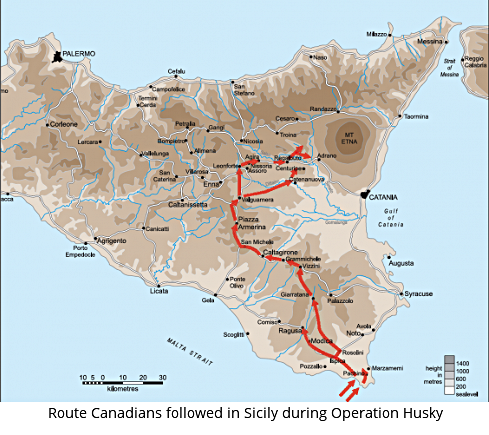
The pre-invasion loss of ships to enemy submarine or air attack was taken fully into account during the weeks before the convoys set out. But as with all military planning, the enemy gets a vote too.
Comments Off on The 1st Canadian Infantry Division in Operation Husky, 10 July 1943
Why Didn’t France and Britain Stop Germany’s Secret Rearmament? – Out of the Bullpen 001
World War Two
Published 10 Jul 2025In this special “Out of the Bullpen” episode, we answer your burning questions about Weimar Germany’s most turbulent years. From clandestine military pacts with the Soviets to the creative ways Germany sidestepped Versailles, we dig into aspects which shaped a republic on the brink.
(more…)
Comments Off on Why Didn’t France and Britain Stop Germany’s Secret Rearmament? – Out of the Bullpen 001
History of Britain V: Roman Conquest of Britain
Thersites the Historian
Published 5 Feb 2025The emperor Claudius felt insecure about his standing in the Roman world, so he sent four legions to Britain. The result was that Britain officially joined the Roman world and was now a peripheral part of the Roman Empire rather than an independent land of Celts.
Comments Off on History of Britain V: Roman Conquest of Britain
QotD: Pyrrhus arrives in Magna Graecia to support the Tarantines
The Roman response to Pyrrhus’ initial arrival was hardly panic. Military operations in Etruria for 280, under the consul Tiberius Corucanius, continued for the year, while the other consul, Publius Valerius Laevinius, went south to fight Pyrrhus and shore up Rome’s position in Southern Italy. We don’t have clear numbers for the size of the armies at Heraclea – Plutarch stresses that they were big (Plut. Pyrrh. 16.3) – but I think it is fair to suppose that Lavinius probably has a regular consular army with two legions and attached socii, roughly 20,000 men. It has sometimes been supposed this might have been a double-strength army (so 40,000 men) on the basis of some of our sources (including Plutarch) suggesting somewhat nebulously that it was of great size.
There are a few reasons I think this is unlikely. First, sources enlarging armies to fit the narrative magnitude of battles is a very common thing. But more to the point, Pyrrhus has crossed to Italy with 28,500 men total and – as Plutarch notes – hasn’t had a chance to link any of his allies up to his army. That may mean he hasn’t even reabsorbed his scouting force of 3,000 and he may well have also had to drop troops off to hold settlements, secure supplies and so on. Pyrrhus’ initial reluctance to engage (reported by Plutarch) is inconsistent with him wildly outnumbering the Romans, but his decision to wait for reinforcements within reach of the Romans is also inconsistent with the Romans wildly outnumbering him. So a battle in which Pyrrhus has perhaps 20-25,000 men and the Romans a standard two-legion, two-alae army of 20,000 give or take, seems the most plausible.1
The two forces met along the River Siris at Heraclea on the coastal edge of Lucania, Laevinius having pushed deep into southern Italy to engage Pyrrhus. As usual for these battles, we have descriptions or partial descriptions from a host of sources (in this case, Plutarch, Dionysius of Halicarnassus, Zonaras, Florus) which don’t always agree, leaving the modern historian in a bit of a pickle. Generally, we assume that a lot of the later Roman narratives of a famous defeat are likely to have been tailored to try and minimize the embarrassment, either by implying the battle was closer than it was or that Pyrrhus was a very impressive foe (or both) or other “face-saving” inventions. Worse yet, all of our sources are writing at substantial chronological distance, the Romans not really having started to record their own history until decades later (though there would have been Greek sources for later historians to work with). Generally, Patrick Kent tends to conclude that – somewhat unusually – Plutarch’s moralizing focus renders him more reliable here: Plutarch feels no need to cover for embarrassing Roman defeats or to embellish battle narratives (which he’d rather keep short, generally) because his focus is on the character of Pyrrhus. Broadly speaking, I think that’s right and so I too am going to generally prefer Plutarch’s narratives here.
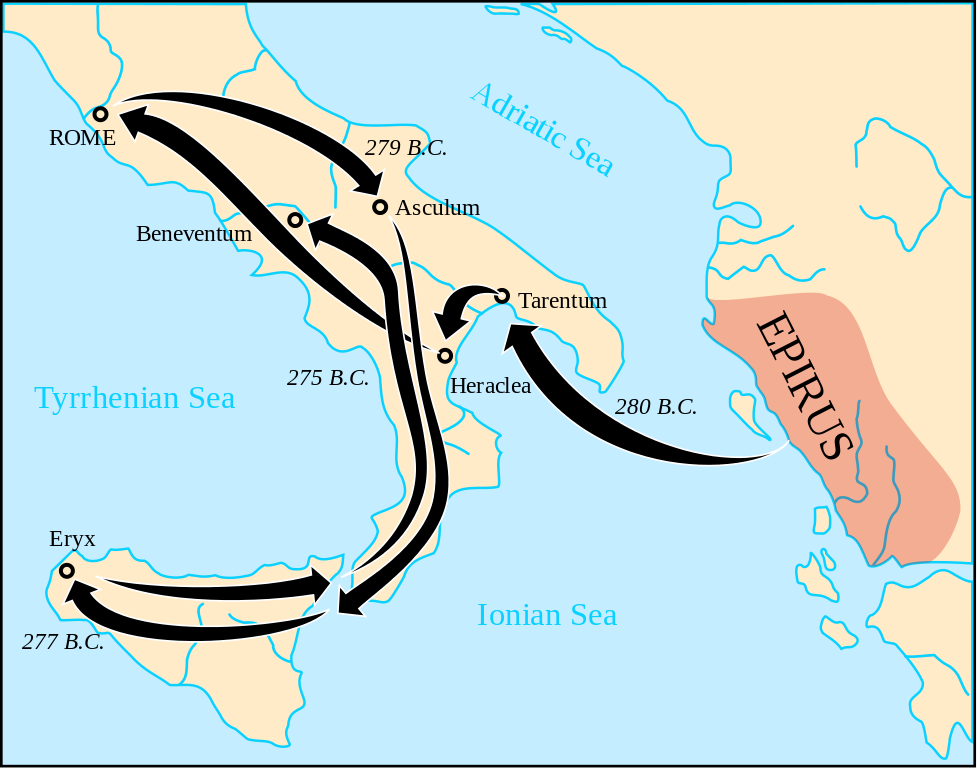
A fairly handy map of Pyrrhus’ campaigns (though some of the detail is lost in the big sweeping arrows). What is notable is, apart from Pyrrhus’ lightning raid into Latium in 280, he is almost invariably fighting in “friendly” territory, either in Lucania (Heraclea), Apulia (Asculum) or Samnium (Beneventum), the lands of his allies. Pyrrhus never fights an actual pitched battle on Roman-controlled territory, which I think speaks to his strategic intent: to carve out a kingdom in Greater Greece, not to conquer the whole of Italy.
Wikimedia Commons.The battle was defined by Pyrrhus’ use of terrain – Pyrrhus thought delay might be wiser (to link up with his allies) but left a blocking force on the river (the Romans being on the other side). The Romans responded by forcing the river – typical Roman aggression – but Plutarch at least thinks it caught Pyrrhus by surprise (he hadn’t fought Romans before) and so it leaves him in a scramble. He charges his cavalry (Plut. Pyrrh. 16.5) to give his main phalanx time to form up for battle resulting in what seems like a cavalry engagement near the river. Pyrrhus nearly gets himself killed in the fighting, but survives and falls back to his main infantry force, which then met the Romans in an infantry clash. The infantry fighting was fierce according to Plutarch and Pyrrhus, still shaken from being almost killed, had to come out and rally his troops. In the end, the Romans are described as hemmed in by Pyrrhus’ infantry and elephants before some of his Greek cavalry – from Thessaly, the best horse-country in Greece – delivers the decisive blow, routing the Roman force.
It is, on the one hand, a good example of the Hellenistic army “kit” using almost all of its tactical elements: an initial – presumably light infantry – screen holding the river, followed by a cavalry screen to enable the phalanx to deploy, then a fierce and even infantry fight, finally decided by what seems to be flanking actions by cavalry and elephants. Plutarch (Pyrrh. 17.4) gives two sets of casualty figures, one from Dionysius and another from Hieronymus; the former says that the Romans lost 15,000 to Pyrrhus’ 13,000 killed, the latter that the Romans lost 7,000 to Pyrrhus’ just a bit less than 4,000 killed. The latter seems almost certainly more accurate. In either case, the Roman losses were heavier, but Pyrrhus’ losses were significant and as Plutarch notes, his losses were among his best troops.
Even in the best case, in victory, Pyrrhus had lost around 15% of his force (~4,000 out of 28,000), a heavy set of losses. Indeed, normally if an army loses 15% of its total number in a battle, we might well assume they lost. Roman losses, as noted, were heavier still, but as we’ve discussed, the Romans have strategic depth (in both geography, political will and military reserves) – Pyrrhus does not. By contrast, Alexander III reportedly wins at Issus (333) with just 150 dead (and another 4,802 wounded or missing; out of c. 37,000) and at Gaugamela (331) with roughly 1,500 losses (out of c. 47,000). The Romans will win at Cynoscephelae (197) with just 700 killed.
This isn’t, I think, a product of Pyrrhus failing at all, but rather a product of the attritional nature of Roman armies: even in defeat they draw blood. Even Hannibal’s great victory at Cannae (216) costs him 5,700 men, according to Polybius (more, according to Livy). But the problem for Pyrrhus is that his relatively fragile Hellenistic army isn’t built to repeatedly take those kinds of hits: Pyrrhus instead really needs big blow-out victories where he takes few losses and destroys or demoralizes his enemy. And the Roman military system does not offer such one-sided battles often.
Nevertheless, Pyrrhus shows that a Hellenistic army, capable handled, could beat a third-century Roman army, albeit not cleanly, and that is well worth noting.
Bret Devereaux, “Collections: Phalanx’s Twilight, Legion’s Triumph, Part IIIb: Pyrrhus”, A Collection of Unmitigated Pedantry, 2024-03-08.
1. I should note, this is Kent’s assessment as well.
Comments Off on QotD: Pyrrhus arrives in Magna Graecia to support the Tarantines
July 10, 2025
The Prussian defeats at Jena and Auerstadt in 1806
At Dead Carl and You, Kiran Pfitzner describes the disastrous 1806 campaign that knocked Prussia out of the war against Napoleon and shattered the military reputation of the army built by Frederick the Great:
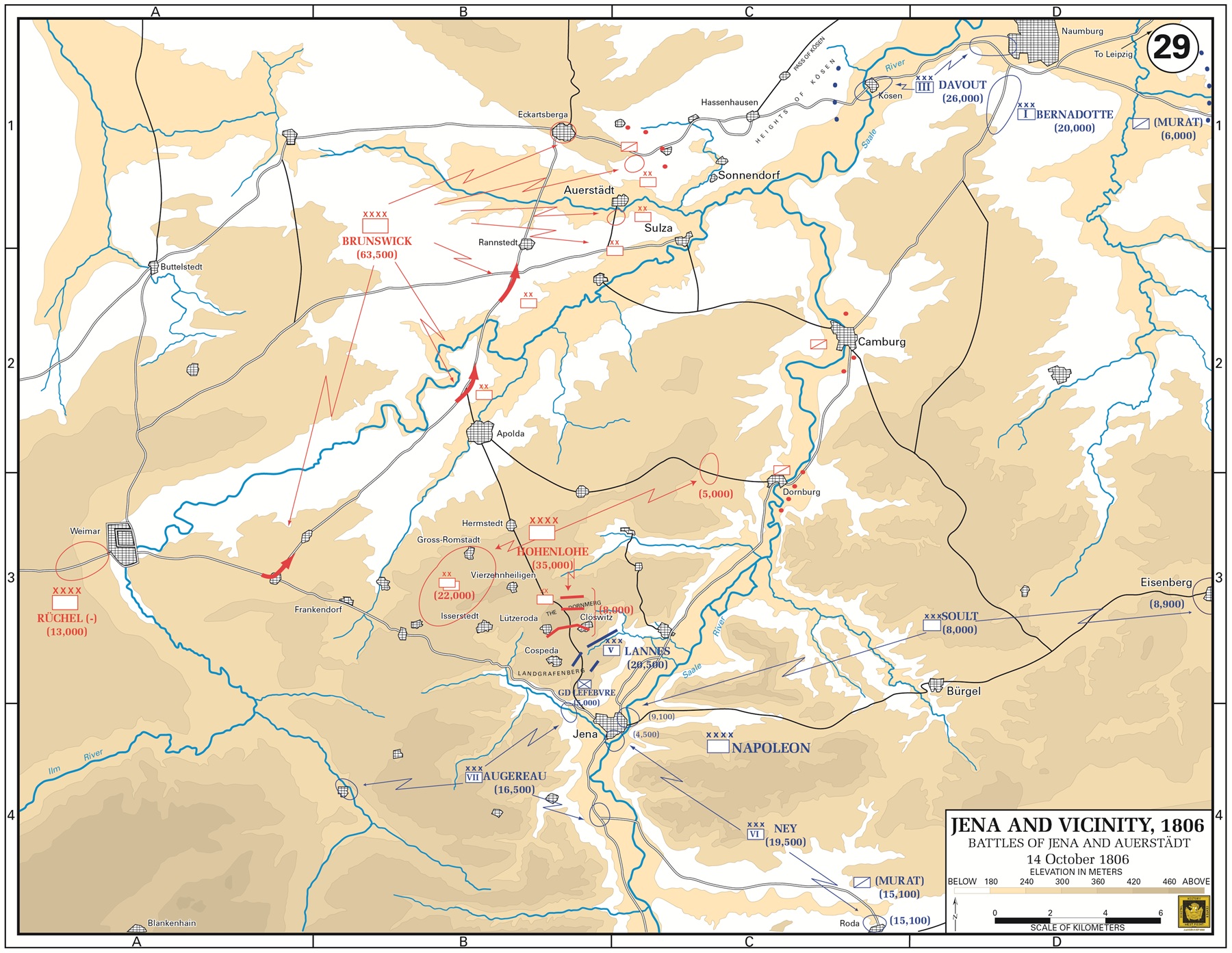
In brief, the course of the 1806 campaign was that the Prussians met the French at Saalfeld and were initially defeated. The Prussians therefore decided to retreat before meeting Napoleon himself in battle. However, poor command organization and irresolution ended up dividing and delaying the Prussian forces. Thus, the rearguard ended up meeting the French main body under Napoleon which was able to overwhelm it at Jena.
The battle itself was not especially punishing, but the relentless pursuit of the French cavalry yielded many prisoners and prevented the reconstitution of the army. On the same day, the Prussian main body had encountered a French corps under Marshal Davout at Auerstedt, but failed to overcome it in a series of piecemeal attacks that cost it the lives of its commanders. The Prussians were demoralized enough that an attack from the outnumbered French was enough to force the main body into disorder. The arrival of fleeing forces from Jena spread a general panic and prevented any chance of recovery. From there, the campaign was a matter of pursuit and capitulation — within weeks the French were parading through the streets of Berlin. This humiliating defeat gave Clausewitz impetus to seek an understanding of the nature of war. How could the vaunted Prussian army, envy of the world in the days of Frederick the Great (still within living memory), be so summarily dispatched?
It was clear to virtually all military thinkers of the time that war had changed. To many, Napoleon was utilizing a higher, more perfect form of war than had been previously known. Clausewitz instead recognized that Napoleon was not refining war, but recognizing that changes in social conditions had enabled fighting with more energy and violence than had been possible in the cabinet wars of the 18th century. This had proven significant because the limitations of the 18th century made maneuver and logistics central to skilled generalship. Battles were important, but much that was won or lost in a battle could be subsequently lost or won outside it.
The removal of these restrictions drastically increased the importance of battle as it was able to produce results that could not be compensated for actions outside of it. Skilled generalship was therefore no longer a matter of outmaneuvering the enemy or protecting your supply lines while threatening his, but of bringing maximum force to the point of battle. Initiative, coordination, and aggression become the key traits of an officer. Thus, more expansively, the task of the officer is to recognize changes to the character of war and so understand what is required in practice. Neither history nor experience can anticipate these developments — it falls to the judgment of the individual to recognize them.
This framing shows clearly the mistakes of the Prussians. Operating in the old paradigm, they sought to make good with maneuver what they had lost in the opening battle of the campaign. They had divided their forces under the assumption the French would be unable or unwilling to aggressively pursue their retreat. At the same time, when they engaged the French, they showed caution entirely congruent with a cabinet army but fatally out of place when facing a Napoleonic force. On numerous occasions, the French made serious blunders that went unpunished because the Prussians failed to take the initiative and capitalize on them.
Nowhere is this more clear than in the failure of the Prussian main body to overcome the single corps it faced at Auerstedt. While outnumbering the French, the Prussian attacked piecemeal, becoming demoralized under French fire. The morale of the Prussians was substantially more brittle on account of their relative lack of nationalism — the state and therefore the army were not objects of any great affection by those subject to them. While this would require social reforms to remedy, Auerstedt had nevertheless been an opportunity for the Prussians. They had a French corps outnumbered more than two-to-one and merely needed to bring that force to bear to inflict a serious defeat. A Prussian victory would have positioned the main body to receive the retreating forces from Jena, allowing another confrontation with Napoleon on at least equal terms. Timidity and irresolution therefore played as big a part in the disaster as did the deeper defects.
In part, this must be ascribed to the advanced age of Prussian leadership. The senior commanders at both Jena and Auerstedt were over seventy. Not only did this ensure continuity with older forms of war, but men of such an age were unlikely to have the energy to campaign aggressively — by contrast, Napoleon and his marshals were three or four decades younger. The Prussian leaders did not lack physical courage, as their valiant deaths attest, but exposing oneself to danger is not the same quality that is needed for decisive and energetic action over an extended period of time.
The Prussian strategy deserves further criticism because by that point Bonaparte’s character was well known. There was no justification to have any illusions as to what the consequences of defeat would be. Prussia’s status amongst the great powers — if not its very existence as an independent state — would be determined by the confrontation. Leaving troops in Silesian fortresses or Polish garrisons (through which Prussia’s available forces were reduced by half) meant narrowing the odds of victory in pursuit of things that could be no substitute for victory and no comfort in defeat.
Comments Off on The Prussian defeats at Jena and Auerstadt in 1806
Was Matilda II the BEST Tank of WWII?
The Tank Museum
Published 21 Feb 2025Forget the Sherman, forget the Panther, forget the T-34 … Should Matilda II be considered the best tank of WWII?
Emerging from the request for a new and improved infantry tank, Matilda II debuted on the battlefield in France. The heroic actions of Matilda crews at Arras stopped Blitzkrieg in its tracks and allowed the British army to be evacuated from the beaches of Dunkirk.
The Matilda’s fighting peak was during the North Africa campaign, where the 2pdr gun was more than a match for any of the Italian armour it came up against. Despite some mechanical issues, the performance of Matilda II at this time would earn her the title “Queen of the Desert”. Once the Germans arrived in North Africa, Matilda started to become obsolete but remained useful as a testbed for experimental equipment that would eventually be used on D-Day.
Matilda II saw service in all theatres of the Second World War. Around 900 tanks were deployed by the Soviets in 1942, filling the gap as the Red Army increased its roster of T-34s. Matilda made great contributions to campaigns in the Pacific – its small and solid profile making it ideal for jungle bashing. The Australians made effective use of the Matilda, creating variants including a mortar launcher and a flamethrower.
Some say that if it wasn’t for Matilda II we would be speaking German right now. Watch this video to find out why …
00:00 | Introduction
00:36 | Heroics at Arras
03:29 | It Takes Two
06:00 | Matilda II – Inside and Out
13:03 | Queen of the Desert
18:14 | Soviet Service on The Eastern Front
19:49 | The Pacific – Welcome to the Jungle…
(more…)
Comments Off on Was Matilda II the BEST Tank of WWII?
July 9, 2025
NATO secretary general Mark Rutte – Trump’s biggest European fanboy?
I don’t often encounter positive reactions to US President Donald Trump from the other side of the pond, but Paul Wells makes a case here for Mark Rutte, the current secretary general of the NATO alliance, being utterly sincere in his regard for his American “daddy”:

Mark Rutte, the NATO secretary general.
Photo from Paul Wells’ substack
I haven’t seen much commentary about Mark Rutte’s weekend interview with the New York Times. It’s quite an interview. If the NATO secretary general is faking his enthusiasm for Donald Trump, he’s really committing to the bit.
I’m going to quote Rutte’s remarks in greater detail than you sometimes get, because what really stands out over the 36-minute podcast that resulted from the Times interview is Rutte’s doggedness. He doesn’t simply treat the US president as a containable problem, as European security experts sometimes do, but as nothing less than a full NATO partner and, indeed, as the hero of the alliance’s revitalization.
“President Trump deserves all the praise,” he tells interviewer Lulu Garcia-Navarro, a longtime NPR foreign correspondent before she joined the Times, “because without his leadership, without him being re-elected president of the United States, the 2% this year and the 5% in 2035 — we would never, ever, ever have been able to achieve agreement on this.”
Does he regret that Trump posted what the AP and a lot of others called a “fawning” text message in which Rutte wrote to Trump, “Europe is going to pay in a BIG way, as they should, and it will be your win”? “Not at all, because what was in the text message is exactly as I see it.”
Is the integrity of NATO’s defense perimeter solid? “But it’s not that the Estonians are left to themselves. It would be the full force of NATO, including the full backup of the United States, which will come to the rescue. Putin knows this.”
Garcia-Navarro keeps pushing. Full backup of the United States, she says? You bet, Rutte says. In “everything I’ve discussed over the last six months with the new U.S. administration” there is “absolutely no shiver of a doubt that the U.S. is completely committed to NATO, is completely committed to Article 5,” the Alliance’s collective-defence principle.
Isn’t there a “fundamental disconnect” between the way Trump views the world and the commitments needed to make NATO work? Rutte answers: Nope! “President Trump put in place an excellent foreign-policy team, including Marco Rubio and Pete Hegseth,” he offers.
But “what we are seeing,” Garcia-Navarro insists, perhaps in reference to this or this, “is the United States pulling back from Europe.”
“I really have to correct you,” Rutte insists in turn. “The United States is not pulling away from Europe.”
Where does Rutte stand on the credibility and prospects of Russia-Ukraine peace talks? “With the risk that I’m again praising President Trump: He is the one who broke the deadlock with Putin. When he became president in January, he started these discussions with Putin, and he was the only one who was able to do this. This had to happen.”
Comments Off on NATO secretary general Mark Rutte – Trump’s biggest European fanboy?
WF-54: The Swiss FG-42 Scaled up to 7.5×55
Forgotten Weapons
Published 19 Aug 2024After World War Two the Swiss needed a new self-loading military rifle to replace their K-31 bolt actions. Two major design tracks followed; one being a roller-delayed system based on the G3 at SIG and the other being a derivative of the German FG-42 at Waffenfabrik Bern. Bern, under the direction of Adolph Furrer, had been experimenting with intermediate cartridges since the 1920s, and they used this as a basis to develop an improved FG-42 using an intermediate cartridge (7.5x38mm). The program began in 1951 and went through about a half dozen major iterations until it ultimately lost to the SIG program (which produced the Stgw-57).
Today we are looking at one of the later steps in the Bern program, the WF-54. By this point the intermediate cartridge had been discarded in favor of using the standard Swiss GP11 (7.5x55mm). The overall design was a bit simplified as well. The Bern program would continue for two more years after this rifle before ultimately losing out to the SIG 510 for Swiss military adoption.
(more…)
Comments Off on WF-54: The Swiss FG-42 Scaled up to 7.5×55


