
World War Two
Published 6 Sept 2025In this episode of Out of the Foxholes, we dive into your community questions about World War II. How did Hermann Göring manage to get the cyanide capsule that ended his life at Nuremberg? What role did Slovakia really play in 1939? Why didn’t the Allies invade the Balkans instead of France, and why didn’t Japan use its submarines like Germany did?
(more…)
September 7, 2025
How Did Göring Get the Cyanide? OOTF Community Questions
Comments Off on How Did Göring Get the Cyanide? OOTF Community Questions
Up on the Mountain: a History of the Ski Cap
HatHistorian
Published 1 May 2025The ski cap, sometimes also called by its german name of Bergmütze, is a visored cap with ear flaps secured to the front by buttons or a buckle. Allegedly descended from eastern bashlyks worn by Russian soldiers, it was popular in the alpine regions of Germanic countries. First adopted by the AUstro-Hungarian Empire as a field cap, it was infamously worn by the Wehrmacht during WWII. It continues to be used as a field or dress cap by German, Austrian, and Hungarian armed forces, and civilian versions can be found around Central and Eastern Europe.
(more…)
Comments Off on Up on the Mountain: a History of the Ski Cap
September 6, 2025
New Evidence on the loss of HMS Hood!
Drachinifel
Published 5 Sept 2025Today we take a look at a heretofore unpublished account from a sailor who saw the destruction of HMS Hood, and take a look at what this might tell us about the incident.
(more…)
Comments Off on New Evidence on the loss of HMS Hood!
Unique British Crankfire .58 Morse Manual Machine Gun
Forgotten Weapons
Published 30 Apr 2025This is a really interesting piece with a mostly unknown origin. It was manufactured in the UK (the barrel was deemed Enfield-made by former Royal Armouries curator Herb Woodend) and is chambered for the .58 Morse centerfire cartridge. The date of production is unknown. It uses a gravity-feed magazine and fires via hand crank. Turning the crank cycles the bolt forward and back, not completely unlike a Maxim gun but without the automatic operation. It came out of a small Canadian museum in the 1950s, but its provenance before that is unknown.
(more…)
Comments Off on Unique British Crankfire .58 Morse Manual Machine Gun
September 5, 2025
BBC’s new King and Conqueror series
In The Critic, Sebastian Milbank discusses the BBC’s latest attempt to recast British history in a way more pleasing to, as the Critical Drinker would say, “modern audiences”:

If you care about truth, beauty or goodness, I have bad news for you: the BBC has just created a historical drama set in the Middle Ages. Yes, this is the arrival of King and Conqueror, which depicts the events leading up to the Battle of Hastings and the Norman Conquest. The raw matter of the historical record is incredibly promising: ferocious royal intrigues, hagiographical piety, civil and not so civil war, and all the strange poetics and ceremony of French and Anglo-Saxon courtly life. The culture that gave us Lincoln Cathedral and the culture that gave us Sutton Hoo, should be reason alone for the most spectacular of costumes, battles and speeches.
But anyone hoping for a moving epic or a gripping thriller would be equally disappointed, as the brainless BBC tramples cheerfully into a sordid pastiche even more gormless than Game of Thrones (which at least had a decent budget). Future King of England Harold Godwinson (played by James Norton) is introduced to audiences uttering the admittedly pretty Anglo-Saxon phrase “it’s a fucking massacre”, in the manner of someone commenting on an especially brutal 3-nil football match.
I could induce miserable groaning from readers at this point by listing every meta-level historical inaccuracy from the almost entirely fictitious events of the coronation, to the succession of geographical and biographical distortions that rain down on viewers like so many 11th century arrows, to the inexplicable but inevitable (it’s the BBC) presence of black Anglo-Saxons. But none of these departures from the historical record are inherently unforgivable and might in theory be justified in the name of telling a compelling story.
What is truly egregious is not the fictionalisation of details, but the outright misrepresentation of the morals, manners and minds of medieval man. If the past really was a foreign country, then the BBC would be rightly besieged by those outraged at the bigoted, hate-filled and slanderous portrayal of that alien nation in this drama. Edward the Confessor, a man who has been quite literally beatified, is depicted beating his own mother to death. Duke William of Normandy, is shown murdering a man in broad daylight for setting a captured enemy free. Later on, when the enemy — rebellious vassal Guy of Burgundy — is recaptured, he is personally tortured by William’s wife Matilda.
The modern imagination has rendered these figures, and the times they lived in, as more brutal than they truly were. Even the famously ruthless William, who grew up dodging assassins and facing down rebellious barons, is not the thuggish hard man the series would present. The historical accounts suggest that he was a strict adherent to chivalric custom and a deeply pious man. In the real world, William banishes Guy then declares the “peace of God” in Normandy, bringing an end to violence and retribution for the crimes of the past decades. King Edward, who is presented as a snivelling, cowardly mother’s boy, was by every contemporary account a heroic, forceful and gregarious ruler, one who had his mother exiled, and certainly not murdered.
Comments Off on BBC’s new King and Conqueror series
How To Host An Ancient Roman Dinner
Tasting History with Max Miller
Published 1 Apr 2025Roast duck basted with defrutum and served with a sweet and savory dipping sauce atop a bed of herbs
City/Region: Rome
Time Period: 1st CenturyFirst off, this is not a flamingo. While they’re still eaten in some parts of the world, where I live is not one of those parts. I’m using a duck instead, and it’s absolutely delicious.
The real star of this dish is the sauce, which I think would go well with pretty much anything. It’s sweet at first, then you get the savoriness and complexity of the herbs and spices along with a luxurious richness from the duck drippings. It might just be my favorite Roman sauce that I’ve made (and I’ve made quite a few).
For flamingo:
Pluck the flamingo wash, tie, and put it in a pot; add water, salt, dill, and a little vinegar. Half-way through cooking, add a bundle of leek and cilantro and cook. When it is nearly done add defrutum to give it color. Pound in a mortar pepper, cumin, coriander, silphium, mint, rue; moisten with vinegar, add dates, pour over some of the drippings. Put it in the pot, thicken with starch, pour the sauce over the bird, and serve. The same recipe can be used for parrot.
— Apicius De re coquinaria, 1st Century
Comments Off on How To Host An Ancient Roman Dinner
September 4, 2025
They can’t catch actual criminals, but they are quite capable of arresting social media users
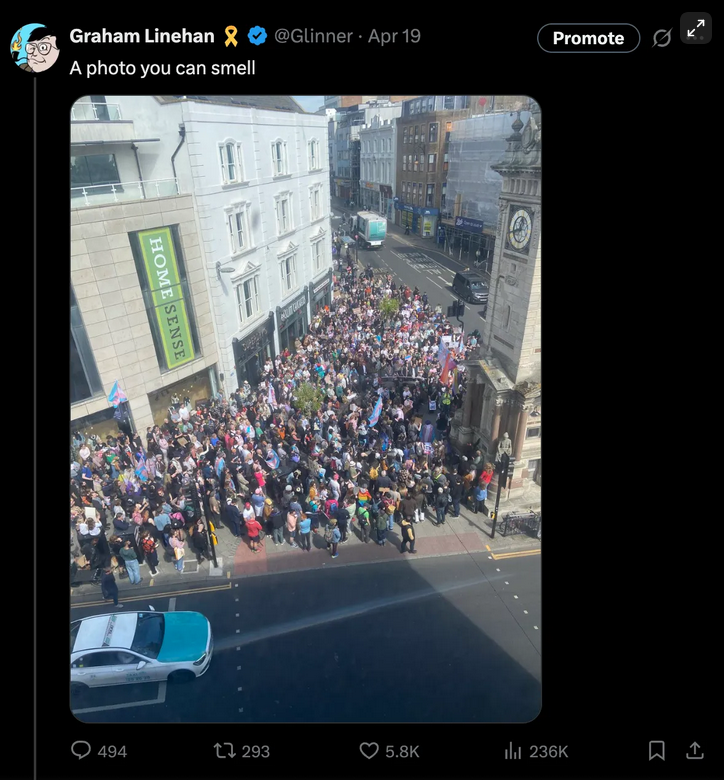
Andrew Doyle hopes that the farcical performance by British police in sending five armed officers to arrest Graham Linehan as he stepped off the plane will be a tipping point:

How many more controversies will it take? The arrest of comedy writer Graham Linehan by five armed police officers as he landed at Heathrow Airport has become an international news story because it so self-evidently tyrannical. The stress of the ordeal raised his blood pressure to an alarming degree and he was rushed to hospital. With the help of the Free Speech Union, Graham is now suing the Metropolitan Police. You can donate to his crowdfunder here.
It is reassuring to see that some action is being taken against such chilling state overreach, but when will our politicians follow suit? Many of us have been warning about this ongoing assault on liberty for many years, and at every watershed moment we’ve been led to believe that something will be done. Then, inevitably, the “blob” is activated and swallows up any potential for progress in its viscous and undulating folds.
So when Sir Mark Rowley, head of the Metropolitan Police, complains that the police are acting on unclear laws, and that the responsibility for the maltreatment of the likes of Graham lies with those in power, he’s overlooking the impact of the activist middlemen. Let’s not forget that the Home Office has twice instructed the College of Policing to stop the recording of “non-crime hate incidents” (NCHIs) and has been ignored. Or that the chairman of the College of Policing, Lord Herbert, said the solution to the complaints about NCHIs might be to rename them. As though the public’s concerns about this brazen authoritarianism might be assuaged with a touch of rebranding.
Rowley’s buck-passing is likewise inadequate. He claimed that Graham’s arrest was necessary because officers “had reasonable grounds to believe an offence had been committed”, which is palpably untrue. He said: “I don’t believe we should be policing toxic culture wars debates and officers are currently in an impossible position”. He also made clear that police would continue to behave in this way “unless the law and guidance is changed or clarified”.
But this is precisely the problem. At present, a quango called the College of Policing trains officers in England and Wales. In my article for UnHerd about Graham’s arrest (which you can read here) I make the case that the College of Policing has become woefully unfit for purpose due to activist capture. For a long time, agitators within the system have reinterpreted and fudged the actual law in favour of what they would like it to be. This has led to some police acting in potentially criminal ways. Most egregiously, there is clear evidence of systemic bias against gender-critical individuals within the police force, and a reluctance to apply identical standards to trans activists who routinely post threats of death and rape and are rarely investigated for it.
In the wake of the Linehan arrest, Tom Knighton wonders why the US isn’t treating the UK as it would any other tyranny where free speech and other civil liberties are denied to the people on a whim or a suspicion:
The United States has a history of dealing with tyrannical governments, who oppose tyrannical governments we like even less. We worked with Saddam Hussein, for example, because he was at war with Iran.
But we never stopped pretending these weren’t tyrants.
So, it’s time we start treating the UK just the same.
The latest incident was a well-known comedian from the UK being arrested over a couple of jokes.
Something odd happened before I even boarded the flight in Arizona. When I handed over my passport at the gate, the official told me I didn’t have a seat and had to be re-ticketed. At the time, I thought it was just the sort of innocent snafu that makes air travel such a joy. But in hindsight, it was clear I’d been flagged. Someone, somewhere, probably wearing unconvincing make-up and his sister/wife’s/mum’s underwear, had made a phone call.
The moment I stepped off the plane at Heathrow, five armed police officers were waiting. Not one, not two—five. They escorted me to a private area and told me I was under arrest for three tweets. In a country where paedophiles escape sentencing, where knife crime is out of control, where women are assaulted and harassed every time they gather to speak, the state had mobilised five armed officers to arrest a comedy writer for this tweet (and no, I promise you, I am not making this up.
… and then, a follow up to that one.
When I first saw the cops, I actually laughed. I couldn’t help myself. “Don’t tell me! You’ve been sent by trans activists” The officers gave no reaction and this was the theme throughout most of the day. Among the rank-and-file, there was a sort of polite bafflement. Entirely professional and even kind, but most had absolutely no idea what any of this was about.
While the officers were kind, they still arrested him. They arrested him because he made some jokes. He spent time in a jail cell, was interviewed by detectives, and was treated like a criminal because he made some jokes.
They waited for him at the airport with five officers, something that would be a clear indication to others that he was truly dangerous, over some jokes.
The first one wasn’t a great joke, really, but that wasn’t the issue. This wasn’t that it wasn’t as funny as it should have been, but that it was made at all.



Comments Off on They can’t catch actual criminals, but they are quite capable of arresting social media users
Net Zero targets and Britain’s ever-declining car industry
At the Foundation for Economic Education, Jake Scott charts the decline of the British auto manufacturing centres and the government’s allegiance to its Net Zero programs:
Custom image by FEE
Britain was once a giant of car manufacturing. In the 1950s, we were the second-largest producer in the world and the biggest exporter. Coventry, Birmingham, and Oxford built not just cars, but the reputation of an industrial nation; to this day, it is a source of great pride that Jaguar–Land Rover, a global automotive icon, still stands between Coventry and Birmingham. By the 1970s, we were producing more than 1.6 million vehicles a year.
Today? We have fallen back to 1950s levels. Last year, Britain built fewer than half our peak output—800,000 cars, and the lowest outside the pandemic since 1954. Half a year later, by mid-2025, production has slumped a further 12%. The country that once led the automotive revolution is now struggling to stay afloat, and fighting to remain relevant.
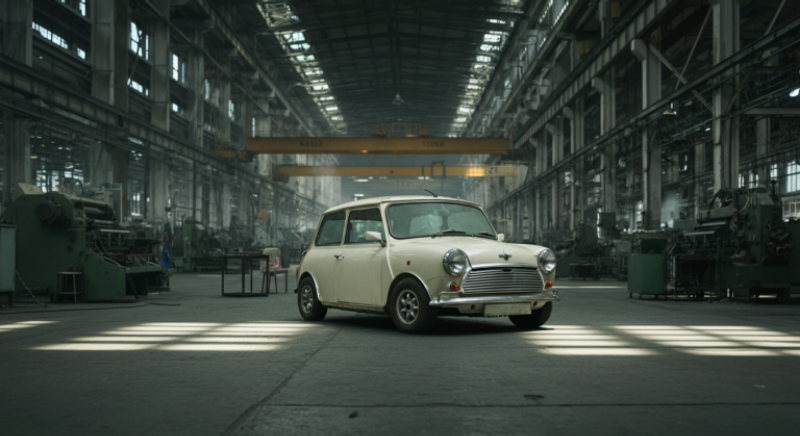
This is why the news that BMW will end car production at Oxford’s Mini plant, shifting work to China, is so damning, bringing this decline into sharp focus. The Mini is not only a classic British car; Alec Issigonis’s original design made it an international icon. For decades, the Mini has been the bridge between British design flair and foreign investment. Its departure leaves 1,500 jobs at risk at a time when the government is desperate to fuel growth and convince a wavering consumer market that there is no tension between industrial production and Net Zero goals.
It’s a bitter reminder that we in Britain have been here before: letting an industrial crown jewel slip away.
The usual explanations will be offered: global competition, exchange rates, supply chains. All true, in the midst of a global trade war that is heating up and damaging major British exports. But such a diagnosis is incomplete. The truth is that Britain’s car industry is being squeezed by a mix of geopolitical realignment and government missteps.
The car industry has become the frontline of a new trade war. Washington has already moved aggressively to shield its own firms: the Inflation Reduction Act offers vast subsidies for US-made EVs and batteries, an unapologetic attempt to onshore production, and something that became a flashpoint of tension in Trump’s negotiation with the EU in the latest trade deal. On the production side, the Act has poured billions into US manufacturing: investment in EV and battery plants hit around $11 billion per quarter in 2024.
Ripples have been sent across the world in the US’s wake: Europe, faced with a flood of cheap Chinese EVs, has imposed tariffs of up to 35% after an anti-subsidy investigation. Talks have even turned to a system of minimum import prices instead of tariffs. Unsurprisingly, China has threatened retaliation against European luxury marques, while experts warn the tariffs may slow the EU’s green transition by raising prices.
This is no longer a free market: cars are treated as strategic assets, the 21st-century equivalent of shipbuilding or steel. Whoever controls the supply chains, particularly for EV batteries and the mining of lithium, controls not only the future of the industry but an important lever of national power.
The results are visible. In July 2025, Tesla’s UK sales collapsed nearly 60%, while Chinese giant BYD’s deliveries quadrupled. Europe responded by talking up new tariffs. Britain did nothing. In this asymmetric contest, our market risks becoming a showroom for foreign producers — subsidizing both sides of the trade war without defending our own.
Comments Off on Net Zero targets and Britain’s ever-declining car industry
Mussolini’s Blunder: Greece and North Africa 1940
Real Time History
Published 4 Apr 2025Hitler’s victories in 1940 present a historic opportunity to Italian dictator Benito Mussolini to expand the Italian Empire. Instead, Italy suffers a series of humiliating disasters in Greece and North Africa. So why did Mussolini declare war on the Allies at this moment, and could Germany be ultimately responsible for the Italian fiasco?
(more…)
Comments Off on Mussolini’s Blunder: Greece and North Africa 1940
QotD: The development of the “halftrack” during the interwar period
The period between WWI and WWII – the “interwar” period – was a period of broad experimentation with tank design and so by the time we get to WWII there are a number of sub-groupings of tanks. Tanks could be defined by weight or by function. The main issue in both cases was the essential tradeoff between speed, firepower and armor: the heavier you made the armor and the gun the heavier and thus slower the tank was. The British thus divided their tank designs between “cruiser tanks” which were faster but lighter and intended to replace cavalry while the “infantry tanks” were intended to do the role that WWI tanks largely had in supporting infantry advances. Other armies divided their tanks between “light”, “medium”, and “heavy” tanks (along with the often designed but rarely deployed “super heavy” tanks).
What drove the differences in tank development between countries were differences between how each of those countries imagined using their tanks, that is differences in tank doctrine. Now we should be clear here that there were some fundamental commonalities between the major schools of tank thinking: in just about all cases tanks were supposed to support infantry in the offensive by providing armor and direct fire support, including knocking out enemy tanks. Where doctrine differed is exactly how that would be accomplished: France’s doctrine of “Methodical Battle” generally envisaged tanks moving at the speed of mostly foot infantry and being distributed fairly evenly throughout primarily infantry formations. That led to tanks that were fairly slow with limited range but heavily armored, often with just a one-man turret (which was a terrible idea, but the doctrine reasoned you wouldn’t need more in a slow-moving combat environment). Of course this worked poorly in the event.
More successful maneuver warfare doctrines recognized that the tank needed infantry to perform its intended function (it has to have infantry to support) but that tanks could now move fast enough and coordinate well enough (with radios) that any supporting arms like infantry or artillery needed to move a lot faster than walking speed to keep up. Both German “maneuver warfare” (Bewegungskrieg) and Soviet “Deep Operations” (or “Deep Battle”) doctrine saw the value in concentrating their tanks into powerful striking formations that could punch hard and move fast. But tanks alone are very vulnerable and in any event to attack effectively they need things like artillery support or anti-air protection. So it was necessary to find ways to allow those arms to keep up with the tanks (and indeed, a “Panzer divsion” is not only or even mostly made up of tanks!).
At the most basic level, one could simply put the infantry on trucks or other converted unarmored civilian vehicles, making “motorized” infantry, but […] part of the design of tanks is to allow them to go places that conventional civilian vehicles designed for roads cannot and in any event an unarmored truck is a large, vulnerable tempting target on the battlefield.
The result is the steady emergence of what are sometimes jokingly called “battle taxis” – specialized armored vehicles designed to allow the infantry to keep up with the tanks so that they can continue to be mutually supporting, while being more off-road capable and less vulnerable than a truck. In WWII, these sorts of vehicles were often “half-tracks” – semi-armored, open-topped vehicles with tires on the front wheels and tracks for the back wheels, though the British “Universal Carrier” was fully tracked. Crucially, while these half-tracks might mount a heavy machine gun for defense, providing fire support was not their job; being open-topped made them particularly vulnerable to air-bursting shells and while they were less vulnerable to fire than a truck, they weren’t invulnerable by any means. The intended use was to deposit infantry at the edge of the combat area, which they’d then move through on foot, not to drive straight through the fight.
The particular vulnerability of the open-top design led to the emergence of fully-enclosed armored personnel carriers almost immediately after WWII in the form of vehicles like the M75 Armored Infantry Vehicle (though the later M113 APC was eventually to be far more common) and the Soviet BTRs (“Bronetransporter” or “armored transport”), beginning with the BTR-40; Soviet BTRs tended to be wheeled whereas American APCs tend to be tracked, something that also goes for their IFVs (discussed below). These vehicles often look to a journalist or the lay observer like a tank, but they do not function like tanks. The M113 APC, for instance, has just about 1.7 inches of aluminum-alloy armor, compared to the almost four inches of much heavier steel armor on the contemporary M60 “Patton” tank. So while these vehicles are armored, they are not intended to stick in the fight and are vulnerable to much lighter munitions than contemporary tank would be.
At the same time, it wasn’t just the infantry that needed to be able to keep up: these powerful striking units (German Panzer divisions, Soviet mechanized corps or US armored divisions, etc.) needed to be able to also bring their heavy weaponry with them. At the start of WWII, artillery, anti-tank guns and anti-air artillery remained almost entirely “towed” artillery – that is, it was pulled into position by a truck (or frequently in this period still by horses) and emplaced (“unlimbered”) to be fired. Such systems couldn’t really keep up with the tanks they needed to support and so we see those weapons also get mechanized into self-propelled artillery and anti-air (and for some armies, tank destroyers, although the tank eventually usurps this role entirely).
Self-propelled platforms proved to have another advantage that became a lot more important over time: they could fire and then immediately reposition. Whereas a conventional howitzer has to be towed into position, unlimbered, set up, loaded, fired, then limbered again before it can move, something like the M7 Priest can drive itself into position, fire almost immediately and then immediately move. This maneuver, called “shoot-and-scoot” (or, more boringly, “fire-and-displace”) enables artillery to avoid counter-battery fire (when an army tries to shut down enemy artillery by returning fire with its own artillery). As artillery got more accurate and especially with the advent of anti-artillery radars, being able to shoot-and-scoot became essential.
Now while self-propelled platforms were tracked (indeed, often using the same chassis as the tanks they supported), they’re not tanks. They’re designed primarily for indirect fire (there is, of course, a sidebar to be written here on German “assault guns” – Sturmgeschütz – and their awkward place in this typology, but let’s keep it simple), that is firing at a high arc from long range where the shell practically falls on the target and thus are expected to be operating well behind the lines. Consequently, their armor is generally much thinner because they’re not designed to be tanks, but to play the same role that towed artillery (or anti-air, or rocket artillery, etc.) would have, only with more mobility.
So by the end of WWII, we have both tanks of various weight-classes, along with a number of tank-like objects (APCs, self-propelled artillery and anti-air) which are not tanks but are instead meant to allow their various arms to keep up with the tanks as part of a combined arms package.
Bret Devereaux, “Collections: When is a ‘Tank’ Not a Tank?”, A Collection of Unmitigated Pedantry, 2022-05-06.
Comments Off on QotD: The development of the “halftrack” during the interwar period
September 3, 2025
Dad’s Army caricatures capture life in Britain today
At The Daily Skeptic, Guy de la Bédoyère wonders why everything in modern Britain emulates an episode of the 70s sitcom Dad’s Army:
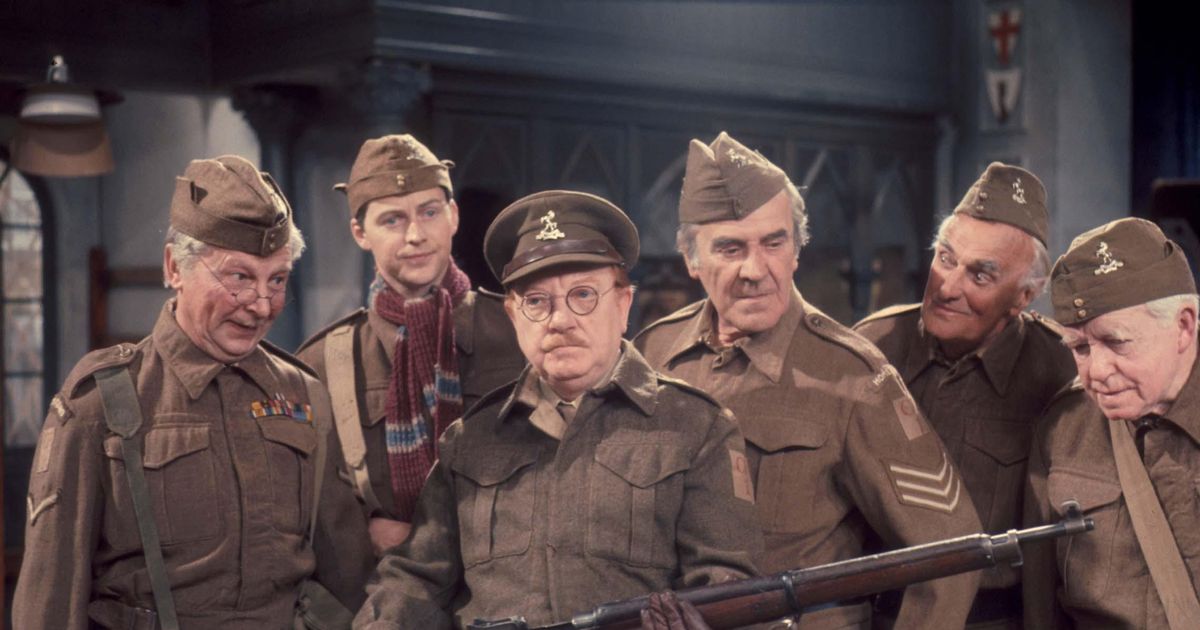
Dad’s Army, a BBC sitcom that ran from 1968 to 1977, starring Arthur Lowe as Captain Mainwaring, John Le Mesurier as Sergeant Wilson, and Clive Dunn as Lance Corporal Jones.
There are plenty of natural laws, but here’s one unique to Britain:
Every organisation, committee, scenario, initiative and government-backed and corporate project in Britain will inevitably degenerate into a scene from Dad’s Army.
That of course is the celebrated sitcom Dad’s Army, based on the world of Britain’s Home Guard in the Second World War, which ran for nine series in the 1970s. Every character is caricature, and sometimes not even as much as that.
Just think about it. Captain Mainwaring, the prickly bank manager and obsessed with status – the ultimate incompetent management figure, forever frustrated by his own paltry military service in the Great War and now strutting around like a dumpy cockerel as commanding officer of the platoon.
Sgt Wilson, a complacent, dozy and lazy member of the establishment, effortlessly imbued with a sense of privilege and world-weary detachment. Persistently given to undermining Mainwaring.
Lance-Corporal Jones, the panic-stricken jobsworth stifling initiative at every turn and floundering haplessly around to demolish every project with his matchless ability to overcomplicate anything and everything. He has a special skill for wasting inordinate amounts of time with ludicrously impenetrable explanations, usually based on fantasy.
Private Frazer, the miserable doom-laden pessimist and undertaker, forever raining down scorn and stirring up opposition and discontent in the ranks, his own ambitions in the platoon thwarted.
Private Walker, the skiving skimmer who dodged regular military service. Forever on the take but essentially harmless and even with some good characteristics.
Private Godfrey, the embodiment of the well-intentioned but largely hopeless pensioner whose presence relies usually on everyone else. Constantly called away to relieve himself.
Private Pike, the idiotic mummy’s body excused military service. Today he would have a certificate excusing him from any form of employment for anxiety, ADHD and anything else his mother or the system could come up with.
Then there’s the ARP Warden Hodges, whose sole purpose in life is feuding with Mainwaring, finding fault with the platoon’s men and triumphantly announcing their infractions. Hodges is the confrontational and dispute-loving trade union leader to Mainwaring’s shambolic management. His only mission in life is to create conflict and throw his weight about.
To these we can add various other characters, all comic figures (like the vicar and the verger) but essential props that amplify the authenticity.
The reason the sitcom lasted so long is very simple. Every single organisation in Britain is in home to some of or all these personality types, whether it’s the parish council, a local arts society, a corporation or the government.
Almost every problem the Home Guard platoon is confronted with results in bickering, chaos and wasted time, based mostly on posturing, obstinacy, incompetence, obsession with status and a lack of foresight, common sense and lateral thought. If the outcome is a good one, it’s invariably the result of chance.
Sounds familiar? It doesn’t matter what you think about the boats, climate change, the welfare state or the NHS. Every one of Britain’s current problems is being dealt with as if each was an episode of Dad’s Army.
Update, 5 September: Welcome, Instapundit readers! Please do have a look around at some of my other posts you may find of interest. I send out a daily summary of posts here through my Substack – https://substack.com/@nicholasrusson that you can subscribe to if you’d like to be informed of new posts in the future.
“Once is happenstance. Twice is co-incidence” … but SIX?
I depend on eugyppius to keep me up to date on German affairs, and despite the eyebrow-raising total of six AfD candidates dying unexpectedly, he doesn’t think it’s actually “enemy action” as Ian Fleming once wrote in Goldfinger, but it is statistically boggling:
I had plans to write about something else today, and I even have a half-finished post, but the story of the mysteriously dying AfD candidates is everywhere …
… and I feel compelled to address it.
The West German state of Nordrhein-Westfalen (NRW) is slated to hold municipal elections in just under two weeks, on 14 September. Eighteen million Germans scattered across thirty-one districts and 393 municipalities will elect councillors, board members, mayors and district administrators.
It’s important to understand the scale of these elections and the enormous numbers involved: Tens of thousands are presently running for office in NRW. The exact number isn’t certain, but it may be as great as 90,000. Most of these candidates are totally ordinary people. They are not professional politicians and they are not widely known outside their communities.
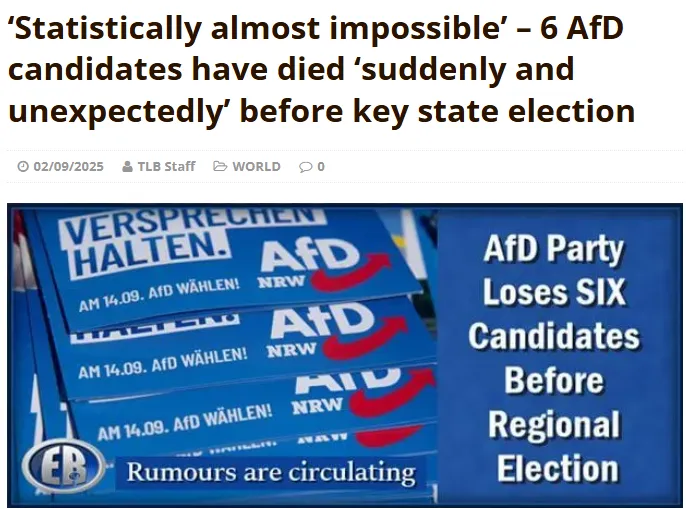
Four days ago, the German press began reporting on bureaucratic chaos stirred up by a series of unexpected deaths in late stages of the NRW campaign. Each of these deaths happened so late in the game that ballots had to be reprinted and the postal vote repeated. The German economist and social media personality Stefan Homburg picked up the story and called the deaths “statistically almost impossible“. AfD co-chair Alice Weidel retweeted Homburg’s suspicions, ultimately attracting the attention of Elon Musk.
Despite the widespread interest in this story, I really think it’s a nothingburger. We may be looking at an unusual cluster of AfD deaths in the upcoming elections, but we don’t know enough to say for sure how improbable this cluster is. All we can really say is that the deaths themselves are not unexplained and that their coincidence doesn’t look that improbable on its face.

Comments Off on “Once is happenstance. Twice is co-incidence” … but SIX?
German Occupation FN High Power Pistols
Forgotten Weapons
Published 28 Apr 2025When Germany occupied Belgium in the summer of 1940, the took over the FN factory complex and ordered production of the High Power pistol to continue. It was put into German service as the Pistole 640(b), and nearly 325,000 of them were made between 1940 and 1944. The first ones were simply assembled from finished Belgian contact parts, and included all the features like shoulder stock slots and 500m tangent rear sights. As the war continued, however, production was simplified. The stock slots disappeared first, then the tangent sights, then the wooden grips (replaced by bakelite) and eventually even the magazine safety was omitted. Resistance among Belgian factory workers increased as well, with deliberate sabotage in the form of incorrect heat treating, errors in fine tolerance parts, and sometimes even spending lots of time to give a very fine surface finish instead of making more pistols.
These are a particularly popular subject of collecting, and there are a lot of nuances of the production and inspection marks that are worth understanding if you want to take them seriously. I highly recommend Anthony Vanderlinden’s 2-volume book FN Browning Pistols for very good detail on these, as well as other FN handguns: https://amzn.to/42Bc541
(more…)
Comments Off on German Occupation FN High Power Pistols
QotD: The distance between NHS PR and NHS reality
It wasn’t difficult to promote such historiography by using horror stories from the past, stories which were perfectly plausible because almost any conceivable system will give rise to such stories. If, per impossibile, a new system were to replace the NHS, it would not be difficult to justify it by reference to horror stories, whether or not the new system was better. A war of anecdotes, while always gratifying to the human mind, is not the way to decide important questions such as the superiority or inferiority of a system of health care. Only anecdotes that also illustrate statistical trends or truths are valuable in such a context.
The statistics are not favourable to the NHS, at least if one chooses reasonable standards of comparison, namely other European countries. The results are not disastrous, but they are not good either. The NHS has failed even in its egalitarian goal: the gap between the health of the richest and poorest in society has only grown under its dispensation. And yet the belief in its levelling effect persists.
The propaganda in favour of the NHS has been so successful that it now accords with the sentiments of the population, a triumph that no communist regime achieved despite herculean efforts at indoctrination. The triumph has been achieved without compulsion or violence and ought to be an interesting case for political scientists who study the successful inculcation of political mythology. Of course, the danger of such a study would be that it might induce doubt or cynicism about other political mythologies, and we all need such mythologies to live by.
Theodore Dalrymple, “Worshipping the NHS”, New English Review, 2020-05-07.
Comments Off on QotD: The distance between NHS PR and NHS reality
September 2, 2025
Too much empathy can be more dangerous than too little
Spaceman Spiff explains why boundaries matter, in so many different areas of modern life:

Empathy is a virtue many strive to demonstrate. But few will discuss its downsides. Why it is not universally good or useful. How it can be misdirected.
In some situations it is lethal. It can reflect a suicidal urge we now see in Western nations.
Much empathy in society is in fact sentimentality, which is dangerous. Sentimental ideas about mixing cultures, elevating poor performers through quotas, or tinkering with traditional gender roles have real world effects.
With such an emphasis on empathy, which many think of as niceness, we overlook the need for boundaries to maintain a functioning society.
This is the issue at the heart of much that is damaging us today.
Individual rights
We live in an era that champions individual rights to an almost autistic degree. This is a product of Western liberalism, which now seems to be entering its terminal phase as its effects ultimately destroy what made Western societies strong.
Since an individual’s rights trump everything we cannot easily enforce boundaries our ancestors could take for granted. Try challenging a gay pride parade or transgender material in schools on the grounds of public decency and the least you can expect is to lose your job.
Profound changes have happened just in the last few decades and all in the name of individual rights. The erosion of boundaries on behaviour is one of the most visible aspects of this.
Physical boundaries
The concept of boundaries is almost universal and spans everything from the mundane to the spiritual.
Most countries recognize the right to private property and inherent within this is the notion of boundaries. My car is mine and no one else’s, for example.
This is applied to our homes and gardens. These are ours and defendable from theft. Ultimately this in turn includes a neighbourhood or locale, even a region or state. All these things have visible boundaries that demarcate where they begin and end.
Most famously this applies to national borders, a traditional form of boundary in use for thousands of years. Failing to enforce this barrier is national suicide. The world is not like us and if it comes to us we will look like the world in return. Borders keep the barbarians out.
Everyone instinctively grasps these kinds of boundaries. We close our windows and have locks on our doors because of this understanding.
Using boundaries to exclude others feels natural.
Cultural boundaries
Less explicitly visible are cultural boundaries, often transmitted via tradition and convention. We have spent the last century attacking many of these as old fashioned, with little pause to consider why tradition emerges in the first place.
Marriage between men and women. Complementary gender roles. Sexual mores kept private. The sanctity of childhood, its innocence protected from intrusion.
As we removed constraints in the name of progress we destroyed much of the glue that held our societies together. We are now watching things unravel as people marry less and produce fewer children. We see widespread mental illness and anguish as the few basic certainties of life are destroyed in the name of progress.
People don’t know who or what they are when cultural boundaries are deleted. Women, men, natives, newcomers, the working class. Who are we really without some certainties in life?
Comments Off on Too much empathy can be more dangerous than too little


