
Within a couple of months of the Invergordon mutiny, Japan intervened in Manchuria, deaf to all the entreaties of the League of Nations. While, today, we are used to the fact that a ringing denunciation from the United Nations is probably the single most ineffective tool in international relations, the revelation of its predecessor’s impotence came as a disagreeable surprise. So many statesmen had placed their faith in collective security that the naked aggression of the Japanese left them floundering for a response. In 1931 the British people had more pressing concerns than remote Asian wars, but the lesson was not lost on Germany’s rising political star Hitler, nor the posturing Mussolini in Italy whose Fascist Party dreamed of a new Roman Empire.
Max Arthur, The True Glory: The Royal Navy 1914-1939, 1996.
February 16, 2015
QotD: The impotence of the League of Nations
February 15, 2015
They call it “Great” Britain, after all
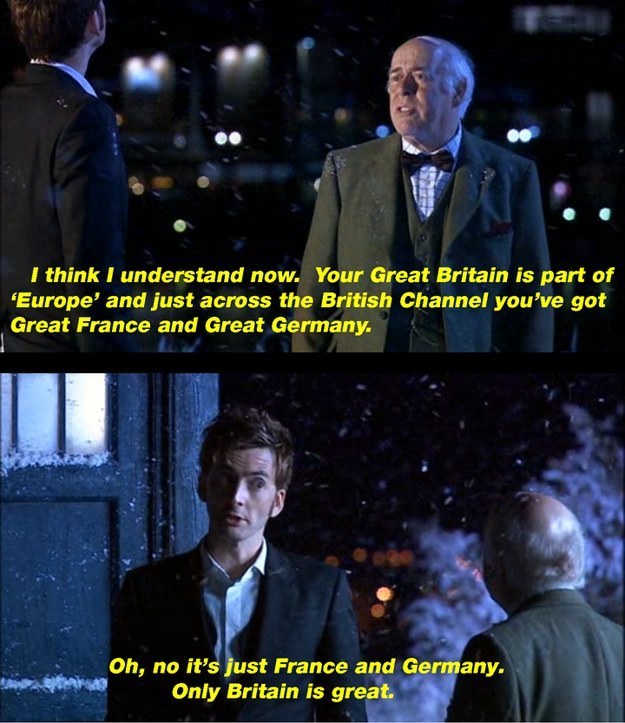
H/T to Think Defence for the image.
Let’s make no mistake, Great Britain is great, the clue is in the name after all.
Anyone who thinks otherwise is obviously uneducated, or French.
And not only that …
Without Great Britain the world would be a poorer place in every regard.
Lets just remind ourselves why…
We gave the world democracy, common law, the Bailey Bridge, tanks, gravity, the worlds most common second language, Led Zeppelin, fair play, queuing, the backhoe loader, metal bridges, modern economics, the industrial revolution and Hollywood villains.
The Beatles, Morris Dancing, penicillin, HP sauce, Top Gear, the World Wide Web (your welcome), One Direction, Carry On and Simon Cowell.
Tea drinking, chicken tikka masala, Shakespeare, Winston Churchill, battered Mars Bars, the BBC, the mini (car, roundabout and skirt), the Spice Girls, Darwin, football, Marmite, rugby, cricket, golf, tennis, ping pong, pubs, tea, sharp suits, Spitfires and the fact there are homosexuals, lesbians and transsexuals in the armed forces and no one gives two shits.
With our friends and allies stood against the Nazis, invented the railway, sarcasm, MRI scanners, the screw propellor and a proper breakfast, been on the right side of the Napoleonic, First, Second and Cold War and gave the world steam power, the Mexeflote, Wallace and Gromit, roast beef dinners, the Dyson, Doctor Who, television, telephones, text messaging, GMT, electric motors, lawn movers, spotted dick, sewage systems, the thermos flask, the jet engine, carbon fibre, the flushing toilet and polyester (just for the RAF), pencils, radar and the Bank of France (ha ha ha).
February 14, 2015
Europe in 1899, according to Fred W. Rose
Before the modern age of the infographic, artists like Fred W. Rose still had their own idiosyncratic ways to present as much information as they could for a wider audience:

H/T to Tam for the link.
QotD: The “acquisition” of the British Empire
A word first, though. You’ll have heard it said that the British Empire was acquired in a fit of absence of mind — one of those smart Oscarish squibs that sounds well but is thoroughly fat-headed. Presence of mind, if you like — and countless other things, such as greed and Christianity, decency and villainy, policy and lunacy, deep design and blind chance, pride and trade, blunder and curiosity, passion, ignorance, chivalry and expediency, honest pursuit of right, and determination to keep the bloody Frogs out. And often as not, such things came tumbling together, and when the dust had settled, there we were, and who else was going to set things straight and feed the folk and guard the gate and dig the drains — oh, aye, and take the profit, by all means.
George MacDonald Fraser, Flashman and the Mountain of Light, 1990.
February 13, 2015
Stopping Russia – Hindenburg’s Final Offensive? I THE GREAT WAR Week 29
Published on 12 Feb 2015
This week, well over 1 million soldiers are on the advance everywhere in Europe. General Hindenburgs tries to beat the Russians once and for all at the Masurian Lakes. Austria-Hungary is fighting the Russians with German support in the Carpathian mountains and on the Western Front the Champagne offensive is still going.
Britain’s next defence review
Think Defence looks at the 2015 iteration of the British defence review process:
There is a pre defence review ritual that everyone with an interest indulges in. It starts with a few gentle discussions on Great Britain’s ‘place in the world’, the scale of our global ambition and obligations as a G8 regional power with a seat with our name on at the UN.
After a suitable period has elapsed the discussion then veers into areas of risk and threat but even during this phase the mood is still good natured.
Phase 3 gets heated because it is the first stage at which money is usually involved and therefore consideration of how the diminishing cake is sliced up between the services.
It is during this phase that negotiations and backroom deals kick in and the inevitable ‘test the water’ leaking to sympathetic journalists.
The final phase happens when it is all over and then as the implications of actual decisions made become clearer the bitterness sets in which can last for decades (see moving Australia and CVA01 for a good example).
If you start with the money and define a fixed budget you still get into the same argument and all that happens then is people tend to shape the first phases so that, oh look, my answer was right all along.
Start with risks and threats and the answers will always have to be tempered by the time it comes back around to budgets. Each review is rapidly made redundant by ‘events dear boy’ and the cycle starts again.
There are no easy answers and to think so is rather foolish, if there was an easy method, everyone would be doing it.
[…]
The ‘punching above our weight’ theme needs to be ruthlessly struck from the vocabulary because not only does it lead to illogical equipment decisions and hollowed out forces it fundamentally results in the talk loud small stick foreign policy that we seem unable to wean ourselves off.
You can only get away with this for so long until others start to realise you are bluffing and I believe this is where we are now, even our allies are starting to realise that our big talk isn’t backed up, despite having the worlds most advanced x or y, they are of little practical value if you only have a handful. Fur coat and no knickers could be an apt description of much of the UK’s defence capabilities, as painful as it may be for us all to recognise, and so I think there is a fundamental need to reassess ‘our place’.
Feeling nostalgic for Cold War-era Soviet propaganda? Don’t worry … it’s back!
Strategy Page on the disturbing resurrection of Soviet style “news”:
Westerners in Russia, especially those who speak and read Russian, report that state controlled Russian media has seemingly reverted to stories and attitudes right out of the Cold War. It is, in short, unreal but actually happening. Russian media is full of stories of NATO aggression against Russia and anything that is going wrong in Russia is blamed on a NATO conspiracy to destroy Russia. The Russian aggression in Ukraine is described as largely a fable created by a NATO conspiracy to take over the Ukrainian government and institute a terror campaign against the ethnic Russian minority in Ukraine, especially eastern Ukraine. There, the Russian media described ethnic Russians leading a rebellion against this NATO puppet government running Ukraine and NATO soldiers pretending to be Ukrainians doing most of the fighting. No captured NATO agents are presented which Russian media describes as proof of how clever and dangerous this NATO aggression is.
The reality is that Russian soldiers are regularly captured (dead and alive) and presented on Ukrainian TV but this is ignored and dismissed by Russian media as more insidious NATO propaganda. Those Russians familiar with their own history who point out the current government propaganda in Russia is similar to what went on in 1939 and 1941 are condemned as traitors. But it is a fact that in 1939 the communist Soviet Union signed a peace treaty with Nazi government of Germany and overnight Germany went from threat to valued ally according to Soviet media. That switched again in mid-1941 when Germany broke the treaty and invaded the Soviet Union. But during the time the treaty was in force Russian invaded Poland, the Baltic States and Finland. Russia was defeated in Finland and only got control of some territory just across the border. But eastern Poland was seized (as part of the 1939 treaty, with Germany taking most of Poland) as were the three Baltic States (Estonia, Latvia and Lithuania)
February 12, 2015
EU governments and GM crops
Last month, Matt Ridley ran down the benefits to farmers, consumers, ecologists and the environment itself that the European Union has been resisting mightily all these years:
Scientifically, the argument over GM crops is as good as over. With nearly half a billion acres growing GM crops worldwide, the facts are in. Biotech crops are on average safer, cheaper and better for the environment than conventional crops. Their benefits accrue disproportionately to farmers in poor countries. The best evidence comes in the form of a “meta-analysis” — a study of studies — carried out by two scientists at Göttingen University, in Germany.
The strength of such an analysis is that it avoids cherry-picking and anecdotal evidence. It found that GM crops have reduced the quantity of pesticide used by farmers by an average of 37 per cent and increased crop yields by 22 per cent. The greatest gains in yield and profit were in the developing world.
If Europe had adopted these crops 15 years ago: rape farmers would be spraying far less pyrethroid or neo-nicotinoid insecticides to control flea beetles, so there would be far less risk to bees; potato farmers would not need to be spraying fungicides up to 15 times a year to control blight; and wheat farmers would not be facing stagnant yields and increasing pesticide resistance among aphids, meaning farmland bird numbers would be up.
Oh, and all that nonsense about GM crops giving control of seeds to big American companies? The patent on the first GM crops has just expired, so you can grow them from your own seed if you prefer and, anyway, conventionally bred varieties are also controlled for a period by those who produce them.
African farmers have been mostly denied genetically modified crops by the machinations of the churches and the greens, aided by the European Union’s demand that imports not be transgenically improved. Otherwise, African farmers would now be better able to combat drought, pests, vitamin deficiency and toxic contamination, while not having to buy so many sprays and risk their lives applying them.
I made this point recently to a charity that works with farmers in Africa and does not oppose GM crops but has so far not dared say so. Put your head above the parapet, I urged. We cannot do that, they replied, because we have to work with other, bigger green charities and they would punish us mercilessly if we broke ranks. Is the bullying really that bad? Yes, they replied.
Yet the Green Blob realises that it has made a mistake here. Not a financial mistake — it made a fortune out of donations during the heyday of stoking alarm about GM crops in the late 1990s — but the realisation that all it has achieved is to prolong the use of sprays and delay the retreat of hunger.
World War II Relics: Juno Beach
Published on 5 Feb 2015
National Geographic television series The Sea Hunters Relics exploring the history of World War II Juno Beach.
February 10, 2015
Companions In The Trenches – Animals of World War 1
Published on 9 Feb 2015
The deeds of animals in World War 1 are often forgotten next to the sufferings the soldiers had to endure in this industrial war. Millions of horses, thousands of dogs and pigeons were useful companions and dependable comrades. In this special episode Indy explains everything about the usage of animals in the great war and under which conditions they had to live.
The cautionary tale of the Kosovo intervention
Michael Brendan Dougherty looks back at the UN’s intervention in Kosovo and the situation in Kosovo after more than a decade and a half:
It’s been almost 16 years since a NATO coalition banded together to defeat Serbia’s Slobodan Milošević in Kosovo. Ever since, it has been exhibit A in the case for “humanitarian intervention.” A swift short war, a thug removed from power, a series of oppressions redressed. After the hostilities ceased, Kosovo’s government was overseen by the United Nations, and declared full independence from Serbia in 2008.
In the meantime, the U.N. bungled possibly the easiest show-trial in world history, letting Milošević score a lot of points from the stand as the trial dragged on longer than it took F.D.R. to declare war on Germany, mobilize a few million men, and beat Hitler. Milošević died of a heart attack in prison before his trial finished. NATO troops are in Kosovo, a decade and a half after the “short” 78-day campaign.
What’s the political scene like in liberated Kosovo? Well, here’s a story. Last week Aleksandar Jablanovic, an ethnic Serb who served in the cabinet as minister of communities, was sacked by Prime Minister Isa Mustafa, in order to appease ethnic Albanians who were planning riotous protests against him. Kosovars threw rocks at government buildings. About 170 people were injured in the clash between protesters and police.
What did Jablanovic do to cause the unrest? He had described a group of Albanians as “savages” in January. Why? Because they had blocked (with the threat of violence) the route of Serbian Christians making a traditional pilgrimage to a monastery in Western Kosovo.
Sounds unpleasant, right? It gets worse. Unemployment in Kosovo is around 45 percent. (That’s not a typo.) The electricity is very unreliable, and Kosovars often don’t pay their electricity bills to the state. The government is considering canceling all debts that citizens owe to the government, to rebuild trust (and popularity) and start putting services on a firmer footing. About a third of Kosovars live on less than $2 a day.
[…]
But there’s also no doubt that Kosovo should serve as a permanent warning against the idea that humanitarian interventions are easy. The bombing was a perfect example of the moral hazard involved in “Responsibility to Protect” interventions. The roar of NATO jets so raised the stakes for Serbian forces and for Milošević, that Serbians killed five times as many people after the intervention became a fait accompli than they had before that time, under the theory that rubble makes less trouble.
Edmund Curll, “printer, pirate, and pornographer”
Sherwood Smith and Rachel Manija Brown, guest-posting at Charlie’s Diary, discuss a thoroughly awful man of letters:
Like now, there were ripoff booksellers masquerading among the legitimate ones, though today’s scammers (see Writer Beware) are rarely as colorful as the rascally Edmund Curll — printer, pirate, and pornographer. He stole material with flagrant disregard for copyright. As soon as some prominent person died, he collected gossip — it didn’t matter if it was true — for a biography, and if he didn’t have enough material, he made it up. Prominent people reportedly dreaded dying because of what Curll would do to them. A faint echo of the Curll treatment occurred a couple weeks ago, when Colleen McCullough’s obit started off by noting how fat and unlovely she’d been.
Curll churned out so much X-rated stuff under various guises that the word ‘Curlicism’ became synonymous with porn. Prison, a stint in the stocks, even being blanket-tossed and beaten by the boys at Westminster school not only didn’t stop him from theft and libel, he turned them all into marketing opportunities. Even when he was convicted of libel and forced to publish an apology and a promise to stop printing, his repentant words touted his latest books.
He’s best known for the twenty-year running duel with the poet Alexander Pope, from whom he not only stole, he lampooned under his own name and with sockpuppets. It began when he first pirated Pope, prompting the poet and his publisher to meet Curll at the Swan, where they slipped a mega dose of “physic” (think ExLax) into his drink. He turned that, too, into a marketing event, once he’d recovered from the extremes of ejecta; when Pope published a couple of triumphant pamphlets, claiming Curll was dead, Curl came right back with new material demonstrating that he was very much alive and up to his usual racket.
Their history — and there are other equally crazy-ass stories — remind me of the whoops and hollers of internet feuds and FAILS now, among writers, editors, publishers (some individuals wearing all three hats).
Aside from the Curlls, most booksellers, the publishers of the eighteenth century — like the editors working at traditional publishers now — were hardworking people who made careful decisions about what to publish because they were the ones fronting the costs of printing and of copyright.
The booksellers of Grub Street were all about copyright. For most of the eighteenth century, they met yearly, over sumptuous dinners, to hold a copyright auction that was exclusive to the booksellers. Interlopers were unceremonious chucked out.
February 9, 2015
Paradoxically, rising cancer deaths are a form of good news
Last month, in his Times column, Matt Ridley explained why — until we discover a treatment for aging itself — rising cancer rates are a weird form of good news:
If we could prevent or cure all cancer, what would we die of? The new year has begun with a war of words over whether cancer is mostly bad luck, as suggested by a new study from Johns Hopkins School of Medicine, and over whether it’s a good way to die, compared with the alternatives, as suggested by Dr Richard Smith, a former editor of the BMJ.
It is certainly bad luck to be British and get cancer, relatively speaking. As The Sunday Times reported yesterday, survival rates after cancer diagnosis are lower here than in most developed and some developing countries, reflecting the National Health Service’s chronic problems with rationing treatment by delay. In Japan, survival rates for lung and liver cancer are three times higher than here.
Cancer is now the leading cause of death in Britain even though it is ever more survivable, with roughly half of people who contract it living long enough to die of something else. But what else? Often another cancer.
In the western world we’ve conquered most of the causes of premature death that used to kill our ancestors. War, smallpox, homicide, measles, scurvy, pneumonia, gangrene, tuberculosis, stroke, typhoid, heart disease and cholera are all much rarer, strike much later in life or are more survivable than they were fifty or a hundred years ago.
The mortality rate in men from coronary heart disease, for instance, has fallen by an amazing 80 per cent since 1968 — for all age groups. Mortality rates from stroke in both sexes have halved in 20 years. Cancer’s growing dominance of the mortality tables is not because it’s getting worse but because we are avoiding other causes of death and living longer.
It is worth remembering that some scientists and anti-pesticide campaigners in the 1960s were convinced that by now lifespans would be much shorter because of cancer caused by pesticides and other chemicals in the environment.
In the 1950s Wilhelm Hueper — a director of the US National Cancer Institute and mentor to Rachel Carson, the environmentalist author of Silent Spring — was so concerned that pesticides were causing cancer that he thought the theory that lung cancer was caused by smoking was a plot by the chemical industry to divert attention from its own culpability: “Cigarette smoking is not a major factor in the causation of lung cancer,” he insisted.
In fact it turns out that pollution causes very little cancer and cigarettes cause a lot. But aside from smoking, most cancers are indeed bad luck. The Johns Hopkins researchers found that tissues that replicate their stem cells most run the highest risk of cancer: basal skin cells do ten trillion cell divisions in a lifetime and have a million times more cancer risk than pelvic bone cells which do about a million cell divisions. Random DNA copying mistakes during cell division are “the major contributors to cancer overall, often more important than either hereditary or external environmental factors”, say the US researchers.
(Emphasis mine.)
To sum it up, until or unless medical research finds a way to stop the bodily effects of aging, cancer becomes the most likely way for all of us to die. Cancer is a generic rather than a specific term — it’s what we use to describe the inevitable breakdown of the cellular division process that happens millions or even trillions of times over our lifetime. As Ridley puts it, “even if everybody lived in the healthiest possible way, we would still get a lot of cancer.” I’m not a scientist and I don’t even play one on TV, but I suspect that the solution to cancers of all kinds are to boost our immune systems to more quickly identify aberrant cells in our bodies before they start reproducing beyond the capability of the immune system to handle. The short- to medium-term solution to cancer may be to make us all a little bit cyborg…
QotD: The hyper-rich are not like you and I
Convening to ring the alarm about global warming, our putative betters and would-be rulers gathered in Davos, Switzerland, filling the local general-aviation hangars with some 1,700 private jets. Taking an international commercial flight is one of the most carbon-intensive things the typical person does in his life, but if you’re comparing carbon footprints between your average traveler squeezed into coach on American and Davos Man quaffing Pol Roger in his cashmere-carpeted intercontinental air limousine, you’re talking Smurfette vs. Sasquatch. The Bombardier’s Global 6000 may be a technical marvel, but it still runs on antique plankton juice. The emissions from heating all those sprawling hotel suites in the Alps in winter surely makes baby polar bears weep bitter and copious baby-polar-bear tears.
The stories add up: Jeff Greene brings multiple nannies on his private jet to Davos, and the rest of the guys gathered to talk past each other about the plight of the working man scarf down couture hot-dogs that cost forty bucks. Bill Clinton makes the case for wealth-redistribution while sporting a $60,000 platinum Rolex.
The hypocrisy of our literally (literally, Mr. Vice President!) high-flying crusaders against fossil fuels — who overlap considerably with our high-living crusaders against economic inequality — is endlessly annoying if frequently entertaining. And there is something unseemly about enduring puritanical little homilies on how we need to learn to live with less from guys wearing shoes that cost more than the typical American family earns in a quarter. When that obnoxious Alec Baldwin character from Glengarry Glen Ross informs that sad-sack real-estate salesman that his watch costs more than that guy’s car, he was trying to provoke him into getting richer, to the tune of a Cadillac Eldorado or, if not that, at least the second-prize set of steak knives. But our modern progressive versions of that guy are even more obnoxious: They demand that we lower our expectations while they live lives of opulence that would have embarrassed the Count of Monte Cristo.
Out-obnoxious-ing a guy with Alec Baldwin’s smirking mug takes a lot of brass.
Kevin Williamson, “Davos’s Destructive Elites: ‘None of us is as dumb as all of us'”, National Review, 2015-01-25.
February 8, 2015
QotD: The trouble with tandem bicycles
There is always unpleasantness about this tandem. It is the theory of the man in front that the man behind does nothing; it is equally the theory of the man behind that he alone is the motive power, the man in front merely doing the puffing. The mystery will never be solved. It is annoying when Prudence is whispering to you on the one side not to overdo your strength and bring on heart disease; while Justice into the other ear is remarking, “Why should you do it all? This isn’t a cab. He’s not your passenger” to hear him grunt out:
“What’s the matter — lost your pedals?”
Harris, in his early married days, made much trouble for himself on one occasion, owing to this impossibility of knowing what the person behind is doing. He was riding with his wife through Holland. The roads were stony, and the machine jumped a good deal.
“Sit tight,” said Harris, without turning his head.
What Mrs. Harris thought he said was, “Jump off.” Why she should have thought he said “Jump off,” when he said “Sit tight,” neither of them can explain.
Mrs. Harris puts it in this way, “If you had said, ‘Sit tight,’ why should I have jumped off?”
Harris puts it, “If I had wanted you to jump off, why should I have said ‘Sit tight!’?”
The bitterness is past, but they argue about the matter to this day.
Be the explanation what it may, however, nothing alters the fact that Mrs. Harris did jump off, while Harris pedalled away hard, under the impression she was still behind him. It appears that at first she thought he was riding up the hill merely to show off. They were both young in those days, and he used to do that sort of thing. She expected him to spring to earth on reaching the summit, and lean in a careless and graceful attitude against the machine, waiting for her. When, on the contrary, she saw him pass the summit and proceed rapidly down a long and steep incline, she was seized, first with surprise, secondly with indignation, and lastly with alarm. She ran to the top of the hill and shouted, but he never turned his head. She watched him disappear into a wood a mile and a half distant, and then sat down and cried. They had had a slight difference that morning, and she wondered if he had taken it seriously and intended desertion. She had no money; she knew no Dutch. People passed, and seemed sorry for her; she tried to make them understand what had happened. They gathered that she had lost something, but could not grasp what. They took her to the nearest village, and found a policeman for her. He concluded from her pantomime that some man had stolen her bicycle. They put the telegraph into operation, and discovered in a village four miles off an unfortunate boy riding a lady’s machine of an obsolete pattern. They brought him to her in a cart, but as she did not appear to want either him or his bicycle they let him go again, and resigned themselves to bewilderment.
Meanwhile, Harris continued his ride with much enjoyment. It seemed to him that he had suddenly become a stronger, and in every way a more capable cyclist. Said he to what he thought was Mrs. Harris:
“I haven’t felt this machine so light for months. It’s this air, I think; it’s doing me good.”
Then he told her not to be afraid, and he would show her how fast he could go. He bent down over the handles, and put his heart into his work. The bicycle bounded over the road like a thing of life; farmhouses and churches, dogs and chickens came to him and passed. Old folks stood and gazed at him, the children cheered him.
In this way he sped merrily onward for about five miles. Then, as he explains it, the feeling began to grow upon him that something was wrong. He was not surprised at the silence; the wind was blowing strongly, and the machine was rattling a good deal. It was a sense of void that came upon him. He stretched out his hand behind him, and felt; there was nothing there but space. He jumped, or rather fell off, and looked back up the road; it stretched white and straight through the dark wood, and not a living soul could be seen upon it. He remounted, and rode back up the hill. In ten minutes he came to where the road broke into four; there he dismounted and tried to remember which fork he had come down.
While he was deliberating a man passed, sitting sideways on a horse. Harris stopped him, and explained to him that he had lost his wife. The man appeared to be neither surprised nor sorry for him. While they were talking another farmer came along, to whom the first man explained the matter, not as an accident, but as a good story. What appeared to surprise the second man most was that Harris should be making a fuss about the thing. He could get no sense out of either of them, and cursing them he mounted his machine again, and took the middle road on chance. Half-way up, he came upon a party of two young women with one young man between them. They appeared to be making the most of him. He asked them if they had seen his wife. They asked him what she was like. He did not know enough Dutch to describe her properly; all he could tell them was she was a very beautiful woman, of medium size. Evidently this did not satisfy them, the description was too general; any man could say that, and by this means perhaps get possession of a wife that did not belong to him. They asked him how she was dressed; for the life of him he could not recollect.
I doubt if any man could tell how any woman was dressed ten minutes after he had left her. He recollected a blue skirt, and then there was something that carried the dress on, as it were, up to the neck. Possibly, this may have been a blouse; he retained a dim vision of a belt; but what sort of a blouse? Was it green, or yellow, or blue? Had it a collar, or was it fastened with a bow? Were there feathers in her hat, or flowers? Or was it a hat at all? He dared not say, for fear of making a mistake and being sent miles after the wrong party. The two young women giggled, which in his then state of mind irritated Harris. The young man, who appeared anxious to get rid of him, suggested the police station at the next town. Harris made his way there. The police gave him a piece of paper, and told him to write down a full description of his wife, together with details of when and where he had lost her. He did not know where he had lost her; all he could tell them was the name of the village where he had lunched. He knew he had her with him then, and that they had started from there together.
The police looked suspicious; they were doubtful about three matters: Firstly, was she really his wife? Secondly, had he really lost her? Thirdly, why had he lost her? With the aid of a hotel-keeper, however, who spoke a little English, he overcame their scruples. They promised to act, and in the evening they brought her to him in a covered wagon, together with a bill for expenses. The meeting was not a tender one. Mrs. Harris is not a good actress, and always has great difficulty in disguising her feelings. On this occasion, she frankly admits, she made no attempt to disguise them.
Jerome K. Jerome, Three Men on the Bummel, 1914.


