
Tasting History with Max Miller
Published 3 Jun 2025Mashed potatoes over a corned beef and onion filling with gravy
City/Region: United Kingdom
Time Period: 1914Many of the young men headed to fight in World War I didn’t already know how to cook, so the British government set up army schools of cookery to teach some of them how to make the most of the rations they were given. Even that ancient army standby, hardtack (clack clack), is better when you can cook it into a stew or pudding.
This potato pie, kind of a simplified preserved meat version of shepherd’s pie, isn’t half bad. If I were to make changes, I would leave out the additional salt (canned corned beef is plenty salty on its own) and add some more onions. While relatively tasty as-is, if you have any HP Sauce lying around, it makes this pie delicious, and many troops would have had access to it during World War I. Delicious and historically accurate: a win-win!
Potato Pie.
16 1/2 lbs. meat, 20 lbs. potatoes, 1 lb. onions, 3 ozs. salt, 1/2 oz. of pepper.
Cut up and stew the onions with jelly from the meat added; boil or steam the potatoes; when cooked mash them. Line the sides of the dish with one-third of the mashed potatoes; place the meat and cooked onions in the centre; season with pepper and salt; cover over the remainder of the mashed potatoes, and bake till the potato cover is brown. As the mashed potatoes absorb the moisture of the meat and render it dry, about 2 pints of gravy prepared from the liquor in which the onions were cooked, should be poured into the pie before serving.
— Manual of Military Cooking. Prepared at the Army School of Cookery, 1914
November 10, 2025
Food in the Trenches of World War One
November 9, 2025
Sir Arthur Currie, commander of the famous Canadian Corps in WW1
As a counterpoint to the OTT summary of Sir Arthur posted last week, here’s The Black Horse with part one of a two-part look at the man’s early career before joining the Canadian Expeditionary Force in Europe:
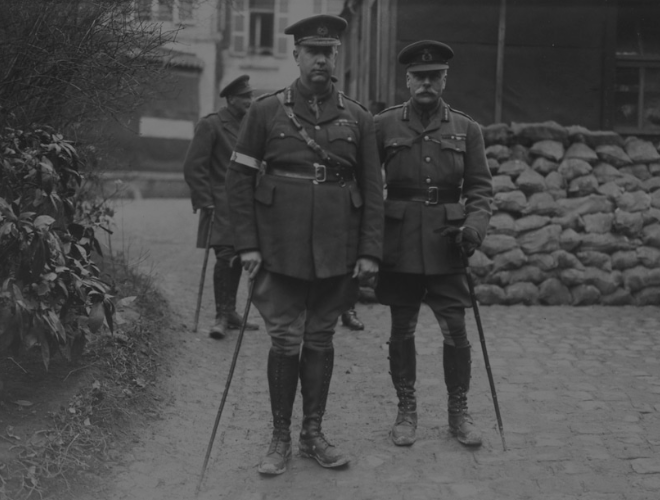
Sir Arthur Currie with Field Marshal Sir Douglas Haig, February 1918.
Libraries and Archives Canada item ID number 3404878.
The Red Ensign is a publication deeply interested in leadership; the good, the bad, and the ugly. For this reason, this Remembrance Day, I have chosen to draw the audience’s attention to the life and times of Sir Arthur Currie, the first Canadian commander of the Canadian Corps during the Great War. This presents an opportunity to both on honour and reflect upon the courage and sacrifice of the men who have fought under the flag of this great nation, but also offers the language to articulate the task facing any who would attempt to lead Canada today. As Currie’s war was defined by the challenge [of] leadership of Canadians in the context of the shifting priorities of the late British Empire, any who would seek to lead Canadians today face will struggle to harmonize efforts on behalf of the Canadian people and the priorities and policies of the American power block which he cannot eschew.
Dulce et decorum est pro patria mori; but when your country is an Imperial Dominion, who and what is “pro patria“, and how can one spend their life for them?
The Man Before the Great Man:
Arthur Currie was born in 1875 in Napperton, Ontario [50 km West of London], the third of eight children living on a homestead belonging to his grandfather. Raised with a the vigorous discipline of a Methodist home, Currie would remain a convicted Christian for his entire life, though he converted to Anglicanism as an adult. Currie was a good student, intending to pursue a career in law or medicine but dropped out of school twice, first temporarily because of the financial constraints brought on by the death of his father, and then for a second time at 19 because of a quarrel with one of his teachers. After leaving school he went West; after a string of failed efforts to establish himself via entrepreneurship and real-estate speculation he joined the Canadian militia as a gunner in 1897 in Victoria B.C. at the age of 23. A giant man (6’3″ at a time when the average Canadian height was 5’7″) with a noted eye for technical detail and, in the words of his son, a “tremendous command of profanity”, he quickly distinguished himself and was promoted to corporal before earning a commission as an officer in 1900. As an officer in peace time Currie was noted for his detailed inspections and his rapid transformation from “one of the boys”, into a rigid disciplinarian. This duality, an officer raised from the ranks, who could both embody the rigid tradition of the British military and who had an intimate familiarity with the life and ways of the enlisted men would become a defining feature of his career.
During Currie’s peace-time career as an officer he maintained a second career as a real-estate [agent]. After becoming head of Matson Insurance Firm 1904, he and the firm invested aggressively in the Victoria real-estate market. In 1913 Currie’s financial situation began to rapidly deteriorate as a consequence of price declines in the real-estate market. Currie’s financial problems nearly led him to refuse to stand up the 50th Regiment Gordon Highlanders of Canada in 1913. In July 1914 Curry used $10,833.34 of regimental funds intended for the purchase of uniforms and kit to pay his personal debts, and found himself facing forcible retirement just as the Canadian Army was being mobilized for war. At the intervention of one of his subordinates, Major Garnet Hughes, he instead accepted promotion as brigadier-general of the 2nd Brigade of the 1st Canadian Division, and ignored correspondence from the new commander of the 50th regiment, Major Cecil Roberts, about the missing funds until he was overseas.
Currie arrived at camp Valcartier on September 1st, 1914 to find himself charged with 10x as many men as he had ever led before, no staff, a shared tent as a command center, and the duty to prepare these men for one of the most difficult theatres of war the world has ever seen. The six months between taking command and the arrival of his brigade in the trenches near Ypres were marked by two mud besotted poorly supplied training camps, shoddy kit, rampant disease, and the company of a certain bear that was to become beloved by children around the world. Through this period Currie was well liked by the men, but known as a disciplinarian with an eye for technical detail. In March 1915 the brigade was deployed to what was expected to be a quiet part of the front with the intent of allowing the men to gain some experience with trench warfare before they were relied upon for action. Nobody anticipated what would happen next.
North Africa Ep. 7: Hitler says No! Rommel doesn’t care!
World War Two
Published 8 Nov 2025Rommel is called to Berlin, where he’s told to wait until May and settle for Benghazi, but he rejects that plan and decides to strike sooner. In Cairo, Wavell reads ULTRA decrypts and realizes the Luftwaffe is preparing something, while admitting he has almost nothing left to hold Cyrenaica. On the ground, the Australians storm Giarabub in a sandstorm, El Agheila is snatched after a botched British ambush, and Rommel orders preparations to hit Mersa Brega before the British can dig in.
(more…)
Samopal vz 38: Czechoslovakia’s Interwar Drum-Fed SMG in .380
Forgotten Weapons
Published 25 Jun 2025Military interest in a submachine gun was late in Czechoslovakia, but by the late 1930s a development program was put into place. Interestingly, the main use case for an SMG was seen as being a replacement for a rifle-caliber LMG in fortification mounts. The thought process seems to have been that a large volume of fire was the necessary element to keep invaders away from border fortresses, and the ballistic power of the fire was not so important.
The vz38 was designed by František Myška, chambered for the 9x17mm (.380) cartridge used by the vz22/24 pistol then in service. It was tested against the ZB26 light machine gun. It proved reliable and effective, and its 96-round drum magazine (copied from the Finnish Suomi) was a particularly nice element. An initial order was placed and the gun was formally adopted into service, but production never began. Instead, German occupation of the country put an end to the project and only 20 preproduction examples were ever made.
Many thanks to the VHU — the Czech Military History Institute — for giving me access to this very rare example to film for you. The Army Museum Žižkov is a part of the Institute, and they have a three-story museum full of cool exhibits open to the public in Prague. If you have a chance to visit, it’s definitely worth the time! You can find all of their details (including their aviation and armor museums) here:
November 8, 2025
History Summarized: Greece… TWO (it’s in Italy)
Overly Sarcastic Productions
Published 4 Jul 2025From the Olympians who brought you “Greece” and “The Other Side of Greece” comes the bold, innovative, and way shinier “GREECE TWO”.
SOURCES & Further Reading:
The Greeks: A Global History by Roderick Beaton
Ancient Greece: The Definitive Visual History produced by DK & Smithsonian
The Complete Greek Temples by Tony Spawforth
Ancient Cities Brought To Life by Jean-Claude Golvin
“From Sicily to Syria – The Growth of Trade and Colonization” from Ancient Greek Civilization by Jeremy McInerney
“Magna Graecia: Taras and Syracuse” and “Cyrene, Leptis Magna, and Ancient Libya” from Great Tours: Ancient Cities of the Mediterranean by Darius Arya
Sicily: An Island at the Crossroads of History by John Julius Norwich
“The Greeks: An Illustrated History” by Diane Harris Cline for National Geographic
November 7, 2025
The Flavians – Vespasian, Titus and Domitian – The Conquered and the Proud 18
Adrian Goldsworthy. Historian and Novelist
Published 2 Jul 2025Today we look at the death of Nero, then briefly cover the civil war that followed — the Year of Four Emperors — before dealing with the Flavian dynasty (AD 70-96) — Vespasian and his sons Titus and Domitian. How did their regime differ from that of the Julio-Claudians and what was going on in the wider empire?
November 6, 2025
Lines of Fire: Operation Market Garden Part 1 of 2 – WW2 in Animated Maps
TimeGhost Cartographic
Published 5 Nov, 2025September, 1944. Soviet forces push ever westwards, slicing their way through Poland en route to Berlin. In the west, the Allies have made great strides after the invasion of Normandy, but now face a winter of relative stagnation as supply issues threaten to undercut their momentum. At this time, British Field Marshal Bernard Montgomery believes has a plan to carve a corridor through occupied Netherlands and get his forces into Germany within days, striking at the heart of the German war economy, and maybe, just maybe, ending this war before 1945 dawns. In Part 1 of 2, we look over the plan, the forces involved, and the colossal effort required to make Monty’s vision a reality.
00:00 Intro
01:12 Background
04:40 Planning
07:07 Disposition of Forces
09:05 Geographic Overview
11:30 Conclusion
(more…)
Galand de Guerre Model 1872: Too Good for the Military
Forgotten Weapons
Published 23 Jun 2025Charles François Galand is best known for his simultaneous-extraction Model 1868, but he also developed a very good solid-frame revolver. This was specifically for the French 1871 military trials, which specifically required a solid frame. The Galand was chambered for 12mm Galand (with its distinctive very thick rim), held 6 rounds, operated in either single or double action, required no tools to disassemble, and had very simple but durable lockwork. The gun was very good, and was a very tight competitor for the other trials finalist, the Chamelot-Delvigne. Ultimately, it lost out because it was the more expensive of the two options.
For more information on the Model 1873 Chamelot-Delvigne that won the French trials, I suggest the C&Rsenal video on that model:
• History of WWI Primer 061: French and Ital…
(more…)
QotD: The Reformation
[W]e can thank Henry VIII (really Thomas Cromwell, I suppose, and Thomas Wolsey, and ironically Saint Thomas More) for giving us a good look at how Church administration actually functioned in the late Middle Ages. England was by far the best-governed major polity in Europe, even before the famous “Tudor revolution in government“. Lots of paperwork in Merrie Olde, and so Henry VIII’s little cock-driven temper tantrum gives us a priceless picture of how the Reformation went down.
It’s easy to get lost in this stuff — I had a long bit about Cardinal Wolsey, Thomas Cromwell, the Supplication Against the Ordinaries, the Annates Bill, and so on here — but the upshot is, pulling the Church down in England revealed the massive scale of its corruption. I want to say that the Annates Bill alone doubled the King’s revenue, and the dissolution of the monasteries (well underway in Cardinal Wolsey’s time, incidentally) unlocked unimaginable wealth. But it also fatally undermined the regime, because now an attack on the existing Church structure was also an attack on the King … and vice versa.
What you got, in short, was a total social conflagration. The “Reformation” wasn’t really about theology. Nothing Luther said was particularly new. Jan Huss and John Wyclif said basically the same things 100 years earlier; hell, St. Augustine said them 1000 years before. There’s still an irreconcilable “Protestant” strain in Catholicism now — Cornelius Jansen was just a Catholic Luther, and in a lot of ways a much better one; he was declared a heretic because reasons, and “because reasons” was good enough in Jansen’s time (the very nastiest phase of the Thirty Years’ War), but since he’s just quoting St. Augustine …
The point is, the undeniable rottenness of the Catholic Church made it a convenient whipping boy for any conceivable beef against society as a whole. Because it wasn’t just the Church that was too decadent, depraved, and corrupt to go on — it was the entirety of Late Medieval society. Again, stop me if this sounds familiar, but Late Medieval society looks a lot like spoiled, histrionic children playing dress up. They look like kings, and they act like kings (popes, bishops, etc.), but it’s obvious it’s just an act — they know they’re supposed to do these things (put on tournaments, hold jubilees, preach sermons, fight wars, etc.) but they have no idea why.
Severian, “Reformation”, Founding Questions, 2022-03-07.
November 5, 2025
Hands To Flying Stations (1975)
David Bober (Royal Navy Films)
Published 25 Jun 2013Official govt film uploaded as “fair use”. Naval Instructional Film A2690.
Royal Navy documentary from 1975 featuring aircraft carrier HMS Ark Royal (R09). The film details flight operations aboard the Ark. Aircraft in the film include the Phantom FG1, the Buccaneer S2, the Gannet AEW3, the Wessex HAS1 and the Sea King HAS2.
HMS Ark Royal (R09) was an Audacious-class aircraft carrier built by Cammell Laird, Birkenhead and commissioned into the Royal Navy on 25 February 1955. She was decommissioned on 14 February 1979 after 23-years service. She was the last operational RN aircraft carrier to use “cats and traps” (conventional catapult launch and arrested landing). The Ark featured in the 1976 BBC television series Sailor.
QotD: Progressive anger
As they did so in this case, I could not help but think of the analogy with our present situation. We have a huge fund of very angry people buzzing about in mobs looking for somewhere on which their anger can settle. It seems an epoch ago that it landed on #MeToo and turned all men into Harvey Weinstein. Then, under the direction of little Greta, who somehow managed to combine an autistic manner with hysteria, opposing tendencies reconciled no doubt by the ineffable self-pity of the privileged, global warming provided a temporary resting place. However, with the killing of George Floyd, climate change seems as passé as Mussolini’s spats. (“Too many spats, too many spats!” someone once said of him.) But if no new thing is found after all the statues have been pulled down, the books burned, and the films withdrawn from circulation, climate change could return faute de mieux. On the other hand, free-floating anger is highly inventive as to the reasons for its existence: It can attach itself to almost anything, as flies can walk upside down on ceilings. Being no prophet myself, I have no idea what will be the next object of angry righteousness by people brought up to believe in moral relativism.
Theodore Dalrymple, “Bees With Degrees”, Taki’s Magazine, 2020-07-02.
November 4, 2025
The Bear Who Beat the Nazis | Wojtek
The Rest Is History
Published 29 Jun 2025The story of Wojtek — the bear who took on the Nazis — amidst the death and devastation of the Second World War, and more specifically Poland’s heroic resistance, is a flicker of redemption amidst an otherwise deeply depressing period of history. His is a life that exemplifies not only Poland’s struggle in microcosm, but also the global nature of the war overall. Discovered by a young boy as a tiny cub, his mother dead, he was sold to Polish officers travelling to Palestine in the hills outside Tehran. The soldiers nursed and fed the young bear with milk from a vodka bottle, treating him like one of their own. Later, he was even purported to keep them warm at night, drink beer, delight in wrestling and showers, and both march and salute. When the Polish forces were finally deployed to Europe, “Wojtek” as he had been named, went with them; a mascot and morale booster to the men. There he was given military rank, and actively participated in the Italian campaign, carrying ammunition and artillery crates. But with death and destruction on all sides, what would be his fate?
Join Tom and Dominic as they discuss Wojtek, one of history’s most extraordinary animals, and his life in the army — an emblem of hope and resilience in the face of the horrors of the Second World War.
(more…)
QotD: What are Castles?
That purpose (defense) and that method (denying freedom of movement) are key to understanding how castles function, why they matter, and why they sprang up everywhere across Europe. So remember it: a castle is built in order to deny an enemy freedom of movement. We’ll get into what that actually means below.
But let’s stay on this definition for a moment, because, while all castles are fortifications, not all fortifications are castles.
I’ve often seen a further narrowing of the definition among medieval scholars, who often argue that to be a true castle, the structure must be from the European Middle Ages and be a fortified residence. This is why castles often have courtly rooms within them (like grand halls, bedrooms, chapels, etc.) beyond the storerooms, barracks, and defensive structures that their military purpose require.
I, of course, defer to the scholarly opinion in that definition — that a castle must be a medieval fortified residence. However, whether or not a castle’s owner continually lives there is actually less important for our purposes than the fact that a castle would be continually inhabited by someone loyal to its owner. A castle would not be left empty, whether or not anyone was sleeping in the master bedroom.
Eric Falden, “What Were Castles Actually For?”, Falden’s Forge, 2025-07-29.
November 3, 2025
“Vice-Admiral Angus Topshee more or less kiboshed the notion of building new submarines here in Canada”
Assuming that this government or the next one follows through with current plans, the Royal Canadian Navy (RCN) will replace the four current British-built Victoria-class submarines with up to a dozen new subs based on either the German Type-212CD design or the South Korean KSS-III. There is no reason at all that these new submarines need to be built in Canada, as there is no existing shipyard with any experience in this kind of vessel and no chance that creating a domestic submarine industry would be anything more than a perpetual money-sink. Our existing shipyards can, at a stretch (and at a significant cost increase), build surface ships from small motorboats up to frigates, destroyers, and larger supply ships, but there’s always a hefty premium for building the hulls here because once the order is complete, the shipyard can rarely use that skilled workforce and their specialized expertise to build more ships for other navies, so the yards shrink, the workers move on and a decade or so later, we have to start all over again from basically nothing.
Submarines are even more specialized than the ships the RCN is likely to buy, and there’s almost zero chance an allied navy or a neutral power would choose to have submarines built in Canada. The head of the RCN, Vice-Admiral Topshee clearly recognizes this:
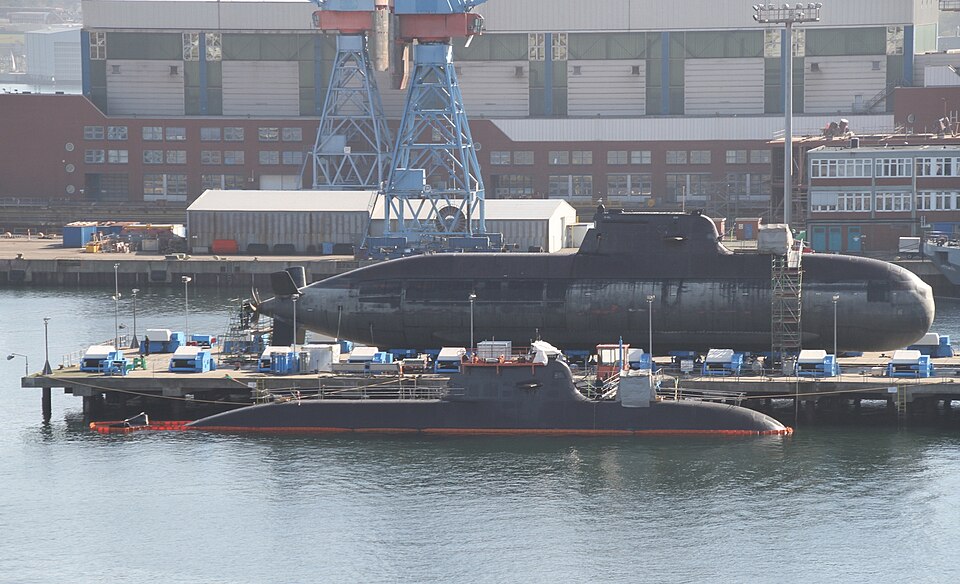
Type 212 submarines at the HDW shipyard in Kiel, Germany, 1 May 2013.
Photo by Bjoertvedt via Wikimedia Commons.
On Thursday in South Korea, Royal Canadian Navy Vice-Admiral Angus Topshee more or less kiboshed the notion of building new submarines here in Canada. He cited two major concerns: One, that we need these submarines “quickly.” And two, that our demand for submarines couldn’t possibly sustain an operation on its own.
“A submarine industry requires a consistent production line, and to be able to build enough submarines … to sustain a production line will be a real challenge,” Topshee said at the Hanwha Ocean Shipyard, where he, Defence Minister David McGuinty and Prime Minister Mark Carney tickled the periscope on one potential replacement for Canada’s aging-out Victoria-class subs.
Both Hanwha and ThyssenKrupp say it’s technically possible they could build the subs in Canada; it would just take a long time to lay down the infrastructure, and we’re in an uncommon hurry. We are assured plenty of Canadian steel and sweat will go into maintaining them.
And I suspect that won’t be very controversial, if at all. We’ve had American submarines, British submarines and German submarines in the past. Submarines are just something that are not made in Canada, like a lot of other things: jumbo jets, fighter planes, aircraft carriers, pineapples, cellular telephones, home electronics.
And we’re fine with it. Aside from the odd Avro Arrow obsessive, everyone seems to accept we’ll be buying new fighter jets off the peg from abroad — assuming we ever come to a final decision on which to buy, of course.
The question is, why isn’t that controversial? Or, why is it by contrast seen as controversial to buy surface vessels from abroad. Whoever’s fault it is, Canadian shipbuilding for the navy is a scrapyard of blown deadlines, outrageous cost overruns and sometimes outright failure. If we’re happy with South Korean or German subs, why not South Korean or German or Danish frigates and destroyers — or passenger ferries, for that matter?
Until this silly “elbows up” narrative took hold, no one seemed to care very much where our ferries were built: Marine Atlantic sails Chinese-built ferries between Cape Breton and Newfoundland with barely a whisper of controversy. But the entire political class is now essentially united against BC Ferries’ decision to buy Chinese ferries from the same shipyard. The fact that BC Ferries needs ferries almost seems like an afterthought.
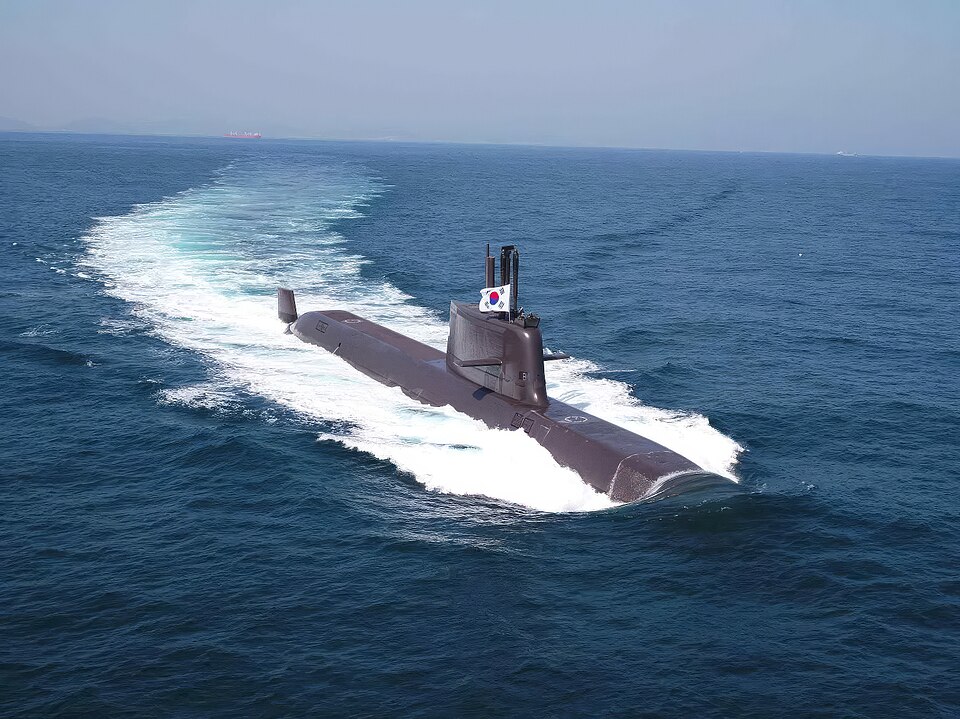
ROKS Shin Chae-ho, a KSS-III submarine at sea on 4 April, 2024.
Photo from the Defense Acquisition Program Administration (DAPA) via Wikimedia Commons.
Update: Noah posted a Q&A session with his readers that included some comparisons of the two contending designs for the Canadian Patrol Submarine Project (CPSP):
Q4. Have you had a chance to compare the AIP on the Ks III & 212CD yet with respect to Time underwater. There are different numbers floating around with new systems?
The truth is that no manufacturer is going to give you the accurate endurance. None. That is a closely guarded secret. I can say the KSS-III is higher, though out of respect for everyone and to not get myself in trouble I won’t say numbers. Both have endurance of several weeks and fit the HLMR.
I do plan to go into details about the systems themselves soon though, so I’m not leaving it alone!
Q5. The Type 212 has been described as an “ambush” submarine silently lying in wait for Russian subs. What advantages does the 212 bring to the Pacific?
Understand that both the KSS-III and Type 212CD are products of different needs and philosophies. Both focus on different strengths, in this case the 212CD puts almost all its efforts into being as stealthy and quiet as possible.
Its not just about ambush. Its about survival. The Type 212CD is designed to operate in the shallow, tight waters of the Baltic, and the littoral regions of the North Sea. That isn’t just about submarines but also being survivable against a dense field of Russian Maritime Patrol Aircraft and Anti-Submarine Helicopters.
That means a lot of effort was taken to ensure they’re as quiet and undetectable as possible. That’s where things like the Diamond-Shaped hull are supposed come into play, the use of non-magnetic stainless steel.
A lot of its value comes in what role you expect it to play. It is still an excellent asset in the littoral regions of the pacific, however it isn’t optimized for prowling around the open ocean, deep-diving nature of the Pacific. That is the domain of platforms like the KSS-III, at least in my opinion.
That doesn’t mean it can’t, but just as the KSS-III can also operate in the littoral regions of the Baltic doesn’t mean it’s optimized too. That’s the thing about CPSP. There’s a lot of requirements, a lot of different environments we expect these subs to operate in, and both [designs] focus on different priorities.
The advantages it has as a stealth-optimized platform don’t disappear. It could easily act in complement to other assets like U.S. and future Australian SSN [which] are more optimized for operations in the wider Pacific.
Strengths and weaknesses.
Update, the second: South Korea looks to be joining the nuclear-powered navy club with a new class of Korean subs to be built in Philadelphia using US navy nuclear propulsion technology.
South Korea has been wanting to get in the SSN club for a long time. Good on them for their persistence.
I’m not sure how this will work out. The Philadelphia Shipyard, even at its heyday, never built nuclear powered ships of any kind.
The South Koreans build a solid conventional submarine, the KSS-III that they offered to Canada recently, but nuclear submarines are at another level. Besides the infrastructure issues specific to nuclear shipbuilding at the shipyard that would need to be addressed, there is the fact that the U.S. nuclear workforce and hardware providers are already behind schedule with expected demands. While another yard is great, whoever is going to successfully solve those two structural issues needs superhuman abilities and one heck of a funding line.


