
TimeGhost History
Published 2 Nov 2025From the miracle material of the 1950s to the global crisis of the 21st century — this is the story of how plastic reshaped our lives, our economies, and our planet.
Born from wartime innovation, plastic promised a future of convenience, color, and endless possibility. From nylon stockings to Tupperware parties, it defined modern life — light, bright, and disposable. But the same durability that made it revolutionary also made it permanent.
In this episode of War 2 War, we trace how postwar optimism turned into an age of overproduction and pollution — how a chemical miracle became the material legacy of the modern world. Join us as we uncover how the postwar dream of “Better Living Through Chemistry” changed everything — forever.
(more…)
November 3, 2025
Plastic Fantastic: How the Modern World Became Synthetic – W2W 051
Swedish Kulspruta m/36 Double Browning MGs
Forgotten Weapons
Published 18 Jun 2025Despite being a neutral power during World War Two, Sweden had a variety of very interesting small arms — like their dual-mount Browning m/36 machine guns. These were originally adopted because the Swedes wanted a heavier medium MG cartridge and didn’t think their delayed-blowback Schwarzlose guns could handle it. The cartridge was 8x63mm, pushing a 219 grain projectile at 2500 fps. The m/36 Browning was a water cooled gun, an improvement on the older M1917 design. It not only handled the powerful new round, but it could also be easily swapped to the older 6.5x55mm round to use stocks of existing ammunition (and it would be later adapted to 7.62mm NATO as well). Most of the guns were built as matching pairs for antiaircraft use, with mirrors left and right side feeds and in effective recoil-absorbing cradle mounts.
Special thanks to Bear Arms in Scottsdale, AZ for providing access to this rare pair of guns for today’s video!
(more…)
QotD: Was Alexander “the Great”?
Finally, I think we need to talk briefly about Alexander’s character and his immediate impact in all of this. As I noted above, Alexander was charismatic and even witty and so there are a number of very famous anecdotes of him doing high-minded things: his treatment of Darius’ royal household, his treatment of the Indian prince Porus, his refusal to drink water in Gedrosia when his soldiers had none, and so on. These anecdotes get famous, because they’re the kind of things that fit into documentaries and films very neatly and making for arresting, memorable moments. But there is a tendency to reduce Alexander’s character to just these moments and then end up making him out – in a very Droysen-and-Tarn sort of way – into the “Gentleman Conqueror”.
And that’s just not a reading of Alexander which can survive reading all of any of our key sources on him. The moment you read more than just the genteel anecdotes (“for he, too, is Alexander”, – though note that Alexander’s gentle words do not keep him from trying to use Darius’ family to extort Darius out of his kingdom, Arr. Anab. 2.14.4-9), I think one must concede that Alexander was quite ruthless, a man of immense violence. I mean, and I want to stress this, he killed one of his closest companions with a spear in a drunken rage. I do not think there is a collection of polite-but-witty one-liners to make up for that. But Cleitus was hardly the only person Alexander killed.
Alexander had Bessus, the assassin of Darius, mutilated by having his nose and ears cut off before being executed (Arr. Anab. 4.7.3). He has 2,000 survivors of the sack of Tyre crucified on the beach (Q. Curtius Rufus 4.4.14-17). Because he resisted bravely and wouldn’t kneel, Alexander had the garrison commander at Gaza dragged to death by having his ankles pierced and tied to a chariot (Q. Curtius Rufus 4.4.29). Early in his reign, Alexander sacks Thebes and butchers the populace, as Arrian notes, “sparing neither women nor children” (Arr. Anab. 1.8.8; Arrian tries, somewhat lamely, to distance Alexander from this saying it was is Boeotian allies who did most – but not all – of the killing). Of the Greek mercenaries enrolled in the Persian army at Granicus – a common thing for Greek soldiers to do in this period – Arrian (Anab. 1.16.6) reports that he enslaved them, despite, as Plutarch notes, the Greeks holding in good order and attempting to surrender under terms before they were engaged (Plut. Alex. 16.13). Not every opponent of Alexander gets Porus’ reward for bravery and pride.
Meanwhile, Alexander’s interactions, as noted above, with the civilian populace were self-serving and generally imperious. That’s not unusual for ancient armies, but I should note that Alexander’s conduct towards civilians was also no better than the (dismally bad) norm for ancient armies: he foraged, looted what he wanted, occasionally burned things (including significant parts of Persepolis, the Persian capital), seized land and laborers for his colonies and so on. Alexander’s operations in Central Asia seem to have been particularly brutal: when the populace fled to fortified settlements, Alexander’s orders were to storm each one in turn, killing all of the men and enslaving all of the women and children (Arr. Anab. 4.2.4, note also 4.6.5, doing the same in Marakanda).
And this, at least, brings back to our original question: Was Alexander “Great”? In a sense, I think the expectation in this question is to deliver a judgment on Alexander, but I think its actual function is to deliver a judgment on us.
The Alexander we have in our sources – rather than in the imperialistic hagiographies of him that still condition so much popular memory – seems to have been a witty, charismatic, but arrogant, paranoid and violent fellow. As I joke to my students, “Alexander seems to have enjoyed two things in life, killing and drinking and he was only good at the former”. He could be gentle and witty, but it seems, especially towards the end of his reign, was more often proud, imperious and murderous.
He was at best an indifferent administrator and because he was so indifferent to that task, most of his rule amounted to questions of the men he chose to do the job for him, and those choices were generally quite poor. He made no meaningful preparations for the survival of his empire, his family or his friends upon his death; Arrian (Anab. 7.26.3) reports famously that his last words were, when pushed by his companions to name a successor, τῷ κρατίστῳ (toi kratistoi), “to the strongest”. Translation: kill each other for it. And they did, killing every member of Alexander’s family in the process.1
He was not a great judge of men – for every Perdiccas, there is a Harpalus – or a great military innovator. He largely used the men and the army that his father gave him, and where he deviated from the men, the replacements were generally inferior. That said, he was an astounding commander on campaign and on the battlefield, managing the complex logistics of a massive operation excellently (until his pride got the better of him in Gedrosia) and managing his battles with unnatural calm, skill and luck. He was also, fairly clearly, a good fighter in the personal sense. Alexander was a poor ruler and a lack-luster king, but he was extremely good at destroying, killing and enslaving things.
To the Romans – who first conferred the title “the Great” on Alexander, so far as we know (he is Alexander Magnus first in Plautus’ Mostellaria 775 (written likely in the late 200s)) – that was enough for greatness. And of course it was enough for his Hellenistic successors, who patterned themselves off of Alexander; Antiochus III even takes the title megas (“the Great”) in imitation of Alexander after he reconquers the Persian heartland. Evidently by that point, if not earlier, the usage had slipped into Greek (it may well have started in Greek, of course; Plautus’ comedies are adapted from Greek originals). It should be little shock that, for the Romans, this was enough: this was a culture that reserved their highest honor, the triumph, for military glory alone. And it was clearly enough for Droysen and Tarn too: to be good at killing things and then hamfistedly attempt – and mostly fail – to civilize them, after all, was what made the German and British Empires great. It had to be enough, or else what were all of those Prussian officers and good Scottish gentlemen doing out there with all of that violence? To question Alexander might mean questioning the very system those men served.
What is greatness? Is it pure historical impact, absent questions of morality, or intent? If that is the case, Alexander was Great, because he killed an exceptionally large number of people and in so doing set off a range of historical processes he hadn’t intended (the one he did intend, fusing the Macedonian and Persian ruling class, didn’t really happen) which set off an economic boom and created the vibrant Hellenistic cultural world, outcomes that Alexander did not intend at all. This is a classic “great, but not good” formulation: we might as well talk of “Chinggis the Great”, “Napoleon the Great” or (more provocatively) “Hitler the Great” for their tremendous historical impact. Yet this is a definition that can be sustained, but which robs “greatness” of its value in emulation.
One cannot help but suspect in many of these circumstances, “greatness” is about killing larger numbers of people, so long as they are strange people who live over yonder and dress and pray differently than we here do. It is ironic that Tarn credited Alexander with imagining the unity of mankind, given that Alexander was in the process of butchering however many non-Macedonians was required to set up a Macedonian ethnic ruling class over all other peoples. One suspects, for Droysen and Tarn, it was “greatness”, to be frank, because they understood the foot inside the boot Alexander was planting on the necks of the world, was European and white and so were they. In that vision, greatness is “our man” as opposed to “their man”. But that is such a small-minded, petty form of greatness, “our killer and not your killer”.
Does greatness require something more? The creation of something enduring, perhaps? Alexander largely fails this test, for it is not Alexander but the men who came after him, who exterminated his royal line and built their kingdoms on the ashes of his, who constructed something enduring. Perhaps greatness requires making the world better? Or some kind of greatness of character? For these, I think, it is hard to make Alexander fit, unless one is willing, like Tarn was, to bend and break the narrative to force it. Had Alexander, in fact, been Diogenes (Plut. Alex. 14.1-5), rather than Alexander, but with his character – witty, charismatic, but imperious, arrogant and quick to violence – I do not think we would admire him. As for making the world better, Alexander mostly served to destroy a state he does not seem to have had the curiosity or cultural competence to understand, as Reames puts, it, “not King of Asia, but a Macedonian conqueror in a long, white-striped purple robe” (op. cit. 212). He surely did not understand their religions.2
In a sense, Alexander, I think, serves as a mirror for us. We question the greatness of Alexander and what is revealed are the traits, ideals, and actions we value. Alexander’s oversized personality is as captivating and charismatic now as it was then, and his record as a killer and conqueror is nearly unparalleled. But what is striking about Alexander is that beyond that charisma and military skill there is almost nothing else, which is what makes the test so discerning.
And so I think we continue to wrestle with the legacy and value of Alexander III of Macedon.
Bret Devereaux, “Collections: On the Reign of Alexander III of Macedon, the Great? Part II”, A Collection of Unmitigated Pedantry, 2024-05-24.
- I thus find it funny that every few years another “inspiring” anecdote about Alexander’s wise last words filters around the internet that Alexander’s actual reported last words were so grim and heartless.
- On this, see F. Naiden, Soldier, Priest and God (2018).
November 2, 2025
“Why not go all the way and order His former Royal Highness to wander the streets as Mr Sarah Ferguson?”
Mark Steyn has a bit of fun at the expense of the artist formerly known as Prince Andrew, His Royal Majesty King Charles III, and the current British government:
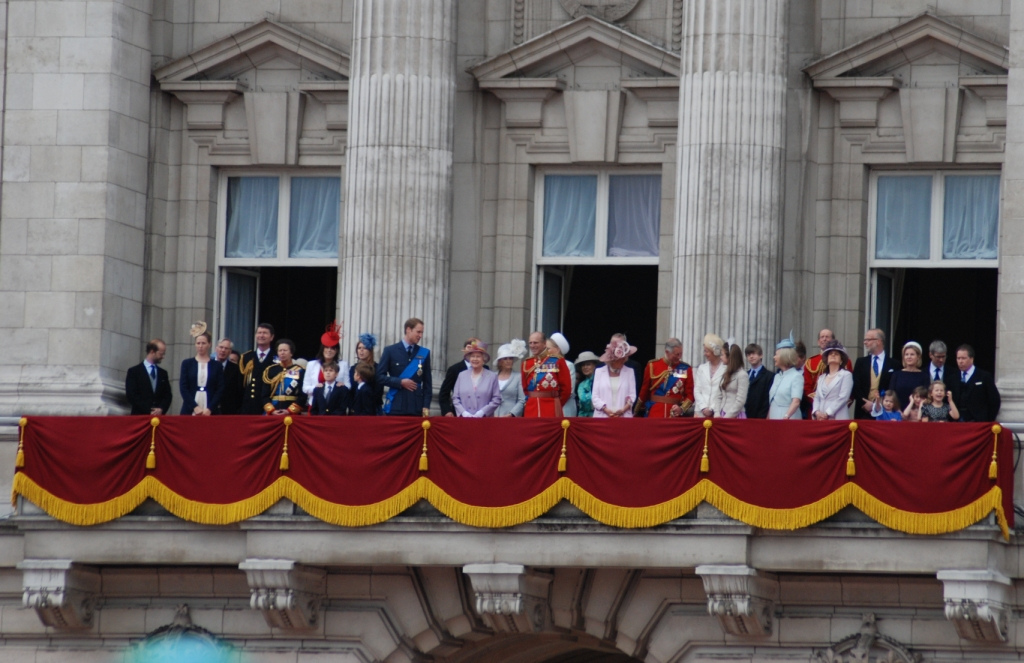
The royal family at Buckingham Palace for the Trooping of the Colour 2010, 30 June, 2015.
Photo by Robert Payne via Wikimedia Commons.
Last night, HM The King announced that his brother, until recently HRH The Duke of York KG KCVO, will now be formally stripped of all his titles, styles and dignities and will be reduced to trying to book fashionable London restaurants — or even Pizza Express in Woking — as plain old Mr Andrew Mountbatten Windsor. As longtime readers may recall, I dined at Buckingham Palace, midst princes, dukes, earls, viscounts and knights, as the only mister at the table and rather enjoyed it — although, even at that lowly rank, the sense of remorseless imperial decline down the decades is palpable: from Mr Gladstone … to Mr Steyn … to Mr Mountbatten Windsor … Why not go all the way and order His former Royal Highness to wander the streets as Mr Sarah Ferguson?
Be that as it may, it was the final sentence in the Palace’s 109-word statement that caught my eye:
Their Majesties wish to make clear that their thoughts and utmost sympathies have been, and will remain with, the victims and survivors of any and all forms of abuse.
Had the King said that to me in person, I would have had great difficulty in restraining myself from punching him on the nose. Their Majesties have never expressed any “utmost sympathies” for the thousands upon thousands of their own young subjects in virtually every town up and down what passes for the spine of England gang-raped, sodomised, urinated on, dangled off balconies, doused in petrol, burned alive, fed into kebab mincers, etc. A decade ago, when I first met “grooming gang” victims in Rotherham, one of Sammy Woodhouse’s chums told me that “Charles and Camilla” were said to have expressed interest in meeting with survivors — although Sammy herself, ground down by official dissembling even then, expressed some cynicism as to the likelihood of any such Royal audience ever happening.
It never did. The Prince of Wales has his Earthshot campaign to save the planet, and for a while the Duke of Sussex had his HIV-Aids charity in Botswana and Lesotho. You would think one’s “utmost sympathies” for such uncontroversial apolitical causes as climate change and Aids could be easily extended to little girls taken as sex slaves — particularly when it’s visible from the sod-bollocking turrets of Windsor Castle. Just to pluck at random, less than three miles from St George’s Hall, where the King uncontroversially celebrates Ramadan iftars and where equally uncontroversially Princess Beatrice’s masked ball once hosted not only Jeffrey Epstein but also Harvey Weinstein … how does the old song go? “I Danced with a Perve who Danced with a Girl who Danced with the Prince of Wales“? Anyway, less than three miles from Windsor Castle lies Diamond Road in Slough, where a chap called Azid Ahmed was found to have engaged in “five acts of sexual activity with a child”.
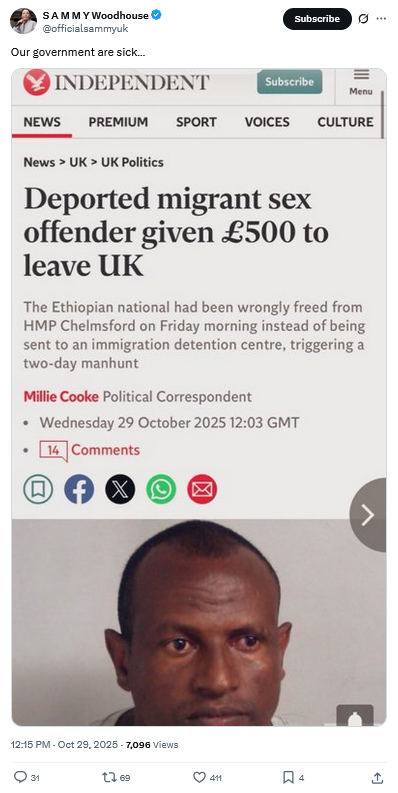
Any “utmost sympathy” for that victim, sir? Or does your sympathy in such matters not extend beyond the territorial waters of Epstein Island? England is a land that, literally, rewards sex predators. If you want the Andrew Formerly Known as Prince to bugger off out of sight, why not give him a year’s salary as the British state has just done to Hadush Kebatu? Mr Kebatu is the Ethiopian who two days after arriving by dinghy sexually assaulted a fourteen-year-old schoolgirl in Epping and set off the summer of “far-right” “racist” protests. He was convicted and imprisoned at HMP Chelmsford, which then managed to release him — “accidentally”. He spent two days wandering around the most surveilled city on earth and piling up enough camera footage to outpace the director’s cut of Lord of the Rings. So, for the crime of embarrassing Sir Keir Starmer, he was immediately put on a flight to Addis Ababa and given five hundred quid if he would agree not to contest his deportation.
Average annual salary in Ethiopia: 524 pounds sterling. So Hadush Kebatu is back home living large and telling friends he had a great holiday in England and this King Charles guy paid him a year’s wages for raping a fourteen-year-old.
Next time (he’ll be back by Christmas) he should make like Harvey Weinstein and hold out for a CBE.
The taqiyya mayor of London, soon to be joined by the taqiyya mayor of New York, claims that the “King apologised for taking so long to knight me“. I can well believe it. So Sir Sadiq Khan now outranks Mr Mountbatten Windsor at state banquets (my palace dinner was a little more informal, so I got to sit between Sir Angus Ogilvy and the Earl of Carnarvon). Is that because Sir Sadiq has also expressed his “utmost sympathies” for “victims and survivors”? Not at all. As the political overseer of the Metropolitan Police he has consistently lied about the existence of any Pakistani Muslim rape-gangs in London. The official position of the British state was that “grooming gangs” may all very well be operating in Newcastle, Middlesborough, Blackpool, Bolton, Manchester, Rotherham, Sheffield, Nottingham, Telford, Leicester, Birmingham, Coventry, Banbury, Aylesbury, Oxford, High Wycombe … but that it all mysteriously grinds to a halt once you hit the outskirts of the Metropolitan Line.
Alas, there are now so many dark secrets swept under the rug even Scotland Yard has noticed the bulge. So the Met has just announced they’re “reviewing” one or two … er, actually, no, nine thousand cases of “grooming”.
The striking feature of the end-phase Yookay is its total lack of “utmost sympathies”. Earlier this week, in Uxbridge (where, as it happens, the Metropolitan Line does end), an apparently pleasant fellow called Wayne Broadhurst was taking his dog for a walk when he was fatally stabbed by an Afghan who’d arrived in Britain in the back of a lorry and had, as is traditional, been given “leave to remain” — because of his potential contribution to GDP through increased machete sales.
North Africa Ep. 6: Do You Smell What The Fox Is Cooking?
World War Two
Published 1 Nov 2025Rommel pushes his HQ toward the front, seizes the oasis at Marada, and sends a long-range Italo-German column deep toward Murzuk to harden his forces for true desert warfare. A brutal Ghibli sandstorm shows how the Sahara itself is a third enemy, choking engines, wrecking vehicles, and nearly killing Rommel in the air. At the same time, ULTRA intelligence finally reaches Wavell, Malta’s bombers are forced off the island under relentless Luftwaffe pressure, and Rommel is already ordering preparations to hit El Agheila despite supposedly leaving for Berlin.
(more…)
November 1, 2025
The Spanish-American War 1898
The Great War
Published 13 Jun 2025In the last years of the 19th century, tension was building in the Caribbean. American newspapers were filled with grisly reports of Spanish atrocities against the people of Cuba struggling for independence. US businessmen and expansionist politicians also saw practical opportunities in Spain’s struggles: great power status and an empire for the United States. It’s the Spanish-American War.
(more…)
October 31, 2025
Halloween Special: Doctor Jekyll and Mister Hyde
Overly Sarcastic Productions
Published 31 Oct 2019Some monsters are undead creatures of the night. Some monsters are cosmic horror nightmare gods. Some monsters are existential personifications of dread and decay. But perhaps the greatest monster of all… is man.
Have a very spooky Halloween! And don’t forget the explicit moral of Jekyll and Hyde — that the greatest danger you’ll ever face comes from wealthy middle-aged white men who get away with their crimes because society refuses to believe they would ever do such horrible things. … Hm. Are we SURE this was written in 1886 …?
(Topic originally requested by patron Kyakan!)
MERCH LINKS: https://www.redbubble.com/people/OSPY…
OUR WEBSITE: https://www.OverlySarcasticProduction…
October 30, 2025
Cowardice & Courage – Fear, Flying & Combat Stress
HardThrasher
Published 24 Oct 2025Just getting into a bomber took guts. To do it twice required balls of steel. What happened when men wouldn’t or couldn’t continue to fly? We’ll look at the dangers they faced, what the RAF and the USAAF did to tackle the problem and talk about the infamous “LMF” cases in the RAF
00:00 – Come with Me
03:51 – Intro
04:16 – Shell Shock
06:00 – Inter War vs Early War
09:17 – Night Terrors
10:31 – Death in the Daylight
11:00 – Common Fears
13:22 – Raw Numbers
14:55 – The Mew Who Flew
16:35 – In The Hands of the CO
18:53 – LMF
21:01 – Combat Stress in the USAAF
22:03 – Attempts at treatment
24:47 – Wrap up and Closing Message
(more…)
October 29, 2025
The Making Of Modern London – The Heyday of London Transport 1914 – 1939
Classic Vehicle Channel
Published 15 May 2020A lovely documentary telling the story of the development of the London transport system from 1914 to 1939 — The heyday of London Transport. This film features awesome archive footage of buses, trams and London street scenes from the time. It’s one of a number of episodes this one featuring London’s transport system.
I’ve cut out the LWT adverts but I have left two in that I think you’ll love!
This film was broadcast by London Weekend Television in 1984 and later by CH4.
Written, Directed & Narrated by Gavin Weightman
October 28, 2025
Whitechapel protest – “an unholy union of witless leftists and menacing Islamists”
In Spiked, Brendan O’Neill discusses the weekend protest in the Whitechapel area of London, after the police had prevented a UKIP event in the same part of the city:
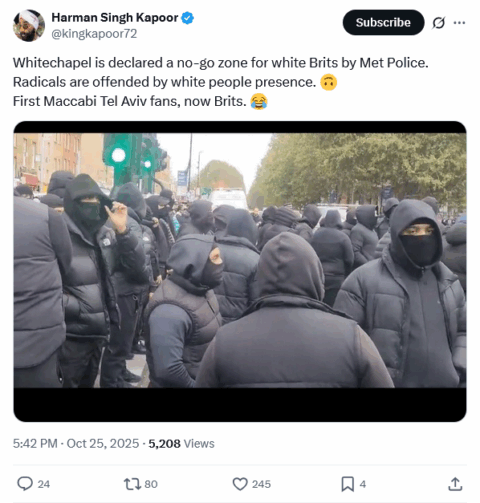
The next time someone asks what we mean when we say “Islamo-left”, I’m going to show them footage from yesterday’s protest in Whitechapel in East London. What a morally suicidal schlep that was. What an unholy union of witless leftists and menacing Islamists. “Refugees welcome here!”, cried the granola-fed grads of the limp-wristed left. “Allahu Akbar!”, barked the masked mob of religious hotheads. Rarely has the lethal idiocy of the left’s bed-hopping with Islamism been so starkly exposed.
This assembly of godless genderfluids and Koran-botherers was ostensibly a march against UKIP. That knackered old party had hoped to hold its own protest in Whitechapel yesterday. It was clearly a provocation: they targeted Whitechapel precisely because it has a large Muslim population. A Ukipper’s wet dream is to wang on about “Islamist invaders” and the need for “remigration” as Bangladeshi Brits look on with alarm. A wind-up masquerading as a march. The Metropolitan Police, fearing “serious disorder”, put the kibosh on it and told UKIP to do their wailing elsewhere.
So they went to Whitehall instead. Around 75 of them gathered outside the London Oratory with their flags and their hernias. And Whitechapel was left to the Islamo-left, to that seething mob of plummy radicals and gruff Islamists who love to scream blue murder about “Zionists”. And there you have it: in the eyes of the Met it is an offence against decency to let a handful of Ukippers traipse through Whitechapel, but it is absolutely fine to surrender those same streets to columns of black-clad fanatics raging against “Zionist scum“. The hypocrisy stinks to heaven.
The anti-UKIP counter-demo in Whitechapel was not an anti-racist march. We all know it. The dogs in the street know it. It was an orgy of intolerance dolled up as tolerance. It was a display of Islamist arrogance wearing the thin veil of “anti-racism” to fool the overeducated idiots of the bourgeois left. Well, if they’ll believe someone with a cock can be a lesbian, they’ll believe Islamist fanatics who dream of annihilating the Jewish homeland are anti-racists.
For those of us who still have a quaint attachment to the virtues of reason and secularism, it was a sickening spectacle. Mobs of men in black masks hollered Islamist slogans in a distinctly menacing manner. They denounced “Zionist scum” and darkly promised to hound them “off our streets”. They yelled “From the river to the sea” (translation: destroy the Jewish homeland) and sang the praises of “our martyrs” (translation: the Jew-killers of Hamas). And all the while, the pricks of the new left who think it’s bigotry to say “he” about a fella in a dress just stood there smiling.
Anyone who says “They were just criticising Zionism” is going to get slapped. Our crisis is too pressing for pussy-footing. When the devotees of a hardcore species of Islam take to the streets to fume about “Zionists”, we know who they mean. We know they don’t mean people like me – Gentiles who support Jewish nationhood. It’s not the likes of us they want to drive out of Britain, 1290-style. It’s them. Those Zios. The kippah people. Are we really going to do that dumb dance of saying, “Criticising Zionism is not the same thing as hating Jews”? Stop it. I’m tired.
Here’s my question: why is it racism for Ukippers to dream of expelling “Islamist invaders” from the UK, but anti-racism for Islamists and their posh simps on the left to agitate for the expulsion of “Zionists” from Britain’s streets? I agree UKIP’s chants were racist. To brand Muslims “Islamist invaders” and demand their “remigration” is vile bigotry. But why can’t the left say the same about the Zio-bashing that we all know is Jew-bashing? Far from calling that out, they snuggle up to it. They fancy themselves as the righteous enemies of racism when in truth they are the obsequious fluffers of Islamist bigotry.
Andrew Doyle on the “useful idiots” at the protest:
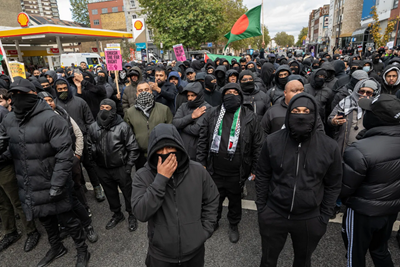
There is a species of leftist that is so blinded to the lack of compassion in its enemies that it sees them as friends. The Chinese even have a word – baizuo (白左) – to describe white Western liberals whose generous nature leaves them open to exploitation. I am reminded of Nietzsche’s remark in Beyond Good and Evil (1886): “There is a point in the history of society when it becomes so pathologically soft and tender that among other things it sides even with those who harm it, criminals, and does this quite seriously and honestly”. For the most egregious example of recent years, look no further than the absurdly self-defeating phenomenon of “Queers for Palestine”.
What happened at Tower Hamlets this weekend was a show of strength. The video footage makes that clear enough. Men blocked the streets to pray to Allah in public as a sign of religious dominance, while other men roamed aggressively, virtually daring anyone to object. Women were notably absent.
These chest-thumping, territorial displays followed the Metropolitan Police’s decision to ban a UKIP march through the East End under the banner of “reclaim Whitechapel from the Islamists”. With a significant Muslim population in the area – 40% in Tower Hamlets – this was always bound to provoke. Of course, protests are by their nature provocative, or they wouldn’t be protests. Islamic supremacists are likewise permitted to march peacefully, but we shouldn’t be foolish enough to ignore what this demonstration portends.
The End of European Superpowers? The Suez Crisis – W2W 050
TimeGhost History
Published 26 Oct 2025Egypt nationalizes the Suez Canal, Israel strikes under a secret Sèvres pact, and Britain and France launch Operation Musketeer, only to meet U.S. and UN pressure that forces a ceasefire at midnight.
UN peacekeeping is born, Nasser’s stature soars, and Eden’s government collapses as Suez ends the illusion of old imperial power.
(more…)
QotD: Pyrrhus after his bloody defeat of the Romans at Heraclea
On Pyrrhus’ side, his army had been bloodied, but was mostly intact and was almost immediately bolstered by the arrival of his Italian allies, including the Lucanians and Samnites, along with the Tarantines. On the Roman side, Laevinius’ army was battered, but still extant; he fell back to Roman-controlled Campania, eventually taking up a position at Capua, the chief city of that region. Pyrrhus then marched north, entering Campania, bypassing the Roman force at Capua (which had been reinforced with two legions pulled from Etruria) and entering Latium, apparently getting within about 60 kilometers (c. 37 miles) of Rome (Plut. Pyrrh. 17.5). And here the question students as is why not take Rome?
And there is an easy answer: because he couldn’t.
The first thing to remember here is the natural of the human-created terrain Pyrrhus has to operate in: functionally all of the cities of any significant size in third-century Italy were likely to be fortified and their populations – thanks to Rome’s recruitment system – experienced and armed. Consequently, if the locals didn’t voluntarily switch sides, Pyrrhus would have been forced to take their settlements either by siege or storm. Pyrrhus might well have hoped that the Campanians would go over to him, but here the problem is the human geography of Italy: his army is full of Samnites, whose emnity with the Campanians is what started the Samnite wars. This is a feature of Rome’s alliance system noted by M.P. Fronda in Between Rome and Carthage (2010): because Rome extended its alliance system by intervening in local rivalries, both sets of new “allies” had long-standing grudges against the other, which makes it hard to dismantle Rome’s alliance network, since any allies you peel away will push others closer to Rome.
In the case of Campania, Capua might have felt strong enough to try their luck without Rome, but that’s why Laevinius was sitting on it with a large army. But the other Campanian cities (of which there were about a dozen) might well fear exposure to Samnite raiding without Rome’s protection. Meanwhile, the Latins – the people of Latium, the region immediately to Rome’s south (technically Rome is in Latium, on its edge) – seem to have been pretty profoundly uninterested in siding against Rome either at this juncture or later when Hannibal tries to dismantle Rome’s alliance system.
So after Heraclea, Pyrrhus has fairly limited options: he can start the slow process of reducing the cities of Campania one by one to open the logistics necessary to permit him to operate long-term in Latium or he can conduct a lightning raid through Roman territory to try to maximize the psychological effect of his victory and perhaps get a favorable peace. He opts for the second choice and when the Romans opt not to take the deal – though they do consider it – he has to pull back to southern Italy (where he focuses on consolidating control, pushing out the last few Roman positions there).
Why not attack Rome directly? Well, Rome itself was fortified, of course. Moreover, the Romans had raised a fresh levy of troops for its defense (Plut. Pyrrh. 18.1), while dispatching Tiberius Corucanius with his army to reinforce Laevinius in Capua. So as Pyrrhus enters Latium, he has a well-defended fortified city in front of him and a Roman army of, conservatively, 30,000 men (Corucanius’ 20,000 men, plus whatever was left of Laevinius’ army) behind him. I don’t usually quote movie tactics, but Ridley Scott’s Saladin has the right wisdom for this problem: “One cannot maintain a siege with the enemy behind“. Had Pyrrhus stopped to besiege Rome, his supply situation would have quickly become hopeless as the Roman army behind him could have easily prevented him from foraging to feed his army during the long process setting up for an assault on the city, which might then simply fail, since the city was well-fortified and defended.
If Plutarch (Pyrrh. 18.4-5) is correct about the terms Pyrrhus offered – an alliance with Rome, a recognition of their hegemony over Italy outside of his new clients in southern Italy (who would of course, fall under Pyrrhus’ control now) – Pyrrhus may have hoped at this juncture to consolidate southern Italy and turn back towards the East or perhaps head on to Sicily. But the Romans refused the deal and so Pyrrhus seems to have set above clearing out the last Roman strongholds (Venusia and Luceria) in Apulia to consolidate his hold. The Romans responded in the following year by sending a new army, under the command of Publius Sulpicius Saverrio and Publius Decius Mus to challenge him and they met at Asculum, in northern Apulia.
Bret Devereaux, “Collections: Phalanx’s Twilight, Legion’s Triumph, Part IIIb: Pyrrhus”, A Collection of Unmitigated Pedantry, 2024-03-08.
October 27, 2025
“The Church of England has lost 80 per cent of Anglicans on the planet”
In The Conservative Woman, Daniel Jupp considers the recent schism in the Church of England, which has left the original church shorn of the vast majority of Anglican worshippers across the globe:
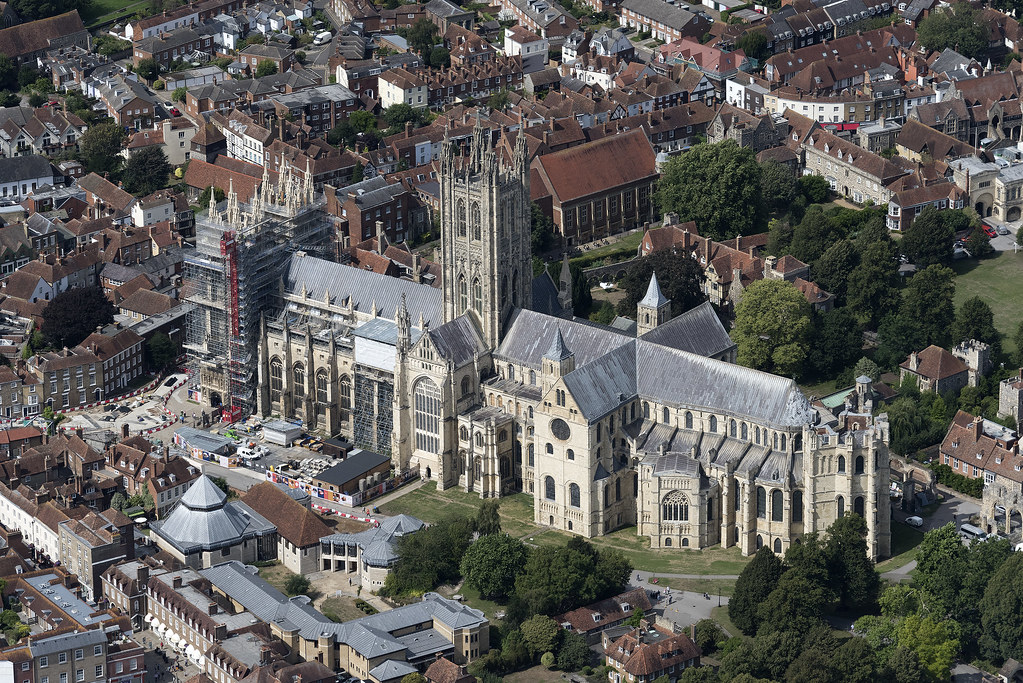
“Canterbury Cathedral aerial image” by John D Fielding is licensed under CC BY 2.0 
 .
.
Today, though, the English Church is broken. The Anglican Communion, which encompassed all the places across the world touched by English exploration, discovery, trade and power, where English Christian missionaries often led the way, has witnessed a devastating schism. At the start of this month Dame Sarah Mullally was appointed the first female Archbishop of Canterbury. As is tradition, the appointment was approved by the Prime Minister and the King, but the nomination came from the Church.
Whether Anglican Christians worldwide approved doesn’t seem to have been considered. Based on multiple past fissures between the part of the Church active in the United Kingdom and the (much larger) Anglican communities globally which had each time been papered over, it may be that the hierarchy in England assumed that the same would happen again.
If so, they were wrong.
The Global Fellowship of Confessing Anglicans (also known as Gafcon) represent the Anglican faith in Africa. Their response was to declare publicly that they would no longer send delegates to Church meetings in the United Kingdom, no longer consider the Archbishop of Canterbury as first among equals or a seat of authority to which they deferred, and no longer consider themselves in the same communion as the Bishops and clergy of the Church of England within England. Perhaps even more tellingly, they asserted that they were the true Anglican communion, more loyal to the instructions of the Bible and Anglican interpretation of those than priests in England. There’s a subtle but powerful distinction there – they were saying not that they had broken away from an Anglican vision of Biblical instruction and Christian identity but that the Church in England had done so.
African Anglicans now assert that they are the true Anglicans, and that the organisation within the UK is not. And in terms of the number of people who follow their message, they are right to assert this.
In losing the African churches and the global, more conservative branch of Anglicanism, the Church of England has lost 80 per cent of Anglicans on the planet.
Imagine a company that lost 80 per cent of its customers. Or a political party that lost 80 per cent of its voters. Or a nation state that lost 80 per cent of its territory. These would in each case be recognised as unmitigated disasters.
Now imagine this following a previous disaster, which was the end of Justin Welby’s period as Archbishop over a scandal based on not being firm enough and honest enough about paedophile cases in the clergy. One would think the Church might be looking for a non-controversial appointment intended to restore moral trust immediately and defuse criticism.
They did not do this. Knowing the much more conservative and traditionalist stance held by the majority of Anglicans, they chose not to listen to those people, and did something it knew to be passionately opposed by them.
There is an intense irony here that gets to the heart of the self-inflicted problems of the Church of England today. Sarah Mullally has been very clear on the kind of Church she believes in – she’s a supporter of LGBTQ+ rights and activism, she has strongly backed asylum and migration, she is a self-declared feminist, and she is both politically and it seems religiously progressive. As Bishop of London, she boasted about representing a diverse and multicultural city, and put her experience in handling diversity as one of the key qualifications and evidence of positive experience she could bring to being the Archbishop of Canterbury.
This was an intensely reality-averse selling-point. London’s slightly lower trend on the relentless decline of Christian faith and attendance compared with the UK as a whole is based not on Mullally’s competence and persuasion. It is based on traditionalist, conservative-minded members of the African Anglican communion in London being more likely to go into a church.
And these people hate woke attitudes and politics.
Update, 28 October: Welcome, Instapundit readers! Please do have a look around at some of my other posts you may find of interest. I send out a daily summary of posts here through my Substack – https://substack.com/@nicholasrusson that you can subscribe to if you’d like to be informed of new posts in the future.
Britain and the Claudian Invasion – The Conquered and the Proud 17
Adrian Goldsworthy. Historian and Novelist
Published 28 May 2025Today we look at Roman relations with island of Britannia between Caesar and the invasion sent by Claudius in AD 43. We discuss the motives for that invasion, the campaigns fought to take control of the south east, before considering the rebellion of Boudica and the expansion in the north under the Flavians.
October 26, 2025
North Africa Ep. 5: Desert Fox Prepares to Pounce
World War Two
Published 25 Oct 2025Tripoli hums as staff and both battalions of Panzer-Regiment 5 bolster Rommel; Ariete is formally pulled under his hand to guard the rear while he eyes Marada. Malta’s Wellingtons and Sunderlands withdraw under X. Fliegerkorps pressure, a British war council prioritizes Greece, and HMS Greyhound bags Anfitrite as both sides struggle to hit each other’s convoys.
(more…)


