
I came across an article on my phone about a women’s rugby championship. It is unseemly for women to play rugby, and they will never be any good at it. It is a game made for men and increasingly for monsters. In the days when it was still a genuinely amateur sport, those who played it were of ordinary dimensions and often young men who went on to sensible careers in medicine, law, business, and the like.
Now, however, the sport is professional and played by men who seem to be eight feet wide and run straight into one another, very fast and often headfirst. Not surprisingly, a significant proportion of them suffer from traumatic dementia very early in their lives, and some, understandably though I do not think justifiably, try in the early stages of their sad condition to obtain financial compensation. The sport has become so violent that even people who are not unduly sensitive to violence shrink from observing it close-up.
Freud might have taken these women’s desire to participate in a sport that is so radically unsuited to them as an instance of what, in one of his absurd speculations about the psychology of women, he called penis envy. I think, rather, it is a sign of the masculinization of at least some women, who are responding to the overvaluation in our culture of the exercise of power as the supreme end in life. The exercise of all power is fleeting, sporting prowess being among its most fleeting forms; but the illusion dies hard.
Theodore Dalrymple, “All in a Day’s Irk”, New English Review, 2025-08-29.
December 20, 2025
QotD: Women’s Rugby
December 19, 2025
The strange rebirth of English patriotism
In The Conservative Woman, Niall McCrae discusses what he calls “a new crusade” as the downtrodden English rediscover — or in many cases, discover for the first time — patriotic feelings for their nation, and earn the scorn and contempt of the ruling class and their media fart-catchers:
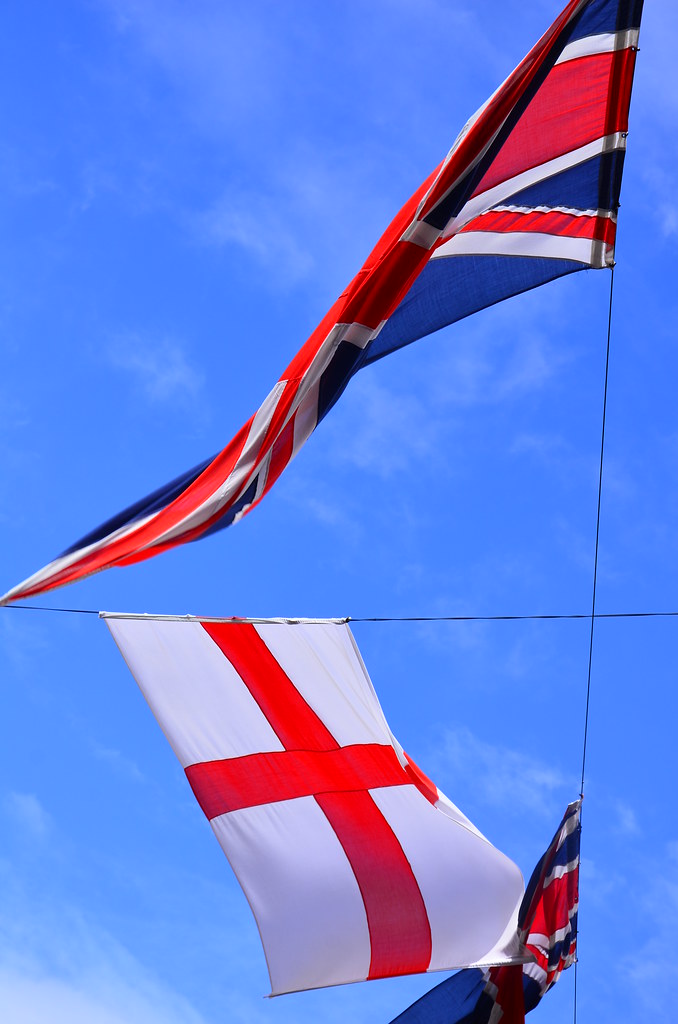
“Union Jacks and crosses of St George” by Ben Sutherland is licensed under CC BY 2.0 
 .
.
A wave of patriotism swept across England last summer. Flags were tied to lampposts up and down the country, but while these displays had wide public support, the intelligentsia were troubled, particularly as the colours were often flown in areas of cultural diversity or on roads passing hotels accommodating illegal immigrants. This suggested provocation, rather than the use of national flags to celebrate sporting success.
Politicians and Guardian commentators were careful not to appear too negative, but they emphasised unity and inclusion over nationalistic fervour. The Union Jack was preferable to the St George’s Cross, because they associated the latter more with the far right (this is not accurate, as groups such as the National Front and BNP rallied under the Union Jack).
The Union Jack (properly termed “flag” as a jack is hoisted at sea), comprises the crosses of St George, St Andrew and St Patrick. It is perhaps the most impressive flag in the world, a classic design of great cultural impact. How globalists, the EU and Islamists would like to banish it!
The “Unite the Kingdom” march led by Tommy Robinson in September, which brought a million people to the streets of London, was a marvellous spectacle of patriotism. For the counter-Jihad movement, conflict in the Middle East is regarded as an existential struggle against militant Islam. Israeli flags are often waved towards pro-Palestine marchers, and the London rally gave several Zionists a platform at Whitehall. However, the vast majority of marchers were there for one country only – their own. This was truly a British event, with a roughly equal mix of Union and St George flags, alongside some Welsh dragons and Scottish saltires, and Irish tricolours too.
Significantly, there was another symbol prominently at the London march: the Christian cross. A poignant moment was at the ramparts of Westminster Bridge, where a fearless young man mounted the head of the stone lion and from that precarious pedestal raised in one hand the flag of St George, and in the other a wooden cross. (https://www.instagram.com/reel/DOpagGvkQk9/)
I first observed the resurgence of Christian faith at the huge protests against the Covid-19 regime. Several marchers bore crosses, or placards asserting the power of God over earthly evil. The Book of Revelation was quoted, and when the “vaccine” was launched it was cast as the “Mark of the Beast”.
Socially unacceptable they may have been, but now St George and Christian crosses are regularly appearing together in gatherings for patriotic or traditional causes. In his book Worth Dying For: The Power and Politics of Flags (2017), Tim Marshall observed that “with the rise of Islam in Europe, these symbols are likely to be increasingly used by the far right to try to define the continent as what they think it is, and in opposition to what they think it is not”. You can’t get a book released by a mainstream publisher without expressing such approved outlook, but Marshall is making the mistake of blaming patriots for the devaluing of their national flag; it is surely the subversive ideology of the progressive left that has taught generations that national pride is regressive and bigoted. Meanwhile “woke” warriors are not shy of waving the Pride rainbow, transgender stripes and the flag of Palestine. And the likes of Hope Not Hate had no complaint about huge fascist-style marches awash in the blue and yellow stars of the EU.
Pick One: G1 (FAL) vs G3 (H&K) w/ John Keene
Forgotten Weapons
Published 2 Aug 2025If you had to pick one, would you take a G1 (FAL) or a G3 (H&K)? Both are 7.62mm NATO rifles adopted by Germany. The G1 has more features and capabilities, like the carry handle, bipod, multiple muzzle devices, and adjustable gas system. The G3, on the other hand, is simpler, without things to change for better or worse. So which would you take?
(more…)
December 17, 2025
“The ‘liberal international order’ – a technocratic oligarchy sustained by tightly interlocked institutions”
Last week, Len D. Pozeram wrote about how the real (but mostly unacknowledged) American empire is facing unprecedented challenges and may indeed be in serious decline:
“The Empire’s Mask is Slipping”, The Libertarian Alliance
For generations, Americans were sold a saccharine myth: that our nation’s vast global presence — its military bases on every continent, its endless wars, its economic interventions — was all done in the name of “freedom” and “human rights”. This was the sales pitch. Washington, we were told, was the benevolent policeman of a dangerous world, upholding a Pax Americana designed to uplift humanity.
But for those willing to look beyond the rhetoric, the truth was never hidden — only ignored. This narrative was never more than a sophisticated marketing campaign, engineered to pacify a domestic public and legitimize imperial conquest abroad. From the very beginning, the post-WWII global order was not about freedom, but about power — and who would control it after the collapse of the old European empires.
With the fall of the British Empire, America did not merely “step up” to defend the West — it seized control of the imperial machinery and rebranded it. The British financial aristocracy gave way to a new though related American elite, its nucleus formed around Wall Street banks, the military-industrial complex, Big Oil cartels, and, increasingly, a rising Zionist lobby with ambitions stretching far beyond Tel Aviv.
Under the guise of “containing communism” or “defending democracy”, this new managerial class waged a quiet war against genuine national independence movements across the globe. Countries seeking to control their own resources, chart their own destinies, or resist Western financial domination were systematically targeted for destabilization or outright annihilation.
Guatemala in 1954. Iran in 1953. Indonesia in 1965. The Congo. Chile. Nicaragua. Greece. Even Australia, whose 1975 constitutional crisis remains a textbook case of covert Anglo-American regime change. The public, of course, was kept in the dark. History books were rewritten. Journalists who strayed from the script were destroyed or silenced. CIA fingerprints are now visible in dozens of these cases — operations sanctioned not to spread freedom, but to preserve a system of elite extraction and control.
This system — often referred to in polite company as the “liberal international order” — is, in fact, a technocratic oligarchy. It is sustained by tightly interlocked institutions: the Federal Reserve, the IMF, the World Bank, NATO, and a sprawling Intelligence Community whose true loyalties lie not with the American public, but with transnational networks of finance, energy, and geopolitical strategy. To the extent that ideology plays a role, it is the convergence of evangelical apocalypticism and messianic Zionism — two religious currents that have dangerously informed U.S. foreign policy since the Reagan era.
Yet today, this system is beginning to eat itself. The ideology of endless war, and top-down control has run up against hard limits: financial, and political. The de-dollarization trend in the Global South, the rise of multipolar alliances like BRICS, and the exposure of elite criminality — from Epstein to the endless intelligence scandals — are all symptoms of imperial overstretch and rot.
We are watching the slow collapse of an empire built not on democratic values but on lies, coercion, and institutionalized greed.
From a slightly different viewpoint, Spaceman Spiff maintains that the narratives that have been used to direct and control political thought in the west are in the process of collapsing:
Image from Postcards from the Abyss
As reality intrudes the naivety behind many sacred cows is exposed. The emperor is naked and his supporters look equally naked. The narratives driving their fantasies are failing.
The big three issues common in the West illustrate why people are noticing.
Diversity and immigration
The promotion of diversity as a strength is a consequence of blank slate thinking, a belief disparate populations are substantially the same with most observable differences due to environment only.
This is at odds with what we observe, the significant range in ability and proficiency between distinct groups that becomes apparent when we interact. So artificial variety is sold as a positive in an attempt to downplay the homogeneity that gets better results.
The consequence of this is quotas, where arbitrary rules are enforced to ensure a diverse outcome.
This destroys competency even if we ignore the potential for conflict when foreigners are imported in large numbers.
The main effect of pushing this absurd policy seems to be the rise of ethnic awareness among those who must step aside to accommodate it. How could it not? When people are excluded because of their ethnicity it becomes important to them.
This is not what advocates of diversity intended but is already happening.
Climate
Climate and energy policy is based on anti-scientific magical thinking. With the current emphasis on carbon dioxide we are told a tiny portion of our atmosphere is responsible for most of the future changes that will cause widespread harm. There is no evidence for such claims.
The reality of climate is different from the narrative. It is resilient, as many things are. Our obsession is arrogance. A belief we matter more than we do.
Intellectuals are prone to get lost in their theories of how the world ought to work. Activists then latch on to their utopian ideas to gain some sense of meaning in their lives.
Society also has people lacking conscience who will profit from anything no matter how much damage it causes. Combining these two, dreamers with schemers, is often lethal. Seemingly opposing forces, left-wing activists and capitalist profiteers, can cooperate even if they embrace distinct beliefs.
As many memes remind us, if you have corporate sponsorship you are not the resistance. This is precisely what we see.
Narratives begin to collapse as we witness ruthless corporations promote feelgood nonsense about climate while fleecing taxpayers in the background. Many are noticing.
And the effects of suicidal climate goals are difficult to hide. Every closed factory or power station kills another element of credibility.
Socialism
Socialism is based on the idea an educated elite can make decisions for us all while simultaneously conditioning us to be better versions of ourselves. It ignores all of history and everything we have learned of human psychology to embrace a literal fantasy utopia that no one has even come close to realizing.
Nothing sums up the bankruptcy of our intellectuals more than their inability to reject this failed ideology.
But it also shows us the Anglo-Saxon instinct to restrict others’ control over us is the only way to counter it.
It teaches us of the wisdom of documents like Magna Carta or the Bill of Rights, designed to constrain the powerful regardless of their motives, ambitions or mental state. Rare moments of historical sanity that remind us what effective countermeasures can look like.
It would seem this lesson must be relearned every few generations. But we are learning it. Real life is reminding us why we must limit government and its agents no matter how inconvenient.
Bad ideas are inevitable. It is the ability of activists and the powerful to enact them many are now waking up to as narratives visibly fail.
“The core hypocrisy of modern Western governance”
On the social media site formerly known as Twitter, Tom Marazzo discusses the extremely weird experience we’ve all lived through since 9/11 in almost every major western nation:
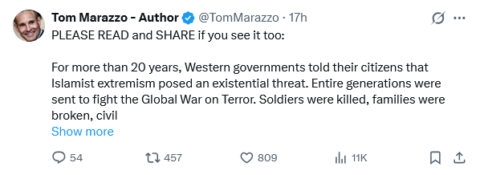
For more than 20 years, Western governments told their citizens that Islamist extremism posed an existential threat. Entire generations were sent to fight the Global War on Terror. Soldiers were killed, families were broken, civil liberties were curtailed, and trillions were spent, all justified by the claim that terrorism had to be stopped over there so it would not reach us here.
Then something strange happened.
The same governments that built their legitimacy on that fear now insist that even discussing the cultural, security, or integration risks associated with mass immigration from unstable regions is immoral. Raise concerns and you are no longer a citizen asking questions, but a bigot, an extremist, or a threat yourself. In some countries, speech alone now draws police attention, while violent acts are reframed as isolated incidents or stripped of ideological context.
The irony deepens when you look at the timeline.
During the first years of Covid, terrorism all but vanished from news coverage, just as Covid seemed to erase the common cold, cancer, and every other cause of death from public discourse. Nothing had disappeared. The narrative had simply changed. Attention was redirected. Fear was reassigned.
Now, as governments pursue aggressive mass immigration policies, the public is told that questioning outcomes is unacceptable, even as the very threats once used to justify war reappear domestically. The message is clear and profoundly cynical: the danger was real when it justified foreign wars, but discussion becomes forbidden when it complicates domestic policy.
This is not tolerance. It is coercion.
And now comes the final insult.
The same political class that demands silence at home is preparing to demand sacrifice abroad. The same citizens who are told to accept social breakdown, rising crime, collapsing services, and cultural fragmentation are being told they may soon be required to fight Russia to “defend our way of life”.
What way of life, exactly?
The one being systematically dismantled by the very governments issuing the call. The one they are actively transforming into something unrecognizable through reckless policy, moral intimidation, and managed decline. They are asking people to die for values they no longer practice and for societies they are actively degrading.
This is the core hypocrisy of modern Western governance.
We were told to fight, bleed, and die to defend liberal democratic values. Now we are told those same values require silence, compliance, and obedience, while our countries are reshaped without consent and against the will of the people who built them.
A government that suppresses debate at home while demanding loyalty abroad is not defending democracy. It is consuming it.
And history is not kind to regimes that ask their people to die for a future they are busy destroying.
History of Britain X: King Arthur, History or Myth?
Thersites the Historian
Published 7 Aug 2025In this lecture, I discuss the historicity (or lack thereof) of the Arthurian myth.
(more…)
December 16, 2025
If your military embraces “Net Zero”, you’ve actually got a civil service in uniform, not a military
In The Critic, Maurice Cousins points out the painful truth (painful that is to policians and career bureaucrats) that no serious military can prepare and carry out their prime duties if they also tout their allegiance to “Net Zero” bullshit:
Two developments explain the shift in tone. The first is the protracted US–Russia peace talks conducted largely over Europe’s head. The second is the publication of Donald Trump’s National Security Strategy, which makes explicit that Europeans must now assume far greater responsibility for their own defence. None of this should surprise anyone who has been paying attention. The Trump administration has been saying the same thing, bluntly and repeatedly, since its inauguration.
Speaking at the NATO Defence Ministers’ meeting in February 2025, the US War Secretary, Pete Hegseth, put it plainly: “To endure for the future, our partners must do far more for Europe’s defence. We must make NATO great again. It begins with defence spending, but must also include reviving the transatlantic defence industrial base, prioritising readiness and lethality, and establishing real deterrence.”
After nearly eighty years of relying on American power to underwrite their security, European leaders are being forced to relearn the fundamentals of hard power and grand strategy. It is difficult to overstate how profound a challenge this represents for both Europe and the UK. It demands a rethink across policy areas that, for decades, have been treated as marginal to national security.
Since the 1990s, Britain’s political and intellectual elite has operated within a fundamentally different paradigm. The “end of history” has become a cliché, but it is worth recalling just how deeply it shaped elite thinking. In the aftermath of the Soviet Union’s collapse, Anthony Giddens — one of the intellectual architects of New Labour — argued in The Third Way that the West no longer faced “clear-cut enemies”. Cosmopolitanism, he claimed, would be both the “cause and condition” of the disappearance of large-scale war between nation-states. The “strong state”, once defined by preparedness for war, “must mean something different today”. They believed that post-material and post-traditional values, including ecological modernisation, human rights and sexual freedom, would come to dominate politics.
For realists, this utopian worldview was always naïve. In her final book, Statecraft (2003), Margaret Thatcher warned that the post-Cold War world was far more likely to vindicate Samuel Huntington’s “clash of civilisations” than Francis Fukuyama’s progressive vision of an “end of history”, in which liberal democracy emerged as the inevitable global victor.
Clearly, the liberal internationalist illusion should finally have been shattered by Russia’s annexation of Crimea in 2014. Alas, it was not. Instead of prompting a fundamental strategic reset, Britain’s governing class doubled down on the same post-material, cosmopolitan assumptions that had shaped the 1990s and 2000s. In 2015, Europe and the UK embraced the Paris Climate Agreement. In 2019 — a year after the attempted murder of Sergei Skripal on British soil with a chemical weapon — ministers enshrined Net Zero in law and banned fracking. Each decision reflected the same belief: that geopolitics could remain subordinate to “climate leadership”, and that the material foundations of security could continue to be dismantled.
That worldview is now colliding with reality.
The US National Security Strategy contains a series of blunt truths about Europe’s condition. British commentary has focused on its remarks about culture, migration and defence spending. But one critical area has been largely overlooked: energy and industry.
The document begins from a hard material premise: that dominance in dense and reliable sources of energy — oil, gas, coal and nuclear — is essential to the ability of the United States, and its allies, to project power. From that foundation it draws a sharper conclusion, rejecting what it describes as the “disastrous ‘climate change’ and ‘Net Zero’ ideologies” that have hollowed out Europe’s industrial base while subsidising its adversaries. The result, it argues, is a defence problem that runs far deeper than military budgets. Alongside cultural weaknesses, myopic energy policy and de-industrialisation — exemplified by Germany’s recent offshoring of its chemical industry to China — are identified as anti-civilisational forces that directly erode Western hard power.
This makes Carns’s most important observation all the more sobering. While armies, navies and air forces respond to crises, he said, it is “societies, industries and economies [that] win wars”. He is unequivocally right.
On his Substack, Niccolo Soldo discusses the contents of the Trump administration’s new National Security Strategy:
Egyptian President Gamel Nassar had some choice lines to describe US foreign policy too:
The genius of you Americans is that you never make clear-cut stupid moves, only complicated stupid moves which make the rest of us wonder at the possibility that we might be missing something.
With the Soviet Union, you know where you stand today and where you will stand tomorrow. With the United States, you never know where you will stand tomorrow—and sometimes not even today.
America is like a beautiful woman who changes her mind every night. You can love her, you can fear her, but you can never be sure what she will do in the morning.
And then there is this recent classic from Russia’s chief diplomat, Sergey Lavrov:
The USA is agreement non-capable.
The point of sharing these quotes is to highlight the obvious fact that US foreign policy has long been unpredictable. This wouldn’t be too much of an issue if it were a middling power. When a superpower routinely upends the table, it makes life very, very difficult for those countries that have become “states of interest” for the Americans. Creating and pursuing foreign policy strategies require a lot of time and effort, meaning that they are very rarely predicated on short-term trends. When the predictability of foreign actors is removed from the strategic equation, the foundation of any plan becomes very weak.
Earlier this month, the White House issued its 2025 National Security Strategy vision in a 33 page .pdf document available for all to see and read here. This is an action that the US Executive Branch is mandated to do, ever since the Goldwater-Nichols Act of 1986. The point of this exercise is to articulate the vision of the President of the United States of America regarding foreign policy, so as to effectively communicate said vision to Congress and the American people. It does not mean that it is an official foreign policy strategy, since this area of governance is the responsibility of both the executive and legislative branches of the US Government.
Because this is the Trump Administration, and because of the fever pitch that has coloured both of his terms in office, a lot of attention is being given to this iteration of this mandatory document. This document is intentionally high-level (meaning that it purposely doesn’t drill down into specifics), keeping within the tradition of previous administrations. However, attention is warranted this time, because the vision outlined by President Trump per this document indicates a significant break in both the USA’s approach to and philosophical arguments regarding how and why it conducts its foreign policy. Despite the obvious Trumpist (think: transactional) touches interspersed throughout this document, what it does represent is a stated desire to break with certain idealist practices of recent administrations in favour of a more realist approach and worldview, one that stresses respect (if we accept the document at face value) for national sovereignty, and an admission that US global hegemony is simply not possible.
So what we are left with is a document that outlines a new vision for US foreign policy, one that has determined that taking on both Russia and China simultaneously is the wrong approach to securing American national interests. This makes it very worthy of closer inspection and analysis (something that I have been thinking about deeply since it was first made available to the public a fortnight ago). Before we begin to dive into it, I am asking you all to temporarily suspend your cynicism and take the strategy outline at face value for the sake of this analysis. I will once again repeat that this is not official policy, and there is a very strong chance that it will never be adopted as that.
The Battle of Algiers: France’s “Victory” That Lost the War – W2W 057
TimeGhost History
Published 14 Dec 2025In the mid-1950s, what Paris insists on calling a “police operation” in Algeria, steadily sparks into a full-scale war that exposes the fragility of the French Republic itself. As the FLN launches coordinated attacks, the army responds with mass arrests, torture, and collective punishment, drawing the military deeper into politics. The Battle of Algiers becomes a laboratory of counterinsurgency, even as public opinion fractures at home and successive governments collapse under the strain. By the decade’s end, the conflict has eroded faith in France’s imperial mission and helped trigger the fall of the Fourth Republic, proving that Algeria was not just a colonial war, but a crisis of the French state.
(more…)
Swedish Paratrooper Prototype: AK Fm/57
Forgotten Weapons
Published 30 Jul 2025As Sweden was looking to adopt a new self-loading infantry rifle in the 1950s, one of the contenders was a modernized version of the Ljungman. The Fm/57 is one of the last iterations of that project. It is chambered for 6.5x55mm but uses the short-stroke gas piston conversion that we previously saw on the 7.62mm NATO conversions of the Ljungman. It also uses a more refined lower receiver than its Fm/54 predecessor, with a nose-in-rock-back 20 round magazine and a folding stock. It was entered into formal trials against the GRAM-63 (another domestic Swedish design), the M14, G3, SIG 510, FAL, and AR10 … which it lost.
(more…)
QotD: Arms and the (pre-modern) man (at arms)
Here we do have some significant price data, but of course its tricky to be able to correlate a given value for arms and armor with something concrete like wages in every period, because of course prices are not stable. But here are some of the data points I’ve encountered:
We don’t have good Roman price data from the Republic or early/high Empire, unfortunately (and indeed, the reason I have been collecting late antique and medieval comparanda is to use it to understand the structure of earlier Roman costs). Hugh Elton1 notes that a law of Valens (r. 364-378) assessed the cost of clothing, equipment and such for a new infantry recruit to be 6 solidi and for a cavalryman, 13 solidi (the extra 7 being for the horse). The solidus was a 4.5g gold coin at the time (roughly equal to the earlier aureus) so that is a substantial expense to kit out an individual soldier. For comparison, the annual rations for soldiers in the same period seem to have been 4-5 solidi, so we might suggest a Roman soldier is wearing something like a year’s worth of living expenses.2
We don’t see a huge change in the Early Middle Ages either. The seventh century Lex Ripuaria,3 quotes the following prices for military equipment: 12 solidi for a coat of mail, 6 solidi for a metal helmet, 7 for a sword with its scabbard, 6 for mail leggings, 2 solidi for a lance and shield for a rider (wood is cheap!); a warhorse was 12 solidi, whereas a whole damn cow was just 3 solidi. On the one hand, the armor for this rider has gotten somewhat more extensive – mail leggings (chausses) were a new thing (the Romans didn’t have them) – but clearly the price of metal equipment here is higher: equipping a mailed infantryman would have some to something like 25ish solidi compared to 12 for the warhorse (so 2x the cost of the horse) compared to the near 1-to-1 armor-to-horse price from Valens. I should note, however, warhorses even compared to other goods, show high volatility in the medieval price data.
As we get further one, we get more and more price data. Verbruggen (op. cit. 170-1) also notes prices for the equipment of the heavy infantry militia of Bruges in 1304; the average price of the heavy infantry equipment was a staggering £21, with the priciest item by far being the required body armor (still a coat of mail) coming in between £10 and £15. Now you will recall the continental livre by this point is hardly the Carolingian unit (or the English one), but the £21 here would have represented something around two-thirds of a year’s wages for a skilled artisan.
Almost contemporary in English, we have some data from Yorkshire.4 Villages had to supply a certain number of infantrymen for military service and around 1300, the cost to equip them was 5 shillings per man, as unarmored light infantry. When Edward II (r. 1307-1327) demanded quite minimally armored men (a metal helmet and a textile padded jack or gambeson), the cost jumped four-fold to £1, which ended up causing the experiment in recruiting heavier infantry this way to fail. And I should note, a gambeson and a helmet is hardly very heavy infantry!
For comparison, in the same period an English longbowman out on campaign was paid just 2d per day, so that £1 of kit would have represented 120 days wages. By contrast, the average cost of a good quality longbow in the same period was just 1s, 6d, which the longbowman could earn back in just over a week.5 Once again: wood is cheap, metal is expensive.
Finally, we have the prices from our ever-handy Medieval Price List and its sources. We see quite a range in this price data, both in that we see truly elite pieces of armor (gilt armor for a prince at £340, a full set of Milanese 15th century plate at more than £8, etc) and its tricky to use these figures too without taking careful note of the year and checking the source citation to figure out which region’s currency we’re using. One other thing to note here that comes out clearly: plate cuirasses are often quite a bit cheaper than the mail armor (or mail voiders) they’re worn over, though hardly cheap. Still, full sets of armor ranging from single to low-double digit livres and pounds seem standard and we already know from last week’s exercise that a single livre or pound is likely reflecting a pretty big chunk of money, potentially close to a year’s wage for a regular worker.
So while your heavily armored knight or man-at-arms or Roman legionary was, of course, not walking around with the Great Pyramid’s worth of labor-value on his back, even the “standard” equipment for a heavy infantryman or heavy cavalryman – not counting the horse! – might represent a year or even years of a regular workers’ wages. On the flipside, for societies that could afford it, heavy infantry was worth it: putting heavy, armored infantry in contact with light infantry in pre-gunpowder warfare generally produces horrific one-sided slaughters. But relatively few societies could afford it: the Romans are very unusual for either ancient or medieval European societies in that they deploy large numbers of armored heavy infantry (predominately in mail in any period, although in the empire we also see scale and the famed lorica segmentata), a topic that forms a pretty substantial part of my upcoming book, Of Arms and Men, which I will miss no opportunity to plug over the next however long it takes to come out.6 Obviously armored heavy cavalry is even harder to get and generally restricted to simply putting a society’s aristocracy on the battlefield, since the Big Men can afford both the horses and the armor.
But the other thing I want to note here is the social gap this sort of difference in value creates. As noted above with the bowman’s wages, it would take a year or even years of wages for a regular light soldier (or civilian laborers of his class) to put together enough money to purchase the sort of equipment required to serve as a soldier of higher status (who also gets higher pay). Of course it isn’t as simple as, “work as a bowman for a year and then buy some armor”, because nearly all of that pay the longbowman is getting is being absorbed by food and living expenses. The result is that the high cost of equipment means that for many of these men, the social gap between them and either an unmounted man-at-arms or the mounted knight is economically unbridgeable.7
Bret Devereaux, “Fireside Friday, January 10, 2025”, A Collection of Unmitigated Pedantry, 2025-01-10.
- Warfare in Roman Europe AD 350-425 (1996), 122.
- If you are wondering why I’m not comparing to wages, the answer is that by this point, Roman military wages are super irregular, consisting mostly of donatives – special disbursements at the accession of a new emperor or a successful military campaign – rather than regular pay, making it really hard to do a direct comparison.
- Here my citation is not from the text directly, but Verbruggen, The Art of War in Western Europe during the Middle Ages (1997), 23.
- From Prestwich, Armies and Warfare in the Middle Ages (1996).
- These prices via Hardy, Longbow: A Social and Military History (1992).
- Expect it no earlier than late this year; as I write this, the core text is actually done (but needs revising), but that’s hardly the end of the publication process.
- Man-at-arms is one of those annoyingly plastic terms which is used to mean “a man of non-knightly status, equipped in the sort of kit a knight would have”, which sometimes implies heavy armored non-noble infantry and sometimes implies non-knightly heavy cavalry retainers of knights and other nobles.
December 15, 2025
Clankers on the bench, again
On Substack, Helen Dale discusses the most recent high profile case of clanker mis-use in the justice system, as Scottish Employment Judge Sandy Kemp clearly leaned far too heavily on ChatGPT or another AI instance to crank out 312 pages of dubious content:

Grok generated this in response to the request for “Robbie the Robot as a judge”
Maybe Judge Kemp only identifies as a judge, because the farrago of nonsense he’s managed to produce in the Peggie matter is, well, a sight to behold.
Industry news/gossip magazine Roll on Friday — otherwise known as the “orange time-suck” among City solicitors — has a handy run-down of the most egregious fake quotations, selective editing, and incorrect citations. It’s a concise one-stop-shop for Peggie errors, although they’ve already had to add to it since it was published yesterday.
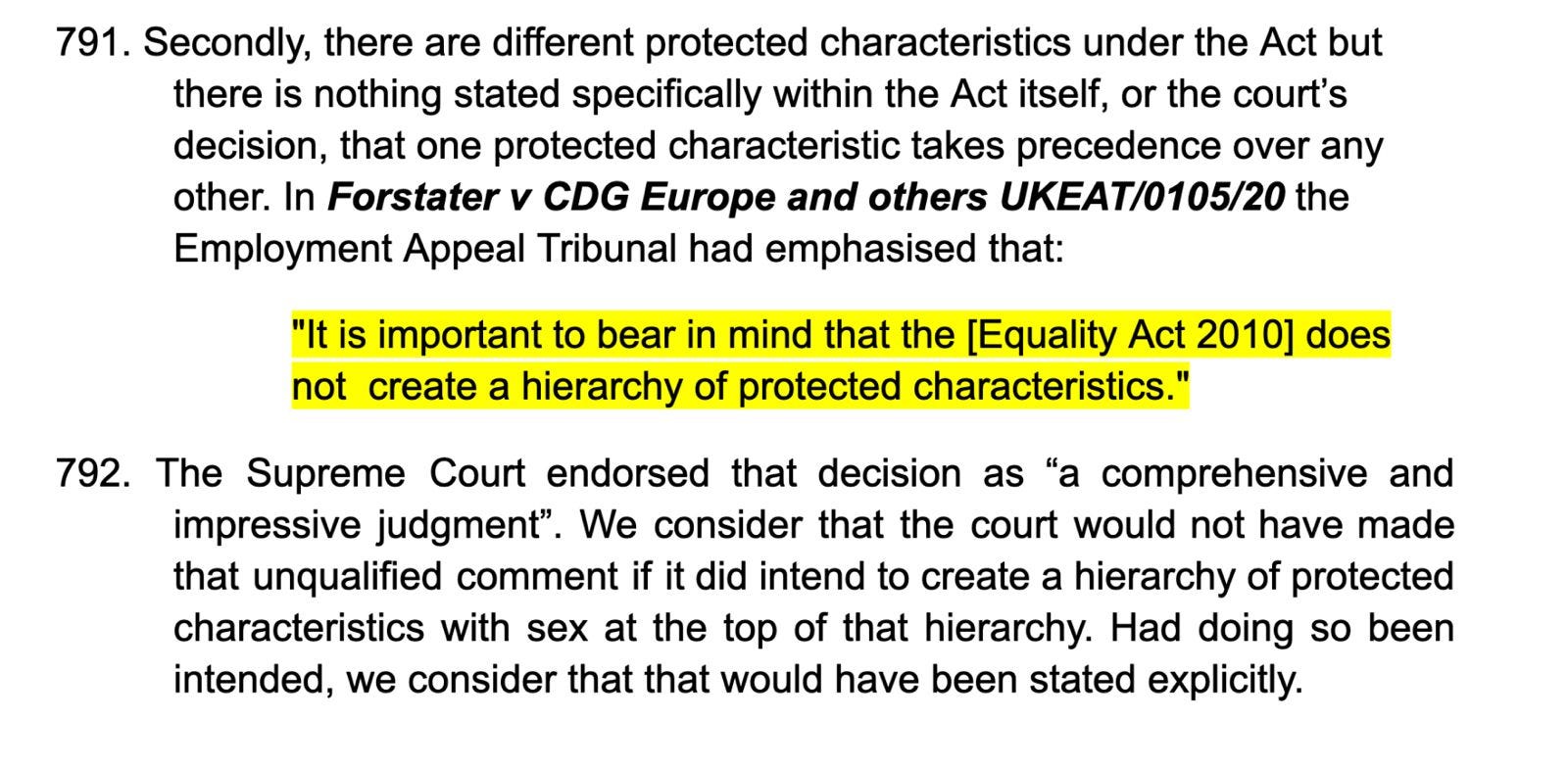
The situation is far more serious than the single — and that was bad enough — fake quotation from Forstater, since corrected by means of what lawyers call “the slip rule”. Notably, the corrected quotation does not support the point Judge Kemp wanted to make, rendering the passage nonsensical.
The slip rule or procedure — something many of us have seen in practice — exists to fix typos, wrong page/paragraph numbers, misspellings. One common error I remember from my pupillage days is fat-fingered judges leaving the “o” out of county in “County Court”, which of course litters the judgment with “Cunty Court”. Yes, everyone laughs and says “typo”, but things like this do have to be fixed.
The Roll on Friday piece notes that the Peggie opinion presents “a summary as if it was a quote from a judgment”, something that “appears to be a recurring issue”. This, as most people know by now, is a hallmark of AI.
I can’t prove that Judge Kemp used ChatGPT or Grok or a bespoke AI made available through the Judicial Office, although my suspicions are strong on this point. As an associate back in the oughts (a special kind of pupil barrister who works for a judge in a superior state or federal court in Australia), I’ve drafted multiple legal judgments. I have a good idea about what goes into them.
I also don’t know if Judge Kemp is on the transactivist side of this particular debate. I do know, however, that the judgment is dreadfully written and full of woolly reasoning, and — as other people have pointed out — all the errors tend in one direction.
I’m now going to set out what I think has happened, with the caveat that I could be wrong — something no-one will know until the appeal is heard and an opinion handed down.
How to Eat Like an Ancient Stoic
Tasting History with Max Miller
Published 8 Jul 2025Lentil soup with leeks, coriander seeds, and herbs
City/Region: Greece | Rome
Time Period: 3rd Century B.C.E. | 1st CenturyThe ancient stoics were all about being happy with what you’ve got. If one could learn to take pleasure in eating simple foods like lentil soup and barley bread (usually eaten by the poorest members of society), then they would have more happiness than if they constantly craved luxurious food. Granted, most of these philosophers were wealthy, so they didn’t actually have to live like the very poor.
The ancient Greek stoic philosopher Zeno of Citium was known for carrying around lentil soup in a clay pot, and that was probably just lentils boiled in water. This recipe, adapted from ancient Rome’s Apicius from a few centuries later, is a little fancier, but still rather simple and uses ingredients that would have been available to Zeno. Despite its simplicity, it’s surprisingly delicious with a hint of sweetness, oniony leek, and the cooling effect of the mint.
Boil the lentils; when skimmed, put in leeks and green cilantro. Pound coriander-seed, pennyroyal, silphium, mint, and rue, moisten with vinegar, add honey, blend with garum, vinegar, and defrutum. Pour over the lentils, add oil, serve.
— Apicius, de re coquinaria, 1st Century
December 14, 2025
Hitler becomes a German – Rise of Hitler 23, January-March 1932
World War Two
Published 13 Dec 2025The big news this winter is the German Presidential elections, held now in March for the first time since 1932, which pit current President Paul von Hindenburg against Nazi Party leader Adolf Hitler. Hitler, though, must become a German citizen before he can run; he been stateless since he gave up his Austrian citizenship seven years ago. The campaigns are quite different, but both effective, and the German people head for the polls.
(more…)
QotD: Why are Castles?
Castles differ from that other standby of medieval fortifications — city walls — in one crucial way, and that difference sheds a lot of light on their military application.
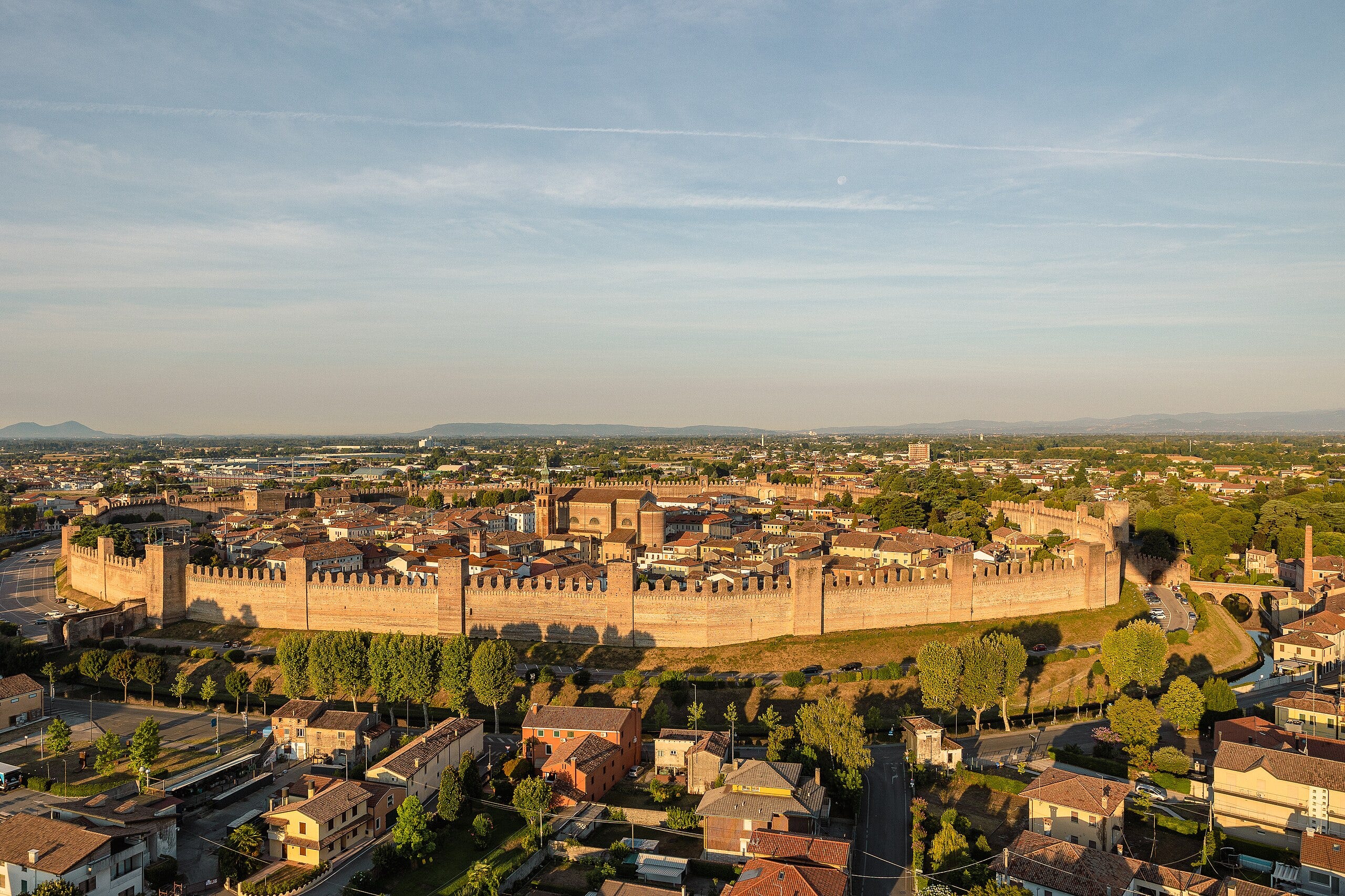
The walls of Cittadella, Italy (photo by Edoardo Bortoli, CC BY-SA 4.0).
A massive city wall, like the one shown above, has the very clear purpose of limiting access to a city or town. Close the gates, and no one can get in. Try to get in, and we’ll shoot you! The walls are meant to protect the settlement, both its inhabitants as well as its structures and physical wealth.
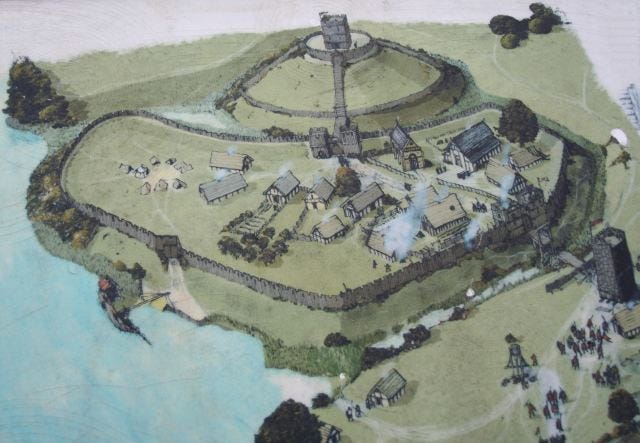
A castle, on the other hand, has a much smaller footprint than a city. It might only be a few buildings and a courtyard. Indeed, as we’ll see later in the series, the earliest castles (the classic “motte and bailey” design) were relatively small fortifications of earth and timber, capable of being built in a matter of days.
Image of a motte and bailey style castle. This particular one would take much longer than a few days to make, but it’s worth noting that even this “primitive” castle of timber and earth would have been a serious problem for any attacker. (Duncan Grey – Display Board of Huntingdon Hill Motte and Bailey Castle – CC BY-SA 2.0).
Especially if a lord was not in residence, a castle might only have a garrison of a few dozen, a far cry from the walls around urban centers that protected thousands or tens of thousands of lives!
So why bother?
Because, unlike a city wall which is meant to defend everything within it, a castle isn’t built in order to protect a tiny bit of land on top of a hill. Instead (say it with me, class): a castle is built to deny an enemy freedom of movement.
It’s not about what’s inside the walls. It’s about what’s outside the walls.
A castle allows you to control a disproportionately large area of land.
That control matters a great deal, because land was the source of wealth in pre-modern contexts. In societies where 80-95% of the populace were farmers, wealth and power came from controlling arable land. Capital did not derive principally from urban centers — wealthy and valuable as those were.1
Before we go further into how that impacts war and politics, I want to take a moment and dig deeper into why a castle allows its owner to control the land, because it’s something that’s usually glossed over, and understanding this dynamic will have a significant bearing on everything else we talk about here.
The Ugly Nature of Rule
As I’ve explained before, in order to actually rule an area, the ruler needs to have a monopoly on legitimate violence within that area. The emphasis here is on legitimate violence, which is significantly different than just “brute force”; force alone will always be a temporary and unstable method of rule. [You can read this explainer for more on that.] A ruler’s legitimacy allows that monopoly to continue unopposed.
One of the main reasons why a ruler needs that monopoly is that it allows for the collection of resources for use by the state. I’m going to lump all this together under the word “taxes”, but to be clear: in pre-modern societies, “taxes” could include manual labor commitments, payments in kind (in crops, in material, etc.), or in cash.
For all that, the ruler needs his agents to have unfettered access to the country he aims to rule; his tax collectors, law enforcers, merchants, judges, and certainly his lords and military all need to be able to move freely throughout the realm in order to do all the necessary business of maintaining law, order, and the collection of taxes.
Those are the most basic elements of statehood, the most basic mechanism of ordinary, everyday governing.
Castles fit into that system the same as any other governmental or administrative center: it’s a place to collect and store resources, a place for state agents to shelter, a locale for arbitration of justice, a residence for a lord … A castle can be a courthouse, police station, secret service listening post, governor’s mansion, and revenue service office all in one.
And a castle is fortified for much the same reasons that governmental buildings across history have always been fortified.
Even if the majority of a subject populace believes your rule is legitimate — a big if! — then there will still be people who chafe at the collection of taxes and who feel wronged by the administration of justice. Those outliers — if indeed they even are outliers — might try something stupid, like taking back their resources or stabbing your
thugspeace-loving tax collectors. Better to have everything locked up, right?And if the castle is large, and visibly imposing? Well that doesn’t hurt, does it?
That’s the every-day purpose of castles, at least in the sense that on any average Tuesday morning, that’s what the castle is for. That’s what people in the castle are doing. Ruling.
Eric Falden, “What Were Castles Actually For?”, Falden’s Forge, 2025-07-29.
1. There are exceptions, of course, such as thassalocratic polities. But sea-faring societies don’t built castles and are therefore WAY outside the bounds of this discussion.
December 13, 2025
“Europe must prepare for ‘scale of war our grandparents’ endured”
On the social media site formerly known as Twitter, @InfantryDort responds to the NATO Secretary General’s announcement that Europe should gird its collective loins for combat on a scale similar to the World Wars:
Fighting Like Our Grandparents, Without Becoming Like Them?What a strange moment it is to belong to the warrior culture in the West.
To watch your society fracture in real time. To see cohesion traded for comfort. And to be told to prepare for wars of national survival while the nation itself dissolves at home.
Europe, in particular, has already spent its strongest men. Bled out across the killing fields of the 20th century. Now it is warned to fight like its grandparents once did.
The warning is correct, but not in the way people think.
Violence, chaos, entropy … these are the default state. They pull on human societies the way gravity pulls on matter. Left alone, everything falls.
Function requires resistance. A rocket escapes gravity only by burning fuel. An exoskeleton works only by pushing back. Civilization is no different.
You cannot fight a war of national survival abroad when the nation no longer coheres at home. When families are exposed, trust is gone, and the social fabric has been cut to make the room feel larger.
It’s not strength. It is just removing load-bearing walls and mistaking openness for stability.
The lesson: Our grandparents didn’t just fight with weapons. They fought with unity, discipline, restraint, and shared purpose.
Without those, you don’t get their victories. You only inherit their destruction. And all without the moral scaffolding that survived it. Wars are not won by nostalgia. They are won by societies that still function.
TLDR: Few sane men will go off to war in a far away land when hordes of their previous battlefield opponents have moved into their neighborhoods.
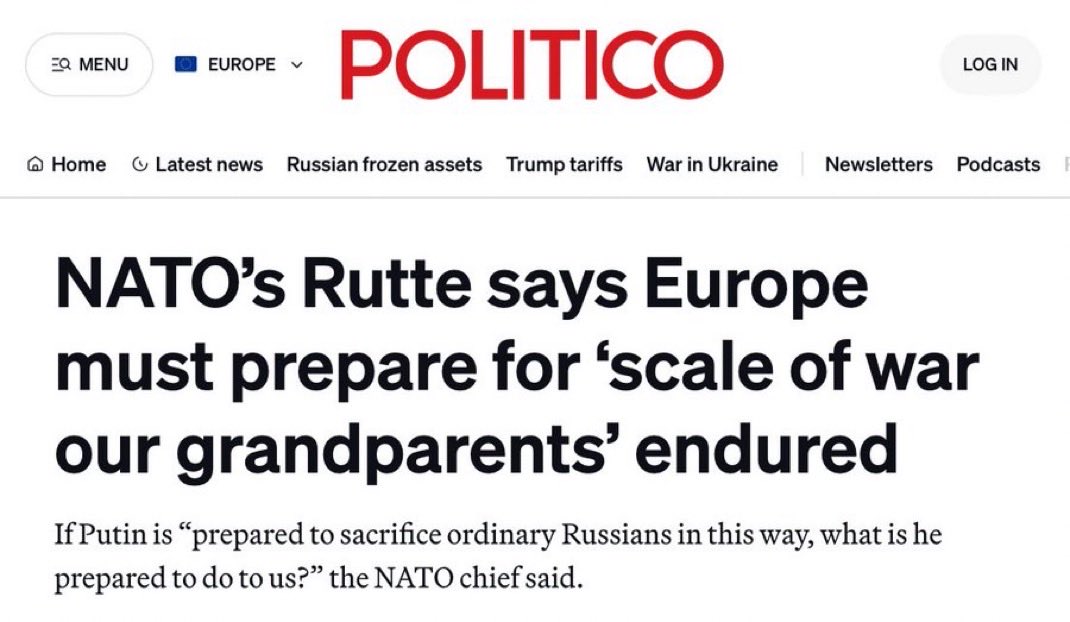
Update, 13 December: On the social media site formerly known as Twitter, John Carter responds to Rutte’s speech:
These are just empty rituals indulged in by the clerisy of hermetically sealed institutions. They have no ability to mobilize for war. The financialized economies they preside over have been hollowed out by deindustrialization, over-regulation, and climate hysteria. The populations of their countries are deracinated, alienated, and ethnoculturally fragmented. They did all of this themselves, deliberately and systematically, over decades, because it benefited them to do so. It made the institutions stronger, and enriched them as a class. That it came at the expense of the viability of their societies didn’t bother them in the slightest.
Membership in the institutional theocracy is predicated on absolute alignment with internal narratives. Those narratives are simply whatever the theocracy needs to believe at any given moment to justify itself. At the moment, they need to believe that nothing fundamental has shifted in Western countries since the end of WWII, in particular that it is still in principle possible to mobilize a (non-existent) industrial base for wartime production, and that it is possible to motivate an alienated population to fight. They also need to believe that the loathing with which native populations regard them is inorganic, a function of narrative warfare from the troll farms of foreign adversaries, and that this resentment can be effectively curtailed with censorship and propaganda.
Internally they see themselves as very serious people, statesmen and generals, guardians of the moral order.
From the outside, they are clowns engaged in a pantomime.


