
MoAn Inc.
Published 23 Dec 2025
(more…)
December 29, 2025
What Do We ACTUALLY Know About Homer? (Author of Iliad & Odyssey)
Comments Off on What Do We ACTUALLY Know About Homer? (Author of Iliad & Odyssey)
What Are Sugar Plums? How to make real Victorian sugar plums
Tasting History with Max Miller
Published 10 Dec 2024Purple, green, yellow, red, blue, and white hard candies with cherry centers
City/Region: United States of America
Time Period: 1865Sugar plums go hand-in-hand with Christmas, but what exactly are they? There are recipes out there for a confection made of dried fruit and nuts that’s rolled into balls, but true Victorian sugar plums were a kind of candy made up of layers of hardened sugar syrup and gum arabic surrounding a fruit or nut core. They were pretty much the same thing as Jordan almonds.
You won’t find many recipes for them in Victorian-era cookbooks because no one really made them at home. The specialized equipment and labor involved meant that most people bought them from a confectioner, and I can see why.
Making these was a three-day endeavor for me, and I had to get a panning machine attachment for my stand mixer, and gum arabic, which I surprisingly didn’t already have in my pantry. They’re a nice sweet treat, but really more trouble than they’re worth to make at home.
Cherry Sugar-Plums. Set preserved cherries on a sieve in the stove. When they are partly dry, mix them with pounded sugar, and rub them over a sieve; dry them again, and proceed as with barberry sugar-plums.
Barberry Sugar-Plums. Take perfectly ripe barberries, stem them, dry them in a stove, and add the gum and sugar in the swinging basin. To accomplish this, after being heated in the stove, give them a coating of one part sugar, and one part gum arabic; and, when thoroughly moistened, powder with sifted sugar. Dry the coating in a stove; add a second on the next day, so as to completely cover the fruit; then thicken, and finish like the verdun sugar-plums. The fruit must be coated away from the fire. They are colored like the rose sugar-plums, and pearled like the lemon.
— The Art of Confectionery, 1865
December 28, 2025
It may seem petty to deny entry to EUrocrats, but it’s all they will understand
At first, I thought it was just another bout of Trump being deliberately petty over trivial stuff, but on reflection, it’s actually a neat way to bring home the message to the EU bureaucrats personally that they will be held responsible for their actions:
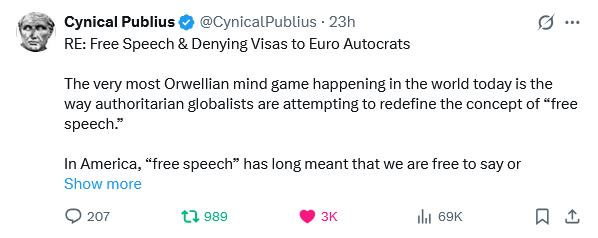
RE: Free Speech & Denying Visas to Euro Autocrats
The very most Orwellian mind game happening in the world today is the way authoritarian globalists are attempting to redefine the concept of “free speech”.
In America, “free speech” has long meant that we are free to say or write virtually anything without fear of government intervention or suppression. It is this ability to express whatever we want that makes it “free”.
The authoritarian globalists, however, have stood this on its head. They have decided that in order for their citizens to be “free”, they must be free of ever hearing or reading any speech that might offend someone or sow doubt as to government policies. To these fascists, “free speech” means GOVERNMENT MODERATED speech which somehow — through its moderation — sets people “free” from ever hearing conflicting views. As I said — straight out of Orwell.
Europe is, of course, the hotbed of this fascist redefinition of what free speech means, but we in America have only narrowly escaped this plague by electing Trump. Remember, Biden and his team were reliant on institutionally stamping out so-called “disinformation” as a means of control over the populace. We must be ever vigilant here in the USA that such thuggish government criminality never again be allowed to prosper.
I think it is very important that every citizen of the USA and the world understand the depths of depravity these people will sink to in order to control ordinary people. This is about mind control, and nothing else.
Ultimately, the value of true free speech is that it embraces the idea that we all have agency over ourselves; that we are free individuals who can and should hear conflicting views, and decide for ourselves what is true and just, and what is untrue and unjust. This is sovereignty over the self, and unfortunately Europe has never let go of the concept of serfdom, so self-sovereignty is a threat that must be stamped out.
The Trump Administration has been prescient, bold and effective in denying visas to the Eurotrash autocrats who would see free speech reduced to whatever speech unelected bureaucrats deem acceptable. I cannot commend Trump enough for the thoughtfulness and importance of that action.
In a world where almost all humans are linked by essentially the same communications platform, only one world leader is truly standing for free speech: Donald Trump. And I thank him for it. We all should — even the TDS sufferers.
For a relevant example, Dries Van Langenhove:

Update, 29 December: Welcome, Instapundit readers! Please do have a look around at some of my other posts you may find of interest. I send out a daily summary of posts here through my Substack – https://substack.com/@nicholasrusson that you can subscribe to if you’d like to be informed of new posts in the future.
QotD: The Middle Ages saw rebellions but no revolutions
At some point in this space, we discussed the difference between a rebellion and a revolution. Drawing on Michael Walzer’s key work The Revolution of the Saints, I argued that a true revolution requires ideology, as it’s an attempt to fundamentally change society’s structure.
Therefore there were no revolutions in the Middle Ages or the Ancient World, only rebellions — even a nasty series of civil wars like The Wars of the Roses were merely bloody attempts to replace one set of rulers with another, without comment on the underlying structure. A medieval usurpation couldn’t help but raise questions about “political theory” in the broadest sense — how can God’s anointed monarch be overthrown? — but medieval usurpers understood this: They always presented the new boss as the true, legitimate king by blood. I forget how e.g. Henry IV did it — Wiki’s not clear — but he did, shoehorning himself into the royal succession somehow.
Combine that with Henry’s obvious competence, Richard II’s manifest in-competence, and Henry’s brilliant manipulation of the rituals of kingship, and that was good enough; his strong pimp hand took care of the rest. Henry IV was a legitimate king because he acted like a legitimate king.
A revolution, by contrast, aims to change fundamental social relations. That’s why medieval peasant rebellions always failed. Wat Tyler had as many, and as legitimate, gripes against Richard II as Henry Bolingbroke did, but unlike Henry’s, Tyler’s gripes couldn’t really be addressed by a change of leadership — they were structural. 200 years later, and the rebels were now revolutionaries, willing to give structural change a go.
Severian, “¡Viva la Revolución!”, Founding Questions, 2025-02-27.
Comments Off on QotD: The Middle Ages saw rebellions but no revolutions
December 27, 2025
Campaign Furniture by Christopher Schwarz
I try not to clutter the blog with woodworking-related posts, as I know it’s a niche interest among my readership, but every now and again I find something I just have to share. Today, it’s a post from Lost Art Press on the book Campaign Furniture written by Christopher Schwarz:
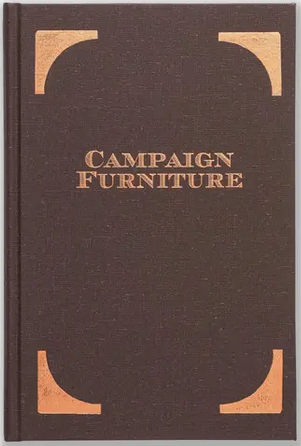
My 2014 book Campaign Furniture is now a free pdf download for everyone. You can download it via this link (a compressed version for slower connections is available here). And customers will always be able to download it from the book’s page in our store.
I’m a fan of the book … I ended up buying two copies through Lee Valley Tools (I loaned my first copy out and it got lost in the shipwreck of a friend’s messy divorce). I like Chris’s writing style and I’ve long been a fan of Campaign furniture.
Why Do I Do This?
I get asked by fellow publishers why I offer my books for free download. “Surely you use it to gather emails to market to readers.” Nope. “Are these out-of-print books that you are using to get eyeballs on your website?” Nope. “So what’s the strategy?”
I think – as much as possible – that information should be free. I think the best hope for inspiring other woodworkers is to give them whatever they need to begin in the craft.
And, I fu&%ing hate this world we’ve created where people can’t own anything. Companies come into your house and your phone and change things or take away stuff you’ve bought. Many times they take back stuff you owned then rent it back to you.
That’s why we make books. Buy a book from us, and it’s yours. Its contents can’t be changed by some ideologue a thousand miles away. All of our digital products are free of DRM (digital rights management). That means they can’t be locked or disabled. And you can copy them onto whatever device you like.
OK, the holiday rant is over.
I hope you find something of interest in Campaign Furniture. We still use three of the pieces from the book every day in our home. Other pieces are with my kids. So my family’s love of this neglected furniture style continues.
Comments Off on Campaign Furniture by Christopher Schwarz
December 26, 2025
Allied Bombing 1944 – Distraction and Destruction before Dresden
HardThrasher
Published 25 Dec 2025Hello my little Christmas puddings; today’s film covers the strategic bombing forces in WW2, what they did to support Operation Overlord, the aerial war across France and into Germany during 1944, taking out enemy formations, V1 and V2 sites, and breaking up the Nazi oil fields in the process. But all did not go according to plan … this is the inbetweeny bit from June – December 1944 and the part everyone forgets before the Bulge, Dresden and all that …
00:00:00 – Introduction
00:01:12 – A Word From Our Sponsor
00:03:25 – A Few Notes For New Viewers
00:04:02 – How End A War
00:06:25 – A 90 second (well 6 minutes) Recap of the story so far
00:12:15 – On With The Show
00:18:40 – The Key Players
00:20:10 – Enter Trafford Leigh-Mallory
00:24:05 – Trafford in Charge At the AEAF
00:26:15 – The Strategic Bombers Role In D-Day
00:27:29 – The Bombers As Part Of The Deception Plans
00:28:18 – Cutting Off Normandy
00:29:41 – The V1s, Poison Gas and Biological Warfare
00:37:31 – The One True Raid To End The War
00:41:50 – Self Harm in Normandy (It’s Trafford Time Again)
00:52:04 – Focus On Oil – Why, How and What Happened in 1944
01:05:00 – And on to Dresden
01:05:25 – Survivor’s Club
(more…)
Comments Off on Allied Bombing 1944 – Distraction and Destruction before Dresden
The Pinnacle of Movie ⚔️Swordfights⚔️
Jill Bearup
Published 8 Sept 2025Scaramouche had, until recently, the longest swordfight in cinema history. It’s still regarded as one of the best. Why? Let’s talk about it.
Comments Off on The Pinnacle of Movie ⚔️Swordfights⚔️
December 25, 2025
Repost – “Fairytale of New York”
Time:
“Fairytale of New York” by The Pogues featuring Kirsty MacColl
This song came into being after Elvis Costello bet The Pogues’ lead singer Shane MacGowan that he couldn’t write a decent Christmas duet. The outcome: a call-and-response between a bickering couple that’s just as sweet as it is salty.
Comments Off on Repost – “Fairytale of New York”
QotD: Christmas dinner
It is a simple recipe for happiness. First the meal, then the antidote, then another meal. The ancient Romans were the great masters of this technique. However, having just looked up the word vomitorium in the Latin dictionary, I find that after all it does not mean a place where you went to be sick after dinner. So perhaps this was not a normal feature of every Roman home, as is commonly believed.
Implied in the above-mentioned advertisement is the notion that a good meal means a meal at which you overeat yourself. In principle I agree. I only add in passing that when we gorge ourselves this Christmas, if we do get the chance to gorge ourselves, it is worth giving a thought to the thousand million human beings, or thereabouts, who will be doing no such thing. For in the long run our Christmas dinners would be safer if we could make sure that everyone else had a Christmas dinner as well. But I will come back to that presently.
The only reasonable motive for not overeating at Christmas would be that somebody else needs the food more than you do. A deliberately austere Christmas would be an absurdity. The whole point of Christmas is that it is a debauch — as it was probably long before the birth of Christ was arbitrarily fixed at that date. Children know this very well. From their point of view Christmas is not a day of temperate enjoyment, but of fierce pleasures which they are quite willing to pay for with a certain amount of pain. The awakening at about 4 a.m. to inspect your stockings; the quarrels over toys all through the morning, and the exciting whiffs of mincemeat and sage-and-onions escaping from the kitchen door; the battle with enormous platefuls of turkey, and the pulling of the wishbone; the darkening of the windows and the entry of the flaming plum pudding; the hurry to make sure that everyone has a piece on his plate while the brandy is still alight; the momentary panic when it is rumoured that Baby has swallowed the threepenny bit; the stupor all through the afternoon; the Christmas cake with almond icing an inch thick; the peevishness next morning and the castor oil on December 27th — it is an up-and-down business, by no means all pleasant, but well worth while for the sake of its more dramatic moments.
Teetotallers and vegetarians are always scandalized by this attitude. As they see it, the only rational objective is to avoid pain and to stay alive as long as possible. If you refrain from drinking alcohol, or eating meat, or whatever it is, you may expect to live an extra five years, while if you overeat or overdrink you will pay for it in acute physical pain on the following day. Surely it follows that all excesses, even a one-a-year outbreak such as Christmas, should be avoided as a matter of course?
Actually it doesn’t follow at all. One may decide, with full knowledge of what one is doing, that an occasional good time is worth the damage it inflicts on one’s liver. For health is not the only thing that matters: friendship, hospitality, and the heightened spirits and change of outlook that one gets by eating and drinking in good company are also valuable. I doubt whether, on balance, even outright drunkenness does harm, provided it is infrequent — twice a year, say. The whole experience, including the repentance afterwards, makes a sort of break in one’s mental routine, comparable to a week-end in a foreign country, which is probably beneficial.
George Orwell, “In praise of Christmas”, Tribune, 1946-12-20.
Comments Off on QotD: Christmas dinner
December 24, 2025
The Pagan Roots of Christmas
History With Hilbert
Published 23 Dec 2017It’s Christmastime everyone, as you can tell from the name, it has a lot to do with Christ and Christianity, after all, Jesus was born on the 25th of December, right? Well, not quite. Most of what we do at Christmas time has little or nothing to do with Christianity and is rather rooted in the ancient pagan pasts of both Europe and other places. In this video I’m going to explore the aspects of Christmas that come form the traditions and beliefs of the Northern Europe Germanic or Nordic Pagans as this is what I know the most about and what interests me the most. This isn’t to say there are more explanations for where certain traditions come from or that there were other groups who contributed aspects of our modern Christmas celebrations. Things like Carol Singing, Christmas Trees, Christmas Lights, Yule Logs, Christmas Dinner, Santa Claus, the Elves, New Year’s Resolutions and Kissing under the Mistletoe can all be traced back to the pagan times of our forefathers and to various characters of Norse Myth and Legend like Odin, Freyja, Baldr and Thor.
(more…)
Comments Off on The Pagan Roots of Christmas
QotD: Moderation for the inveterate port fan at Christmas
A nice spätburgunder, the delightful German word for pinot noir, would be a good alternative. Or perhaps an English red. They’re not easy to find or cheap but I can thoroughly recommend the 2020 pinot noirs from Gusbourne in Kent and Danbury Ridge in Essex.
With the turkey, keep the pork accessories to a minimum. Don’t sneak into the kitchen to polish off the pigs in blankets. Instead have lots of vegetables, but do not have seconds, no matter how tempting that might be. As for Christmas pudding, avoid, avoid, avoid. Maybe a crumb for appearances’ sake. But you must resist the sweet wine. I’m a sucker for a nice monbazillac but I’ve decided you don’t need port and sweet wine, and I’m going for the port. Eyes on the prize and all that.
The strategy is to reach the port and stilton course having consumed no more than the equivalent of one bottle of wine. Ideally less. If you’ve had two, that’s too much. Go for a walk.
Assuming you’ve reached this stage soberish and with a stomach that’s not rebelling, that doesn’t mean that you can suddenly channel your inner Georgian squire when the decanter comes round. Don’t be like John Mytton, one time MP for Shrewsbury, who arrived at Cambridge University with 2,000 bottles of port: unsurprisingly he didn’t graduate. He was notorious for drunken antics such as setting fire to his nightshirt in a bid to cure hiccups and once rode a bear into a dinner party for a jape. We’ve all had that urge after too much port.
It might seem heretical, but you don’t need to finish off the decanter at the table. A vintage port should be good for four or five days, whereas tawny lasts for weeks, so you can keep coming back to it. If there are only a few port fans in the family, it’s worth opening a bottle on Christmas Eve and having a glass or two. Then if you do decide to polish it off while outlining your plan for getting the British economy back on track, there won’t be quite so much in the bottle. Oh, and tiny glasses, please. Think Russell Crowe and Paul Bettany in Master and Commander.
When lunch is over, say no to coffee and find somewhere to have a nap until it’s time for a cup of tea. Try to avoid eating or drinking alcohol again for the rest of the day. But who am I kidding, I’ll probably open a bottle of Beaujolais to go with my turkey sandwich. And maybe a little port and Stilton. But nothing after nine o’clock. That is very important.
And so to bed for a good night’s sleep and awake rested, if not quite refreshed, and without an angry wife glaring at me. That’s the plan anyway.
Henry Jeffreys, “How to drink port without the storm”, The Critic, 2022-12-09.
Comments Off on QotD: Moderation for the inveterate port fan at Christmas
December 23, 2025
Vagabond by Tim Curry
Andrew Doyle reviews Tim Curry’s new autobiography Vagabond:
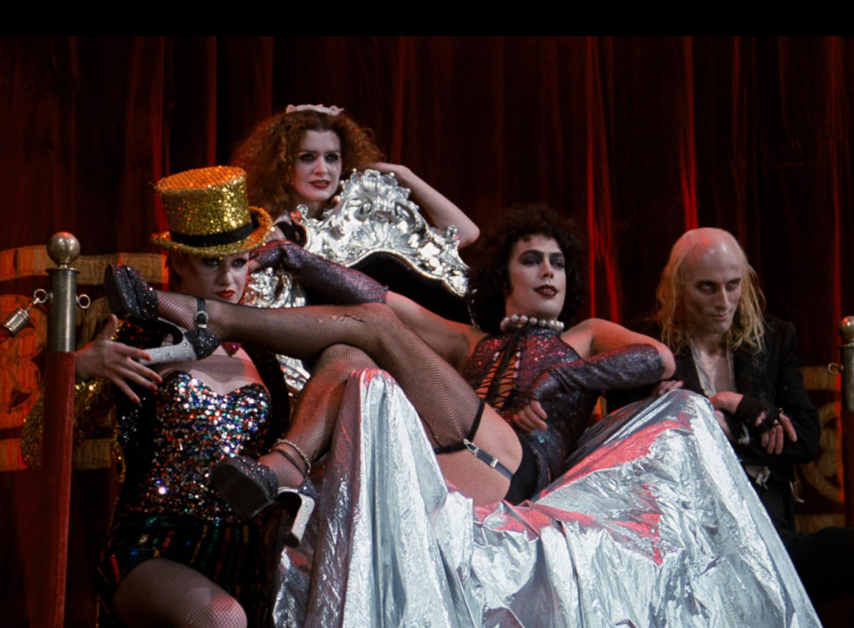
Tim Curry, Nell Campbell, Richard O’Brien and Patricia Quinn in The Rocky Horror Picture Show (1975)
Tim Curry is a shapeshifter. I have a childhood memory of the moment I learned that the demon in Legend (1985), the villain in Annie (1982), the butler in Clue (1985) and the cross-dressing alien scientist in The Rocky Horror Picture Show (1975) were all played by the same man. It was quite the revelation.
Curry’s protean talents have meant that as a personality he has forever remained mysterious. He rarely gives interviews – only grudgingly whenever there is a movie to promote – and fans have therefore tended to project onto this reclusive figure the persona that best fits their expectations or desires. When more insistent fans have formed an emotional bond with the Tim Curry of their imaginations, he has on occasion been forced to put them right. “I’m just a person,” he says, “and I’m not your person”.
Fans will therefore be delighted at the publication of Curry’s memoir, Vagabond, which offers fascinating snapshots from his life. The approach is episodic, with chapters devoted to particular projects in his career. As such, Curry offers us morsels in lieu of a meal. Those who are hoping for salacious anecdotes about his love life will be disappointed, because – as he rightly points out – “specifics about my affairs of the heart or the bedroom are – respectfully – none of your fucking business”. Instead, we have a wonderfully compelling account of Curry’s origins and how his philosophy of life has informed his craft.
Tim Curry as Wadsworth in Clue and King Arthur in Spamalot
His vagabond status has been well earned. As the child of a military father, he was forever on the move, and it is easy to see how these early experiences shaped his capacity to embody such a wide breadth of humanity. His first accolade came early when he was awarded the prize for the “Most Beautiful Baby in Hong Kong”. His family relocated roughly every eighteen months for the first eleven years of his life, which is why he tells us that “mutability felt like a part of my DNA”. It was the ideal apprenticeship for his future vocation.
Writing in 1817, William Hazlitt called actors the “motley representatives of human nature” who “show us all that we are, all that we wish to be, and all that we dread to be”. For his part, Curry sees the actor as the vagabond of his book’s title. “How can you trust somebody, or truly know somebody, who appears as a king one day and a jester the next? What does it mean when neither role is the true identity of the person, and when that very person might be gone the next day?” In this, he could be paraphrasing Hazlitt’s description of actors as “today kings, tomorrow beggars”, and how “it is only when they are themselves, that they are nothing”.

Comments Off on Vagabond by Tim Curry
QotD: Vacations
Auberon Waugh, diary entry for 23 July 1975, republished in William Cook, Kiss Me Chudleigh: The World according to Auberon Waugh, 2010.
Comments Off on QotD: Vacations
December 21, 2025
The Fall of Chancellor Bruning – Rise of Hitler 24, April-June 1932
World War Two
Published 20 Dec 2025The runoff elections for German President give Paul von Hindenburg a strong victory over Adolf Hitler, and convince the Bruning government to try to reign in the Nazis by banning the SA and SS. However, Kurt von Schleicher has managed to convince Hindenburg that Bruning is a liability and by the end of May, Bruning is out and Schleicher has maneuvered Franz von Papen into the post of Chancellor. The Reichstag is dissolved, the ban is lifted, and who knows where Germany is headed!
(more…)
Comments Off on The Fall of Chancellor Bruning – Rise of Hitler 24, April-June 1932
Getting Dressed – Victorian Maid, Christmas 1853
CrowsEyeProductions
Published 5 Dec 2018A Victorian maidservant dresses ready for a day of work, then ventures out into a cold evening …
(more…)
Comments Off on Getting Dressed – Victorian Maid, Christmas 1853


