
Forgotten Weapons
Published 28 Jul 2025The ZK-381 was designed by Josef Koucký, his first design of 1938 (hence 381). This is one of the last of the Czech pre-war self-loading rifle projects, of which there were quite a lot. It uses a tilting bolt and a short-stroke gas piston, with ZB26 machine gun magazines and chambered for 7.92mm Mauser (although they would have been happy to offer a model in any other modern rifle cartridge). It was tested in the spring of 1938 by the Soviet Union, which liked it enough that they requested a model in 7.62x54R — and those were tested in November 1938. Ultimately domestic Russian designs were chosen instead, and tests in German, France, Spain, and Italy also led to naught.
Thanks to the Czech Military History Institute (VHU) for graciously giving me access to this one-of-a-kind prototype to film for you! If you have the opportunity, don’t miss seeing their museums in Prague:
https://www.vhu.cz/en/english-summary/
(more…)
December 13, 2025
ZK 381: Czech Pre-War Prototype Battle Rifle
QotD: Victorian mores, homosexuality, and the Empire
The public school phenomenon, which probably isn’t a euphemism but we’ll use it as one. You know, the whole “beatings and buggery” thing, and I’m going to stop now, because of course you know what I mean. Lots of Old Boys from all tiers of the public school system really did go out to run the Empire because they wanted to escape Victorian women, who were indeed as bad as that in a lot of cases (again, think “Karen on steroids”). But how much of that “to escape women” thing was because the women were awful, and how much of it was because the Old Boys were not-very-repressed homos?
This is where modern identity politics really messes up historical analysis. We probably all know that the vast majority of Victorian homosexuals were married, because the vast majority of Victorians were married. This isn’t my professional field, but because I went to grad school I’m pretty well up on it – the ivory tower finds Victorian poofters endlessly fascinating, because they are huge homo cheerleaders (obviously), but also because of the costumes.
Women and gay men love playing dress up — have you noticed? — and Victorian dress up is the best, because it’s a) expensive, and b) time consuming, but also c) flattering to just about any body type. It was socially acceptable among the upper classes to be porky (and nobody dresses up like a chimney sweep or factory hand), so both men’s and women’s fashion in the Late Victorian era can accommodate modern bodies. (Unlike the early Victorian era, which continued Regency fashion. They’d love to dress up Regency style — there’s a reason “Regency romance” is the most popular genre of light porno books for cat ladies — but it takes a specific physical type to pull off, and they don’t have it). […]
Anyway, where was I? Oh yeah — lots of people in grad school really, really into Victorian queers, so if I seem extremely well informed on this topic, don’t read too much into it.
“Repressed homosexual” was redundant back then. Oscar Wilde, for instance, was sort of the ur-homo — he was so gay, just gazing too long at a picture of him at his dandiest could give you an uncomfortably strong urge to touch a penis. […] Oscar Wilde was also married, and had two children, because that’s how even the queerest of the queer rolled in Victorian London.
Given that, you’d expect one of two things to happen to public schoolboys once they got out into the bush. Either they’d totally let their freak flag fly — you know, given that everyone else in their social world was an equally repressed public schoolboy — or they’d bottle it up even further, because it was important to show nothing but the best image of Her Majesty’s servants to the wogs at all times.
As far as I know, the latter was almost universally the case. Before the opening of the Suez Canal (1869), you could have a nonstop bacchanalia over there … if you were straight. Those guys could, and did, rock the casbah with extreme prejudice. It started tapering off early in Victoria’s reign, but in the late 1700s you had British army officers converting to Islam (no, really) for the express purpose of getting even more tail, by marrying the Koranically sanctioned four wives (sometimes with all the age of consent queasiness that implies).
The repressed homos, on the other hand, got really into scholarship. It’s not generally known (because even then the vast majority of their works were of interest only to micro-specialists) but Anglo-Indians were insanely productive scholars, on every conceivable topic. You could fill a decent sized library with their five-, seven-, nine-volume works on Sanskrit philology, and the botany of the lower Himalayas, or the migratory habits of tigers, or pretty much anything. And if they weren’t the scholarly sort, the repressed homos simply threw themselves into their work, of which there was always an endless supply — take a look at a map of India, recall that there were at most 200,000 Britons in the whole place, and you’ll see what I mean.
So: Were they going out there to get away from Victorian women? Absolutely. Were they therefore going to turn the place into Studio 54? Absolutely not.
Severian, “Ruling Caste II”, Founding Questions, 2022-03-10.
December 12, 2025
QotD: Crime and the army
But in the Army, “crime” is capable of infinite shades of intensity. It simply means “misdemeanor”, and may range from being unshaven on parade, or making a frivolous complaint about the potatoes at dinner, to irrevocably perforating your rival in love with a bayonet. So let party politicians, when they discourse vaguely to their constituents about “the prevalence of crime in the Army under the present effete and undemocratic system”, walk warily.
Ian Hay (Major John Hay Beith), The First Hundred Thousand: Being the Unofficial Chronicle of a Unit of “K(1)”, 1916.
December 11, 2025
Lines of Fire: Operation Market Garden Part 2 of 2 – WW2 in Animated Maps
TimeGhost Cartographic
Published 10 Dec 2025September 17, 1944. A slight morning fog over Britain gives way to clear skies, as the first of hundreds of Allied aircraft leave the ground to execute the largest airborne operation ever attempted. Will Montgomery’s gamble pay off? Or are the Germans in the Netherlands far less beaten than he believes? Last time out we covered the planning, rationale, and logistics of the idea. Now, watch it unfold from beginning to end, map by map.
(more…)
Britain’s Top 10 UGLIEST Aircraft
Rex’s Hangar
Published 13 Aug 2022Today we take a look at the top 10 ugliest aircraft every to grace the skies of the United Kingdom. Some were failures, some were hugely successful, but all were lacking in the good looks department, lets check out these ugly planes!
(more…)
December 9, 2025
Krieghoff’s Bizarre Prototype FG42 Proposal
Forgotten Weapons
Published 23 Jul 2025When the Luftwaffe was looking for its new universal paratrooper rifle, six different German arms companies were asked to submit proposals. Only two actually did; Krieghoff and Rheinmetall. Krieghoff designed this very interesting system, clearly optimized to reduce weight and length as required by the design brief. It uses a tiny vertically traveling locking block and an unusual gas trap system combined with an under-barrel piston. The total number made is unknown, but both fixed- and folding-stock models were produced (the German museum at Koblenz has a fixed-stock example on display). This particular example appears to have been tested after the war by engineers at Springfield Armory by drilling a hole in the gas tube to measure pressure while it cycled.
Thanks to the Springfield Armory National Historic Site for giving me access to this rare prototype from their reference collection to film for you! Don’t miss the chance to visit the museum there if you have a day free in Springfield, Massachusetts:
QotD: The development of army discipline and drill in pre-modern armies
The reason we cannot just call this “drill” is because while drill is the most common way agrarian societies produce this result, it is not the only way to this end. For instance as we’ve discussed before, steppe nomads could achieve a very high degree of coordination and synchronization without the same formal systems of drill because the training that produced that coordination was embedded in their culture (particularly in hunting methods) and so young steppe nomad males were acculturated into the synchronicity that way. That said for the rest of this we’re going to place those systems aside and mostly focus on synchronized discipline as a result of drill because for most armies that developed a great deal of synchronized discipline, that’s how they did it.
Fundamentally the principle behind using drill to build synchronized discipline is that the way to get a whole lot of humans to act effectively in concert together is to force them to practice doing exactly the things they’ll be asked to do on the battlefield a lot until the motions are practically second nature. Indeed, the ideal in developing this kind of drill was often to ingrain the actions the soldiers were to perform so deeply that in the midst of the terror of battle when they couldn’t even really think straight those soldiers would fall back on simply mechanically performing the actions they were trained to perform. That in turn creates an important element of predictability: an individual soldier does not need to be checking their action or position against the others around them as much because they’ve done this very maneuver with these very fellows and so already know where everyone is going to be.
The context that drill tends to emerge in (this is an idea invented more than once) tends to give it a highly regimented, fairly brutal character. For instance in early modern Europe, the structure of drill for gunpowder armies was conditioned by elite snobbery: European officer-aristocrats (in many cases the direct continuation of the medieval aristocracy) had an extremely poor view of their common soldiers (drawn from the peasantry). Assuming they lacked any natural valor, harsh drill was settled upon as a solution to make the actions of battle merely mechanical, to reduce the man to a machine. Roman commanders seemed to have thought somewhat better of their soldiers’ bravery, but assumed that harsh discipline was necessary to control, restrain and direct the native fiery virtus (“strength/bravery/valor”) of the common soldier who, unlike the aristocrat, could not be expected to control himself (again, in the snobbish view of the aristocrats).
In short, drill tends to appear in highly stratified agrarian societies, the very nature of which tends to mean that drill is instituted by a class of aristocrats who have at best a dim view of their common soldiers. Consequently, while the core of drill is to simply practice the actions of battle over and over again until they become natural, drill tends to also be encrusted with lots of corporal punishments and intense regulation as a product of those elite attitudes. And though it falls outside of our topic today it seems worth noting that our systems of drill to produce synchronized discipline have the same roots (deriving from early modern musket drill).
Bret Devereaux, “Collections: Total Generalship: Commanding Pre-Modern Armies, Part IIIa”, A Collection of Unmitigated Pedantry, 2022-06-17.
December 8, 2025
If Britain’s political leadership were trying to destroy the country, what would they have done differently?
My Canadian readers — and possibly the occasional Aussie or Kiwi — can read Spaceman Spiff‘s essay and feel it applies almost 100% to our respective nations as well:
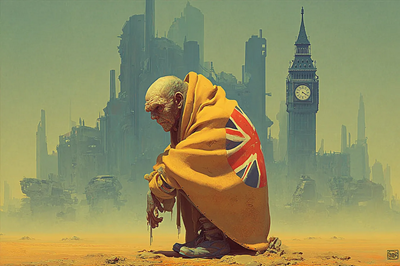
Image from Postcards from the Abyss
Britain is a disaster. The country seems to be in terminal decline.
Not only do we see a lack of ability to turn things around we witness leaders and prominent decision makers evidently clueless about normal life and the hardships many now face.
The political and media classes best reflect this phenomenon. Their views are insular, fictional and at odds with reality. They promote unorthodox ideas that are widely derided yet their enthusiasm is evident as are their hostile responses to being challenged.
Minor comments about immigration are treated as precursors to genocide. Criticism of a biased media unwilling to report events is dismissed as conspiracy. No discussion of climate policy and its unaffordable costs is tolerated. Deviation from the establishment view means excommunication and social exile.
Those in leadership positions drive Britain’s descent into authoritarian governance. Attempts to discuss changes to society leads to extreme overreactions, including jailing noticers, something they now boast about.
Britain has become a madhouse. Our leaders are unable to think like normal people. None of them are facing reality. They seem crazy.
Or, rather, they seem neurotic.
Neurosis is everywhere
Britain has degenerated into a technocratic regime that views the public as its enemy. Normal people disgust the country’s leaders and it shows. They no longer hide their contempt.
But there is a palpable sense of fear emanating from the powerful. Their reactions to normal events paint a troubling picture of who is leading the country, particularly the political and media classes.
If the British establishment were a person we would think them mentally unstable. The qualities we see most are those of a neurotic individual, a type that is well understood.
Here are some features visible in Britain’s ruling class.
Chronic anxiety and worry
A key attribute of neurosis is persistent fear or worry. Rumination is commonplace, circling around and around the same problems. There is also a tendency to overreact, with the response disproportionate to the issue at hand.
The current British regime is wracked with anxiety and worry. This defines them. They are vocal about their concerns.
We are reminded of an endless series of horrors we must attend to; systemic racism, lack of diversity, an imperial past and our cultural dominance along with our impact on the world.
One simple example illustrates the degree to which minds can become distorted by excessive worry.
James Watt perfected the steam engine in 1769 which kickstarted in the industrial revolution, changing the world forever. This would ultimately elevate most nations on earth and led eventually to the establishment of cheap abundant energy for almost everyone.
Until recently these events were viewed as an epoch-defining moment of engineering brilliance. Now this has been recast as a dark stain on Britain’s place in the world, with climate zealots keen to blame the British for all pollution caused by industrialization.
Instead of pride we now see embarrassment and even anxiety about the “damage” Britain has done to the world because it ushered in an era of cheap widespread energy for everyone.
Any rational person would understand this extreme view to be a distortion of reality and excessively negative, yet it permeates everything. Those who rule Britain are ashamed of our past. They worry about it. Only they do this, normal people are proud of our history.
[…]
Welcome to the madhouse
A system of governance driven by neurotics takes on their characteristics. Britain has become a neurotic bureaucracy; a neurocracy.
Neurotics overthink and live inside their heads. They lack the calm, detached strength needed to govern sensibly. Power structures inevitably take on these qualities.
The British government has become paranoid. Digital IDs, internet regulation, censorship. They jail normal people for social media posts. Dissenting views are increasingly punished with custodial sentences.
These are not the actions of the mentally strong. This is an embattled minority fighting reality and becoming desperate.
A gulf is opening between the rulers and the ruled. Increasingly no common ground is even conceivable as the fictions needed to maintain narratives grow. They become overtly false but are needed to feed the neurosis.
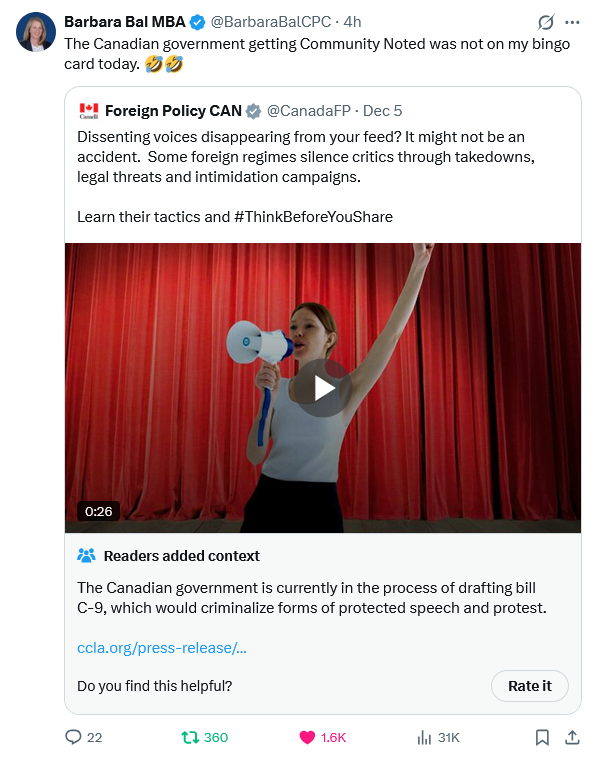
One of the things I like about the social media site formerly known as Twitter is how quickly authoritarian bullshit like this can get called out:
Update, 9 December: Welcome, Instapundit readers! Please do have a look around at some of my other posts you may find of interest. I send out a daily summary of posts here through my Substack – https://substack.com/@nicholasrusson that you can subscribe to if you’d like to be informed of new posts in the future.
Hungary 1956: The Day Hope Met Soviet Steel – W2W 056
TimeGhost History
Published 7 Dec 2025Here we trace how, only eleven years into Soviet rule, Hungary’s brief hope after Stalin’s death ignites into demands for reform, free speech, and withdrawal of Soviet troops. Students mass in Budapest, the secret police fire on demonstrators, and the uprising spreads as workers’ councils seize factories and crowds pull down Stalin’s statue. Imre Nagy promises neutrality and multi-party politics, but Moscow wavers, then sends in overwhelming force. As tanks return to Budapest, street fighting erupts, radios broadcast desperate pleas, and the revolution is crushed, leaving thousands dead and a generation convinced that the thaw was an illusion.
(more…)
December 7, 2025
“Anglofuturism” – slogan or beacon of hope?
At Without Diminishment, Robert King argues for Anglofuturism as the most hopeful path forward from the morass all of the Anglosphere seems to be bogged down in:

(From the Ministry of Space, created by Warren Ellis, 2004.)
Born in the digital backwaters of podcasts and Substacks, Anglofuturism has climbed into public view like a rocket nearing the King Charles III Space Station, gathering both attention and indignation as it ascends.
The New Statesman mutters about it being rooted in “nostalgia“, while the far-left activist group Hope Not Hate insists it is something deeply sinister. Yet their agitation merely confirms a familiar sequence. First, they ignore you, then they laugh at you, then they fight you, and then you win.
At its essence, Anglofuturism is a project of civilisational renewal.
It begins with the conviction that Britain’s decline is not destiny but a decision, and the consequence of decades of political miscalculations that consider the national story to be over, Britain’s very own “end of history”.
Just turn on the news and you will see evidence for this everywhere. Strategic islands like the Chagos Islands surrendered to the vassals of hostile powers. A once-thriving energy sector crippled by the ritual self-flagellation of net zero policies, despite abundant North Sea oil resources.
The capital city of London, once envied for its composure, now deafened by the shrill chants of imported grievances, “From the river to the sea”. Britain was once a country whose streets were said to be paved with gold, according to the legend of Dick Whittington.
Today, they are paved with boarded banks, betting slips, and vape shops. The country’s future is already playing out in London, a place where the nation of Britain has faded into the idea of “the Yookay”. Britain is told that because it once colonised, it must now invite colonisation, that because it once conquered, it must now submit.
The result is a people bending ever lower in the hope of forgiveness from a self-appointed virtuous minority at home, and from the ever-growing numbers of strangers who now claim the country as their own.
Anglofuturism is the vanguard against this ideology. It insists that love of one’s civilisation is a duty, not a sin. It binds identity to optimism, and pride to ambition. It seeks to remind Britons that its best days may yet lie ahead, but only if it learns once more to have confidence in itself.
[…]
The policy of splendid isolation simply will not work for the twenty-first century.
Enter CANZUK, the proposed alliance of Canada, Australia, New Zealand, and the United Kingdom. Four constitutional monarchies, four democracies, and four maritime powers linked by law, language, and lineage. Together they would represent over 140 million people and a combined GDP exceeding $6 trillion. It would be a realm on which, once again, the sun would never set.
Our shared day of remembrance on November 11 is a reminder that we partake in traditions born of shared sacrifice.
Such a bloc would not be a re-creation of empire, but a confederation of equals who share the responsibilities of defence and trade, coordinating space and science, and projecting stability from north to south and east to west.
It could stand apart from American turbulence, Chinese authoritarianism, and European stagnation, and be a new civilisational pole rooted in innovation and freedom under common law. It could even be a new contender to lead the free world.
Britain is still a nation successful at exporting ideas like capitalism, liberalism, and, regrettably, Blairism. Anglofuturism could be its most powerful export to the Anglosphere yet.
For those of us at the edge of that world, in Cape Town, Perth, or Vancouver, the message of Anglofuturism is that our story is not over. Our civilisation may be weak, even fading, but it can be revived. Doing this will demand the same courage that built it, in the spirit of the pioneers and soldiers, the engineers and thinkers who shaped continents and defended freedom when it was under siege.
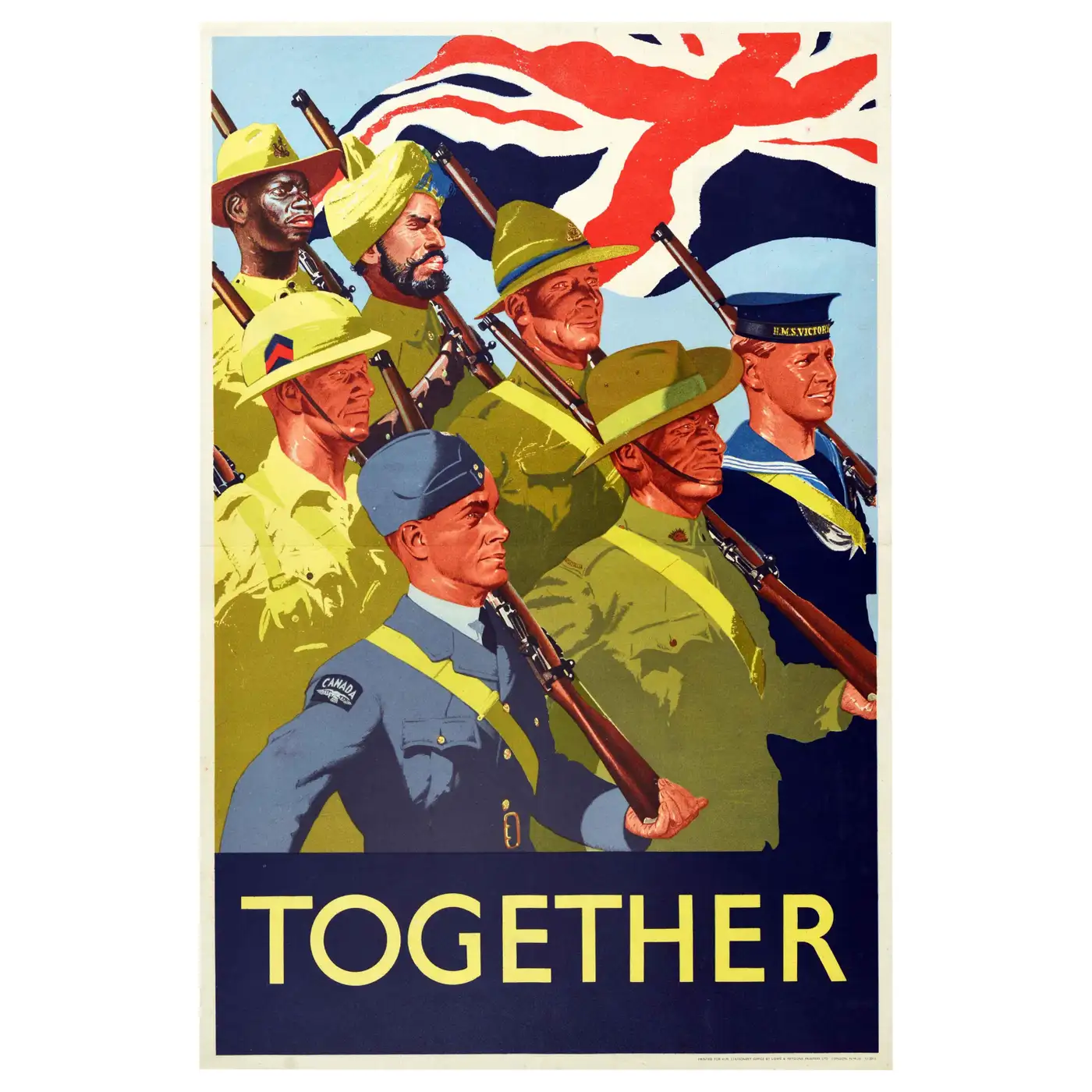
Like this, but better.
Can Hitler Be Tamed? – Rise of Hitler 22, October-December 1931
World War Two
Published 6 Dec 2025The so-called “Boxheim Papers” are leaked to the public this fall. These outline what the Nazi Party would do should there be a Communist coup; it involves a lot of people being shot or starved, and paints a rather haunting picture of what Nazi rule may be like in general. The Nazi Party, though, continues to grow in popularity, and President Hindenburg even meets with Adolf Hitler for the first time, indicating to the country and the army that Hitler is no longer an upstart, but a legitimate political force.
(more…)
History Summarized: Quebec’s Architectural Memory
Overly Sarcastic Productions
Published 1 Aug 2025Congratulations, you just got Chateau’d.
Ten years ago I visited Quebec City with my dad, this summer the two of us went back, and today I bring you the analytical fruits of a visit well spent. (Let it be known I did my best attempt at Quebecois, recalling pronunciation differences like Frontenac condensing to “Frotnak”, but otherwise defaulting to Metropolitan French when I wasn’t sure of local pronunciations. Alas, any attempt to “split the difference” between Quebecois and Metropolitan French will invariably result in utter disaster. For this, je suis désolé.)
(more…)
December 6, 2025
The least offensive kind of soft power – The Rest is History
Ed West recounts his (very) early discovery of The Rest is History, a podcast featuring Dominic Sandbrook and Tom Holland (not that Tom Holland, I’m told). I’ve been a (free) subscriber on YouTube for the last year or two, but Ed got there much earlier than I did:

The Rest is History must be the only thing of which I can say that I was into it before it was popular, my sole experience of being an early adopter. I remember listening to the very first episode as soon as it was released, during Lockdown 2, because I had been a fan of Tom Holland for years and followed him on Twitter. Straight away, I knew that it would be an enormous success, because even people who rarely watched history documentaries or read history books would find it entertaining.
And now, as they say, “the rest is history” (ho ho). The programme has just been named Apple Podcasts Show of the Year 2025, the first ever British winner, and is beyond successful, into the realm of “phenomenon”. When television writers in the distant future make dramas set in the 2020s and wish to give immediate shorthand to establish the decade, they’ll put The Rest is History soundtrack somewhere in the background, just as they always have Tears for Fears playing on the radio during any drama set in the 80s.
It became such a huge part of my life that, when cooking or cleaning and unresponsive to questions, the children came to learn that I must be listening to “Tom and Dom” on my AirPods. Initially, of course, when I mentioned that I had actually met Tom Holland a few times, they’d respond with awe until they realised that I was not talking about the Spiderman actor. It became a running joke about “your Tom Holland” rather than the “famous” one.
During the golden years of television there were a number of shows which became so commonly popular in one’s friendship circles that they were routinely talked about – The Sopranos, The Wire, Breaking Bad or Game of Thrones – but there were always plenty of people who had never watched them; there’s so much choice, after all, and the media culture has fragmented.
As Tom and Dom discussed on an old episode about the 1990s, that was the last period when the whole country had a common popular culture. Yet The Rest is History is approaching something close to that. It’s become so all-pervading that literally everyone I know, or ever speak to, listens to it. Perhaps I live in a bubble, but it’s a warm and cosy bubble filled with chat about the Kaiser’s deck shoes and Costa Rica’s infamous Dr Valverde, a sick and twisted psychopath who liked to torture frogs. The word I’d use to describe the show is “wholesome”, a term they’re fond of, an escape from the modern world, without rancour, hectoring or — crucially — swearing.
I realised that it must have become something more than popular when I read that it was the biggest podcast in Finland. Admittedly the Finnish market is not globally important, but this obviously wasn’t some quirky localised fanbase, like Norman Wisdom in Albania. It had become big everywhere, including the largest market of all; to use an analogy that Holland might appreciate, they’d reached their Ed Sullivan moment.
[…]
All the great drama series of the 2000s I mentioned were American, and I’d even go as far as to argue that The Rest is History is now Britain’s main cultural export and proponent of soft power. While the case might be made for the Premier League or Warhammer, the Goalhanger production has far more sway on international elites and how educated, cultured people around the world see our country.
Foreigners tend to value an idea of Britishness characterised by classiness and erudition, but also humour and modesty. Yet the global popularity of our national brand is out of tune with what our own cultural elites value, which reflects their sense of cringe but often comes across as strangely parochial and inward-looking. Two erudite historians who wear their scholarship lightly, whose interests are openly Anglocentric but reflect a passionate interest in the world beyond our island, talking to the audience like a pair of friendly academics in a cosy pub in Oxford – that’s the fantasy they want.
Fans are always conscious that any show will pass its peak, and then start to decline as everyone runs out of ideas. There’s no sign of it yet, and the good thing about history is that it’s literally endless, and you can always return to the subject at greater length. Their recent series on Nelson was outstanding, despite covering previous ground, and nothing says the holiday season like that festive subject, the Nazis. I can’t wait for the eleven-episode series about the Costa Rican Civil War.
G150: Swiss Silenced Guerrilla Anti-Materiel Rifle
Forgotten Weapons
Published 21 Jul 2025The G150 is a rifle specifically assembled by and for the Swiss P-26 organization: a very secretive stay-behind group intended to fight foreign occupiers of Switzerland. It was one of a series of such organizations that began with a concern during World War Two the Germany might invade, and continued during the Cold War with the threat of Soviet occupation in the aftermath of nuclear war. The P-26 group specifically was formed in 1981, and disbanded in 1991 under a cloud of controversy over its political leanings.
P-26 was armed with an assortment of weapons ideal for guerrilla warfare, including P210 pistols and suppressed MP5 submachine guns. The G150 rifle was intended to be a very quiet rifle for destroying enemy materiel like radar systems, fuel tanks, parked aircraft, and the like. About 250 were made using commercial JP Sauer actions, SIG 540 like pistol grips and folding stocks, and very large two-part suppressors. They were chambered for the .41 Remington Magnum revolver cartridge, loaded with a 408-grain subsonic bullet. The scopes were adjustable from 4-6 power (yes, 4-6: it;s a weird choice) and had BDC elevation turrets adjustable out to 200 meters.
Only three G150 rifles are known today, although the remainder may still be in some deep military storage in Switzerland. Many thanks to the anonymous viewer who arranged access to this one for me to film! To see another perspective on one of the other known examples, I recommend Bloke on the Range’s video:
• BotR Exclusive! Swiss 10.4mm G150 subsonic…
(more…)
QotD: King Henry wants a divorce
In 1532, then, Parliament presented the King with the Supplication Against the Ordinaries. “Ordinaries” means “members of a religious order” — basically, the Supplication is everyone’s beefs with the Church. You can read the list at the Wiki link, but they all boil down to this: The Church was effectively a state-within-the-State, operating a different system of law, taxation, etc. And that’s what praemunire means, too — “a 14th-century law that prohibited the assertion or maintenance of papal jurisdiction, or any other foreign jurisdiction or claim of supremacy in England, against the supremacy of the monarch”. By accusing Wolsey of it, Henry VIII was saying that he, Wolsey, was ultimately working for the Church, not the King … which is kinda what you’d expect from a Cardinal, no?
That’s the problem.
Long story short, by 1532 the state-within-the-State that was the Church was blocking the upward mobility of new men like Thomas Cromwell.1 There was an entire secular education system; it was cranking out talented, ambitious men; in short, there was an “overproduction of elites”, since there were limited spaces in the nobility and the Church and they were all already occupied by either bluebloods, or guys like Wolsey who had jumped on the gravy train much earlier.
But this was an artificial bottleneck. The Tudor state had plenty of room to expand; they needed far more educated bureaucrats than the old system was capable of supplying. The old system needed to go, on order to make room for the new, and in many ways that’s what the Reformation was: A brushfire, clearing off the deadwood. A political and administrative brushfire, disguised as a theological dispute. It’s no accident that the most Reformed polities — late Tudor England, the Netherlands, the Schmalkaldic League — were the most politically and economically efficient ones, too.
And by Reforming the Church, the brushfire could extend to the rest of the depraved, decadent, moribund, fake-and-gay culture. The Renaissance is obsessive about the old, but it is, obviously, something very very new. People raised in the Late Medieval world were emotionally incapable of a total break with the past — I don’t think any culture really is, but a culture as hidebound as the Middle Ages certainly isn’t. But so long as they could find some warrant for change in the Classical past (and being the inventive types they were, they’d always find such a warrant), they could purge the culture, root and branch, in the guise of “returning ad fontes“.
Severian, “Reformation II”, Founding Questions, 2022-03-08.
- This is where the analogy breaks down, because Late Medieval men were not Postmodern men — Cromwell was actually loyal to Wolsey almost to his, Cromwell’s, literal death. Men had honor back then. It also speaks to the kind of man Wolsey must’ve been, to have inspired the loyalty of a guy like Cromwell despite it all. Cromwell was a ruthless motherfucker, even by Tudor England’s Olympic-class standards; he’d stab his own mother if he found it politically necessary; but he still stayed loyal to his man even when it looked like that would cost him his life.


