
Contemplating the riots/demonstrations of the weekend (statues defaced and pulled down, police officers assaulted, social distancing ignored, etc) I ask myself about the extraordinary power of events a thousand-plus miles away in the US to excite supposedly “spontaneous” reactions here in the UK. And yet if, say, French police get all heavy with yellow-jacket protesters, I don’t recall marches of demonstrators in front of the French embassy. Or nor do I see this if or when there are problems in Germany, Italy or Spain (racism is a thing in these countries, after all).
Ironically – and this must drive those of a pro-EU frame of mind nuts – it is still North America, with its rawer culture and politics, its legal similarities to the UK (for good and for ill) that resonates, even in the minds (for want of a better noun) of the sort of folk going on BLM demos. What goes on in France, Germany or Italy tends not to have the same grip on the mind. The Atlantic is wide and the Channel is narrow, but in every other sense, it is the other way around. To that extent, then, the Anglosphere lives, even in the hearts and minds of the far Left.
Johnathan Pearce, “The Anglosphere and our present discontents”, Samizdata, 2020-06-08.
December 5, 2025
QotD: The Anglosphere
December 4, 2025
The Swiss vote overwhelmingly against a new wealth tax
As the California government wants to impose a new wealth tax, it’s worth checking how similar schemes are viewed in other jurisdictions. The Swiss voters were given an opportunity to scalp their very richest citizens and permanent residents with a proposed wealth tax, but it went down with 78% voting against it:

“Switzerland on Sunday overwhelmingly rejected a proposed 50% tax on inherited fortunes of 50 million Swiss francs ($62 million) or more, with 78% of votes against the plan, an outcome that even exceeded the two-thirds opposition indicated in polls,” Reuters reported this week.
All Swiss cantons already tax assessed gross worldwide assets, minus debts and with exceptions, making it one of the few countries in the world to retain a wealth tax. But competition among cantons keeps the tax burden relatively low and, as the Tax Foundation notes, “the Swiss wealth tax acts as a substitute for a capital gains tax and an estate tax, which are common in other countries”. The referendum would have imposed an additional and very steep national tax.
This was actually the second recent failed attempt to impose a national wealth tax on inheritances. Seventy-one percent of Swiss voters rejected a 2015 proposal for a 20 percent tax on estates and gifts of over 2 million francs. The revenues would have been earmarked for old-age pensions.
‘Inequality in Opulence is Better than Equality in Poverty’
The 2025 tax scheme openly played to envy. It was targeted at combating “inequality” by seizing half the assets of the rich and allocating proceeds to offset the climate damage they allegedly cause.
Finance Minister Karin Keller-Sutter opposed the proposal, warning that “many wealthy people would simply emigrate to avoid the tax and keep their wealth”. She also pointed out that while all but two of the country’s 26 cantons tax inheritances, “the people have abolished inheritance tax for children and spouses in many cantons”. She added, “I think it is right that what was developed in the nuclear family can be passed on”.
Philosopher Olivier Massin, a professor at the University of Neuchâtel, criticized the motivation driving much of the campaign for the tax. He wrote that “inequality is by nature neither good nor bad” and that envy is the main driver of egalitarianism. “Envy being inglorious, we grimace in indignation, making what is ultimately only the expression of resentment a moral cause.”
Massin added that “inequality in opulence is better than equality in poverty”.
And Switzerland is undoubtedly “opulent” — or, at least, prosperous — with a per capita gross domestic product of $103,669 as compared to $85,809 for the U.S., according to the World Bank. It builds that wealth with a second-place score in the current Index of Economic Freedom (the U.S. is now ranked at 26), suggesting that less government meddling in economic matters is the best way to increase prosperity.
December 3, 2025
QotD: Origins of the Mediterranean “omni-spear”
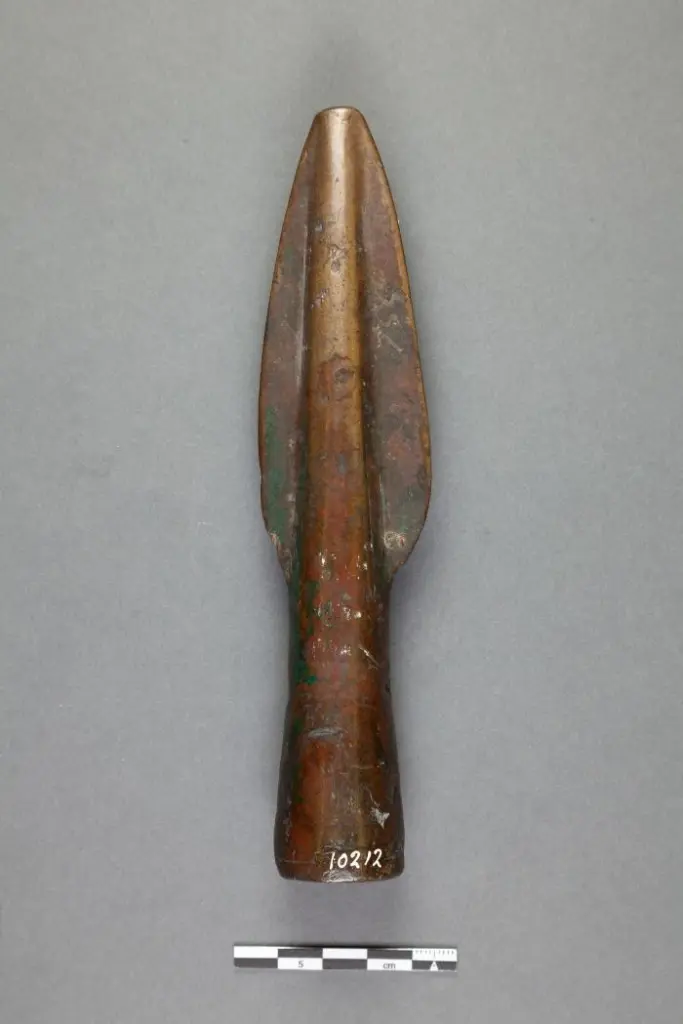
From the Museo Arqueológico Nacional in Madrid, a bronze spearhead (inv. 10212) from Italy, c. 1300-900 BC, identified as Villanovan or proto-Villanovan.
Why are so many early iron spearheads shaped this way? Well, the easy answer to the question is that it is because even earlier bronze spearheads were shaped this way. In every culture I’ve studied with the omni-spear, you can find bronze spearheads with the same basic shape – the strong mid-ridge, leaf-shaped blades and circular socket – proceeding them. There are differences; the bronze spearheads of this type tend to be shorter and as a result somewhat “stubbier” (that is, they’re just as wide, but not as long) compared to the later iron spearheads which borrow their shape. That seems like it is probably a concession to metallurgy and possibly production. On the production side, bronze artifacts were generally cast to shape and depending on the temperature of the cast and type of casting method, that can place upper-limits on the size of the final artifact. Certainly ancient bronze-smiths were capable of managing very large casts with high quality metals – the heaviest recovered naval ram (the Athlit ram, as far as I know) is absolutely massive at 465kg, cast in a single piece.
That said, I suspect the real issue that limits the size of bronze spearheads is the metal itself. Weapons generally tend to push their materials to the outer edges of what they are capable of, because of the demand to keep weight low: the smith is looking to hit the absolute minimum amount of metal which will handle the strains of impact. And the strains of impact here are considerable! Bronze under stress tends to undergo plastic deformation, which is to say that it bends and doesn’t bend back, it isn’t “springy”. As a result bronze weapons – swords, spearheads, arrow-heads, etc. – tend to be quite a bit shorter than later iron weapons, so that they can withstand the rigors of combat without permanently deforming in a way that would render them useless. But iron when put under mild stress deforms elastically, which is to say it is “springy” and when the force of stress is removed it bends back to its original shape (adding carbon to make a high-carbon “spring steel” can improve this quality), so even while iron isn’t any harder than bronze (though steel most certainly is), an iron weapon can take a bigger hit and not end up hopelessly bent. And that is even more true once you begin adding really any amount of carbon to make even very mild steels.
Consequently, you can push an iron sword to be longer for the same weight because you can count on it withstanding a hit, bending a bit to absorb the force and bending back when the force is removed, better than bronze. I suspect the same thing is happening as bronze spearhead designs shift to iron: smiths are realizing they can get a somewhat longer point, with a longer more deadly taper, without an unacceptable increase in weight.
But then why keep the shape? Because a lot of bronze age sword shapes drop or are extensively modified fairly quickly in the shift to iron in places where the omni-spearhead remains the standard shape, albeit somewhat larger than its bronze variant.
Well, the answer, to me, seems to be that its a pretty useful shape, at least in a particular combat environment.
The round socket, of course, is to fit the round haft of the spear. These sockets are, as noted, generally round, which suggests that these spears are almost entirely being used to thrust. You probably could cut with the edges of these blades, but if that was how you expected to use the spear, you’d want a different haft shape so that you could feel the alignment of the edges of the blades. Interestingly, octagonal or rhombic sockets are a minority type that appears in a lot of places (both Gaul and Spain, for instance), but they remain really rare, as opposed to, say, medieval polearms, where non-circular hafts become common over time so that the wielder can feel that edge-alignment.
Extending the socket to make the mid-ridge also makes a lot of sense, as it provides a nice, thick, stout element of the spear to resist the forces of impact, which is going to be a mix of compression and bending. In an ideal, perfect impact, it’d be all compression, but in the real world, your target isn’t standing still and your hit probably isn’t dead-on, so you want some part of the spearhead that can resist that impact and hold its shape, transmitting the force instead into the shaft. The mid-ridge, being nice and thick (and generally not hollow past the socket) accomplishes this neatly.
Meanwhile, those wide, thin blades ensure a wide wound that is going to slice through a lot of the target. You want that too, because the fellow striking with the weapon wants a wound which will disable their opponent as quickly as possible. After all, all of the time between the delivery of a wound and it becoming disabling is, definitionally, a period where you are in range of their counter-attack and they are not disabled and so able to give it. If you ever wondered why a lot of really narrow, quick effective piercing weapons like rapiers were less common on the battlefield, this is a big part of it: those penetrating wounds are really lethal but often not very quickly and in a battlefield (where you may not be able to quickly back off after having delivered a fatal wound) you want a wound that, fatal or not, is going to disable fast.
Wide slicing wounds do that for you, because they cut across blood vessels, muscles and tendons. The former leads to rapid blood-loss, which can be disabling (and of course, fatal, but again, you care about disabling; fatal or not is a problem to consider once you are out of danger), while the later can instantly render limbs useless. It doesn’t matter how much adrenaline or willpower an enemy has, if a blow has sliced the muscles they would use to move their limbs, they cannot physically move those limbs.
The shape of the blades also seems intentional. While we do see neatly “oval” shaped blades, the most common shapes are “teardrop” or “leaf” shapes, which are widest close to the base. That probably helps in preventing over-penetration, because you need to be able to pull the spear back after delivering a strike; you do not want it stuck in the target. Likewise, I think that’s why truly “arrow” shaped spearheads tend to be both early and relatively rare. Instead the base curves back into the socket rather than having barbs, to make it easier to get that spear back out of an opponent after you strike them.
At the same time, spears are by no means immune to weight considerations. Ideally a combatant wants the longest spear they can manage easily in a single hand. That in turn is going to place a hard limit on the weight of the spearhead; every gram in the spearhead shifts the center of balance forward, making the weapon harder to handle. Shifting that center of balance back means adding a gram to the spear butt. Spearheads are pretty much always heavier than spear butts (often several times over), but the basic interaction is there where adding mass to the tip of the spear imposes weight costs which limit length. The trade-off is actually quite clear in medieval spears, where winged and “hewing” spears with larger spear-tips do, in fact, tend to be shorter and may have often been intended for use in two hands.
And because the humans in these systems don’t differ all that much, everyone more or less hits the same set of tradeoffs at basically the same point and so ends up developing spears with very similar weight and length characteristics. This should, I hope, help to dispel any myths that this or that group of ancient agrarian people were super-strong supermen; Greek, Roman, Spanish, Gallic, and Persian spears are all of the same basic length and weight and modern enthusiasts, reenactors and experimental archaeologists can wield those spears just fine. The basic limits of an average warrior haven’t changed all that much.
What you are left with is a spear with a 2-2.5m haft (probably just under 1kg), with spear-tips ranging from 150-450g, mostly clustered in the center of that range around 200g, and spear-butts typically very light, less than 100g and very simple in design (with an exception here for the elaborate Greek saurotar). A simple, no-frills design that would have been very effective on foot or on horseback.1
But as a basic design, the typical omni-spear provides a very effective balance of capabilities: the longest infantry spear that is easy enough to handle with a tip that is suitably deadly against lightly armored or unarmored targets and typically a spear-butt which both encloses the base of the spear (preventing it from delaminating) and provides a point which can be used to both brace the weapon and as an emergency back-up weapon, without adding unacceptable amounts of weight. Note, of course, that I’ve said unarmored or lightly armored: the wide blade on that spearhead is going to cause a strike to have to move aside quite a bit of armor if your opponent is wearing some, greatly limiting the depth of a strike if you have to move the weapon through, say, thick textile armor or mail. But assuming you only expect to strike unarmored targets, or the unarmored portions of armored targets, the shape is very effective.
Bret Devereaux, “Collections: The Mediterranean Iron Omni-Spear”, A Collection of Unmitigated Pedantry,
- Though the Greek cavalry spear of the late-Classical and Hellenistic, the xyston – pronounced ksuston, not zystin – is differently structured than this.
December 2, 2025
QotD: Brutalism “is to architects what propaganda was to communist leaders: It serves to make them feel powerful”
I have long suspected, but cannot prove with an indisputable argument, that this architecture has played its part in the brutalization of daily life and social behavior in the country. Certainly, it has dehumanized the appearance of many towns and cities; its harsh surfaces and willfully austere and jagged designs leave the mere human being feeling that he is about as welcome as an ant on a kitchen counter — which, indeed, he now much resembles.
This architecture is to architects what propaganda was to communist leaders: It serves to make them feel powerful, not despite the fact that so many people detest it, but because so many people detest it. They are like the doctors of old, who, if they could not cure their patients, could at least make them take the most repellent and noxious medicine, on the grounds that a little bit of what revolts you does you good.
The projected museum is in a former school in the north of London, designed in 1968. Here is fairly typical commentary on the building:
Despite decades of wear and some unfortunate interventions, the raw concrete structure has remained a cherished example of socially driven modernist design.
It is to be noticed that the cherishing done here is independent of anyone who cherishes; as for “socially driven modernist design”, we might read “totalitarian”. Indeed, the building exudes totalitarianism, as raw reinforced concrete exudes ghastly stains after a short time.
Le Corbusier, one of the founders of this kind of architecture, was indeed a fascist in the most literal sense, though he had no real objection to communist totalitarianism, either. What he most hated was what he called the street, that is to say the place where people behave spontaneously and without direction from above, and where they are not corralled into functions imposed on them by all-wise socially driven architects. It was for this reason that he and his acolytes preferred to build urban wildernesses of the kind that have now been built the world over, but especially in Britain.
The architects who have been given the task of renewing the school building where the museum dedicated to architectural brutalism is to be housed have “noted its distinct geometry, as well as its symbolic presence reflecting the ideals of the school’s broader 1960s Brutalist architecture conceived in an era of social progress”.
Apologists for such architecture write a pure Soviet langue de bois — or perhaps I should say langue de béton, since concrete rather than wood is their favorite material:
Consultation with the school, families and local stakeholders has underpinned the project from the outset, ensuring that the building’s next chapter remains tied to its founding ethos centered on architecture as a tool for collective learning and expression.
Does anyone, after the death of the late, not much lamented, Leonid Brezhnev, have thoughts that correspond to, or are couched in, words such as these? By their language shall ye know them.
Theodore Dalrymple, “Architects of Our Own Destruction”, New English Review, 2025-08-08.
December 1, 2025
Why Uncle Sam entered the Vietnam War – W2W 055
TimeGhost History
Published 30 Nov 2025The Vietnam War didn’t begin with American boots on the ground. It began with a promise — and a break. After the French defeat at Dien Bien Phu in 1954, the Geneva Accords split Vietnam at the 17th parallel. Ho Chi Minh led the North. In the South, Ngo Dinh Diem struggled to hold a fragile new state together while armed sects, crime syndicates, and political rivals challenged his rule. Washington saw Vietnam as the next battleground of the Cold War, and threw its support behind Diem — believing he could stop the spread of communism in Southeast Asia.
But as elections for reunification approached, tensions rose. Diem refused the vote. The North rebuilt. The South descended into repression, unrest, and quiet rebellion. Former Viet Minh fighters slipped into the shadows. Secret networks formed. Targeted killings began. By 1958, the storm clouds of a new war gathered — one the United States could no longer afford to ignore.
This episode explores how the U.S. found itself pulled into Vietnam, how Diem rose to power, why the reunification election collapsed, how American aid reshaped the South, and how the first sparks of insurgency ignited a conflict that would define a generation.
Join us as we trace the origins of a war long before the Marines landed at Da Nang — to understand why Uncle Sam entered the Vietnam War in the first place.
(more…)
The United States is not – and should not be – the arbiter of all the world’s conflicts
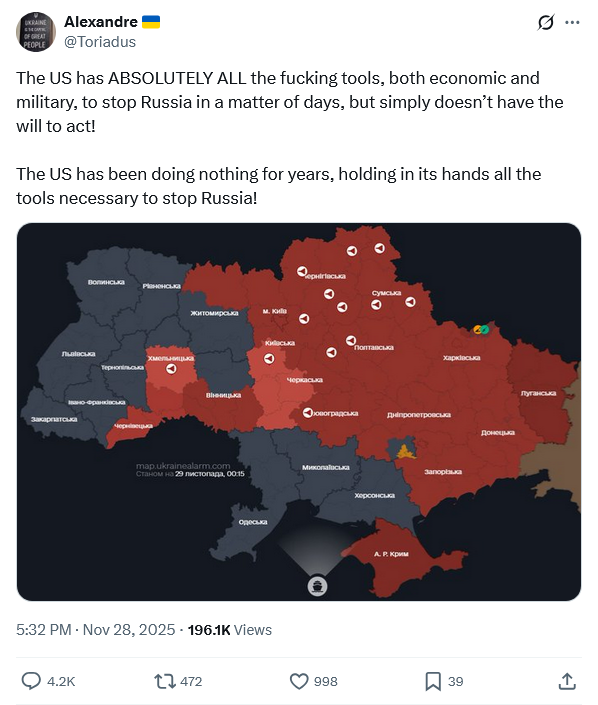
On the social media site formerly known as Twitter, Devon Eriksen responds to a demand that the United States intervene directly in the Russia-Ukraine war:
America is not special. It’s just a country.
Yes, it’s the best country, but it is not the god of all other nations.
A lot of people like to point this out when saying that America doesn’t have special rights, but those same people very rapidly and conveniently forget that phrase when they want something from America.
Because no special rights means no special obligations.
We don’t have to rob our own citizens to keep African AIDS patients alive, or feed nations that overbreed while they are unable to feed themselves.
We don’t have to stop the genocide in East Ethnicklashistan.
We don’t have to accept refugees from anywhere, much less from the worst failed states on the planet.
We don’t have to cooperate with, fund, host, or even participate in the United Nations.
And we don’t have to take sides in ethnic conflicts on the other side of the planet.
The assumption that any conflict is between the good guys and the bad guys, and that the US must help the good guys is the assumption that America is god, responsible for bringing peace, justice, and prosperity to the planet.
Are you ready to be ruled by us as if we were gods?
No?
Then don’t demand justice from us as if we were gods.
The responsibility of America, as just another nation, is to look after the interests of Americans.
Look, we all know that Russia is dogshit at warfare, because wars are not won by being tough. They are won by being organized, coordinated, trained, and equipped.
And Russia is an extraction economy, not a high-trust, high-tech first world state.
So, yes, we could easily beat Russia in a war. That does not mean it is in our best interests to do so. Lots of costs, no benefits.
And while we are wealthiest nation in the history of … everything … we still have a severe overspending problem, mostly because we’ve been the wealthiest nation for a long time, and have developed some bad problem with political corruption, and throwing money at ever grifter with a sob story and an outstretched hand.
I know you think your cause is just. I’m not trying to tell you it isn’t, because I don’t need to decide if it is or not.
It doesn’t matter.
America’s responsibility is to Americans, and if that responsibility is not being discharged, taken care of, thoroughly handled, then support of any other side quest, regardless of its merits, is dereliction of duty.
Update, 2 December: Welcome, Instapundit readers! Please do have a look around at some of my other posts you may find of interest. I send out a daily summary of posts here through my Substack – https://substack.com/@nicholasrusson that you can subscribe to if you’d like to be informed of new posts in the future.
November 30, 2025
North Africa Ep. 10: Rommel’s Desert Cannae – The Trap at Mechili
World War Two
Published 29 Nov 2025This episode, Rommel sets up a “Cannae, modern style” at Mechili, a three-pronged encirclement with Wechmar pressing from the west, Schwerin/Ariete and MG 8 driving up from the south, and Olbrich’s panzers meant to close the center. A Ghibli, fuel chaos and delays upset the timing, but Ponath cuts the Derna road and captures Generals Neame and O’Connor. And after failed breakout attempts against Fabris, the Bersaglieri and Streich, Gambier-Parry surrenders about 1,700 men and Mechili falls, opening the road to Tobruk.
(more…)
Canada’s growing Islamist problem
At Juno News, Joe Adam George points to the problems Britain is having with their well-established Muslim extremists and says Canada has exactly the same issues here:
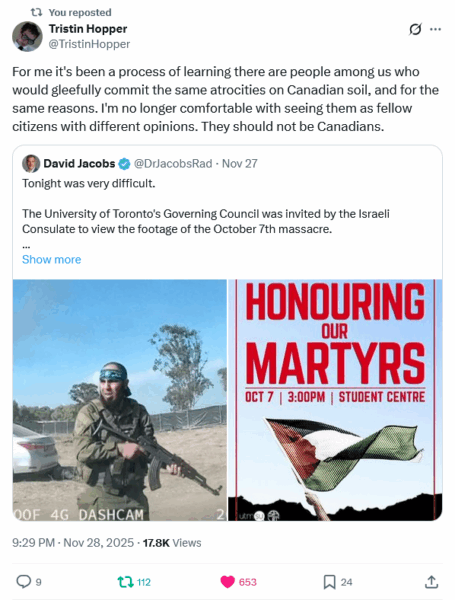
When 35-year-old Jihad al-Shamie terrorized a Manchester synagogue last month on Yom Kippur pledging allegiance to ISIS, few were shocked by what investigators later uncovered. He attended a Salafi-inspired mosque where extremist rhetoric was routine. His father had praised Hamas’s October 7 attackers as “Allah’s men on earth”. Years of indoctrination taught him that violence was virtue, resistance was glory, and terror was faith.
What unfolded in Manchester is a warning to Canada, where similar currents of Islamist radicalism have been manifestly gathering strength. Across Canadian cities, extremist narratives are taking root among young people through community networks, activist circles, and online echo chambers.
A prominent Shia mosque in Windsor, Ontario, recently held a memorial service for slain Hezbollah leader Hassan Nasrallah — for the second year running — where youths eulogised the notorious terrorist as a “hero” and “martyr”. The Toronto Metropolitan University’s arts faculty funded a research paper which argues that Canada’s designation of Islamist groups as terrorist organizations is deeply flawed because of “systemic Islamophobia” and racism. Such episodes do not merely glorify violence; they sanctify terrorism and rebrand militancy as a necessity.
Earlier this year, Canada’s spy agency, the Canadian Security Intelligence Service, warned it was “increasingly concerned” about the threat of ISIS-inspired attacks. That concern is well-founded. The Royal Canadian Mounted Police reported a staggering 488 per cent rise in terrorism-related charges between April 2023 and March 2024, much of it driven by ISIS-motivated youth radicalisation. In the same period, antisemitic incidents surged by more than 670 per cent. An ISIS-inspired teenager was arrested in Montreal in August for terrorism offences. These are not isolated events but symptoms of a cultural shift — where extremism masquerades as activism and hate is sold as justice.
Since the breakout of the Israel-Hamas war, unrestrained radicalisation has seeped into mosques, schools, charities, and universities — often protected by Canada’s own liberal frameworks. Islamist networks have mastered the art of exploiting the Charter of Rights and Freedoms to propagate radical ideologies while deflecting scrutiny. Wrapped in the language of “human rights” and “anti-racism”, they advance intolerance behind a façade of moral virtue.
As former FBI agent and counter-terrorism expert Lara Burns noted, it’s a tactic that echoes the Muslim Brotherhood’s “sabotage strategy” in North America — infiltrating institutions to steer public debate and soften attitudes toward Islamist causes.
Campaigns to institutionalize so-called “anti-Palestinian racism” (APR) is turning Canada’s classrooms and government offices into laboratories for grievance politics. Marketed as anti-discrimination, APR in reality brands any criticism of Palestinian militancy as racism, giving extremists a moral shield and silencing dissent. Even Canada’s Islamophobia czar, Amira Elghawaby, has been accused of abusing her taxpayer-funded post to conjure up Islamophobia and APR where none existed. During a visit to London in June, she reportedly met officials shaping the UK’s own Islamophobia legislation — a troubling sign of cross-pollination between partisan ideologues.
November 28, 2025
CZ247: Experimental Swivel-Action SMG
Forgotten Weapons
Published 16 Jul 2025The CZ247 was developed for Czechoslovakia’s post-war submachine gun trials, where it was pitted against the ZB47. It was a simple blowback 9x19mm SMG with a number of interesting elements, most notably the ability to fire with the magazine either vertical or horizontal. In theory, this made the gun more compact for use in a jungle sort of environment (vertical) or to allow a shooter to get much lower to the ground when shooting prone (horizontal). In practice, it really isn’t very important, and requires a bit of extra complexity in the gun’s design. The CZ247 also has a neat safety mechanism for preventing unintended firing and a stripper clip guide built into the stock (both of which would be incorporated in the vz.48 SMG that was eventually adopted).
When the CZ247 failed to win the military trials, CZ got government permission to sell it on the export market. A contract for 10,000 guns was quickly obtained from Egypt, but before the guns could be shipped the export permission was cancelled by the government. Czechoslovakia opted to support Israel in its declaration of independence in 1948, and the government decided to not send weapons to Egypt which might be used against Israel. This left the guns sitting in CZ warehouses, and the basically all stayed there for a few decades. Eventually most were sold to Nigeria in 1967 and Ethiopian in 1977 — and as a result they show up occasionally in African and Middle Eastern conflict zones to this day.
Thanks to CZ for giving me the opportunity to take this example out to film and also to shoot for you!
(more…)
QotD: Life is not a race to some arbitrary “finish line”
I wrote:
The hostility to inheritance also comes from a mistaken sense of fairness. As Robert Nozick argued in Anarchy, State and Utopia (I quote from memory), people wrongly think life resembles an athletics race, where the racers compete to hit the finishing line. As a result, those “lucky” athletes endowed by nature/god whatever with stronger muscles etc must be handicapped by having weights in their shoes, for example. Just as a child of rich parents must be deliberately held back to give poor kids a more “fair” chance of winning. But as Nozick said, life isn’t like that. It is about people exchanging goods, services and ideas with one another. There’s no fixed end-point to which we are all racing.
Also, the idea that there is some “prize” that humans compete for implies that someone or some entity has created that “prize” in the first place. But that’s smuggling in a sort of communitarian assumption into the actions of individuals. In an open society, the prizes on offer are varied and multiply constantly.
I should add that the second section of Nozick’s renowned book dissects and ultimately rejects forced redistribution for egalitarian or other forms of “patterned” notions of justice, and he robustly defends what he calls an “entitlement” concept of justice.
One of the approaches that the late Prof. Nozick used was the thought experiment, such as the example referenced above about a fictitious athletics race in which the entrants are hampered/favoured to make the race more “even”, and then assuming that society in general should be like this. A race, held by people who know the rules and seek to abide by them, is not like an open society. “Open” is the key word here: there is no single end to which persons are heading, such as winning the race.
And yet a lot of the metaphors one comes across around discussions around equality, including equality of opportunity as well as outcome, seem to borrow, perhaps unwittingly, from this “race competition” worldview. To give another example, I remember reading some months ago about a university professor (Warwick) who suggested that when parents read stories to their children, this is a form of privilege. This also plays to the idea that life has a fixed end-measure of success, so that anyone giving a value to someone else is giving the latter an unfair “head start” on someone else. It would require a State to exercise totalitarian control of our actions from the moment we wake up to go to sleep lest our actions unfairly advantage/hamper someone in the “race” they are considered, by this worldview, to be on. (It also, by the way, shows that today’s Higher Ed. is full of certifiable fools and worse.)
Johnathan Pearce, “The assault on inheritance and the assumptions that drive it”, Samizdata, 2025-08-21.
November 27, 2025
Operation Catapult: The Royal Navy’s day of infamy?
Lindybeige
Published 28 May 2025Operation Catapult took place on July 3rd 1940 at Mers El Kebir on the Algerian coast. It remains a point of controversy in the relations between the British and the French. Who was to blame for the sinking of the French ships and deaths of French sailors? You be the judge.
Erratum: Acting Rear Admiral Onslow, captain of the aircraft carrier Hermes, was not “Rodney” Onslow as I named him, but Richard Francis John Onslow, M.V.O., D.S.C. (29 March, 1896 – 9 April, 1942).
(more…)
QotD: Honor, homage, and fealty in Game of Thrones
To refer to a distinction introduced in Wayne Lee’s talk [here] – Tywin cannot rely on force (do it because I will kill you if you don’t), he has to use power (do it because you think you ought). Because the apparatus of the state here is very limited, that power is largely generated through personal relationships – you ought to fight for your liege because you have a personal relationship with him. You see him fairly often, you swore loyalty to him (in person!!), he (or his ancestors) have helped resolve your problems in the past and most importantly, because he has kept faith with you in the past.
Which is a way of saying that this system runs on trust and reputation, and that runs both ways. Even as Tywin watches his vassals for signs of disloyalty, his vassals are watching him. Is he true to his word? Can I trust him? Because if the answer is no – I best start hedging my bets. And that bet-hedging is going to come in ways Tywin does not want – I might refuse to come out and fight, or redirect my efforts to fortifying my own holdings, or even switch over to another liege. And in the very early seasons, key characters – most notably Tywin and Tyrion – know this and act accordingly. Tywin talks a good game about lions and sheep, but when it comes down to it, he knows his reputation matters – what the sheep say about the lion matters a great deal, it turns out. Robb Stark’s failure to handle the Karstarks, Tullys and Freys is his eventual undoing. Tyrion berates Cersei on returning to King’s Landing for her actions which might call the Lannister reputation into question (“that bit of theatre will haunt our family for a generation”.)
What is unusual here is how frequently key characters deviate from the norms these societies need to function – Westerosi nobles are stunningly treacherous for people who rely on systems based in trust for survival. In a system which runs on trust and reputation, elites tend to value trust and reputation. They produce literature extolling it (as, indeed, do most “mirrors for princes” – guidebooks on how to be a good ruler – from the Middle Ages do; see, for instance, Book 3 of Dhouda’s Liber Manualis (9th cent.), which goes on and on about trustworthiness) and refine its practice. The sort of eye-popping treachery so common in Game of Thrones was far rarer in the actual historical Middle Ages for exactly the reason Game of Thrones would lead you to believe: it is almost always self-defeating.
The problem here comes in the later seasons and how they re-contextualize all of this concern. That problem has a name, and it is Cersei. Cersei breaks all of these rules. Even early on, she has her soldiers (who recall – are not paid mercenaries, but likely vassals of her house who can very much take their skills elsewhere if they don’t like their current employer) demonstrate her own capricious untrustworthiness on Lord Baelish (she has also, I will note, mistaken violence for power). She humiliates Barriston Selmy in court, a spectacle her own future vassals might have remembered. She incinerated her own family – by blood and marriage – along with her erstwhile allies. Cersei is endlessly treacherous, often foolishly and obviously so, and yet …
And yet it doesn’t matter. The Lannister bannermen in the penultimate episode mount the walls to fight a doomed battle for her anyway. Not only is that behavior inexplicable, it hardly seems possible. Who, after all, is raising and leading these men? Who is coordinating supplies and grain shipments to the capital? Remember, the reason for this distributed system of political leadership is that the central state does not have the administrative apparatus to raise armies or feed cities on its own – it has to outsource that to vassals. Vassals that Cersei has murdered or alienated, almost to a man. Cersei is defeated because dragons are unstoppable monsters, but she should have been defeated because she would have simply been incapable of raising an army at all.
Bret Devereaux, “New Acquisitions: How It Wasn’t: Game of Thrones and the Middle Ages, Part III”, A Collection of Unmitigated Pedantry, 2019-06-12.
November 26, 2025
The RCAF needs either F-35s or Gripens … not both
Although the Trump provocations are a unique situation for the Royal Canadian Air Force to find itself dealing with, the long-delayed decision on what the replacement for our current CF-18 fleet can’t be realistically put off for much longer. The government has committed to paying for the first 16 aircraft of an 88-plane order, but many pundits are crying out for the government to cancel the remaining portion of the order and instead purchase different aircraft … the leading contender being the Swedish Gripen. This might be the worst of all worlds for the RCAF, in needing to support two different airframes with zero parts compatibility. This two-fleet “solution” would make life much more difficult for RCAF training and logistics, but it’d be a performative eLbOwS uP to Trump, so there’s a strong chance it’ll happen despite military and economic reality. Bryan Moir makes the argument for the Gripen on his Substack:
Mark Carney loves the big phrases. “Build Canada strong.” “Rewire the economy.” “Generational investments.”
It’s good branding. But slogans don’t build nations — decisions do. And right now, one decision matters more than the rest:
Will Canada assemble the Saab Gripen fighter on Canadian soil — or will we lock ourselves into permanent military dependence through the F-35?
Let’s start with the truth no one in Ottawa wants to say out loud.
The F-35 is a 56% aircraft in a 100% environment.
The F-35 fleet’s mission-capable rate sits at 55–56%. That means a country buying 16 aircraft can expect maybe eight airborne on a good day. Eight jets to defend the Northwest Passage, the Arctic archipelago, and a coastline longer than Russia’s.
This isn’t speculation; it’s physics, logistics, and accounting.
Meanwhile, the United States fields 54 F-35s at Eielson AFB in Alaska — backed by billions in supporting infrastructure: software hubs, spares depots, rapid part cycling, and multiple layers of maintenance and training.
They can sustain the F-35 in the Arctic.
Canada cannot.
And pretending that we can — or worse, pretending that it doesn’t matter — is not national defence. It’s denial.
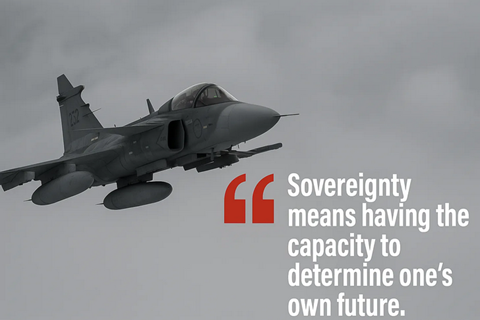
Gripen was designed for the world Canada actually lives in.
Gripen’s core design features are the ones Canada pretends the F-35 also has:
- Cold-weather resilience
- Short runway and road-base operations
- Minimal crew requirements
- Quick turnarounds
- Low maintenance footprint
- Sovereign sustainment
Gripen isn’t just compatible with Canada.
It was built for countries whose geography forces them to be independent.
November 25, 2025
Roller Delay in France: The H&K 33F (Trials & Export Models)
Forgotten Weapons
Published 14 Jul 2025When France was looking to replace the MAS 49/56 rifle for military service in the 1970s, it tested all of the major rifle options available. These included the Colt M16, FN CAL, and HK33. The HK required some modification to meet French military requirements, specifically the capability to launch rifle grenades. The model 33F was developed specifically to meet these requirements — first as a modified standard HK33, and later as a factory production run. The modifications made include a reinforced magazine well, 4-position fire control gourd (including 3-round burst), a reinforced stock attachment, grenade range rings on the barrel, and a mounting bracket for a rifle grenade sight.
Apparently the HK33F performed very well in trials, but it was ultimately deemed politically unacceptable to adopt a German rifle for the French Army (a policy which has changed now, 50 years later …). Instead, the domestic FAMAS was chosen, along with the SIG-Manurhin 540 purchased in limited numbers for the Foreign Legion.
A second type of 33F came about from the program, however. Berlin police wanted HK33 rifles, but treaty prohibited West German arms from entering Berlin in East Germany. The loophole found was to send the parts to MAS in France, where they were assembled and marked HK33F, thus making them French origin gun which could be sent to Berlin. These rifles had none of the French grenade launching adaptations, and were completely standard HK33s except for the use of heavy barrels. MAS eventually added the G3, HK33, and MP5 to its export catalog in the late 1970s and sold quantities to a number of small countries in the French sphere of influence (including Haiti, Burkina Faso, Lebanon, and others).
Many thanks to the IRCGN (Institut de Recherche Criminelle de la Gendarmerie Nationale) for allowing me access to film these rather rare HK variants for you!
(more…)
QotD: British Socialism in the 1930s
George Orwell, The Road to Wigan Pier (1937)


