
Engineering Explained
Published on 11 Feb 2018Why Does The Porsche 911 Carrera Put The Engine In The Back?
When you’re sitting at the drawing board, one of the most critical decisions you’ll make in designing a vehicle is where you place the engine. The engine’s placement will have a huge impact on passenger space, practicality, acceleration, braking, weight distribution, and overall driving dynamics.
Porsche decided to put the 911’s engine in the back, behind the rear axle, way back in the day when the 911 was first designed. Since then, that engine has remained there, and while some might say it’s out of stubbornness, there are legitimately wonderful reasons for having a rear-engine car. In this video, we’ll discuss five different scenarios, and how a rear engine makes a lot of sense for each.
March 4, 2018
Why Is The Porsche 911 Rear-Engine?
QotD: Rousseau’s “Noble Savage” myth
The concept of a primeval matriarchy may be regarded, on one level, as a modern incarnation of the Golden Age myth, a belief found in primitive societies throughout the world that during the infancy of the human race mankind lived in perfect peace and harmony in a world of abundance. The Garden of Eden is the biblical take on the legend. In the Bible story however, as in all traditional accounts, there was a “Fall” from grace, after which strife and hardship entered the world. The Fall, or Original Sin, represented an implicit acceptance of human imperfection and in a way accounted for the violence and discord of life by pointing the finger of blame at humanity as a whole and the individual in particular. The essential imperfection of human nature was recognized by all ancient societies, and is a theme which we encounter in the works of the Chinese philosophers as well as those of India and Greece. With Rousseau and the Enlightenment, however, there came a change. Reacting against the rationalism and industrialization of the eighteenth century, Rousseau and his fellow proto-romantics adopted a sentimentalized view of ancient and primitive man, arguing that human nature, in its pristine form, was not “fallen” at all, and that human beings had in modern times been corrupted by an exploitative and degenerate economic system.
Rousseau’s Noble Savage has caused untold harm over the past two centuries as totalitarians of various hues sought to foster and free the inherent nobility of humanity by destroying the corrupt and exploitative economic systems which had supposedly turned people into butchers and criminals. Both fascism and communism trace a direct line of descent to Rousseau, as do anarchism and the various extremist ecology movements of our time.
Feminism, too, is a branch of Rousseau’s tree, though it has other wellsprings. Marx and Freud, of course, with their negative attitudes to Christianity and Christian civilization in general, contributed much to feminism. Marx in particular emphasized how “bourgeois” Christian society had oppressed women, and called for the abolition of the family and complete sexual liberation. Freud contributed by his claim that neuroses and mental illness in general were the result of sexual repression. But the myth of a primeval matriarchy also owed much to students of mythology such as James Frazer and (more especially) Robert Graves. Archaeology too played its part, as scholars began to uncover ancient images of goddesses and female deities from various parts of the globe. The Palaeolithic epoch, the earliest age of homo sapiens, revealed small statuettes of clay, ivory and bone, depicting some form of Mother Goddess. Perhaps the most influential archaeological discoveries, however, came from Crete, where between 1900 and 1905 Sir Arthur Evans uncovered a splendid pre-Greek civilization where women and female deities apparently enjoyed a privileged position.
Emmet Scott, “The Myth of the Primeval Matriarchy”, The Gates of Vienna, 2016-07-13.
March 3, 2018
Cuban Missile Crisis – Black Saturday – Extra History – #3
Extra Credits
Published on 1 Mar 2018*Sponsored by DomiNations: https://smarturl.it/CubanMissile1
With simultaneous nuclear tests by both the US and Russia, and tense miscommunications among troops on the ground, in the air, and on the water, the doomsday clock ticked to 11:59 PM for one fateful day.
How A Man Shall Be Armed: 11th Century
Royal Armouries
Published on 20 Feb 2017Discover how a Norman knight of the 11th Century would be armed for battle with the finest equipment available.
QotD: Elite incompetence
Most people, most of the time, are perfectly happy to let elites run the country. After all, it seems to make the elites happy to run run things, and as long as they’re reasonably competent at it, and do it reasonably unobtrusively, no one much seems to care. But when elite competence is compromised by faulty ideology and cronyism, people become unhappy. And when the elite response to complaints is dismissal or insult, political problems begin to bloom. People begin to think about politics. They begin to do things. It is no coincidence, as our Soviet friends used to say, that the last decade has seen the rise of the TEA Party, the Occupy Movement, and the Trump phenomenon. People of all political stripes are becoming unhappy.
I think we’re about to watch the elites start paying a price for their incompetence, inattention and contempt. Euroskepticism is on the rise elsewhere in Europe. If EU membership were put to a popular vote in the Netherlands, Spain, or Sweden, there is a good chance that Leave would win there, too. Indeed, it’s possible that a vote to leave the EU might even win in France, the nation for whom creating and strengthening the EU has been the primary policy goal for 60 years.
Perhaps the “Vote Remain, you virulent racist!” PR campaign for staying in the EU needs a bit more thought.
Dale Franks, “Vote Properly, You Virulent Racist!”, Questions and Observations, 2016-06-28.
March 2, 2018
Ludendorff’s Window Of Opportunity I THE GREAT WAR Week 188
The Great War
Published on 1 Mar 2018German victory in the East, chaos in the British High Command, stable fronts in the Balkans and Italy, the US still not in full strength; German General Erich Ludendorff has a window of opportunity for his spring offensive and he intends to use it. Within the next weeks the German Army will launch their biggest offensive of WW1: Operation Michael.
Sean Gabb on the ever-more-likely “hard Brexit” option
Sean Gabb hasn’t read the full text of the draft treaty of withdrawal from the European Union, but does offer some general points that do not depend on the details in that document:
I wish the Referendum had not been called. Nobody in or near power had so much as the vaguest idea of how to leave the European Union. Nearly two years on, nobody still knows what to do or how to do it. The politicians are all incompetent or dishonest, or both. The politicians in charge called an election, and were so sure of winning it that they effectively lost it. The politicians most likely to replace them are probably more incompetent, and certainly more dishonest. The other European powers and the European powers have now had time to recover from their initial shock, and are behaving like that spurned and vindictive wife. Though I repeat that I have not read it, I have no doubt their draft treaty is the modern equivalent of the Versailles Diktat. They are pushing this on us because they want to deter any other member state from trying to leave. I also suspect they are pushing it because, for the past three centuries, they have been repeatedly stuffed by us, and they now want to do some stuffing of their own.
If we accept the draft treaty, or anything like it, we shall have exchanged an equal membership of the European Union for satellite status. We shall have limited control over our internal regulations. We shall have limited control over our borders. We shall have consented to a unification of Ireland on the most humiliating terms. If, unable to negotiate better terms, our leaders tell us that we should stay in after all, that will involve still more humiliation. What little authority we ever had to negotiate opt-outs from inconvenient regulations will have evaporated. We shall be forced to join the Euro and the Schengen Agreement. Any future British “No!” will be met with pitying smiles and firm insistence. I will say nothing about the prospects for civil disorder in this country.
On the bright side, the draft treaty – if as bad as I am told it is – makes everything much simpler that it was. The Tory ultras strike me as no less corrupt and dishonest than everyone else. I think little of the people concerned. But their plan, such as it is, has become the only plan on offer.
Whether she is profoundly stupid is beside the point. Our main problem with Theresa May is that she appears to be unable to make up her mind. Well, I think it was Abba Eban who said that, when everything else has been tried and seen to fail, people will often do the right thing. Here for what they are worth, are my proposals for Mrs May:
- Reject the draft treaty without further discussion;
- Propose a free trade treaty to cover goods and services, and call for a joint committee to examine how all present and future European regulations can be imposed and verified in this country for those things alone that are exported into the European Union;
- Tell the Irish that they can avoid a hard border with Ulster by joining us outside the European Union;
- Put up whatever cash may be needed in the short term to keep Ulster from economic collapse;
- Tell the Americans that, if they want any kind of future alliance, they should give us their full backing, and be prepared to make an emergency free trade agreement;
- Tell everyone to plan for an economic shock next April, and make collective preparations for dealing with it.
By this point, it seems it’d be a major concession on the part of the EU negotiators to agree not to hold the formal signing of the agreement in that railway carriage at Compiègne.
DicKtionary – F is for Fraud – Jeanne de Valois Saint-Remy
TimeGhost
Published on 28 Feb 2018F is for fraud, the art of deceit,
And it’s not so nice to be labeled a cheat,
F is also for France, and female, so let me,
Introduce today’s hero, Jeanne Saint-Remy.Join us on Patreon: https://www.patreon.com/TimeGhostHistory
Like TimeGhost on Facebook: https://www.facebook.com/TimeGhostHistory/
Written and Hosted by: Indy Neidell
Based on a concept by Astrid Deinhard and Indy Neidell
Produced by: Spartacus Olsson
Executive Producers: Bodo Rittenauer, Astrid Deinhard, Indy Neidell, Spartacus Olsson
Camera by: Ryan Tebo
Edited by: Bastian BeißwengerA TimeGhost format produced by OnLion Entertainment GmbH
March 1, 2018
Churchill: The Man Who Saved the Free World
PragerU
Published on 26 Feb 2018The West is free today thanks in large part to one man – Winston Churchill. Historian and bestselling author Andrew Roberts explains how Churchill saved the world from Nazi Germany.
Script:
In May 1940, Adolf Hitler and his Nazi war machine were sweeping across the European continent.
The future of the free world hung in the balance. An isolationist-leaning United States was an ocean away. There was one man who stood between Hitler’s seemingly invincible army and crushing defeat.
That one man was Winston Churchill.
He was born on November 30, 1874. Though we think of him as the quintessential Englishman, he was actually half American.
His mother, Jennie, was the daughter of a wealthy New York stock speculator. His father, Lord Randolph Churchill, was of English nobility and a major political figure.
From his early school days, Churchill recognized the power of words. Throughout his life, he used them with consummate skill. They never let him down.
He first made a name for himself as a war correspondent in the 1890s, covering conflicts in Cuba, Northern India, the Sudan, and South Africa. Though he never abandoned journalism, and became one the greatest historians of his age, Churchill used his family connections and his own fame to launch himself into politics. His confident manner and matchless oratory marked him as a natural leader.
1914 and World War I found him in the key position of First Lord of the Admiralty where he did much to modernize Britain’s navy. In 1915, Churchill thought he could bring a speedy end to the war by opening a new front in Turkey, which he perceived as the weak link in the German alliance against the allies.
This led to the infamous Gallipoli campaign.
Badly underestimating the fighting strength of the Turks, thousands of British, Australian and New Zealand soldiers were killed in battles that proved to be every bit as indecisive and bloody as the campaigns on Europe’s Western front.
Churchill took the blame.
This was perhaps the low point of his life. Dismissed from the war cabinet, five months later he enlisted in the army, where he saw action in France.
He rose again in British politics throughout the 1920s, making money — as he always did — through his writing and speaking. As Adolph Hitler took power in Germany in the 1930s, Churchill was one of the first and certainly the loudest voice in England sounding the alarm. But it was an alarm few in England wanted to hear.
The English had been traumatized, as had all of Europe, by the shocking amount of death and destruction of the First World War. No one wanted to face the possibility that it could happen again.
Churchill, however, saw that a new confrontation with Germany was inevitable. And when the inevitable arrived with the stunning German attack on France in May 1940, a desperate nation turned to him. He was ready.
His weapons were his pen, his voice and his words. “I have nothing to offer but blood, toil, tears and sweat,” he told the House of Commons in his first speech as Prime Minister.
Things quickly turned from bad to worse. France collapsed, Belgium surrendered, and a quarter of a million British soldiers barely managed to escape from Dunkirk. Even as the war news moved from dangerous to desperate to disastrous, Churchill never wavered. In speech after speech, he infused the British with the spirit to fight on against Hitler’s monstrous tyranny.
“We shall not flag or fail,” he said after Dunkirk. “We shall go on to the end. We shall defend our island, whatever the cost may be…we shall never surrender.”
For the complete script, visit https://www.prageru.com/videos/churchill-man-who-saved-free-world
February 28, 2018
Great Blunders of WWII: A Bridge Too Far 6
Anthony Coleman
Published on 4 Nov 2016From the History Channel DVD series “Great Blunders of WWII”
February 27, 2018
The Czechoslovak Legion’s Odyssey Through Russia I THE GREAT WAR Special
The Great War
Published on 26 Feb 2018The Czechoslovak Legion wanted to return home or continue the fight for independence even when peace on the Eastern Front was declared. But they needed to cross the whole of Civil War torn Russia for this.
February 26, 2018
A few jotted notes on woodworking plane companies
I’ve been dabbling more in the woodworking hand tool market recently, and found myself getting confused about the various manufacturers and their products. Mostly to try to sort out the history for myself, I started taking notes as I trawled from website to forum to auction site, looking for answers. In a very abbreviated and assuredly incomplete and inaccurate thumbnail sketch, here’s how I think the woodworking hand tool market has changed over the last hundred and fifty years or so:
- Until the mid-19th century, most woodworkers made their own tools whenever they could, as the ability of manufacturers to produce economical, dependable tools was limited, and woodworkers (like other skilled craftsman of the early industrial era) were capable of producing most of the necessary tools with only minimal outlay to other trades.
- By the mid-19th century, innovators and inventors were prolific in their proposed solutions to all kinds of problems (some real and many probably imaginary). Among those many, many febrile innovators was a gentleman named Leonard Bailey. Bailey managed to almost single-handedly revolutionize the woodworking market by coming up with a line of hand planes that could out-compete most of the hand-made competitors while taking advantage of the economies of scale offered by mass production. It became more economical for a woodworker to buy a ready-made tool rather than take time away from productive work to fabricate it for himself.
- The Stanley Works of Massachusetts bought Bailey’s company — probably more for the value of Leonard’s patents than for the company’s sake itself — and parlayed that patent protection into becoming the acknowledged standard for woodworking planes.
- Even after the Bailey patents expired, other manufacturers paid backhanded tribute to Bailey by straight-out cloning his designs with very minor changes and putting their own functional copies on sale in direct competition with the original Stanley products … often even using the same or barely concealed names/numbers for their clones (for example, the British company Record generally just prepended a zero in front of the “standard” Stanley model numbers, where a #4 plane from Stanley was a #04 from Record).
- In the British market following the financial crisis of 1929, the government’s imposition of tariffs against inter alia American hand tool manufacturers encouraged many British companies to introduce Stanley clones for both domestic and Imperial markets. To their credit, not all of the opportunistic entrants went for the low-hanging fruit, and some of the British clones were at least as good and in some cases superior to the original products.
- After the Second World War, the market for woodworking hand tools in North America began a rapid decline, although it remained strong enough in Britain to keep many of the clone manufacturers going for another 20 years or so. In response to the softening market, Stanley began to cheapen their manufacturing processes and the product quality began a precipitous decline.
- By the early 1970s, Stanley had almost completely given up the hand tool market in woodworking, and their products were a sad mockery of what they’d been producing just a decade before, but North American woodworkers were inundated with innovative power tools from, among others, Black & Decker and the Sears Craftsman line that promised better/faster/more productive output from amateur woodworking shops than could be done with hand tools alone. That, coupled with the decreased emphasis on “shop” subjects in North American high school curricula meant that youngsters didn’t automatically become familiar with the use of hand tools unless they were already interested and had access to a workshop to indulge that interest.
- The same process of shrinking market requiring “rationalization” and “economization” hit the British manufacturers fifteen to twenty years after Stanley and their surviving American competitors, and the order of the day was ever-shrinking profit margins, smaller markets, and mergers/bankruptcies/take-overs among the tool manufacturers.
- After the financial bloodbath of the 70s through the 90s, it became clear that there was still a small-but-affluent market for quality woodworking hand tools, and a few new entrants made their mark by first copying the best designs of the past and then, hesitatingly, innovating with modern technology beyond what was possible a generation or two earlier.
Here are some notes I jotted down about a few of the key woodworking hand tool manufacturers and their respective rise and decline, based on a very cursory survey of what information is available online at the moment:
STANLEY (USA, UK, CANADA and AUSTRALIA)
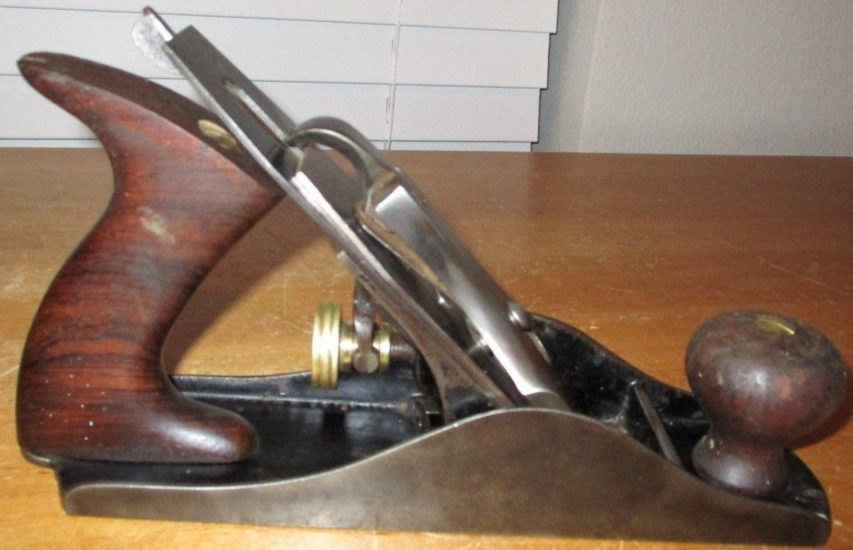
A vintage Stanley No. 4 smoothing plane from a recent eBay listing. Even though this is the single most common woodworking plane ever, the example I own is a late-70s piece of crap, so I went looking for a more representative image.
The Stanley Works was founded in 1843 by Frederick Stanley in New Britain, Connecticut.
In 1857, the Stanley Rule & Level Company was founded by Frederick Stanley’s cousin Henry. I imagine most people of the time assumed there was only the single Stanley company, as they produced products in related-but-not-competitive fields.
Stanley purchased Bailey, Chaney and Company in 1869 along with the Bailey plane patents. The Bailey patents were the key to Stanley’s future dominance of the hand plane market.
Stanley Rule & Level Co. purchased the Roxton Tool and Mill Company in Roxton Pond, Quebec (founded 1873). Manufacturing continued here from 1907 until about 1984. From the timing, I assume this was seen as a good way to get Stanley hand tools into the Canadian market without paying tariffs.
In 1920, The Stanley Works merged with the Stanley Rule & Level Company. The initials “S.W.” within a heart outline was introduced at that time. Later references to tools with this mark invariably refer to them as “Sweetheart”, but it’s not clear that the newly unified Stanley used that term in their own marketing until a few years later. The logo and name have been revived in the last decade or so, probably to cash in on the nostalgia factor.
In 1937, Stanley acquired J.A. Chapman (of Sheffield, England). I’m assuming this was a shortcut to getting non-tariff access to the British (and Imperial) hand tool market.
Stanley manufactured planes in Australia from 1965 to the early 1990s in Moonah, Tasmania.
In 2010, The Stanley Works merged with Black & Decker to become Stanley Black & Decker (Stanley Hand Tools is a division of the much larger company).
MILLERS FALLS (USA)
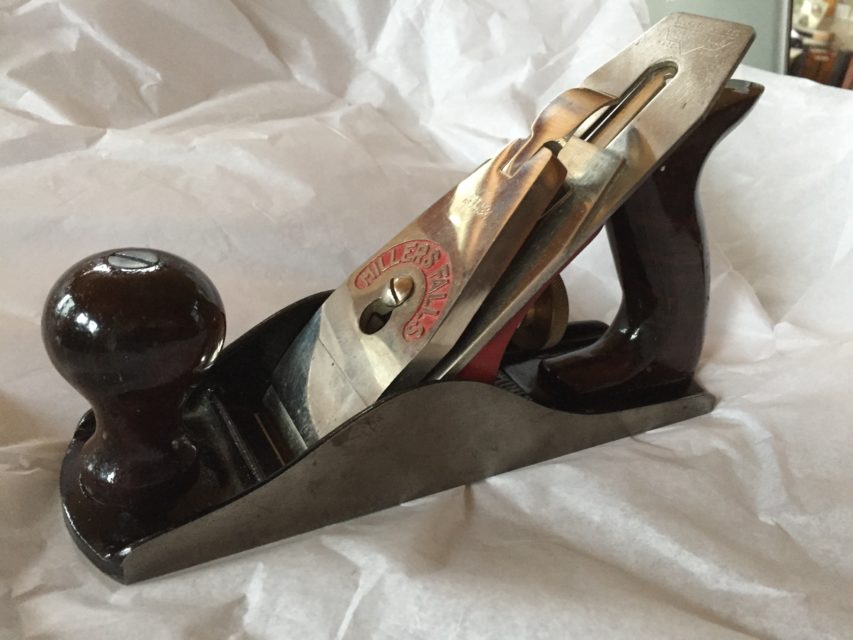
I happen to actually own a Millers Falls #9 smoothing plane (as of Friday). Look similar to the Stanley #4 above? It should, as it’s a near-clone.
Incorporated in 1868 as the Millers Falls Manufacturing Company, renamed as the Millers Falls Company in 1872. Introduced hand planes into its line of tools in 1928/29. Millers Falls chose to compete for the high-end of the hand tool market and managed to carve out a profitable niche for themselves, especially in the hand plane segment. Their futuristic plastic-and-chrome “Buck Rogers” planes of the late 1950s were visually distinctive enough that they kept the company in the black for longer than almost all of their US competitors.
In 1957, Millers Falls acquired the Union Tool Company of Orange, Massachusetts. The Union brand was kept active until 1975 when the Union plant was closed down.
Millers Falls became a subsidiary of Ingersoll Rand in 1962, and closed down their Massachusetts operation in 1982 with a corporate relocation to New Jersey after a buyout.
RECORD (UK)
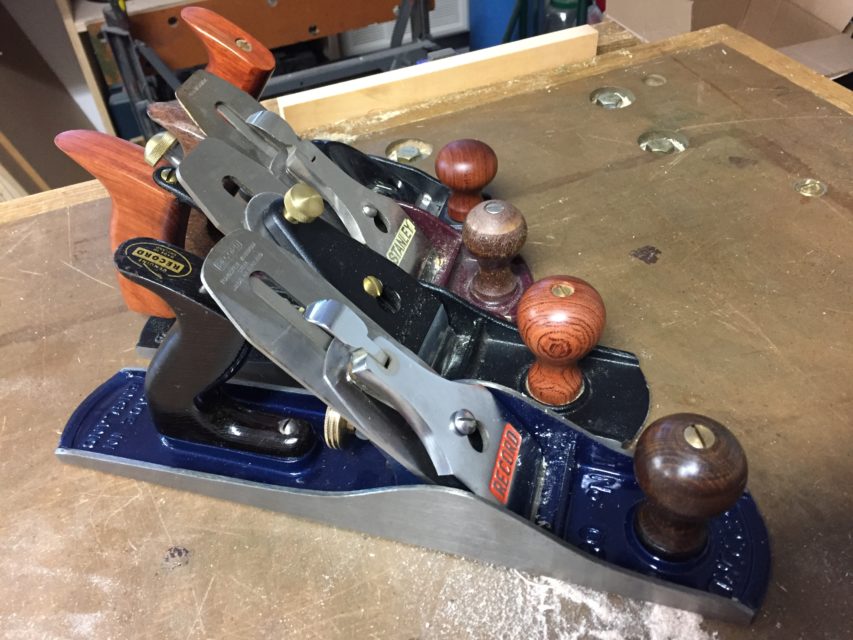
(front) A Record No. 05 jack plane, a close copy of the Stanley #5
Record was a brand name used by C & J Hampton from 1909. The company was founded in 1898 and incorporated a decade later. The founders, Charles and Joseph Hampton, had left the family business (The Steel Nut & Joseph Hampton Ltd in Wednesbury, Staffordshire) to set up shop in Sheffield. Joseph eventually returned to the family firm, but the sons of Charles succeeded to leadership roles in the younger company.
The first Record planes were offered for sale in 1931 (No. 03 through 08 and three block planes: No. 0110, 0120 and 0220). Record got into the plane business partly due to the preferential tariffs the British government levied on foreign (mainly American) hand tools and the fact that the Stanley Works’ Bailey patents had expired, so there was no legal issue with flat-out cloning Stanley’s plane line.
In 1934, Record took over production of some Edward Preston and Sons Ltd. products (mainly bullnose and rabbet planes). Preston had been acquired by John Rabone and Sons Ltd. (Birmingham) in 1932, but they decided to stick with the rule and level business and offload the plane manufacturing to Record.
Woden Tools Ltd was purchased from The Steel Nut & Joseph Hampton Ltd in 1961 and Record continued to use the Woden trademark for another 10 years (some sources say only five years: take your pick).
Record acquired 50% of William Marples and Sons Limited in 1963, the other 50% being held by William Ridgway & Sons, Ltd. (Parkway Works), also of Sheffield.
In 1972, Record merged with Ridgway to form Record Ridgway Tools Ltd.
In 1982, Record Ridgeway was acquired by AB Bahco of Sweden, but a management buyout in 1985 took it back to British ownership as Record Holdings plc.
In 1988 the company became Record Marples (Woodworking Tools) Ltd.
In 1998, Record Marples accepted an offer from American Tool Corporation and became part of the Record Irwin Group as Record Tools Ltd. Irwin was acquired by Stanley Black & Decker in 2017.
WODEN TOOLS (UK)
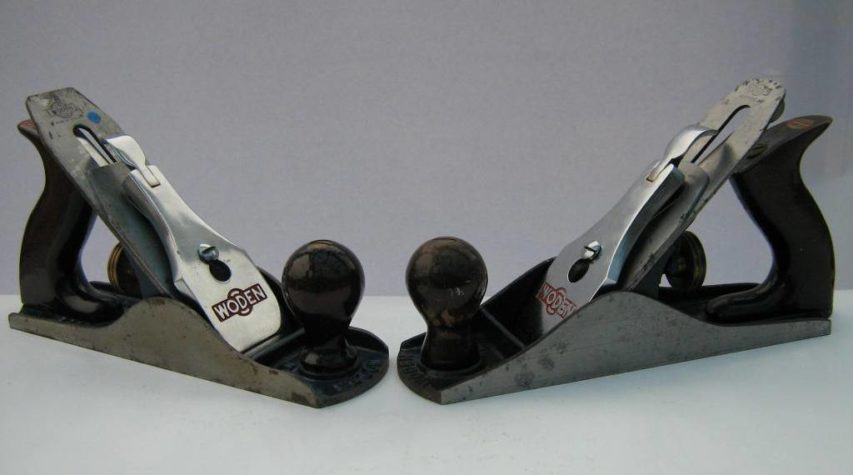
A pair of Woden planes as shown on the wodentools.com website.
Woden Tools was a wholly owned subsidiary of The Steel Nut & Joseph Hampton Ltd, producing planes from 1953/54 in Wednesbury, Staffordshire. (The planes were originally manufactured by W.S Manufacturing (Birmingham), which was acquired by The Steel Nut & Joseph Hampton around 1952.)
C & J. Hampton (Record) purchased Woden Tools Ltd from SNJH in 1961 and continued to use the Woden trademark for another 10 years (some sources say only until 1965).
LEE VALLEY/VERITAS (CANADA and USA)
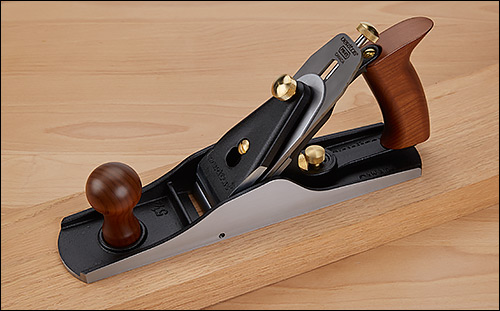
A current Veritas 5 1/4 junior jack plane from Lee Valley Tools
Founded in 1978 by Leonard Lee in Ottawa, Ontario. The first out-of-town store was opened in 1982 (Toronto West). I think I visited that store in its original location in 1984. The company launched their website in 1997 and added e-commerce features in 2000.
In the early-to-mid 1980s, Lee Valley contracted with Footprint (UK) to produce a line of bench planes to their specifications. The “Paragon” line were sold in Canada by Lee Valley and by Garret Wade in the United States for a few years, but quality issues apparently doomed the venture. In a thread on the Sawmillcreek.org forums, Robin Lee said “Actually – we ‘remanufactured’ many of them here [in Ottawa]… We set out the specs, made some tooling changes, and had Footprint make them for us (and GW). All planes were received and inspected … – and in many cases, fettled and reground… We abandoned the brand shortly after – and formed Veritas tools as our manufacturing company…”
In 1999, the first Lee Valley manufactured plane, the Low-Angle Block Plane, was introduced. The Veritas line of bench planes was launched in 2001. The first shoulder plane was introduced in 2003. In 2014, the Veritas Custom Bench Plane line was introduced, which the company characterizes as the first user-customizable line of planes in the industry.
In 1982, the company began manufacturing its own tools under the Veritas label. In 1985, Lee Valley Manufacturing Ltd. was incorporated and later renamed as Veritas Tools, Inc. Manufacturing is primarily in Ottawa and (possibly) in Ogdensburg, New York.
Taking Corbyn seriously
In The Spectator, Brendan O’Neill begins considering the threat of a Corbyn premiership:
This week, the Corbynistas bared their teeth. They gave us an insight into the mob-like authoritarianism that lurks behind the facade of their ‘kind’ politics. They insisted Jeremy Corbyn wasn’t a spy for the Stalinists while at the same time exposing their Stalinist tendencies. ‘How dare you lump us in with Stalinists?’, they cried, while in the next breath making manic-eyed videos threatening the press and forming online mobs to punish those who criticise their Dear Leader. The irony has been dark.
For the first time, I feel fearful of Corbynism. Until now, I’ve seen the Corbynistas as a somewhat tragic movement, a kind of cosplay for middle-class millennials who doll up their rather staid politics — their love of the nanny state, their fear of Brexit, their preference for identity politics over class politics — in Marxist memes and Red blather. But this week we have seen another side to them. We have seen their intolerance of rowdy political criticism, their instinct for political interference in the press. This looks increasingly like a movement of petit-bourgeois vengeance.
Exhibit A is Corbyn’s positively Trumpite threat to the press that ‘change is coming’. For all the Corbyn camp’s loathing of Trump, they share his brutish disdain for the trouble-making media. In the video, Corbyn’s contorted face takes to task right-wing newspapers that have indulged the Czech spy story over the past week, and warns that when the Corbynistas come to power there will be a shake-up of press ownership and pressure on press oligarchs to pay more taxes.
His supporters present this an anti-establishment act: a brave Labourite standing up to filthy rich newspaper men. Please. Corbyn’s threatening video was directly inspired by the press’s attacks on him over the past week. He publicly denounced the press in the manner of a tinpot tyrant for one reason only: because the press has been ridiculing his naff, Soviet-tinged shenanigans in the late 1980s. This is political interference: angry at the press attacks on him, he whipped up an online mob to agitate for more press control.
[…]
The Corbynistas’ reactionary clamour for official interference in the press was captured in an article at Novara Media, home to the weird mix of nanny statism, anti-democracy and middle-class pity for the poor that motors the millennial wing of the Corbynista movement. It congratulated Corbyn for ‘send[ing] shivers down the spine of the media establishment’, and promised that under a Labour government Leveson 2 would ‘finish the job and open up this bankrupt industry’. This promise of Leveson 2 is reason enough never to vote for Corbyn’s Labour: it would ride roughshod over the great radical history of this nation, from the Levellers to the Chartists, all of whom were repulsed by the idea of state meddling in the press.
Tank Chat: 100 Years of The Tank at TANKFEST 2016 | The Tank Museum
The Tank Museum
Published on 1 Jul 2016Watch David Fletcher make a comparison of the First World War Mark IV and Challenger 2, the British Army’s current Main Battle Tank, from the back of the Rolls Royce Armoured car.
QotD: Regulations in the EU
As for the idea that the individual should be as free as possible from state coercion, this is regarded as the ultimate Anglophone fetish. Whenever the EU extends its jurisdiction into a new field — decreeing what vitamins we can buy, how much capital banks must hold, how herbal remedies are to be regulated — I ask what specific problem the new rules are needed to solve. The response is always the same: “But the old system was unregulated!” The idea that absence of regulation might be a natural state of affairs is seen as preposterous. In Continental usage “unregulated” and “illegal” are much closer concepts than in places where lawmaking happens in English.
Daniel Hannan, Inventing Freedom: How the English-speaking peoples made the modern world, 2013.


