
The Great War
Published on 24 Feb 2018Ask your questions here: http://outofthetrenches.thegreatwar.tv
February 25, 2018
Amphibious Landing Craft – Widow Compensation – Repatriation I OUT OF THE TRENCHES
Comments Off on Amphibious Landing Craft – Widow Compensation – Repatriation I OUT OF THE TRENCHES
Feature History – Russo-Japanese War
Feature History
Published on 28 May 2017Hello and welcome to Feature History, featuring a Russian and Japanese disagreement, and why you don’t record when sick.
Comments Off on Feature History – Russo-Japanese War
February 24, 2018
“Oxfam, like many large British charities, has long been a villainous organisation”
Theodore Dalrymple puts the boots to Oxfam:
It is very wrong, morally, to take pleasure in the misfortunes of others, but I cannot disguise from myself the intense pleasure, amounting almost to joy, with which I learned of the public exposure of the wrongdoings of Oxfam in Haiti, Chad, and elsewhere. Its workers, sent to bring relief to the acute and chronic sufferings of those countries, used the charity’s money, partly derived from voluntary contributions and partly from government subventions (the British government and the European Union are by far the largest contributors to British Oxfam), to patronise local prostitutes, some of them underage, and also to conduct orgies, no doubt at a fraction of what they would have cost to conduct at home.
Oxfam, at least in Britain, has long been one of the most Pecksniffian of organisations, much give to auto-beatification. Mr. Pecksniff, in Dickens’ Martin Chuzzlewit, introduces his daughters, called Charity and Mercy, to Mrs. Todgers, adding ‘Not unholy names, I hope.’ It is therefore of the hypocritical Mr. Pecksniff that I think whenever I pass the Oxfam shop in my small town, with its unctuous slogan, Thank you for being humankind, posted in the window. It is only with difficulty that I resist the urge to throw a brick through it.
Of course, Oxfam, like many large British charities, has long been a villainous organisation — and the sexual exploits (or should I say exploitations?) of its workers in Haiti and elsewhere are the least of it. In the moral sense, though not the legal, it has for many years been guilty of fraud, of misleading the public.
I first realised this some years ago when I found a used book dealer of my long acquaintance poring in his shop over Oxfam’s annual accounts.
‘Look at this,’ he said, but I saw nothing until he pointed it out to me.
Oxfam, in common with many other charities in Britain, runs thrift stores in practically every British town and city. Such thrift stores are now more numerous even than Indian restaurants: they allow people to give away their unwanted belongings in the belief that, by so doing, they are furthering a good cause.
My acquaintance pointed out that, despite receiving their goods free of charge, paying practically nothing for their labour (which was voluntary), and paying much reduced local taxes, Oxfam shops made a profit on turnover of a mere 17 per cent, much less than his own, despite his incomparably greater expenses. How was such a thing possible, by what miracle of disorganisation (or malversation of funds)?
Until then, I had carelessly assumed that the great majority of any money that I gave to a large charity went to serve its ostensible end, say the relief of avoidable suffering. I was not alone in this, of course. When I asked the volunteer ladies in a local shop run on behalf of the British Red Cross what percentage of the money I paid for a book there went to the Red Cross, they looked at me as if I were mad.
‘Why, all of it of course,’ piped up one of the ladies.
The real average figure at the time for Red Cross thrift stores was 8 per cent; but the volunteer ladies supposed, because the goods they sold were free to the Red Cross and they themselves were not paid, that (apart from a small amount for unavoidable expenses) all the money raised went directly to victims of earthquakes and the like.
Comments Off on “Oxfam, like many large British charities, has long been a villainous organisation”
How to Speak Cockney – Anglophenia Ep 36
Anglophenia
Published on 26 Aug 2015Have a butcher’s at this video with your china plates. Not sure what this means? Learn how to speak Cockney rhyming slang with Anglophenia’s Kate Arnell.
Comments Off on How to Speak Cockney – Anglophenia Ep 36
February 23, 2018
Cuban Missile Crisis – Eyeball to Eyeball – Extra History – #2
Extra Credits
Published on 22 Feb 2018Sponsored by DomiNations: https://smarturl.it/CubanMissile1
After President Kennedy’s television address, tensions are rising. Fidel Castro is getting annoyed at the US and Soviet Union alike, and everyone else has their own ideas on what retaliation looks like.
Comments Off on Cuban Missile Crisis – Eyeball to Eyeball – Extra History – #2
Operation Faustschlag – Germany Advances In The East Again I THE GREAT WAR Week 187
The Great War
Published on 22 Feb 2018Germany has had enough with the stalling tactics by the Bolsheviks and is unleashing its military might on the Eastern Front again to show who is in charge. Within the first days of Operation Faustschlag, the German Army marches on Kiev and the Baltic region. At the same time, the plans for a German spring offensive in the West are getting more pronounced.
Comments Off on Operation Faustschlag – Germany Advances In The East Again I THE GREAT WAR Week 187
QotD: Cosmopolitans, as viewed by non-Cosmopolitans
… it’s a problem that our tribe of self-styled cosmopolitans doesn’t see itself clearly as a tribe: because that means our leaders can’t see themselves the way the Brexiteers and Trumpistas and Marine Le Pen voters see them.
They can’t see that what feels diverse on the inside can still seem like an aristocracy to the excluded, who look at cities like London and see, as Peter Mandler wrote for Dissent after the Brexit vote, “a nearly hereditary professional caste of lawyers, journalists, publicists, and intellectuals, an increasingly hereditary caste of politicians, tight coteries of cultural movers-and-shakers richly sponsored by multinational corporations.”
They can’t see that paeans to multicultural openness can sound like self-serving cant coming from open-borders Londoners who love Afghan restaurants but would never live near an immigrant housing project, or American liberals who hail the end of whiteness while doing everything possible to keep their kids out of majority-minority schools.
They can’t see that their vision of history’s arc bending inexorably away from tribe and creed and nation-state looks to outsiders like something familiar from eras past: A powerful caste’s self-serving explanation for why it alone deserves to rule the world.
Ross Douthat, “The Myth of Cosmopolitanism”, New York Times, 2016-07-03.
Comments Off on QotD: Cosmopolitans, as viewed by non-Cosmopolitans
February 22, 2018
DicKtionary – E is for Eugenics – Otmar von Verschuer
TimeGhost
Published on 21 Feb 2018E for eugenics, pseudo science about race,
Selective breeding of humans can make the world a purer place,
When saying, “that’s scary”, those words are ne’er truer,
Then of the main man today, Otmar von Verschuer.Hosted by: Indy Neidell
Written by: Spartacus Olsson
Produced and Directed by: Astrid Deinhard
Executive Producers: Bodo Rittenauer, Astrid Deinhard, Indy Neidell, Spartacus Olsson
Camera by: Jonas Klein
Edited by: Spartacus Olsson, Jonas KleinA TimeGhost chronological documentary produced by OnLion Entertainment GmbH
Comments Off on DicKtionary – E is for Eugenics – Otmar von Verschuer
Curse of the FRIDAY THE 13TH I IT’S HISTORY
IT’S HISTORY
Published on 21 Feb 2018On today’s episode we are going to talk about the end of the Templar Order and the famous curse of Jacques de Molay.
Comments Off on Curse of the FRIDAY THE 13TH I IT’S HISTORY
The worst episode of The Avengers? “How to Succeed … at Murder”
In a column ostensibly devoted to the British Labour party’s ongoing ructions over their “all women shortlist” problems, David Cole recaps what he calls the worst episode of the brilliant 1960s British TV show The Avengers:
(Image via Aveleyman.com)
When I think of The Avengers, what comes to mind is not the bloated comic-book franchise in which overpaid actors cavort in front of a greenscreen for the masturbatory pleasure of nerds. No, to me, there is and will always be only one Avengers, and that’s the 1960s British crime and espionage TV series. As a kid, it was my favorite show, and I have fond memories of rushing home from elementary school every day to catch Emma Peel (my favorite of John Steed’s female partners) in action.
Among Avengers superfans, there is one episode that is generally considered the worst. Indeed, the episode is outright despised, because in a series lauded (and properly so) for being a trailblazer when it came to presenting strong, intelligent, and independent action heroines, the episode “How to Succeed…at Murder” is seen as a giant chauvinistic step backward. It’s known as the “anti-feminist” episode, the one that took the show’s message of female empowerment and stood it on its head. “How to Succeed…at Murder” was first broadcast in March 1966. The setup is typical Avengers-style mystery. Prominent businessmen are being murdered by unknown assailants, and it’s up to Steed and Peel to get to the bottom of it. It turns out, a group of sexy female ballet students have created a secret society dedicated to the destruction of powerful men. They use their feminine charms to get hired as secretaries, only to quickly begin taking control of the business to the point that when they murder the boss, ownership falls to them. The society’s motto is “Ruination to all men.”
Mrs. Peel infiltrates the group and learns that the girls take their orders from a female marionette, which seems to speak and move on its own. In a voice somewhat resembling that of a drag queen, the marionette explains the group’s mission: “To take woman out of the secretary’s chair and put her behind the executive desk. To bring men to heel and put women at the pinnacle of power.”
The marionette’s “helper” is Henry, the clumsy, doughy owner of the ballet school where the secret society meets.
Emma is soon exposed as an infiltrator, and it’s up to Steed to confront the evil ballerinas on their home turf. “No man will dominate us again,” the girls crow as they hold Steed at gunpoint. However, the unflappable Steed quickly deduces that the marionette is actually being controlled remotely by…Henry. Yep, these women had a male boss all along! Revealed as the mastermind, Henry tearfully explains that following the loss of his late wife’s ballet company at the hands of greedy investors, he vowed vengeance against powerful businessmen (it’s also revealed that the marionette is crafted in his wife’s image, and Henry, his mind bent by grief, actually believes he’s his dead wife when he gives the puppet voice). To achieve his revenge against the business world, Henry took advantage of the anti-male sentiments of his students. “No man will ever dominate you?” Steed mockingly asks the girls. “You’ve been taking orders from a man all this time!” As the murderous dancers stand crestfallen, their mouths agape, their boastfulness sapped, Emma disarms the lead girl and beats the living crap out of each and every one of them.
You cannot read a review of this episode on any Avengers fansite without encountering the words “sexist,” “reactionary,” or “misogynistic.” The vitriol stems from the fact that the man-hating feminists turn out to be gullible morons. In their fanatical crusade against male domination, they inadvertently allowed a weak, delusional man-who-believes-he’s-a-woman to dominate and control them.
Comments Off on The worst episode of The Avengers? “How to Succeed … at Murder”
February 21, 2018
British KFC outlets fall fowl of distribution fustercluck
The BBC reports on recent supply disruptions that have forced the majority of British KFC restaurants to close or run reduced hours:
KFC says some of the outlets which had to close when delivery problems meant they ran out of chicken have reopened.
Latest figures show that 470 of the fast-food chain’s 900 outlets in its UK-based division were shut as of 13:00 on Tuesday.
That compares with 575 that were closed at 21:00 on Monday.
Last week, the fried chicken chain switched its delivery contract to DHL, which has blamed “operational issues” for the supply disruption.
Earlier a KFC spokesperson said: “We anticipate the number of closures will reduce today [Tuesday] and over the coming days as our teams work flat out all hours to clear the backlog.
“Each day more deliveries are being made, however, we expect the disruption to some restaurants to continue over the remainder of the week, meaning some will be closed and others operating with a reduced menu or shortened hours.”
[…]
Until 13 February, KFC’s chicken was delivered by specialist food distribution group Bidvest.
But after the contract switched to DHL, many of the food giant’s outlets began running out of chicken products.
The GMB union said it had tried to warn KFC that switching from Bidvest to DHL was a mistake. The change led to 255 job losses and the closure of a Bidvest depot, said Mick Rix, GMB national officer.
He said: “Bidvest are specialists – a food distribution firm with years of experience. DHL are scratching around for any work they can get, and undercut them.
“KFC are left with hundreds of restaurants closed while DHL try and run the whole operation out of one distribution centre. Three weeks ago, KFC knew they had made a terrible mistake, but by then it was too late.”
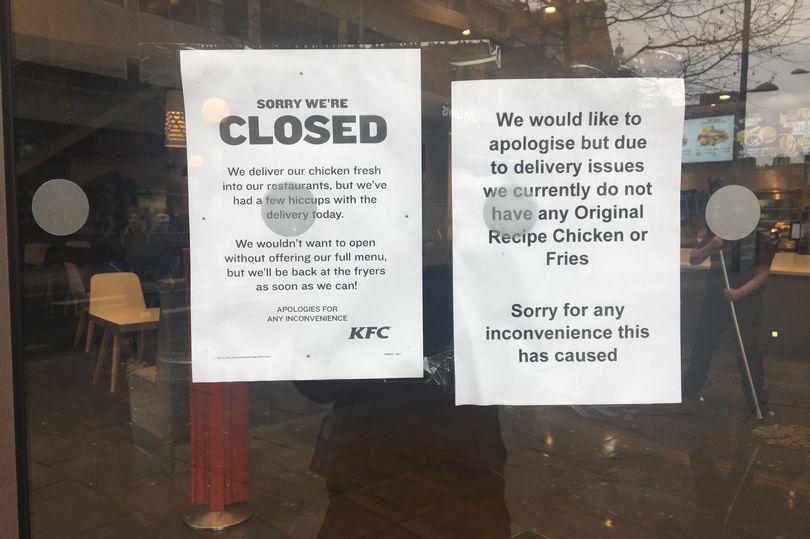
Signs posted in a KFC store window in Nottingham
Photo from the Nottingham Post (click image to read their article)
H/T to Jim Guthrie, who said “I suspect that this will be a ‘how not to do it’ example in delivery logistics for years to come.”
Comments Off on British KFC outlets fall fowl of distribution fustercluck
February 20, 2018
Russian Rifles of World War 1 I THE GREAT WAR Special feat. C&Rsenal
The Great War
Published on 19 Feb 2018Othais’ video about the Winchester Contract Rifle: https://www.youtube.com/watch?v=4grSRn5wnHI
Indy and Othais from C&Rsenal talk about Russian Rifles during World War 1.
Comments Off on Russian Rifles of World War 1 I THE GREAT WAR Special feat. C&Rsenal
The EU transition period proposals “are the sort of terms which might be imposed by a victorious power in war on a defeated enemy”
Martin Howe on the way the European Union “negotiators” are treating the transition period for the UK as a re-run of the Versailles Treaty, with the UK substituted for the Kaiser’s Imperial Germany:
The European Union’s proposals for the UK’s transition period make grim reading. They are the sort of terms which might be imposed by a victorious power in war on a defeated enemy. They are not terms which any self-respecting independent and sovereign country could possibly agree to, even for an allegedly limited period.
Apparently, we must agree to implement every new EU law while having no say or vote; and we shall not be allowed to conclude trade agreements, even to roll over existing agreements which the EU has with other countries so that they continue to apply to us, without the EU’s permission. We must abide by the rulings of a foreign court on which there will no longer be any British representation.
Apparently, an outrageous and demeaning proposal by the Commission that the UK should be subject to extra-judicial sanctions under which the EU could suspend market access rights is now to be “re-worded”. But that would still leave the UK extremely vulnerable to damaging new rules being imposed on us during the transition period by processed in which we would have no vote and no voice. As reported in the Telegraph last week, the EU has plans to use these powers in order to launch regulatory “raids” on financial institutions on British territory and to make rules which will damage the competitiveness of the UK’s financial services industry.
But quite apart from the totally unacceptable terms for the transition period itself which are being proposed by the EU, the EU is seeking to use the transition period deal as a lever to secure damaging long term commitments from the UK. The most damaging of these is the EU’s attempt to lever the Irish border issue in order to force the UK to act as a long term captive market for EU goods exports by pressing for legally binding text that would force us into a long term obligation to comply with EU tariffs and regulations on standards of goods, on the specious ground that it is impossible to have an open border without all tariffs and regulations being the same.
There should be no doubt that being required to follow either EU tariffs or EU standards on goods would be a total disaster for the UK. It would make it difficult or impossible to conduct an independent trade policy, and to negotiate trade agreements with non-EU countries. How could we expect any significant trading partner to be willing to enter into an agreement with us, if we tell them that we cannot grant mutual recognition to their own goods standards because our own are permanently regulated by the EU? And how can subordinating the UK to the vassal status of taking rules on which we have no vote possibly be compatible with the British people’s vote to take back control of our laws and our courts?
Comments Off on The EU transition period proposals “are the sort of terms which might be imposed by a victorious power in war on a defeated enemy”
February 19, 2018
Why the Pith Helmet?
Major Sven Gaming
Published on 14 Apr 2017Anyone love the old Zulu movie staring Michael Caine?
I do, but why did the British wear these awesome hats? Well watch and you will find out…
And a link to more info on these wonderful Helmets. http://www.throughouthistory.com/?p=3153
Comments Off on Why the Pith Helmet?


