
World War Two
Published on 20 Oct 2018For the men in the navies of the warring nations in Europe, there was nothing phony about WW2 in October 1939 – mortal danger was immediately under the cold surface at the receiving end of a torpedo or a depth charge…
Join us on Patreon: https://www.patreon.com/TimeGhostHistory
Or join The TimeGhost Army directly at: https://timeghost.tvWritten and Hosted by: Indy Neidell
Produced and Directed by: Spartacus Olsson and Astrid Deinhard
Executive Producers: Bodo Rittenauer, Astrid Deinhard, Indy Neidell, Spartacus Olsson
Research by: Indy Neidell
Edited by: Spartacus Olsson an Ben Ollerenshaw
Trainee editor SarveshColoring by Spartacus Olsson, Olga Shirnina and Norman Stewart
Olga’s pictures: https://klimbim2014.wordpress.com
Norman’s pictures https://oldtimesincolor.blogspot.com/Archive by Screenocean/Reuters https://www.screenocean.com
A TimeGhost chronological documentary produced by OnLion Entertainment GmbH
October 21, 2018
The Submarine War – WW2 – 008 October 20 1939
Tank Chats #36 Tiger 131 | The Tank Museum
The Tank Museum
Published on 21 Apr 2017Tiger 131 is the most famous tank in The Tank Museum’s collection and arguably the most famous tank in the world.
Here curator David Willey discusses the history of Tiger 131, it’s current place and importance in the collection, and its future.
Support the work of The Tank Museum on Patreon: ► https://www.patreon.com/tankmuseum
Or donate http://tankmuseum.org/support-us/donate
October 19, 2018
The Battle of the Selle – Ludendorff Resigns I THE GREAT WAR Week 221
The Great War
Published on 18 Oct 2018As the Germans are retreating further and further during the Battle of the Selle, Erich Ludendorff – the German Quartermaster General, one half of Germany’s military dictatorship and mastermind behind the last big German offensive in spring 1918 – resigns under pressure by the Kaiser and the Reichstag. The German upper class realizes that their days might be numbered if the war continues in the current form and Austria-Hungary’s Emperor Karl has the same epiphany.
Webley Model 1911 Stocked .22 Single-Shot Target Pistol
Forgotten Weapons
Published on 29 Sep 2018http://www.patreon.com/ForgottenWeapons
The Webley Model 1911 is a single-shot, self-ejecting target pistol made only for a few years. It was fitted with a long barrel to increase sight radius and also a detachable shoulder stock for those who wanted a bit more stability when shooting. Mechanically, the piece must be loaded manually, and it will then open the slide and eject the empty case automatically when fired, leaving the slide open for the shooter to load the next round. These were manufactured until 1914, with the final batch of pistols sold in 1919 from remaining parts stocks.
I am at the range with this example on Malta, thanks to the Association of Maltese Arms Collectors and Shooters. I thought it would be interesting to compare shooting with and without the stock, although my biggest takeaway was that I need more practice time on the range!
If you enjoy Forgotten Weapons, check out its sister channel, InRangeTV! http://www.youtube.com/InRangeTVShow
Contact:
Forgotten Weapons
PO Box 87647
Tucson, AZ 85754
October 18, 2018
The Chieftains – O’Sullivan’s March
Beatriz
Published on 9 May 2015The Chieftains – O’Sullivan’s March
October 17, 2018
How Toronto got its name
Colby Cosh on the origins of the name of Canada’s largest city (which, surprisingly, isn’t the Mississauga name for “big stink on the water”):
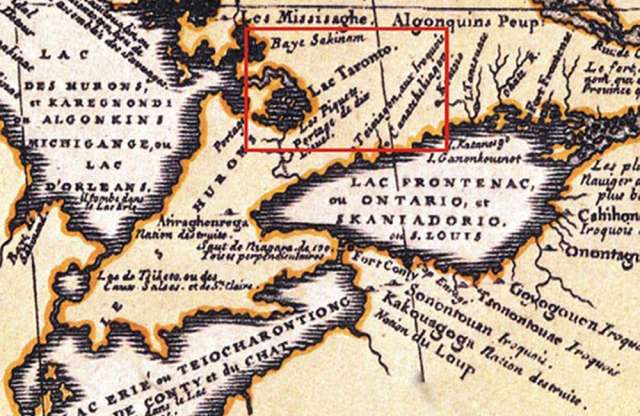
Detail from a 1688 map of western New France by Vincenzo Coronelli that locates “Lac Taronto” at Lake Simcoe.
City of Toronto Culture Division/Library and Archives Canada via the National Post
By the time of Franquelin, “Tkaronto” had already become “Taronto,” a generic name for the highway between Lake Simcoe and Lake Ontario. The Humber River was called the Toronto River by the French before Gen. John Graves Simcoe and the British got hold of everything. The word, in turn, became attached to a trading settlement at the southern end of the trail — a pretty crummy place, by all accounts, but one destined for bigger things as part of a global seafaring empire.
The miracle is that it held on to the name. Simcoe insisted that “Toronto,” on being anointed as the site of the new capital of Upper Canada in 1793, be dubbed “York” in honour of Prince Frederick (1763-1827), Duke of York and second son of George III. This Duke of York is the “Grand Old Duke of York” from the satirical verse about military futility. He was also commander-in-chief of the British armies that helped to chase Napoleon out of Europe twice, and is thought to deserve genuine credit for this, so be careful who you write insulting rhymes about.
Simcoe dubbed Toronto “York” just because he was sucking up to a very identifiable future boss, and for no other reason. The people of Toronto seem to have understood this and resented it. In the decades to come, it was occasionally observed that there were something like a dozen other places in Upper Canada called “York.” Moreover, Simcoe’s “Little York,” as it was often called, seems to have presented an increasingly embarrassing parallel with the Americans’ bustling New York.
In 1834, when the Legislative Council of Upper Canada decided that the capital needed to be formally incorporated as a city, the citizenry remembered that they belonged to “Toronto” and appealed to the council to have the more musical old name restored. Over four decades their annoyance had not receded. Diehards who wanted York to remain York for imperial-grandeur reasons were outvoted, and Toronto’s formal Act of Incorporation observes that “it is desirable, for avoiding inconvenience and confusion, to designate the Capital of the Province by a name which will better distinguish it.” The appellation “Toronto,” of course, had actually been nicked from a spot some way off, but the white settlers had mislaid that information, and didn’t check with anyone who would know better.
Bren vs Spandau part two
Lindybeige
Published on 31 May 2016The WW2 German fanboys didn’t like my first video on this topic, some were quite hostile. Here I explain myself even more fully.
Support me on Patreon: https://www.patreon.com/Lindybeige
Many people didn’t read the description on my last video, and so missed my dealing with most of the objections. People don’t read descriptions, so here I come back at my critics in video form. So terrified were some people to think that someone out there might be suggesting that German WW2 equipment wasn’t superb in every way, or that British equipment might have been as good as adequate, that they were very quick to misinterpret me, and to jump to wild and erroneous conclusions. Most people were not like this, and I was blessed as ever by many pleasant comments, but when a YouTuber concludes that a piece of WW2 German or medieval Japanese kit was sub-perfect, then he will face the wrath and wails of the fan-boys.
Musical stings kindly contributed by David Bevan.
Lindybeige: a channel of archaeology, ancient and medieval warfare, rants, swing dance, travelogues, evolution, and whatever else occurs to me to make.
Follow me…
Twitter: https://twitter.com/Lindybeige I may have some drivel to contribute to the Twittersphere, plus you get notice of uploads.
website: www.LloydianAspects.co.uk
October 16, 2018
Crown Prince Rupprecht & Erich Ludendorff – Westerner vs. Easterner I WHO DID WHAT IN WW1?
The Great War
Published on 15 Oct 2018A Prussian Quartermaster General and a Bavarian Crown Prince. The tactician in the east and the strategist in the west. Two deeply different characters and approaches to warfare. Erich Ludendorff and Rupprecht of Bavaria.
Modernism and the “so-called international style … is the blight of Germany (and of almost everywhere else where it has been tried)”
Theodore Dalrymple on the awful concrete-and-glass monoliths of modern architecture, especially those designs by Le Corbusier, Mies van der Rohe, and Gropius:
The modernism and so-called international style that is the blight of Germany (and of almost everywhere else where it has been tried, which is almost everywhere in the world), and which the author of the article appears to think is apolitical, was hardly without its intellectual, ideological, and political foundations.
And what hideous intellectual, ideological, and political foundations they were! The great figures of modernism — great, that is, in the scope and degree of their baleful influence, not great in artistic or aesthetic merit — were from the first totalitarian in spirit. They were toadies to the rich and bullies to the poor; they were communists and fascists (not in the merely metaphorical sense, either), and by a mixture of ardent self-promotion, bureaucratic scheming, and intellectual terrorism managed to gain virtual control of the world’s schools of architecture. Just try saying in a French architectural school what is perfectly obvious, that Le Corbusier was not a genius except in self-advertisement, that his fascist ideas were repugnant, that he regarded humans in his cities much as we all regard bedbugs in beds, that during the Occupation he suggested deporting millions of people from Paris because he thought they had no business to be there, that his designs were incompetent, and that his constructions were instinct with and the very embodiment of his odious ideas, and see how far you get up the academic ladder! (How, incidentally, were the world’s most beautiful cities and buildings erected without the aid of architectural schools?) Anyone interested in the ideological foundations, as well as effects, of architectural modernism should read James Stevens Curl’s recently published Making Dystopia: The Strange Rise and Survival of Architectural Barbarism (Oxford), a magisterial and to me unanswerable account of one of the greatest aesthetic disasters to have befallen Europe in all its history. A single modernist building in a townscape is like a dead mouse in a bowl of soup, that is to say you cannot very well ignore it however splendid its surroundings may otherwise be.
Ah, you might protest, we have moved on from Mies van der Rohe et al., and so we have. (By the way, Professor Curl is very amusing on the opportunistic evolution of Mies van der Rohe’s name, as well as his equally opportunistic passage from being pro-Nazi to purely careerist refugee from Nazism.) Nonetheless two things need to be said about this supposed moving on from modernism to postmodernism and other isms: first that the damage, reparable only by demolition on a vast and inconceivable scale, has been done, and second that change is not by itself necessarily for the better. The capacity of eminent architects to spend vast sums of money to build aesthetic monstrosities fit to make Vitruvius weep is illustrated by the Whitney Museum in New York and the Philharmonie in Paris, the latter in particular of truly astonishing hideousness, that would have been almost comical had it not absorbed and wasted so much money, in the process becoming for many generations of the future as pleasing an aesthetic experience as a foreign body in the eye.
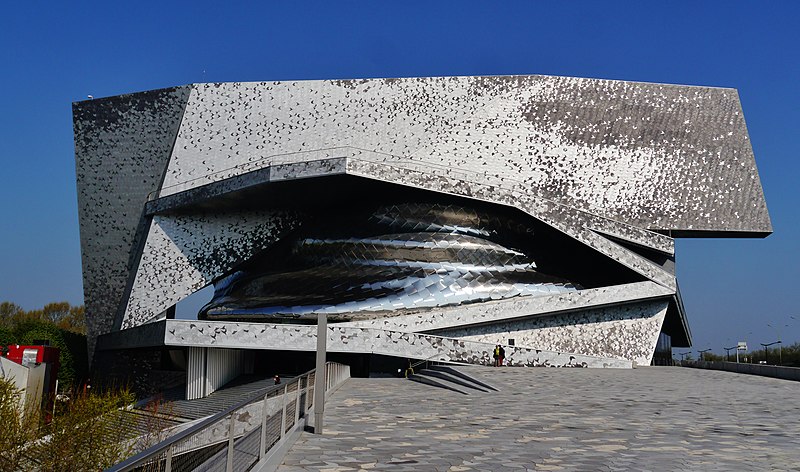
Philharmonie at the Parc de la Villette, Paris.
Photo by Zairon via Wikimedia Commons.
The mystery is how and why the patrons, those who choose the designs, stand for it. The key, I suppose, is to be found in Hans Christian Andersen — the Emperor’s New Clothes. The patrons are afraid to be thought by the architects not to understand: an accusation that Le Corbusier leveled decades ago at all those who did not approve of his plans to destroy old cities and cover the world with an ocean of raw concrete and a forest of almost identical towers. In other words, it is intellectual and moral cowardice that makes the world go round.
Julie d’Aubigny – Duelist, Singer, Radical – Extra History
Extra Credits
Published on 13 Oct 2018Julie d’Aubigny lived during an unusual time in 17th-century France when political and cultural norms were shifting. She was allowed to exist openly as a bisexual woman pursuing her swordsmanship and singing talents in the court of King Louis XIV.
Join us on Patreon! http://bit.ly/EHPatreon
Bren vs Spandau – which was better?
Lindybeige
Published on 15 May 2016The Bren gun and the Spandau were rather different, and each the prime infantry weapon of its army. Was one better?
Support me on Patreon: https://www.patreon.com/Lindybeige
After reading the comments, I shall respond with the following, because the same few points were coming up again and again:
1. The two weapons were both section MGs. This makes them comparable. The standard infantry section of a British Commonwealth infantry unit had one Bren per section, and the standard German equivalent had one Spandau. Yes, they were in other ways different weapons. That is largely my point. If they were almost identical in performance and use, then there would be no video to make. The comparison is only interesting because they were different.
2. Yes, I am well aware that there are descendants of the Spandau still around today, notably the MG 74 and MG 3. I never said otherwise. I was talking about the Bren and the Spandau in the context of WW2, when they went up against each other.
3. I say things in praise of both weapons in this video, and point out short-comings of both, and conclude that they were both fit for purpose. I reject, therefore, accusations of bias one way or the other. The usual thing one hears/reads is that the Bren was rubbish and the Spandau excellent, and the reality was more complicated than that.
4. I concede that when I mention some of the good things about one gun, it may imply to some that these things were lacking in the other. For example, I mention that it was easy to change the barrel on a Bren, which some people have mistakenly interpreted as my saying that it was awkward to change the barrel on an MG 42, which it wasn’t.
5. Yes, very obviously there were more factors than Bren guns that explain the advance of the Allies in in 1944/5 in the west. However, the point I make is that the front advanced towards Berlin every day, and this can only happen if infantry are moving forward, and taking and holding that ground. Artillery and air support cannot do this. It is also a way of countering the too-often-repeated notion that the Germans were better troops with better equipment. Yes, the best German troops were excellent, but let us not forget that they lost. If they were consistently better troops with better equipment, then they would not so consistently have lost.
6. Yes, there were differences between the MG34 and the MG42 more than simplicity of manufacture. The MG42 had a higher rate of fire, for example. I lumped them together at the start of the video for convenience. They served the same battlefield role, and were used with the same doctrine. After-action reports written at the time, and memoirs written afterwards almost never differentiate between them. Everything I say about the relative merits of Bren and Spandau are true for both MG34 and MG42, which both fired substantially faster than a Bren, and were both belt-fed.
7. The name ‘Spandau’ originally referred to the MG 08 used in World War One. It was made at the factory in Spandau, a borough of Berlin. The nick-name then got transferred to the machine guns used by the Germans in WW2. It was a misnomer in that the MG 34 and MG 42 were not made in Spandau, as I say in the video, but it is still a good word to refer to the two weapons since it is quick, clear, and was the term used at the time.
8. Yes, the MG 34 was accurate enough for purpose. Had it not been, I would have been sure to mention that. With a new and cool barrel, fired single shot, the MG34, with its double-crescent trigger, lacking in the MG42, could indeed be decently accurate. However, the barrel quickly got hot and worn, and more importantly, that was not the doctrine of use. The gun was designed to put plenty of rounds down against the enemy. Also — psychology. Give a man a gun that can spray bullets really effectively, suppressing his foes and thus keeping him safe, while making a really impressive noise, and he will use it this way, but accuracy will suffer. Give a man a slow-firing MG with a magazine of 28 rounds, and he will take careful aim and fire far fewer bullets, but with greater accuracy.
Musical stings kindly contributed by David Bevan.
Lindybeige: a channel of archaeology, ancient and medieval warfare, rants, swing dance, travelogues, evolution, and whatever else occurs to me to make.
Follow me…
Twitter: https://twitter.com/Lindybeige I may have some drivel to contribute to the Twittersphere, plus you get notice of uploads.
website: www.LloydianAspects.co.uk
QotD: I’m All Right Jack
I’m All Right Jack is a film delicately poised between two very different cultural moments. The opening scene looks back to the war, the heyday of collective endeavour and national solidarity, but the song — both in content and style — seems to look forward to a new era of aggressive hedonism and unashamed self-interest.
At the time, though, what attracted most attention was Peter Sellers’s hilarious performance as the obstreperous trade unionist Fred Kite (“We do not and cannot accept the principle that incompetence justifies dismissal”), which delighted many cinemagoers and won him a BAFTA. Not surprisingly, it went down very badly with union leaders and left-wing reviewers, but the Boultings were unrepentant. In an article for the Daily Express, they explained their reasoning:
As individuals we believe in Britain because Britain has always stood for the individual.
Nowadays there seem to be two sacred cows — Big Business and Organized Labour. Both are deep in a conspiracy against the individual — to force us to accept certain things for what in fact they are not. Both are busy feathering their nests most of the time. And to hell with the rest of us…
AFter all, who is King in the Welfare State? That humourless, faceless monster — the official, the bureaucrat, the combine executive.
Certainly a great deal has changed since we used to be Angry Men before the war … But at the end of this huge revolution we are not so sure that the losses have not been as great as the gains.
For example, the tendency to think of people not as human beings but as part of a group, a bloc, a class.
The Boultings knew, of course, that this would annoy some poeple. But the great strength of the “average Briton”, they insisted, lay in “laughing at his leaders and institutions. We believe our films reflect the popular attitude and mood. Their success seems to prove our point.”
Since I’m All Right Jack is in black and white, it is easy to forget how bracingly modern it must have seemed, not just to the Queen and Harold Macmillan, but to the large audiences who flocked to see it in the autumn of 1959. It was released only ten years after Passport to Pimlico, but the difference in mood and tone can hardly be exaggerated. It is not just a question of colletivism versus individualism, but the social context that those two ideas reflected. The Ealing film was made against a background of austerity; the Boultings’ film is drenched in consumerism. In the early scenes of Passport to Pimlico, we find ourselves in a world of rationing and restrictions, bomb damage and dereliction. What kicks off the action, in fact, is the accidental detonation of an unexploded German bomb. But I’m All Right Jack is set in the late 1950s, a world awash with appliances and advertising, in which wartime austerity is merely a fading memory. The narrator tells us that at long last “industry, spurred by the march of science in all directions, was working at high pressure to supply those viatl needs for which the people had hungered for so long”. But when Ian Carmichael’s blundering hero gets a job in industrial management, he soon finds out what these “vital needs” are: Num-Yum chocolate bars and Detto washing powder, each with its own irritatingly catchy jingle.
Dominic Sandbrook, The Great British Dream Factory: The Strange History of our National Imagination, 2015.
October 15, 2018
German Afghanistan Mission I OUT OF THE ETHER
The Great War
Published on 13 Oct 2018Thank you again Jack Sharpe!
Forgotten History: Glade of the Armistice
Forgotten Weapons
Published on 25 Sep 2018http://www.patreon.com/ForgottenWeapons
Here at a forested railroad crossing outside Compiègne in Picardy, France, two rail cars met in November of 1918 – one with members of the Allied/Entente high commend and ones with representatives of Imperial Germany. They met here to end 5 years of slaughter; the German delegation being presented terms for armistice by the Allies. Faced with no other viable option, they would accept these terms, and the fighting officially ended at the 11th hour of the 11th day or the 11th month of 1918. More than a year would go by before the Treaty of Versailles was fully ratified, but it was here that the decision to end the death was made.
The rail car in which the papers were signed was kept as a monument here, along with a rather pointed monument to the French dead, featuring a slain German Imperial eagle. A large stone message was also put up in the center of the clearing, reading (in translation):
“Here on the 11th of November 1918 succumbed the criminal pride of the German reich, vanquished by the free peoples which it tried to enslave.”
When France signed an armistice with Germany in 1940, Hitler would have those papers signed here as well, in that very same rail car. The car was then taken to Berlin as a trophy, and the monuments here destroyed. The car itself was burned accidentally in 1945, but the monuments were rebuilt by the French following the war, and a sister car is now on display here with many of the original artifacts of the Armistice (which were hidden from the Germans in 1940).
Thanks to Military History Tours for making this video possible!
If you enjoy Forgotten Weapons, check out its sister channel, InRangeTV! http://www.youtube.com/InRangeTVShow
Contact:
Forgotten Weapons
PO Box 87647
Tucson, AZ 85754
October 14, 2018
The Baltic in Stalin’s Squeeze – WW2 – 007 13 October 1939
World War Two
Published on 13 Oct 2018While the Third Reich and USSR consolidate their Polish conquest, their leaders are wary of each other but turn the attention to the next prize. Stalin moves to the North and Hitler pushes for an attack in the West.
Join us on Patreon: https://www.patreon.com/TimeGhostHistory
Or join The TimeGhost Army directly at: https://timeghost.tvWritten and Hosted by: Indy Neidell
Produced and Directed by: Spartacus Olsson and Astrid Deinhard
Executive Producers: Bodo Rittenauer, Astrid Deinhard, Indy Neidell, Spartacus Olsson
Research by: Indy Neidell
Edited by: Spartacus Olsson and Ben OllerenshawColorized Pictures by Spartacus Olsson, Olga Shirnina and Norman Stewart
Olga’s pictures: https://klimbim2014.wordpress.com
Norman’s pictures https://oldtimesincolor.blogspot.com/Archive by Screenocean/Reuters https://www.screenocean.com
A TimeGhost chronological documentary produced by OnLion Entertainment GmbH


