
Extra Credits
Published on 25 Apr 2015Support us on Patreon! http://bit.ly/EHPatreon
____________Robert Walpole’s attempts to use the South Sea Company scandal to enhance his own ambitions are threatened by the appearance of Robert Knight, a former South Sea employee whose records of corporate bribery implicate Walpole and his friends in Parliament. But faced with threats of retribution if he ever shares these records, Knight flees the country rather than face a public inquiry. Although he gets caught and sent to prison in Antwerp, Walpole deftly engineers his release and escape. With Knight finally gone, Walpole teams up with John Blunt to pin the blame for the South Sea stock bubble on his political opponents, conveniently clearing the way for himself to become essentially the first Prime Minister of England. He also makes sure that all of his own supporters get off easy (if not scot free) for their involvement, and even Blunt walks away from the South Sea Bubble with more money than he started with.
November 29, 2018
England: South Sea Bubble – It Was Walpole – Extra History – #5
November 28, 2018
The Difficult Road To Peace 1919 I THE GREAT WAR Epilogue 2
The Great War
Published on 26 Nov 2018After 4 1/2 years of war and millions of dead and wounded any kind of peace would be difficult. The peace process in 1919 was even more difficult because it happened in turbulent times with a rapidly changing landscape and new ideas about a future world order that should prevent this level of bloodshed in the future.
England: South Sea Bubble – The Bubble Pops – Extra History – #4
Extra Credits
Published on 11 Apr 2015Support us on Patreon! http://bit.ly/EHPatreon
____________With the South Sea Company’s value dangerously inflated, Blunt drives one more scheme to raise stock prices – and it finally backfires on him. Early investors (including the famous politician Robert Walpole) seize the opportunity to sell their stock while the value is high, and the general public finally realizes that the South Sea Company has no actual worth. Everyone who didn’t sell their stock in the first round finds themselves suddenly bankrupt as the stock value plummets. Even King George, on vacation when disaster strikes, loses a large amount of the royal fortune. Robert Walpole, however, sees this as an opportunity to make himself a hero of the public. Hiding his own involvement in the South Sea Swindle, he cancels all debts owed for the company’s stock to help put its public investors back on their feet. Despite this, the public demands an inquiry and Walpole must walk a thin line between his facade as defender of the people and the reality of his, his party, and the King’s blatant corruption.
November 27, 2018
Viking Expansion – A Song of Ice and Greenland – Extra History – #5
Extra Credits
Published on 24 Nov 2018The Scandinavians stumbled on Iceland, at first on accident — then, gradually exploring it — and finally intentionally migrating there because despite the clash of glaciers and volcanoes, Iceland was full of uninhabited empty land — perfect for settlers and saga-writers.
Join us on Patreon! http://bit.ly/EHPatreon
England: South Sea Bubble – Buying Out Britain – Extra History – #3
Extra Credits
Published on 28 Mar 2015Support us on Patreon! http://bit.ly/EHPatreon
____________The time has come for Blunt to enact the final act of his scheme: taking on the 31 million pound British debt. When Parliament initially balks at transferring responsibility for that much money to Blunt’s insolvent South Sea Company, he bribes them with special deals on his own stock. Despite a legal clause that should have locked the stock price until the company began paying off the debt, Blunt keeps introducing new plans to inflate the stock price and pocket the money for himself. He does everything from selling stocks on layaway to loaning people money so they could buy more stocks from him, creating an artificial demand for South Sea Company stock that drives the company’s worth up to 300 million pounds: a staggering ten times the initial value of the already stunning debt it had assumed. His success, founded entirely on speculation with no actual revenue from trade, not only starves out other businesses across Britain but exceeds the total amount of money in the country’s entire economy. This bubble can not last.
November 26, 2018
Will the Kriegsmarine Rule the Waves? – WW2 – 013 24 November 1939
World War Two
Published on 24 Nov 2018The European Allies seek a countermeasure to the mysterious German mines, in China the Japanese advance, and in Poland it is the beginning of the Warsaw Ghetto.
WW2 day by day, every day is now live on our Instagram account @World_war_two_realtime https://www.instagram.com/world_war_t…
Join us on Patreon: https://www.patreon.com/TimeGhostHistory
Or join The TimeGhost Army directly at: https://timeghost.tvWritten and Hosted by: Indy Neidell
Produced and Directed by: Spartacus Olsson and Astrid Deinhard
Executive Producers: Bodo Rittenauer, Astrid Deinhard, Indy Neidell, Spartacus Olsson
Research by: Indy Neidell
Edited by: Wieke Kapteijns and Spartacus Olsson
Community Manager: Joram AppelColoring by Spartacus Olsson and Norman Stewart
Norman’s pictures https://oldtimesincolor.blogspot.com/Archive by Screenocean/Reuters https://www.screenocean.com
A TimeGhost chronological documentary produced by OnLion Entertainment GmbH
England: South Sea Bubble – Too Big to Fail – Extra History – #2
Extra Credits
Published on 14 Mar 2015Support us on Patreon! http://bit.ly/EHPatreon
____________Frustrated at every turn by the Whig-controlled Bank of England, Harley and Blunt decide to start their own institution: a trading company that will exchange government debt for stock shares. This new South Sea Company will have a monopoly on trade in the rich new lands of South America, but all the ports there are controlled by Spain, with whom Britain is at war. So Blunt pushes the country into a premature and unfavorable peace with Spain, enlisting famous authors to write his propaganda and convincing Queen Anne herself to tip the balance of Parliament in his favor. After the queen dies and the government changes hands, Blunt kicks Harley and his Tory leaders out of the company. He manages to bring King George I himself on board as a ceremonial leader, linking the success of the South Sea Company with the reputation of the monarchy. But while his maneuvering inflates the value of his company’s stock, it’s never produced anything close to the amount of money he’s convinced people to invest in it.
November 25, 2018
Lenin’s death and Stalin’s rise to Power I BETWEEN 2 WARS I 1924 Part 1 of 2
TimeGhost History
Published on 24 Nov 2018As Lenin’s health starts to fail, the struggle to become his successor picks up speed with Stalin maneuvering closer and closer to power. The outcome of this struggle will define a century of world events.
First off: sorry for some sound issues this was recorded before we built our studio. Again we jump ahead a bit to cover events in the 1920s that have a huge impact on the current events in our WW2 In Real Time series. Our TimeGhost Army member Kamil Szadkowski made this episode possible with his research and balanced views on the events of 1924. Also many, many thanks to Olga Shirnina for providing us with the excellent colorized images for this episode. Check out Olga’s amazing volume of work here: https://klimbim2014.wordpress.com.
Join us on Patreon: https://www.patreon.com/TimeGhostHistory
Hosted by: Indy Neidell
Written and directed by: Spartacus Olsson
Research Contributed by: Kamil Szadkowski
Produced by: Astrid Deinhard
Executive Producers: Bodo Rittenauer, Astrid Deinhard, Indy Neidell, Spartacus Olsson
Community Manager: Joram AppelArchive by Screenocean/Reuter https://www.screenocean.com
A TimeGhost chronological documentary produced by OnLion Entertainment GmbH
Miracle on the Vistula – Polish Soviet War I BETWEEN 2 WARS I 1920 Part 1 of 4
https://www.youtube.com/watch?v=Equ7u…Russia Before the 1917 Revolution I THE GREAT WAR Special
https://www.youtube.com/watch?v=t1b3f…The Russian February Revolution 1917 I THE GREAT WAR Week 137
https://www.youtube.com/watch?v=5SyO5…The Russian October Revolution 1917 I THE GREAT WAR Week 172
https://www.youtube.com/watch?v=2uoLo…The Last Tsar of Russia – Nicholas II I WHO DID WHAT IN WW1?
https://www.youtube.com/watch?v=2OnTL…Lenin & Trotsky – Their Rise To Power I WHO DID WHAT IN WW1?
https://www.youtube.com/watch?v=CPoJ6…
England: South Sea Bubble – The Sharp Mind of John Blunt – Extra History – #1
Extra Credits
Published on 28 Feb 2015Support us on Patreon! http://bit.ly/EHPatreon
____________When Robert Harley steps in as England’s new Chancellor of the Exchequer, he discovers that not only is the government deeply in debt, but no one knows quite how much debt it owes. Because vicious political infighting between the Tory and Whig politic parties made it difficult to pass new tax laws, Harley turned to a private financier named John Blunt to help find enough money for England to keep up with its expenses for the year. Using Harley’s government resources, Blunt instigated a series of get-rich schemes that drove artificial demand for unsustainable land and lottery investments with tremendous short term gains. Before the year was done, Blunt had successfully covered the shortfall for the government that year – albeit at the cost of driving England’s already outrageous debt even higher.
November 24, 2018
QotD: The Anglo-Saxon invasion
The withdrawal of the Roman legions to take part in Gibbon’s Decline and Fall of the Roman Empire (due to a clamour among the Romans for pompous amusements such as bread and circumstances) left Britain defenceless and subjected Europe to that long succession of Waves of which History is chiefly composed. While the Roman Empire was overrun by waves not only of Ostrogoths, Vizigoths, and even Goths, but also of Vandals (who destroyed works of art) and Huns (who destroyed everything and everybody, including Goths, Ostrogoths, Vizigoths, and even Vandals), Britain was attacked by waves of Picts (and, of course, Scots) who had recently learnt how to climb the wall, and of Angles, Saxons, and Jutes who, landing at Thanet, soon overran the country with fire (and, of course, the sword).
Important Note
The Scots (originally Irish, but by now Scotch) were at this time inhabiting Ireland, having driven the Irish (Picts) out of Scotland; while the Picts (originally Scots) were now Irish (living in brackets) and vice versa. It is essential to keep these distinctions clearly in mind (and verce visa).
The brutal Saxon invaders drove the Britons westward into Wales and compelled them to become Welsh; it is now considered doubtful whether this was a Good Thing. Memorable among the Saxon warriors were Hengist and his wife (? or horse), Horsa. Hengist made himself King in the South. Thus Hengist was the first English King and his wife (or horse), Horsa, the first English Queen (or horse). The country was now almost entirely inhabited by Saxons and was therefore renamed England, and thus (naturally) soon became C. of E. This was a Good Thing, because previously the Saxons had worshipped some dreadful gods of their own called Monday, Tuesday, Wednesday, Thursday, Friday, and Saturday.
W.C. Sellar & R.J. Yeatman, 1066 And All That, 1930.
November 23, 2018
Defense of Poland – The Battle of the Border – Extra History – #1
Extra Credits
Published on 22 Nov 2018This series is brought to you by World of Tanks PC. Check out the game at https://redir.wargaming.net/z3ehuthn/… and use the code ORLIK for extra goodies.
Poland is threatened in 1939 not just by the Nazis, but by its own precarious geography between Germany and Soviet Russia. Edward Rydz-Śmigły spreads the Polish cavalry and tanks as thin as he has to around the border…
Join us on Patreon! http://bit.ly/EHPatreon
November 22, 2018
Perseus – Medusa – Extra Mythology – #2
Extra Credits
Published on 19 Nov 2018Join the Patreon community! http://bit.ly/EMPatreon
Perseus is not intimidated by the grey women and their eyeball, or by Hermes’s complicated directions, or by Medusa, or by a winged horse sprouting out of Medusa’s blood, or by Andromeda’s boyfriend, or by his own dad.
November 21, 2018
Allied War Economy During World War 1 I THE GREAT WAR Special
The Great War
Published on 19 Nov 2018Check Out Supremacy 1914: https://www.supremacy1914.com/index.p…
Financing and supplying the First World War was a huge economic undertaking that influenced the British, French, American and Italian economies profoundly and shaped the global balance of power.
November 19, 2018
Viking Expansion – The Lands of the Rus – Extra History – #4
Extra Credits
Published on 17 Nov 2018The Rus Vikings headed further inland into eastern Europe, raiding Constantinople (unsuccessfully) at first, and then eventually falling into negotiations with the Byzantines and changing their own culture over time. One of their most famous descending rulers was Olga of Kiev, who was also the grandmother of Vladimir.
Join us on Patreon! http://bit.ly/EHPatreon
What we know about the sinking of the HNoMS Helge Ingstad near Bergen
The Verdigris blog has a very interesting analysis of what seems to have happened leading up to the collision of the Norwegian frigate HNoMS Helge Ingstad and the tanker Sola TS in the restricted waters near Bergen:
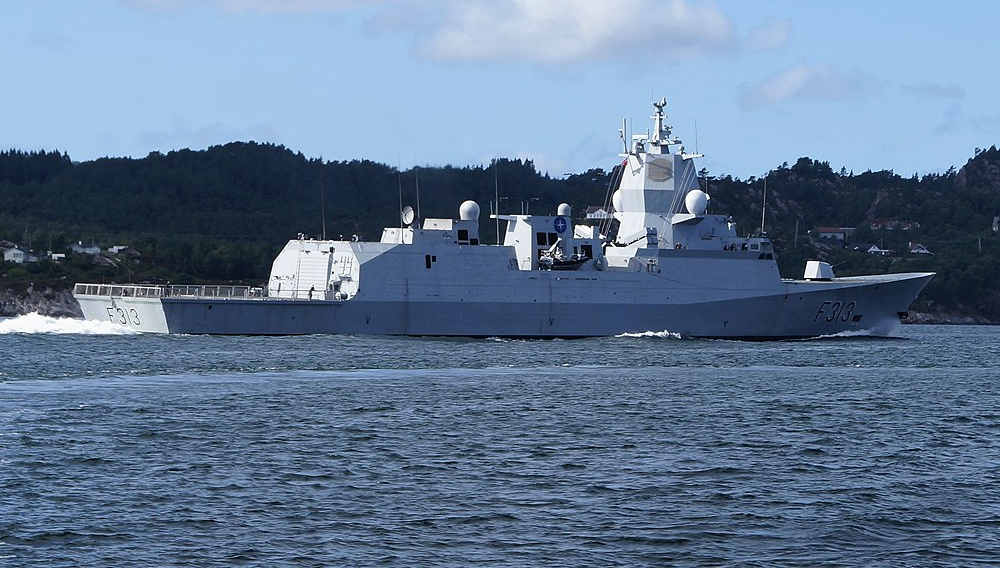
HNoMS Helge Ingstad, a Fridtjof Nansen-class frigate commissioned in 2009.
Photo detail via Wikimedia Commons
The island west of the collision location is Alvoyna in the Oygarden municipality, and the oil terminal at Sture is a busy port that receives large tankers such as the Sola TS which was involved in the collision. Otherwise the islands in this area are relatively sparsely populated with just 4,900 or so inhabitants across the whole municipality. From that we can assume that there would be few lights at night to mark the shoreline, with the exception of the oil terminal which would be brightly lit. The channel is approximately 2 miles wide but is relatively deep, narrowing south of Sture into a channel little over a mile wide.
The collision occurred at approximately 0400 local time on Thursday 8th November 2018. Sunset the previous evening was at approximately 1623; sunrise would not be until 0821. There was no moon; the moon set at around 1718 the previous day and would not rise until 0847. We cannot be certain of the weather conditions which may have restricted visibility. However, there is no evidence of weather or high seas on the radar picture and if visibility was restricted by rain or fog, a ship would be unlikely to be sailing at high speed.
Finally the ships involved. Sola TS is a Maltese flagged oil tanker of 62,000 tonnes. We know she had 23 personnel onboard and after the collision was reported to have little or no damage. Merchant ships are usually well built, especially when carrying petroleum cargoes which if leaked could have devastating environmental consequences; consequently the lack of damage is hardly a surprise. As a result they are sluggish, slow to manoeuvre or accelerate/decelerate. They are not, however, considered to be ‘restricted in their ability to manoeuvre’, a special condition identified in the International Regulations for the Prevention of Collision at Sea – the IRPCS or ‘Rules of the Road’ – this is a condition applied only to vessels which are restricted by their work, such as picking up or laying submarine cables or pipelines, launching or recovering aircraft, carrying out underway replenishment, etc. Sola TS might have been slow to manoeuvre, but she is not exceptional and is unlikely to have carried any special status. Sola TS had a tug, Tenax, in company and might conceivably have been considered to be under tow; however, once again no special status is conferred unless the nature of the tow made it particularly difficult to alter course. The tug is more than likely to have been pacing the tanker, probably not connected and likely a precaution for a fully laden oil tanker in narrow waters.
Helge Ingstad, by contrast, is a Fridtjof Nansen-class air defence frigate of just 5,290 tonnes. Lightly built for speed and manoeuvrability, warships are invariably less robust than merchant ships, but are more tightly compartmented and have more complex damage control arrangements to compensate.
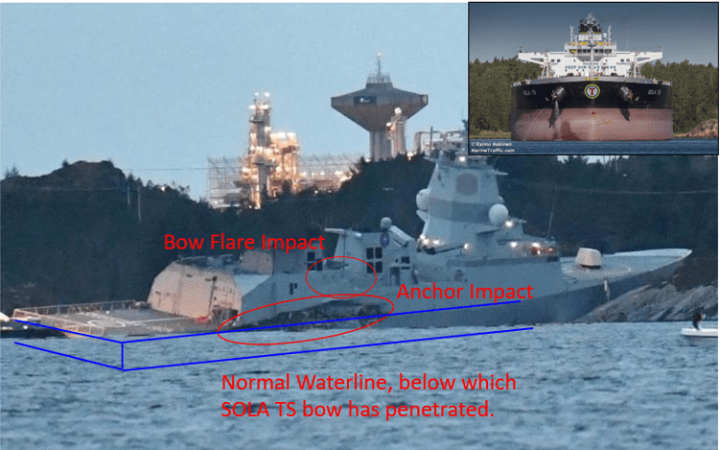
Very quickly after the collision, the Helge Ingstad was run ashore to prevent the ship sinking, but the ship slid down further into the water, despite attempts to keep her close in shore, and eventually slipped down almost completely beneath the waterline:
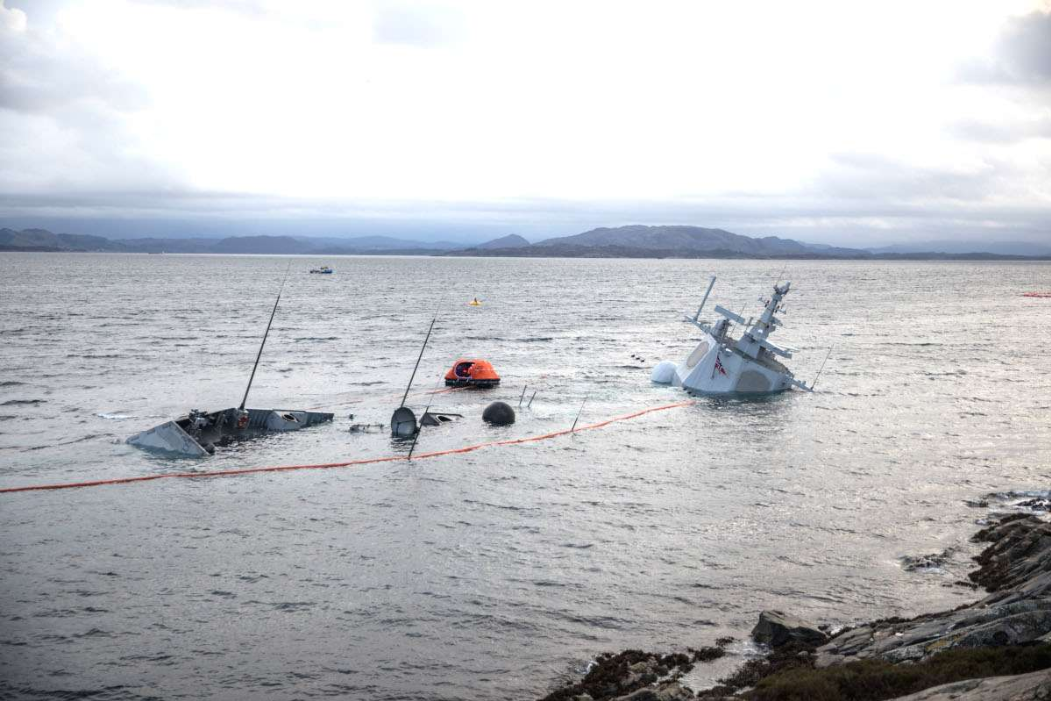
HNoMS Helge Ingstad after grounding, 13 November 2018.
Photo via The Drive.
The consensus among the commenters is that the ship can probably be re-floated, but that the damage to the electronic gear onboard most likely renders her a complete loss:
Regardless of the circumstances, the loss of Helge Ingstad, even temporarily, is a major blow to the Royal Norwegian Navy, which relies on the Fridtjof Nansen-class as its primary surface combatants, especially in a time of increased tensions between Norway and its NATO allies and Russia. The frigate had been on its way back from a massive NATO-led exercise, called Trident Juncture, the largest such drill in decades, when the accident occurred.
If it turns out that Helge Ingstad is a total loss, which seems likely at this point, it could have a significant impact on Norwegian naval operations for years to come. In the meantime, we will continue to follow this story closely and provide any additional updates as they become available.


