
Corvus Corax
Published on 25 May 2018The new album “SKÁL” – OUT NOW ► http://hyperurl.co/corvuscorax
With “the voice of the icelandic wind” Arndis Halla!
http://arndishalla.isMusic by Corvus Corax
Lyrics: traditionalVideo Credits:
Produced by Swieding Medien
Executive Producer: Corvus Corax & Doro Peters
Second Camera: Sarah Wieding, Serge Foly & Halldór Sveinsson
Color Correction: Sarah Wieding
Filmed, Edited & Directed by Ronald Matthes
November 19, 2018
Corvus Corax featuring Arndis Halla: Hugin & Munin
Comments Off on Corvus Corax featuring Arndis Halla: Hugin & Munin
QotD: How nationalism distorts opinion and judgement
For those who feel deeply about contemporary politics, certain topics have become so infected by considerations of prestige that a genuinely rational approach to them is almost impossible. Out of the hundreds of examples that one might choose, take this question: Which of the three great allies, the U.S.S.R., Britain and the USA, has contributed most to the defeat of Germany? In theory, it should be possible to give a reasoned and perhaps even a conclusive answer to this question. In practice, however, the necessary calculations cannot be made, because anyone likely to bother his head about such a question would inevitably see it in terms of competitive prestige. He would therefore start by deciding in favour of Russia, Britain or America as the case might be, and only after this would begin searching for arguments that seemed to support his case. And there are whole strings of kindred questions to which you can only get an honest answer from someone who is indifferent to the whole subject involved, and whose opinion on it is probably worthless in any case. Hence, partly, the remarkable failure in our time of political and military prediction. It is curious to reflect that out of all the ‘experts’ of all the schools, there was not a single one who was able to foresee so likely an event as the Russo-German Pact of 1939. And when news of the Pact broke, the most wildly divergent explanations were of it were given, and predictions were made which were falsified almost immediately, being based in nearly every case not on a study of probabilities but on a desire to make the U.S.S.R. seem good or bad, strong or weak. Political or military commentators, like astrologers, can survive almost any mistake, because their more devoted followers do not look to them for an appraisal of the facts but for the stimulation of nationalistic loyalties. And aesthetic judgements, especially literary judgements, are often corrupted in the same way as political ones. It would be difficult for an Indian Nationalist to enjoy reading Kipling or for a Conservative to see merit in Mayakovsky, and there is always a temptation to claim that any book whose tendency one disagrees with must be a bad book from a literary point of view. People of strongly nationalistic outlook often perform this sleight of hand without being conscious of dishonesty.
George Orwell, “Notes on Nationalism”, Polemic, 1945-05.
Comments Off on QotD: How nationalism distorts opinion and judgement
November 18, 2018
New research shows 536AD to have been the true annus horribilis
There have been bad years in human history. There have been worse days in human history. But according to a recent study summarized in Science magazine, the worst year in recorded history was 536AD:
Ask medieval historian Michael McCormick what year was the worst to be alive, and he’s got an answer: “536.” Not 1349, when the Black Death wiped out half of Europe. Not 1918, when the flu killed 50 million to 100 million people, mostly young adults. But 536. In Europe, “It was the beginning of one of the worst periods to be alive, if not the worst year,” says McCormick, a historian and archaeologist who chairs the Harvard University Initiative for the Science of the Human Past.
A mysterious fog plunged Europe, the Middle East, and parts of Asia into darkness, day and night — for 18 months. “For the sun gave forth its light without brightness, like the moon, during the whole year,” wrote Byzantine historian Procopius. Temperatures in the summer of 536 fell 1.5°C to 2.5°C, initiating the coldest decade in the past 2300 years. Snow fell that summer in China; crops failed; people starved. The Irish chronicles record “a failure of bread from the years 536–539.” Then, in 541, bubonic plague struck the Roman port of Pelusium, in Egypt. What came to be called the Plague of Justinian spread rapidly, wiping out one-third to one-half of the population of the eastern Roman Empire and hastening its collapse, McCormick says.
Historians have long known that the middle of the sixth century was a dark hour in what used to be called the Dark Ages, but the source of the mysterious clouds has long been a puzzle. Now, an ultraprecise analysis of ice from a Swiss glacier by a team led by McCormick and glaciologist Paul Mayewski at the Climate Change Institute of The University of Maine (UM) in Orono has fingered a culprit. At a workshop at Harvard this week, the team reported that a cataclysmic volcanic eruption in Iceland spewed ash across the Northern Hemisphere early in 536. Two other massive eruptions followed, in 540 and 547. The repeated blows, followed by plague, plunged Europe into economic stagnation that lasted until 640, when another signal in the ice — a spike in airborne lead — marks a resurgence of silver mining, as the team reports in Antiquity this week.
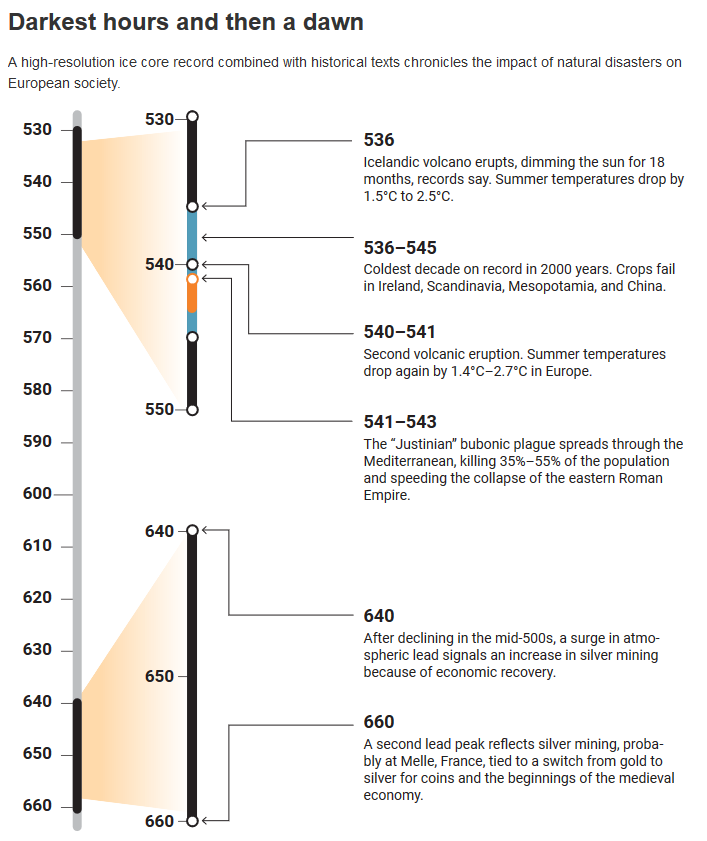
H/T to Blazing Cat Fur for the link.
Comments Off on New research shows 536AD to have been the true annus horribilis
The Mysterious Threat to the Royal Navy – WW2 – 012 17 November 1939
World War Two
Published on 17 Nov 2018While the Finns and the Soviets seem to be moving ever closer to war, the Royal Navy is losing ships at a frightening rate to an explosive threat not yet understood.
WW2 day by day, every day is now live on our Instagram account @World_war_two_realtime https://www.instagram.com/world_war_t…
Between 2 Wars: https://www.youtube.com/playlist?list…
Join us on Patreon: https://www.patreon.com/TimeGhostHistory
Or join The TimeGhost Army directly at: https://timeghost.tvWritten and Hosted by: Indy Neidell
Produced and Directed by: Spartacus Olsson and Astrid Deinhard
Executive Producers: Bodo Rittenauer, Astrid Deinhard, Indy Neidell, Spartacus Olsson
Research by: Indy Neidell
Edited by: Wieke Kapteijns and Spartacus Olsson
Community Manager: Joram AppelColoring by Spartacus Olsson
Archive by Screenocean/Reuters https://www.screenocean.com
A TimeGhost chronological documentary produced by OnLion Entertainment GmbH
Comments Off on The Mysterious Threat to the Royal Navy – WW2 – 012 17 November 1939
November 17, 2018
The MG 08/15 Updated Between the Wars
Forgotten Weapons
Published on 25 Oct 2018https://www.forgottenweapons.com/the-…
http://www.patreon.com/ForgottenWeapons
In the aftermath of World War One, the Treaty of Versailles strictly limited the number of machine guns that the German military could keep in inventory. The main type that the Germans chose to keep was the MG08/15 (although a substantial number of MG08 guns were kept as well). Through the 1920s and 1930s, these Maxim guns were improved and updated in a variety of ways until finally replaced by the MG34 starting in 1936. Many of these updated 08/15s would be deployed in reserve areas during World War Two, but relatively few survive today. Today we are looking at one such gun, and noting the changes made to it compared to the 08/15 of World War One. Specifically:
* Anti-aircraft sights and mounting brackets
* Oiler bottle in the stock
* Bipod attachment at the muzzle
* New water drain and fill plugs
* Modified drum hanger bracket
* Feed block for both cloth Maxim belts and metal MG34 belts
* Leather pistol grip cover
* Top cover locking latchContact:
Forgotten Weapons
PO Box 87647
Tucson, AZ 85754If you enjoy Forgotten Weapons, check out its sister channel, InRangeTV! http://www.youtube.com/InRangeTVShow
Comments Off on The MG 08/15 Updated Between the Wars
November 16, 2018
The Victors & The Vanquished I THE GREAT WAR Epilogue
The Great War
Published on 15 Nov 2018G.J. Meyer: A World Undone
Martin Gilbert: The First World War
Peter Hart: The Great War
David Zabecki: The German Spring Offensives
Alexander Watson: Ring of Steel
Robin Neillands: Western Front Generals
Comments Off on The Victors & The Vanquished I THE GREAT WAR Epilogue
QotD: Defining hate speech
Then, of course, there is the question of where hate-speech ends and legitimate commentary starts. It is generally easy to recognise the vilest abuse that is intended only to inflame and not to argue, just as it is easy to recognise pure pornography (I use the word ‘pure’ in its chemical, not its moral sense, of course). But often matters are much more complex than this.
For example, I recently saw the following statistic in a serious article on the internet: that Nigerian immigrants to Switzerland are seven times as likely to be convicted for a crime as Swiss citizens. Surely no one who wrote such a thing could think that it was calculated to create warm feelings in the hearts of the Swiss towards Nigerian immigrants, except those very few of Fabian mentality, who see in serial killers a cry for help (from the killers, of course, not from their victims).
The statistic – let us assume – is true. But then let us ask whether it has been corrected for the different sex and age structures of the two populations, that of the Nigerian immigrants and that of the Swiss population.
If it has not (and the article does not say), it is easily conceivable that a better, or at least different, statistic would be that Nigerian immigrants are only twice or three times as likely to be convicted for a crime as Swiss citizens. And if this were in fact the case, would the man who published the article be guilty of hate-speech, or merely of intellectual error? Is the test of hate-speech to be whether something does in fact bring a group into hatred, ridicule and contempt, or whether it is intended to do so?
It is easy to multiply examples. In this country, young Moslem men far out-fill their quota in prison, while young Hindu and Sikh far underperform where criminal conviction is concerned. Is this an interesting and important sociological fact, or an incitement to hatred, ridicule and contempt, or perhaps both?
A further problem is that of judging how sensitive people actually are or should be to perceived slights and insults. Just as the expression of hatred can be self-reinforcing, so can the sensitivity to slight and injury. The more you are protected from it, the more of it you perceive, until you end up being a psychological egg-shell. The demand for protection becomes self-reinforcing, until a state is reached in which nobody says what he means, and everybody infers what is not meant. Temperatures, or tempers, are raised, not lowered. The disgracefully pusillanimous (and incompetent) Macpherson report into the killing of Stephen Lawrence demonstrated the risks we run: it suggested that a racial incident should be defined as an incident which any witness to it believed to be racial, without there being any need for objective evidence that it was. Where a British judge can be so pusillanimously unattached to the rule of law, we can be sure that one day hate-speech will be defined as any speech that anyone finds hateful.
Theodore Dalrymple, “Hating the Truth”, Salisbury Review, 2011-06.
Comments Off on QotD: Defining hate speech
November 14, 2018
The un-foretold rise of nationalism
Justin Raimondo is clearly not an instinctive globalist:
“Patriotism is the opposite of nationalism” bleated the poodle Macron at the Armistice celebration as he yipped and yapped and wagged his tail before the German conqueror of Europe. Meanwhile the Front Nationale outpolled the “mainstream” “centrist” parties in municipal elections for the first time and nationalist Italy is telling the European Union to stay out of its financial affairs.
Despite the best efforts of the Davos crowd, the wave of nationalism that is rising over Europe has global resonance. Nationalism is what’s driving the peace process and reunification effort on the Korean peninsula. Nationalism is what’s defying the pretensions of Spain’s chauvinist government and energizing the Catalonian rebels. Nationalism brought down the Soviet Union: it threatens the EU.
This wasn’t supposed to happen. The idea was that, in the wake of the Soviet collapse, the West would gradually and inevitably merge into what the theoreticians of European unity, citing Hegel, dubbed the “universal homogenous state.” And History – capitalize that H! – would quietly and unobtrusively come to an end. “Liberal democracy,” they claimed, was the “final” form of human organization: no ideological challenger was on the horizon nor was one likely to arise in this age of skepticism, secularism, and agnosticism. (I think it was one of Hegel’s European followers, the French professor Alexandre Kojeve, who hypothesized that post-historical music would be like “the buzzing of bees,” a prophecy that certainly sounds accurate to me.)
What happened instead is that all the old crap was simply regurgitated by the same ruling classes who had lorded it over the rest of us since time immemorial. Rather than mellowing out into a kumbaya-esque “end of history”-ish Eloi-land, the US and its allies redoubled their efforts to dominate the world, moving NATO steadily eastward, launching a decades-long invasion of the Middle East, and openly declaring their self-appointed role as enforcer of something called the “liberal international order” – a concept which no countries outside of Western Europe accept, and which the American people certainly never voted for.
Trump is challenging all that, which is why the Establishment hates him: he threatens the intricate web of alliances, cronyist networks, tripwires, and gravy-trains that are so essential for the economic and political survival of our transnational elites. The supra-national architecture of the “New World Order,” which once threatened to harden into a global super-state, is now under siege and being shaken to its foundations by the forces of disaggregation. Trump is the effect, not the cause.
Comments Off on The un-foretold rise of nationalism
Ronnie Barker – British Rail
T.V Allsorts
Published on 13 Apr 2016
Comments Off on Ronnie Barker – British Rail
November 13, 2018
A Kristallnacht album
9 November, 1938. The Germans called it Kristallnacht, the “Night of Broken Glass”, Reichspogromnacht or simply Pogromnacht. Elisheva Avital tells the story of a photo album from that terrible event that came into her grandfather’s possession at some point during World War 2:
Comments Off on A Kristallnacht album
General Sir Charles Napier lived in vain
Douglas Murray on the Asia Bibi case:
All of this is to say that the latest news from the U.K. is both thoroughly predictable and deeply disturbing. Readers of National Review will be familiar with the case of Asia Bibi. She is the Christian woman from Pakistan who has been in prison on death row for the last eight years. Her “crime” is that a neighbor accused her of “blasphemy.” […]
Her case has had ramifications throughout Pakistani society in the years since. For instance, it provoked the statement by the brave governor of Punjab, Salman Taseer, which led to his own murder by one of his own bodyguards. In the days since her release from jail, there have been mass protests in Pakistan where thousands of enraged fanatics have called, literally, for Asia Bibi’s head. The case has amply demonstrated the type of country that Pakistan is these days. But who would have guessed that her case would also throw so much light on the type of country Britain now is?
There are clearly international efforts underway to get Bibi out of Pakistan. If anybody in the world deserves asylum it is her. And any civilized country should be queuing up to give asylum to her and her family. Among those reported to have done so is the Netherlands.
But today there are reports that the British government has said that it will not offer asylum to Asia Bibi. The reason being “security concerns” — that weasel term now used by all officialdom whenever it needs one last reason to avoid doing the right thing. According to this report, the government is concerned that if the U.K. offered asylum to Bibi it could cause “unrest among certain sections of the community.” And which sections would that be? Would it be Anglicans or atheists who would be furious that an impoverished and severely traumatized woman should be given shelter in their country? Of course not. The “community” that the British government will be scared of is the community that comes from the same country that has tortured Asia Bibi for the last eight years.
So what’s the tie-in with General Sir Charles Napier? He was the governor of Sindh from 1843 to 1847. During his time in that office, he had opportunity to challenge certain long-established barbaric cultural practices:
Napier opposed suttee, or sati. This was the custom of burning a widow alive on the funeral pyre of her husband. Sati was rare in Sindh during the time Napier stayed in this region. Napier judged that the immolation was motivated by profits for the priests, and when told of an actual Sati about to take place, he informed those involved that he would stop the sacrifice. The priests complained to him that this was a customary religious rite, and that customs of a nation should be respected. As recounted by his brother William, he replied:
“Be it so. This burning of widows is your custom; prepare the funeral pile. But my nation has also a custom. When men burn women alive we hang them, and confiscate all their property. My carpenters shall therefore erect gibbets on which to hang all concerned when the widow is consumed. Let us all act according to national customs.”
Britain could use another General Napier.
Comments Off on General Sir Charles Napier lived in vain
The Maginot Line: Actually a Good Idea
Historigraph
Published on 13 Oct 2018If you enjoyed this video and want to see more made, consider supporting my efforts on Patreon: https://www.patreon.com/historigraph
My old video on the invasion of France in 1940, which is useful for background info to this video: https://www.youtube.com/watch?v=-4-l0…
Check out my Norway 1940 series: https://www.youtube.com/playlist?list…
► Twitter: https://twitter.com/historigraph
Sources:
James Holland, The War in the West – A New History Vol. 1: Germany Ascendant 1939-1941 (kindle edition)
Lloyd Clark, Blitzkrieg: Myth, Reality and Hitler’s Lightning War – France, 1940.
Alistair Horne, To Lose a Battle: France 1940.
Charles River Editors, The Maginot Line: The History of the Fortifications that failed to protect France from Nazi Germany during World War II.
Comments Off on The Maginot Line: Actually a Good Idea
QotD: Julius Caesar’s invasion of Britain
The first date in English History is 55 B.C., in which year Julius Caesar (the memorable Roman Emperor) landed, like all other successful invaders of these islands, at Thanet. This was in the Olden Days, when the Romans were top nation on account of their classical education, etc.
Julius Caesar advanced very energetically, throwing his cavalry several thousands of paces over the River Flumen; but the Ancient Britons, though all well over military age, painted themselves true blue, or woad, and fought as heroically under their dashing queen, Woadicea, as they did later in thin red lines under their good queen, Victoria.
Julius Caesar was therefore compelled to invade Britain again the following year (54 B.C., not 56, owing to the peculiar Roman method of counting), and having defeated the Ancient Britons by unfair means, such as battering-rams, tortoises, hippocausts, centipedes, axes, and bundles, set the memorable Latin sentence, “Veni, Vidi, Vici“, which the Romans, who were all very well educated, construed correctly.
The Britons, however, who of course still used the old pronunciation, understanding him to have called them “Weeny, Weedy, and Weaky”, lost heart and gave up the struggle, thinking that he had already divided them All into Three Parts.
W.C. Sellar & R.J. Yeatman, 1066 And All That, 1930.
Comments Off on QotD: Julius Caesar’s invasion of Britain
November 12, 2018
Viking Expansion – Ireland – Extra History – #3
Extra Credits
Published on 10 Nov 2018When Thorgest arrived on the coasts of Ireland with over a hundred long ships, he was ready to raid — and to establish cities like Dublin and many others that shaped the religion and culture of Ireland, much to the population’s excitement.
Join us on Patreon! http://bit.ly/EHPatreon
Comments Off on Viking Expansion – Ireland – Extra History – #3
German U-Boat Line-Thrower Rifle Conversions
Forgotten Weapons
Published on 21 Oct 2018https://www.forgottenweapons.com/germ…
http://www.patreon.com/ForgottenWeapons
These two Gewehr 98 rifles were converted by the Mauser factory to be used as naval line-throwing rifles. The exact nature of the line and lead projectiles is not clear, but they are clearly original military conversions and came form the Geoffrey Sturgess collection. Entirely new stocks were made for these guns, with a substantially increased length of pull to mitigate the harsh recoil of line throwing. The magazines were blocked with wooden plugs, allowing only one short (blank) round to be held, but allowing that round to be depressed enough to close the rifle’s bolt over it and keep the chamber empty. The barrels were replaced with launch tubes, on 10 inches long with a 2 inch bore and the other 10.5 inches long with a 1.75 inch bore.
Contact:
Forgotten Weapons
PO Box 87647
Tucson, AZ 85754If you enjoy Forgotten Weapons, check out its sister channel, InRangeTV! http://www.youtube.com/InRangeTVShow
Comments Off on German U-Boat Line-Thrower Rifle Conversions


