Quotulatiousness

October 6, 2020

Has Boris had his fifteen minutes yet?

Filed under: Britain, Government, Politics — Tags: , , , , — Nicholas @ 05:00

James Delingpole is very much of the opinion that Boris Johnson’s time is almost up and is starting to consider who would replace him as British PM:

Prime Minister Boris Johnson at his first Cabinet meeting in Downing Street, 25 July 2019.
Official photograph via Wikimedia Commons.

It’s no longer a question of “if” but when the ailing, flailing UK Prime Minister crashes and burns. The only remaining questions now are “How much more damage is the buffoon going to inflict before he retires, gracefully or otherwise?” and “Who is going to pick up the pieces when he is gone?”

With the second question, my money is on Chancellor Rishi Sunak. Sure he’s a young-ish (40), fairly untested, partly unknown quantity and, perhaps worse, he’s a graduate of Goldman Sachs. On the other hand, with no General Election likely till 2024, it’s a simple fact that whoever replaces Johnson as prime minister will almost certainly be a member of his current cabinet. Sunak scores highly because he’s arguably the senior minister least tainted by Johnson’s spectacular mishandling of Chinese coronavirus.

Unlike Johnson, his preening Health Secretary Matt Hancock, and Chancellor of the Duchy of Lancaster Michael Gove, Sunak is not one of the so-called “Doves” advocating for ever more stringent measures — lockdowns, masks, curfews, quarantines, a mooted cancellation of Christmas.

Rather, he is the leader of the Hawk faction arguing that it is long since time to prioritise the economy.

Dominic Cummings advising Boris Johnson, probably

True, opinion polls currently favour the Doves — aka the Bedwetters. The British public has so far proved remarkably amenable to having its freedoms snatched away in order to keep it “safe” from coronavirus. Polls continue to suggest that the vast majority of British people want more authoritarian measures, not fewer, in order to deal with the crisis. And Dominic Cummings — the sinister, opinion-poll-driven schemer who, as Johnson’s chief advisor has been controlling the Prime Minister much in the manner of Wormtongue controlling King Théoden in Lord of the Rings — has been more than happy to oblige.

But it would be a massive error to assume that this state of affairs will last.

Rowan Atkinson Live – The devil Toby welcomes you to hell

Filed under: Britain, Humour, Religion — Tags: , — Nicholas @ 04:00

Rowan Atkinson Live
Published 29 Jul 2010

In this sketch, Rowan plays the devil, also known as “Toby”, he welcomes new people to hell.

Selected Highlights from Rowan’s stand up tours during the years 1981 to 1986.

Whether mesmerising us with the sheer visual mastery of Mr. Bean, beguiling us with the acerbic wit of Edmund Blackadder, or simply entertaining us as the suave, but rather hapless British Secret Agent Johnny English, you surely won’t have escaped the comic genius that is Rowan Atkinson.

In Rowan Atkinson Live, co-written with Richard Curtis (4 Weddings & a Funeral, Notting Hill, Love Actually) and Ben Elton, Atkinson runs the whole gamut of his remarkably versatile 30 year career, with sketches, mimes and monologue’s that are guaranteed to have you shedding tears of laughter. Performing live on stage alongside “straight man” Angus Deayton, the show features a number of original and familiar routines, including sketches that appeared in the original Mr. Bean series.

“The Caucasus is a bad neighborhood”

Filed under: History, Middle East, Military, Religion, Russia — Tags: , , , , — Nicholas @ 03:00

Fighting broke out between Azerbaijan and Armenia last week over the status of the Nagorno-Karabakh region, a quasi-independent Armenian-majority territory still technically part of Azerbaijan (Nagorno-Karabakh’s declaration was not followed by formal recognition by other states). Mark Movsesian provides some historical background to the conflict in First Things:

Thirty years ago, in response to discriminatory treatment and outright pogroms against Armenians, the region declared independence. Armenia (population 3 million) supported Karabakh — though it has never formally recognized its independence — and a bloody war followed, in which 30,000 people died and hundreds of thousands on both sides became refugees. Against all odds, Armenia and Karabakh prevailed and established a buffer zone comprising perhaps 20 percent of Azeri territory.

An unstable ceasefire has held since 1994. But last week, Azerbaijan launched a military offensive against Karabakh and Armenia itself. This is more serious than past Azeri efforts to break the stalemate. Flush with petrodollars, Azerbaijan has purchased a large stockpile of heavy weapons, which it now employs against Armenia. Moreover, Turkey (population 80 million), which borders Armenia on the other side, is supporting Azerbaijan. Azeris are a Turkic people, though they are Shia, not Sunni, Muslims, and the Erdogan government sees the conflict as a way to pursue its goal of pan-Turanism. Turkey has supplied Azerbaijan with military advisers and equipment, including drones and fighter jets and thousands of Islamist soldiers from Syria, who fight for Azerbaijan on the front lines.

[…]

One needs to go back at least a century, to the collapse of the Ottoman and Czarist Empires. The two empires had long contested the border between them, which ran to the southwest of the Caucasus. Armenians, an ancient Christian people who lived on both sides of the border, found themselves in the crosshairs. During World War I, fearful that Armenians on the border would rise up and side with Russia — some Armenians did fight with the Russians, but many others fought with the Ottomans, and the Armenian threat was always exaggerated — the Ottoman government undertook an ethnic cleansing campaign, killing millions of Armenians and other Christians in the Armenian Genocide.

The Genocide eliminated Turkey’s once sizable Christian population. It likely would have eliminated the Armenian population on the other side of the border, too, except that a hastily-organized Armenian militia stopped a Turkish army in 1918 at the Battle of Sardarabad, which took place just outside the city of Yerevan, today Armenia’s capital. Sardarabad is unknown in the West, but the image of a small group of Christian Armenians fighting, alone, to stop a Muslim Turkish army bent on their annihilation is a powerful part of Armenian consciousness today.

When the war ended, the Soviet Union quickly settled the border dispute with Turkey, giving up some historic Armenian lands around the city of Kars, and took over the Caucasus and divided it among the region’s ethnic groups. The Soviets initially promised to place Karabakh, whose Armenian identity dated back many centuries and whose population was more than 90 percent Armenian, in the new Soviet Republic of Armenia. But Stalin, as commissar for nationalities, decided to place the region in Azerbaijan instead, as part of a divide-and-conquer strategy. Armenians never accepted the decision and, when the Soviet Union collapsed and the nations of the Caucasus gained independence, the conflict over the region resumed.

⚜ | The Great Tank Destruction Myth ft. The Chieftain

Filed under: Britain, Germany, History, Military, Russia, USA, WW2 — Tags: , , , , — Nicholas @ 02:00

Military Aviation History
Published 24 May 2018

Planes kill tanks in the thousands, Sir! Why, do they really? Lets find out.

You can support my Channel with Patreon: https://www.patreon.com/Bismarck

Get a tanker’s perspective from ‘The Chieftain’: https://www.youtube.com/watch?v=AirRX…

⚜ Official Merchanidizing ⚜
[Teepublic] Click here – https://goo.gl/e2PMXu

⚜ Find Me On Social Media ⚜
– Twitch: http://www.twitch.tv/bis18marck70
– Twitter: https://twitter.com/Bis18marck70

⚜ Sources ⚜
Ian Gooderson, Air Power at the Battlefield
Amazon US (Affiliate): https://amzn.to/2GLsRkR
Amazon UK (Affiliate): https://amzn.to/2IJc08g

Tank Encyclopedia.org,

Zeller, “Estimates concerning the effectiveness of some contemporary American fighters in
defeating a defended and undefended IS-III tank”,

⚜ Music ⚜
Music and Sfx from Epidemic Sound

⚜ DISCLAIMER ⚜
Amazon Associates Program (US): “Bismarck is a participant in the Amazon Services LLC Associates Program, an affiliate advertising program designed to provide a means for sites to earn advertising fees by advertising and linking to amazon.com.”

Amazon Associates Program (UK): “Bismarck is a participant in the Amazon EU Associates Program, an affiliate advertising program designed to provide a means for sites to earn advertising fees by advertising and linking to amazon.co.uk.”

#CAS #GroundAttack #Typhoon

QotD: Herbert Hoover and the Belgian relief program

Filed under: Britain, Europe, Food, Germany, History, Quotations, WW1 — Tags: , , , , , — Nicholas @ 01:00

Just as Hoover is preparing to rest on his laurels, he receives a cry for help. Germany has occupied and blockaded Belgium. The blockade prevents this tiny, heavily urban country from importing food, and the Belgians are starving. Germany needs its own food for its own armies, and is refusing to help. The Belgians order a thousand tons of grain from Britain, but when their representative comes to pick it up, Britain refuses to let them transport it, nervous at sending food into enemy-occupied territory. During tense negotiations, someone suggests using neutral power America as a go-between. But America is 5,000 miles away and busy with its own problems. So the US Ambassador to Britain asks his new best friend Herbert Hoover if he has any ideas.

Hoover invites Emile Francqui, a Belgian mining engineer he knows, to Britain. Together, they plan a Committee For The Relief of Belgium, intended not just to help transport the thousand tons of grain at issue, but to develop a long-term solution to the impending Belgian famine. Nothing like this has ever been tried before. Belgium has seven million people and almost no food. No government is offering to help, and they don’t have enough money to feed seven million people even for one day, let alone indefinitely. Hoover springs into action …

… by crushing all competing attempts to provide food for Belgium. He attacks the Rockefeller Foundation, which is trying to help, with a blitz of press coverage accusing it of various forms of insensitivity and interference, until it finally backs off. Then he gets to work on the government:

    The letter bore several Hoover watermarks, beginning with its heavy load of facts and figures organized in point form. It noted that myriad relief committees were springing up both inside and outside of Belgium, and urged consolidation. “It is impossible to handle the situation except with the strongest centralization and effective monopoly, and therefore the two organizations [Hoover outside Belgium and Francqui inside it] will refuse to recognize any element except themselves alone.” The letter also contained Hoover’s usual autocratic and slightly paranoid demands for “absolute command” of his part of the enterprise.

Control attained, Hoover springs into action actually feeding Belgium. He launches one of the largest public relations campaigns the world has ever seen, sending letters to newspapers around the world asking for donations. He “urged reporters to investigate the famine conditions in Belgium and play up the ‘detailed personal horror stuff’. He personally arranged for a motion picture crew to capture footage of food lines in Brussels, and he hired famous authors, including Thomas Hardy and George Bernard Shaw, to plead for public support of the rescue effort.” He constantly telegrams his exasperated wife and children, now safely back in Palo Alto, demanding they raise more and more money from the West Coast elite.

He browbeats shipping conglomerates until they agree to ship his food for free, then browbeats railroads until they agree to carry it. By telegraph and letter he coordinates banks, railroads, docks, ships, and relief workers on both sides of the Atlantic. But that’s just the prelude. His real problem is the governments. Britain doesn’t want food shipped to Belgium, because right now the starving Belgians are Germany’s problem, and they don’t want to solve an enemy’s problem for them. But Germany also doesn’t want food shipped to Belgium, because the Belgians are resisting the occupation, and they figure starvation will make them more compliant. Shuttling back and forth across the North Sea, Hoover tries to get them to switch theories: Germany needs to think starving Belgians are their problem which it would be helpful to solve, and Britain needs to think starvation would make Belgians more compliant with the German occupation. In the end, both countries allow the shipments.

He goes on a fact-finding mission to Belgium, and managed to somehow offend everyone in the country that he is, at that very moment, saving from mass starvation […] By 1915, Hoover is, indeed, feeding millions of Belgians, indefinitely, using only private funding. He is also almost broke. Millions of Brits and Americans have given him contributions, from tycoons donating fortunes to ordinary people donating their wages, but it’s not enough. His expenses pass $5 million a month, which would be about $100 million today; all these bills are starting to catch up to him. In an act of supreme sacrifice, Hoover pledges his entire personal fortune as collateral for the Committee’s loans, then takes out more money. The grain shipments continue to flow, but his credit is at its end.

He continues beating on the doors of every government official he can find – British, German, American – demanding help. They all say their budgets are already occupied with the war effort. He begs them, lectures them, tells them that millions of people are doing to die. He goes all the way to the top, finagling an opportunity to meet with British Prime Minister David Lloyd George. Lloyd George later calls Hoover’s presentation “the clearest he had [ever] heard on any subject”, but he can offer only moral support.

What finally works is going to Germany and meeting with their top military brass. The brass are unimpressed; they still think that Belgium starving is as likely to help them as hinder. But the contact spooks top British officials, who agree to meet with Hoover again. Hoover feeds them carefully crafted lies, saying that the German brass have told him that British aid to Belgium would be a disaster to the Central Powers and so they, the Germans, are going to fund everything Hoover wants and more. “Oh no they don’t!” say the British, who promise to give Hoover even more funding than his imaginary German partners. The Committee for the Relief Of Belgium is finally back in the black. And what a black it is:

    The scope and powers of the Committee For Relief of Belgium were mindboggling. Its shipping fleet flew its own flag. Its members carried special documents that served as CRB passports. Hoover himself was granted a form of diplomatic immunity by all belligerents, with the British permitting him to cross the Channel at will and the Germans providing him a document saying “this man is not to be stopped anywhere under any circumstances”. Hoover had privileged access to generals, diplomats, and ministers. He enjoyed personal contacts with the heads of warring governments. He negotiated treaties with the belligerents, advised them on policy, and delivered private messages among them. Great Britain, France, and Belgium would soon be turning over to him $150 million a year, enough to run a small country, and taking nothing for it beyond his receipt. As one British official observed, Hoover was running “a piratical state organized for benevolence.”

Scott Alexander, “Book Review: Hoover”, Slate Star Codex, 2020-03-17.

October 5, 2020

Napoleonic Wars: Battle of Marengo, 1800

Filed under: Europe, France, History, Italy, Military — Tags: , , , — Nicholas @ 04:00

Kings and Generals
Published 1 Oct 2017

Napoleon Bonaparte is one of the most talented military leaders in the history, so every battle he fought is fascinating, as well as his complete knowledge of tactical and strategic aspects of the war. He was part of the French Revolution and ended it, he was the biggest conqueror of Europe, but also brought its unity closer. The battle of Marengo of 1800, which took place during the War of the Second Coalition between Napoleon and Austrian troops under Baron Michael von Melas is interesting, as French leader committed a big mistake, but was able to score a big victory through sheer will and tactical acumen.

Support us on Patreon: http://www.patreon.com/KingsandGenerals or Paypal: http://paypal.me/kingsandgenerals

We are thankful to our patreons, who made this video possible: Koopinator, Ibrahim Rahman, Daisho, Łukasz Maliszewski, Nicolas Quinones, William Fluit and Juan Camilo Rodriguez

This video was narrated by good friend Officially Devin. Check out his channel for some kick-ass Let’s Plays. https://www.youtube.com/user/Official…

✔ Twitch ► https://www.twitch.tv/nurrrik_phoenix
✔ Twitter ► https://twitter.com/KingsGenerals
✔ Instagram ► https://www.instagram.com/nurrrrrik
✔ Steam ► http://steamcommunity.com/id/nurrrik

Primary sources used:
Chandler, David (1966). Campaigns of Napoleon. Scribner.
Hollins, David (2000). The Battle of Marengo 1800. Osprey Publishing
Тарле Е. В. Наполеон // Собрание сочинений: в 12 томах. — М.: Издательство АН СССР, 1959.

Inspired by: BazBattles, Invicta (THFE), Epic History TV and Historia Civilis, Time Commanders

Machinimas made on Napoleon: Total War

Production Music courtesy of Epidemic Sound: http://www.epidemicsound.com, Napoleon: Total War

Songs used:
Richard Beddow – “Napoleon Bonaparte” – Total War Napoleon Soundtrack
Peter Sandberg – “Subtle Substitutes 3”
Johannes Bornlof – “Solemn”
Magnus Ringblom – “Marching In”
Johannes Bornlof – “Exile Before Dishonor”
Rannar Sillard – “Emperors of Tomorrow 13”
Rannard Sillard – “Deathmatch 3”
Johannes Bornlof – “Barbarians”

October 4, 2020

A huge new German Offensive begins – Operation Typhoon! – WW2 – 110 – October 3, 1941

Filed under: China, Germany, History, Japan, Military, Russia, WW2 — Tags: , , , , , — Nicholas @ 04:00

World War Two
Published 3 Oct 2020

Adolf Hitler’s renewed drive on Moscow, the Soviet capital, begins this week, even as the Japanese drive on Changsha ends. But major news this week is the colossal amount of equipment, arms, and ammunition that Britain and the neutral USA plan to ship to the beleaguered Soviet Union.

Join us on Patreon: https://www.patreon.com/TimeGhostHistory
Or join The TimeGhost Army directly at: https://timeghost.tv

Follow WW2 day by day on Instagram @ww2_day_by_day – https://www.instagram.com/ww2_day_by_day
Between 2 Wars: https://www.youtube.com/playlist?list…
Source list: http://bit.ly/WW2sources

Written and Hosted by: Indy Neidell
Director: Astrid Deinhard
Producers: Astrid Deinhard and Spartacus Olsson
Executive Producers: Astrid Deinhard, Indy Neidell, Spartacus Olsson, Bodo Rittenauer
Creative Producer: Joram Appel
Post-Production Director: Wieke Kapteijns
Research by: Indy Neidell
Edited by: Miki Cackowski
Sound design: Marek Kamiński
Map animations: Eastory (https://www.youtube.com/c/eastory)

Colorizations by:
Dememorabilia – https://www.instagram.com/dememorabilia/
Carlos Ortega Pereira, BlauColorizations – https://www.instagram.com/blaucolorizations
Norman Stewart – https://oldtimesincolor.blogspot.com/
Klimbim – https://www.flickr.com/photos/2215569…

Sources:
Bundesarchiv
Narodowe Archiwum Cyfrowe
RIA Novosti archive, image #585208
Yad Vashem 3725/4
Picture of Lord Beaverbrook, courtesy Yousuf Karsh, Dutch National Archives
Graphics of Hawker Hurricane, courtesy Martin Čížek https://en.wikipedia.org/wiki/File:Hu…
Graphic of P-39Q Airacobra, courtesy Martin Čížek https://commons.wikimedia.org/wiki/Fi…
From the Noun Project: Skull by Muhamad Ulum, Radar by Econceptive, Mining by Pham Duy Phuong Hung, golds by iconsphere, Diamond by IconMark, puncture by supalerk laipawat, tire by Juan León, wool ball by IconMark, Boots by Atif Arshad, Oil by TTHNga, Needle by artworkbean, Gloves by Berkah Icon, Knife by Vladimir Belochkin, saw by Stepan Voevodin, forceps by IcoLabs, Chest X-ray by Turkkub, pills by Komkrit Noenpoempisut, antibiotics by UNiCORN, Roll by rivercon

Soundtracks from the Epidemic Sound:
Johan Hynynen – “Dark Beginning”
Johannes Bornlof – “Death And Glory 3”
Jon Bjork – “For the Many”
Johannes Bornlof – “Last Man Standing 3”
Reynard Seidel – “Deflection”
Johannes Bornlof – “The Inspector 4”
Bonnie Grace – “The Dominion”
Johannes Bornlof – “Deviation In Time”
Gunnar Johnsen – “Not Safe Yet”
Rannar Sillard – “March Of The Brave 10”

Archive by Screenocean/Reuters https://www.screenocean.com.

A TimeGhost chronological documentary produced by OnLion Entertainment GmbH.
October 3, 2020

Sir John Glubb (“Glubb Pasha”), general and amateur historical theorist

Filed under: Britain, History, Middle East, Military — Tags: , — Nicholas @ 05:00

In Quillette, Leo Nicolletto considers the theories of Sir John Glubb (commonly known as “Glubb Pasha”):

Glubb Pasha at a parade of the Arab Legion’s honor guard of the Jordanian army at the palace.
Detail of an original photo by Willem van de Poll via Wikimedia Commons.

Pasha Glubb was an English army officer who spent the best part of his career serving the newly-independent governments of Iraq and Jordan. An avid — if amateur — historian, he developed a theory on hegemonic orders that he called the “Fate of Empires.” Comparing a series of ancient and modern empires, he concluded that their average lifespan was 10 generations — about 250 years — and that, despite great geographic, technological, religious, and cultural differences, all empires follow a general pattern as they expand, develop, and finally decline and collapse. Although Glubb himself was the first to acknowledge the risks of over-simplification in his generalised model, his observations aptly describe, in broad-brushstrokes, not only the fate of past empires, but the contemporary situation in global politics today, particularly regarding the West and China.

Glubb was agnostic on whether the “laws” of history he claimed to uncover were at all deterministic, but hoped that, by understanding how empires decline and collapse, modern citizens stood a chance of avoiding their typical fate. And so, I want to consider ways in which the predicted collapse of Western hegemony might be averted. It’s another question whether or not such a collapse ought to be avoided. Glubb — as a man of his time and class — had imperialist tendencies, though his immersion in foreign cultures gave him an open-mindedness that is generally lacking in the present-day imperialists of Western conservative parties. At any rate, as we go along, I’ll suggest that if the West is to avoid the fate of past empires, it needs to stop acting like a typical empire. And to do that, it needs to move as far as possible from modern conservative policy — and its emphasis on corporate profit and economic growth — as it can.

* * *

Glubb noted that empires tend to begin with a “breakout” phase, in which an insignificant nation on the margins of an established power — say, the Macedonians before Alexander, the Arabs before Muhammed, or the Mongols before Genghis Khan — suddenly overwhelms its neighbours. This “Age of Pioneers” becomes an “Age of Conquests” when, encouraged by early successes, the rising nation takes over the power structures of its conquered neighbour and continues to expand. Glubb noted that successful new empires are not motivated simply by loot and plunder. With an emphasis on “noble” virtues — adventurousness, courage, strength, and, importantly, honesty — rising empires don’t want simply to subdue the established power; they want to become as they perceive them to be: advanced, technological hegemons. The Arabs took over Greek and Persian institutions — as the Mongols would take over Chinese and Islamic institutions — to become masters of a revitalised and expanded civilisation.

A rising empire, argued Glubb, has at its advantage an optimistic sense of initiative, and a spirit of improvisation, that contrasts with the defensive deference to tradition found in more established powers, who have too much to lose by experimentation. The rising power, he claimed, is also typically marked by a racial homogeneity, and its members consequently feel a strong sense of duty and loyalty to their tribe. This frequently evolves into a sort of “ruling caste,” as the conquerors situate themselves at the head of the pre-existing societal order of the conquered, as happened in India, first with the Mughals, and later with the British.

Having established control over large, diverse territories, the new pax impera creates ideal conditions for trade. And so begins what Glubb called the “Age of Commerce.” The desire for honour and glory gradually becomes a desire for material riches. At first, the conquering class may participate only indirectly in such commerce. Their military success has made the roads and seas safe for merchants, whom they tax and protect, but from whom they remain aloof — indeed, it’s intriguing how low on the social scale merchants and businessmen are considered in many pre-modern cultures. But sooner or later, seeing the potential for riches, the ruling class can’t but get itself involved. However, Glubb claimed that at these still-early stages of the “Age of Commerce,” material gain is still seen in terms of national glory, an extension of political conquest. “Noble” virtues continue to be taught and idealised, above all a sense of duty to the nation.

The “Age of Commerce” thus gives way to an “Age of Affluence,” marked by great civic works and building projects, and investments in art and culture, as the rich look for ways to spend their newfound wealth. In our own day, this depiction aptly fits China. The ruling class of the Communist Party — long aloof, at least in theory, from material excess — has joined forces with the commercial classes to promote not just prosperity but fantastic wealth. All the same, many Chinese — in business as well as in engineering or research — describe their motivations just as much as a duty to the country as for their own or their family’s benefit. Success in business is a source of national pride.

Though perhaps not for long.

“The Tory party, desirous of a fat majority, will sell the country out over Europe”

Filed under: Britain, Europe, Politics — Tags: , , , , — Nicholas @ 03:00

In The Critic, Gawain Towler sees a major opportunity for Nigel Farage and the Brexit Party:

The simple fact is that this Government had the opportunity to do something about our negotiations with the EU in the months after the election. They had a whopping great majority and the goodwill of the nation. Boris had used his ebullience to present the country with a vision that with one bound we would be free, the deal was oven-ready, he was going to get Brexit done. Yes, he had inherited the Withdrawal Agreement, a deeply duff deal, from his predecessor. His resignation as Foreign Secretary over it gave us the confidence that he recognised it as such. And yet on the 25 January, a mere month after his triumphant election victory, he signed that same duff deal and condemned the country to this slow lingering betrayal. It was not necessary to do so, he could have pointed to the election, the vote, and with the support of the country gone to Brussels and made it clear he would not sign. This he signally failed to do.

So here we are again, with the EU making threatening noises, taking legal action with leaks coming out of Berlin and London suggesting that the UK is prepared to make more concessions. A No 10 spokesman confirmed that “The PM will be speaking to President von der Leyen tomorrow afternoon to take stock of negotiations and discuss next steps.”

According to Bruno Waterfield of The Times, “This is seen broadly as a good sign – if, as expected, the British prime minister is ready to signal a bit more give on fish, state aid and subsidy control”.

Note the “more give” – there has already been a lot of giving.

The thing is that Boris is beset with problems, with the Remain lobby, both on his own green benchers and elsewhere; yet again digging up dire predictions of economic meltdown, the CBI taking the lead. The ERG group of Tory sceptics have been oddly quiet, focusing more on Covid-19 than on the clear danger of a failed Brexit. There is no pressure on one side, and a great tidal wave of it pushing him to make a deal at any cost.

Then there is the electoral arithmetic. This shouldn’t matter so far out from an election, but the rumours of Boris’s political demise and the currents swirling around the Chancellor make Labour’s slight lead in the polls a matter of concern. Labour is beginning to solidify after years of infighting, but it is not cutting into Tory support.

That is where Nigel Farage and the Brexit Party come in.

October 2, 2020

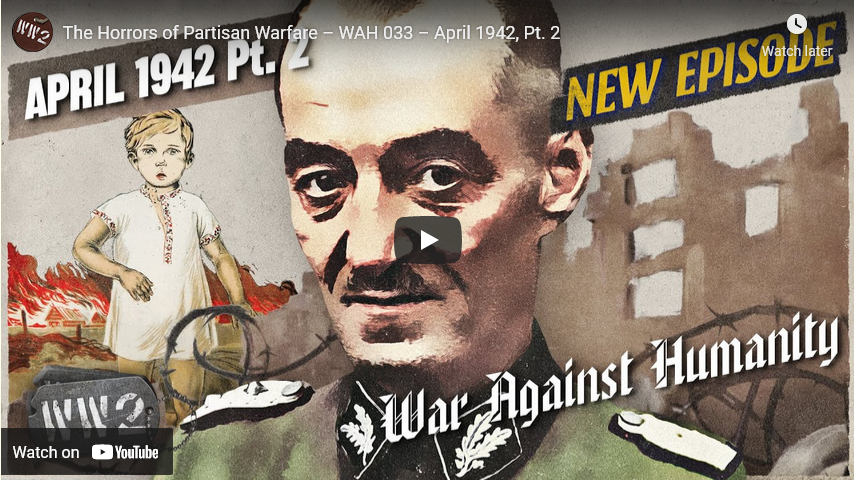
The Rape of Humanity at Babi Yar – War Against Humanity 019

Filed under: Germany, History, Military, Russia, WW2 — Tags: , , , , — Nicholas @ 04:00

World War Two
Published 1 Oct 2020

Killing Jews by the thousands becomes the main way of eradicating the Jews in Eastern Europe in August and September 1941. The Mass Murder at Babi Yar in Kiev is yet another escalation in that process.

Join us on Patreon: https://www.patreon.com/TimeGhostHistory
Or join The TimeGhost Army directly at: https://timeghost.tv

Check out our TimeGhost History YouTube Channel: https://www.youtube.com/c/timeghost?s…

Follow WW2 day by day on Instagram @ww2_day_by_day – https://www.instagram.com/ww2_day_by_day
Between 2 Wars: https://www.youtube.com/playlist?list…
Source list: http://bit.ly/WW2sources

Hosted by: Spartacus Olsson
Written by: Joram Appel and Spartacus Olsson
Director: Astrid Deinhard
Producers: Astrid Deinhard and Spartacus Olsson
Executive Producers: Astrid Deinhard, Indy Neidell, Spartacus Olsson, Bodo Rittenauer
Post-Production Director: Wieke Kapteijns
Creative Producer: Maria Khyle
Research by: Joram Appel
Edited by: Miki Cackowski
Sound design: Marek Kamiński
Map animations: Eastory (https://www.youtube.com/c/eastory)

Colorizations by:
Carlos Ortega Pereira, BlauColorizations – https://www.instagram.com/blaucolorizations
Julius Jääskeläinen – https://www.facebook.com/JJcolorization/
Tzo15 https://commons.wikimedia.org/wiki/Fi…
Mikolaj Uchman
Spartacus Olsson

Image Sources:
Bundesarchiv
Yad Vashem 3725/4, 7717/273, 5705/29, 5705/43, 3150/37, 5705/48, 5705/53, 5705/54, 5705/21, 2725/7, 5705/12, 5705/20, 5705/22, 4788/72, 5705/26, 5705/40, 4613/1055, 3521/134, 3521/133
USHMM
Narodowe Archiwum Cyfrowe
from the Noun Project: Skull by Muhamad Ulum, soldier by Simon Child

Soundtracks from the Epidemic Sound:
Cobby Costa – “Flight Path”
Andreas Jamsheree – “Guilty Shadows 4”
Jon Bjork – “For the Many”
Farell Wooten – “Blunt Object”
Fabien Tell – “Never Forget”
Gunnar Johnsen – “Not Safe Yet”

Sources:
Berkhoff, Karel (ed.), Basic Historical Narrative of the Babi Yar Holocaust Memorial Center (2018).
Desbois, Patrick, The Holocaust by Bullets: A Priest’s Journey to Uncover the Truth Behind the Murder of 1.5 Million Jews (2008).
Fox, Holquist and Martin, The Holocaust in the East: Local Perpetrators and Soviet Responses (2014).
Kay, Alex and David Stahel, Mass Violence in Nazi-Occupied Europe (2018).
Longerich, Peter, The Unwritten Order: Hitler’s Role in the Final Solution (2001)
Longerich, Peter, Holocaust: The Nazi Persecution and Murder of the Jews (2010).
Klee, dressen and Reiss, The Good Old Days: The Holocaust as Seen by its Perpetrators and Bystanders (1991).
Müller, “The Brutalisation of Warfare, Nazi Crimes and the Wehrmacht”, In: Erickson & Dilks, Barbarossa: The Axis and the Allies.
Pieper, Henning, Fegelein’s Horsemen and Genocidal Warfare: The SS Cavalry Brigade in the Soviet Union (2015).
Rutherford, Jeff, Combat And Genocide on the Eastern Front: The German Infantry’s War, 1941-1944 (2014).
Snyder, Timothy, Bloodlands: Europe Between Hitler and Stalin (2010).
United States Holocaust Memorial Museum, Encyclopaedia of Camps and Ghettos, 1933-1945, volume II, Part A (2012).
United States Holocaust Memorial Museum, Encyclopaedia of Camps and Ghettos, 1933-1945, volume II, Part B (2012).

Archive by Screenocean/Reuters https://www.screenocean.com.

A TimeGhost chronological documentary produced by OnLion Entertainment GmbH.

From the comments:

World War Two
3 hours ago
No one should have to go through what the subjects of todays episode went through. Every one of the 33,000 victims of the mass-murder at Babi Yar has their own personal story. They were humans, just like you and me, with memories, interests, hobbies, fears, hopes and loved ones. This is why we tried to make this episode as personal as we could – So that we don’t forget that we’re talking about real people here.

October 1, 2020

English lead and the European markets of the 1600s

Filed under: Britain, Economics, Europe, History, Religion, Technology — Tags: , , , , , — Nicholas @ 05:00

In the latest Age of Invention newsletter, Anton Howes considers the meteoric rise in lead production in England and Wales from the dissolution of the monasteries under Henry VIII to the Thirty Years’ War in Europe:

The well-preserved ruins of Fountains Abbey, a Cistercian monastery near Ripon in North Yorkshire. Founded in 1132 and dissolved by order of King Henry VIII in 1539. It is now owned by the Royal Trust as part of Studley Royal Park, a UNESCO World Heritage Site.
Photo by Admiralgary via Wikimedia Commons.

In the early sixteenth century, England was a minor producer of the stuff. It was widespread and cheap enough to be used for roofing buildings (unlike much of the rest of Europe, where copper was preferred), but the country never produced more than a few hundred tons per year. It didn’t really need to. Like stone in [the game] Dawn of Man, you could amass a stockpile and not worry too much about any leaky bucket problems [where stockpiles need to be replenished due to wastage or other “drains”]. The lead in roofs could always be recycled, and hardly any more was needed for pipes or cisterns. The vast majority of the demand came from Germany, and then the New World, where it was used to extract silver from copper ore. Even this dissipated in the mid-sixteenth century, when the New World silver mines began to switch to using mercury instead.

Yet by 1600, England was producing about 3,000 tons of lead a year, up from just 300 in the 1560s. By 1700, it was producing two thirds of Europe’s lead — a whopping 20,000 tons a year. How?

Unlike copper or iron, there is no evidence that lead mining or processing techniques were imported. If anything, they seem to have emerged from the Mendips, in Somerset, where production costs fell with the introduction of furnace smelting in the 1540s. As well as raising the extraction rates from the ore coming up from the mines, the new furnaces allowed previously unusable ores — found in the easily-accessible waste tips of old mining camps — to be smelted after some simple sifting. Unfortunately, we don’t have a clear idea of who was responsible for the innovation.

Yet the source of England’s supremacy was really, at first, religious. Following the dissolution of the monasteries by Henry VIII in the 1530s, the melting down of their roofs dumped some 12,000 tons of lead onto England’s markets — at least a year’s worth of Europe’s entire output. Although the immediate effect was to annihilate England’s own lead industry, the medium-term effect was to send the other European producers into disarray. By the 1580s, once the stockpile had depleted, England’s lead producers were among the only ones left standing. The sale of monastic lead ensured that the English retained a foothold in foreign markets, while the cost-saving innovations then gave them the competitive edge. These factors explain, at least, England’s eventual hold over the European lead market.

But there was yet another phenomenon responsible for the industry’s massively increased scale: the development of hand-held firearms. Gunpowder technology was of course centuries old, but cannon had largely fired balls made of stone or cast iron. Muskets and pistols, however, used bullets made of lead. With the proliferation of the weapons over the course of the seventeenth century, lead thus acquired a major leaky bucket problem. Bullets were too costly to recycle, leading to an estimated fifth of Europe’s annual production of lead disappearing every year — a wastage that only increased as armies grew, weapons’ rate of fire improved, and the continent experienced extraordinary violence. Europe lost an estimated fifth of its population to the Thirty Years’ War, and England itself succumbed to civil strife.

England’s lead industry thus had to drastically increase its production just to maintain Europe’s stock of lead, let alone increase it. It was from soldiers entering the fray, to trade bullets across sodden fields, that it owed its extraordinary success.

Historical Breakdown of A Bridge Too Far – Planning and Failure of Market Garden I RHINELAND 45

The Great War
Published 30 Sep 2020

Support our brand new World War 2 documentary about The Battle of the Rhineland (not to be released on YouTube): https://realtimehistory.net/rhineland45

After last year’s Downfall video (with over 1 million views!) we thought we look at another classic WW2 movie and give you a breakdown about the historical figures and background. Our pick this time: A Bridge Too Far.

» SUPPORT THE CHANNEL
Patreon: https://www.patreon.com/thegreatwar

» OUR PODCAST
https://realtimehistory.net/podcast – interviews with World War 1 historians and background info for the show.

» BUY OUR SOURCES IN OUR AMAZON STORES
https://realtimehistory.net/amazon *
*Buying via this link supports The Great War (Affiliate-Link)

» SOURCES
A. Beevor, Arnhem: The Battle for the Bridges (2018)
B. Horrocks, Escape to Action (1960)
R. Neillands, The Battle for the Rhine 1944 (2005)
Builder, Bankes, Nordin, Command Concepts (1999)
www.pegasusarchive.org
www.nam.ac.uk/explore/market-garden
www.iwm.org.uk/history/the-story-of-operation-market-garden-in-photos

» MORE THE GREAT WAR
Website: https://realtimehistory.net
Instagram: https://instagram.com/the_great_war
Twitter: https://twitter.com/WW1_Series
Reddit: https://reddit.com/r/TheGreatWarChannel

»CREDITS
Presented by: Jesse Alexander
Written by: Jesse Alexander
Director: Toni Steller & Florian Wittig
Director of Photography: Toni Steller
Sound: Toni Steller
Editing: Toni Steller
Motion Design: Philipp Appelt
Mixing, Mastering & Sound Design: http://above-zero.com
Maps: Daniel Kogosov (https://www.patreon.com/Zalezsky)
Research by: Matthew Moss
Fact checking: Florian Wittig

Channel Design: Alexander Clark
Original Logo: David van Stephold

Contains licensed material by getty images
All rights reserved – Real Time History GmbH 2020

From the comments:

The Great War
6 hours ago
Support our brand new World War 2 documentary about The Battle of the Rhineland (not to be released on YouTube): https://realtimehistory.net/rhineland45 *

*We know that some of you don’t like the fact that we upload non-Great War content once in a while. But here are a few fun facts: Last year’s video about THAT scene from Downfall has been one of our most successful videos ever produced. It helped us spreading the word about our crowdfunding campaign last year and it also brought new subscribers to The Great War that hadn’t heard about it. And in the cut-throat world of the YouTube attention economy this is really important for our continued existence. Another “fun” fact: Both this video and the Downfall video were both claimed for copyright violation even though they clearly fall under fair use. We disputed and lost and now there is nothing we can do about the fact that someone else is earning money through our work. Just one of the reasons why it’s increasingly frustrating working with YouTube and why we are exploring other avenues for The Great War and our other projects.

Tank Revolutionary: Fuller’s Diary | The Tank Museum

Filed under: Books, Britain, France, History, Military, Weapons, WW1 — Tags: , , , , , — Nicholas @ 02:00

The Tank Museum
Published 5 Jun 2020

J.F.C. Fuller has been described as a satanist, Nazi and bigot. Director Richard Smith, explores this highly controversial character, who was pivotal to the story of armoured warfare, using Fuller’s personal diary.

Support the work of The Tank Museum on Patreon: ► https://www.patreon.com/tankmuseum
Visit The Tank Museum SHOP & become a Friend: ► https://tankmuseumshop.org/

Twitter: ► https://twitter.com/TankMuseum
Instagram: ► https://www.instagram.com/tankmuseum/
Tiger Tank Blog: ► http://blog.tiger-tank.com/
Tank 100 First World War Centenary Blog: ► http://tank100.com/

September 30, 2020

“The culture war is the ‘New Normal'”

Filed under: Books, Britain, Media, Politics, USA — Tags: , , , , — Nicholas @ 05:00

Andrew Doyle discusses the debate over the culture war in Spiked:

The phrase that probably best characterises the events of 2020 is the “New Normal”. Although it’s typically used to describe our changed circumstances under lockdown, it could just as easily be applied to the way in which we have all grown accustomed to the worst excesses of the social-justice revolution.

News stories that only five years ago would have been dismissed as asinine aberrations now recur with a quotidian certainty. Recent notable examples include: Princeton University confessing to “systemic racism”, leading to an investigation by the Department of Education on the grounds that racism is a violation of civil-rights law; the Royal Academy of Dramatic Arts making a similar admission, thereby emboldening some of its students to produce a 100-page document full of demands so entitled that it would make Veruca Salt blush; and an academic and novelist stating that debate is “an imperialist capitalist white supremacist cis-heteropatriarchal technique that transforms a potential exchange of knowledge into a tool of exclusion and oppression”. Yes, the culture war is the “New Normal”.

Yet with all the evidence before our eyes, certain commentators persist with their view that the culture war is a right-wing myth advanced by those who are resistant to change. “There’s no actual ‘culture war’, is there?”, writes LBC’s James O’Brien: “It’s just a new way of describing disagreements between people who hate racism and discrimination and people who love it.” Then there is the Guardian‘s Owen Jones, who maintains that “a lot of what’s called ‘the culture war’ is just younger people trying to assert their different social and moral values over older generations who run most of the media”. Nesrine Malik has argued that the culture war has been manufactured by the right, although it will not have escaped most people’s attention that the majority of salvos come from the left side of the battlefield.

It’s this kind of gaslighting – to borrow the language of social-justice activists – that we have already seen from writers who insist that “cancel culture” doesn’t exist, in spite of abundant and incontrovertible evidence that it does.

This is because, as Helen Pluckrose and James Lindsay have so clearly outlined in their seminal book Cynical Theories, the ideology of social justice has its origins in postmodernism, a school of thought which favours “lived experience” and multiple “ways of knowing” over objective truth. It doesn’t matter, for instance, that JK Rowling has never said or written anything transphobic — her new novel must be denounced for advancing an anti-trans agenda, even though it contains no actual references to trans people. These activists have apparently taken their cues from Humpty Dumpty in Lewis Carroll’s Through the Looking Glass (1871). “When I use a word”, he says to Alice, “it means just what I choose it to mean – neither more nor less”.

New Orleans History 101

Atun-Shei Films
Published 2 Apr 2019

A brief crash course in the history of the city, from the founding in 1718 to the 20th century.

Support Atun-Shei Films on Patreon ► https://www.patreon.com/atunsheifilms

#NewOrleans #Louisiana #AmericanHistory

Watch our film ALIEN, BABY! free with Prime ► http://a.co/d/3QjqOWv
Reddit ► https://www.reddit.com/r/atunsheifilms
Twitter ► https://twitter.com/alienbabymovie
Instagram ► https://www.instagram.com/atunsheifilms
Merch ► https://atun-sheifilms.bandcamp.com

« Newer PostsOlder Posts »

Powered by WordPress