In our continuing series on the development of the British Lee Enfield rifles, we are looking at the CLLE conversions today. In 1907 the British adopted a new universal short rifle (the SMLE) that used charger (aka stripper) clips. Previous models of the Lee in British service had to be loaded one round at a time by hand. In order to make use of the hundreds of thousands of “Long Lee” (and Metford) rifles already manufactured, the British instituted a program to update them with charger guides. The began in 1908 and ran to 1914, although the majority were done in 1909 and 1910. In addition to removing the dust cover and fitting the charger guide, the front sight, rear sight, magazine, and volley sights were all updated. The new sights were windage-adjustable on both front and rear, and calibrated for Mk VI ammunition (although many were later updated again and re-re-calibrated for Mk VII ammunition).
These CLLE rifles would serve as second-line rifles in World War One and even through the end of World War Two.
Contact:
Forgotten Weapons
6281 N. Oracle #36270
Tucson, AZ 85740
Comments Off on Charger-Loading Lee Enfields: The CLLE MkI* and MkII
Follow WW2 day by day on Instagram @ww2_day_by_day – https://www.instagram.com/ww2_day_by_day
Between 2 Wars: https://www.youtube.com/playlist?list…
Source list: http://bit.ly/WW2sources
—
Hosted by: Spartacus Olsson
Written by: Joram Appel and Spartacus Olsson
Director: Astrid Deinhard
Producers: Astrid Deinhard and Spartacus Olsson
Executive Producers: Astrid Deinhard, Indy Neidell, Spartacus Olsson, Bodo Rittenauer
Creative Producer: Maria Kyhle
Post-Production Director: Wieke Kapteijns
Research by: Joram Appel
Edited by: Karolina Dołęga
Sound design: Marek Kamiński
Sources:
Picture of building appartement on Prinzregentenplatz 16, Munich in 1910. courtesy of Stadtarchiv München, DE-1992-FS-NL-PETT1-2847 https://stadtarchiv.muenchen.de/scope…
– Bundesarchiv
– National Archives NARA
– Imperial War Museum: IWM Art.IWM PST 4099
– United States Holocaust Memorial Museum
– Narodowe Archiwum Cyfrowe
– Nationaal Archief
– The picture of the Eagle’s Nest in 2020 courtesy of Marcus Hebel from Wikimedia – https://commons.wikimedia.org/wiki/Fi…
– The picture of the Eagle’s Nest in 2014 courtesy of Nordenfan – from Wikimedia https://commons.wikimedia.org/wiki/Fi…
– Icons from The Noun Project: barracks by Smalllike, Cook by Alice Design, Farm by Laymik, football field by Mavadee, House by Abhimanyu Bose, Kitchen by RD Design, Library by Adrien Coquet, Housekeeper by Richie Romero, Old Car by Halfazebra Studio, Pool by Loritas Medina, Projector by Ralf Schmitzer, Waiter by chris dawson, Woman by Deemak Daksina, Woman by Wilson Joseph, Woman hat by Xinh Studio, Woman With a Hat by Graphic Enginer
Soundtracks from Epidemic Sound:
– “The Inspector 4” – Johannes Bornlöf
– “London” – Howard Harper-Barnes
– “Other Sides of Glory” – Fabien Tell
– “Rememberance” – Fabien Tell
– “Deviation In Time” – Johannes Bornlof
– “Break Free” – Fabien Tell
– “March Of The Brave 10” – Rannar Sillard – Test
– “Ominous” – Philip Ayers
– “Symphony of the Cold-Blooded” – Christian Andersen
– “Please Hear Me Out” – Philip Ayers
In Quillette, Aaron Sarin traces the last twenty years of successful diplomacy, industrial espionage, and ever-increasing CCP media influence in China’s relationships with western nations:
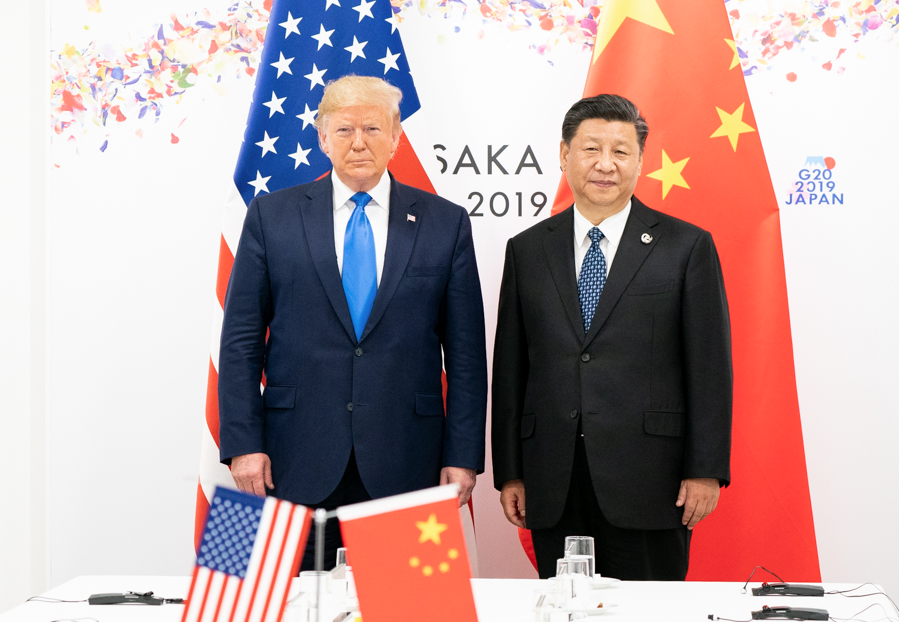
President Donald Trump and PRC President Xi Jinping at the G20 Japan Summit in Osaka, 29 June, 2019. Cropped from an official White House photo by Shealah Craighead via Wikimedia Commons.
By the end of 2020, China’s relationships with the US and Australia had reached their lowest point in living memory, while Sino-British relations weren’t far behind. Yet the European Commission chose this moment to sign a major new investment treaty with Beijing. The deal appeared to have been rushed to completion just before Joe Biden’s inauguration, as if to avoid the fuss that a new American administration would be sure to make. Indeed, incoming National Security Adviser Jake Sullivan felt sore enough to send a pointed tweet: “The Biden-Harris administration would welcome early consultations with our European partners on our common concerns about China’s economic practices.”
The truth is that Brussels has been drifting further and further from Washington ever since the election of Donald Trump, and there are few signs the winds will change now that Biden has taken office. In 2017, Merkel said that Europe could no longer rely on America. By 2020, it seemed truer to say that Europe would rely on China from now on. Indeed, diplomats like Emmanuel Bonne (Macron’s foreign policy adviser) have been most enthusiastic about “France’s readiness to step up strategic communication with China.” In his gushing deference, Bonne can sometimes sound like a man with a gun to his head: “France respects China’s sovereignty, appreciates the sensitivity of Hong Kong-related issues, and has no intention of interfering in Hong Kong affairs.” There are times when the language of neutrality reveals with painful clarity that a side has been chosen.
Brussels officials talk of “strategic autonomy,” of course. They hope to carve out a path to self-sufficiency while at the same time enjoying mutually beneficial relationships with partners like Beijing. The problem is that mutually beneficial relationships are not possible with predators. As successive American administrations have found, those who maintain close connections with the Communist Party will eventually suffer large-scale intellectual property theft and the loss of millions of manufacturing jobs.
Brussels can hardly expect that Beijing will respect this new agreement. Recall the various promises that were made regarding Hong Kong: all of them were broken. Party officials may have signed a legal document recognising the city’s special administrative status, but this was purely for show. In 2017, having apparently now ascended to a position above the law, they declared that the document had “no practical significance.” Remember how Barack Obama was given firm assurance that Beijing would never militarize the South China Sea? There were handshakes and smiles all round, and then Beijing proceeded to militarize the South China Sea.
Indeed, some of the commitments included as part of the new deal echo those made 20 years ago, when China first joined the World Trade Organisation. It was agreed in 2001 that prices in every sector would be determined by market forces; that state-owned enterprises would begin operating free of state influence; that international norms regarding intellectual property would be respected; and so on. After two decades, we can see that the Communist Party has kept not one of its promises.
The error in Western thinking was to view CCP officials as civilised counterparts. We failed to see that we were dealing with a pack of thugs and grifters — men for whom the rule of law is neither reality nor ideal, but façade. This lesson has now been learned in some quarters, but clearly not in the upper echelons of the European Union. This new investment deal even includes a reference to “commitments on forced labour,” which is little short of an insult when we consider the hundreds of thousands of Uyghurs who have been made to toil all day till dusk in the cotton fields of Xinjiang. The truth is that the EU has been fooled. There will be no “win-win situation.” Not when dealing with the Communist Party, which has always viewed geopolitics as a zero-sum game. In the words of Bilahari Kausikan, once Singapore’s top diplomat, “only the irredeemably corrupt or the terminally naïve take seriously Beijing’s rhetoric about a ‘community of common destiny.'”
Comments Off on “The error in Western thinking was to view CCP officials as civilised counterparts”
Here Curator David Willey discusses the T-54, and its successor the T-55, tanks which can source their roots back to the Second World War and are probably the most produced tanks of all time.
Support the work of The Tank Museum on Patreon: ► https://www.patreon.com/tankmuseum
Visit The Tank Museum SHOP & become a Friend: ► tankmuseumshop.org
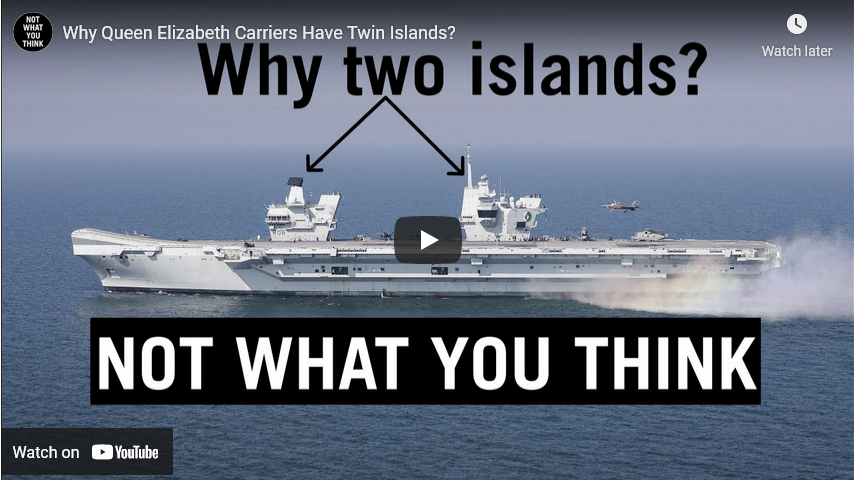
There are at least five advantages to having two separate islands on the Royal Navy’s Queen Elizabeth-class aircraft carriers. But the main reason for such a design can only be found below the deck. Enjoy!
Ever heard of Atlantropa? Probably not. It was a nutty scheme hatched by a nutty guy, and it never had even the remotest chance of ever coming to pass. In the 1920s, Europe was suffering from a myriad of post–World War I problems. There was a refugee crisis, the result of the shifting borders and population transfers that occurred at the war’s end. There was an energy crisis, and a serious shortage of natural resources. And, of course, there was the economic depression. Several years before a madly gesticulating Austrian with a wacky mustache would rise to power with his own solution to the continent’s ills, a plucky architect from Bavaria named Herman Sörgel proposed a different one: Drain the Mediterranean! Dam the Med and partially drain it, in order to form a contiguous body of land between Europe and Africa. A new continent that would be called Atlantropa. To Sörgel, this would cure Europe of all that ailed her. The dammed Mediterranean would create hydroelectric power plants to relight Europe’s recently dimmed lamps, and the elimination of pesky ocean crossings would allow millions of European refugees to stream into Africa, where they would take their rightful place as lord and master. Better still, this newly conquered African land would be ripe with fertile soil, minerals, and a plethora of natural resources for the taking.
Oh, Herman Sörgel, you pie-in-the-sky dreamer! You were the Elon Musk of your day (but slightly more grounded). The idea never took off, not just because of the fact that it was batshit insane, but also because, at that time, the left’s intellectual elite — the League of Nations crowd, the “forward-thinkers” — understood that you don’t cure one nation or one continent’s refugee problem by sending all of the huddled, wretched refuse to another people’s nation or continent. Back then, the left understood that this would pose serious problems for the host nation or continent. And the left was right. Atlantropa would have been a nightmare for native Africans, and eventually, there would have been a Rhodesia- or South Africa-style reckoning.
In the 1920s, if anyone had suggested that the specter of millions of European refugees streaming into Africa did not constitute an invasion, that person would have been dismissed as a lunatic, because of course it would have been an invasion. Those in favor of Atlantropa, and those against it, all got that point. The European refugees would not have been content to live like Africans, or to live under African rule. Europe’s refugee crisis would have become Africa’s domination crisis. So to the liberal elites, the best solution was to tell the refugees to stay put.
The Doolittle Raid is just a little bombing raid over Tokyo that doesn’t do that much physical damage. It does, however, have big repercussions — partly in terms of future offensive plans for the Japanese fleet, and partly in terms of the thousands of Chinese lives taken in reprisals for allowing the US bombers to land in China. There is small scattered action on the Eastern Front, more Japanese advances in Burma, and a French VIP escapes captivity in Germany and heads for Switzerland and freedom.
Written and Hosted by: Indy Neidell
Director: Astrid Deinhard
Producers: Astrid Deinhard and Spartacus Olsson
Executive Producers: Astrid Deinhard, Indy Neidell, Spartacus Olsson, Bodo Rittenauer
Creative Producer: Maria Kyhle
Post-Production Director: Wieke Kapteijns
Research by: Indy Neidell
Edited by: Iryna Dulka
Sound design: Marek Kamiński
Map animations: Eastory (https://www.youtube.com/c/eastory)
(Edit: Tungsten carbine is, of course *denser* than steel, not lighter. Sorry.)
I have done several previous videos on the Boys antitank rifle, but never actually fired one — until today! We’re out at the range with a MkI Boys and five rounds of its .55 Boys ammunition. So let’s see if it’s as painful to shoot as people say …
Contact:
Forgotten Weapons
6281 N. Oracle #36270
Tucson, AZ 85740
Comments Off on Boys Mk I Anti-Tank Rifle at the Range
Overly Sarcastic Productions
Published 16 Apr 2021
You asked, I deliver: the Neoclassicism tangent receives the full-video spotlight it deserves. But there’s plenty more architectural and art-historical analysis where that came from. So if this kind of thing seems fun, please comment and let me know!
SOURCES & Further Reading: Francesco’s Venice by Francesco Da Mosto, A History of Venice by John Julius Norwich, “Renaissance Architecture” via Britannica, and many many many hours spent staring at buildings in Italy.
Maldivian media outlets this morning published as fact a satirical Telegraph news blog citing “unconfirmed rumours” that the 14th edition of the Times Comprehensive Atlas of the World will omit the Maldives, Tuvalu, “and major parts of Bangladesh” as a statement on global warming.
The blog post, written by climate change skeptic James Delingpole who describes himself as “a writer, journalist and broadcaster who is right about everything”, features comments by a “Times Atlas spokesman” David Rose.
In a UK press scandal this year, “David Rose” was found to be a psuedonym used by left-wing Independent journalist and climate change writer Johaan Hari to edit his own Wikipedia entry, advocate his own position and attack his critics.
Rose, who in Delingpole’s article holds “a doctorate in Cambridge in Climate Change and Sinking Islands Studies so I know what I’m talking about, and if you don’t believe me, ask my friend Johaan Hari who taught me everything I know”, acknowledges that it “may not be strictly geographically accurate to say the Maldives and Tuvalu will definitely have disappeared in about ten years time when our next edition appears.”
“But did you see that picture of the Maldives cabinet holding a meeting underwater? If the Maldives government says the Maldives are drowning, they must be drowning. And frankly I think it’s despicable, all those deniers who are saying it was just a publicity stunt, cooked up by green activist Mark Lynas, to blackmail the international community into giving the Maldives more aid money while simultaneously trying to lure green Trustafarians to come and spend £1500 a night in houses on stilts with gold-plated organic recyclable eco-toilets made of rare earth minerals from China. Why would a government lie about something as serious as climate change?”
Rose goes on to state that “I’m pleased to say that this is a view of the world shared by my colleagues at Times Comprehensive Atlas Of The World. They understand that maps based on accurately recorded geographical features belong in the Victorian age of child chimney sweeps. What we need now is maps that change the world, transforming into something which it isn’t actually yet but might be one day if we don’t act NOW!”
The origin story of New Orleans is a tale of rampant corruption, unchecked greed, fiendish vice, and gross incompetence – not much has changed!
Join me on an epic journey of discovery as I trace the route of the first French explorers to this area by paddling down Bayou St. John and walking overland to the French Quarter, exploring the geography and history of the city along the way.
[1] B.F. French. Historical Collections of Louisiana and Florida, Including Translations of Original Manuscripts Relating to Their Discovery and Settlement (1875). Albert Mason, Page 24-25
[2] Lawrence N. Powell. The Accidental City: Improvising New Orleans (2012). Harvard University Press, Page 11-15
[3] Philomena Hauck. Bienville: Father of Louisiana (1998). Center for Louisiana Studies, University of Louisiana at Lafayette, Page 12-13
[4] Richard Campanella. “Link to the Past: From French Colonists to the Beginnings of Jazz, Spanish Fort Traces its History Across Three Centuries” (2019). Times Picayune/New Orleans Advocatehttps://richcampanella.com/wp-content…
[5] Hauck, Page 23-25
[6] Hauck, Page 6
[7] Hauck, Page 44-57
[8] Powell, Page 25-32
[9] Richard Campanella. Bienville’s Dilemma: A Historical Geography of New Orleans (2008). Center for Louisiana Studies, University of Louisiana at Lafayette, Page 109-110
Sky Gilbert responds more than adequately to a demand to “Cancel Shakespeare” that also appeared in The Line recently:
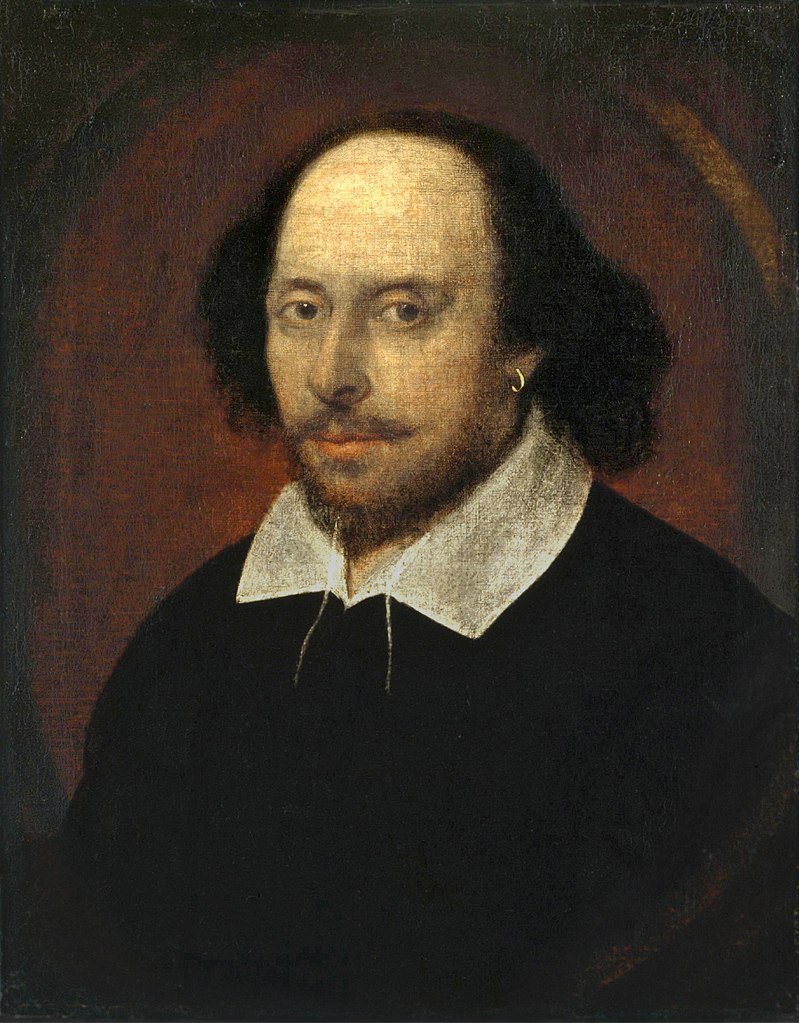
This was long thought to be the only portrait of William Shakespeare that had any claim to have been painted from life, until another possible life portrait, the Cobbe portrait, was revealed in 2009. The portrait is known as the “Chandos portrait” after a previous owner, James Brydges, 1st Duke of Chandos. It was the first portrait to be acquired by the National Portrait Gallery in 1856. The artist may be by a painter called John Taylor who was an important member of the Painter-Stainers’ Company. National Portrait Gallery image via Wikimedia Commons.
Allan thinks that Shakespeare’s language is difficult and old fashioned, and that students today find analyzing the complexities of his old-fashioned rhetoric boring and irrelevant. Yes, Shakespeare essentially writes in another language (early modern English). And reading or even viewing his work can be a tough slog. Not only did he invent at least 1,700 words (some of which are now forgotten today), he favoured a befuddling periodic syntax in which the subject does not appear until the end of a sentence.
But a study of Shakespeare’s rhetoric is important in 2021. There is one — and only one — exceedingly relevant idea that can be lifted from Shakespeare’s congested imagery, his complex, sometimes confusing metaphors — one jewel that can be dragged out of his ubiquitous references to OVID and Greek myth (references which were obviously effortless for him, but for most of us, only confound). And this idea is very relevant today. Especially in the era of “alternate facts” and “fake news.”
This idea is the only one Shakespeare undoubtedly believed. I say this because he returns to it over and over. Trevor McNeely articulated this notion clearly and succinctly when he said that Shakespeare was constantly warning us the human mind “can build a perfectly satisfactory reality on thin air, and never think to question it.” Shakespeare is always speaking — in one way or another — about his suspicion that the bewitching power of rhetoric — indeed the very beauty of poetry itself — is both enchanting and dangerous.
Shakespeare lived at the nexus of a culture war. The Western world was gradually rejecting the ancient rhetorical notion that “truth is anything I can persuade you to believe in poetry” for “truth is whatever can be proved best by logic and science.” Shakespeare was fully capable of persuading us of anything (he often does). But his habit is to subsequently go back and undo what he has just said. He does this so that we might learn to fundamentally question the manipulations of philosophy and rhetoric — to question what were his very own manipulations. Shakespeare loved the beautiful hypnotizing language of poetry, but was also painfully aware that it could be dangerous as hell.
In fact, Shakespeare’s work is very dangerous for all of us. That’s why students should — and must — read it. Undergraduates today hotly debate whether The Merchant of Venice is anti-Semitic, or whether Prospero’s Caliban is a victim of colonial oppression. Education Week reported that “in 2016, students at Yale University petitioned the school to ‘decolonize’ its reading lists, including by removing its Shakespeare requirement.”
It’s true that Shakespeare is perhaps one of the oldest and whitest writers we know. (And sometimes he’s pretty sexist too — Taming of the Shrew, anyone?). But after digging systematically into Shakespeare’s work even the dullest student will discover that for every Kate bowing in obedience to her husband, there is a fierce Lucrece — not only standing up to a man, but permanently and eloquently dressing him down. (And too, the “colonialist” Prospero will prove to be just as flawed as the “indigenous” Caliban.) William Hazlitt said: Shakespeare’s mind “has no particular bias about anything” and Harold Bloom said: “his politics, like his religion, evades me, but I think he was too wary to have any.”
Comments Off on “Students will find in Shakespeare absolutely no moral compass”
Malta and British cities are victim to German bombs, while the Japanese advance in Burma causes a refugee crisis. In the Philippines, 80,000 Allied POWs walk the Bataan Death March.
Sources:
IWM C 4743, CL 2377
Bundesarchiv
From the Noun Project: Watchtower by Eliricon
Soundtracks from the Epidemic Sound:
Johan Hynynen – “Dark Beginning”
Fabien Tell – “Weapon of Choice”
Wendel Scherer – “Defeated”
Philip Ayers – “Trapped in a Maze”
Cobby Costa – “From the Past”
Cobby Costa – “Flight Path”
Wendel Scherer – “Growing Doubt”
Jon Bjork – “For the Many”
A TimeGhost chronological documentary produced by OnLion Entertainment GmbH.
From the comments:
World War Two
3 days ago (edited)
Under our previous episode I told you about how YouTube has been age restricting these videos, effectively censoring them and turning the format into an echo chamber that doesn’t reach beyond the viewers who already know about it. As I explained we feel that it’s a great disservice to education and remembrance, and it has affected me deeply personally making me question why we do this. Two things happened:
1. You collectively gave us the most amazing reception and reminded us of how important the work we do is. I can’t thank you enough for the amazing comments, many of them where kind, supportive, and motivating far beyond what I feel we deserve. You lifted my spirits and brought me out of the slump I was in, cementing, and confirming that what we do matters. In the name of the entire team: thank you so much, it is an immense honor to have you all with us.
2. YouTube did not age restrict the video, and even cleared it for monetization, leading to that it once again reached a viewership like before the string of age restrictions we were struck with. We haven’t heard any explanation from YouTube and we won’t. Furthermore, I am painfully aware that these decisions depend completely on the whims of the individuals at Google who review the videos. We also know that these individuals are different for every video, so I fear that that this state of affairs will not remain. Already, this video was judged as “not suitable for all advertisers” and will therefore be recommended to viewers less often in YouTube’s system. Hence, although it pains us, and is against the principles we stand for, we have also prepared a version of this video with all images documenting the atrocities we expose blurred out – we can only hope that we don’t need it.
I’d like to end with an anecdote out of my motivation to create this series. Many, many moons ago, when I was in senior high at boarding school in Sweden, Elie Wiesel – author, chronicler of the Holocaust, and survivor of Auschwitz and Buchenwald came to our school. It was in 1986, the same year that he received the Nobel Peace Prize for his work, and if I remember correctly he had connected a lecture tour to his reception of the award.
In any case — I had the privilege of speaking to Mr. Wiesel in a small group. He explained something that has stayed with me ever since. To him, his experiences were not defeating, the entire Holocaust was not a defeat, not only had humanity been victorious in the end, but he and others had survived to tell the tale — which to him was a special kind of victory that came with the responsibility of sharing and educating.
Mr. Wiesel, a kind, warm hearted man, full of humor and life despite the horrors he had lived, passed five years ago. It is for him, for the other survivors of every ethnicity faced by any kind or terror, and for those who didn’t make it through that we do this — to celebrate their life and continue turning their suffering from defeat into victory by remembering even after they are gone.
Yours,
Spartacus
Comments Off on The Bataan Death March Begins – WAH 032 – April 1942, Pt. 1
One of the phrases in the mouth of managers or bureaucrats that indicates almost unfailingly that they are about to commit an act of betrayal is, “We believe passionately in.”
The only thing that most managers or bureaucrats believe in passionately is their career, in the broad sense of that term: for they are quite willing to abandon or sacrifice a career completely in the narrow sense if it is in the interest of their career in a broader sense.
I learned this in the hospitals in which I worked. As soon as a hospital manager said “I believe passionately in the work that Department X has been doing,” I knew that Department X was about to be closed down by that very same manager.
Thus, when I read that a publisher claimed that “We believe passionately in freedom of speech,” I knew at once that the publisher was about to withdraw a book from publication that it had previously advertised for publication.