
The Tank Museum
Published 18 Jun 2021Curator David Willey discusses the Cold War era Swedish Ikv 91. Short for Infanterikanonvagn 91, this tank destroyer was developed to meet the operational requirements of the Swedish Army post-WW2.
(more…)
October 28, 2021
Tank Chats #130 | Ikv 91 | The Tank Museum
Comments Off on Tank Chats #130 | Ikv 91 | The Tank Museum
October 27, 2021
Looting WW2 Java Sea Wrecks – “The Biggest Grave Robbery in History”
Historigraph
Published 26 Oct 2021Support on Patreon to help keep the videos coming https://www.patreon.com/historigraph
Come join the historigraph discord: https://discord.gg/cjTaHFNAjS
Buy Historigraph Posters here! historigraph.creator-spring.comFollow me on Twitch for upcoming livestreams! https://www.twitch.tv/historigraph
► Second Channel: https://www.youtube.com/channel/UCpIj…
► Twitter: https://twitter.com/historigraph
► Instagram: https://www.instagram.com/historigraphSources:
[A] Mediacorp documentary on the salvaging: https://www.youtube.com/watch?v=k9iRR…
[B] Footage of the wreck of Prince of Wales, by Nigel Sinclair – https://www.youtube.com/watch?v=YD96F…
[C] Footage of the wreck of Repulse, by Clayton Neilson – https://www.youtube.com/watch?v=T3U_e…[1] https://www.bbc.co.uk/news/world-asia…
[2] https://www.theguardian.com/world/201…
[3] https://www.theguardian.com/world/201…
[4] https://www.theguardian.com/world/ng-…
[5] https://ses.library.usyd.edu.au/bitst…
[6] https://www.reclamet.co.uk/scrap-meta…
[7] https://www.nst.com.my/news/2015/10/n…
[8] https://www.maritime-executive.com/ar…

Comments Off on Looting WW2 Java Sea Wrecks – “The Biggest Grave Robbery in History”
October 26, 2021
The Constitution of Athens
Historia Civilis
Published 15 Dec 2017Patreon | http://historiacivilis.com/patreon
Donate | http://historiacivilis.com/donate
Merch | http://historiacivilis.com/merch
Mailing List | http://historiacivilis.com/mailinglist
Twitter | http://historiacivilis.com/twitter
Website | http://historiacivilis.comSources:
The Athenian Constitution by Aristotle: http://amzn.to/2C1mHLv
Politics by Aristotle: http://amzn.to/2AB6KPV
Parallel Lives: The Life of Solon by Plutarch: http://amzn.to/2AT5Viv
The Constitution of the Athenians by Pseudo-Xenophon: http://amzn.to/2z9rE6l
The Rise of Athens by Anthony Everitt: http://amzn.to/2C2ryMu
The Athenian Democracy in the Age of Demosthenes by Mogens Herman Hansen: http://amzn.to/2AEAtYj
Persian Fire by Tom Holland: http://amzn.to/2AjLB8WMusic:
“Direct to Video,” by Chris Zabriskie
“It’s Always Too Late to Start Over,” by Chris Zabriskie
“Mario Bava Sleeps In a Little Later Than He Expected To,” by Chris Zabriskie
“Hallon,” by Christian BjoerklundWe are a participant in the Amazon Services LLC Associates Program, an affiliate advertising program designed to provide a means for us to earn fees by linking to Amazon.com and affiliated sites.
Comments Off on The Constitution of Athens
What is Marmite?
Atomic Shrimp
Published 13 Mar 2021I used Marmite to flavour gravy in a previous video — loads of people asked what it was. Here (I hope) is the answer you need.
I’ve tried — and liked — both Marmite and Vegemite and I have a very slight preference for Marmite, but now I’ll need to search for the reduced salt and XO versions … for science, of course.

Comments Off on What is Marmite?
October 25, 2021
P90: FN’s Bullpup PDW
Forgotten Weapons
Published 2 Jul 2021http://www.patreon.com/ForgottenWeapons
https://www.floatplane.com/channel/Fo…
Cool Forgotten Weapons merch! http://shop.forgottenweapons.com
FN began developing the P90 in the late 1980s, actually preceding the NATO requirement that it would eventually compete for. The idea of the P90 was to develop a weapon for secondary troops to replace 9mm pistols and SMGs. There was an anticipated threat of Russian paratroops wearing armor that could defeat 9mm ball. The P90 was intended to be a light and handy weapon that was easily controllable without a tremendous about of training, and could defeat that sort of body armor.
The result was the 5.7x28mm cartridge, firing a 31 grain armor-piercing bullet at 2350 fps. This was combined with a simple blowback action and a Hall-style 50-round magazine in a fully ambidextrous, bullpup layout. The gun was introduced onto the market in 1990, and has been widely purchased by security and special operations organizations. In its original intended role for support troops, it has only been adopted by Belgium.
Contact:
Forgotten Weapons
6281 N. Oracle 36270
Tucson, AZ 85740

October 24, 2021
Showdown at El Alamein – WW2 – 165 – October 23, 1942
World War Two
Published 23 Oct 2021Could this be the beginning of the big break in North Africa? The Allies have the men, the armor, and the fuel … they just have to deal with the Axis minefields to try and get started. And the Axis are throwing ever more men at Stalingrad as the Soviets grimly hold on. Another roller coaster of a week.
(more…)
Comments Off on Showdown at El Alamein – WW2 – 165 – October 23, 1942
QotD: Origins of the upper-class twit
By 1920 there were many people who were aware of all this. By 1930 millions were aware of it. But the British ruling class obviously could not admit to themselves that their usefulness was at an end. Had they done that they would have had to abdicate. For it was not possible for them to turn themselves into mere bandits, like the American millionaires, consciously clinging to unjust privileges and beating down opposition by bribery and tear-gas bombs. After all, they belonged to a class with a certain tradition, they had been to public schools where the duty of dying for your country, if necessary, is laid down as the first and greatest of the Commandments. They had to feel themselves true patriots, even while they plundered their countrymen. Clearly there was only one escape for them – into stupidity. They could keep society in its existing shape only by being unable to grasp that any improvement was possible. Difficult though this was, they achieved it, largely by fixing their eyes on the past and refusing to notice the changes that were going on round them.
George Orwell, “The Lion And The Unicorn: Socialism and the English Genius”, 1941-02-19.
Comments Off on QotD: Origins of the upper-class twit
October 23, 2021
French Guerrilla War & German Retaliation during the Franco-Prussian War 1870
Real Time History
Published 21 Oct 2021Sign up for Curiosity Stream and get Nebula bundled in and SAVE 26%: https://curiositystream.com/realtimeh…
The French increasing reliance on franc-tireurs, guerrilla style fighters, is causing brutal German retaliation and a spiral of violence in the fall phase of the Franco-Prussian War.
Special thanks goes out to Quentin Censier from Sur le Champ. Check out his Channel: https://www.youtube.com/surlechamp
» THANK YOU TO OUR CO-PRODUCERS
John Ozment
James Darcangelo
Jacob Carter Landt
Thomas Brendan
James Giliberto
Kurt Gillies
Albert B. Knapp MD
Tobias Wildenblanck
Richard L Benkin
Scott Deederly
John Belland
Adam Smith
Taylor Allen
Jim F Barlow
Rustem Sharipov» OUR PODCAST
https://realtimehistory.net/podcast – interviews with historians and background info for the show.» LITERATURE
Arand, Tobias: 1870/71. Die Geschichte des Deutsch-Französischen Krieges erzählt in Einzelschicksalen. Hamburg 2018Keegan, John: Die Kultur des Krieges. Berlin 1995
Neitzel, Sönke/Hohrath, Daniel (Hrsg.): Kriegsgreuel. Die Entgrenzung der Gewalt in kriegerischen Konflikten vom Mittelalter bis ins 20. Jahrhundert. Paderborn, München 2008
Roth, François: La Guerre de 1870. Paris 1990
» SOURCES
Busch, Moritz: Graf Bismarck und seine Leute während des Krieges mit Frankreich. Bd. I. Berlin 1878Chuquet, Arthur: La Guerre 1870-71. Paris 1895
Engels, Friedrich: Der Deutsch-Französische Krieg. Sechzig Artikel aus der “Pall Mall Gazette”. Berlin (Ost) 1957
Fontane, Theodor: Kriegsgefangen. Erlebtes 1870. Briefe 1870/71. Berlin (Ost) 1984
Kriegsgeschichtliche Abteilung des Großen Generalstabs (Hrsg.): Der deutsch-französische Krieg 1870-71. II.1 Berlin 1878
Kürschner, Joseph (Hrsg.): Der große Krieg 1870–71 in Zeitberichten. Leipzig o. J. (1895)
Meisner, Heinrich Otto (Hrsg.): Kaiser Friedrich III. Das Kriegstagebuch von 1870/71. Berlin, Leipzig 1926
Roux, Georges: La Guerre de 1870. Paris 1966
Sarrepont, Major H. de (i.e. Eugène Hennebert): Histoire de la défense de Paris en 1870-1871. Paris 1872
Zeitz, Karl: Kriegserinnerungen eines Feldzugsfreiwilligen aus den Jahren 1870 und 1871. Altenburg 1905
» OUR STORE
Website: https://realtimehistory.net»CREDITS
Presented by: Jesse Alexander
Written by: Cathérine Pfauth, Prof. Dr. Tobias Arand, Jesse Alexander
Director: Toni Steller & Florian Wittig
Director of Photography: Toni Steller
Sound: Above Zero
Editing: Toni Steller
Motion Design: Philipp Appelt
Mixing, Mastering & Sound Design: http://above-zero.com
Maps: Battlefield Design
Research by: Cathérine Pfauth, Prof. Dr. Tobias Arand
Fact checking: Cathérine Pfauth, Prof. Dr. Tobias ArandChannel Design: Battlefield Design
Contains licensed material by getty images
All rights reserved – Real Time History GmbH 2021
Comments Off on French Guerrilla War & German Retaliation during the Franco-Prussian War 1870
The English Statute of Monopolies gets far more credit than it actually deserves
The Statute of Monopolies (1624) is often said to have been critical in helping to start England on the road to the Industrial Revolution, but in the latest Age of Invention newsletter Anton Howes argues it is far more complicated than it seems:
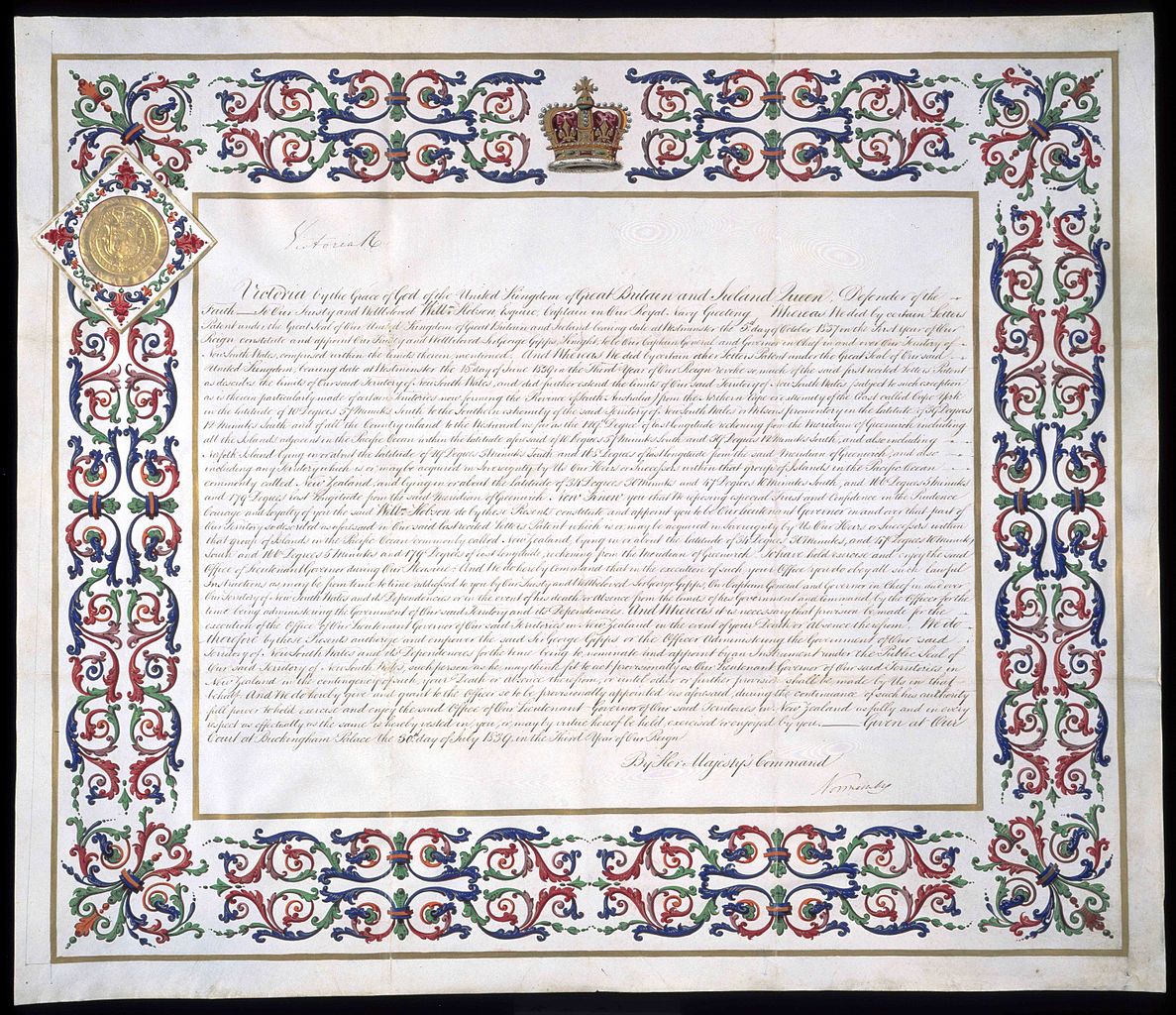
Letters Patent Issued by Queen Victoria, 1839. On 15 June 1839 Captain William Hobson was officially appointed by Queen Victoria to be Lieutenant Governor General of New Zealand. Hobson (1792 – 1842) was thus the first Governor of New Zealand.
Constitutional Records group of Archives NZ via Wikimedia Commons.
One of the most frequently mentioned landmarks in the history of intellectual property is the Statute of Monopolies, passed by the English parliament in 1624. I’ve often seen it lauded as the beginning of the system of patents for invention, or the first patent law. I remember giving a talk a few years ago where I downplayed the role of formal institutions in encouraging the Industrial Revolution, prompting an outraged economist in the audience to point to the law as a sort of gotcha — “here’s a better explanation: with patents you incentivise invention, and the Brits had just invented patents”.
Which is all to illustrate that the Statute of Monopolies is often fundamentally misunderstood. So what, exactly, did it actually do? It’s a tale of opportunism, corruption, and court intrigue, with some actual innovation inbetween. The whole saga ended Francis Bacon’s political career, led to a major constitutional crisis, and set the scene for how inventors were to behave and act for well over a century. In this first part, I’ll give the context you’ll need to really appreciate what was going on, and I’ll publish the rest in the weeks to come.
First off, the Statute of Monopolies was certainly not the first patent law. Venice’s senate had enacted a law on monopolies for invention as early as 1474. But even then, we shouldn’t be looking for statutes at all. The history of patents does not begin in 1474, but much earlier, with plenty of monopolies over new inventions having already been granted by the ruling grand council of Venice, and by the authorities of other Italian cities like Florence. The key thing to recognise about early patents is that they were not a creation of parliaments or their statutes, but of those in charge. They were the creation of sovereigns, a creature of kings and queens (or in the case of republics like Venice, of governing councils).
As regular readers of this newsletter might remember, patent monopolies for invention had already had long history in England, well before 1624. Patents in general were a very ordinary tool of English monarchs, used to communicate their will. By issuing letters patent, monarchs essentially issued public orders, open for everyone to see. (Think “patently”, as in clearly or obvious, which comes from the same root.) Monarchs used letters patent to grant titles and lands, appoint or remove people as officials, extend royal protections to foreign immigrants, incorporate cities, guilds, even theatre troupes — in general, just to rule.
And, eventually, English monarchs copied the Venetians by issuing letters patent to grant temporary monopolies to particular people, to encourage them to make discoveries, publish books, or introduce new industries or inventions to the realm. It’s only over the passage of centuries that we’ve come to refer to patents for invention — a mere subset of letters patent, and really even a mere subset of patent monopolies for all sorts of other creative work — as simply patents. Intellectual property was thus a ruler-granted privilege, created in the same way that a town gains the official status of a city, or a commoner becomes a knight. English monarchs began granting monopolies for discovering new territories and trade routes from 1496, for printing certain books from 1512, and for introducing new industries or inventions from 1552 (with one weird isolated exception from as early as 1449).
Comments Off on The English Statute of Monopolies gets far more credit than it actually deserves
Flower class corvettes – Guide 124
Drachinifel
Published 25 May 2019The Flower class, ASW corvettes of the Royal Navy, are today’s subject.
Want to support the channel? – https://www.patreon.com/Drachinifel
Want to talk about ships? https://discord.gg/TYu88mt
Want to get some books? www.amazon.co.uk/shop/drachinifel

Comments Off on Flower class corvettes – Guide 124
QotD: Patum Peperium, the Gentleman’s Relish
Opinions differ as to how and when you should eat Gentleman’s Relish. According to the Ritz, breakfast is the time to enjoy its piquant flavour, preferably on thinly sliced, brown toast. I prefer to eat it for tea, on white toast with a little mustard and cress. Mrs Beeton suggests that anchovy paste is usually spread on toast as “an excellent bonne bouche which enables gentlemen at wine-parties to enjoy their port with redoubled gusto”.
It was originally created in 1828 by John Osborn, an English provision merchant in Paris. Like any good marketing man, he created a grandiose name from a fictitious fudge of Latin and Greek implying pepper paste, to tempt his fashion-conscious customers into buying it. It only became known as Gentleman’s Relish once his son brought the business to London. According to Elsenham, its current manufacturer, it is still made according to the original recipe. It imports the finest Spanish anchovy fillets, which have been packed in barrels of salt and left to mature for 18 months. Once suitably fruity, they are rinsed in brine and gently cooked before being cooled and blended with butter and rusk. A secret blend of spices and herbs is then added.
Sybil Kapoor, “Spreading the word”, The Guardian, 2001-02-18.
Comments Off on QotD: Patum Peperium, the Gentleman’s Relish
October 22, 2021
Explaining why British police clearly favour road-blocking protestors over the rights of ordinary Britons
In The Critic, Andrew Tettenborn believes it can be traced back to a change in the oath that new police constables take and the changed emphasis in police training to support that change:
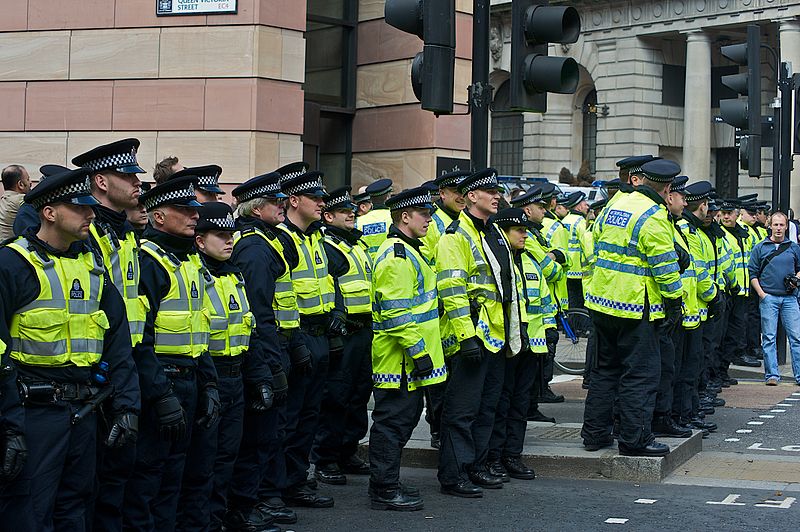
Metropolitan Police at G20 protests in London, 2009-04-01
Photo via Wikimedia Commons
Last week Insulate Britain magnanimously announced it would suspend its forcible road-blocking campaign. Apart from noting the impudence of this announcement (remember the IRA sanctimoniously calling its Christmas ceasefires, as if this were something we should be grateful for?), commentators on Twitter, the tabloid press and indeed many of the general public, have found another question troubling. Why, in the face of deliberate criminality aimed at discommoding ordinary people (most of whom will have been less well-off than many of the protesters), did the police hold back, at times apparently chatting with the obstructionists and threatening with arrest any exasperated driver who tried to take steps to remove them? We aren’t told, but we can make some educated guesses.
[…]
Nearly twenty years ago in 2002, there was a subtle, little-reported but very symbolic change in the oath sworn by all constables on appointment. Instead of the 19th century undertaking to serve the Queen “without fear or favour, malice or ill-will” in the course of keeping the peace and preventing crime, there is now a much more tendentious promise preceding the duty to keep the peace: namely, to act with “fairness, integrity, diligence and impartiality, upholding fundamental human rights and according equal respect to all people”. This requirement, thoroughly reflected as it is in police training today and imbued in policing culture, has two effects.
One is that all officers must keep at the front of their minds not only the law of the land but also two other guidelines: considerations of fairness and equality (whatever those mean), and human rights laws — something peculiarly complex and frequently opaque, even to lawyers. Human rights laws involve a subtlety well beyond the average constable called out to police a tense situation. Put yourself in the position of a policeman, faced with a choice whether to intervene in a case involving illegality and an intent to inconvenience people, but where no-one is actually engaging in violence — exactly the situation with Insulate Britain or Extinction Rebellion. You might well think that, if you wish to avoid future trouble and possible complaints of discrimination or unfairness, discretion and inaction would be the better part of valour.
Thanks to the pervasiveness of human rights culture, the constable’s traditional function of upholding the law ceases to be a black-and-white matter, and becomes a potential mire of conflicting duties. Even if the letter of the law says you should arrest a middle-aged protester or at least drag them off the M25 to prevent them obstructing it, there is always a possibility that someone somewhere will hold that this was contrary to their human rights. Once again, a cautious police officer intent on avoiding disciplinary hearings and a possible black mark, may well conclude that it is better to let sleeping dogs lie (at least for the moment), condone the illegality and avoid possible violence.
The police constable on the scene is extremely well advised to avoid doing anything that might possibly be construed as infringing on the human rights of everyone at the scene, for fear of becoming the scapegoat if clever lawyers convince a judge or jury that the police acted contrary to their revised oath.
Comments Off on Explaining why British police clearly favour road-blocking protestors over the rights of ordinary Britons
L-34 Sampo: Aimo Lahti’s Rejected Masterpiece
Forgotten Weapons
Published 30 Jun 2021http://www.patreon.com/ForgottenWeapons
https://www.floatplane.com/channel/Fo…
Cool Forgotten Weapons merch! http://shop.forgottenweapons.com
Finland’s standard light machine gun going into the Winter War was the LS-26, a gun which did not succeed in field use. It was complex and cumbersome, and Finnish troops quickly replaced it with captured Russian DP-27 LMGs. Part of the problem of the LS-26 was its recoil-operated design. Finnish military authorities specified a recoil-operated mechanism for their LMG in light of the success of the recoil-operated heavy Maxim guns in Finnish service. Gas operation was quickly recognized as a superior system for light machine guns, but too late to stop adoption of the LS-26.
In the early 1930s, Aimo Lahti did design a gas-operated LMG, heavily influenced by the Czech ZB-26 system. A handful of prototypes were made by VKT, looking for both Finnish military acceptance and international sales. The gun was made in several calibers, most notably 7.62x54R for Finland and 7.92x57mm Mauser for export. However, bureaucratic issues prevented its consideration by the Finnish Army, and the timing was too late for exports. The L-34 was significantly lighter and simpler than the LS-26, and it was performed quite well in Finnish trials — which did not happen until the 1950s. By that time, the Finnish military was looking for an intermediate-caliber belt-fed gun, and the L-34 was not suitable regardless of its performance.
Many thanks to Sako for providing me access to film this L-34 from their reference collection!
Contact:
Forgotten Weapons
6281 N. Oracle 36270
Tucson, AZ 85740

Comments Off on L-34 Sampo: Aimo Lahti’s Rejected Masterpiece
QotD: Post-traumatic stress disorder (PTSD) in the ancient (or medieval) world
That is often not the impression that you would get from a quick google search (though it does seem to be the general consensus of the range of ancient military historians I know) and that goes back to arguments ex silentio. A quick google search will turn up any number of articles written by folks who are generally not professional historians declaring that PTSD was an observed phenomenon in the deep past, citing the same small handful of debatable examples. But one thing you learn very rapidly as a historian is that if you go into a large evidence-base looking for something, you will find it.
That’s not a species of research positivity – it’s a warning about confirmation bias, especially if you do not establish a standard of proof before your investigation. It is all too easy to define down your definition of “proof” until the general noise of the source-base looks like proof. In this case, we have to ask – before we go looking – what would evidence of PTSD in ancient societies (I’m going to start there because it is where I am best informed) look like?
Well, ancient societies engaged in a lot of warfare. Among the citizenry – the sort of fellows who write to us and are written about in our sources – combat experience was almost ubiquitous. That only really changes as we get into the Roman Empire, as violence levels both decline generally and are pushed to the frontier via a professional army. The percentage of veterans in the citizen population (again, citizen here is an important caveat, but then those fellows basically are our primary source base) probably equaled that of the WWI generation in Britain or France, except all the time (there’s a point in the Second Punic War where the Roman censors went through the entire rolls, checking to see how many had managed to avoid military service and found only a few thousand in a citizen body of c. 150,000 adult males). So what ought we expect from our sources? We should expect to see signs of PTSD everywhere. It should be absolutely pervasive in a source-base produced almost entirely by, for and about combat veterans, in societies where military mortality exceeded modern rates by a robust margin.
And it simply isn’t there. There is one very frequently cited account in Herodotus (Hdt. 6.117) of a man named Epizelos experiencing what is generally understood as “conversion disorder” (which used to be badly labeled “hysterical blindness”) in combat. Without being wounded he went blind at a sudden terror in battle and never recovered his sight. Herodotus terms it a θῶμα – a “wonder” or “marvel”, a word that explicitly implies the strange uncommonness of the tale. Herodotus is concerned enough about how exceptional this sounds that he is quick not to vouch for its veracity – he brackets the story (beginning and end) noting that it was what he was told (by someone else) that Epizelos used to say happened to him. In short, this was uncommon enough that Herodotus distances himself from it, so as not to be thought as a teller of tall-tales (though Herodotus is, in fact, a teller of tall tales).
This one example – cited endlessly and breathlessly in internet articles – is remarkable not because it is typical, but because it is apparently very unusual (also, it is my understanding – with the necessary caveat that I am not an expert – that while conversion disorder is a consequence of emotional trauma, it is not clear that it is associated with PTSD more generally). Meanwhile, in the war literature of the Romans, in their poetry (including that by folks like Horace, who fought in quite terrible battles), in the military literature of the Greeks, in the reflections of Xenophon (both on his campaigns and his commands), in the body of Greek lyric poetry … all of it – nothing. It is simply not there – not as a concern that such a condition might befall someone, nor a report that it had done so. Nothing. The lacuna baffled me for years.
My impression is that the medieval literature looks much the same: a few scattered passages that, if you squint hard enough, might be PTSD set against a vast backdrop of nothing in a society where literature was dominated by the war-fighting class. More examples than in the classical corpus (but then the medieval corpus is much larger; oddly, the examples I’ve seen all seem to concern crusading particularly), but nothing close to what we would expect given a literary tradition absolutely dominated by military aristocrats and their (often clerical) families. I call this my impression, because the medieval corpus is both much larger and I have read much less of it; but if there is a hidden reservoir of accounts showing clear symptoms of PTSD, I have not found it yet. I was always struck that – despite the fact that monastic life was often a destination for medieval military aristocrats troubled by their life of violence – none of the monastic rules I have read (admittedly, not all of them), which often have guidelines for abbots to deal with difficult monks, have had anything about how to deal with the symptoms of PTSD.
Now that’s not to say there isn’t grief at loss, mind you! The lamentations of defeat, the sorrow of losing a loved one (even in victory), the misery of war – that you find in the ancient texts in abundance. It occupies literary topoi, it is depicted in artwork, it gets entire tragedies to stretch out in, it is addressed by great big political speeches, it sits at the cornerstone of the Iliad‘s narrative (one reason, no doubt, that the Iliad remains a useful text for soldiers working through their experiences). But the persistent symptoms of PTSD, no. I haven’t been able to find one “flashback” or combat-memory related dissociative episode in ancient literature. You might argue that they simply weren’t recorded, but that strikes me as unlikely in societies where other forms of war-damage were so fiercely valorized and which would have often seen – as with Epizalos – such symptoms as divine omens. There should be dozens and dozens of them. These are societies with active medical literature, after all!
I think the evidence strongly suggests that ancient combatants did not experience PTSD as we do now. The problem is that the evidence of silence leads us with few tools with which to answer why. One answer might be that it existed and they do not tell us – because it was considered shameful or cowardly, perhaps. Except that they do tell us about other cowardly or shameful things. And the loss and damage of war – death, captivity, refugees, wounds, the lot of it – are prominent motifs in Greek, Roman and European Medieval literature. War is not uniformly white-washed in these texts – not every medieval writer is Bertran. We can’t rule out some lacuna in the tradition, but given just how many wails and moans of grief and loss there are in the corpus it seems profoundly unlikely. I think we have to assume that it isn’t in the sources because they did not experience it or at least did not recognize the experience of it.
Bret Devereaux, “Fireside Friday”, A Collection of Unmitigated Pedantry, 2020-04-24.
Comments Off on QotD: Post-traumatic stress disorder (PTSD) in the ancient (or medieval) world
October 21, 2021
Tank Chats #129 | Marmon-Herrington Mk. IV | The Tank Museum
The Tank Museum
Published 11 Jun 2021David Fletcher examines the Marmon-Herrington Mk IV, an armoured car produced by South Africa and used by the British, among others, during the Second World War.
(more…)
Comments Off on Tank Chats #129 | Marmon-Herrington Mk. IV | The Tank Museum


