TimeGhost History
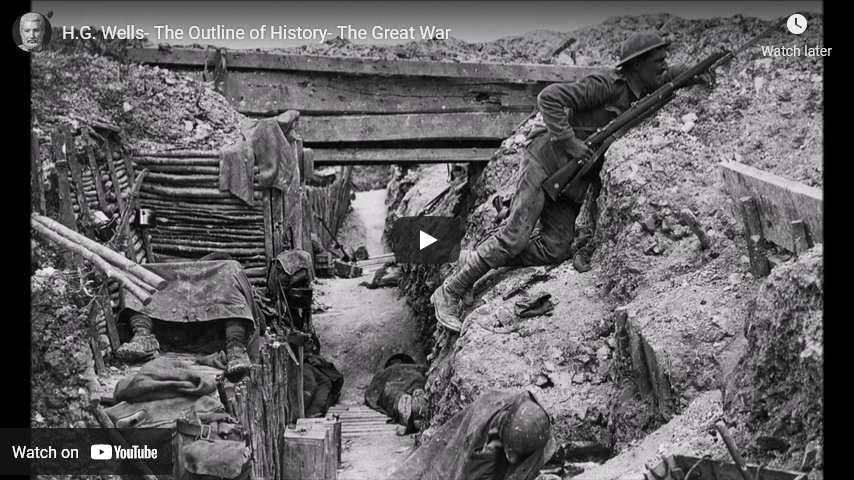
Published 2 Jun 2021Being the creator of the legendary Sherlock Holmes has made Arthur Conan Doyle famous for his scientific rationality. But Doyle also has a deeply held belief in the existence of the spirit universe. In a world still reeling from the shock of the Great War, he is not alone.
(more…)
June 3, 2021
The Supernatural Adventures of Arthur Conan Doyle | B2W:ZEITGEIST! I E.19 Spring – 1923
QotD: Simon de Montfort
While he was in the Tower, Henry III wrote a letter to the nation saying that he was a Good Thing. This so confused the Londoners that they armed themselves with staves, jerkins, etc., and massacred the Jews in the City. Later, when he was in the Pope’s Bosom, Henry further confused the People by presenting all the Bonifaces of the Church to Italians. And the whole reign was rapidly becoming less and less memorable when one of the Barons called Simon de Montfort saved the situation by announcing that he had a memorable Idea.
Simon de Montfort’s Good Idea
Simon de Montfort’s Idea was to make the Parliament more Representative by inviting one or two vergers, or vergesses, to come from every parish, thus causing the only Good Parliament in History. Simon de Montfort, though only a Frenchman, was thus a Good Thing, and is very notable as being the only good Baron in history. The other Barons were, of course, all wicked Barons. They had, however, many important duties under the Banorial system. These were:
- To be armed to the teeth.
- To extract from the Villein(*) Saccage and Soccage, tollage and tallage, pillage and ullage, and, in extreme cases, all other banorial amenities such as umbrage and porrage. (These may be collectively defined as the banorial rites of carnage and wreckage).
- To hasten the King’s death, deposition, insanity, etc., and make quite sure that there were always at least three false claimants to the throne.
- To resent the Attitude of the Church. (The Barons were secretly jealous of the Church, which they accused of encroaching on their rites — see p. 30, Age of Piety.)
- To keep up the Middle Ages.
(*) Villein: medieval term for agricultural labourer, usually suffering from scurvy, Black Death, etc.
W.C. Sellar & R.J. Yeatman, 1066 And All That, 1930.
June 2, 2021
How Hitler Manipulated Germany into Committing Genocide – WW2 Special
World War Two
Published 1 Jun 2021In the wrong hands, propaganda is a powerful tool that can trick whole countries into supporting a dictator, go to war, or even commit genocide.
(more…)
Media Fearmongering
Laura Dodsworth on how the BBC and other British media outlets turned all the dials to 11 to ramp up fear over the spread of the Wuhan Coronavirus:
The media have served us a cornucopia of frightening articles and news items about Covid-19 in 2020 and 2021. While writing my new book, A State of Fear: How the UK Government Weaponised Fear During the Covid-19 Pandemic, I encountered a panoply of doom-mongering headlines. These were an indication of the significant role the media have played in creating our state of fear.
Of course, news media should not shy away from reporting frightening news during a pandemic. They should make us aware of the numbers of deaths, the policies being implemented to tackle the pandemic and the latest scientific developments. But during Covid, the media went beyond reporting on the pandemic. Instead, they appeared beholden to the old commercial imperatives, “If it scares, it airs”, and “If it bleeds, it leads”. It seems fear does sell.
The anxious, frightened climate this has helped to create has been suffocating. Death tolls were constantly brandished without the context of how many people die every day in the UK, and hospital admissions were reported while recoveries were not. As a result, Covid often appeared as a death sentence, an illness you did not recover from – even though it was known from the outset that Covid was a mild illness for the majority of people.
Given the wall-to-wall doom, it is therefore no surprise that the British were one of the most frightened populations in the world. Various studies showed that we were more concerned than other countries about the spread of Covid and less confident in the ability of our government to deal with it. One survey in July 2020 showed that the British public thought between six and seven per cent of the population had died from Covid – which was around 100 times the actual death rate at the time. Indeed, if six or seven per cent of Brits had died from Covid, that would have amounted to about 4,500,000 bodies – we’d have noticed, don’t you think?
While researching A State of Fear, I interviewed members of the general public about how they were impacted by the “campaign of fear” during the epidemic. Many talked of how the media had elevated their alarm.
“There wasn’t much to do”, Darren told me, “so we’d watch TV and we saw programmes about disinfecting your shopping when it arrives, and having a safezone in the kitchen. The nightly bulletins on the TV about death tolls, the big graphs with huge spikes on them, came at us ‘boom, boom, boom!’. It was a constant barrage of doom and gloom. My fear of the virus went through the roof.”
Sarah told me she had to stop watching the BBC. As her daughter put it, “If you just watched or listened to the BBC every day, what hope would you have had?”. Jane, meanwhile, described the “gruesome headlines” that came at her “thick and fast”.
The fearmongering about Covid began even before the pandemic hit the UK. We were primed by videos from Wuhan in China, which were then widely circulated by UK-based media outlets. These painted an apocalyptic picture, featuring collapsed citizens, medics in Hazmat suits, concerned bystanders and a city grinding to a halt. In one memorable video, which went viral, so to speak, a woman fell, stiff as a board, flat on her face, on a pavement. The split second where she falters is a giveaway – this was a set-up. If the rest of the world had Covid, China had “Stunt Covid”.
June 1, 2021
Rise and Fall of the Sikh Empire explained in less than 7 minutes
Epimetheus
Published 8 Oct 2019Rise and Fall of the Sikh Empire explained in less than 7 minutes Sikh history documentary
This video covers Sikh history from the Guru Nanak till the fall of the Sikh Empire.
This video and others like it are sponsored by my Patrons over on patreon.
https://www.patreon.com/Epimetheus1776
Undoing Dr. Beeching’s cuts
In The Critic, Brice Stratford looks at the British government’s “nationalization if necessary, but not necessarily nationalization” scheme to once again reform Britain’s passenger railway network:
Astonishing scenes this week, whereby the Tory government announces a White Paper to re-nationalise the railways. The union bosses and Guardianistas who have called for such policy for decades immediately decided that actually it’s a terrible idea, or that this doesn’t count as re-nationalising because it’s the Conservatives doing it, or that calling the new entity “Great British Railways” just because it will run Great Britain’s railways is so offensive that the entire project should be called off. It’s all very tribal, and very silly, and very 2021, alas.
Of course, the Department for Transport (DfT) is still afraid of admitting that this is in fact renationalisation, as to do so would be to rile up certain elements of the Right, and to admit what we all know: that their generations-long experiment in railway privatisation has been a failure. Today we have a service which is overpriced, unreliable, and generally an unpleasant and ineffective experience from start to finish.
The postwar Labour government included railway nationalization in its many, many reforms to the economic life of Britain and in 1948 the remaining railway systems were unified as British Railways. By the 1960s, the system was losing money at a high rate of speed, so Dr. Beeching was called upon to recommend how to put the railway if not into profit then at least into a much more acceptable rate of loss:

Maps originally from Losing Track by Kerry Hamilton and Stephen Potter (1985), by way of Is Your Journey Really Necessary?, 2012-12-31.
https://isyourjourneyreallynecessary.wordpress.com/2012/12/31/nice-work-if-you-can-get-there/
Click map to enlarge.
The aim of the Beeching cuts, which followed on from a pair of reports written by Dr Richard Beeching in 1963 and 1965 for the British Railway Board (of which he was Chair), was to turn the loss-making British railways network into a profitable enterprise. Prioritising this profitability over all else, he proposed axing about a third of Britain’s then 7000 railway stations, removing passenger service from around 5000 route miles, and cutting 70,000 jobs over three years. The moves were highly controversial, and though they certainly saved money, the social consequences were extensive and the scars remain visible today.
As a consequence of the cuts, Britain became over-reliant on car travel, and over the 1970s and 80s town planners gutted the experientially human-scale city centres in service of this newly favoured road transport. We still very much feel the consequences of the Beeching axe today, whereby a rail journey between neighbouring cities is often only possible by zigzagging up to London and back down again, and public transport between rural communities is limited to one bus service every hour or two in the morning and mid-afternoon, which crawls along at a testudinian pace, further isolating and atrophying the scattered settlements that once were happy, thriving homes.
The Avengers – Must See TV
May 31, 2021
The History of HSTs in the West
Ruairidh MacVeigh
Published 29 May 2021Hello again! 😀
With the recent withdrawal of the last HST operations into London, I wanted to make a series of videos chronicling the history of these mighty trains in terms of their years of each region they were assigned to, the Great Western, East Coast, Midland, West Coast and Cross Country Routes.
With that in mind, we start with the first of the BR Regions to employ the venerable HST, but also the first to withdraw them from long distance services, the Great Western, a line that, since its inception under the auspices of Brunel, has played host to many different types of trains, but none have had greater impact that the superb HSTs.
All video content and images in this production have been provided with permission wherever possible. While I endeavour to ensure that all accreditations properly name the original creator, some of my sources do not list them as they are usually provided by other, unrelated YouTubers. Therefore, if I have mistakenly put the accreditation of “Unknown”, and you are aware of the original creator, please send me a personal message at my Gmail (this is more effective than comments as I am often unable to read all of them): rorymacveigh@gmail.com
The views and opinions expressed in this video are my personal appraisal and are not the views and opinions of any of these individuals or bodies who have kindly supplied me with footage and images.
If you enjoyed this video, why not leave a like, and consider subscribing for more great content coming soon.
Thanks again, everyone, and enjoy! 😀
References:
– 125Group (and their respective sources)
– Wikipedia (and its respective references)
“For four generations our culture and education has been in the hands of an unholy hybrid of Marxism and Rousseau’s Romanticism”
In the most recent edition of the Libertarian Enterprise, Sarah Hoyt regrets not learning some traditional — manual — skills when she was younger, and how children today are even worse served by the education system:
… there are are other things. I mean, husband and I to an extent were thrown in to the world with no clue how to do the most basic things, like home maintenance or how to clean with proper products, how to take care of clothes, how to do anything with our savings other than let it sit in the bank, how to organize and sort files and records. It goes on. (I do still tend to use bleach for most things. It’s cheap. I have at least learned what it will damage.) Our first ten years of marriage would make a good sitcom, as they had a repeating pattern: figure out we need to do something; extrapolate how it can be done; invest untold amount of time and effort into doing thing; find out after that it can be done in a simpler and cheaper way. And then people wonder why I curse.
And so many times, we just come up on something that must be done — even now — and have no clue how to get to the place where we can even think about how to do it. Teaching the kids what we never learned has been fun, too.
Heck, even in my religion — and I taught it was a young woman — I keep coming across these massive gaps where no one ever taught me what to do or why. As for the education my kids got: pfui.
In the same way, I’ve spent most of my adult life learning history, grammar, natural science and the basics of things that I supposedly learned the advanced form for with my degree, but without anyone ever teaching me the fundamentals.
Kind of like part of my degree is the study of literature but until I read Dwight Swain’s Techniques of the Selling Writer I’d never realized that books are composed of conflict and reaction units. (No, not physical conflict, though heck, you could sell that.) Instead I tried to fit them into the structure of plays and wondered why it wasn’t working.
Because no one had ever taught me the basics. I mean, I knew how to do a lot of advanced things, even as a beginning writer. I just had no clue how to do the basic things. And it showed.
For four generations our culture and education has been in the hands of an unholy hybrid of Marxism and Rousseau’s Romanticism. (The two are related in that both believe that natural man left to his own devices creates paradise.)
I can understand how those scarred by the long war of the 20th century would decide that they were going to ditch all the evil bad things in civilization and let the children grow up “naturally” so they would be sweet and innocent angels. (Spit.) I understand but I don’t forgive. If they thought what they saw in the war was the result of Western Civilization, they’d never studied other civilizations or for that matter hid in a playground and watched the children be “natural”.
Then the cascade started. People who only half learned could only half teach. On top of which the doubts instilled in them about the purpose of civilization made them teach less than half. And the next generation knew less. And then less.
More than once, as an inquisitive student, I’d go to my teacher and ask why something worked the way it did or didn’t work the way they said, only to be given a glib explanation I knew was wrong. I must have been 11 the first time I realized the teacher had no more clue than I did. (This was a good thing. It set me on a path of researching and investigating on my own.)
By the time my kids were in school it had become more so, partly because to justify themselves, and abate the feeling they were incompetent, people derived entire theories on why they shouldn’t learn the basics, learning the basics was bad, and you could be so much better by learning naturally.
I don’t have enough words to revile the “immersion” method of language learning, particularly was applied in our schools. Yes, sure “but the military used it” – yeah, but the military could enforce LIVING in the language. It also — which seems to elude most people — does teach people grammar and vocabulary in formal classroom settings.
[…]
Part of the unlearning are people who never learned enough to realize what works and what doesn’t trying to do things in ways that only work for a very few highly gifted individuals. That’s how we got whole word, new math, total immersion, whateverthehelltheyretryingnow all of which involved “less work for teachers” and the vague hope that unschooled children, or children who learned “naturally” were just somehow “better”.
Kind of like what would happen if I decided my digit dyslexic, half-baked way with wood meant my making, say, a table that was lopsided and wobbly made the table better and more authentic.
May 30, 2021
Rommel’s Desert Dash – The Whole Bloody Afrika Korps! – Gazala – WW2 – 144 – May 30, 1942
World War Two
Published 29 May 2021Erwin Rommel begins his surprise new offensive with “Rommel’s Moonlight Ride”, bringing all of his mighty mobile units to the fray in North Africa, while in the Pacific, dozens of warships and tens of thousands of men set sail from Japan — their mission? Attack the Aleutian Islands and Midway Island, but above all, destroy the US Pacific Fleet!
(more…)
The History of the English Flag
History With Hilbert
Published 13 Apr 2018Most people know that the Union Flag (sometimes incorrectly called the Union Jack by normies) is made up of the various flags of the United Kingdom combining things like the Scottish Saltire and the English Saint George’s Cross. But what is the history behind these symbols and why were they adopted by these nations, and what is more, why these flags, and what about the competitors who if history had been different might have come to symbolise these nations. In today’s episode, I’m going to explore the history and symbolism behind England’s flag, the Saint George’s Cross, as well as the other banners that were once seen as being representative of the English people.
Music Used:
“Sneaky Snitch” – Kevin MacLeod
“Pippin the Hunchback” – Kevin MacLeod
“Angevin” – Kevin MacLeod
“Gregorian Chant” – Kevin MacLeod
“Ever Mindful” – Kevin MacLeod
“Ever Mindful” – Kevin MacLeod (incompetech.com)
Licensed under Creative Commons: By Attribution 3.0 LicenseAll images are from the Public Domain of Wikimedia Commons and Pixabay.
May 29, 2021
Prototype Jungle Carbine: A No1 MkV Becomes a No5 MkI
Forgotten Weapons
Published 17 Feb 2021http://www.patreon.com/ForgottenWeapons
https://www.floatplane.com/channel/Fo…
Cool Forgotten Weapons merch! http://shop.bbtv.com/collections/forg…
When the British began developing a shortened version of the No4 Lee Enfield in 1943 (which would become the No5 MkI “Jungle Carbine”), the development process included work with some rather older rifles. What we have here is a 1922 production No1 MkV rifle cut down as a trials prototype for the carbine development program. The No1 MkV was a trials gun itself from the early 1920s which basically gave a rear aperture sight to the classic MkIII SMLE. Unfortunately, I don’t have any specific details on the testing or use of this particular example, but I think it is a fascinating example!
Contact:
Forgotten Weapons
6281 N. Oracle #36270
Tucson, AZ 85740
May 28, 2021
Justin Trudeau apologizes for WW2 detainment of card-carrying Fascists by Mackenzie King’s government
As Colby Cosh notes in the latest NP Platformed newsletter, it is hard to reconcile the mythological events the Prime Minister is busy apologizing for with the actual, documented facts of the case as recorded in a book published by three Italian-Canadian academics about 20 years ago:
What they found was that the 500 people, singled out from 112,000 Italian-Canadians by the government in 1940, were scarcely the victims of racial hysteria. They were, in fact, a hardcore fraction of 3,000 or so literal card-carrying Fascists in Canada. They hadn’t been thrown into camps willy-nilly, as Canada’s Japanese would be later; most had Fascist ties and sympathies that had been carefully investigated, abundantly documented and double-checked by the RCMP.
The internees had mostly been members of overtly pro-Fascist “fraternal organizations”, whose loyalty they later protested in the face of the facts. As that young reporter’s review observed, many of those groups reported directly to the Italian government, all were devoted to promoting the idea of Mussolini’s near-godhood and some helped finance Italy’s Fascist (and racist) 1935 invasion of Ethiopia, which annihilated the League of Nations security apparatus and set the table for further fascist aggression in Europe. Although the impugned Italians were detained without trial, none lost their homes or property as Japanese internees later would, and in fact none were held beyond the end of 1942.
That review was just about the only notice Enemies Within received anywhere in the Canadian press. The author, whose alliterative name you can probably guess by now, interviewed (now emeritus) Prof. Perin and was told the book had “fallen into a big black hole”. The revisionist account of Italian-Canadian internment as an out-of-control racial panic directed at anyone whose name ended in a vowel had long since taken hold in Canadian schools, and has never lost its grip.
Today, the prime minister, attentive to his nose for votes, apologized officially in the House of Commons for the “unjustified” detentions. And opposition parties are competing vigorously to out-apologize the apologizer-in-chief. One wonders what our present-day anti-fascists, who favour street beatings for anyone wearing the wrong hat, make of this laborious grieving for honest-to-God anti-Fascist action. As Michael Petrou argued courageously in the Globe and Mail on May 3, we shouldn’t be consecrating a falsehood for the sake of anyone’s political advantage. (And the CBC, to its credit, gives some attention to the historically informed side of the debate.)
The Plot to Kill Hitler’s Hangman – Operation Anthropoid – WAH 035 – May 1942, Pt. 2
World War Two
Published 27 May 2021Arthur Harris and his RAF Bombers carry out a massive bombing raid on Cologne. Meanwhile, one of the architects of the Holocaust, Reinhard Heydrich is the target of a spectacular assassination attempt.
(more…)