
On my trips to this part of the world, I’ve noticed that women here are what we in America would call high maintenance. The men seem to put a lot of effort into doting on their women, while the women act like they deserve it plus more. In Copenhagen, I saw men pushing a cart in which their date would ride. Contrary to the Viking image, men in this part of the world seem almost henpecked. Given what we see with their politics, it’s clear that the culture veered into matriarchy at some point and politics followed.
Even if this is just a superficial affectation, it is interesting because of what we think caused the variety of eye colors, hair textures and hair colors in Northern European people. The most common explanation is that there was an imbalance between the sexes, as the males needed to engage in high risk activity like hunting large animals and fishing cold waters. The result was more girls than boys, which gave an edge to women with unusual eye and hair color, as far as the sexual marketplace.
A trait that offers an edge in terms of attracting a mate, especially for women in a world short of eligible men, is going to spread quickly. It would follow that women would be the pursuers, while the men could be indifferent. If things are the reverse today, then it suggests something important changed over the last many generations. Perhaps enough cads were killed off in wars to turn the tables, giving the doting males an edge. That would have changed the dynamic among women, making them high maintenance …
The Z Man, “Travelogue: Talinn”, The Z Blog, 2019-04-03.
August 25, 2022
QotD: Scandinavian women
August 24, 2022
“A spectre is haunting Britain – the spectre of whingers”
A pub that was partially an inspiration for George Orwell’s description of the “perfect pub” is under threat from post-covid NIMBY complaints:
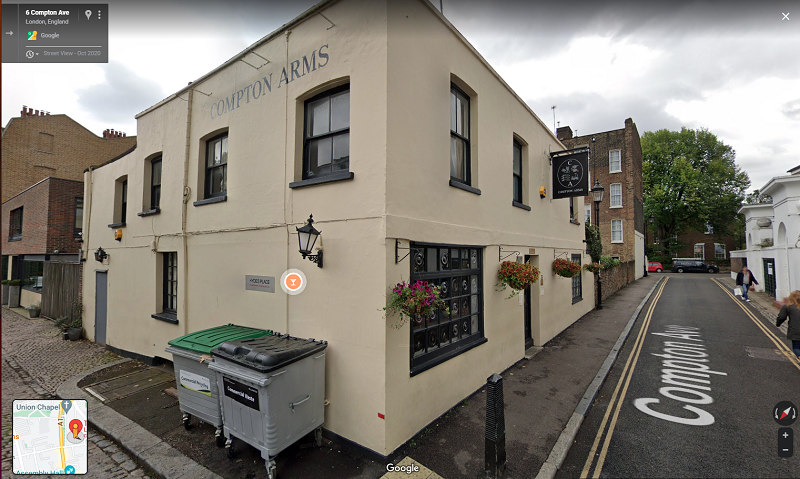
Google street view of the Compton Arms in Islington.
George Orwell’s favourite pub could be closed down because four neighbours have moaned about the noise.
A spectre is haunting Britain – the spectre of whingers. The dead hand of NIMBYism is felt on so many of our national crises, from the housing crisis to the “drought” to the energy crisis. The comfortably off classes have fought tooth and nail, all too successfully, in recent decades to block the building of anything – from houses to reservoirs – that might make life easier for everyone else. But their killjoy war on pubs might just be their most grating accomplishment.
The Compton Arms in Islington is the latest pub, still struggling in the wake of lockdown and now faced with soaring energy costs, to be threatened with closure over a handful of complaints. It’s been open since the 1800s. George Orwell drank there and it reportedly inspired his essay “The Moon Under Water”, published in the Evening Standard in 1946, which laid out his idea of the perfect pub. Now it has been slapped with a licence review by the local council after four neighbours complained that it was a “public nuisance” and posed a danger to health.
Given the Compton Arms was just voted the second-best pub in the UK by Time Out, with a review that hails its “seasonally led” “small-plates menu”, it seems unlikely to have become some den of criminal depravity. The furious explanation of Nick Stephens, the pub’s owner, seems more plausible – that some killjoys on this well-to-do Highbury side street got used to the pub being shut during lockdown and are now throwing their toys out of the pram.
“Our managers have gone to extreme lengths and worked their socks off to run the pub considerately (and exceptionally) – in spite of some more than challenging behaviour from some of the four complainants”, Stephens posted on Facebook. “A minority get used to the quiet then decide the pub that’s been there since the 1800s, that is an asset of community value, is now a nuisance.” He says that if this “minority of four” succeeds, the Compton won’t be financially viable “for us … or any other responsible operator”.
This is a story we have seen playing out time and again across the UK. An unholy alliance of whingers and council bureaucrats are shutting down and imposing punishing restrictions on much-loved pubs, stopping them from staying open later or blocking the opening of new venues over often ludicrous claims of noise and disruption. There seems to have been a particular flurry of this in recent months, following the end of lockdown and the entrenchment of working from home.
A Floating Airfield Made of Ice – WW2 Newsflash
World War Two
Published 23 Aug 2022In 1943, the British are working on a radical plan which could revolutionize the Allies’ productive capacity. It might sound crazy, but ice might be the magic material they need.
(more…)
Serbia ensures that we still have fresh concerns this summer
CDR Salamander on yet more potential trouble in the Balkans that has drawn some serious attention from the US Air Force:

USAF B-52 Stratofortress near the North Pole on 31 July, 2016 during the Polar Roar exercise.
Detail of original USAF photo by Senior Airman Joshua King via Wikimedia Commons.
I know everyone is busy and all … but you need to keep an eye on the usual problem areas.
You would think one war in Europe at a time would be enough, but you should never underestimate the Serbs.
As with most of us who were on active duty in the 1990s, I have more than a passing interest in the former Yugoslavia — and invested my quota of effort in its wars.
Later in my career I later served in NATO with Slovenes, Croatians, and N. Macedonians. I’ve vacationed a few times in Slovenia and Croatia. One of my daughters has studied, twice, in Serbia.
I keep an eye on it … and thankfully so are some smart people in The Pentagon.
The Balkans is always on the edge and has been for centuries, so it is only natural that now and then it bubbles over.
You may have missed with all the other news that the frozen conflict in Kosovo was throwing sparks again. That is why on Friday I tilted my head a bit with this announcement;
Two U.S. Air Force B-52 Stratofortress aircraft assigned to the 23rd Bomb Squadron currently operating out of RAF Fairford, United Kingdom, will conduct low approach flyovers over Southeastern Europe scheduled on August 22.
The purpose of each flyover is to demonstrate U.S. commitment and assurance to NATO Allies and partners located in Southeastern Europe. Additionally, this will provide citizens an opportunity to take photos, videos, and enjoy the aircraft flying overhead.
That told me that the Balkans desk has run their concerns up the chain and whatever they briefed was enough to greenlight a not insignificant display.
Sure enough, off it went Monday;
A pair of U.S. Air Force B52 strategic bombers on Monday flew low over the Croatian resort of Dubrovnik and three other NATO-member states in the region as a sign of support amid the Russian aggression in Ukraine.
In addition to the walled Croatian tourist resort of Dubrovnik, the aircraft flew over the government headquarters in Skopje, North Macedonia, the downtown Skanderbeg Square in the Albanian capital, Tirana, and up the Adriatic coast of Montenegro.
The Balkans and the Adriatic Sea have lately seen increased military, intelligence and propaganda activity by Moscow, which considers the region of its strategic interest because of its access to the Mediterranean.
Serbia is about Russia’s last friend in Europe and make no mistake … the Serbs do not consider borders settled anywhere — they are just waiting for the moment to be ripe.
A History of Ice Cream | A Recipe from 1789
Tasting History with Max Miller
Published 29 Jun 2021
(more…)
QotD: Cromwell dismisses the “Rump Parliament”
Ye are a factious crew, and enemies to all good government.
Ye are a pack of mercenary wretches, and would like Esau sell your country for a mess of pottage, and like Judas betray your God for a few pieces of money.
Is there a single virtue now remaining amongst you? Is there one vice you do not possess?
Ye have no more religion than my horse. Gold is your God. Which of you have not bartered your conscience for bribes? Is there a man amongst you that has the least care for the good of the Commonwealth?
Ye sordid prostitutes have you not defiled this sacred place, and turned the Lord’s temple into a den of thieves, by your immoral principles and wicked practices?
Ye are grown intolerably odious to the whole nation. You were deputed here by the people to get grievances redressed, are yourselves become the greatest grievance.
Your country therefore calls upon me to cleanse this Augean stable, by putting a final period to your iniquitous proceedings in this House; and which by God’s help, and the strength he has given me, I am now come to do.
I command ye therefore, upon the peril of your lives, to depart immediately out of this place.
Go, get you out! Make haste! Ye venal slaves be gone! So! Take away that shining bauble there, and lock up the doors.
In the name of God, go!
Oliver Cromwell, speaking to the so-called “Rump” Parliament, 1653-04-20.
August 23, 2022
Greece Burns Under Nazi Occupation – WAH 074 – August 21, 1943
World War Two
Published 21 Aug 2022The aerial bombing of Germany takes a new turn but continues to fail to bring long-term results. In occupied Greece and Poland, over a thousand children are murdered by the Nazis.
(more…)
QotD: The fate of suddenly poor Spartiates
First, we need to reiterate that a “poor” spartiate was still quite well off compared to the average citizen in many Greek poleis – we talk about “poor” spartiates the same way we talk about the “poor” gentry in a Jane Austen novel. None of them are actually poor in an absolute sense, they are only poor in the sense that they are the poorest of the rich, clinging to the bottom rung of the upper class.
Nevertheless, we should talk about them, because the consequences of falling off of that bottom rung of the economic ladder in Sparta were extremely severe because of the closed nature of the spartiate system. Here is the rub: membership in a syssition was a requirement of spartiate status, so failure to be a member in a syssition – either because of failure in the agoge or because a spartiate could no longer keep up the required mess contributions – that meant not being a spartiate anymore.
The term we have for ex-spartiates is hypomeiones (literally “the inferiors”), which seems to have been an informal term covering a range of individuals who were (or whose family were) spartiates, but had ceased to be so. The hypomeiones were, by all accounts, mostly despised by the spartiates and the hatred seems to have been mutual (Xen. Hell. 3.3.6). Interestingly in that passage there – Xenophon’s Hellenica 3.3.6 – he lists the Spartan underclasses in what appears to be rising order of status – first the helots (at the bottom), then the neodamodes (freed helots, one step up), then the hypomeiones, and then finally the perioikoi. The implication is that falling off of the bottom of the spartiate class due to cowardice, failure – or just poverty – meant falling below the largest group of free non-citizens, the perioikoi.
Herodotus gives some sense of the treatment of men who failed at being spartiates when he details the two survivors of Thermopylae – Aristodemus and Pantites. Both had been absent from the battle under orders – Pantites had been sent carrying a message and Aristodemus had suffered an infection. When they returned to Sparta, both were ostracized by the spartiates for failing to have died – Pantites hanged himself (Hdt. 7.232) while Aristodemus was held to have “redeemed” himself with a suicidal charge at Plataea which cost his life (Hdt. 7.231). And as a side note: Aristodemus is the model for 300’s narrator, Dilios – so when you see him in the movie, remember: the Spartan system drove these men to pointless suicide because they followed an order.
But my main point here is that falling out of the spartiate system meant social death. Remember that the spartiates are a closed class – failing at being a spartiate because your kleros is too poor to maintain the mess contribution means losing citizen status; it means your children cannot attend the agoge or become spartiates themselves. It means you, your wife, your entire family forever are shamed, their status as full members of society forever revoked and your social orbit collapses on you, since you are cut off from the very ties that bind you to your friends. No wonder Pantites preferred to hang himself.
In essence then, the core of the problem here is not that these poor spartiates were poor in any absolute sense – they weren’t. It was that the difference between being rich and being merely affluent in Sparta was a social abyss completely unlike any other Greek state. And that abyss was completely one way. As we’ll see – there was no way back.
Our sources are, unfortunately, profoundly uninterested in answering some crucial questions about the hypomeiones: did they keep their kleroi? What happened to the status of their children? What happened to the status of the women in their families? We can say one thing: it is clear that there was no “on-ramp” for hypomeiones to get back into the spartiate system. This is made quite clear, if by nothing else, by the collapsing number of spartiates (we’ll get to it), but also at the inability of extremely successful non-Spartan citizens – men like Gylippus and Lysander – to ever join the homoioi. Once a spartiate was a hypomeiones, they appear to have been so forever – along with any descendants they may have had. Once out, out for good.
All of that loops back to the impact of the great earthquake in 464. It is likely there were always spartiates who – because their kleroi were just a bit poorer, or were hit a bit harder by helot resistance, or for whatever reason – clung to the bottom of the spartiate system financially, struggling to make the contributions to the common mess. When the earthquake hit, the death of so many helots – on whom they relied for their economic basis – combined with the overall disruption seems to have pushed many of these men beyond the point where they could sustain themselves. Unlike in a normal Greek polis, they could not just take up some productive work to survive and continue as citizens, because that was forbidden to the spartiates, so they collapsed out of the class entirely.
(As an aside – the fact that wealthy spartiates, as mentioned, seemed to prefer each other’s company over the rest probably also meant that the social safety-net of the poor spartiates likely consisted of other poor spartiates. Perhaps in normal circumstances they remained stable by relying on each other (you help me in my bad year, I help you in yours – this is very common survival behavior in subsistence agriculture societies), but the earthquake – by hitting them all at once – may well have caused a downward spiral, as each spartiate who fell out of the system made the remainder more vulnerable, culminating in entire social groups falling out.)
As I said, our sources are uninterested in poor spartiates, so we can only imagine what it must have felt like, clinging desperately to the bottom of that social system, knowing how deep the hole was beneath you. One imagines the mounting despair of the spartiate wife whose job it is to manage the household trying to scrounge up the mess contributions out of an ever-shrinking pool of labor and produce, the increasing despair of her husband who because of the laws cannot do anything but watch as his household slides into oblivion. We cannot know for certain, but it certainly doesn’t seem like a particularly happy existence.
As for those who did fall out of the system we do not need to imagine because Xenophon – in a rare moment of candor – leaves us in no doubt what they felt. He puts it this way: “they [the leaders of a conspiracy against the spartiates] knew the secret of all of the others – the helots, the neodamodes, the hypomeiones, the perioikoi – for whenever mention was made of the spartiates among these men, not one of them could hide that he would gladly eat them raw” (Xen. Hell. 3.3.6; emphasis mine).
Bret Devereaux, “Collections: This. Isn’t. Sparta. Part IV: Spartan Wealth”, A Collection of Unmitigated Pedantry, 2019-08-29.
August 22, 2022
Sellers Home | Paul Sellers
Paul Sellers
Published 25 Apr 2022You are going to want a hot cup of tea or coffee with this one. It is something a little different. Paul has been working to build for his home, Sellers Home, all the hand-made furnishings that can practically be made from wood. This is the story of Paul, the story of woodworking and the story of Sellers Home.
We sometimes do something short and snappy for viewers but this is for those of you who want a deeper dive. Enjoy!
The full detailed projects are available with premium membership over on woodworkingmasterclasses.com (we will be switching to sellershome.com soon).
(more…)
QotD: The inevitability of World War 1
You can blame the usual suspects for a lot of this — the Kaiser et al are far too White and male to be worth spending time on, especially when you’ve got to devote so many weeks to Harriet Tubman and Rosa Parks. But the other reason — the far more important one for our purposes — is this: It’s a mystery to the teachers, too.
As academics who have never set foot in the real world, they take other academics’ words at face value. And the academics of 1913 couldn’t figure it out either. They pointed out that a general European war would cause the world’s financial system to collapse; ergo there would be no war. Besides, they argued, even if Germany did go to war, she lacked the natural resources to sustain the fight. And finally, they claimed, the firepower of modern infantry is just too overwhelming — given their rates of fire, two regiments equipped with machine guns would wipe each other out in less than two minutes.
Credit where it’s due: The eggheads were right about all of that. The global financial system did collapse; Germany as constituted at the outbreak of war didn’t have the resources to keep fighting; and the initial skirmishes showed the overwhelming impact of massed firepower. But the eggheads never learned that people are people, and since people love fighting more than anything else in the world, solutions were quickly found.
The United States, with its shiny new Federal Reserve system (created late 1913), was more than happy to step into the financial breach, just as American companies were more than happy to help Germany (and everyone else) with their armaments shortage. And Walther Rathenau happened, as my students would write, keeping the raw materials flowing to German industry. And faced with the overwhelming firepower of machine guns, soldiers ducked. Then they dug, and there’s your four years of bloody trench warfare.
Even the outbreak of the war, far from being a mystery, is painfully obvious if you know the first thing about the major players. In what historians call the Long 19th Century (1789-1914), it was taken for granted that a nation needed colonies to be a serious power. The reasoning behind this was never too sound, and by the turn of the 20th century various smart guys had figured out that on balance colonies were more trouble than they were worth, but pretty much by definition smart guys don’t hold on to the reins of power. Bismarck didn’t — the Berlin Conference was supposed to keep jingo knuckleheads like Wilhelm II from starting a war over a few acres of scrub jungle, but since Wilhelm II shared his class’s raging hardon for colonial expansion, all it ended up doing was sweeping Bismarck out of office. And as for Tsar Nicholas and his colonial adventures in the Balkans (and the Far East), one could write an entire book about that stupidity and still not cover all of it. Throw in England’s stuffed shirt of a king, and France’s legendary inability to maintain a stable government, and tragedy was inevitable.
In short, World War 1 was a massive, indescribably bloody dick-measuring contest between a few inbred yokels. To anyone who has met the Sons of Privilege*, or who is passingly familiar with the Peter Principle, this comes as no surprise. Hell, Lenin saw it, and a guy with his egg head further up his own ass you’ll never find.** All you have to do is look at the people, not the paper.
* they’re like the Sons of Anarchy, but effete and usually gay.
** though he basically just stole the idea from Hobson, who, though a goofy love-the-worlder, was actually a pretty smart guy.Severian, “1913”, Rotten Chestnuts, 2019-08-20.
August 21, 2022
The pandemic lockdowns heralded the “worldwide end of the Nuremburg code”
At Samizdata, Perry de Havilland considers how British culture has been impacted by many of the worst notions coming out of American culture in the last few years:

… support for Brexit, by no means confined to the lumpenproletariat of Guardian reader’s imagination, might not indicate what purveyors of the high status opinion fondly imagine. The conflation of Brexit with the “Trump phenomenon” was always overblown, given the deep social and structural differences between UK and USA. Yes, we are influenced by America, but we are not the same in oh so many ways.
But western civilisation, not just Britain, is undeniably going through a very strange phase. The insane and demonstrably pointless covid lockdowns seem to have had a pressure cooker effect, with every -ism being dialled up several notches. The mainstreaming of transsexuality, a largely harmless hobby until a lunatic fringe grabbed hold of it, indicates the world is not running in well-oiled grooves. An inability to define “what is a woman?”, by sages and politicians who nevertheless expect to be treated as serious people, would have seemed implausible just a few years ago.
But the covid lockdowns, that is the “biggie”: an egregious abridgement of liberty & common sense that placed the global economy into repeated bouts of cardiac arrest. The worldwide end of the Nuremburg code.
The lockdowns were an even more polarising issue that Brexit or Trump or indeed anything else. Why? Because there was no opt-out, you could not just go to work, or visit granny, no ability to ignore the whole thing and just head down the pub or retire for a macha latte in some café. The effects of that will be enduring. That was the issue that taught a lot of people to fear what other people believe to be true, and people always hate what they fear.
Now just wait to see what happens when the green lunacy that stopped investment in reliable power supply and new reservoirs means we start running out of power and water. I suspect that will be what makes the cork finally blow off.
Sicily Liberated; Italy in the Firing Line – WW2 – 208 – August 20, 1943
World War Two
Published 20 Aug 2022The British and Americans race for Messina to complete the conquest of Sicily — who will reach it first? On New Guinea, the Allies destroy a substantial Japanese air force; there are several major Allied air raids over Europe, the fighting in the USSR around Kharkov is brutal and costly for both sides, and a secret Allied leadership conference in Quebec begins to determine the course of the war. Busy week.
(more…)
History Summarized: The Acropolis
Overly Sarcastic Productions
Published 29 Apr 2022They say of the Acropolis, where the Parthenon is …
(more…)
August 20, 2022
How Turkey Fought a WW1 Peace Treaty – The Greek-Turkish War 1919-1923
The Great War
Published 19 Aug 2022The defeat of the Ottoman Empire in 1918 meant that it got its own peace treaty like the other three Central Powers. But the emerging Turkish National Movement under Mustafa Kemal resisted the Treaty of Sevres and occupation by various Entente Powers. Their successful resistance led to the creation of modern Turkey and the Treaty of Lausanne in 1923.
(more…)
The historical tourist attractions of Pisa
In the latest Age of Invention newsletter, Anton Howes talks about a recent trip to Italy, specifically the historically interesting places in Pisa and Lucca:

Galileo Galilei circa 1640.
Detail of an oil portrait by Justus Sustermans (1597-1681) from the National Maritime Museum via Wikimedia Commons.
Some are famous. Galileo Galilei, for example, is said to have used the leaning tower of Pisa to drop two spheres of different masses, to show that they would fall at the same speed — at least, that’s what his disciple Vincenzo Viviani claimed, ten years after Galileo’s death, and many decades after the alleged demonstration. Even if Viviani was being accurate, however, Galileo certainly wasn’t the first to demonstrate the concept. And Viviani mistakenly claimed priority for all sort of other scientific breakthroughs for his master, so like most other historians I’m inclined to doubt the story.
Nonetheless, Pisa was certainly Galileo’s birthplace — though it turns out that there are three different locations in the city to have claimed the honour over the years.
Galileo was initially thought to have been born in or near the fortress (its walls are impressive to look at and contain a pleasant garden). But this location was then refuted on the basis that for Galileo’s father Vincenzo Galilei to have lived in the fortress he would have had to have been a master at arms, which he was not. He was in fact a merchant and lute-maker. So in the nineteenth century a new location emerged: the casa Bocca, on the Stretto Borgo, which Vincenzo rented a few months before Galileo’s birth, and where the Galilei family lived for the next decade. It seemed a secure candidate for a while, except for a weird discrepancy: Galileo’s baptismal certificate assigned his birth to the wrong parish.
It then emerged that Galileo’s mother’s family — the Ammannati — lived in the correct parish, and that the custom of the time was for women to return to their parents’ home for the birth of their first child. Thus, the evidence points to Galileo having been born at the Casa Ammanati on the via Giusti. It’s a neat story of how a tourist destination can jump around based on new research, though there’s unfortunately not much to visit there other than a plaque.
In terms of things to actually see, one of the most impressive things in Pisa is the Museo delle Navi Antiche (Museum of Ancient Ships), which we found to be undeservedly deserted. Housed in the old stables for the city’s cavalry, and once the site of the Medici-era naval arsenal, the museum gives a fantastically thorough overview of the city from its Etruscan beginnings through to Roman subjugation, Ostrogothic invasion, Byzantine reconquest, and Longbeard settlement in the sixth century (although they’re usually called the Lombards, this comes from langobardi — literally, longbeards — so I think calling them that is both more accurate and more fun).
The museum’s highlight, however, is the ancient ships for which it is named, and which are incredibly well-preserved. I was stunned to see a massive actual wooden anchor, not just a reconstruction, of a cargo ship from the second century BC. It’s so well-preserved that you can even make out a decoration, carved into the wood, of a ray fish. The same goes for the rest of the various ships’ timbers. You can see almost all of their original hulls and planking, as well as finer details like rudder-oars, benches for the rowers, and in one case even the ship’s name carved into the wood — the Alkedo, which appears to have been a pleasure boat from the first century. Apparently, during excavation, the archaeologists could even make out the Alkedo‘s original red and white paint, as well as the impression left by an iron sheet that had covered its prow. The ships’ contents are often just as astonishing, with well-preserved baskets, fragments of clothing, and even bits of the rigging like its wooden pulleys and ropes. Well worth a visit.


