
World War Two
Published 4 Oct 2023Last episode we saw Klaus Fuchs steal details of the American atomic bomb for the Soviet Union. But he’s only one component of a much bigger conspiracy. Today, Astrid introduces you to the mysterious web of Soviet atomic spies. Their work changed our world forever.
(more…)
October 5, 2023
The Soviet Spies who Kickstarted the Nuclear Arms Race
Comments Off on The Soviet Spies who Kickstarted the Nuclear Arms Race
From Hilaire Belloc’s sailboat to your nearest international airport terminal
The most recent review at Mr. and Mrs. Psmith’s Bookshelf considers Hilaire Belloc’s The Cruise of the “Nona”:
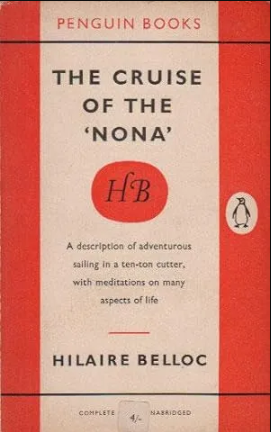
Late in the May of 1925, around midnight, Hilaire Belloc climbed into a tiny boat and put out to sea so that he would have some time to think. The sea gives ample time to think, especially if like Belloc you disdain the use of a motor. Some wag once jested that sailing is like being at war: long stretches of boredom punctuated by moments of abject terror. I suppose in some sense that’s correct, but give me the boredom of the sailboat any day over the boredom of the trench, the boredom of the cubicle, the boredom of endless doomscrolling.
Sailing is productive boredom, and seems unusually well calibrated for causing the mind to wander in interesting or delightful or just plain ridiculous directions. Maybe it’s the stimulating effects of the wind in your face and the smell of salt in the air, or maybe it’s the weird altered state of consciousness that comes from staring at the ocean. I think it’s because sailing is the human condition in miniature. It places you perfectly-balanced on a knife’s edge between agency and helplessness, and in so doing it both spurs the mind to activity and gives it space to relax and reflect.1
[…]
Anybody who’s travelled extensively in the third world has seen the modern version of this. There’s nothing intrinsic to being a reformer or a liberalizer that makes you an agent of American power, and yet … there’s a better than even chance that you are. After a while these people all blend together — the idealistic students, the LGBT activists, the NGO staffers, the embassy employees recruited from amongst the locals. They come from a hundred nations, from every conceivable race and religion, and yet something invisibly and inexorably molds them all into the same shape, like iron filings lining themselves up in the presence of a powerful magnet.
Soon they have American souls, and divided loyalties to match. The local regime panics and views them as an internal enemy, which only furthers their alienation from their motherland and their flight into the bosom of Global America. Most empires rule primarily though influence, not coercion, and this class of people is one of America’s most powerful weapons for maintaining and extending its hegemony.
A related phenomenon is the awful sameness that is slowly taking over the whole world. Perhaps your cruise ship docks at a dozen ports over the course of its journey, and every one of them looks exactly the same — the same tiki bar with the same sign, the same shops selling the same ornamental kitsch probably all made in the same factory. You aren’t visiting a place, you’re visiting a psychic manifestation of the Buffetverse, another outpost of Margaritaville, a Potemkin seaport with frozen daiquiris. You all know what I’m talking about. We make fun of it all the time, because cruise ships are for chuds. But it doesn’t just happen with cruise ships.
The cancer usually starts in an international airport. Form follows function, so it’s superficially reasonable that every airport on earth should look and feel exactly the same. But the real reason is that it follows in the wake of the kinds of people who fly into those airports, praising the broadening effects of foreign travel whilst terraforming everything they touch until it resembles the “arts district” of a midsize American city, replete with distressed wood finishes, gravid with craft beers. Real foreignness would cause these people to recoil in shock, or to demand a peacekeeping intervention. It’s not unusual for the imperial functionary class to be parochial, but what’s surreal about ours is how they combine the blinkered innocence of a farm boy with an ideology of weary cosmopolitanism.
None of this was as far along when Belloc took his little cruise, but the seeds had been planted, and he could feel in his bones that something horrible lay across the horizon. So he fights it the only way he knows how — by noticing and celebrating everything distinctive and local and weird about every place he visits. No island is too small for him to mention by name and recall a ghost story or two associated with it. No village is too commonplace for him to remark on the habits, physiognomy, and vices of the people who live in it. It’s the same spirit as that which animates Chesterton’s essay on cheese, but applied to a hundred hamlets and fishing ports, a paean to the regional diversity and distinctiveness that was already slipping away.
1. Oh hey, it’s the focused-mode and diffuse-mode of cognition! The best way to think deeply about anything is to toggle between them.
Comments Off on From Hilaire Belloc’s sailboat to your nearest international airport terminal
The Great War: Its End and Effects, Lecture by Prof Margaret MacMillan
McDonald Centre
Published 25 Jan 201922 January 2019, “How far did the Versailles Treaty make Peace?”, Professor Margaret MacMillan, Warden of St Antony’s College, Oxford. The lecture was sponsored by Christ Church Cathedral and the McDonald Centre for Theology, Ethics, and Public Life, Oxford.
Comments Off on The Great War: Its End and Effects, Lecture by Prof Margaret MacMillan
October 4, 2023
Paris under the Swastika – Collaboration and Resistance – On the Homefront 019
World War Two
Published 3 Oct 2023Occupied Paris, a paradoxical city of banality and brutality, of resistance and collaboration. Join Anna as she takes you on a tour of the city from occupation, the establishment of the Pétain regime and collaboration, the growth of resistance, and finally liberation. But the story doesn’t end there and into the 21st century, the city of lights is haunted by its occupation.
(more…)
Comments Off on Paris under the Swastika – Collaboration and Resistance – On the Homefront 019
Last Gasp of the German Maxim: the Air-Cooled MG 08/18
Forgotten Weapons
Published 7 Jun 2023The MG 08/18 was developed at the very end of World War One as a lighter alternative to the MG 08/15. It used an air-cooled barrel, and between not needing water and having lighter parts it managed to weigh about 6 pounds less than the 08/15. Only a few hundred appear to have been produced before the end of the war, and they were not used by the German military during the Weimar era (the Mg 08/15 was). The 08/18 barrel jacket served as the basis for the MG34 barrel shroud, interestingly.
Thanks to Limex for giving me access to this very rare gun to film for you!
(more…)
Comments Off on Last Gasp of the German Maxim: the Air-Cooled MG 08/18
QotD: The Witchburning and the “Mandate of Heaven”
Turning to more familiar Western examples, look at Germany, especially in contrast to England. Germany was on the forefront of every big social and economic change in the late Middle Ages, but you couldn’t blame their rulers for not handling it, because they didn’t have any. The minor princely states, the Electors of the Holy Roman Emperor, the Emperor himself, the Hanseatic League, and what have you — what could any of them do in the face of plagues and economic dislocations and terminal papal corruption and the massive intellectual upheaval of the printing press, even if their authority extended more than a few miles in any given direction, which it didn’t?
So they burned witches. The “European Witch Craze” of the 15th century has been a feminist bugbear for a long time, and one must naturally assume that pretty much all modern scholarship on it is uber-politicized hooey1, but it’s clear that there really were a lot of witch burnings in Germany in the 1400s. All that free-floating anxiety has to land somewhere, and since it’s pointless to blame the Margrave — he of the one decrepit castle and three square miles of territory — “witches” are a prime target. See also “the Period of the Wars of Religion” — is it any surprise that the most famous witchcraft stuff came from Germany just before the Reformation, or France in the depths of the religious wars, or England around the Civil War?
Clearly something is wrong with the universe – the Mandate of Heaven has been lost, not by any individual ruler necessarily, but by society. “Purity spirals” are also characteristic of these periods, and they quickly spiral out of control — see e.g. the Anabaptist Commune at Munster, or of course the Puritans.
Speaking of, the most famous-to-Americans example is the Salem Trials, and here we see all the trends converge. Not that the Puritans of Plymouth Bay would be so hubristic as to claim the Mantle of Heaven for themselves — Puritans were nothing if not ostentatiously self-effacing — but claim it they did, in deed if not in word, since Plymouth Bay was the closest thing one will ever get to a theocracy this side of Calvin’s Geneva (they burned their “witches”, too). And they just as clearly lost the Mandate — economic dislocations, a devastating Indian war brought about largely by their own hubristic incompetence, even a plague.
The aftermath of all this is fascinating. COVID, of course, is our new witch panic, and feel free to prognosticate on our current situation based on the life of Cotton Mather. The colony’s hottest young intellectual superstar in 1693, he went all-in on “spectral evidence” and the like, and by 1700 he was a joke on both sides of the Atlantic. So, too, with “critical race theory” and all the rest. There’s a racial awakening happening, kameraden, no doubt about that, but it has nothing to do with the eggheads’ fantasies. Those are just witch panics, and while witch panics are devastating to those caught in them, the wheel always turns sooner than later …
Severian, “Witch Trial Syndrome”, Rotten Chestnuts, 2021-01-27.
1. Which was also true of earlier scholarship, most famously Miss Murray’s The Witch-Cult in Western Europe, which is Marxist economics-level disproven, but still fervently believed by “Wiccans” everywhere.
Comments Off on QotD: The Witchburning and the “Mandate of Heaven”
October 2, 2023
The fall and rise of siege warfare
Sieges are probably about a year or so younger than the first fortified village — as soon as someone came up with the bright idea of throwing a wall around it for protection, some equally bright spark likely started coming up with ways to get inside that wall. In The Critic, Peter Caddick-Adams considers the eclipse and return of siege warfare in Europe in reviewing Iain MacGregor’s The Lighthouse of Stalingrad and Prit Buttar’s To Besiege a City: Leningrad 1941-42:
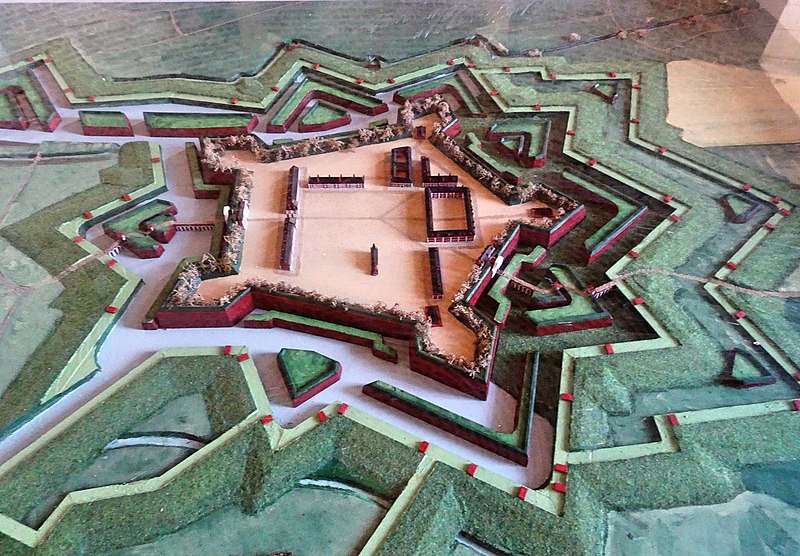
A model of the Vauban fortress at Arras in northern France. Arras is one of the Fortifications of Vauban, a UNESCO World Heritage Site.
Image via Wikimedia Commons.
The history of war is never far removed from battles for cities. Many of us, of whatever creed, were brought up on the story of the walls of Jericho tumbling after the Israelites marched around the stronghold once a day for six days, seven times on the seventh day, and then blew their trumpets. Though no archaeological evidence at Tell es-Sultan, in modern Palestine, corroborates the arresting visual image related in Joshua, Chapter 6, diggers have uncovered a range of defensive stone and brick walls dating back to 8,000 BC. It indicates that even 10,000 years ago, the ancients indulged in the odd siege when the mood took them. The biblical story also introduces us to the concept of intimidation, today fashionably called “psychological warfare”.
The much younger fortress of Troy provides insights into another city-focussed era of battles. Beneath today’s Hisarlik in northern Turkey are nine archaeological layers. Troy VIII was the alluring city of Classical and Hellenistic times, as portrayed in the Iliad, Homer’s Odyssey and Virgil’s Aeneid. The Romans took the lessons of Homeric Troy seriously and clad all their major settlements with defensive walls, as any exploration of Canterbury, Chester or York will confirm. These acted as magnets for opponents, as in Boudicca’s revolt of AD 60–61. Cities such as Colchester, London and St Albans were sacked, as much for what they represented as for their physical presence.
When the Normans arrived in their longships, they imported the concept of stone castles to control the newly conquered English. Their walled cities would be ungraded and contested scores of times over the succeeding six centuries. Henry V’s siege of Harfleur (modern Le Havre) in 1415, the beginning of the Agincourt campaign famously depicted in Shakespeare’s play, underlined the drawback of traditional sieges. They took longer and were usually far costlier than expected. Several thousand men camped in a small area with no knowledge of hygiene inevitably resulted in a high mortality rate amongst the attackers before a shot was fired.
Harfleur was also the first time an English army made use of gunpowder artillery in a siege, a technology that had trickled its way across the world from China. Powder and fuse heralded events 38 years later, when an Ottoman army shook the Christian world to its core by breaching the massive walls of Constantinople (Istanbul) after a 53-day bombardment using cannons. On Tuesday, 29 May 1453, stone finally gave way to bronze and iron, finishing the last remnant of the Roman Empire. Europe was never quite the same again. Fortress architecture started to employ breadth, using earthen ramparts and ditches, rather than height.
Strategy for urban warfare intensified during the lifetime of the French fortress engineer Vauban (1633–1707), who used landscaped terrain as well as geometrically designed defensive walls to deter would-be besiegers. When viewed from above, his fortification designs resemble starfish. So successful were his tactics that sieges, always costly and time-consuming, lessened in importance. His contemporary Marlborough recognised that on any cost-benefit analysis, Vauban had rendered sieges militarily unprofitable, restoring manoeuvre to campaigns.
Subsequent wars fought in the Napoleonic era, the Crimea, between the American North and South, and by Prussia generally reflected this return to mobility. There was the odd attritional discrepancy with the 1854–55 siege of Sevastopol, that of Petersburg in 1864–65 and Paris in 1870–71. Cities were still fought for, but usually contests were removed away from the walls, where forces could conduct wide sweeping manoeuvres, such as Leipzig in 1813 or Ypres in the Great War. As weapons grew more accurate and their munitions heavier, fortifications broadened and sank into the ground, culminating in the trenches of 1914–18. In this era, dominance of terrain became the hallmark, and it was virtually siege-free.
It was remarkable that urban warfare returned on an industrial scale during the Second World War, a time usually associated with blitzkrieg and rapid tank thrusts. This happened at Leningrad, Sevastopol and Stalingrad in the East; at Ortona and Cassino in Italy, Caen; Carentan and St Lo in Normandy; in Aachen and later assaults on Aschaffenburg and Cologne, Magdeburg, Leipzig and Berlin in 1945. Subsequent NATO doctrine for the defence of central Europe focussed on the threat of more attrition. Plans were devised to defend quite small localities, putting grit in the Soviet steamroller and making the cost of attacking Western towns and cities prohibitive.
Update: Broken URL corrected.
Comments Off on The fall and rise of siege warfare
Why France Lost Vietnam: The Battle of Dien Bien Phu
Real Time History
Published 29 Sept 2023After the French success in the Battle of Na San, the battle of Dien Bien Phu is supposed to defeat the Viet Minh once and for all. But instead the weeks-long siege becomes a symbol of the French defeat in Vietnam.
(more…)
Comments Off on Why France Lost Vietnam: The Battle of Dien Bien Phu
Why Web Filters Don’t Work: Penistone and the Scunthorpe Problem
Tom Scott
Published 6 Jun 2016In a small town with an unfortunate name, let’s talk about filtering and innuendo. And use it as an excuse for as many visual jokes as possible.
(more…)
Comments Off on Why Web Filters Don’t Work: Penistone and the Scunthorpe Problem
QotD: Who were the Celts?
From antiquity we have two standard terms. On the one hand, the Greeks encountered a people in the Mediterranean and called them keltoi. From Caesar and Strabo we know that at least some peoples called themselves keltoi (or celtae), though as we’re going to see the people who did this are not actually co-terminus with this military system or with all the people folks (including the original video) think of as Celtic or any identifiable polity or political structure. In particular, Caesar reports that the folks living in what is today France (then Gaul) north of the Garonne and south of the Marne and the Seine called themselves celtae, which he takes to be equivalent to the Latin galli (Caes. BGall. 1.1). Strabo, meanwhile, describes peoples in Spain as both keltoi and also keltiberes (which enters English as Celtiberians, Strabo, Geography 3.2.15) as well as those in Gaul (Geography 4.1ff), but doesn’t make the claim that they call themselves that (instead repeatedly noting these groups broken up into smaller tribal units with their own names). Both Caesar (Caes. BGall. 1.1) and Strabo (Geography 4.1.1) go out of their way to stress that the folks they’re talking about do not have the same languages, institutions or mode of life, even those who are, to Strabo, galatikos – “Gallic” or more precisely “Galatian-like” (referring to the sub-group of Gallic peoples the Greeks were the most familiar with).
Galli, rendered into modern English as “the Gauls” (though the latter is not a descendant of that word, but a wholly different derivation), is likewise tricky. We’re fairly sure that both keltoi and galli are Celtic-language words, meaning that (contrary to the video) they’re both probably “endonyms”, (a thing people call themselves) but it is really common for peoples in history to take the endonym of the first group of people they meet and apply it to a much larger group of “similar” (or not so similar) people. The example I use with my students is “Frank”; – it was common in both the Eastern Mediterranean and later in East Asia to use some derivative of “Frank” or “Frankish” to mean “Western or Central European” – the term got applied to the Portuguese in China, and to both Germans and Sicilian Normans during the Crusades. It’s possible that galli in Latin is connected to the Galatai (Greek) or Galatae (Latin), the Galatians, a Celtic-language speaking La Tène material culture group who migrated into Anatolia in the 270s, but a number of etymologies have been proposed. It certainly wouldn’t be the first time the Romans named a massive ethnic group after the first people they met; this is how we get the word “Greek” when the Greeks call themselves Hellenes. So assuming off the bat that all of these different tribal groups that Caesar or Strabo treat as a cultural unity thought of themselves that way is most unwise. The most we know is that if you called some of these folks (but not all of them, as we’ll see) keltoi or galli, they’d say, “yeah, I guess that more or less describes me”, perhaps in the same way describe a Swiss person as “European” isn’t wrong, but it also isn’t quite right.1
Surely here linguistics will help us out? If we can identify a Celtic language then surely everyone who speaks that language will have that culture? First, this is yet more question begging; English is the official language of South Sudan and yet the South Sudanese are not English, British or American. Linguistic connections do not always imply ethnic or cultural connections extending beyond language. And, in fact, examining the Celtic language family is a brilliant way to illustrate this.
There is, in fact, a family of Celtic languages and indeed it is only in the sense of languages which you will see me use the word Celtic in a formal way precisely to avoid the giant pickle of confusion we are currently working through. Very briefly, it has been shown linguistically that the various surviving Celtic languages are related to each other and also to the extinct languages of pre-Roman continental Europe that were spoken in Gaul, Noricum and parts of Spain. So far so good, right, we have a nice, perfect match between our keltoi and Celtic-language-speakers, right?
Of course not. That would be easy! Because notice there that Irish, Manx, Scottish Gaelic and Welsh are all Celtic languages. But our sources are actually quite clear that at least the Romans and the Greeks did not consider these folks to be galli or keltoi. Indeed, Strabo explicitly defines the people of Britain against the keltoi as two distinct groups, making it clear he doesn’t think the inhabitants of the British Isles were “Celts” (Geography 4.5.2); Caesar doesn’t either (BGall. 4.21ff). Tacitus sees in the britanniae evidence of German, Iberian and Gallic influence, marking them as distinct from all three, but concludes that Gallic settlement is the most likely cause, a point on which we may be quite certain he is wrong, for reasons discussed just below (Tac. Agr. 11). So the groups described as “Celts” don’t entirely overlap with Celtic language speakers.
Well, surely here the archaeologists can help us out, right? Yes and no. On the one hand, we have a collection of object types, artistic motifs and archaeologically visible patterns that we associate with some of the areas settled by people who our sources regard as “Celts” and who were Celtic language speakers. The older of these two material culture groupings we call “Halstatt culture” after the original type-site in Hallstatt, Austria, though we find Hallstatt culture objects (remember, these are objects, not people, a thing to be relevant in a moment) in a territorial range that forms a sort of crescent shape embracing the northern edges of the Alps, from around 1200 BC to around 500 BC. We then shift to a material culture pattern which may have developed out of late Hallstatt culture which we call La Tène culture after its type-site of La Tène in Switzerland; it runs from around 500 BC (very roughly) to around 50 AD, with lots of subdivisions.
And just about all of the folks our sources will identify as “Celts” or “Gauls” tend to live in areas where where we find, by the third century or so, at least some elements of La Tène material culture (and many in places where they have the full package). So do we at last have a way to identify some “Celts”, by matching wherever we find La Tène material culture?
No. Of course not. That would be easy and history is not easy.
First, not all of the people our sources describe as Celts adopt all or even most of the elements of La Tène material culture. Most notably, the folks in Iberia who were keltoi (according to Strabo) or Celtiberians have some elements of La Tène material culture, but are notably missing others. They don’t have, for instance, the whole La Tène military package – mail in particular is absent in Iberia until the Romans arrive, and the La Tène swords they have are local variations of early La Tène I swords by the third and second centuries, not the La Tène II swords we find in most of the rest of the cultural zone.2 The artistic style in “Celtic” Spain is also different and unsurprisingly there’s a lot of Iberian borrowing. As a result, archaeologically, the keltoi of south-western Iberia aren’t some sort of carbon-copy of the keltoi of central France. There’s not no connection here, they are Celtic-language speakers and they have some La Tène stuff, but the Iberian Celtici are quite a bit further from the Helvetii (the folks who probably inhabited the La Tène site) than, say, the Senones.
Meanwhile, we find some La Tène material culture objects in southern Britain, but they don’t fully penetrate the Isles (despite the general assumption that all of the people of Britain and Ireland were Celtic language speakers) and many appear to be expensive, high-status imports. Indeed, while it was once supposed that the arrival of La Tène material culture objects signified some invasion or settlement of Britain by people from Gaul, an analysis of burial patterns3 demonstrates pretty clearly that this isn’t happening in this period, because burial practices in southern Britain remain distinct from those on the continent. Instead, we’re seeing trade.
Meanwhile, we find tons of La Tène material culture objects in cultural contexts that we know were neither “Celtic” in any cultural sense nor filled with Celtic-language speakers. The clearest instance of these are in Illyria and Thrace, who spoke Indo-European but not Celtic language (so a language as close to Celtic languages as Latin or Greek or German), where it’s clear that folks adopted at least some La Tène material culture, including weapons and armor. Of course by the third century, when it came to militaria, we’d have the same problem with the Romans, who by the end of the Second Punic War, had adopted a La Tène sword (albeit from Spain and with a different suspension system), a variant of the La Tène shield, a La Tène helmet type (domestically manufactured), and La Tène body armor (mail). If we didn’t have any surviving Latin language material, I am almost certain there would be nationalist pseudo-archaeologists claiming the Roman Empire was clearly some “pan-Celtic” imperial construct on that basis.4 And of course in the third century, a Greek variant of the La Tène shield, the thureos, begins showing up everywhere in the Hellenistic East, but that doesn’t make them Celts either (they’d be the first to tell you).
Meanwhile, there’s even more complexity than this, because objects of La Tène material culture aren’t the whole of archaeologically visible culture. There are building habits, burial habits, evidence for social organization and on and on. And those vary significantly within the La Tène material culture zone. I put this in the bibliography and I’m afraid it is a (necessarily) difficult and technical read, but if you want to get a sense of just how complex this can get, check out Rachel Pope’s efforts to define the Celts in the Journal of Archaeological Research (2022). To quote some of her conclusions, “In fact, ‘Celts’ as a historical label does not map neatly onto any archaeological tradition; it overlaps with late Hallstatt traditions in northeast France and less ostentatious archaeologies farther west … Nor did the name ‘Celt’ ever equate to all of Gaul, let alone all of Europe.”
So to be clear, we have Celtic-language speakers who aren’t called Celts by our sources and don’t have La Tène material culture (Ireland, N. Britain), Celtic-language speakers who are called Celts by our sources but don’t have the full La Tène material culture package (Spain, Portugal), non-Celtic language speakers who do have some of the La Tène material culture package but who are clearly not Celts to our sources (Thracians, Illyrians, Dacians, etc.), full La Tène material culture-havers who are explicitly not Celts in our sources (Caesar, specifically) and maybe speak a Celtic-language (the Belgae), and partial La Tène material-culture-havers who do speak a Celtic language but are still explicitly not Celts in our sources (S. Britain). Oh, and while we’re here, by the second century we also have La Tène material culture-havers who probably still speak a Celtic-language and are called Celts/galli by our sources but write inscriptions in Greek (the Galatians) and seem to have different religious structures and folks identified as Celts in our sources who are in the process of ditching large parts of La Tène material culture and learning Latin (Cisalpine Gaul), who might, à la Pope (op. cit.), actually be the direct, local descendants of the “original” Celts.
And then of course we have a band across parts of the Alps and central France where everything lines up: Celtic-language speakers with La Tène material culture who our sources call keltoi or galli and live in a place called Gallia by the Romans. But it would be a mistake to assume this is the cultural “heartland” of a “Celtic” people – indeed, La Tène material culture may be more deeply rooted in more Northern parts of France [than in] the Danube region, which has a lot of non-Celtic language speakers in it in this period! Because, to be clear, what we actually have are a host of smaller, tribal societies which share come cultural elements and differ in others, who seem to think of themselves primarily as members of a tribe and who lack notable “pan-Celtic” institutions, to which Greeks and Romans, needing a way to label their neighbors, took whatever ethnic signifiers they had and applied them (over)broadly.
[…]
At no point where all of these people united in a single polity (the closest they get is that most of them get conquered by the Romans) and there’s no indication that they ever saw themselves as a cultural or ethnic unity. And of course we haven’t even gotten into the idea that they might all be somehow closely ethnically related but let’s just go ahead and tag that as “very unlikely” and keep moving.
All of that is to make the point that any treatment of “Celtic” warfare is immediately begging an enormous question because “who were the Celts?” is at best an unanswered question and to be frank, probably an unanswerable question. Crucially, “the Celts” do not share a military system. Warfare among Celtic-language speakers in the British Isles isn’t necessarily based around La Tène material culture, nor is warfare in S. Portugal among peoples identified by our sources as keltoi; both areas seem to have very substantial regional variation. By contrast, the galli of central France and Cisalpine Gaul do seem to share at least substantial elements of a military system with the – according to Caesar – non-celtae of broader Gaul and as well as with the Galatians who live, I must repeat, in Anatolia (having migrated there in the third century). There is thus no “Celtic” military system which maps clearly onto either Celtic-language distribution or peoples described as keltoi by our sources.
Bret Devereaux, “Collections: Who Were ‘the Celts’ and How Did They (Some of Them) Fight?”, A Collection of Unmitigated Pedantry, 2023-05-12.
1. Especially in the sense that “European” gets used to mean “citizen of a country in the European Union”, which Switzerland is not. Mostly. The EU is complicated.
2. On these differences, see F. Quesada Sanz, “Patterns of Interaction: ‘Celtic’ and ‘Iberian’ weapons in Iron Age Spain” in Celtic Connections, vol. 2, eds. W. Gillies and D.W. Harding (2005) and in even more detail F. Quesada Sanz, “El Armamento Ibérico. Estudio tipológico, geográfico, functional, social y simbólico de las armas en la Cultura ibérica” (siglos VI-I a.C.) (1997). Interestingly, the Roman gladius Hispaniensis seems likely to have been a Roman adaptation of the peculiar Iberian La Tène swords, so you have the La Tène I sword making its way to Iberia, becoming distinctive, being adopted by the Romans instead of the more common (to them) La Tène II sword, thus becoming the gladius. On this, see F. Quesada Sanz, “Gladius Hispaniensis: an Archaeological View from Iberia” JRMES 8 (1997).
3. On this, see S. James, The Atlantic Celts: Ancient People or Modern Invention (1999).
4. On this, see M.J. Taylor, “Panoply and Identity During the Roman Republic” PBSR 88 (2020). On the helmet type and its evolution, see U. Schaaff, “Keltische Helme”, in Antike Helme (1988) for a rundown; P. Connolly Greece and Rome At War (1981), 121 also has a fantastic visual chart of the development of the type in the La Tène material culture zone, where you can see quite clearly where in the fourth century the Italic variants of this helmet type are breaking off from, while the La Tène helmets continue their development in other directions, later to be re-adopted by the Romans who thought it was so nice, they borrowed it twice.
Comments Off on QotD: Who were the Celts?
October 1, 2023
The End of Market Garden – WW2 – Week 266 – September 30, 1944
World War Two
Published 30 Sep 2023This week, Operation Market Garden comes to its unsuccessful conclusion, but there’s a lot more going on — the Soviets launch an offensive in the Estonian Archipelago, the Warsaw Uprising is on the ropes, the Allies advance in Italy, the Americans on Peleliu, and Tito and Stalin make plans to clear Yugoslavia of the enemy.
(more…)
Comments Off on The End of Market Garden – WW2 – Week 266 – September 30, 1944
MGD PM9 Rotary-Action Submachine Gun
Forgotten Weapons
Published 23 May 2017The PM9 was an interesting an unique submachine gun designed by Louis Debuit for the French firm Merlin and Gerin (hence the MGD name – Merlin, Gerin, Debuit) in the late 1940s and early 50s. The design was intended to provide a very compact package, which it did with a very short action, folding stock, and folding magazine.
The PM9 uses a delayed blowback action, and the delaying is done by a rotating flywheel-type block and clock spring. The bolt and flywheel act somewhat like the piston and crank in an engine. As the bolt (piston) moved rearward in a straight line, it forces the flywheel (crank) to rotate because the two are connected. In the case of the PM9, the connection is a nub on the flywheel that rides in a vertical slot in the bolt. The flywheel is pushing against the clock spring to rotate, and the combination of the its inertia and spring pressure keep the bolt closed long enough for pressure to drop to a safe level. The rotary action allows this to be done in a much smaller package than typical submachine guns.
The PM9 was initially chambered for 7.65 French Long, but quickly changed to standard 9mm Parabellum for the production models. It used the same magazine as the German MP38/MP40, giving it a 32-round capacity. In addition to the model with a skeletonized folding stock, the PM9 was also available with a fixed wooden stock and either short barrel of long carbine barrel. A relatively small number of guns were produced in France in 1954 and 1955, but they failed to find commercial success. In 1956 the German Erma company acquired a license to build the PM9, but abandoned the idea after making a few prototypes.
(more…)
Comments Off on MGD PM9 Rotary-Action Submachine Gun
September 30, 2023
The Man Who Stole the Atomic Bomb
World War Two
Published 29 Sep 2023In the New Mexico desert, a secret team of scientists is working flat out to develop atomic bombs. It’s the most important American military project in history. But one of those scientists lives a double life. Klaus Fuchs has decided to betray his country and share America’s most secret technology with the Soviet Union. But is he the only person who has turned traitor?
(more…)
Comments Off on The Man Who Stole the Atomic Bomb
Multiculturalism has led to a “promissory note that the West cannot fulfill”
Colby Cosh on a recent speech by British Home Secretary Suella Braverman decrying the inevitable result of western multicultural attitudes and actions:

The Rt Hon Suella Braverman KC MP, Secretary of State for the Home Department.
Picture by Rory Arnold / No 10 Downing Street via Wikimedia Commons.
U.K. Home Secretary Suella Braverman’s scathing criticism of the postwar framework for refugee protection needs to be considered, but is falling on deaf ears
The concept of multiculturalism, whether you like it or not, is of acknowledged Canadian origin. So perhaps we should all flinch a little when it is grumblingly condemned by European leaders — an increasingly common phenomenon that may have reached a new pinnacle on Tuesday.
Suella Braverman, the United Kingdom’s Conservative home secretary, appeared at the Washington, D.C., headquarters of the American Enterprise Institute to deliver a resounding critique of the postwar framework for refugee protection and of the “misguided” and “toxic” multiculturalism doctrine that has bent it out of shape.
Braverman’s speech is meeting with an orgy of denunciation among British liberals and celebrities. On the other hand, the inevitable fate of the speech is to be laughed off by anti-immigration critics who have heard British and European politicians warn for decades that humanitarianism cannot be a suicide pact for Old World nation-states — without ever doing anything much themselves to change migration policy.
In Braverman’s account, European countries devised the United Nations Refugee Convention largely to sort out the continent’s own affairs in the aftermath of the Second World War. Refugees are defined in the text as those with a “well-founded fear of being persecuted,” but the treaty is now interpreted so as to permit ill-disguised economic migration, to encourage unlawful and risky crossings of seas and borders, and to facilitate prolonged shopping by migrants among desirable destination countries.
The result, for better or worse, is that refugee protections are now potentially available to nigh on a billion people, creating a “promissory note that the West cannot fulfill.” (Or, as French President Emmanuel Macron put it a few days ago, “We (Europeans) cannot accommodate all the misery in the world.”) Braverman enumerates four critiques of a period in which “there has been more migration to the U.K. and Europe … than in all the time that went before.”
Comments Off on Multiculturalism has led to a “promissory note that the West cannot fulfill”
Why did the North Africa Campaign Matter in WW2?
The Intel Report
Published 8 Jun 2023As Erwin Rommel’s Afrika Korps rolled into Egypt in 1942, the only thing standing between them and Cairo and the Suez Canal was the British 8th Army. In this video we look at what was at stake for both sides, and why the North African campaign made a crucial impact on the outcome of the Second World War.
(more…)
Comments Off on Why did the North Africa Campaign Matter in WW2?


