
World War Two
Published 28 Sep 2023Jet planes and jet engine technology revolutionized air travel, as we are all well aware. However, the development of jet planes during WW2 was fraught with all sorts of obstacles and hurdles. Let’s take a look at it.
(more…)
September 29, 2023
WW2 Jet Engine Development
Comments Off on WW2 Jet Engine Development
History-Makers: Plato
Overly Sarcastic Productions
Published 9 Jun 2023For the best experience, project this video onto the wall of a cave.
SOURCES & Further Reading:
Five Dialogues by Plato, translation and introduction by G.M.A. Grube – Introductory Readings in Ancient Greek and Roman Philosophy, Second Edition, edited by C.D.C. Reeve and Patrick Lee Miller – Plato Vol I: Euthyphro Apology Crito and Phaedo from Loeb Classical Library, Edited and Translated by Chris Emlyn-Jones and William Preddy. Stanford Encyclopedia of Philosophy: Plato https://plato.stanford.edu/entries/pl…
I also have a degree in Classical Studies, specifically in “Classics and Philosophy”
(more…)
Comments Off on History-Makers: Plato
September 28, 2023
Gaulois Palm Pistol
Forgotten Weapons
Published 23 Nov 2014The Gaulois (Gallic) was a compact squeeze-type palm pistol made by the Manufrance concern in St. Etienne in the 1890s. It held 5 rounds of 8mm ammunition (similar to the .32 Extra-Short used in other types of palm pistols) and was fired by squeezing the rear grip into the body of the gun.
As with the other weapons of this type that achieved some popularity in the 1880s through early 1900s, the Gaulois eventually faded from the market because of the improvements in conventional handguns. Something like a compact Iver Johnson revolver offered all the capabilities (if not more) of a Chicago Protector or My Friend or Gaulois, without the loading and aiming difficulties of those designs.
(more…)
Comments Off on Gaulois Palm Pistol
September 27, 2023
The British army between 1918 and 1940
Richard Dannatt and Robert Lyman recently published Victory to Defeat, which chronicles the decline of the British army’s fighting capabilities in the interwar years. Robert Lyman posted a longer version of Gordon Corrigan’s review for Aspects of History (with permission):
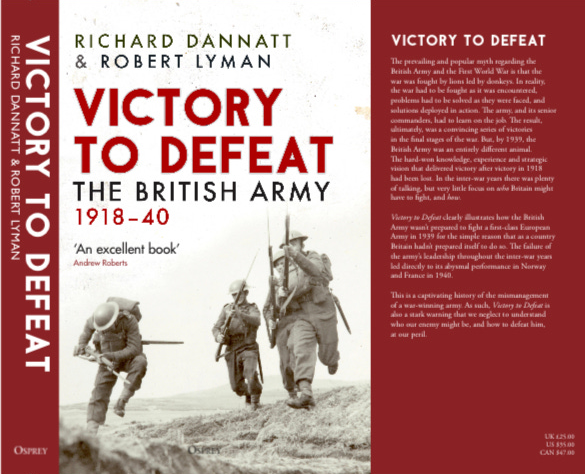
The British Army ended the First World War well trained, well led, well equipped and capable of engaging in all arms intensive warfare. Of all the players, on both sides, this army was unquestionably the most capable of deployment against a first class enemy anywhere in the world. Twenty years later it found itself with very much the same equipment, but with very much less of it, and devoid of either the ability or the means to fight a war in Europe against an enemy which had absorbed the lessons of 1918 but which the British had forgotten. It was the British Army that had invented blitzkrieg (although of course they did not call it that, a term coined by the French press very much later) and used it during the Battle of Amiens and on into the “Hundred Days” that saw the defeat of the German Army on the battlefield, and whatever German myth later averred, it was the British Army that forced that victory on the Western Front, not the French and not the Americans. And yet, in 1939 and 1940 the British were roundly defeated in France and Belgium, in Greece, in Crete and in North Africa. In this important – and to this reviewer almost heart rending – book the authors describe how and why the victors of 1918 were allowed to become incapable of fighting intensive warfare a mere two decades later.
In the first part of the book the authors describe the build up to the First War, and their explanation of the so called “Curragh Mutiny” is much more accurate than many accounts by others (although the officers did not threaten to disobey orders, only to resign, and while Carson’s Ulster Volunteers were indeed incorporated into the British Army as the 36th Ulster Division, so were Redmond’s National Volunteers, into the 16th Irish Division). The authors then go on to show how the British government had, albeit reluctantly, accepted a continental commitment in 1914 and had despatched an expeditionary force to Belgium, described then and later as the finest body of troops ever to leave these shores. Fine they certainly were, well trained, well led and well equipped, but the British Expeditionary Force (BEF) of professional regular soldiers was pitifully small, and with experience of imperial policing and not of war against a first class enemy. With the need to expand enormously and rapidly, this army had to adapt to a theatre where massed artillery, machine guns and barbed wire made any attempt to manoeuvre almost impossible. The book shows how by trial and error, by analysis of operations and by a gradually developing doctrine the British learned to use a combination of all arms to break through German defences and eventually to defeat them. With the infantry, the artillery, the armour, the engineers and increasingly the air all working together to get inside the enemy’s decision making circle, to get him on the back foot and keep him there, these were the elements of blitzkrieg, but it was the defeated Germans who were to absorb those principles and perfect them until twenty years after their defeat they were the most competent army in Europe.
After an excellent account of the British journey from an imperial gendarmerie to a practitioner of intensive war, the next part of the book shows how and why by the time the Second World War came along the British were incapable, not only of deterring war, but of fighting it. The “ten year rule”; the reluctance of governments to spend on defence; the political refusal to contemplate another war in Europe and the reluctance of the public to contemplate another bloodletting like that of the First War; the inability to experiment or to develop tanks and armoured vehicles; the seeming impossibility of reconciling the twin requirements of imperial policing and any commitment to land operations in Europe with the assets available; the myth of the “bomber will always get through” and the absence of any consistent war fighting doctrine, all are lucidly explained. Much of the fault is shown to lie with politicians, and surely the most disgraceful example of political interference was the sacking of the Chief of the Imperial General Staff (CIGS), the professional head of the army, by the leaving of a note on his desk by the very dubious Secretary of State for War, Hore-Belisha. The generals are not spared, however. Despite restrictions on funding and refusal by governments to accept that another war was looming generals could have spoken out, although it does have to be recognised that in a democracy the civil power is paramount.
September 26, 2023
Postwar Warsaw became beautiful, but postwar Coventry became a modernist eyesore
Ed West’s Wrong Side of History remembers how the devastation of Warsaw during World War 2 was replaced by as true a copy as the Poles could manage, while Coventry — a by-word for urban destruction in Britain — became a plaything in the hands of urban planners:
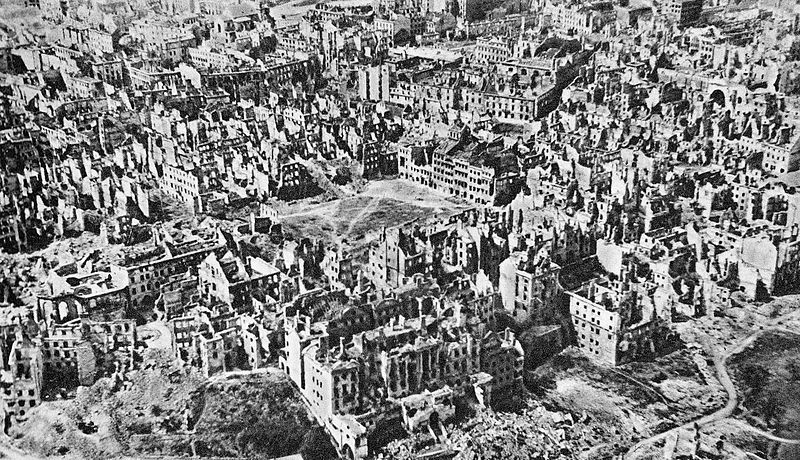
Stare Miasto w Warszawie po wojnie (Old Town in Warsaw after the war)
Polish Press Agency via Wikimedia Commons.
Fifteen months after its Jewish ghetto rose up in a last ditch attempt to avoid annihilation, the people of the city carried out one final act of defiance against Nazi occupation in August 1944.
The Soviets, having helped to start the war in 1939 with the fourth partition of Poland, deliberately halted their advance and refused to help the city in its torment. Without Russian cooperation, the western allies could do little more than an airlift of weapons and supplies, which was doomed to failure.
The Polish Army and resistance fought bravely – some 20,000 Germans were killed or wounded – but at huge cost. As many as 200,000 Poles, most civilians, were killed in the battle and over 80% of the city destroyed – worse destruction than Hiroshima or Nagasaki. And so the Nazis had carried out their plan to erase the Polish capital — yet this was something the Poles refused to accept, even after 1944
Today the Old Town is as beautiful as it ever was, and visitors from around the world come to walk its streets – witnesses to perhaps the most remarkable ever story of urban rebirth.
With the city a pile of rubble and corpses, the post-war communist authorities considered moving the capital elsewhere, and some suggested that the remains of Warsaw be left as a memorial to war, but the civic leaders insisted otherwise – the city would rise again
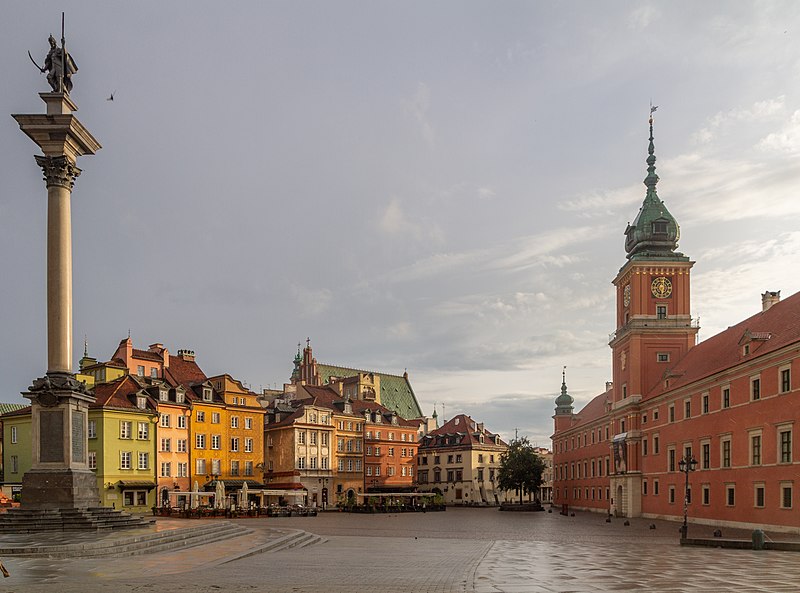
Plac Zamkowy, Warszawa (Castle Square in Warsaw)
Photo by Makxym Kozlenko via Wikimedia Commons.
Warsaw was fought over, bombed, shelled, invaded and twice was the epicentre of brutal urban guerilla warfare, leaving the city in literal ruins. Coventry, on the other hand, wasn’t bombed by the Luftwaffe until 1940 — but the damage had already began at the hands of the urban planners:
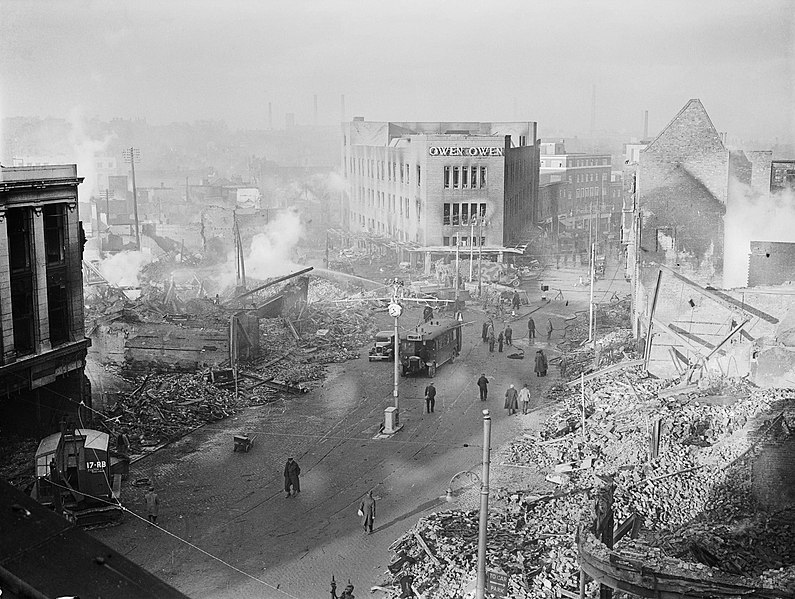
Broadgate in Coventry city centre following the Coventry Blitz of 14/15 November 1940. The burnt out shell of the Owen Owen department store (which had only opened in 1937) overlooks a scene of devastation.
War Office photo via Wikimedia Commons.
The attack was devastating, to the local people and the national psyche, and local historian W.G. Hoskins wrote that “For English people, at least, the word Coventry has had a special sound ever since that night”. Yet Coventry also became a byword for how to not to rebuild a city – indeed the city authorities even saw the Blitz as an opportunity to remake the city in their own image.
Coventry forms a chapter in Gavin Stamp’s Britain’s Lost Cities, a remarkable – if depressing – coffee table book illustrating what was done to our urban centres. Stamp wrote:
British propaganda was quick to exploit this catastrophe to emphasise German ruthlessness and barbarism and to make Coventry into a symbol of British resilience. Photographs of the ruins of the ancient Cathedral were published around the world, and it was insisted that it would rise again, just as the city itself would be replanned and rebuilt, better than before.
But the story of the destruction of Coventry is not so simple or straightforward. … severe as the damage was, a large number of ancient buildings survived the war – only to be destroyed in the cause of replanning the city. But what is most shocking is that the finest streets of old Coventry, filled with picturesque half-timbered houses, had been swept away before the outbreak of war – destroyed not by the Luftwaffe but by the City Engineer. Even without the second world war, old Coventry would probably have been planned out of existence anyway.
In one respect, Coventry had been ready for the attacks … the vision of “Coventry of Tomorrow” was exhibited in May 1940 – before the bombing started. [City engineer] Gibson later recalled that “we used to watch from the roof to see which buildings were blazing and then dash downstairs to check how much easier it would be to put our plans into action”.
The Society for the Protection of Ancient Buildings had estimated that 120 timber houses had survived the war … two thirds of these would disappear over the next few years as the city engineer pressed forward with his plans … A few buildings were retained, but removed from their original sites and moved to Spon Street as a sanitised and inauthentic historic quarter.
Today, whatever integrity the post-war building ever had has been undermined by subsequent undistinguished alterations and replacements. Coventry has been more transformed in the 20th century than any other city in Britain, both in terms of its buildings and street pattern. The three medieval spires may still stand, but otherwise the appearance of England’s Nuremberg can only be appreciated in old photographs.
In fact, the destruction had begun before the war. In order to make the city easier for drivers, the west side had been knocked down in the 1930s, the area around Chapel St and Fleet St replaced by Corporation St in 1929-1931. After the war it would become a shopping centre.
Old buildings by Holy Trinity Church were destroyed in 1936-7, and that same year Butcher Row and the Bull Ring were similarly pulled down, the Lord Mayor calling the former “a blot in the city”.
Indeed, the city architect Donald Gibson hailed the Blitz as “a blessing in disguise. The Jerries cleared out the core of the city, a chaotic mess, and now we can start anew.” He said later that “We used to watch from the roof to see which buildings were blazing and then dash downstairs to check how much easier it would be to put our plans into action”.
Gibson’s plan became city council policy in February 1941, with a new civic centre and a shopping precinct inside a ring road. The City Engineer Ernest Ford wanted to preserve some old buildings, including the timber Ford’s Hospital, which had survived the Blitz. Gibson said it was an “unnecessary problem” and in the way of a new straight road.
Comments Off on Postwar Warsaw became beautiful, but postwar Coventry became a modernist eyesore
“Brothers in Arms” | The Bands of HM Royal Marines
The Bands of HM Royal Marines
Published 23 May 2022“Brothers in Arms” by Dire Straits, arranged by Capt Phil Trudgeon RM, and performed at the Mountbatten Festival of Music 2022 in the Royal Albert Hall, London.
(more…)
Comments Off on “Brothers in Arms” | The Bands of HM Royal Marines
QotD: Bad kings, mad kings, and bad, mad kings
An incompetent king doesn’t invalidate the very notion of monarchy, as monarchs are men and men are fallible. A bad, mad king (or a minor child) would surely find himself sidelined, or suffering an unfortunate hunting accident, or in extreme cases deposed, but the process of replacing X with Y on the throne didn’t invalidate monarchy per se. Deposing a king for incompetence was a very dangerous maneuver for lots of reasons, but it could be, and was, recast as a kind of “mandate of heaven” thing. Though they of course didn’t say that, the notion wasn’t a particularly tough sell in the age of Avignon and Antipopes.
But notice the implied question here: Sold to whom?
That’s where the idea of “information velocity” comes in. Exaggerating only a little for effect: Most subjects of most monarchs in the Medieval period had only the vaguest idea of who the king even was. Yeah, sure, theoretically you know that your lord’s lord’s lord owes homage to some guy called “Edward II” – that whole “feudal pyramid” thing – but as to who he might be, who cares? You’ll never lay eyes on the guy, except maybe as a face on a coin … and when will you ever even see one of those? So when you finally hear, weeks or months or years after the fact, that “Richard II” has been deposed, well … vive le roi, I guess. Meet the new boss, same as the old boss, and meanwhile life goes on the same as it ever did.
Information velocity out to the sticks, in other words, was very low. By the time you find out what the great and the good are up to, it’s already over. And, of course, the reverse – so long as the taxes come in on time, on the rare occasions they’re levied (imagine that!), the king doesn’t much care what his vassal’s vassals’ vassals’ vassals are up to.
Severian, “Inertia and Incompetence”, Founding Questions, 2020-12-25.
Comments Off on QotD: Bad kings, mad kings, and bad, mad kings
September 25, 2023
Girardoni Air Gun (original 1780 example)
Forgotten Weapons
Published 7 Jun 2014The Girardoni (also spelled Girandoni) air rifle was a very advanced design adopted in 1780 by the Austrian Army. While the standard arm of the day was a single-shot flintlock, the Girardoni offered a massive firepower advantage to the men who carried it. The guns (designed by Bartholomäus Girardoni, of Vienna) had a magazine capacity of 22 round balls, which could all be fired within 60 seconds. The balls were .46 caliber, weighing approximately 153 grains, and were propelled at 400-450 feet per second. They were rumored to be silent, but actually had a loud report (although quieter than gunpowder firearms). One of these rifles was carried by the Lewis & Clark expedition into the American West.
The Austrian Army used them for a relatively short time — they were taken out of service by Imperial order in 1788, and issued back to Tyrolian sniper units only in 1792. The reasons for their replacement were more logistical than the result of any actual shortcoming with Girardoni’s design. The problem was that they required special training to use (compared to a normal firearm), required specially trained and equipped gunsmiths to repair and maintain, and difficulty maintaining them in combat conditions. Dr. Robert Beeman has written an outstanding illustrated article on Austrian airguns in general and the Girardoni in particular, which I highly recommend for anyone interested in more detail on these fascinating weapons:
http://www.beemans.net/Austrian%20air…
However, I am privileged to be able to share with you this video of an original 1780 Girardoni put together by Luke Haag for presentation at the 2014 AFTE conference in Seattle. Mr. Haag does a great job explaining the operation of the gun, its capabilities and accessories.
Comments Off on Girardoni Air Gun (original 1780 example)
September 24, 2023
Operation Market Garden Begins – WW2 – Week 265 – September 23, 1944
World War Two
Published 23 Sep 2023Monty’s Operation(s) Market Garden, to drop men deep in the German rear in the Netherlands and secure a series of bridges, begins this week, but has serious trouble. In Italy the Allies take Rimini and San Marino, but over in the south seas in Peleliu the Americans have serious problems with Japanese resistance. Finland and the USSR sign an armistice, and in Estonia the Soviets take Tallinn, and there are Soviet plans being made to enter Yugoslavia.
(more…)
Comments Off on Operation Market Garden Begins – WW2 – Week 265 – September 23, 1944
QotD: The composition of the polis
So what is an oikos? Well that word is about as plastic as polis. Oikos can mean a house (as in a physical building), or it can mean a household (as in the family that dwells in that building) or it can mean all of the property of that household, and indeed Greek writers will use this word to mean all of these things, often in the same context (that is they shift freely between these linked meanings, not seeing them as fully distinct). Now as a “family” we should note that an oikos was rather more extensive than our sense of family (though rather less extensive than the Roman concept of a familia and a lot less extensive than a Roman gens; we’ll come to these in a later series): an oikos consisted of all of the people who lived together in a house, which generally meant the adult citizen male, his wife and dependents and also their enslaved workers. It that family had enslaved workers who did not live with them, they also generally counted as part of the oikos because they were understood as the property of it.
The creation of a polis meant merging all of these things together in a very literal way. In a physical sense the creation of a town core meant literally putting houses together, as a good part of the population might move to live in that town core (with their farms just outside the town in walking distance, remember: most of these poleis are very small). Indeed M.H. Hansen notes in the introductory article on synoikismos in the Inventory that the only “purely political synoecism” – that is, a synoikismos that did not involve actually moving people to form or merge with a new town center but merely politically united existing geographically distinct communities – occurs in myth in Theseus’ supposed creation of the Athenian poleis. That this sort of synoikismos never happens in the historical period (there’s an attempt in Ionia in 547/6 but it never gets off the ground) ought to suggest that it probably didn’t happen with Theseus either.
It is also in a sense the merging of families, as one of the key privileges of citizenship in a polis was the right to marry women of citizen status (that is, the daughters of citizens) and thus have citizen children. And it meant the new citizenry putting their fortunes – in a literal, physical sense of the wealth that enabled them to survive (think farms and farming) – together in common when it came to things like war.
This may all seem fairly straightforward, but I invite you to consider the different implications it has compared to the way we mostly conceive of the population of a country, which we tend to imagine as a collection of individuals; as we’ll see the Greeks did this a bit too, but it wasn’t the first thought they reached for. In the polis, it is the households that have standing, represented by their adult, free citizen male heads, not individuals. The polis protects the households from the world, not the members of the household from each other, with the most obvious and immediate legal implication being the fact that crimes against junior members of the household are often understood as property crimes against the head of the household and actions within the household are simply not the business of the state. Now we shouldn’t over-stretch this: the Greeks were capable of understanding non-free and non-male people as individuals at times, but the political structure of the polis is predicated on units of households.
Bret Devereaux, “Collections: How to Polis, 101: Component Parts”, A Collection of Unmitigated Pedantry, 2023-03-10.
Comments Off on QotD: The composition of the polis
September 23, 2023
More on the history field’s “reproducibility crisis”
In the most recent edition of the Age of Invention newsletter, Anton Howes follows up on his earlier post about the history field’s efforts to track down and debunk fake history:
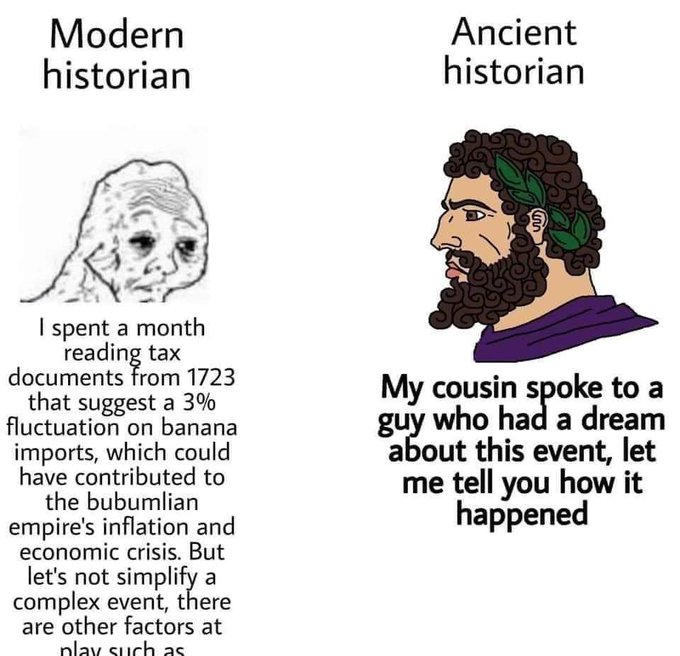
The concern I expressed in the piece is that the field of history doesn’t self-correct quickly enough. Historical myths and false facts can persist for decades, and even when busted they have a habit of surviving. The response from some historians was that they thought I was exaggerating the problem, at least when it came to scholarly history. I wrote that I had not heard of papers being retracted in history, but was informed of a few such cases, including even a peer-reviewed book being dropped by its publisher.
In 2001/2, University of North Carolina Press decided to stop publishing the 1999 book Designs against Charleston: The Trial Record of the Denmark Vesey Slave Conspiracy of 1822 when a paper was published showing hundreds of cases where its editor had either omitted or introduced words to the transcript of the trial. The critic also came to very different conclusions about the conspiracy. In this case, the editor did admit to “unrelenting carelessness“, but maintained that his interpretation of the evidence was still correct. Many other historians agreed, thinking the critique had gone too far and thrown “the baby out with the bath water“.
In another case, the 2000 book Arming America: The Origins of a National Gun Culture — not peer-reviewed, but which won an academic prize — had its prize revoked when found to contain major errors and potential fabrications. This is perhaps the most extreme case I’ve seen, in that the author ultimately resigned from his professorship at Emory University (that same author believes that if it had happened today, now that we’re more used to the dynamics of the internet, things would have gone differently).
It’s somewhat comforting to learn that retraction in history does occasionally happen. And although I complained that scholars today are rarely as delightfully acerbic as they had been in the 1960s and 70s in openly criticising one another, they can still be very forthright. Take James D. Perry in 2020 in the Journal of Strategy and Politics reviewing Nigel Hamilton’s acclaimed trilogy FDR at War. All three of Perry’s reviews are critical, but that of the second book especially forthright, including a test of the book’s reproducibility:
This work contains numerous examples of poor scholarship. Hamilton repeatedly misrepresents his sources. He fails to quote sources fully, leaving out words that entirely change the meaning of the quoted sentence. He quotes selectively, including sentences from his sources that support his case but ignoring other important sentences that contradict his case. He brackets his own conjectures between quotes from his sources, leaving the false impression that the source supports his conjectures. He invents conversations and emotional reactions for the historical figures in the book. Finally, he fails to provide any source at all for some of his major arguments
Blimey.
But I think there’s still a problem here of scale. It’s hard to tell if these cases are signs that history on the whole is successfully self-correcting quickly, or are stand-out exceptions. I was positively inundated with other messages — many from amateur historical investigators, but also a fair few academic historians — sharing their own examples of mistakes that had snuck past the careful scholars for decades, or of other zombies that refused to stay dead.
Comments Off on More on the history field’s “reproducibility crisis”
QotD: In which we discover why they’re called antimacassars
His accents mild took up the tale:
He said ‘I go my ways,
And when I find a mountain-rill,
I set it in a blaze;
And thence they make a stuff they call
Rowlands’ Macassar-Oil –
Yet twopence-halfpenny is all
They give me for my toil.’Better yet, in Don Juan Lord Byron managed to rhyme it:
In virtue, nothing earthly could surpass her
Save thine ‘incomparable oil’, Macassar!Mark Steyn, “Self-Knitting Antimacassars”, Steyn Online, 2019-08-02.
Comments Off on QotD: In which we discover why they’re called antimacassars
September 22, 2023
Is the Slovak Uprising Doomed to Fail? – War Against Humanity 115
World War Two
Published 21 Sep 2023Even as they battle an uprising in Slovakia, the Nazis see the opportunity to continue their racial realignment of Europe. The latest victims of this genocidal legacy are Anne Frank and her family, who arrive at Auschwitz. In Britain, the V-1 menace is defeated. But as London breathes a sigh of relief, the Nazis and their allies reduce Warsaw to rubble in a rampage of burning, looting, rape, and murder.
(more…)
Comments Off on Is the Slovak Uprising Doomed to Fail? – War Against Humanity 115
MAS 49: A Universal Service Rifle
Forgotten Weapons
Published 20 May 2019As the MAS 44 saw combat service with French Marines in Indochina, some of its shortcomings began to reveal themselves. The rifle was reliable and durable, but it lacked some capabilities, most importantly rifle grenade launching and an optics mounting. After a test series of MAS 44A rifles, a new pattern was adopted as the MAS 49 and put into production in 1951.
A total of about 80,000 MAS 49 rifles were made, and they incorporated a scope mounting dovetail in the left side of the receiver and a grenade launching muzzle device and sight. In addition, the bayonet was left out, as it was no longer seen as necessary. Not all rifles were used with scopes or for launching grenades, but with the universal capability it was simple to adapt any rifle to whatever specialized role was required. Ultimately the MAS 49 would be replaced again in only a few year, by the MAS 49-56 iterative improvement — but that’s a subject for a future video.
(more…)
Comments Off on MAS 49: A Universal Service Rifle
September 21, 2023
Iranian Railways, Red Cross Care Packages, and Tail Gunners – WW2 – OOTF 31
World War Two
Published 20 Sept 2023How did the Allies build and manage an enormous railway supplying the Soviet Union through Iran? How did the Red Cross deliver aid parcels through enemy territory to Allied POWs? And, how effective were the rear gunners in ground attack aircraft like the Stuka and Sturmovik? Find out in this episode of Out of the Foxholes.
(more…)
Comments Off on Iranian Railways, Red Cross Care Packages, and Tail Gunners – WW2 – OOTF 31


