
Jago Hazzard
Published 28 May 2023“Make all the railways come to York!”
(more…)
September 21, 2023
This is York
Comments Off on This is York
QotD: The Iliad as Bronze Age gangsta rap
A few months ago I tried moving the Iliad from the list of books I’m good at pretending to have read to the list of books I’ve actually read, and to my surprise I bounced off of it pretty hard. What I wasn’t expecting was how much of it is just endlessly tallied lists of gruesome slayings, disses, shoutouts to supporters, more killings, women taken by force, boasts about wealth, boasts about blinged-out-equipment, more shoutouts to the homies from Achaea who here repreSENTing, etc. The Iliad is basically one giant gangster rap track, and gangster rap is kinda boring.
What was cool though is I felt like I came away with a much better understanding of Socrates, Plato, and that whole milieu. Much like it’s easy to miss the radicalism of Christianity when you come from a culture steeped in it, it’s easy to miss the radicalism of Socrates if you don’t understand that this is the culture he was reacting against. Granted, the compilation of the Homeric epics took place centuries before the time of classical Athens, but my sense is that in important respects things hadn’t changed all that much. In our society, even people who aren’t professing Christians have been subliminally shaped by a vast set of Christian-inflected moral and epistemic and metaphysical assumptions. Well in the same way, in the Athens of Socrates and of the Academy, the “cultural dark matter” was the world of the Iliad: honor, glory, blinged out bronze armor, tearing hot teenagers from the arms of their lamenting parents, etc.
We have a tendency to think of the Greek philosophers as emblematic of their civilization, when in reality they were one of the most bizarre and unrepresentative things that happened in that society. But Numa Denis Fustel de Coulanges is here to tell us it wasn’t just the philosophers! So much of our mental picture of Ancient Greece and Rome is actually a snapshot of one fleeting moment in the histories of those places, arguably a very unrepresentative moment at which everything was in the process of collapsing. It’s like if [POP CULTURE ANALOGY I’M TOO TIRED TO THINK OF]. And actually once you think about it this way, everything makes way more sense. All those weird customs the Greeks and Romans had, all the lares and penates and herms and stuff, those are what these societies were about for hundreds and hundreds of years, and the popular image is just this weird encrustation, this final flowering at the end.
Jane and John Psmith, “JOINT REVIEW: The Ancient City, by Numa Denis Fustel de Coulanges”, Mr. and Mrs. Psmith’s Bookshelf, 2023-02-20.
Comments Off on QotD: The Iliad as Bronze Age gangsta rap
September 20, 2023
Christian views on men and women
The most recent book review from Mr. and Mrs. Psmith discusses Brian Patrick Mitchell’s Origen’s Revenge: The Greek and Hebrew Roots of Christian Thinking on Male and Female:
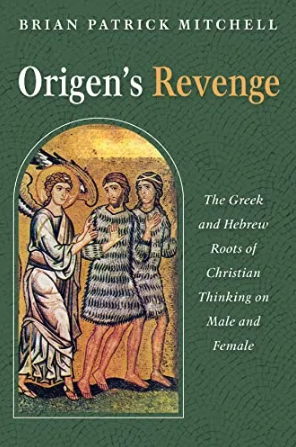
The following is an email exchange between the Psmiths, edited slightly for clarity.
John: You know dear, we’ve been writing this book review Substack for eight months now, ever since that crazy New Year’s resolution of ours, but we still haven’t done “the gender one”. And I feel like we have a real competitive advantage at this, since both sides of the unbridgeable epistemic chasm between the sexes are represented here. So let’s settle some of the eternal questions: Can men and women be friends? Who got the worse deal out of the curse in the Garden of Eden? And what’s up with your abysmal grip strength anyway?
I was perplexed by these and other questions, but then I picked up this book on the theology of gender, and it all got a lot clearer. The author is Deacon Brian Patrick Mitchell, an Eastern Orthodox clergyman and retired military officer. In a previous life, Mitchell testified before the Presidential Commission on the Assignment of Women in the Armed Forces and then followed that up with a book called Women in the Military: Flirting with Disaster, so he’s been interested in the differences between men and women for a while.
People have been observing for centuries that Christianity can be a little bit schizophrenic on the subject of gender relations. From the earliest days of the Apostolic era, there are two strains in evidence within Christianity: one which shores up the gender divisions common to most agricultural societies, and another which radically transcends them. Oftentimes both strains are visible within a single person! Thus you have the Apostle Paul on the one hand saying in his letter to the Ephesians:
Wives, submit yourselves unto your own husbands, as unto the Lord. For the husband is the head of the wife, even as Christ is the head of the church: and he is the saviour of the body. Therefore as the church is subject unto Christ, so let the wives be to their own husbands in every thing. (Ephesians 5:22-24)
But then in Galatians:
There is neither Jew nor Greek, there is neither bond nor free, there is neither male nor female: for ye are all one in Christ Jesus. (Galatians 3:28)
For as long as Christianity has existed, there have been people emphasizing one of these tendencies as the “true” Christian message on gender while attempting to minimize the other. Sometimes these arguments are interesting and sometimes they bring out something important (I’m a fan of Sarah Ruden’s Paul Among the People on the one side, and of Toby Sumpter’s fiery homilies on the other), but I think in both cases they’re falling into the error of trying to simplify something that is actually complicated. There’s a certain kind of person who can’t handle inconsistency, and that kind of person is going to have trouble with Christianity, because to a finite being the products of an infinite mind will sometimes appear inconsistent. Does Christianity want women to be subject to men, or does it want men and women to transcend their natures? The answer is very clearly both.
Mitchell’s book is compelling because it doesn’t try to minimize or hide one of these tendencies, but acknowledges up front that they’re both there and both have to be struggled with. It then advances the novel (as far as I know) argument that these two tendencies with regard to gender relations actually reflect the two major ethnic and cultural influences on the early Church: Hebrew and Greek.
The ancient Hebrew attitudes towards male and female are apparent from the beginning of the Bible: God creates Eve from out of Adam’s rib, and she is called Woman because she was taken out from Man. Thus the woman is subordinated to the man, yet fundamentally made of the same stuff as him. God calls the division of humanity into men and women good, He blesses families and helps barren women conceive, He commands His people to be fruitful and to multiply, and He promises Abraham that his seed shall be numbered as the stars of heaven. The entire Old Testament is a story of families, sometimes dysfunctional families, but families nonetheless, as opposed to lone men roaming the earth as in the Iliad or Bronze Age Mindset. Male headship is assumed, but it’s also assumed that men are fundamentally incomplete without something that only women can give them: a home, a future, and the thing that makes both, children.
So in Mitchell’s telling, the Hebrew legacy is responsible for the more “trad” side of early Christianity. What about the Greeks? Well we already discussed in our joint review of Fustel de Coulanges’ The Ancient City how ancient Greek society was basically the world of gangster rap: honor, boasting, violence, women as trophies, women as a way of keeping score, women torn wailing from the arms of their parents or husbands and forced into marriage or concubinage or outright slavery. You will be shocked to learn that this culture did not hold a high opinion of women, procreation, or the marital union. Greek philosophy is a massively complicated and diverse beast, but there’s a strong tendency within it to associate women with physicality, nature, and brute matter, and to disdain all of these things in favor of rationality, spirit, and the intellect (all coded as male).
Our readers are probably thinking, “Hang on a minute, I thought the Hebrews were the patriarchal ones, do you mean to say that the hyper-masculine and hyper-misogynistic culture was the one that decided maleness and femaleness didn’t matter?” Well yes I do, and it’s pretty easy to see why if one hasn’t been totally brainwashed by modernity, but maybe it’ll be more convincing if a woman explains it to them.
Jane: Well, I think you gave a pretty accurate description of actually-existing ancient Greek culture, but we have to remember that the Church Fathers weren’t classicists poring through the corpus trying to accurately characterize the past. Rather, they were men of late antiquity, mostly educated in a “Great Books” canon heavy on the classical philosophy — and the worldview of philosophers is often quite different from the general norms and presuppositions of their society as a whole. (Not that modern — by which I mean post-1600 — classicists have always recognized this; E.R. Dodds’s The Greeks and the Irrational is considered a seminal work of classical scholarship precisely because it undercuts a long tradition of taking the philosophers as representative of their culture rather than in conflict with it.)1 So the direct influence on early Christians wasn’t the world Fustel de Coulanges describes (which covers roughly the Greek Dark Ages through the Archaic period), but the texts of the period that came after, as interpreted by an even later era. It’s a bit like looking at our contemporary small-l liberals, who draw heavily on a tradition that rose out of Enlightenment philosophy, which in turn was an outgrowth of and/or reaction to the medieval and early modern worlds: they’re not not connected to all that, but Boethius is not going to be the most helpful context for reading Rorty. You should probably look at Locke instead.
1. Bonus, and shorter, Dodds: “On Misunderstanding the Oedipus Rex“, which you probably do too.
Comments Off on Christian views on men and women
Wire Guided Tank Killer | Swingfire | Anti-Tank Chats
The Tank Museum
Published 2 Jun 2023In this video, Chris Copson looks at the Swingfire, a Cold War period anti-tank guided weapons system. This powerful and hard-hitting missile was mounted on vehicles including Striker, Ferret, and FV 432. With a range of up to 4km, it had the significant advantage that it would outrange tank guns and could be fired remotely by the controller, enabling the launch vehicle to remain in cover.
(more…)
Comments Off on Wire Guided Tank Killer | Swingfire | Anti-Tank Chats
September 19, 2023
The end of the Western Roman Empire
Theophilus Chilton updates a review from several years ago with a few minor changes:
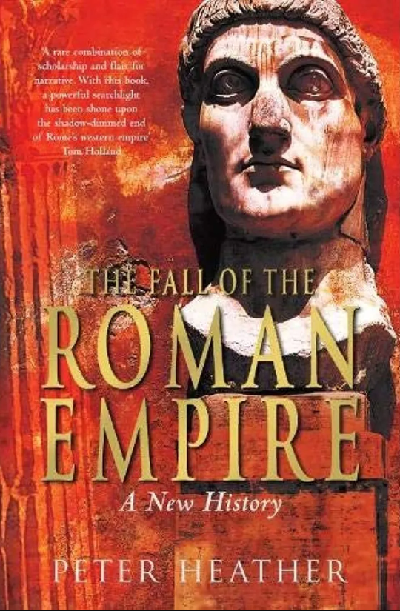
British archaeologist and historian Bryan Ward-Perkin’s excellent 2005 work The Fall of Rome and the End of Civilization is a text that is designed to be a corrective for the type of bad academic trends that seem to entrench themselves in even the most innocuous of subjects. In this case, Ward-Perkins, along with fellow Oxfordian Peter Heather in his book The Fall of the Roman Empire: A New History of Rome and the Barbarians, sets out to fix a glaring error which has come to dominate much of the scholarly study of the 4th and 5th centuries in the western Empire for the past few decades.
This error is the view that the western Empire did not actually “fall”. Instead, so say many latter-day historical revisionists, what happened between the Gothic victory at Adrianople in 378 AD and the abdication of Romulus Augustulus, the last western Emperor, in 476 was more of an accident, an unintended consequence of a few boisterous but well-meaning neighbors getting a bit out of hand. Challenged is the very notion that the Germanic tribes (who cannot be termed “barbarians” any longer) actually “invaded”. Certainly, these immigrants did not cause harm to the western Empire — for the western empire wasn’t actually “destroyed”, but merely “transitioned” seamlessly into the era we term the Middle Ages. Ward-Perkins cites one American scholar who goes so far as to term the resettlement of Germans onto land that formerly belonged to Italians, Hispanians, Britons, and Gallo-Romans as taking place “in a natural, organic, and generally eirenic manner”. Certainly, it is gauche among many modern academics in this field to maintain that violent barbarian invasions forcibly ended high civilization and reduced the living standards in these regions to those found a thousand years before during the Iron Age.
Ward-Perkins points out the “whys” of this historical revision. Much of it simply has to do with political correctness (which he names as such) — the notion that we cannot really say that one culture is “higher” or “better” than others. Hence, when the one replaces the other, we cannot speculate as to how this replacement made things worse for all involved. In a similar vein, many continental scholars appear to be uncomfortable with the implications that the story of mass barbarian migrations and subsequent destruction and decivilization has in the ongoing discussion about the European Union’s own immigration policy — a discussion in which many of these same academics fall on the left side of the aisle.
Yet, all of this revisionism is bosh and bunkum, as Ward-Perkins so thoroughly points out. He does this by bringing to the table a perspective that many other academics in this field of study don’t have — that of a field archaeologist who is used to digging in the dirt, finding artifacts, drawing logical conclusions from the empirical evidence, and then using that evidence to decide “what really happened”, rather than just literary sources and speculative theories. Indeed, as the author shows, across the period of the Germanic invasions, the standard of living all across Roman western Europe declined, in many cases quite precipitously, from what it had been in the 3rd century. The quality and number of manufactured goods declined. Evidence for the large-scale integrative trade network that bound the western Empire together and with the rest of the Roman world disappears. In its place we find that trade goods travelled much smaller distances to their buyers — evidence for the breakdown of the commercial world of the West. Indeed, the economic activity of the West disappeared to the point that the volume of trade in western Europe would not be matched again until the 17th century. Evidence for the decline of food production suggests that populations fell all across the region. Ward-Perkins’ discussion of the decline in the size of cattle is enlightening evidence that the degeneration of the region was not merely economic. Economic prosperity, the access of the common citizen to a high standard of living with a wide range of creature comforts, disappeared during this period.
The author, however, is not negligent in pointing out the literary and documentary evidence for the horrors of the barbarian invasions that so many contemporary scholars seem to ignore. Indeed, the picture painted by the sum total of these evidences is one of harrowing destruction caused by aggressive, ruthless invaders seeking to help themselves to more than just a piece of the Roman pie. Despite the recent scholarly reconsiderations, the Germans, instead of settling on the land given to them by various Emperors and becoming good Romans, ended up taking more and more until there was nothing left to take. As Ward-Perkins puts it,
Some of the recent literature on the Germanic settlements reads like an account of a tea party at the Roman vicarage. A shy newcomer to the village, who is a useful prospect for the cricket team, is invited in. There is a brief moment of awkwardness, while the host finds an empty chair and pours a fresh cup of tea; but the conversation, and village life, soon flow on. The accommodation that was reached between invaders and invaded in the fifth- and sixth- century West was very much more difficult, and more interesting, than this. The new arrival had not been invited, and he brought with him a large family; they ignored the bread and butter, and headed straight for the cake stand. Invader and invaded did eventually settle down together, and did adjust to each other’s ways — but the process of mutual accommodation was painful for the natives, was to take a very long time, and, as we shall see …left the vicarage in very poor shape. (pp. 82-83)
Professor Bret Devereaux discussed the long fifth century on his blog last year:
… it is not the case that the Roman Empire in the west was swept over by some destructive military tide. Instead the process here is one in which the parts of the western Roman Empire steadily fragment apart as central control weakens: the empire isn’t destroy[ed] from outside, but comes apart from within. While many of the key actors in that are the “barbarian” foederati generals and kings, many are Romans and indeed […] there were Romans on both sides of those fissures. Guy Halsall, in Barbarian Migrations and the Roman West (2007) makes this point, that the western Empire is taken apart by actors within the empire, who are largely committed to the empire, acting to enhance their own position within a system the end of which they could not imagine.
It is perhaps too much to suggest the Roman Empire merely drifted apart peacefully – there was quite a bit of violence here and actors in the old Roman “center” clearly recognized that something was coming apart and made violent efforts to put it back together (as Halsall notes, “The West did not drift hopelessly towards its inevitable fate. It went down kicking, gouging and screaming”) – but it tore apart from the inside rather than being violently overrun from the outside by wholly alien forces.
Comments Off on The end of the Western Roman Empire
For some reason, ordinary Londoners don’t seem to appreciate Mayor Khan’s ULEZ initiatives
It’s hard to believe that anyone could possibly want to avoid London Mayor Sadiq Khan’s Ultra Low Emission Zone (ULEZ) expansion beyond the initial areas of the city, but a quick search of Twit-, er, I mean “X” shows evidence of what Justin Trudeau might characterize as a “small fringe minority … holding unacceptable views”:
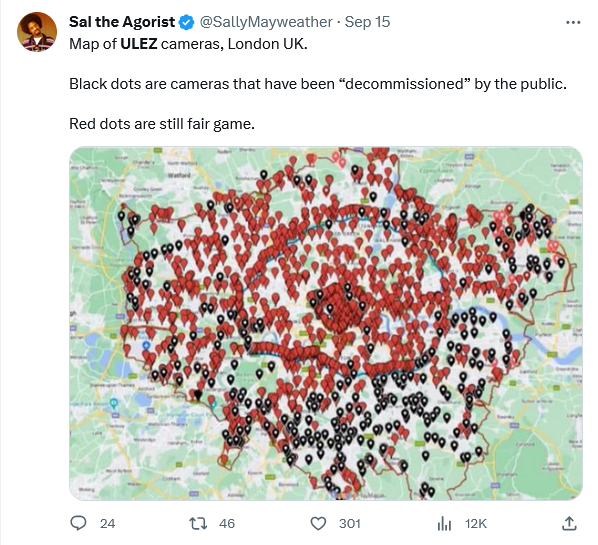
Weird, isn’t it. All those “decommissioned” cameras. And people physically blocking access to workers:
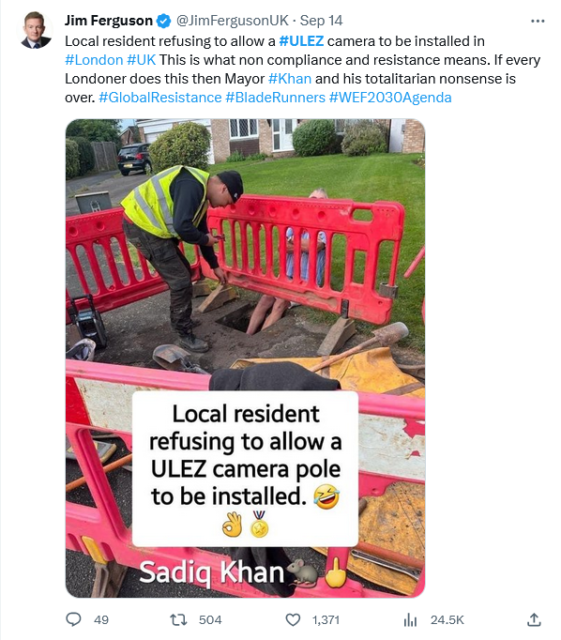
London has put up with a lot over the centuries, but Mayor Khan’s ULEZ somehow seems to have awakened the resistance in a major way:

Brian Peckford republished this article from Yudi Sherman on the pushback against London’s ULEZ expansion:
London taxpayers are damaging the city’s surveillance vans in an escalating feud between Mayor Sadiq Khan and the city’s residents.
Last month Khan peppered the city with ultra-low emission zones (ULEZs), areas in London accessible only to low-emission vehicles. Cars that do not meet the city’s environmental standards are charged £12.50 ($16) for entering the ULEZ. Automatic Number Plate Recognition (ANPR) cameras positioned around the zones read license plates and check them against the vehicles’ make and model in real time. If a vehicle does not meet the environmental threshold, the fine is levied against the car owner. Failure to pay can lead to fines as high as £258 ($331).
The ULEZ climate mandate has drawn heavy protests from residents, including hunger strikes and refusal to pay fines. Taxpayers have also taken to disabling the ANPR surveillance cameras which Transport for London (TfL), the city’s transportation department, said will be used both for climate and law enforcement.
In response, the city deployed mobile surveillance vans mounted with ANPR cameras across London in the hopes of evading attacks, but the vans are being targeted as well. Some have been spotted covered in graffiti with their tires slashed, while others have been completely covered in tarp, reports the Daily Mail.
The activists are said to belong to a group calling itself the Blade Runners and have promised not to rest until every ULEZ camera is removed or destroyed “no matter what”. The group is being widely cheered by its compatriots, including media personality and political commentator Katie Hopkins. Over 4,000 people have joined a Facebook group to report ULEZ van sightings.
Between April 1st and August 31st, police recorded 351 incidents of destruction to ULEZ cameras and 159 removals, reports Sky News, an average of over 100 a month. Of those incidents, 171 reportedly occurred since August 17th alone, just before the ULEZ mandate officially expanded to include all outer London boroughs. Two individuals have been arrested in connection with the incidents, one of whom was charged.
One reported Blade Runner said, “In terms of damage it’s way more than what [London Mayor Saidq Khan and TfL] have stated.”
Comments Off on For some reason, ordinary Londoners don’t seem to appreciate Mayor Khan’s ULEZ initiatives
Jeremy Clarkson’s The Greatest Raid of All
North One
Published 4 May 2020Due to copyright restrictions, some music and scenes have been altered or removed in this upload. You can find the original unaltered documentary here: The Story Of The …
Jeremy Clarkson tells the story of the audacious commando raid on the German occupied dry dock at St Nazaire in France on March 28th 1942. Made for the BBC in 2007 by North One.
(more…)
Comments Off on Jeremy Clarkson’s The Greatest Raid of All
September 18, 2023
Learning lessons from the plight of the British army in 1940
Lessons from history are only occasionally learned easily … they’re more likely brought to our attention by the Gods of the Copybook Headings after we’ve suffered some awful setback. As the latin tag would have it, Si vis pacem, para bellum: if you want peace, be prepared for war. Most western democracies refuse to believe this is true, and one of the easiest things for peacetime democratic governments to do is to short-fund the military and use the “savings” for more politically popular things that will help them get re-elected. The Canadian government has been a shining example of this since the late 1960s, with no end in sight.
A recent book on the British army, tracing its decline from the end of the First World War to the defeat in the Battle of France in 1940 shows just how quickly a world-beating army can be reduced to second-best in its next conflict. Richard Dannatt & Robert Lyman, the authors of Victory: the British Army 1918-1940 to Defeat, had an article in the Sunday Mail, illustrating the parallels between the army in their book and the British army today:
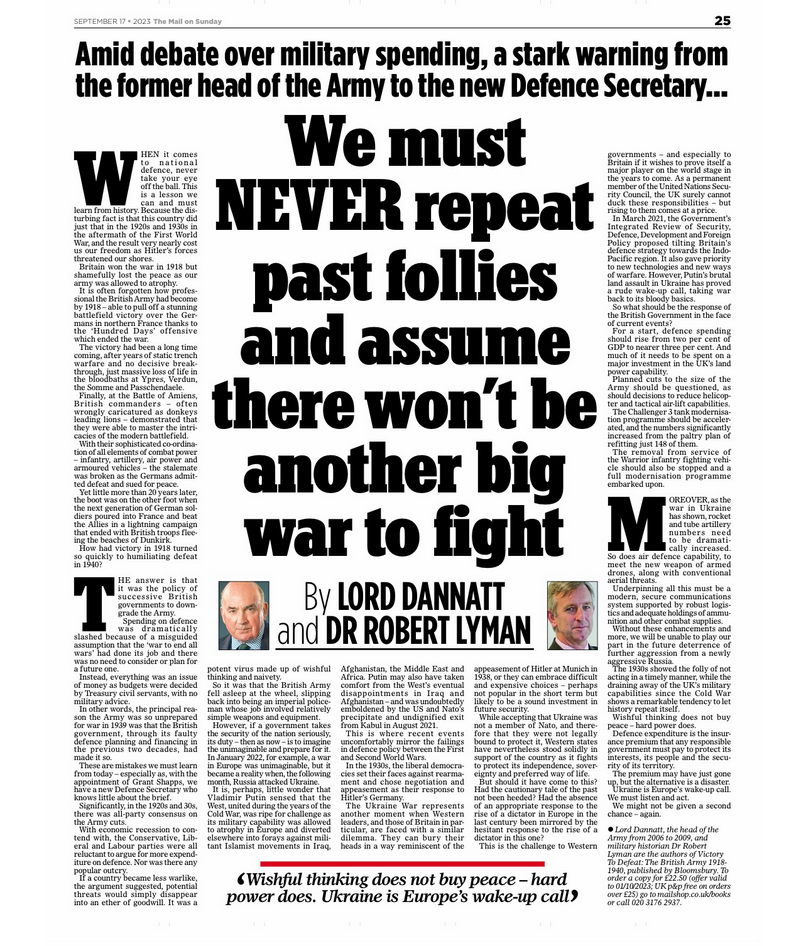
WHEN IT comes to national defence, never take your eye off the ball. That is a lesson we can and must learn from history. Because the disturbing fact is that this country did just that in the 1920s and 1930s in the aftermath of the First World War and the result very nearly cost us our freedom as Hitler’s forces threatened our shores.
Britain won the war in 1918 but then shamefully lost the peace as our army was allowed to atrophy.
It is often forgotten how professional the British Army had become by 1918, to pull off a stunning battlefield victory over the Germans in northern France in the final Hundred Days of the war.
It had been a long time coming after years of static trench warfare and no decisive breakthrough, just massive loss of life in the blood baths at Ypres, Verdun, the Somme and Passchendaele.
But finally, at the Battle of Amiens, British commanders — often wrongly caricatured as dunderheads and “donkeys” leading lions – demonstrated that they were able to understand and master the intricacies of the modern battlefield. With their sophisticated co-ordination of all elements of combat power — infantry, artillery, air power, armour — the stalemate was broken.
Modern war-fighting skills, technology and methods — learned at great cost in lives over the previous three-and-a-half years — secured victory for the British Army and its allies in 1918 as the Germans admitted defeat and sued for peace.
And yet little more than 20 years later, the boot was on the other foot as the next generation of German soldiers poured into France and defeated the Allies in a lightning campaign that ended with British troops fleeing from the beaches of Dunkirk.
How had victory in 1918 turned so quickly to defeat and humiliation in 1940?
The answer is that it had become the deliberate policy of successive British governments to downgrade the Army — a lesson we must learn today, with a new Defence Secretary who knows little about the brief.
Spending on defence was dramatically slashed amid an ill-thought-through assumption that there would not be another major war within ten years and so.
So far as the then government was concerned, the “war to end all wars” (as the Great War was dubbed) had done its job. There was no need to consider or plan for a future one, whether in policy, financial or practical terms. Everything was an issue of money as budgets were decided by Treasury civil servants with no military advice.
The principal reason why the Army was so unprepared for war in 1939 was that the British government, through faulty defence planning and financing in the previous two decades, made it so.
Comments Off on Learning lessons from the plight of the British army in 1940
BM59: The Italian M14
Forgotten Weapons
Published 25 Oct 2017After World War Two, both the Beretta and Breda companies in Italy began manufacturing M1 Garand rifles. When Italy decided that they wanted a more modern selective-fire, magazine-fed rifle, they chose to adapt the M1 Garand to that end rather than develop a brand new rifle. Two Beretta engineers, Vittorio Valle and Domenico Salza, began work in 1957 on what would become the BM-59. Prototypes were ready in 1959, trials were run in 1960, and by 1962 the new weapon was in Italian military hands.
The BM59 is basically an M1 Garand action and fire control system, but modernized. The caliber was changed to 7.62mm NATO, and the barrel shortened to 19.3 inches. A simple but effective selective fire system was added to the fire control mechanism, and the en bloc clips replaced with a 20-round box magazine (and stripper clip loading guide to match). A folding integral bipod was added to allow the rifle to be used for supporting fire on full auto, and a long muzzle device was added along with a gas cutoff and grenade launching sight to allow the use of NATO standard 22mm rifle grenades.
In this form, the BM59 was a relative quickly developed and quite successful and well-liked rifle. In addition to the Italian military, it was purchased by Argentina, Algeria, Nigeria, and Indonesia. A semiautomatic version was made for the US commercial market and designated the BM62, and a small number of fully automatic BM-59 rifles — like the one in this video — were imported into the US before the 1968 Gun Control Act cut off importation of foreign machine guns.
(more…)
Comments Off on BM59: The Italian M14
September 17, 2023
The Ballad of Chiang and Vinegar Joe – WW2 – Week 264 – September 16, 1944
World War Two
Published 16 Sep 2023The Japanese attacks in Guangxi worry Joe Stilwell enough that he gets FDR to issue an ultimatum to Chiang Kai-Shek, in France the Allied invasion forces that hit the north and south coasts finally link up, the Warsaw Uprising continues, and the US Marines land on Peleliu and Angaur.
(more…)
Comments Off on The Ballad of Chiang and Vinegar Joe – WW2 – Week 264 – September 16, 1944
Why Operation Market Garden Failed and Its Devastating Consequences
OTD Military History
Published 5 Apr 2023Why did Operation Market Garden fail and what were the consequences of this failure? This video covers the operation, the reasons for the failure, and its devastating aftermath. The impact Market Garden had on the Dutch during the Hunger Winter and Allied soldiers during the Battle of the Scheldt is explored.
There is footage of the 101st US Airborne, 82nd US Airborne, British 1st Airborne Division, and the troops of the British XXX Corps featured in the video.
(more…)
Comments Off on Why Operation Market Garden Failed and Its Devastating Consequences
September 16, 2023
France’s Vietnam War: Fighting Ho Chi Minh before the US
Real Time History
Published 15 Sept 2023After the Second World War multiple French colonies were pushing towards independence, among them Indochina. The Viet Minh movement under Ho Chi Minh was clashing with French aspirations to save their crumbling Empire.
(more…)
Comments Off on France’s Vietnam War: Fighting Ho Chi Minh before the US
The many, MANY failed VW Beetle Reboots!
Big Car
Published 22 Oct 2021I recently made a video on the many, many times British Leyland tried to update the Mini. The lack of an update helped to make the original Mini an iconic shape. The same has happened to many other iconic cars, and the Volkswagen Type 1 or Beetle falls into the same camp. Why did it take 36 years until the Beetle would get a replacement, and how did a car made as a Nazi show of strength end up in a Disney film?
(more…)
Comments Off on The many, MANY failed VW Beetle Reboots!
QotD: The Persian “Royal Roads”
The oldest road network that we have pretty good evidence for was the Persian Royal Road of the Achaemenids but these too were not the first (the Achaemenid dynasty ruling a vast empire from 559 to 330 BC; this is the Persian Empire of Xerxes and Darius III). Even before them the Assyrians (Middle and Neo-Assyrian Empires running from 1363 to 609 BC)1 had build roadways to hold together parts of their empire, though I confess I know very little of the extent of that road system except that we’re fairly sure it existed and like the later systems we’re going to talk about, it included not just the physical infrastructure of the roads but a sophisticated relay system to allow official messengers to move very rapidly over the network.
The modern perception of the Persian Royal Road is conditioned perhaps a bit too much by Herodotus who described the royal road – singular – as a single highway running from Susa to Sardis. Susa was one of several Achaemenid royal capitals and it sat at the edge of the Iranian plateau where it meets the lowland valley of Mesopotamia, essentially sitting right on the edge where the Persian “heartland” met the area of imperial conquests. Meanwhile, Sardis was the westernmost major Achaemenid administrative center, the regional capital, as it were, for Anatolia and the Aegean. So you can see the logic of that being an important route, but the road system was much larger. Indeed, here is a very rough sketch of how we might understand the whole system.
Compare the dashed line – the Royal Road as described by Herodotus – with the solid lines, the rest of the system we can glean from other sources or from archaeology and you can see that Herodotus hasn’t given us the whole story. For what it is worth, I don’t think Herodotus here is trying to lie – he has just described the largest and most important trunk road that leads to his part of the world.
This system doubtlessly emerged over time. Substantial parts of the road network almost certainly predated the Achaemenids and at least some elements were in place under the first two Achaemenid Great Kings (Cyrus II, r. 559-530 and Cambyses II, r. 530-22) but it seems clear that it is the third Achaemenid ruler, Darius I (r. 522-486; this is the fellow who dispatched the expedition defeated at Marathon, but his reign was far more important than that – he is the great organizer of the Persian Empire) who was responsible for the organization, formalization and expansion of the system. And in practice we can split that system into two parts, the physical infrastructure of roads and then the relay system built atop that system.
In terms of the physical infrastructure, as far as I can tell, the quality of Persian Royal Roads varied a lot. In some areas where the terrain was difficult, we see sections of road cut into the rock or built via causeways over ravines. Some areas were paved, but most – even most of the “royal” roads (as distinct from ancillary travel routes) were not.2 That said, maintenance seems to have been more regular on the royal roads, meaning they would be restored more rapidly after things like heavy rains that might wash an unpaved road out, making them more reliable transport routes for everyone. They also seem to have been quite a bit wider; Achaemenid armies could have long logistics tails and these roads had to accommodate those. Several excavated sections of royal roads are around 5m wide, but we ought to expect a lot of variation.
On top of the physical infrastructure, there was also a system of way-stations and stopover points along the road. These were not amenities for everyone but rather a system for moving state officials, messengers, soldiers, and property (like taxes). While anyone could, presumably, walk down the road, official travelers carried a sealed travel authorization issued by either a satrap (the Persian provincial governors) or the king himself. Such authorizations declared how many travelers there were, where they were going and what the way-stations, which stocked supplies, should give them. Of course that in turn meant that local satraps had to make sure that way-stations remained stocked up with food, fodder for animals, spare horses and so on. Fast messengers could also be sent who, with that same authorization, would change horses at each way-station, allowing them to move extremely fast over the system, with one estimate suggesting that a crucial message could make the trip from Sardis to Susa – a trip of approximately 2,500km (1,550 miles, give or take) in twelve days (by exchanging not only horses, but riders, as it moved).
All of which gives some pretty important clues to why royal roads were set up and maintained. Notice how the system specifically links together key administrative hubs, like the three main Achaemenid capitals (Susa, Ekbatana and Persepolis) and key administrative centers (Memphis, Sardis, Babylon, etc.) and that while anyone can use the roads, the roads serve as the basis for a system to handle the logistics of moving officials and state messages, which of course could also serve as the basis for moving armies. After all, you can send messengers down the royal roads, through the existing system set up for them, to instruct your satraps to gather local forces or more importantly to gather local food supplies and move them to the road in depots where the army can pick them up (and perhaps some local troops) as it moves through to a nearby trouble spot (while the nice, wide road allows you to bring lots of pack animals and carts with your army).
In short this is a large, expensive but effective system for managing the problem of distance in a large empire. Cutting down travel and message times reduces the independence of the satraps, allowing the Great King to keep an eye on them, while the roads provide the means to swiftly move armies from the core of the empire out to the periphery. We can actually see this play out with Alexander’s invasion. He crosses into Asia in 334 and defeats the local satrapal army at Granicus in 334. Moving into the Levant in 333, he’s met at Issus by Darius III with a massive army, collected from the central and western parts of the empire – which means that news of Alexander’s coming has reached Darius who has then marshaled all of those troops from his satrapies (and hired some mercenaries), presumably using his efficient message system to do it and then moved that force down the road system to meet Alexander. Alexander defeats that army, but is met by another huge army at Gaugamela in 331, this time gathered mostly from the eastern parts of the empire. While the Persian army fails in defeating Alexander, the exercise shows the power of the system in allowing the Great King, Darius III to coordinate the military efforts of an enormous empire.
So this is a system meant to enable the imperial center to control its periphery by enabling the court to keep tabs on the satraps, to get messages to and from them and move armies and officials (and taxes!) around. And doubtless it was also not lost on anyone that such a visible series of public works – even if the roads were not always paved and had to be repaired after heavy rains and such – was also an exercise in legitimacy building, both a visual demonstration of the Great King’s power and resources but also a display of his generosity and industry.
And I lead with all of that because the Roman road network works the same way, just on an even larger scale. Which isn’t to say the Romans were copying the Achaemenids (they don’t seem to have been) but rather that this is a common response to the problem of managing an uncommonly large empire.
Bret Devereaux, “Collections: Roman Roads”, A Collection of Unmitigated Pedantry, 2023-06-02.
1. The Middle Assyrian Empire and the Neo-Assyrian or New Assyrian Empires were, in fact, the same state. We split them up because of a severe contraction in Assyrian power during the Late Bronze Age Collapse.
2. On this, see Henkelman and Jacobs, 727-8
Comments Off on QotD: The Persian “Royal Roads”
September 15, 2023
Learning to handle mules to accompany Chindit columns in WW2
Robert Lyman posted some interesting details from veteran Philip Brownless of how British troops in India had to learn how to handle mules and abandon their motor transport in order to get Chindit columns into Japanese territory in Burma:
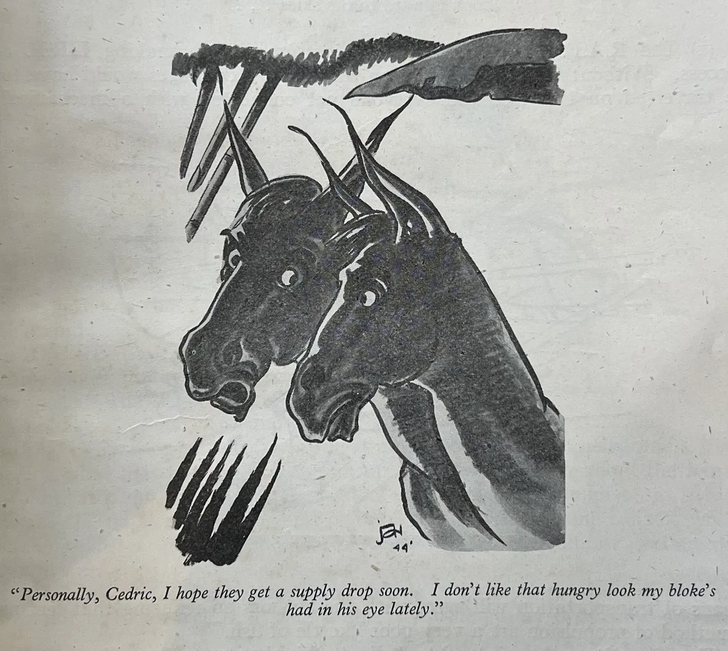
A fabulous drawing from Jungle, Jungle, Little Chindit (1944)
Soon after our return from the Arakan front in the autumn of 1943, we were in central India, and had been told that the whole division was to be handed over to General Wingate and trained to operate behind the Japanese lines. All our motor transport was to be taken away and we were to be entirely dependent upon mules for our transport.
The C.O. one evening looked round the mess and then said to me “You look more like a country bumpkin than anybody else. You will go on a veterinary course on Tuesday and when you come back you will take charge of 44 Column’s mules.”
I had never met one of these creatures before. On arriving at Ambala I reported to the Area Brigade Major who wasn’t expecting me and seemed to have no clue about anything. He said “You’d better go down to the Club and book in”. I reported to the Club, a comfortable looking establishment, and they seemed to have a vague idea that a few bodies like me might turn up on a course and were apologetic that I would have to sleep in a tent but otherwise could enjoy the full facilities of the Club. I was shown the tent, an EPIP tent or minor marquee, with a coloured red lining and golden fleur de lys all over it, (very Victorian) with a small office extension with table and chair in front and another extension at the back with bath, towel rail and a fully bricked floor. Having lived either in a tent or under the stars in both the desert and the Arakan for the last 2 years, this struck me as luxury indeed. Even better, I took on a magnificent bearer, with suitable references, whom I found later was some kind of Hindu priest. I soon got used to having my trouser legs held up for me to put my feet in, and being helped into the rest of my clothes. I had a comfortable 3 weeks learning all about mules.
I discovered all sorts of things like the veterinary term “balls”, which were massive pills which were given to the mule by – first of all grabbing his tongue and pulling it out sideways so he couldn’t shut his mouth on your arm, and then gently throwing the ball at his epiglottis and making sure it went down. Then you let go of his tongue and gave him a nice pat. One of our lecturers, an Indian warrant officer, knew his stuff well and was so pleased about it that when he asked a question he would give you the answer himself. He liked being dramatic and loved to finish a description of some fatal ailment by saying “Treatment, bullet”.
Many of the men in our battalion were East Enders; others came from all over Essex. A few were countrymen, two were Irish and knew all about horses, one sergeant had been in animal transport and one invaluable soldier had been an East End horse dealer. The large majority had had nothing to do with animals: however, the saving grace was that English soldiers seem to be naturally good with animals and soon learned to handle them well. I arranged to get some instruction from the nearby unit of Madras Sappers and Miners and we borrowed a handful of trained mules from them for the men to practise handling, tying on loads and learning to talk to them.
Then came the great day when we were to draw up our main complement of animals, about 70 mules and 12 ponies. We were dumped at a small railway station. It was all open ground and there was a team of Army Veterinary Surgeons to allocate fairly between the three battalions, the Essex, the Borders and the Duke of Wellington’s. Lieut. Jimmy Watt of the Borders was a pal of mine: he and I, with a squad of men were to march them back nearly 100 miles to our camp, sleeping each of the five nights under the stars. As soon as we arrived at the disembarkation site I got all our mule lines laid out, with shackles (used to tie mules fore and aft) and nosebags ready. I had also picked up the tip that the mules would be wild, having spent three days in the train, and almost impossible to hold, so I instructed our men to tie them together in threes before they got off the train. As all three pulled in different directions, one muleteer could hold them. Not everybody had learned this trick so the result was that wild mules were careering all over the place, impossible to catch. When our first handful of mules arrived, they were quickly secured in a straight line and fed. They were familiar with lines like this and cooled down at once, long ears relaxed and tails swishing amiably. When the wild mules careering round saw this line, they said to themselves “We’ve done this before” and came and stood in our lines. We shackled them and I picked out the moth-eaten ones and sent them back to the vets who kept sending polite messages of thanks to Mr. Brownless for catching them. We finished up with a very good set of mules. Jimmy Watt and I had a bit of a conscience about the Duke of Wellington’s so we picked them out a really good pony. We felt even worse a few weeks later when it was sent back to Remounts with a weak heart! The Brigade Transport Officer visited us the second evening so Jimmy Watt and I walked him round rather quickly, chatting hard, to approve the allocation of animals, and he agreed with our arrangement.
In a highly optimistic mood early on, I decided to practise a river crossing. We marched several miles out from camp to a typical wide sandy Indian river, 300 yards across, made our preparations, i.e. assembling the two assault boats, making floating bundles of our clothes and gear by wrapping them in groundsheets, unsaddling the animals, and assembling at the water’s edge. A good sized detachment of muleteers was posted on the opposite bank ready to catch the mules. The mules waded into the shallow water but no one could get them to move off. We tried all sorts of inducements in vain and then suddenly, one sturdy little grey animal decided to swim and the whole lot immediately followed. Calamity ensued! Mules are very short sighted and could only dimly see the opposite bank but downstream was a bright yellow sandy outcrop and they all made for this. The muleteers on the other bank, when they realised what was happening, ran through the scrub and jungle as fast as they could, but the mules arrived first and bolted off into the wilds of India. I swam my pony across with my arm across his withers and directing him by holding his head harness, the gear was ferried across and the mule platoon, with one pony, began the march back to camp. Deeply depressed, I wondered how to tell the C.O. I had lost all his mules and imagined the court martial which awaited me (or, serving under General Wingate, would I be shot out of hand?) An hour and a half later we came in sight of the camp and to my utter astonishment I could see the mules in their lines. When I arrived at the mule lines, the storeman met me and said that the whole lot had arrived at the double and had gone to their places. He had merely gone along the lines, shackling them and patted their noses. Salvation! I kept quiet for a bit but it got out and I was the butt of much merrymaking.
Comments Off on Learning to handle mules to accompany Chindit columns in WW2


