Overly Sarcastic Productions
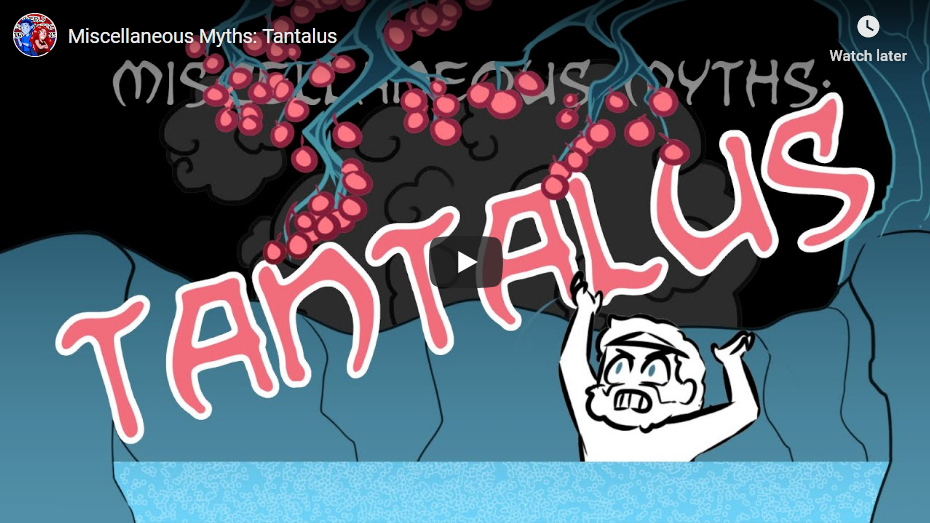
Published 24 Jan 2020Tantalus! The number one dude known for his eternal punishment in Hades, perhaps second only to Sisyphus
Our content is intended for teenage audiences and up.
PATREON: https://www.Patreon.com/OSP
MERCH LINKS: https://www.redbubble.com/people/OSPY…
DISCORD: https://discord.gg/hhAZA2z
OUR WEBSITE: https://www.OverlySarcasticProductions.com
Find us on Twitter https://www.Twitter.com/OSPYouTube
Find us on Reddit https://www.Reddit.com/r/OSP/
January 25, 2020
Miscellaneous Myths: Tantalus
Refuting the pessimism of Malthus
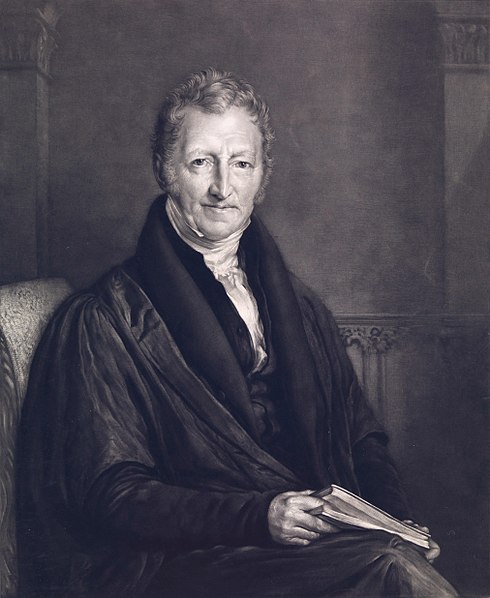
In the latest edition of Anton Howes’ Age of Invention newsletter, he looks at the predictions of that old gloomy Gus, Thomas Malthus:

The Malthusian trap. For Malthus, as population increases exponentially and food production only linearly, a point where food supply is inadequate will inevitably be reached.
Graph by Kravietz via Wikimedia Commons.
For economies before the Industrial Revolution, population growth was an important and ever-present brake on prosperity — an observation most famously articulated by the Reverend Thomas Malthus. Writing at the end of the eighteenth century, he warned against the promises of improvement. Whereas the optimists looked at the acceleration of innovation around them and claimed infinite horizons for increasing living standards, Malthus pessimistically argued that population would always catch up. Although a new agricultural technology might briefly increase the amount of available food, the inexorability of population growth meant that it would soon be eaten up by extra mouths to feed. The population would end up larger than it was before the new technology, but with that population eventually no richer than it had been to begin with. Economic historians call this the Malthusian regime, or the Malthusian Trap.
Fortunately, Malthus’s pessimism would prove unfounded. Economy after economy has managed to escape the trap. British output had already been outpacing its population for two centuries by the time he was writing — England’s agricultural output alone had increased 171% while its population had grown 113% (not even taking into account the fact that it also increasingly relied on imported food, paid for by its other industries). And in the decades and centuries that followed, England’s output continued to shoot ahead, widening the lead. Output per capita rose and rose, to the extent that Malthus’s worries about overpopulation are now usually applied to resources other than food.
But while Malthus is famous for the theory, he wasn’t its inventor. Well before Malthus, the people who actually lived in the trap seem to have recognised its effects. Concerns about overpopulation may have led to the Garland or Flower Wars of the Aztec Empire and its neighbours: after a series of famines in the 1450s, the local states reportedly began to engage in ritual battles, with the losers captured and sacrificed to the gods. Still earlier, in ancient Greece, the young men of a settlement might be formally conscripted to go forth and colonise other islands and coastlines. They were typically banned from returning home for several years, and in at least one case slingers were posted on the shore to kill any of the colonists who tried to make a break for home. In a whole host of pre-industrial societies, “surplus” infants were often simply exposed to the elements.
By the sixteenth century, with the rise of print culture, Malthusian rationales were being clearly articulated. Here’s Richard Hakluyt writing in 1584, over two hundred years before Malthus:
Through our long peace and seldom sickness (two singular blessings of Almighty God) we are grown more populous than ever heretofore; so that now there are of every art and science so many, that they can hardly live one by another, nay rather they are ready to eat up one another.
It’s a direct statement of the Malthusian regime in action, expressed by one of England’s most influential Elizabethan intellectuals, and written specifically for the attention of the queen. Hakluyt thanked god for the recent and unusual lack of mass death, but now worried about overpopulation leading to low wages and unemployment. And he went on to list many other effects. Hakluyt argued that the misery would lead to unrest, thievery, begging, and “other lewdness”. The prisons filled up, where the poor either “pitifully pine away, or else at length are miserably hanged.”
January 20, 2020
Pyrrhus of Epirus: Enemy of Rome
History Time
Published 2 Dec 2017A brief look at one of the first and greatest adversaries of the Romans.
Some of the maps used in this and other History Time videos were produced by the incredible Battles of the Ancients. Check out the awesome website below for your ancient history fix.
http://turningpointsoftheancientworld.com/Music:-
Two Steps From Hell – “Hearts of Courage”
https://www.youtube.com/watch?v=eYj8c…
BrunuhVille – “Song of the North” (Alt. Version)
https://www.youtube.com/watch?v=RHAFr…
Adrian Von Ziegler – “Moonsong”
https://www.youtube.com/watch?v=ifQ3J…If you liked this video and have a spare dollar you can help to support the channel here:-
http://www.patreon.com/historytimeUKAre you a budding artist, illustrator, cartographer, or music producer? Send me a message! No matter how professional you are or even if you’re just starting out, I can always use new music and images in my videos. Get in touch! I’d love to hear from you.
I’ve also compiled a reading list of my favourite history books via the Amazon influencer program. If you do choose to purchase any of these incredible sources of information, many of which form the basis of my videos, then Amazon will send me a tiny fraction of the earnings (as long as you do it through the link) (this means more and better content in the future) I’ll keep adding to and updating the list as time goes on:-
https://www.amazon.com/shop/historytimeI try to use copyright free images at all times. However if I have used any of your artwork or maps then please don’t hesitate to contact me and I’ll be more than happy to give the appropriate credit.
—Join the History Time community on social media:-
Patreon:-
https://www.patreon.com/historytimeUK
Instagram:-
https://www.instagram.com/historytime…
Twitter:-
https://twitter.com/HistoryTimeUK
January 12, 2020
Fighting Far Away From Home – Allied Advance in Africa – WW2 – 072 – January 11 1941
World War Two
Published 11 Jan 2020Action in Albania. Action in North-Africa. Action in East-Africa. Action in China and action on the Mediterranean. It looks like every belligerent party is amping up its efforts to get a foothold wherever they are. And if your enemy is gaining ground? You just throw more material and men at them.
Join us on Patreon: https://www.patreon.com/TimeGhostHistory
Or join The TimeGhost Army directly at: https://timeghost.tvFollow WW2 day by day on Instagram @World_war_two_realtime https://www.instagram.com/world_war_t…
Join our Discord Server: https://discord.gg/D6D2aYN.
Between 2 Wars: https://www.youtube.com/playlist?list…
Source list: http://bit.ly/WW2sourcesWritten and Hosted by: Indy Neidell
Produced and Directed by: Spartacus Olsson and Astrid Deinhard
Executive Producers: Bodo Rittenauer, Astrid Deinhard, Indy Neidell, Spartacus Olsson
Creative Producer: Joram Appel
Post-Production Director: Wieke Kapteijns
Research by: Indy Neidell
Edited by: Daniel Weiss
Map animations: Eastory (https://www.youtube.com/c/eastory)Colorizations by:
– Dememorabilia – https://www.instagram.com/dememorabilia/
– Julius Jääskeläinen – https://www.facebook.com/JJcolorization/Sources:
IWM (A 4161), (E 872), (A 4162), (A 9793), (A 13509).
Division Coat of Arms by Noclador
oil barrel by BomSymbols from the Noun Project
can by Anniken & Andreas from the Noun ProjectSoundtracks from Epidemic Sound:
– “Arriving in Ancient Rome” – Kikoru
– “Easy Target” – Rannar Sillard
– “Split Decision” – Rannar Sillard
– “Road To Tibet 5” – Rannar Sillard
– “Death And Glory 1” – Johannes Bornlöf
– “The Inspector 4” – Johannes Bornlöf
– “Not Safe Yet” – Gunnar JohnsenArchive by Screenocean/Reuters https://www.screenocean.com.
A TimeGhost chronological documentary produced by OnLion Entertainment GmbH.

From the comments:
World War Two
3 days ago (edited)
It looks like all fronts are heating up this week. And that the German reaction to the British offensive in North-Africa and the Greek progress in Albania is to move more German troops southward. This week already shows how that potentially threatens Britains position in the Mediterranean. Well, just like the British and Germans, we hope to increase our manpower in 1941. Do your part and expand our community of loyal supporters and history buffs by joining the TimeGhost Army on https://www.patreon.com/timeghosthistory and https://timeghost.tv. The war effort needs you!
Cheers, Joram
January 6, 2020
Macedonian Battle Tactics
Historia Civilis
Published 5 Jul 2017Patreon | http://patreon.com/HistoriaCivilis
Donate | http://www.paypal.com/cgi-bin/webscr?…
Merch | http://teespring.com/stores/historiac…
Twitter | http://twitter.com/HistoriaCivilis
Website | http://historiacivilis.comSources:
Parallel Lives, by Plutarch: http://amzn.to/2sOfr4O
Alexander of Macedon, by Peter Green: http://amzn.to/2rMJqpn
Alexander the Great, by Robin Lane Fox: http://amzn.to/2sOKqh3
Ghost on the Throne, by James Romm: http://amzn.to/2tpuNxqWe are a participant in the Amazon Services LLC Associates Program, an affiliate advertising program designed to provide a means for us to earn fees by linking to Amazon.com and affiliated sites.
Music:
“Seeing the Future,” by Dexter Britain
“Infados,” by Kevin MacLeod
“Drums of the Deep,” by Kevin MacLeod
“Hallon,” by Christian Bjoerklund
January 5, 2020
It’s 1941 – A World at War – WW2 – 071 – January 4 1941
World War Two
Published 4 Jan 20201941 begins with action in North-Africa and China, but Indy also takes a moment to assess the current stakes and stakeholders in the East-Asian theatre. What is sure, is that 1941 will be an eventful year!
Join us on Patreon: https://www.patreon.com/TimeGhostHistory
Or join The TimeGhost Army directly at: https://timeghost.tvFollow WW2 day by day on Instagram @World_war_two_realtime https://www.instagram.com/world_war_t…
Join our Discord Server: https://discord.gg/D6D2aYN.
Between 2 Wars: https://www.youtube.com/playlist?list…
Source list: http://bit.ly/WW2sourcesWritten and Hosted by: Indy Neidell
Produced and Directed by: Spartacus Olsson and Astrid Deinhard
Executive Producers: Bodo Rittenauer, Astrid Deinhard, Indy Neidell, Spartacus Olsson
Creative Producer: Joram Appel
Post-Production Director: Wieke Kapteijns
Research by: Indy Neidell
Edited by: Iryna Dulka
Map animations: Eastory (https://www.youtube.com/c/eastory)Colorizations by:
– Adrien Fillon – https://www.instagram.com/adrien.colo…
– Julius Jääskeläinen – https://www.facebook.com/JJcolorization/Sources:
– IWM: MH 2718, C 1850, E2294, E 18542, E 378, E 443, E 3721E, E 1573
– Bundesarchiv, Bild 101I-783-0104-09 / Moosmüller / CC-BY-SA 3.0
– Prison by FORMGUT. from the Noun Project
– Artillery by Creative Mania from the Noun ProjectSoundtracks from Epidemic Sound:
– “Easy Target” – Rannar Sillard
– “The Inspector 4” – Johannes Bornlöf
– “Magnificent March 3” – Johannes Bornlöf
– “March Of The Brave 10” – Rannar Sillard
– “March Of The Brave 9” – Rannar Sillard
– “Deviation In Time” – Johannes Bornlof
– “Disciples of Sun Tzu” – Christian Andersen
– “Last Point of Safe Return” – Fabien TellArchive by Screenocean/Reuters https://www.screenocean.com.
A TimeGhost chronological documentary produced by OnLion Entertainment GmbH.
From the comments:
World War Two
2 days ago (edited)
Happy New Year to you all!! We hope you all had a great turn of the decade. We certainly have! Here’s a casual, spoiler-free statement: 1941 will be an interesting year. We are all very grateful for those who found us at the very start with the Invasion of Poland, during the Phoney War, the early fighting Northern and Western Europe and the more recent conflicts in Greece and North-Africa. Those of you who joined the TimeGhost Army and support us financially on patreon.com/timeghosthistory or Timeghost.tv deserve extra praise – as we would not have made 1941 without you! And we have BIG plans for the coming year, so please consider supporting us as well! Make history with us and join the TimeGhost Army!!Here’s to a great 2020 and ‘interesting’ 1941.
Cheers, Joram
January 4, 2020
Blue’s Dumb History Tales #2
Overly Sarcastic Productions
Published 3 Jan 2020Happy new year, have some memes.
Our content is intended for teenage audiences and up.
DISCORD: https://discord.gg/y7uUnzJ
PATREON: https://www.Patreon.com/OSP
MERCH LINKS: https://www.redbubble.com/people/OSPY…
OUR WEBSITE: https://www.OverlySarcasticProductions.com
Find us on Twitter https://www.Twitter.com/OSPYouTube
Find us on Reddit https://www.Reddit.com/r/OSP/
December 29, 2019
Winter is coming, peace is not – the frozen fronts – WW2 – 070 – December 28, 1940
World War Two
Published 28 Dec 2019Italy finds itself in a dire position in Albania as Christmas is celebrated in a war-torn Europe and fighting continues in China.
Join us on Patreon: https://www.patreon.com/TimeGhostHistory
Or join The TimeGhost Army directly at: https://timeghost.tvFollow WW2 day by day on Instagram @World_war_two_realtime https://www.instagram.com/world_war_t…
Join our Discord Server: https://discord.gg/D6D2aYN.
Between 2 Wars: https://www.youtube.com/playlist?list…
Source list: http://bit.ly/WW2sourcesWritten and Hosted by: Indy Neidell
Produced and Directed by: Spartacus Olsson and Astrid Deinhard
Executive Producers: Bodo Rittenauer, Astrid Deinhard, Indy Neidell, Spartacus Olsson
Creative Producer: Joram Appel
Post-Production Director: Wieke Kapteijns
Research by: Indy Neidell
Edited by: Iryna Dulka
Map animations: Eastory (https://www.youtube.com/c/eastory)Colorizations by:
– Dememorabilia – https://www.instagram.com/dememorabilia/
– Julius Jääskeläinen – https://www.facebook.com/JJcolorization/
– Adrien Fillon – https://www.instagram.com/adrien.colo…Sources:
– IWM: CH 251, A12882, FL 1905, A 1732, H 6285, D 717Soundtracks from Epidemic Sound:
– “March Of The Brave 4” – Rannar Sillard
– “March Of The Brave 9” – Rannar Sillard
– “Walk With Legends” – Bonnie Grace
– “The End Of The World 2” – Håkan Eriksson
– “March Of The Brave 10” – Rannar Sillard
– “Easy Target” – Rannar Sillard
– “Guilty Shadows 4” – Andreas Jamsheree
– “Deviation In Time” – Johannes BornlofArchive by Screenocean/Reuters https://www.screenocean.com.
A TimeGhost chronological documentary produced by OnLion Entertainment GmbH.

December 12, 2019
QotD: Economic sophistication in ancient Greece
Let us take the case of Thales of Miletus (c620-c546 BC), one of the earliest of Greek philosophers. This story is told of him by Aristotle:
There is the anecdote of Thales the Milesian and his financial device, which involves a principle of universal application, but is attributed to him on account of his reputation for wisdom. He was reproached for his poverty, which was supposed to show that philosophy was of no use. According to the story, he knew by his skill in the stars while it was yet winter that there would be a great harvest of olives in the coming year; so, having a little money, he gave deposits for the use of all the olive-presses in Chios and Miletus, which he hired at a low price because no one bid against him. When the harvest-time came, and many were wanted all at once and of a sudden, he let them out at any rate which he pleased, and made a quantity of money.
Whether this is a true story about Thales, or even of market conditions in Miletus, is of no importance. What is important is the unvoiced background to the story. It cannot easily be taken as an instance of the predatory capitalism that Polanyi and Finley are willing to grant to the ancient world. Thales decided that there would be a good olive crop. He did not buy olive presses. Instead, he took out options on them. He and those who dealt with him, seem to have understood the nature of the deal made. When it turned out that Thales had predicted right, he seems to have had no trouble enforcing his contracts. This assumes a familiarity of the courts with such contracts, and a commercial state of mind either among the peoples of Chios and Miletus, or — assuming the story is apocryphal — among Aristotle’s Athenian audience.
Many of the Greek city states were considerable trading centres. They lack any detailed commercial histories. Certainly, no ancient writer thought it consistent with the dignity of history to describe their economic structure and the causes of their commercial greatness. But this casual anecdote must stand in place of the unwritten histories as evidence for thriving and sophisticated financial economies.
Sean Gabb, “Market Behaviour in the Ancient World: An Overview of the Debate”, 2008-05.
December 8, 2019
The Road to Moscow – German Invasion Plans – WW2 – 067 – December 7, 1940
World War Two
Published 7 Dec 2019Wilhelm Canaris once again disturbs Hitlers plans to drag Spain into the war, as the Germans finalize their plan for the Invasion of the Soviet Union which is scheduled for the summer of 1941. Meanwhile, the Greek counter-offensive into Albania loses steam and the Pope objects to the German T-4 euthanasia program.
Join us on Patreon: https://www.patreon.com/TimeGhostHistory
Or join The TimeGhost Army directly at: https://timeghost.tvFollow WW2 day by day on Instagram @World_war_two_realtime https://www.instagram.com/world_war_t…
Join our Discord Server: https://discord.gg/D6D2aYN.
Source list: http://bit.ly/WW2sourcesWritten and Hosted by: Indy Neidell
Produced and Directed by: Spartacus Olsson and Astrid Deinhard
Executive Producers: Bodo Rittenauer, Astrid Deinhard, Indy Neidell, Spartacus Olsson
Creative Producer: Joram Appel
Post-Production Director: Wieke Kapteijns
Research by: Indy Neidell
Edited by: Mikołaj Cackowski
Map animations: Eastory (https://www.youtube.com/c/eastory)Colorizations by:
– Cassowary Colorizations
– Julius Jääskeläinen – https://www.facebook.com/JJcolorization/Sources:
Narodowe Archiwum Cyfrowe
USHMM, photograph number 60468
IWM (HU 76031)Archive by Screenocean/Reuters https://www.screenocean.com.
A TimeGhost chronological documentary produced by OnLion Entertainment GmbH.
From the comments:
World War Two
2 days ago (edited)
YouTube has age-restricted our Blitz Spirit WW2 video and had REMOVED our Between Two Wars episode on the Holodomor (1932-02). We received a warning, which means that next time this happens we will be banned from publishing content for one week. They state that our “content was removed due to a violation of our Community Guidelines,” on account of publishing “violent of graphic content”, explaining that “Violent or gory content intended to shock or disgust viewers, or content encouraging others to commit violent acts, is not allowed on YouTube.”EDIT: After pushing our appeal, YouTube has reinstated the episode and it’s back up. The Blitz video is still age-restricted.
Needless to say, we were shocked and disgusted by this action and legitimisation. Though it’s back up [here], this still shows how much our independence depends on our Patreon supporters. Without them, we would have been long gone. So please consider supporting our effort and help us spread vital knowledge about our world’s history, albeit hard to swallow or confronting. Don’t let YouTube decide what will be a part of our public memory! You can support us on https://patreon.com/timeghosthistory or https://timeghost.tv.
Cheers,
Joram
December 4, 2019
The Twelve Labors of Hercules – Rules Lawyering – Extra Mythology – #2
Extra Credits
Published 2 Dec 2019Hercules (or Herakles in the Greek) needs to finish the last five tasks on the list before he will have properly atoned for murdering his family, but it isn’t going to be so easy. The king, seeing that Hercules has completed the tasks declares that two of them are invalid since Hercules got outside help. And I guess that’s technically cheating? More sidequests abound and we meet a familiar face from an older Extra Mythology!
The flesh-eating horses might be the worst monsters we’ve had on Extra Mythology. Something about those eyes. D:
December 2, 2019
The Battle of the Granicus (334 B.C.E.)
Historia Civilis
Published 30 Nov 2019Patreon | http://patreon.com/HistoriaCivilis
Donate | http://www.paypal.com/cgi-bin/webscr?…
Merch | http://teespring.com/stores/historiac…
Twitter | http://twitter.com/HistoriaCivilis
Website | http://historiacivilis.comSources:
Arrian, The Anabasis of Alexander, Book 1 | https://amzn.to/37F4qo3
Diodorus Siculus, “The Library of History,” Book 17 | https://amzn.to/2qPDP71
Plutarch, “Parallel Lives: The Life of Alexander” | https://amzn.to/2QUHXxu
—
Ernst Badin, “The Battle of the Granicus: A New Look,” from “Collected Papers on Alexander the Great” | https://amzn.to/37zeuyO
Peter Green, Alexander of Macedon | https://amzn.to/2OogimY
Robin Lane Fox, Alexander the Great | https://amzn.to/2OlzZvx
Philip Freeman, Alexander the Great | https://amzn.to/35wVtv4Music:
“IMF,” by Dot
“Heliograph,” by Chris Zabriskie
“Infados,” by Kevin MacLeod
“The House Glows (With Almost No Help),” by Chris Zabriskie
“Hallon,” by Christian BjoerklundWe are a participant in the Amazon Services LLC Associates Program, an affiliate advertising program designed to provide a means for us to earn fees by linking to Amazon.com and affiliated sites.
QotD: Evidence of markets in classical civilizations
If someone were to claim that market behaviour was peripheral to life in eighteenth century England, it would be easy to laugh at him. This is not to say the claim has not been or will not be made. But if it were made, it could be refuted with a mass of government and private statistics, of newspaper reports and law reports, of high literature, of sermons, speeches and letters, of descriptive and analytical surveys, of biographies and novels, and of physical remains. Ludicrous claims can always be based on selective and misread evidence. In this case, the weight of the evidence must be decisive.
If we turn, however, to the ancient world, the evidence must almost always be indecisive. Very few ancient writings have survived. Obviously, two thousand years are a long time; and ancient civilisation did collapse. Add to this that far fewer documents relating to economic matters were produced or could be preserved than has been the case with us. There was no printing: everything had to be copied by hand. The best writing material was papyrus, which was both expensive and fragile. The normal writing materials for accounts and administrative documents were waxed tablets, which were scraped and reused, and thin wooden sheets, which were thrown away once they had served their purpose.
The literary remains of Greece and Rome which have come down to us through generations of copying and recopying are the products of a rather snobbish culture, and contain little direct information about economic behaviour. The great writers, as Finley observes, do seem to have lacked the conceptual framework for intelligent discussion of finance and commerce. Even otherwise, these were matters they regarded as beneath the notice of history. Thucydides, for example, gives full discussion to the political causes of the Peloponnesian War, but says nothing of what we know from the archaeological evidence was the complete Athenian displacement of Corinth in the pottery markets of the Western Mediterranean world.
During the past century or so, the rubbish dumps of Egypt have revealed a mass of the everyday documentation we have for no other area of the ancient world. There are tax records, and commercial correspondence, and administrative commands, among much else. The problem here is that Egypt was always an exception. From its earliest history, its geography opened it to capture and exploitation by rent-seeking élites. The Pharaohs were worshipped as gods and given whatever they demanded. The Ptolemies organised the country into one gigantic state enterprise and used the proceeds for making a big noise in the Hellenistic world. The Roman Emperors kept up the monopolies and requisitions, treating Egypt as their personal property, and so far as possible isolating it from the rest of the Empire. The documentary evidence, therefore, we have from Egypt may not be representative of the ancient world as a whole.
But this, plus the material archaeology, is all we have. And if we want to know anything for economic motivations and behaviour, we must press the evidence we have as hard as we can. The history of the ancient world is, in many important respects like a mosaic that has been broken up with many of its tiles thrown away. The whole must be reconstructed from the parts remaining. It is a difficult enterprise, but it can be attempted.
If there is little direct, there is much indirect evidence. This is scattered through the surviving body of ancient literature. It consists of casual remarks, illustrations to arguments, even comments that are in themselves foolish. It is a question of looking for this evidence, and of knowing how to use it.
An interesting example of how evidence can be extracted and used comes not from our own ancient world, but from pre-Columbian South America. Deirdre McCloskey has looked at the geographical distribution of Mayan obsidian tools. She notes that, the farther from the sources of their obsidian, the smaller was the ratio of blade weight to cutting length. She comments:
By taking more care with more costly obsidian the blade makers were earning better profits; as they did by taking less care with less costly obsidian.
What we have here, then, is evidence that illiterate, stone age toolmakers were at least as conscious of opportunity cost as any Victorian mill owner, and rather more so than the average socialist planner of the next century. So long, of course, as this is evidence — this is, so long as the tools are distributed as claimed — we have empirical reason for doubting the Polanyi claim that,
previously to our time no economy has ever existed that, even in principle, was controlled by markets…. Gain and profit made on exchange never [before the nineteenth century] played an important part in human economy.
Sean Gabb, “Market Behaviour in the Ancient World: An Overview of the Debate”, 2008-05.
December 1, 2019
The German Plan to Destroy French Culture – The Occupation of France – WW2 – 066 – November 30, 1940
World War Two
Published 30 Nov 2019While Hitler consolidates his power in occupied France, Japanese and Italian forces try to get an edge, but fail. The war is not looking too well for anyone at this point.
Join us on Patreon: https://www.patreon.com/TimeGhostHistory
Or join The TimeGhost Army directly at: https://timeghost.tvFollow WW2 day by day on Instagram @World_war_two_realtime https://www.instagram.com/world_war_t…
Join our Discord Server: https://discord.gg/D6D2aYN.
Between 2 Wars: https://www.youtube.com/playlist?list…
Source list: http://bit.ly/WW2sourcesWritten and Hosted by: Indy Neidell
Produced and Directed by: Spartacus Olsson and Astrid Deinhard
Executive Producers: Bodo Rittenauer, Astrid Deinhard, Indy Neidell, Spartacus Olsson
Creative Producer: Joram Appel
Post-Production Director: Wieke Kapteijns
Research by: Indy Neidell
Edited by: Mikołaj Cackowski
Map animations: Eastory (https://www.youtube.com/c/eastory)Colorizations by:
– Adrien Fillon (https://www.instagram.com/adrien.colo…)
– Dememorabilia (https://www.instagram.com/dememorabilia/)Sources:
-Archiwum CyfroweArchive by Screenocean/Reuters https://www.screenocean.com.
A TimeGhost chronological documentary produced by OnLion Entertainment GmbH.
November 27, 2019
Herodotus’ Histories – Tom Holland
The Study of Antiquity and the Middle Ages
Published 24 Mar 2018The classical scholar Tom Holland introduces his new translation of Herodotus’ masterpiece – The Histories.
The Histories (Greek: Ἱστορίαι; Ancient Greek: [his.to.rí.ai̯]; also known as The History) of Herodotus is now considered the founding work of history in Western literature.
Written in 440 BC in the Ionic dialect of classical Greek, The Histories serves as a record of the ancient traditions, politics, geography, and clashes of various cultures that were known in Western Asia, Northern Africa and Greece at that time. Although not a fully impartial record, it remains one of the West’s most important sources regarding these affairs.
Moreover, it established the genre and study of history in the Western world (despite the existence of historical records and chronicles beforehand).
The Histories also stands as one of the first accounts of the rise of the Persian Empire, as well as the events and causes of the Greco-Persian Wars between the Achaemenid Empire and the Greek city-states in the 5th century BC. Herodotus portrays the conflict as one between the forces of slavery (the Persians) on the one hand, and freedom (the Athenians and the confederacy of Greek city-states which united against the invaders) on the other.
The Histories was at some point divided into the nine books that appear in modern editions, conventionally named after the nine Muses.