
Forgotten Weapons
Published 13 Apr 2026The design for the St Chamond 75mm field gun was initially created by Mexican small arms designer Manual Mondragon, who worked extensively in artillery as well as small arms. As Mexico had no domestic artillery production capability, he worked with the engineering team at St Chamond under Emile Rimailho to complete the design, and Mexico purchased 100 of these guns by 1910, forming the backbone of Mexican Army artillery during the period. The gun is a screw breech rapid fire piece, using fully self-contained ammunition (both shrapnel and HE projectiles). It fires a 12-16 pound shell at about 1650 fps, with a range of about 6500 meters.
In September 1914 the French government panic-ordered a batch of these guns, but then reconsidered and cancelled its order in favor of simplifying logistics with just the more common Mle 1897 75mm guns. That decision changed again in 1915, with an order for 200. These were not formally classified by the French Army, but St Chamond called them the Mle 1915. The gun was identical to the original Mexican pattern except revised to use the same ammunition as the Mle 1897 (the classic “French 75”) instead of its original slightly different cartridge. These guns were initially used for general field service, but pulled off the line when it became apparent that their recoil systems were not really able to handle the stresses of the constant firing required. Instead, they were used as the main armament for the initial 210 St Chamond heavy tanks (less the first 48 that did not receive main guns). After these were used up, the Mle 1897 was used instead.
One final element of combat service for the guns took place in 1948, when Mexico sold 32 of them to Israel, where they were used in Israel’s war of independence. Three examples remain on display in Israeli museums today, more than anywhere else. The one I am looking at today is a Mexican contract piece made in 1904, registered in the US as a live and transferrable Destructive Device.
(more…)
September 1, 2026
St. Chamond 75mm field gun: From Mondragon to WW1 tanks to Israel
August 23, 2026
QotD: “I found a million dollar baby in a five and ten cent store”
It’s one of those numbers that sings so easily you’d have to be a total idiot to louse it up. I’ve always loved it because it’s pure Americana, a song that no other culture could have produced. As I mentioned last week, I’m often asked how I started writing, what got me interested, who were my influences, all the usual questions. And I don’t really have a ready answer. But, if I were to be semi-serious about it, it was songs like this that tickled my curiosity about language – not just the words and phrases and images, but the way the ideas were expressed so neatly. Compression is the essence of songwriting, and if you had to come up with a couplet that defines the genre, that encompasses a whole world and a whole point of view and an entire musical tradition, “I found a million dollar baby in a five and ten cent store” comes as close as any.
I once asked a friend in the French music biz how the song went over there. I hummed him the tune and he sang me the French lyrics and, although I can’t recall any of them, I remember they were entirely different from the English words. It’s not just the five-and-ten that’s hard to translate or the million dollar baby. But the concept of finding the latter inside the former is also very American. There are a ton of Mitteleuropean operettas in which the prince or duke or count wanders into the streets in disguise and falls in love with a serving wench, but the serving wench usually turns out to be a Countess or Margravine or some such also wandering around in disguise. Even the British are prone to this syndrome (Spring In Park Lane, etc). But in an American song the shop girl is a genuine shop girl, and she’s still a million dollar baby. That’s what makes it American.
In the Sixties, by the way, you could have found a future billion dollar baby in a five and ten cent store: Sam Walton, founder of Wal-Mart, got his start in retail as a franchisee at a Ben Franklin’s, founded in 1920 by the Butler brothers, who’d been in the five-and-dime business since the 1870s. I’m not saying “I Found a Million Dollar Greeter in the Big Box Store at the Strip Mall on the Edge of Town” would be as big a hit, but there is an historical continuity from the Butlers to Wal-Mart.
Mark Steyn, “I Found a Million Dollar Baby (in a Five and Ten Cent Store)”, Steyn Online, 2020-10-25.
August 22, 2026
August 19, 2026
Why The Allied Western Front Offensives in 1915 Failed
The Great War
Published 13 Mar 2026By the spring of 1915, the Western Front had bogged down into trench warfare. Allied offensives tried to break the deadlock in spring and fall 1915. The fall offensives were among the bloodiest of the war. After unprecedented bloodletting and use of munitions, the Western Front was still locked in a stalemate at the end of 1915.
(more…)
August 14, 2026
QotD: Postmodernism’s origins
Leading the way were the French intellectuals, who in the 1960s and 70s questioned the deepest of those assumptions, beginning with truth itself. Was there really such a thing as “objective truth”, or was it simply an invention of the powerful, something declared rather than discovered? Was “progress” a description of reality or just the story told by whoever won? These are serious questions from which they could make fair observations. They were right to point out that institutions serve their own interests, and grand narratives play a defining role in our understanding and interpretation of the world. The trouble is that the same intellectuals didn’t try to place the answers intelligibly within the larger story of our lives. Postmodernism made interrogating power the overriding intellectual move and the answer to its own question.
Postmodernism doesn’t lend itself to a simple explanation, which is appropriate, as we shall see. However, dig beneath the deliberately impenetrable jargon, and the core claims are as follows. There is no objective truth, only competing narratives. What we think of as “knowledge” is just something the powerful tell us is the case. Language doesn’t describe reality but constructs it. Science, reason, and universal liberalism are inventions of Western minds, specifically male ones, while the Enlightenment idea of the individual with supposed natural rights is just another concept made up by those most likely to benefit from it.
There’s an obvious paradox at the outset. In what sense is it true to say there’s no such thing as objective truth? The question is meaningless because the premise is nonsensical. As Roger Scruton put it, “A writer who says that there are no truths, or that all truth is ‘merely relative’, is asking you not to believe him. So don’t.”
Despite the obvious contradiction, it’s an idea that has been pushed aggressively by campus authoritarians for decades. No narrative deserves authority, they say, while demanding intellectual obedience to a narrative of their own.
Frederick Alexander, “Postmodernism: The Idea That Ate Itself”, The Gadfly, 2026-04-03.
August 9, 2026
How To Launch the Apocalypse – Death of Democracy 27 – Q3 1939
World War Two and Spartacus Olsson
Published 8 Aug 2026This is Step 27 in the Death of Democracy: LAUNCH A WORLD WAR — the moment when the collapse of democracy, diplomacy, and collective security culminated in an attack that would engulf the world.
In July and August 1939, Adolf Hitler turned the destruction of German democracy into the instrument for launching a European war.
While Nazi Germany armed Danzig, mobilized reservists, prepared its U-boats, introduced civilian rationing, and manufactured stories of Polish aggression, Britain, France, Poland, the United States, and the Soviet Union made a final series of increasingly desperate attempts to prevent catastrophe.
At the center of the crisis was the failed effort to construct an Anglo-French-Soviet alliance against Nazi aggression. Negotiations foundered on delay, mutual suspicion, the Baltic states, and the Soviet demand for military passage through Poland. Stalin then chose an agreement with Hitler: the Molotov–Ribbentrop Pact and its secret protocol divided Eastern Europe into German and Soviet spheres of influence and prepared the way for the destruction of Poland.
Inside Germany, there was little repetition of the supposed national enthusiasm of August 1914. Nazi leaders and Wehrmacht commanders ranged from confidence and opportunism to anxiety and fatalism, while many ordinary Germans feared that Hitler had finally pushed Europe beyond the point of no return. Yet propaganda, repression, and six years of dictatorship had stripped the population of any effective means of preventing the war.
The next episode will conclude the series with an epilogue examining what the destruction of the Weimar Republic teaches us about defending democracy today.
July 20, 2026
Eight Great Powers Invade China: the Boxer Uprising 1900-1901
Real Time History
Published 20 Feb 2026After the defeat in the 1st Sino-Japanese War, the Qing Dynasty is under pressure: Some are calling for domestic reforms and ousting Western influence, while the Great Powers want to further open up China for their businesses. Violence erupts when the so called Boxer movement kills several Westerners.
(more…)
July 18, 2026
The Top WW2 Spy Was a Disabled Woman
World War Two
Published 16 Jul 2026Virginia Hall was one of the most extraordinary spies of World War II. An American operative for Britain’s Special Operations Executive and later the OSS, Hall built resistance networks in occupied France, coordinated intelligence, organized safe houses, helped escaped prisoners and airmen, and supported maquis fighters who sabotaged German operations during the liberation of France.
Known to the Gestapo as “the Limping Lady”, Hall worked with a wooden prosthetic leg she nicknamed Cuthbert. After escaping over the Pyrenees, she returned to France in 1944 in disguise, operating a radio, arranging parachute drops, and helping organize resistance forces against the German occupation.
This is the true story of Virginia Hall: the disabled American spy who became one of the most feared Allied agents in Nazi-occupied Europe — and one of the most important women in WWII intelligence history.
July 14, 2026
The problem is the state
Brivael Le Pogram explains that acceptance of mediocrity is key to the decline of most western societies … meek acceptance that we are lesser people living in the ruins of a just-passed but rapidly receding Golden Age:

An SNCF Train à Grande Vitesse (TGV) Duplex DASYE (moteur asynchrone, nouvelle generation de duplex) train at Figueres-Vilafant station, May 2011.
Photo by eldelinux via Wikimedia Commons.
I’m on a “air-conditioned” train where it’s 26 degrees. The WiFi doesn’t work. No one says a word.
And that’s what fascinates me the most: not the breakdown, but the collective acceptance.
The socialist state has pulled off a psychological feat. It’s made us internalize that a mediocre service, paid for at exorbitant cost, is normal. That it’s even what “public service” means.
The same service in a free market would cost a fraction of the price. And if the AC broke down, you’d be refunded within the hour, because a competitor is waiting right next door for you to switch shops.
Make a list of everything the state touches:
Education: plummeting standards, teachers burning out, PISA rankings in freefall.
Healthcare: months-long waits, hallways full of gurneys, caregivers fleeing.
Transport: delays, breakdowns, strikes, prices exploding.
Justice: years for a judgment.
Police: overwhelmed, demoralized.
Colossal budgets.
Record-high tax takes in Europe.
Result: everything’s rotten.Why?
Because two things are missing that only the market provides: skin in the game and prices.
Skin in the game first. An entrepreneur who delivers a lousy service goes bankrupt. He loses HIS money, HIS reputation, HIS years of work. A bureaucrat who mismanages a public service loses nothing. He’ll get promoted, transferred, or at worst he’ll coast to retirement. Failure has no personal consequences. So failure repeats, indefinitely.
Prices next. Hayek showed it: market prices are an information system. Every price aggregates millions of individual decisions and signals where to allocate resources. When the state sets prices or subsidizes at a loss, it destroys that signal. No one knows anymore what anything is worth. We sprinkle money at random, we waste, and we call it “public investment”.
That’s why the bureaucrat is the worst possible steward of your taxes: he spends other people’s money, on other people. No incentive to save, no incentive to serve well. Milton Friedman summed it up in one sentence: it’s the worst of the four ways to spend money.
The problem isn’t this minister, that government, this reform. The problem is structural. A monopoly without competition, without prices, without skin in the game, will ALWAYS produce mediocrity. No matter who’s running it. No matter the budget.
If you’ve grasped that, you’ve grasped 90% of political economy.
So do one simple thing: explain it to your loved ones. Next delayed train, next emergency room wait, ask the question: “Who loses money when this service sucks?” Answer: no one. That’s the problem.
The information will eventually spread. And one day, collectively, we’ll stop swallowing it.
The problem is the state. Always.
Auto-translated from the original French by X.
Update, 15 July: Welcome, Instapundit readers! Have a look around at some of my other posts you may find of interest. I send out a daily summary of posts here through my Substack – https://substack.com/@nicholasrusson that you can subscribe to if you’d like to be informed of new posts in the future.
July 13, 2026
A Fair Reading of The Camp of the Saints
Feral Historian
Published 10 Jul 2026Jean Raspail’s 1973 novel The Camp of the Saints has gone from obscurity to infamy in recent years, drawing condemnation for its highly … unflattering depiction of third-worlders. Much of this condemnation comes from people who haven’t read it, or gave it only a shallow and cursory read. But if we let the book speak for itself it can be quite insightful at times, and the true target of its scorn becomes brutally evident.
Rather than use politically-charged b-roll, it’s all hiking shots this time. Mostly to cover some edits. This is a great one for those who listen to these on the commute. Or the commode as the case may be.
00:00 Intro
01:03 The Story
14:22 Escalation Curve
17:38 Hamadura and “Whiteness”
22:05 Culture and Ethnicity
26:33 Why so Serious?
30:09 The End of a World
34:14 Your Virtual Right-Wing Uncle
35:48 A “Martian” Perspective🔹 Patreon | patreon.com/FeralHistorian
🔹 Ko-Fi | ko-fi.com/feralhistorian
🔹 and Merch! | feral-shop.fourthwall.com
🔹 Oh, and book 2 of Stellar Drift is out. https://www.amazon.com/dp/B0GTVXK4CN
July 12, 2026
How WW2 Really Started: Appeasement! – Death of Democracy 23 – Q3 1938
World War Two and Spartacus Olsson
Published 11 Jul 2026On September 30, 1938, Neville Chamberlain returned from Munich promising “peace for our time”. Adolf Hitler returned to Berlin with the Sudetenland.
In this episode of “Death of Democracy”, Spartacus Olsson reports from Berlin as Nazi Germany escalates on two fronts: terror against Jewish citizens at home, and diplomatic blackmail against Czechoslovakia abroad.
While the Evian Conference fails to open the world’s doors to Jewish refugees, the Nazi regime tightens the trap with identity cards, forced names, professional bans, the opening of Mauthausen, and Eichmann’s machinery of forced emigration in Vienna.
At the same time, Hitler manufactures the Sudeten Crisis, threatens war, breaks Czechoslovakia’s defenses through the Munich Agreement, and convinces much of Europe that surrendering another country’s territory is the price of peace.
This is Germany in Q3 1938: the lie that Hitler would not start another war — and the world’s decision to believe him.
July 10, 2026
The Pastry War – When France invaded Mexico over pastry
Tasting History with Max Miller
Published 13 Jan 2026Puff pastry rings filled with raspberry and apricot preserves and topped with a cherry
City/Region: France
Time Period: 1840The Pastry War between Mexico and France was kicked off when, during a time of political upheaval, Mexican soldiers ransacked Monsieur Remontel’s pastry shop in the 1830s. Seeking reparations for M. Remontel as well as the repayment of other debts, the French invaded.
While we don’t know what was sold in Monsieur Remontel’s pastry shop in Mexico, these puits d’amour could certainly have been on the menu. By all means, you can make your own puff pastry, but I gave myself permission to use store bought, and you should, too. You can even use store-bought preserves to simplify things even further, but this preserves recipe is very delicious and very sweet. I used both store-bought apricot preserves and homemade raspberry preserves, and both were delicious. You can also fill them with half jam and half chantilly cream or pastry cream if the fancy strikes you.
PUITS D’AMOUR.
When the puff pastry has received all its turns, roll it out to a thickness of two lines; cut it with a fluted cutter, that is to say with a pastry cutter, and place the first piece on a baking sheet; then, with a cutter of the same type but smaller, cut another piece and place it on top; moisten the round with a little water, press it in slightly, brush these puits with egg, and put them into a hot oven. When they are three-quarters baked, sprinkle them with sugar in order to glaze them — that is, until the sugar melts; then remove them, hollow them out, and fill them with whatever preserves you judge appropriate.
— Le Cuisinier Royal by André Viart, 1840
July 3, 2026
1977 – when the French intelligentsia rallied to protect pedophiles
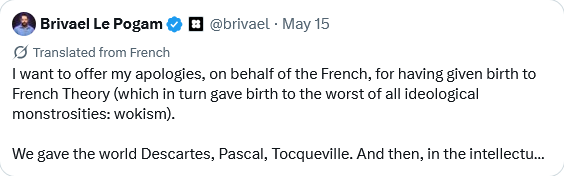
On the social media site formerly known as Twitter, Brivael Le Pogam poinpoints the formal attempt to turn criminal pedophilia into academically supported individuals with “Minor Attraction” (translated from the original French by X):
In 1977, a petition appeared in Le Monde and Libération. It called for the decriminalization of sexual relations between adults and children aged thirteen. Look at the signatures. Foucault. Derrida. Sartre. Beauvoir. Barthes. Deleuze. Guattari. Lyotard. Sollers. The entirety of the French intellectual aristocracy, the very same that would go on to colonize Yale and Berkeley, gathered under a text that pedantically explains that the child is capable of consenting.
This is not an anecdote. It is the proof.
A few days ago, I wrote that French Theory rested on a single thesis: there is no truth, there are only relations of power. I was told I was caricaturing, that these men were too subtle to be reduced to a slogan. Very well. Then let us observe what subtlety produces when pushed to its extreme.
If every norm is merely domination in disguise, then the prohibition protecting childhood is a form of domination like any other. If every truth is a construction, then innocence is a construction. If every desire is worth every other because no law is legitimate, then there is no longer any reason to defend the most elementary boundary that a civilization has ever established. They did not sign this petition despite their philosophy. They signed it because of it. It was the logical conclusion of the system. They simply had the imprudence to write it down in black and white, before their American heirs learned to wrap the same logic in more cautious vocabulary.
This is the man still taught in undergraduate courses. This is the thinker still cited with reverence at conferences. The one who, in 1977, thought the law protected children a little too much.
A thought is judged by what it makes possible. A thought that, when it reaches its term, no longer knows how to say why one does not touch children is not a subtle thought. It is a dead thought. And a civilization that continues to teach it with deference is not subtle either. It is complicit.
One does not deconstruct innocence. One protects it. It is even more or less the only thing one has no right to fail at.
Beef Bourguignon for the French Peasants from 1885
Tasting History with Max Miller
Published 6 Jan 2026Stewed beef in red wine sauce with onions
City/Region: France
Time Period: 1885Originally a peasant dish, early beef bourguignon was a sauce for leftover stewed beef. Elevated and popularized by the father of French haute cuisine, Auguste Escoffier, it shortly thereafter made the transition from a sauce to stew, and beef bourguignon was further popularized by cooking icon Julia Child.
This recipe from 1885 is for the sauce version, and it is just as delicious as the modern stew. It’s a little more wine-forward and a little less sweet, the meat is fall-apart tender, and the onions are my favorite part. If you have some leftover cooked beef like a roast or short ribs, this sauce is a great way to jazz it up. Otherwise, make the stewed beef as instructed in the recipe below because the sauce is absolutely worth it.
Boeuf Bourguignonne
Brown a piece of pork belly, diced, in butter; add a little flour, salt, and pepper, and add a mixture of half broth and half red wine; add a few small white onions, well peeled; let cook for 20 minutes, then add to this sauce your stewed beef, cut into slices. When the meat is well heated through, serve with the sauce.
— La Bonne Cuisine Pour Tous ou l’Art de Bien Vivre a Bon Marché by Marcel Butler, 1885
June 23, 2026
They don’t do “democracy” in Europe for any important issue: the voters might get it wrong
It used to be a joke that voting never matters because the voters can’t be trusted with that kind of power. Over time, the joke stopped being at all funny, because that’s exactly what has happened in most western countries at the national level, but most blatantly in the European Union, where voters can express their will in a clear majority, yet see exactly the opposite policies implemented by Brussels:

EU delenda est
2005: the day they decided your “no” didn’t count
May 29, 2005. The French vote. Referendum on the European Constitutional Treaty.
Result: 54.68% NO.
Turnout: 69%.
Not a vote of abstainers, not a misunderstanding.
A people speaking out, massively, with full awareness.
Three years later, the same text — or nearly so — came into force. Without asking their opinion again.
Here’s how.
The context.
The Constitutional Treaty was the great federal leap: a text that gave the EU the attributes of a state. A flag, an anthem, a “constitution”, a foreign minister, supremacy written in black and white. Chirac, full of confidence, calls the French to the polls. The “yes” campaign mobilizes everything: the state, the major parties, the media, big business, the institutional unions.
And the French say no. For reasons the elite refused to hear: fear of social dumping (the infamous “Polish plumber”, the Bolkestein directive), a sense of a machine slipping out of their control, rejection of a project decided from on high and ratified by acclamation. Five days later, the Dutch say no in turn. 61%.
The treaty is dead. Officially, it’s called a “period of reflection”. In reality, it’s time to find a workaround.
The workaround has a name: Nicolas Sarkozy.
2007 campaign. Sarkozy proposes a “simplified treaty”. And above all, he lays out the adoption method: it will be the parliamentary route. No referendum. Parliament will vote in place of the people.
That’s his promise. He is elected.
And he keeps it against the people who had already decided.
The sleight of hand: the Lisbon Treaty.
Signed in December 2007.
They remove the symbols that scared people: no more “constitution”, no flag in the text, no “minister”.
They keep the essentials: permanent presidency of the Council, extension of qualified majority voting, retreat from unanimity, the Union’s legal personality, European diplomatic service. The institutional substance of the rejected text, repackaged.
The most cynical part is that they admitted it. Valéry Giscard d’Estaing, the architect of the Constitution, wrote it himself: the tools are the same, we’ve simply changed their order in the box. The stated goal: make the text unreadable so no government would be forced to submit it to a referendum. Technique replacing the popular verdict.
February 2008. Versailles.
Congress convenes to amend the French Constitution and allow ratification. Then Parliament ratifies Lisbon. The government left, which had campaigned for “no”, abstains and lets it pass. The French, they are never consulted again.
The “no” of 2005 has just been converted to “yes” by procedure.
And for those who might doubt the method: Ireland, for its part, was constitutionally required to vote. It says no in June 2008. They make it revote in 2009 until they get the right result. Vote until you get it right.
And that’s where it all connects.
This isn’t a procedural anecdote. It’s the founding act of a legitimacy problem that France has never settled.
Because the question of 2005 is exactly the one today. When Brussels signs 96 billion in development aid, when the NDICI directs billions to foreign “civil societies”, when the Global Gateway promises 300 billion the real question is never “should we do it?”.
It’s: who decided, and with what legitimacy?
The answer, we’ve known it since 2005: an administration that believes the people, when they answer wrong, must be circumvented, not heard. Hayek called it the fatal conceit.
The idea that a center knows better than the peoples what is good for them including against their explicit vote.
The French never accepted Lisbon. They were never asked.
And a structure built by going over the head of a lost referendum doesn’t carry a democratic deficit: it carries a birth defect.
The American Constitution starts with “We the People”.
Ours, the European version, started with a people who said no and an apparatus that decided it didn’t count.
Auto-translated by X from Brivael Le Pogam’s original French post.


