
When I look through my own recipe for the perfect cup of tea, I find no fewer than eleven outstanding points. On perhaps two of them there would be pretty general agreement, but at least four others are acutely controversial. Here are my own eleven rules, every one of which I regard as golden:
First of all, one should use Indian or Ceylonese tea. China tea has virtues which are not to be despised nowadays — it is economical, and one can drink it without milk — but there is not much stimulation in it. One does not feel wiser, braver or more optimistic after drinking it. Anyone who has used that comforting phrase ‘a nice cup of tea’ invariably means Indian tea. Secondly, tea should be made in small quantities — that is, in a teapot. Tea out of an urn is always tasteless, while army tea, made in a cauldron, tastes of grease and whitewash. The teapot should be made of china or earthenware. Silver or Britanniaware teapots produce inferior tea and enamel pots are worse; though curiously enough a pewter teapot (a rarity nowadays) is not so bad. Thirdly, the pot should be warmed beforehand. This is better done by placing it on the hob than by the usual method of swilling it out with hot water. Fourthly, the tea should be strong. For a pot holding a quart, if you are going to fill it nearly to the brim, six heaped teaspoons would be about right. In a time of rationing, this is not an idea that can be realized on every day of the week, but I maintain that one strong cup of tea is better than twenty weak ones. All true tea lovers not only like their tea strong, but like it a little stronger with each year that passes — a fact which is recognized in the extra ration issued to old-age pensioners. Fifthly, the tea should be put straight into the pot. No strainers, muslin bags or other devices to imprison the tea. In some countries teapots are fitted with little dangling baskets under the spout to catch the stray leaves, which are supposed to be harmful. Actually one can swallow tea-leaves in considerable quantities without ill effect, and if the tea is not loose in the pot it never infuses properly. Sixthly, one should take the teapot to the kettle and not the other way about. The water should be actually boiling at the moment of impact, which means that one should keep it on the flame while one pours. Some people add that one should only use water that has been freshly brought to the boil, but I have never noticed that it makes any difference. Seventhly, after making the tea, one should stir it, or better, give the pot a good shake, afterwards allowing the leaves to settle. Eighthly, one should drink out of a good breakfast cup — that is, the cylindrical type of cup, not the flat, shallow type. The breakfast cup holds more, and with the other kind one’s tea is always half cold — before one has well started on it. Ninthly, one should pour the cream off the milk before using it for tea. Milk that is too creamy always gives tea a sickly taste. Tenthly, one should pour tea into the cup first. This is one of the most controversial points of all; indeed in every family in Britain there are probably two schools of thought on the subject. The milk-first school can bring forward some fairly strong arguments, but I maintain that my own argument is unanswerable. This is that, by putting the tea in first and stirring as one pours, one can exactly regulate the amount of milk whereas one is liable to put in too much milk if one does it the other way round.
Lastly, tea — unless one is drinking it in the Russian style — should be drunk WITHOUT SUGAR. I know very well that I am in a minority here. But still, how can you call yourself a true tea-lover if you destroy the flavour of your tea by putting sugar in it? It would be equally reasonable to put in pepper or salt. Tea is meant to be bitter, just as beer is meant to be bitter. If you sweeten it, you are no longer tasting the tea, you are merely tasting the sugar; you could make a very similar drink by dissolving sugar in plain hot water.
Some people would answer that they don’t like tea in itself, that they only drink it in order to be warmed and stimulated, and they need sugar to take the taste away. To those misguided people I would say: Try drinking tea without sugar for, say, a fortnight and it is very unlikely that you will ever want to ruin your tea by sweetening it again.
George Orwell, “A Nice Cup of Tea”, 1946.
September 19, 2017
QotD: A Nice Cup of Tea
September 17, 2017
But is it full of eels? If not, feel free to visit the British Hovercraft Museum
In their continuing series of “Geeks’ Guide to Britain”, The Register takes a trip to the former HMS Daedalus, a Fleet Air Arm seaplane training base that is now home to the Hovercraft Museum:
Did you know that the word “hovercraft” was once patented? And did you know that Great Britain is a world leader in the design and manufacture of the floaty transporters, and has been for half a century?
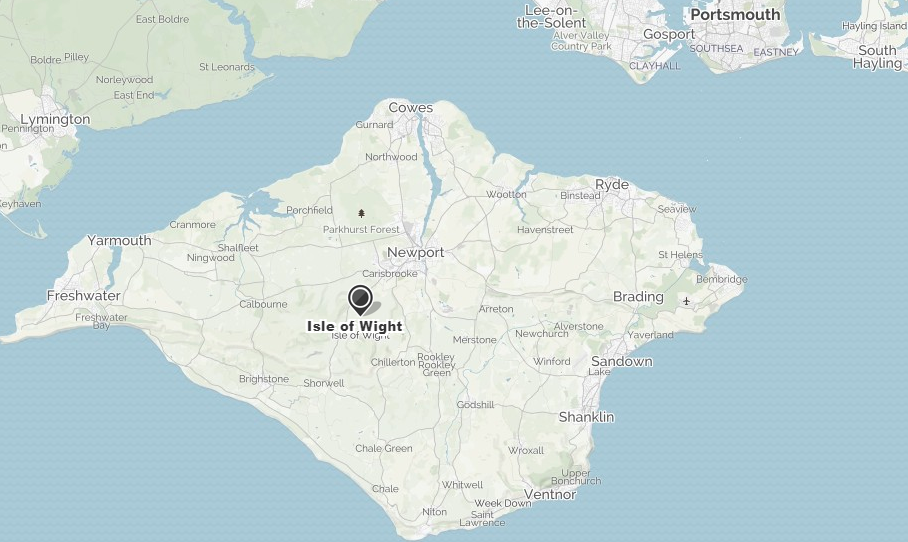
These and other surprising facts – including that some of the largest commercial hovercraft ever to be used in revenue service spent their lives shuttling booze cruisers back and forth across the English Channel – can be found at the Hovercraft Museum, at Lee-on-Solent in the south of England.
A century ago, what is now the site of the museum was known as HMS Daedalus and used as a Fleet Air Arm seaplane base. Back in the early days of aviation, and especially naval aviation, the station was at the forefront of naval and aviation technology alike. Seaplanes and skilled pilots were in great demand by the Royal Navy for anti-submarine patrols, and a new training base had to be set up to fill the service’s demand.
Thus came about the “temporary” Naval Seaplane Training School at Lee-on-Solent, with the new training school being based around a large local property, Westcliffe House. Slipways and hangars were duly erected, with the former leading down into the waters of the Solent itself; of the latter, one of the original J-class hangars, capable of being erected by just 15 men, survives to this day.
[…]
To truly appreciate the hovercraft, one should actually ride one of the things. This is easily done by a short journey along the coast from Lee-on-Solent to Britain’s only scheduled hovercraft service, which operates between Portsmouth and the Isle of Wight.
Operated by Hovertravel, whose sister company Griffon Hoverwork also builds the craft operated by the company, the service runs about every half an hour during the day, with more frequent services during the morning rush hour and a gradual winding-down into the evening.
September 14, 2017
The EU doesn’t want Britain to leave amicably – they want to punish Britain pour encourager les autres
Individual national politicians within the EU may clearly see there is no real benefit to be had in forcing a “hard Brexit”, but the permanent bureaucracy and the EUrocratic leadership seem determined to use the process to inflict as much harm as they can, for fear that other countries may decide to get out, too:
Last week’s headlines in the United Kingdom focused once again on the words of two men: the EU’s chief Brexit negotiator Michel Barnier and Brexit secretary for the UK government, David Davies.
In the ongoing negotiation between Her Majesty’s Government and the European Union, three main issues remain unresolved, notably the border between Northern Ireland and the Republic of Ireland, EU citizens’ rights who reside in the United Kingdom, and the infamous ‘Brexit divorce bill’. The latter has caused considerable outrage in the British public, as the French negotiator demands a full £90 million ($117 million) in payments in order to pay for the expenses caused by the British exit.
I believe the demanded payments are actually billions of pounds rather than millions. Mere millions would be a rounding error in the budget for the UK.
The measure is so unpopular that even a majority of British people who voted to remain in the European Union now oppose it.
A week ago, the UK government refused to cover this large sum and has since issued thorough explanations why it holds that position. This apparently left EU leaders flabbergasted, whose clear intent is to make an example out of the United Kingdom. With Brexit being the first time an EU-member state has chosen to get out of the union, the team around Michel Barnier and EU Commission president Jean-Claude Juncker has every interest in making the Brexit situation a deterrent for large eurosceptic movements in other European countries. In fact, Barnier has been crystal clear on this. As the BBC reports:
Speaking at a conference in Italy on Saturday, Mr Barnier said he did not want to punish the UK for leaving but said: “I have a state of mind – not aggressive… but I’m not naïve.”
“We intend to teach people… what leaving the single market means,” he told the Ambrosetti forum.
Asked by the German newspaper Bild am Sonntag if other member states would follow Britain’s example of quitting the union, Commission chief Juncker said: “No. Britain’s example will make everyone realize that it’s not worth leaving.”
How exactly is the EU expecting to bring other members off their eurosceptic tendencies remains unclear. With a considerable trade imbalance in favor of the Brits, which are still one of the most important economic players on the globe, it is hard to imagine that Angela Merkel will want angry Volkswagen producers before her decisive parliamentary elections and that Emmanuel Macron will want to deal with enraged Bordeaux wineries before the upcoming senate elections.
At the same time the Brexit negotiations rumble on, the EU is now making it ever more clear what their plans are for the future:
Jean-Claude Juncker has confirmed the EU will pursue a policy of ever-continuing expansion, create its own army, and force constituent countries to open their borders and join the beleaguered Euro in an speech which will only serve to confirm the decision of every Brexit voter. In his ‘State of the Union’ address to the European Parliament this morning, Juncker restated the EU’s commitment to an expansionist set of policies to further erode the sovereignty of member states; a platform which Remainers will find difficult to explain away.
He explicitly re-stated his ambition to see the European Union continue to expand:
“We must maintain a credible enlargement perspective for the Western Balkans… the European Union will be greater than 27 in number.”
On immigration and free movement, Juncker said the Schengen passport-less area would be extended “immediately” to Bulgaria and Romania:
“If we want to strengthen the protection of our external borders, then we need to open the Schengen area of free movement to Bulgaria and Romania immediately. We should also allow Croatia to become a full Schengen member once it meets all the criteria.”
He confirmed that the EU will create a ‘European Defence Union’ by 2025 – that is, an EU army:
“And I want us to dedicate further efforts to defence matters. A new European Defence Fund is in the offing. As is a Permanent Structured Cooperation in the area of defence. By 2025 we need a fully-fledged European Defence Union. We need it. And NATO wants it.”
September 12, 2017
Inside A British WW1 Airbase – Stow Maries Great War Aerodrome I THE GREAT WAR Special
Published on 11 Sep 2017
Visit Stow Maries Great War Aerodrome in Essex: http://www.stowmaries.org.uk/
The Royal Flying Corps and later the Royal Air Force maintained aerodromes and airfields around Great Britain for defence against German Zeppelin and Gotha Bomber raids. But would a WW1 aerodrome actually work?
The River Thames: “London River” – 1941 Educational Documentary – WDTVLIVE42
Published on 31 Aug 2017
The River Thames, Key to London’s Importance as a Centre of Commerce and Government‘At Tilbury, near the mouth of the River Thames, liners from all over the world come into the landing stages, past long lines of barges and battalions of cranes. Higher up-river are the giant London docks, the busiest in the world, where the work of importing and exporting cargo us carried on unceasingly.
Westwards, up-river, are huge warehouses; cranes and smoking funnels line the banks. Approaching the City, ships pass beneath Tower Bridge, close to the imposing Tower of London. Nearby is the world of wharves and dockland offices, and directly linked to the river are London’s famous markets – Billingsgate for fish, Smithfield for meat and Covent Garden for fruit, vegetables and flowers. Here, too, is the world of finance – “the richest square mile in the world” – with the Stock Exchange, the Bank of England, and important banking and business houses known throughout the world. Further up-river is County Hall, magnificent headquarters of the London County Council; and on the left bank is the historic City of Westminster, home of the Empire’s government; lining Whitehall are big Government departments and, nearby, Westminster Abbey; and on the water’s edge, the Houses of Parliament with their elaborate and beautiful architecture. Beyond Westminster the character of the river is changed yet again, and giant Power Stations give way to residential houses, roads to gardens. Beyond Richmond, with its willow-lined banks, are the Tudor chimneys and turrets of Hampton Court; higher still is Windsor and its Castle, the home of the King.
As evening falls there is peace on the river at Windsor, but at the mouth of the Thames activity goes on into the night. There is no sleep for the greatest port in the world.’
(Films of Britain – British Council Film Department Catalogue – 1940)
September 10, 2017
Special Air Service (SAS) – The Falklands Campaign
Published on 13 Jul 2016
Special Air Service (SAS) – The Falklands Conflict
When Argentina invaded the Falklands in April, 1982, Britain dispatched a large Naval Task Force to recapture the Falklands. Steaming south with the British fleet were D and G Squadron of the SAS, with supporting signals units.
September 9, 2017
The Seven Years’ War
Published on 19 Nov 2016
The Seven Years’ War essentially comprised two struggles. One centered on the maritime and colonial conflict between Britain and its Bourbon enemies, France and Spain; the second, on the conflict between Frederick II (the Great) of Prussia and his opponents: Austria, France, Russia, and Sweden. Two other less prominent struggles were also worthy of note. As an ally of Frederick, George II of Britain, as elector of Hanover, resisted French attacks in Germany, initially only with Hanoverian and Hessian troops but from 1758 with the assistance of British forces also. In 1762, Spain, with French support, attacked Britain’s ally Portugal, but, after initial checks, the Portuguese, thanks to British assistance, managed to resist successfully.
QotD: Picketty’s unsupported inequality claims
Piketty’s definition of wealth does not include human capital, owned by the workers, which has grown in rich countries to be the main source of income, when it is combined with the immense accumulation since 1800 of capital in knowledge and social habits, owned by everyone with access to them. Once upon a time, Piketty’s world without human capital was approximately our world, that of Ricardo and Marx, with workers owning only their hands and backs, and the bosses and landlords owning all the other means of production. But since 1848 the world has been transformed by what sits between the workers’ ears.
The only reason in the book to exclude human capital from capital appears to be to force the conclusion Piketty wants to achieve. One of the headings in Chapter 7 declares that “capital [is] always more unequally distributed than labor.” No it isn’t. If human capital is included — the ordinary factory worker’s literacy, the nurse’s educated skill, the professional manager’s command of complex systems, the economist’s understanding of supply responses — the workers themselves, in the correct accounting, own most of the nation’s capital — and Piketty’s drama falls to the ground.
Finally, as he candidly admits, Piketty’s own research suggests that only in the United States, the United Kingdom, and Canada has income inequality increased much, and only recently. In other words, his fears were not confirmed anywhere from 1910 to 1980; nor anywhere in the long run at any time before 1800; nor anywhere in Continental Europe and Japan since World War II; and only recently, a little, in the United States, the United Kingdom, and Canada. That is a very great puzzle if money tends to reproduce itself as a general law. The truth is that inequality goes up and down in great waves, for which we have evidence from many centuries ago down to the present, which also doesn’t figure in such a tale.
Deirdre N. McCloskey, “How Piketty Misses the Point”, Cato Policy Report, 2015-07.
September 7, 2017
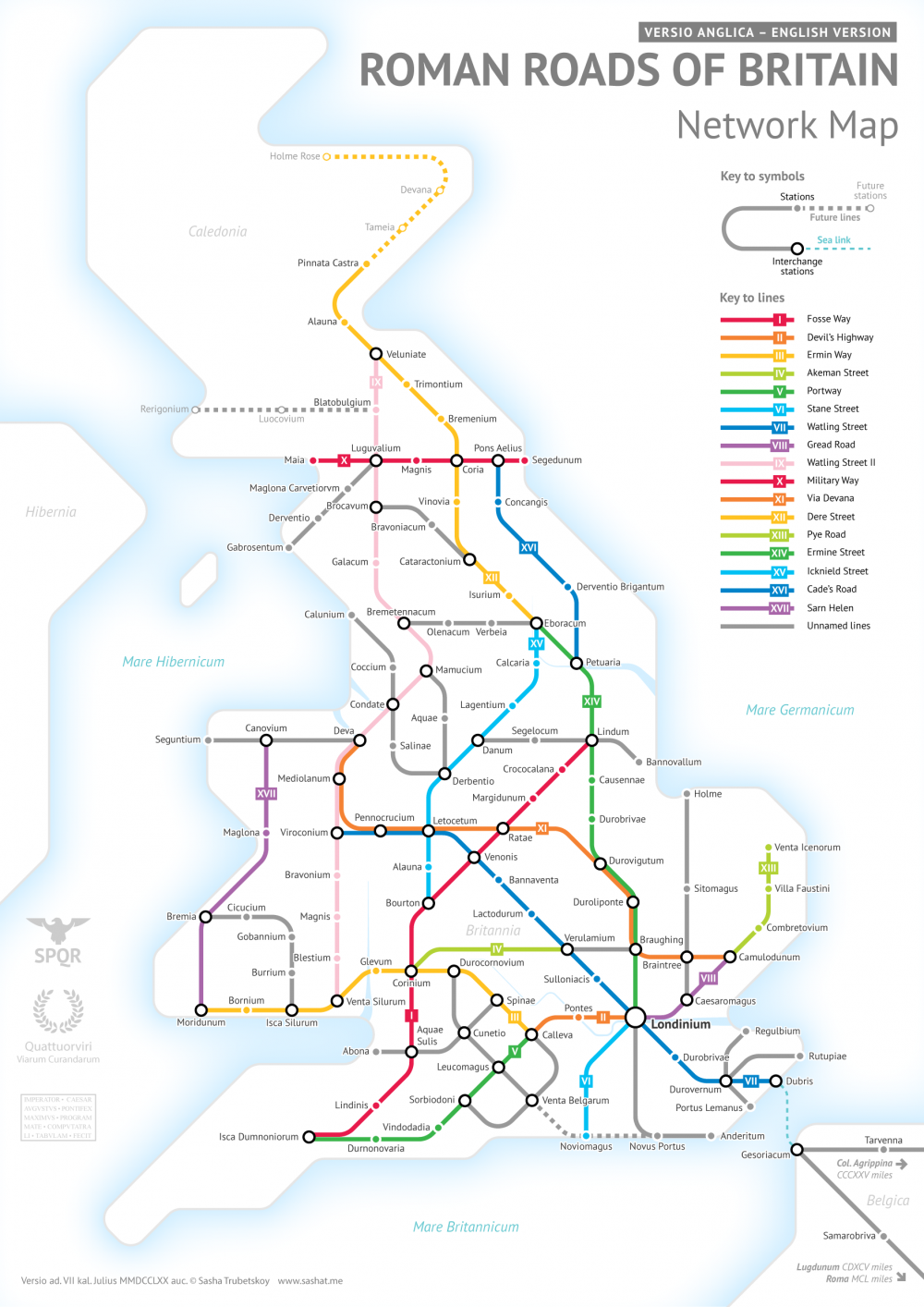
Roman Roads of Britain
Last month, Colin Marshall shared this post on Open Culture:
[Click to embiggen]
Though some of Britain’s Roman Roads have become modern motorways, most no longer exist in any form but those bits and pieces history buffs like to spot. This makes it difficult to get a sense of how they all ran and where — or at least it did until Sasha Trubetskoy made a Roman Roads of Britain Network Map in the graphic-design style of the subway maps you’ll find in London or any other major city today. Trubetskoy, an undergraduate statistics major at the University of Chicago, first found cartographical fame a few months ago with his “subway map” of roads across the entire Roman Empire circa 125 AD.
“Popular request,” he writes, demanded a Britain-specific follow up, a project he describes as “far more complicated than I had initially anticipated.” The challenges included not just the sheer number of Roman Roads in Britain but a lack of clarity about their exact location and extents. As in his previous map, Trubetskoy admits, “I had to do some simplifying and make some tough choices on which cities to include.” While this closer-up view demanded a more geographical faithfulness, he nevertheless “had to get rather creative with the historical evidence” in places, to the point of using such “not exactly Latin-sounding” names as “Watling Street” and “Ermin Way.”
September 6, 2017
When in doubt, cry “Fascist!” or “Racist!”
Brendan O’Neill on Facebook recently:
The left’s greatest mistake so far this century has been to accept at face value the establishment’s explanation for why people gave it a bloody nose. Stunned by Brexit, dizzied by Hillary’s loss, the establishment has gone into serious moral and political meltdown. It can only understand the various populist revolts against it as mass acts of racism, maybe even fascism, as the handiwork of demagogues who “got at” the people and twisted our minds. I mean, why else would anyone reject such wonderful institutions as the EU and the Democratic elite…? And, for shame, most of the left has embraced this propaganda, this made-up horror story. They have nodded along to this perverse politics of fear born of a wounded establishment’s fury with the “deplorable” demos. All those Antifa and commentators out there screaming “OMG, fascists everywhere!” think they’re being radical when in truth they are the unwitting spindoctors of the old establishment, bit-part players in a top-down narrative of hysteria that has no relation to reality.
September 5, 2017
Tank Chats #18 Mark I
Published on 15 Apr 2016
David Fletcher has returned to host the latest Tank Chat, on the Mark I tank.
The Museum’s Mark I is the only surviving example of this, the first tank produced to go into battle.
Find out more about the First World War on the Tank Museum’s Centenary blog, Tank 100 http://www.tank100.com
September 4, 2017
How to Pronounce UK Place Names – Anglophenia Ep 23
Published on 21 Jan 2015
Anglophenia’s Siobhan Thompson teaches Science Friction’s Rusty Ward — and the rest of America — how to pronounce difficult British place names.
Learn how to pronounce even more British place names here: http://www.bbcamerica.com/anglophenia/2014/01/pronounce-deliberately-offputting-british-place-names/
Visit the Anglophenia blog: http://www.bbcamerica.com/anglophenia
August 31, 2017
“… as if millions of future lit-crit students suddenly cried out in terror and were suddenly silenced”
The late Sir Terry Pratchett hatched a cunning plan to thwart the inchoate plans of uncounted would-be literary ghouls:
A hard drive containing the unfinished books of Terry Pratchett has been destroyed by a steamroller, in fulfilment of the late author’s last wishes.
The works were crushed by a vintage John Fowler & Co steamroller at the Great Dorset Steam Fair, ahead of the opening of a new exhibition about the author’s life and work. It is thought up to 10 incomplete novels were flattened.
Friend Neil Gaiman, with whom Pratchett cowrote Good Omens, had revealed in 2015 that Pratchett had instructed that he wanted “whatever he was working on at the time of his death to be taken out along with his computers, to be put in the middle of a road and for a steamroller to steamroll over them all”.
Pratchett’s former assistant Rob Wilkins tweeted that he was “about to fulfil [his] obligation to Terry”.
The hard drive will go on display as part of a major exhibition about the author’s life and work, Terry Pratchett: HisWorld, which opens at the Salisbury Museum in September.
About to fulfill my obligation to Terry @SalisburyMuseum @Wiltshire_flo pic.twitter.com/B0xr3V5Cbg
— Terry Pratchett (@terryandrob) August 25, 2017
There goes the browsing history… Many thanks to @steamfair. Soon to be on display at @SalisburyMuseum in September https://t.co/Di8tvTO4Hi pic.twitter.com/onGGWLDYL4
— Terry Pratchett (@terryandrob) August 25, 2017
The Dieppe raid and the failure of the Churchill tank
Published on 15 Oct 2010
The Dieppe Raid, also known as the Battle of Dieppe, Operation Rutter and, later, Operation Jubilee, was a Second World War Allied attack on the German-occupied port of Dieppe. The raid took place on the northern coast of France on 19 August 1942. The assault began at 5:00 a.m. and by 10:50 a.m. the Allied commanders were forced to call a retreat. Over 6,000 infantrymen, predominantly Canadian, were supported by a Canadian Armoured regiment and a strong force of Royal Navy and smaller Royal Air Force landing contingents. It involved 5,000 Canadians, 1,000 British troops, and 50 United States Rangers.
Objectives included seizing and holding a major port for a short period, both to prove that it was possible and to gather intelligence. Upon retreat, the Allies also wanted to destroy coastal defences, port structures and all strategic buildings. The raid had the added objectives of boosting morale and demonstrating the firm commitment of the United Kingdom to open a western front in Europe.
Virtually none of these objectives were met.
August 29, 2017
Inside A British Bristol Scout WW1 Airplane I THE GREAT WAR Special
Published on 28 Aug 2017
★★★★★ “Bristol Scout Rebuilding History” on Vimeo: http://bit.ly/BristolScoutVimeo ★★★★★
★★★★ “Bristol Scout Rebuilding History on DVD:
http://bit.ly/BristolScoutDVD ★★★★In our first episode from Stow Maries Great War Aerodrome we talk with David Bremner about his Bristol Scout 1264 which is an exact copy of his granddad’s WW1 airplane that he flew on the Mesopotamian front.


