
Anglophenia
Published on 7 Jan 2015From Cadbury Flake to jelly babies, Siobhan Thompson shows us the British candies we should all try at least once.
November 16, 2017
15 British Sweets Everyone Should Try – Anglophenia Ep 22
Comments Off on 15 British Sweets Everyone Should Try – Anglophenia Ep 22
QotD: Carrier cynicism
If you are a follower of UK defence matters, then it seems to be traditional that you must be find a reason, any reason, to naysay and be downbeat about something good. The recent sailing of QUEEN ELIZABETH (QEC, and of course, not yet an HMS), is a good example of this. There were tweets and moans aplenty about an aircraft carrier supposedly without aircraft, about it being empty for years across a barren flight deck with tumbleweed and adrift deck hockey quoits the sole occupants, and of course that’s assuming a 17-year-old hacker hadn’t somehow taken charge of the ship using its SHOCK HORROR Windows XP system that’s not actually connected to the internet to somehow do something bad. This is without mentioning the near orgasmic levels of excitement the media wound themselves up into with the prospect of the vessel running into the side of the dockyard or being stuck under the Forth Bridge.
In reality the opening days of the QE’s sea trials could not have gone better for the Royal Navy and the MOD. An outstandingly effective PR operation managed to secure a great deal of national media coverage of this event, and most of the main papers had photos of the ship at sea. Some highly astute programming ensured that a pair of Type 23 frigates and a pair of Merlin helicopters were immediately available to ostensibly provide cover, but arguably in reality provided the nation with several years of stock footage of British carrier groups at sea. Within a couple of days the first landing was achieved, thus slaying the ‘but she’ll have no aircraft’ argument, and the internet is awash with glorious photos of the biggest warship ever built outside of the United States of America at sea. To top it all off, some sharply pointed jibes towards the Russians by the Secretary of State for Defence managed to elicit a strong reaction, suggesting the Bear is not as thick skinned as it wishes to portray itself to be.
Sir Humphrey, “Some Brief Thoughts on QUEEN ELIZABETH sailing”, Thin Pinstriped Line, 2017-07-03.
Comments Off on QotD: Carrier cynicism
November 15, 2017
The Man Whose Tank Collection Got WAY Out Of Hand | Forces TV
Forces TV
Published on 29 Oct 2017We take a trip to Cobbaton Combat Collection to meet the family with over 70 military vehicles!
Comments Off on The Man Whose Tank Collection Got WAY Out Of Hand | Forces TV
November 11, 2017
Mark Knopfler – “Remembrance Day”
Bob Oldfield
Published on 3 Nov 2011A Remembrance Day slideshow using Mark Knopfler’s wonderful “Remembrance Day” song from the album Get Lucky (2009). The early part of the song conveys many British images, but I have added some very Canadian images also which fit with many of the lyrics. The theme and message is universal… ‘we will remember them’.
Comments Off on Mark Knopfler – “Remembrance Day”
In memoriam
A simple recognition of some of our family members who served in the First and Second World Wars:
The Great War
 Private William Penman, Scots Guards, died 16 May, 1915 at Le Touret, age 25
(Elizabeth’s great uncle)- Private Archibald Turner Mulholland, Argyll & Sutherland Highlanders, mortally wounded 25 September, 1915 at Loos, age 27
(Elizabeth’s great uncle) - Private David Buller, Highland Light Infantry, died 21 October, 1915 at Loos, age 35
(Elizabeth’s great grandfather) - Private Harold Edgar Brand, East Yorkshire Regiment. died 4 June, 1917 at Tournai.
(My first cousin, three times removed) - Private Walter Porteous, Durham Light Infantry, died 4 October, 1917 at Passchendaele, age 18
(my great uncle) - Corporal John Mulholland, Argyll & Sutherland Highlanders, wounded 2 September, 1914 (shortly before the First Battle of the Aisne), wounded again 29 June, 1918, lived through the war.
(Elizabeth’s great uncle)
The Second World War
- Flying Officer Richard Porteous, RAF, survived the defeat in Malaya and lived through the war
(my great uncle) - Able Seaman John Penman, RN, served in the Defensively Equipped Merchant fleet on the Murmansk Run (and other convoy routes), lived through the war
(Elizabeth’s father) - Private Archie Black (commissioned after the war and retired as a Major), Gordon Highlanders, captured at Singapore (aged 15) and survived a Japanese POW camp
(Elizabeth’s uncle) - Elizabeth Buller, “Lumberjill” in the Women’s Land Army in Scotland through the war.
(Elizabeth’s mother) - Trooper Leslie Taplan Russon, 3rd Royal Tank Regiment, died at Tobruk, 19 December, 1942 (aged 23).
A recently discovered relative. Leslie was my father’s first cousin, once removed (and therefore my first cousin, twice removed).
For the curious, the Commonwealth War Graves Commission and the Royal British Legion provide search engines you can use to look up your family name. The RBL’s Every One Remembered site shows you everyone who died in the Great War in British or Empire service (Canadians, Australians, New Zealanders, South Africans and other Imperial countries). The CWGC site also includes those who died in the Second World War.
In Flanders fields the poppies blow
Between the crosses row on row,
That mark our place; and in the sky
The larks, still bravely singing, fly
Scarce heard amid the guns below.We are the Dead. Short days ago
We lived, felt dawn, saw sunset glow,
Loved and were loved, and now we lie
In Flanders fields.Take up our quarrel with the foe:
To you from failing hands we throw
The torch; be yours to hold it high.
If ye break faith with us who die
We shall not sleep, though poppies grow
In Flanders fields.Lieutenant Colonel John McCrae, MD Canadian Army Medical Corps (1872-1918)
Comments Off on In memoriam
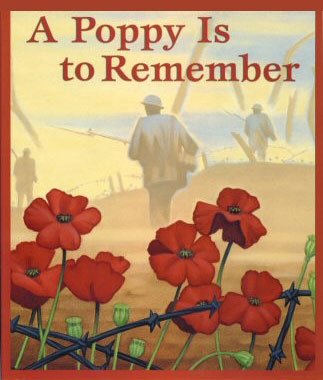
QotD: Wearing the Red Poppy
One hundred years is a short period in history but a long one in human lives and memories. It marks a point when perspective is gained on tragic events: for one, thing no-one who participated in them is still alive. Perspective changes meaning and alters commemoration. It took, for example, white Southerners that long to stop voting Democrat because Abraham Lincoln had been a Republican. Today in Spain we see the quiet rise of memorials for the losses of the Spanish Civil War. Time takes its toll of grievances and opens new avenues of generous remembrance.
Perhaps that’s it. The very length of time since the original Armistice – the eleventh minute of the eleventh hour of the eleventh day of the eleventh month in 1918 – is the reason we still wear red poppies. The conflicting emotions that originally surrounded remembrance – the grief, the survivors’ guilt, the sense of waste and futility, the bitterness of victory – have all washed away. That leaves us with an awareness of a loss we cannot fully feel, and will thankfully never have to. But it’s a loss we can and must acknowledge.
It is a very British thing, the red poppy: a non-militaristic and utterly unexultant commemoration of the need for military force despite the costs. And it has a typically British origin in being multinational; its current form came into being when Earl Haig adopted a French woman’s design that copied an original red silk poppy created by an American woman inspired by a Canadian war poet’s elegy “Flanders Field”.
The poppy has in it the stoicism of the Londoners facing the Blitz – “London can take it”. We wear it to renew our individual and collective belief that Britain can take it.
John McTernan, “Does Jeremy Corbyn have any idea what Poppy Day is about?”, The Telegraph, 2015-10-22.
Comments Off on QotD: Wearing the Red Poppy
November 10, 2017
The future of the Royal Marines
A few months back, Sir Humphrey took a look at the British Royal Marines and suggested that they need to “re-marinize” to avoid just being light infantry that wear a different cap badge:
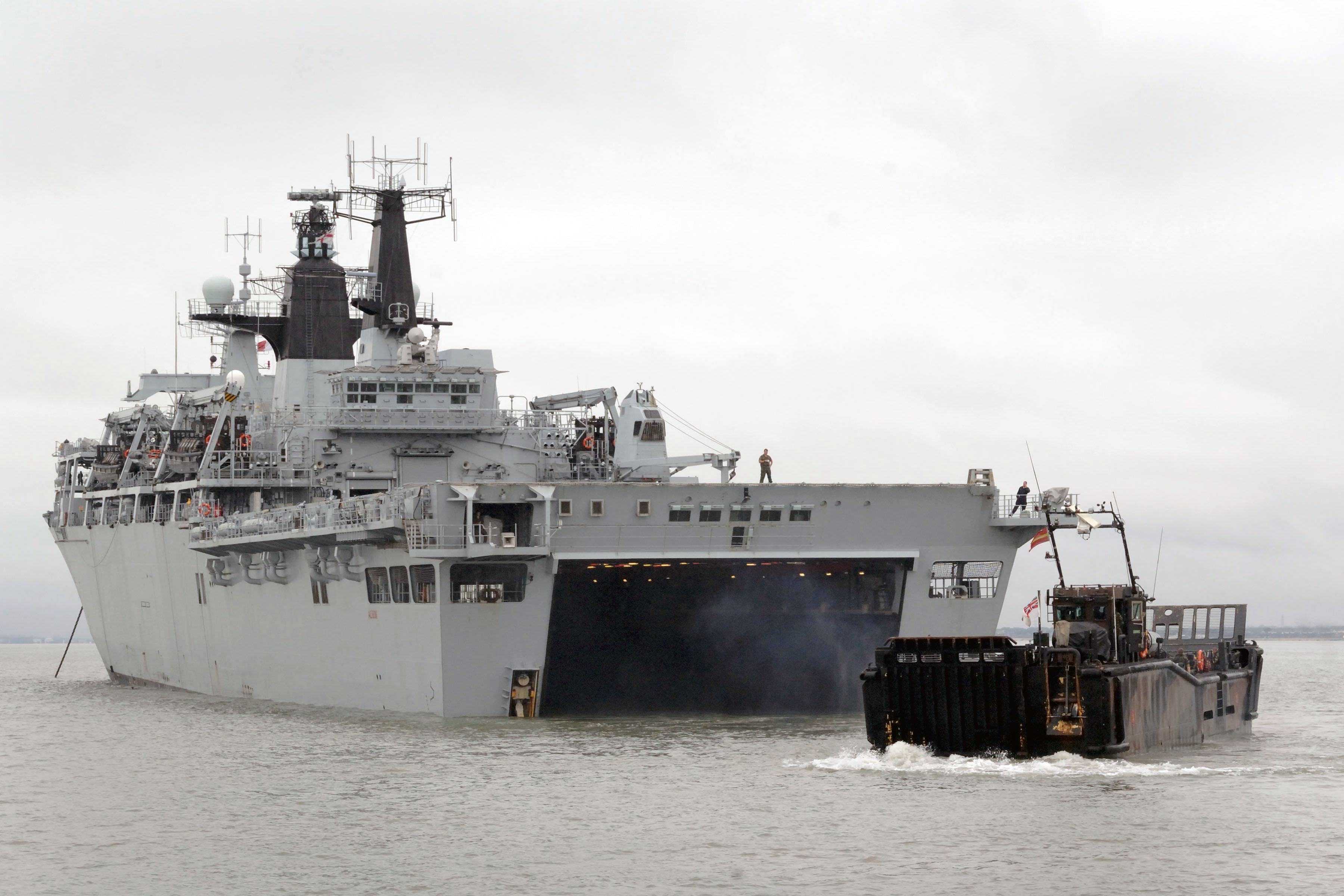
HMS Albion conducts amphibious operations with Landing Craft Utility (LCU) during Exercise Grey Heron off the coast of Portsmouth in 2007.
The Albion Class, Landing Platform Dock ships (LPD) primary function is to embark, transport, and deploy and recover (by air and sea) troops and their equipment, vehicles and miscellaneous cargo, forming part of an Amphibious Assault Force.
(Photo via Wikimedia)
The challenge for the Royal Marines [RM] right now is that they look particularly vulnerable targets, with a highly specialised core role that is increasingly unlikely to be used in anger. The RM and the RN [Royal Navy] have long had a slightly odd, and at times, uneasy relationship. It is often forgotten these days that the role of amphibious warfare isn’t something that really took off until WW2, and that the RM have only been leading on it for about 70 years. Until that point they were arguably merely light infantry embarked on ships and the odd landing party.
[…]
The key point where things began to change was arguably OP HERRICK. At this point the Corps transitioned from being an organisation which fought from the sea onto the land, to one that spent many years focusing on being a land based warfighting force. The depth of commitment to HERRICK meant that the Corps lost a lot of its links to the wider RN; speaking to friends who served in the RM, many remark that during the HERRICK years the RM did very little with the RN at sea. This would have been fine for a short operation, but for a multi-year commitment it meant that an entire generation of Officers and NCOs were growing up who excelled at conventional land warfare, but who had lost touch with their maritime roots.
At the same time, there was a growing sense in some parts of the RN that the RM was arguably a money pit that cost the RN a significant amount of time, money and platforms, but which delivered very little for the RN itself. Tellingly, during the worst years of the piracy issues in Somalia, the RN had to rely heavily on RNR ratings to form ships protection teams, not RM in part reportedly because the RM was so focused on Afghanistan. At a time when the RN was taking heavy cuts to ships and other platforms as part of budget reductions to help deliver success in Afghanistan, there was perhaps some resentment that the Corps delivered little, yet absorbed a huge amount of the Naval Service budget. What is the point of having an amphibious fleet, and maritime amphibious helicopter capability, if your amphibious troops are stuck in a cycle of deploying only to a landlocked country?
[…]
In the current security environment that the UK faces, it is hard to see a need for a major amphibious lift capability to conduct opposed operations. This may sound like heresy to say, but if you consider that any major beach landing would be fraught with risk, and require major military support and logistical access to a port and airhead quickly to succeed, it is hard to see the circumstances where the UK and US would want to conduct such an operation. The political circumstances are such, that it is difficult to see the UK willingly wishing to indulge in a full scale amphibious assault against a hostile nation with a brigade sized force anytime in the future.
There are plenty of situations where the ability to transport equipment and people is vital – for instance conducting a NEO [Noncombatant Evacuation Operation], or moving troops and supplies into a friendly country ahead of a wider land conflict. There are also circumstances where an ‘amphibious raid’ capability is equally important – the ability to quickly send a small number of troops ashore via helicopter or fast landing craft to conduct a specific mission, or diversionary raid is extremely useful.
[…]
For the RM, the chance to re-embark at sea and focus on maritime counter piracy and security could be an opportunity to rebrand and reinvent the organisation, giving it a new lease of life. There is a real and pressing need to marinize the RM again, getting them used to being at sea, not permanently working ashore. At the same time it would free up a lot of highly trained infantry soldiers who could train to deliver boarding teams, and maritime counter piracy duties. This is a deeply complex role that requires a lot of training and support to get right, and is only going to grow in importance over the next few years.
Investing in niche roles such as this, or protection of nuclear weapons, and coupling this with a smaller ability to land raiding parties not brigades has the benefit of making the Corps far more valuable to keep in the long term. Right now it is arguably a light infantry brigade which has some other secondary duties tagged on the side. This is fine, but there are plenty of light infantry brigades out there, and probably too many soldiers in the Army as it is. If the RM were to refocus onto being sea going soldiers again, and deliver a small range of capabilities very well, then this makes them far harder to scrap entirely.
Comments Off on The future of the Royal Marines
November 5, 2017
England: A Beginner’s Guide
exurb1a
Published on 4 Jul 2016I notice that it’s also independence day. How fitting.
You just wait until we throw all your tea in the fucking ocean.The music is Pomp and Circumstance No.1 by Elgar ► https://www.youtube.com/watch?v=moL4MkJ-aLk
Comments Off on England: A Beginner’s Guide
QotD: Explaining comparative advantage
Actually, it’s dead easy. No math, no arithmetic. It is in fact the soul of common sense. But you have to understand that comparative advantage is the principle of cooperation, as against competition. The word “advantage” gets us thinking of competition, which is perfectly reasonable in our own individual lives — we do compete with other businesses or other writers or whomever. But the system as a whole, whatever it is, does well of course by cooperating, in business or science or family life. It’s not all we do, admittedly. We also compete. But within a household or a company or a world economy the job is to produce a result in the best way, cooperatively. If you are running a household or a sports team or a world economy, you would want to assign roles to the various contributors to the common purpose sensibly. It turns out to be precisely on grounds of comparative advantage.
Consider Mum and 12-year old Oliver, who are to spend Saturday morning tidying up the garage. Oliver is incompetent in everything compared with Mum. He cannot sweep the floor as quickly as she can, and he is truly hopeless in sorting through the masses of rubbish that garages grow spontaneously. Mum, that is, has an absolute advantage in every sub-task in tidying up the garage. Oliver is like Bangladesh, which is poor because it makes everything — knit goods and medical reactors — with more labor and capital than Britain does. Its output per person is 8.4 percent of what it is in Britain. So too Oliver.
What to do? Let Mum do everything? No, of course not. That would not produce the most tidied garage in a morning’s work. Oliver should obviously be assigned to the broom, in which his disadvantage compared with Mum is comparatively least — hence “comparative advantage.” An omniscient central planner of the garage-tidying would assign Mum and Oliver just that way. So would an omniscient central planner of world production and trade. In the event, there’s no need for an international planner. The market, if Trump does not wreck it, does the correct assignment of tasks worldwide. Bangladesh does not sit down and let Britain make everything merely because Britain is “competitive” absolutely in everything. And in fact Bangladesh’s real income has been rising smartly in recent years precisely because it has specialized in knit goods. It has closed its ears to the siren song of protecting its medical reactor industry. It gets the equipment for cancer treatment from Britain.
Comparative advantage means assigning resources of labor and capital to the right jobs, whatever the absolute productivity of the economy. It applies within a single family, or within a single company, or within Britain, or within the world economy, all of which are made better off by such obvious efficiencies. Following comparative advantage enriches us all, because it gets the job done best. Policies commonly alleged to achieve absolute advantage lead to protection — that is, extortion, crony capitalism, and the rest in aid of “competitiveness.”
Dierdre N. McCloskey, “A Punter’s Guide to a True but Non-Obvious Proposition in Economics”, 2017-10-16.
Comments Off on QotD: Explaining comparative advantage
November 2, 2017
The Short-Lived No1 Mk6 SMLE Lee Enfield
Forgotten Weapons
Published on 30 Mar 2017Prototype: Sold for $56,350 – http://jamesdjulia.com/item/1645-396/
Pre-production: Sold for $12,075 – http://jamesdjulia.com/item/1646-396/
No1 Mk6: Sold for $12,075 – http://jamesdjulia.com/item/1650-396/
No4 Mk1: Sold for $5,750 – http://jamesdjulia.com/item/1658-396/The SMLE No1 Mk3 was the iconic British infantry rifle of World War 1, but not the final evolution of the Lee Enfield design. By World War 2 it had been replaced by the new No4 Mk1 Lee Enfield, and this is the story of the interim models.
At the end of WW1, the British recognized several areas where the SMLE could be improved: a heavier barrel, a lighter bayonet, and aperture sights. This led to the development of the No1 Mk5 rifle (the Mk4 being a designation for a .22 rimfire training variation), with 20,000 examples made for troop trials in the mid 1920s. The Mk5 was well received by troops, with its rear-mounted aperture sight being seen as a substantial improvement over the previous tangent notch sight. However, experimentation continued and by 1926 prototypes of a Mk6 rifle were being made.
In 1929 a series of 1000 No1 Mk6 rifles was put into production, which would fit a new style of short and light spike bayonet as well as an improved type of aperture sight. They also featured a very distinctive large area of deep square checkering on the hand guard, intended to improve one’s grip on the rifle during bayonet drill. These rifles were nearly the same as what was ultimately adopted as the new No4 Mk1 rifle – so much so that in 1931 that designation was applied to the rifles and a batch of 2500 more made for trials. These trials rifles were mostly issued out to troops in the aftermath of Dunkirk, making them very scarce to find today, as most did not survive the war. Those that did will sport a new serial number with an “A” suffix to indicate their non-standard parts (in comparison to the production model No4 Mk1. Today were will look at the progressive development of a pre-prototype Mk6, Mk6 rifle number 1, a Mk6 trials rifle, and one of those 2500 trials No4 Mk1 rifles.
Comments Off on The Short-Lived No1 Mk6 SMLE Lee Enfield
November 1, 2017
James May’s Top Toys
railwayman2013
Published on 2 Jan 2013I love hornby trains !!!
Comments Off on James May’s Top Toys
October 31, 2017
Strategic Bombing on the Western Front I THE GREAT WAR Special
The Great War
Published on 30 Oct 2017Bismarck’s Channel: https://www.youtube.com/user/Bis18marck70/featured
With the development of planes shortly before the Great War, the concept of strategic bombing made its debut in this conflict. Each country had different doctrines with regards to strategic bombing, and in this video we’ll be looking at British, French and German doctrines regarding the bombing of civilian targets and supply lines, as well as considering their effectiveness.
Comments Off on Strategic Bombing on the Western Front I THE GREAT WAR Special
Yes Minister — The Five Standard Excuses
Hostis Humani Generis
Published on 26 Sep 2015Humphrey Appleby’s five standard excuses from S02E07.
Comments Off on Yes Minister — The Five Standard Excuses
October 30, 2017
Tank Chats #19 Matilda II
Tank Museum
Published on 28 Apr 2016The name Matilda means Strength in Battle from the Germanic roots Maht, meaning strong and Hild meaning battle.
The Matilda was regarded as a superb tank in its day and carved a remarkable career for itself. A few served in France in 1940 but in the early stages of the North African campaign, under General Wavell, it virtually ruled the desert. Even when the Afrika Korps arrived it remained a formidable opponent, immune to everything but the notorious 88mm gun. Its main failings were its slow speed and small gun, which could not be improved.
Comments Off on Tank Chats #19 Matilda II
October 28, 2017
Yorkshire Airlines
esoftnet
Published on 17 May 2010The safest way to fly!! More videos at http://www.esoftnetonline.com/crazyvideos.htm
Comments Off on Yorkshire Airlines


