
Comic Relief
Published on 16 Mar 2009Doctor Who Comic Relief Special starring Rowan Atkinson, Richard E Grant, Hugh Grant, Jonathan Pryce and Joanna Lumley.
December 15, 2017
Rowan Atkinson is Doctor Who | Comic Relief
Comments Off on Rowan Atkinson is Doctor Who | Comic Relief
December 10, 2017
Top Gear – penis length
eduard toma
Published on 18 Sep 2009Top Gear blokes talk about cars but as usual, they are deviated to other things
Comments Off on Top Gear – penis length
December 9, 2017
Berlin Airlift: The Cold War Begins – Extra History
Extra Credits
Published on 7 Dec 2017Tension between the Soviet Union and their former World War 2 Allies escalated into a hostile blockade of Berlin. All sides wanted to avoid another war, but the United States, Great Britain, and France refused to bend to Stalin’s pressure. They came up with a daring plan to supply Berlin by air.
Comments Off on Berlin Airlift: The Cold War Begins – Extra History
December 3, 2017
Command and microcontrol
Ted Campbell relays some thoughts from a recent British criticism of how military operations are now capable — and therefore very frequently are — micromanaged by higher authority:
There is a very useful and, I hope, thought provoking article (written under a nom de plume by a serving British officer) published in the Wavell Room website.* It is entitled “Mission Command; The Fall of the Strategic Corporal; the Rise of the Tactical Minister,” and in it the author laments the fact ~ and it is a fact in Canada, too, I assert ~ that “British Mission Command and performance has regressed, largely as a result of our headquarters incorporating American military information technology as well as replicating American headquarters structures and manning. During recent counterinsurgency operations we have employed increased quantities of manpower, technology and process to try and make sense of the exponentially increasing volumes of information piped into an increasingly static headquarters. These bloated headquarters have bred a culture of over planning and control. The information technology revolution has allowed Ministers and UK based senior officers to directly reach down to the tactical level in distant operational theatres.” As a British general said in a recent speech titled “‘In command and out of control’ [the] creep at the National Level to from Mission Command to Mission Control. Prolonged campaigning in Iraq and Afghanistan has created an expanded bureaucracy with a function of identifying and mitigating risk that has not receded. The advent of ‘lawfare’ and a hysterical media has reduced our Civil Service’s threshold for presentational and reputational risk. This has led to an ever increasing legal and policy oversight and scrutiny of operations. The lack of domestic appetite for wars of choice rather than of national survival has led to a dramatically reduced appetite for risk to life on operations.” I am 99.99% certain that several serving Canadian generals and senior officers (post ship/regiment-battalion and squadron command level) could have and wish they had written the same words.
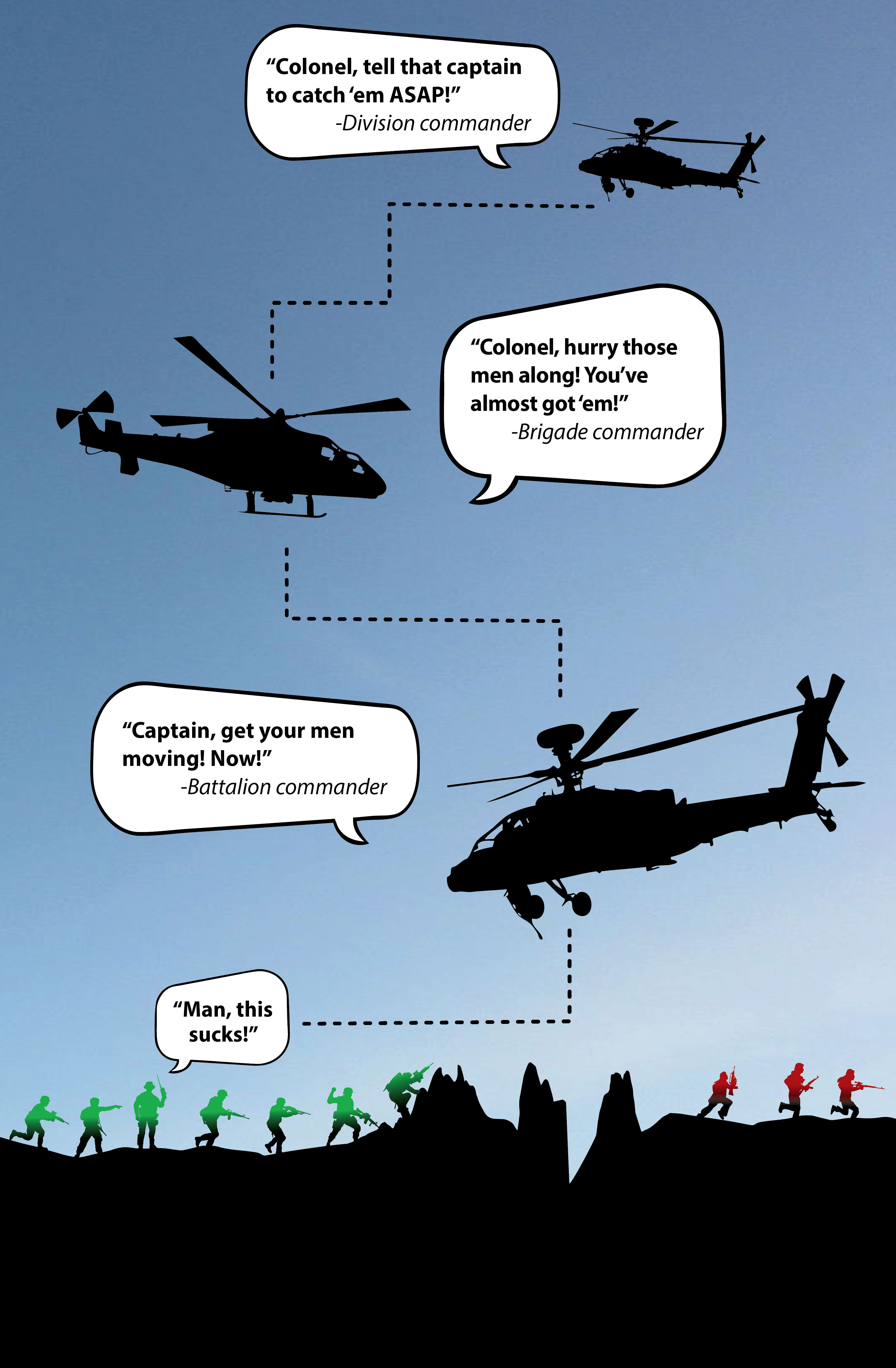
First, the very term “Mission Command” is rubbish. I know there is a whole body of literature about it, but it’s still rubbish ~ just well very documented rubbish. There is, very simply, command which is supported by control. The notion of “Mission Command” came about in the USA when it became clear that too many US senior officers were unable to exercise effective combat command because they were “nervous nellies” (or overzealous careerist) who would not or could not trust their subordinates to get on with the job. The image of a helicopter belonging to the division commander hovering over a helicopter belonging to the brigade commander hovering over the battalion commander’s helicopter that is hovering over the company of men on the ground comes to mind. Then a few other US military leaders decided that a new “concept” and a few PowerPoint presentations featuring gothic lettering and pictures of German generals would put things right … instead things went from bad to worse, but not just in the US military.
[Click to see full-size image]
Second, command and control (C2) is, actually, a quite simple thing to understand … it is the whole process by which a commander receives and analyzes his (or her) orders, does his (or her ~ always presumed from here on in) reconnaissance, makes his appreciation (estimate) of the situation and his plan and then issues the orders that commit his troops to battle. There it is in under 40 words … that’s not too hard to grasp, is it? But it can be bloody hard to do!
Comments Off on Command and microcontrol
December 2, 2017
Breaking news from 55 BC
Despite the written records left by Julius Caesar, Cicero, and Tacitus, until now there had apparently been no physical evidence of Caesar’s invasion of Britain:
… a chance excavation carried out ahead of a road building project in Kent has uncovered what is thought to be the first solid proof for the invasion.
Archaeologists from the University of Leicester and Kent County Council have found a defensive ditch and javelin spear at Ebbsfleet, a hamlet on the Isle of Thanet.
The shape of the ditch at Ebbsfleet, is similar to Roman defences at Alésia in France, where a decisive battle in the Gallic War took place in 52 BC.
Experts also discovered that nearby Pegwell Bay is one of the only bays in the vicinity which could have provided harbour for such a huge fleet of ships. And its topography echoes Caesar’s own observations of the landing site.
Dr Andrew Fitzpatrick, Research Associate from the University of Leicester’s School of Archaeology and Ancient History said: “Caesar describes how the ships were left at anchor at an even and open shore and how they were damaged by a great storm. This description is consistent with Pegwell Bay, which today is the largest bay on the east Kent coast and is open and flat.
“The bay is big enough for the whole Roman army to have landed in the single day that Caesar describes. The 800 ships, even if they landed in waves, would still have needed a landing front 1-2 km wide.
“Caesar also describes how the Britons had assembled to oppose the landing but, taken aback by the size of the fleet, they concealed themselves on the higher ground. This is consistent with the higher ground of the Isle of Thanet around Ramsgate.”
Thanet has never been considered as a possible landing site before because it was separated from the mainland until the Middle Ages by the Wanstum Channel. Most historians had speculated that the landing happened at Deal, which lies to the south of Pegwell Bay.
Comments Off on Breaking news from 55 BC
November 27, 2017
Top Gear Facts Of Handbrake Turns
Dave Lee
Published on 20 Jan 2014Sorry for the bad quality. Season 19 Episode 4
Comments Off on Top Gear Facts Of Handbrake Turns
November 26, 2017
Rowan Atkinson in ‘We are most amused’
Kevin
Published on 3 Dec 2008Rowan Atkinson tells the Gospel of John in ‘We are most amused’, broadcast on ITV on November 15th marking Prince Charles’s 60th birthday.
Comments Off on Rowan Atkinson in ‘We are most amused’
November 25, 2017
Cambrai Tank Chats Special: The Mark IV Tank
Tank Museum
Published on 24 Nov 2017The Mark IV tank was the most numerous of the First World War and went in to battle en masse at the Battle of Cambrai, 20 November 1917. In this special edition of Tank Chats, Curator David Willey explains how the Mark IV tank functions and how it was used to break through the World War One German defences.
Comments Off on Cambrai Tank Chats Special: The Mark IV Tank
Paul Kidby’s Discworld Imaginarium
Jessica Brisbane linked to this Guardian overview of a new book by Paul Kidby, collecting his art to accompany Terry Pratchett’s Discworld series:

Terry Pratchett’s ‘artist of choice’ Paul Kidby introduces some of the images he produced during their decades-long collaboration
Comments Off on Paul Kidby’s Discworld Imaginarium
November 24, 2017
Tank Corps Unleashed – The Battle of Cambrai I THE GREAT WAR Week 174
The Great War
Published on 23 Nov 2017After stopping the offensive at Passchendaele, the British Army launches another, albeit more limited, offensive. Almost 500 tanks are put into place and the initial success is remarkable. But the Germans had been training in anti-tank warfare and are supported by fresh troops from the Eastern Front.
Comments Off on Tank Corps Unleashed – The Battle of Cambrai I THE GREAT WAR Week 174
November 23, 2017
Tank Chats #20 Mark IV
Tank Museum
Published on 13 May 2016Mechanically the Mark IV tank was the same as the Mark I but it had thicker armour, improved fuel supply and modified sponsons with slightly shorter guns in the Male version.
Mark IV tanks went into action for the first time in the summer of 1917, they were the mainstay of the Tank Corps at Cambrai in November and fought through to the end of the war with 7th and 12th Battalions of the Tank Corps. It was a male Mark IV tank which won the very first ‘Tank versus Tank’ action in April 1918 by knocking out the German A7V tank Nixe.
Comments Off on Tank Chats #20 Mark IV
November 21, 2017
QotD: The naval “rule of three”
The RN [Royal Navy], and every other seagoing Navy out there operates its ships on a rotational basis. This simple concept can best be described as ‘the rule of three’. Namely, for every ship that is on the front line at sea right now on live operations (e.g. fully stored, fuelled and munitioned and operating under a specific operation), you require a further two ships in the pipeline. The first is the one that’s just come home and gone into refit or lower level readiness. This is because the crew need to take leave, parts need replacing and the ship needs maintenance. The second is the ship that will replace the ship deployed, and this vessel will usually be in some point of the force generation cycle, which involves final bits of maintenance, trials, basic sea training and more advanced sea training and any other targeted work to get her ready to sail. This is a complex process that takes many months to fully prepare a ship to sail.
Over a couple of years life, a ship is programmed by the RN planners (a special breed of people possessed of wisdom, foresight and very little hair left at the end of their tour) to come out of a refit, work up, complete all trials and training, deploy for 9 months, return home and then wind down before going in for the next cycle of refit and repair. This cycle is either repeated, or broken up by the occasional deep multi-year refit to extend her life or fit major new equipment.
In simple terms this means that to keep 5-6 ships deployed, you need a force of roughly 17-18 escorts at any one time. Possessing 19 escort ships does not mean that 19 ships can go to sea on operations. It means you have got the ability to keep 5-6 ships deployed on station indefinitely.
This may sound a technicality, but is actually really important to understand. What distinguishes the RN from a lot of coastal navies is that sustaining this sort of deployment is routine business – the RN accepts that it goes to sea across the globe and plans this as a routine activity. For many navies, an ‘out of area’ deployment is a major investment of time and support and training, and is something that may occur once every 4-5 years, not every day of the year.
Sir Humphrey, “No – the Royal Navy is not a global laughing stock”, Thin Pinstriped Line, 2017-09-15.
Comments Off on QotD: The naval “rule of three”
November 20, 2017
Cambrai: The Tank Corps Story | The Tank Museum
Tank Museum
Published on 17 Nov 2017100 years on from the Battle of Cambrai, The Tank Museum presents a documentary on the moment the Tank Corps delivered one of the greatest advances of the First World War. This is the full-length version of Cambrai: The Tank Corps Story.
As the regimental museum of the Royal Tank Regiment, The Tank Museum is using the World War One centenary to draw attention to the struggle, sacrifice and ingenuity of the early tank men.
Comments Off on Cambrai: The Tank Corps Story | The Tank Museum
November 19, 2017
Development of British Tank Tactics 1917 I THE GREAT WAR Special
The Great War
Published on 18 Nov 2017The Battle of Cambrai 100 years ago was one of the pivotal moments for the British Tank Corps and tank combat in general. For the first time, the tanks were deployed in a way that they could play to their strengths.
Comments Off on Development of British Tank Tactics 1917 I THE GREAT WAR Special
November 16, 2017
Housing woes in the downtown core
A timely and clearly heartfelt plea by Eleanor Shaw that only needs a brief preface from Colby Cosh:
Some of you will read this without ever knowing it is satire, despite this helpful disclaimer https://t.co/uPSqMrCrts
— Colby Cosh (@colbycosh) November 15, 2017
All I want are the same things my parents wanted – a good job, a loving partner and a two-bedroom live/work space with balcony in a nice area of the world’s third-richest city.
It’s easy for the Gen Xers and Baby Boomers. To them, with low property prices in areas considered ‘undesirable’ at the time and interest rates between five and 15 per cent, getting a mortgage was easy.
But for us, those opportunities have gone. To live anywhere in London, even somewhere unsexy, is prohibitively expensive. All the nice houses are already owned by older people with better jobs, a situation surely unique in the history of the world.
And it’s not just London. In all the other cool cities around the UK – Edinburgh, Bristol, Manchester – stylish city-centre properties suitable for fashionable twentysomethings are priced far, far beyond our reach.
[…]
The government must act now to build affordable properties for millennials, and support us during our tough first decade in the capital as we work our way up in our careers until we have cleared our debts and are pulling in seven figures.
Then, and only then, can we sell our London homes to developers and move to massive houses in the country.
Comments Off on Housing woes in the downtown core


