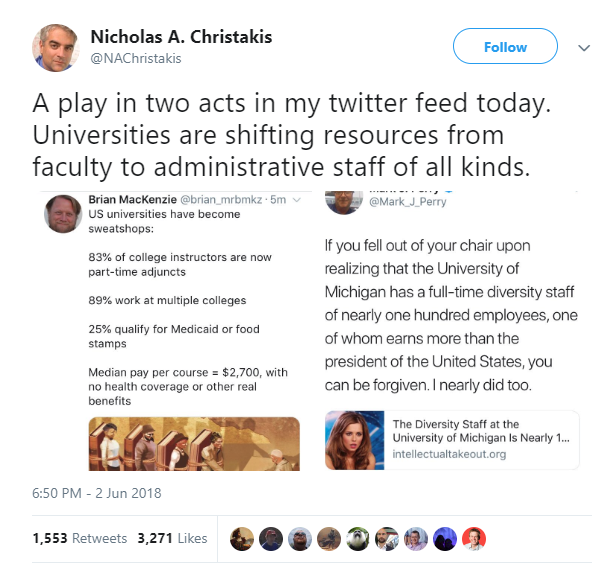
Orwell’s press card portrait, 1943
In spite of my campaign against the jackboot — in which I am not operating single-handed — I notice that jackboots are as common as ever in the columns of the newspapers. Even in the leading articles in the Evening Standard, I have come upon several of them lately. But I am still without any clear information as to what a jackboot is. It is a kind of boot that you put on when you want to behave tyrannically: that is as much as anyone seems to know.
Others besides myself have noted that war, when it gets into the leading articles, is apt to be waged with remarkably old-fashioned weapons. Planes and tanks do make occasional appearances, but as soon as an heroic attitude has to be struck, the only armaments mentioned are the sword (“We shall not sheathe the sword until”, etc., etc.), the spear, the shield, the buckler, the trident, the chariot and the clarion. All of these are hopelessly out of date (the chariot, for instance, has not been in effective use since about A.D. 50), and even the purpose of some of them has been forgotten. What is a buckler, for instance? One school of thought holds that it is a small round shield, but another school believes it to be a kind of belt. A clarion, I believe, is a trumpet, but most people imagine that a “clarion call” merely means a loud noise. One of the early Mass Observation reports, dealing with the coronation of George VI, pointed out that what are called “national occasions” always seem to cause a lapse into archaic language. The “ship of state”, for instance, when it makes one of its official appearances, has a prow and a helm instead of having a bow and a wheel, like modern ships. So far as it is applied to war, the motive for using this kind of language is probably a desire for euphemism. “We will not sheathe the sword” sounds a lot more gentlemanly than “We will keep on dropping block-busters”, though in effect it means the same.
One argument for Basic English is that by existing side by side with Standard English it can act as a sort of corrective to the oratory of statesmen and publicists. High-sounding phrases, when translated into Basic, are often deflated in a surprising way. For example, I presented to a Basic expert the sentence, “He little knew the fate that lay in store for him” — to be told that in Basic this would become “He was far from certain what was going to happen”. It sounds decidedly less impressive, but it means the same. In Basic, I am told, you cannot make a meaningless statement without its being apparent that it is meaningless — which is quite enough to explain why so many schoolmasters, editors, politicians and literary critics object to it.
George Orwell, “As I Please” Tribune, 1944-08-04.
September 13, 2019
QotD: Orwell’s campaign against the jackboot
September 10, 2019
QotD: Mere words are not “violence”
“I’m very concerned about a phenomenon called ‘concept creep’ – which has been happening to a lot of psychological terms since the 1990s”, he says. “When a word like ‘violence’ is allowed to creep so that it includes a lot of things that are not violence, then this causes a cascade of bad effects. It’s bad for the students themselves because they now perceive an idea that they dislike, or a speaker that they dislike, as having committed a much graver offence against themselves – which means that they will perceive more victimisation of themselves. And it’s also really bad for society because, as we are seeing in a spectacular way in the United States this year, when each side can point to rampant occurrences of what they see as violence by the other side, this then justifies acts of actual physical violence on their side. And there’s no obvious end to this mutual escalation process.”
He adds: “Everybody involved in education needs to be dampening down violence and the acceptance of violence. Telling students that words are violence is counterproductive to that effort.”
Jonathan Haidt, quoted by Naomi Firsht, “The Fragile Generation”, Spiked, 2017-08-31.
July 29, 2019
Erasing the past, statue by statue, plaque by plaque
Alexander Adams on the deliberate sabotage of historical monuments in pursuit of a more perfect (i.e., imaginary) past:
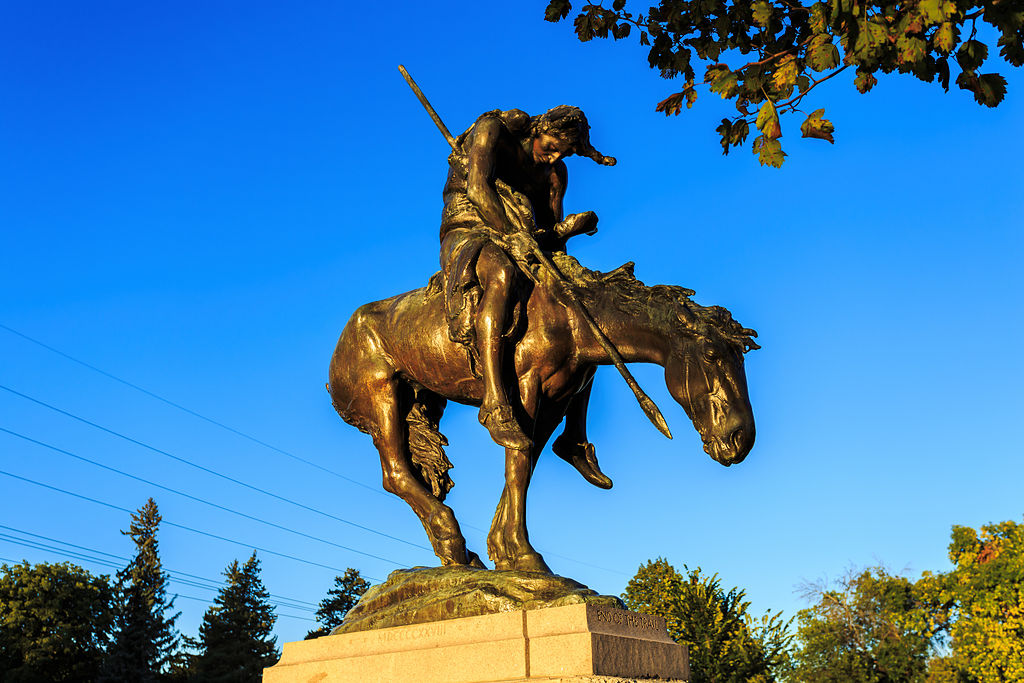
End of the Trail by James Earle Fraser, located in Waupun, Wisconsin.
Photo by Shawn Conrad via Wikimedia Commons.
In the wake of recent attempts – some successful – to have Confederate statues removed from the US south, what is the future of colonialist statues in the US west? In Pioneer Mother Monuments: Constructing Cultural Memory, Cynthia Culver Prescott, a professor of history at the University of North Dakota, senses a reluctance to apply to pioneer monuments the ideological zeal that was turned on Confederate memorials. “We resist applying the insights of settler colonial studies to American pioneer narratives because to do so would call into question foundational myths of Jeffersonian agrarianism and American exceptionalism, and lay bare white conquest of native lands and peoples.” She outlines the cases against statues of colonialists, and particularly against female settlers, who took part in the drive to colonise the American west in the 19th century.
Statues depicting women have been criticised by academics and campaigners for being idealising, inaccurate, generalising and stereotypical. There is a sense that campaigners direct such ire at statues of women settlers not just because they embody sexism and colonialism but because they show women as complicit in the act of dispossessing native peoples. There is a residual resentment that – in intersectional terms – a political minority took part in a project to oppress another minority.
The creation of monuments honouring white settlers of the west began in earnest in the 1890s. As the American western frontier was closed and territories became part of the United States, a chapter of national history had been definitively closed, too. Just under 190 monuments have been erected in the US since the 1880s marking pioneer achievements. It was a way of fixing in collective memory the achievements of forebears just at the moment their stories were becoming history. The western territories had been spared the scourge of the Civil War, and its new states had a history that involved war with Mexico, the persecution and flight of the Mormons and the Indian Wars.
In the statuary, common types emerged. Women were the prairie Madonna, the protective mother, the Indian guide leading the way, the nuclear family. Men were resolute fathers, the epitome of bravery and stoic defiance. Competitions, touring exhibitions, newspaper features and book publications circulated them, encouraging other communities to commission similar statues. Alexander Phimister Proctor’s statue of a male pioneer was an acceptable manifestation of the conquering of the west. Bearded and dressed in buckskin clothing, the pioneer wears European boots and carries a rifle. He straddles the wisdom of the natives and the technological superiority of settlers, explaining how the west was won through a combination of old knowledge and new materials.
Culver Prescott notes the example of James Earle Fraser’s sculpture The End of the Trail (1890s), which depicted an exhausted American Indian on a tired pony. Fraser had apparently developed a deep sympathy for native peoples after witnessing an army eviction. It seems the sculptor intended to elicit sympathy for evicted Indians, yet it was interpreted by contemporary observers as a scene of the sad but necessary extinction of a primitive indigenous people, conforming to the social Darwinist reading of history, in which advanced people defeat and displace inferior peoples. This is an object lesson in the variety of interpretations an artwork can elicit, regardless of artistic intent. It should alert today’s social-justice warriors to the dangers of misinterpreting public art and the risk of suppressing art on the basis of misapprehension.
July 27, 2019
“[T]he more educated a Democrat is … the less he or she understands the Republican worldview”
Last week in the Guardian, Arlie Hochschild explained some of the mutual incomprehension of US Democrats and Republicans based on a recent study:
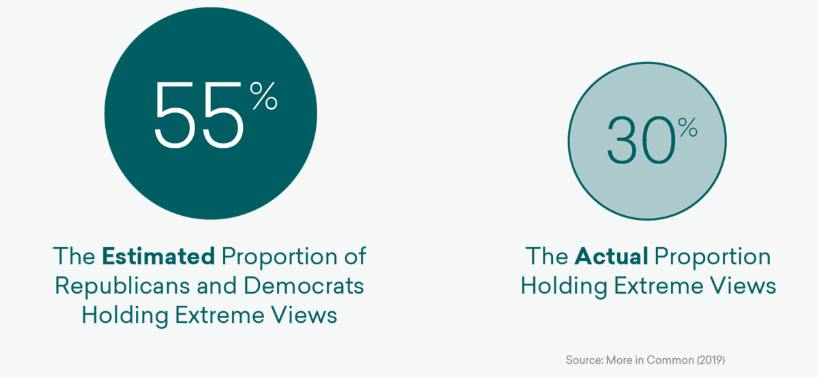
In a surprising new national survey, members of each major American political party were asked what they imagined to be the beliefs held by members of the other. The survey asked Democrats: “How many Republicans believe that racism is still a problem in America today?” Democrats guessed 50%. It’s actually 79%. The survey asked Republicans how many Democrats believe “most police are bad people”. Republicans estimated half; it’s really 15%.
The survey, published by the thinktank More in Common as part of its Hidden Tribes of America project, was based on a sample of more than 2,000 people. One of the study’s findings: the wilder a person’s guess as to what the other party is thinking, the more likely they are to also personally disparage members of the opposite party as mean, selfish or bad. Not only do the two parties diverge on a great many issues, they also disagree on what they disagree on.
This much we might guess. But what’s startling is the further finding that higher education does not improve a person’s perceptions – and sometimes even hurts it. In their survey answers, highly educated Republicans were no more accurate in their ideas about Democratic opinion than poorly educated Republicans. For Democrats, the education effect was even worse: the more educated a Democrat is, according to the study, the less he or she understands the Republican worldview.
“This effect,” the report says, “is so strong that Democrats without a high school diploma are three times more accurate than those with a postgraduate degree.” And the more politically engaged a person is, the greater the distortion.
What could be going on? Bubble-ism, the report suggests. Even more than their Republican counterparts, highly educated Democrats tend to live in exclusively Democratic enclaves. The more they report “almost all my friends hold the same political views”, the worse their guesses on what Republicans think.
So do they believe in sticking with their own? No. When asked in a Pew survey whether it’s important to live in a place “where most people share my political views”, half of conservatives and only a third of liberals agreed. Although in principle more tolerant of political diversity, highly educated – and mostly urban – Democrats live, ironically, with less of it.
Take the quiz or see more of the results here.
July 26, 2019
The young Boris Johnson at Oxford
Toby Young recounts his first encounter with the new Prime Minister of the United Kingdom at Oxford in 1983:
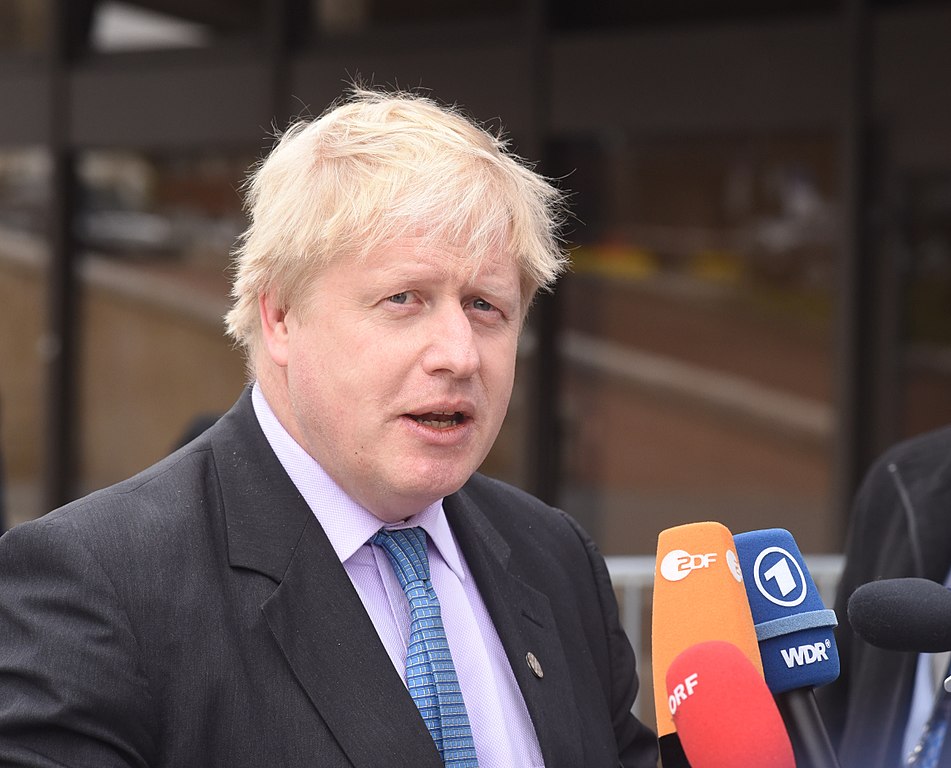
Boris Johnson, Secretary of State for Foreign and Commonwealth Affairs at an informal meeting of the Foreign Affairs Council on 15 February 2018.
Photo by Velislav Nikolov via Wikimedia Commons.
I first set eyes on Boris Johnson in the autumn of 1983 when we went up to Oxford at the same time. I knew who he was since my uncle Christopher was an ex-boyfriend of his mother’s and he had told me to keep an eye out for him, but I still wasn’t prepared for the sight (and sound) of him at the dispatch box of the Oxford Union. This was the world famous debating society where ambitious undergraduates honed their public-speaking skills before embarking on careers in politics or journalism, and Boris was proposing the motion.
With his huge mop of blond hair, his tie askew and his shirt escaping from his trousers, he looked like an overgrown schoolboy. Yet with his imposing physical build, his thick neck and his broad, Germanic forehead, there was also something of Nietzsche’s Übermensch about him. You could imagine him in lederhosen, wandering through the Black Forest with an axe over his shoulder, looking for ogres to kill. This same combination — a state of advanced dishevelment and a sense of coiled strength, of an almost tangible will to power — was even more pronounced in his way of speaking.
He began to advance an argument in what sounded like a parody of the high style in British politics — theatrical, dramatic, self-serious — when — a few seconds in — he appeared to completely forget what he was about to say. He looked up, startled — Where am I? — and asked the packed chamber which side he was supposed to be on. “What’s the motion, anyway?” Before anyone could answer, a light bulb appeared above his head and he was off, this time in an even more orotund, florid manner. Yet within a few seconds he’d wrong-footed himself again, this time because it had suddenly occurred to him that there was an equally compelling argument for the opposite point of view. This endless flipping and flopping, in which he seemed to constantly surprise himself, went on for the next 15 minutes. The impression he gave was of someone who’d been plucked from his bed in the middle of the night and then plonked down at the dispatch box of the Oxford Union without the faintest idea of what he was supposed to be talking about.
I’d been to enough Union debates at this point to know just how mercilessly the crowd could punish those who came before them unprepared. That was particularly true of freshmen, who were expected to have mastered all the arcane procedural rules, some of them dating back to the Union’s founding in 1823. But Boris’s chaotic, scatter-brained approach had the opposite effect. The motion was deadly serious — “This House Would Reintroduce Capital Punishment” — yet almost everything that came out of his mouth provoked gales of laughter. This was no ordinary undergraduate proposing a motion, but a Music Hall veteran performing a well-rehearsed comic routine. His lack of preparedness seemed less like evidence of his own shortcomings as a debater and more a way of sending up all the other speakers, as well as the pomposity of the proceedings. You got the sense that he could easily have delivered a highly effective speech if he’d wanted to, but was too clever and sophisticated — and honest — to enter into such a silly charade. To do what the other debaters were doing, and pretend he believed what was coming out of his mouth, would have been patronising. Everyone else was taking the audience for fools, but not him. He was openly insincere and, in being so, somehow seemed more authentic than everyone else.
To say I was impressed would be an understatement. A few years before arriving at Oxford I had watched the television adaptation of Brideshead Revisited, Evelyn Waugh’s Oxford novel, and had been expecting to meet the modern-day equivalents of Sebastian Flyte and Anthony Blanche: larger-than-life, devil-may-care aristocrats delivering bon mots in between sips of champagne and spoonfuls of caviar. But the reality was very different: warm beer, stale sandwiches and second-hand opinions. Lots of spotty students, all as gauche as me. Less like an Oscar Wilde play than a Mike Leigh film.
In Boris, though, it was as if I’d finally encountered the “real” Oxford, the Platonic ideal. While the rest of us were works-in-progress, vainly trying on different personae, Boris was the finished article. He was an instantly recognizable character from the comic tradition in English letters: a pantomime toff. He was Sir Toby Belch in Twelfth Night demanding more cakes and ale, Bertie Wooster trying to pass himself off as Eustace H. Plimsoll when appearing in court after overdoing it on Boat Race night. Yet at the same time fizzing with vim and vinegar — “bursting with spunk,” as he once put it, explaining why he needs so many different female partners. He was a cross between Hugh Grant and a silverback gorilla.
My uncle had described him as a “genius” and as a boy he’d been regarded as something of a wunderkind. There was the occasion when he was holidaying with his family in Greece, aged 10, and asked a group of Classics professors if he could join their game of Scrabble. They indulged the precocious, blond-haired moppet, only to be beaten by him. Thinking it was a one-off, they asked him to play another round and, again, he won. On and on it went, game after game. At the prep school he attended before going to Eton, Britain’s grandest private school, he was seen as a prodigy. A schoolmaster who taught him back then told his biographer, Andrew Gimson, that he was the quickest-learner he’d ever encountered. In the staff room, the teachers would compare notes about the “fantastically able boy.”
He was without doubt the biggest man on campus — the person most likely to succeed. He made no secret of his desire to be Prime Minister one day, and not just a run-of-the-mill, common-or-garden PM, but up there with Gladstone and Disraeli. And this was a scaling back of his ambitions — as a boy he’d told his younger sister Rachel that he wanted to be “world king.” (There was an intermediate stage during his teenage years when he harboured fantasies of becoming President of the United States — something that’s technically possible, given that he was born in New York.) He was by no means the only member of the Oxford Union to express such hopes during that period, but in his case you felt it might actually happen. Unlike so many other privileged undergraduates, with their vaulting sense of entitlement, Boris’s gargantuan self-belief seemed of a piece with his outsized personality. He had an electrifying, charismatic presence of a kind I’d only read about in books before. Our mutual friend Lloyd Evans, who knew Boris better than me at Oxford, put it well. “He’s a war leader,” he told Andrew Gimson. “He is one of the two or three most extraordinary people I’ve ever met. You just feel he’s going somewhere. People just love him. They enjoy going with him and they enjoy being led.”
To get a sense of Boris Johnson’s unique charm, here’s a brilliant pastiche of some of his TV appearances, stitched together as if it was his Olympic Games Welcome during his time as Lord Mayor of London (do watch, it’s hilarious).
July 25, 2019
YouTube’s secret fight against history documentaries
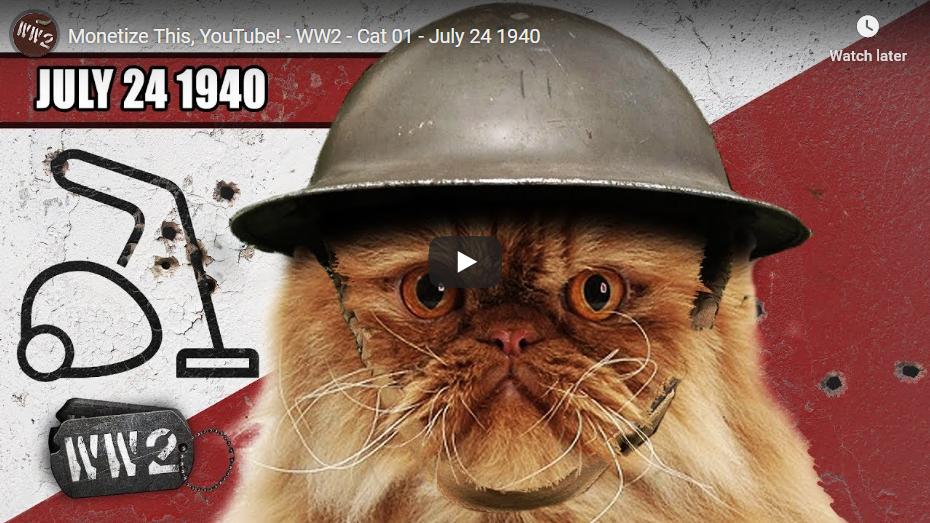
The good folks at TimeGhost have been struggling with YouTube’s monetization and recommendation mechanisms for some time. A number of TimeGhost’s WW2 documentary videos have been demonetized over the last year, and the team noticed that every demonetized video had significantly fewer viewers than those that were not demonetized. They did some analysis and submitted the results to YouTube, showing that the demonetized videos were also being restricted from showing up on the automated recommendation lists that users see, which largely accounted for the lower viewership for their demonetized videos, but YouTube denied that there was any connection between these things … that demonetized videos are just as likely to be recommended as the ones that are not demonetized, and that TimeGhost’s analysis was just wrong. YouTube sent the TimeGhost team a set of guidelines for how to ensure that the videos they post were considered acceptable to advertisers and would not be subject to demonetization (and the stealth omission from recommendation lists). Here’s the first video from TimeGhost, implementing those guidelines:
This is how they explained the situation in the comments:
World War Two
3 hours ago (edited)
Now, to begin with – this is not about that we need YouTube’s ad money, at our viewership levels that money is not near enough to finance our content anyway. We have a fantastic community in the TimeGhost Army that support us financially, and make our shows possible, for which we are eternally grateful. This is also not about politics – nothing in our data indicates that YouTube is choosing what to monetize based on political considerations. However, indirectly this is about money, but even more importantly about our self-appointed mandate to share education about our common past. You see, when YouTube labels content as “not suitable for some, or most advertisers” they also recommend it less – in fact almost only under our own videos. This means that we don’t reach new viewers with those videos, this in turn means that our community grows less, or not at all.When we sent the data proving that (data from YouTube no less), they at first denied that there was a connection between monetization and recommendation. We sent them more data showing conclusively that this is a false statement. Their response then was to say that maybe there is a connection between things that impact monetization and things that impact recommendation. They also sent us a list of things we should do to become “more advertiser friendly” – the list states among other things that content dealing with war, political controversies, terrorism, or death is not suitable for advertisers. That in effect means more or less the better part of human history and all of WW2.
We emphatically object to this interpretation of what is acceptable for advertisers – our kind of content has been attached to advertising for decades in main stream media, historical magazines and websites dealing with exactly the same things we do, receives advertising from major brands. Furthermore less recommendation means less viewers, which means that our content gets less support and thus risks becoming financially impossible – that is censorship by drip. Therefore we also vehemently protest this policy that in effect restricts the access to educational content, with high academic standards covering topics that are essential parts of human history. Events and phenomena that need to be widely understood in order for the world to learn from our past mistakes.
Last but not least we want to point out one more time – we do not have any indication whatsoever that we are being targeted for political reasons. We cover topics covering both right wing and left wing politics, we do not make judgement ourselves, instead we leave it up to you to decide positively or negatively depending on your opinion. We cover these topics factually, with completeness, and unbiased. The portion of our videos that have been deemed unsuitable to advertisers include political themes that cover the entire spectrum from Naziism to Marxism. Notably, and from the educational perspective troubling is that videos covering crimes against humanity such as the Holocaust or war crimes by the Soviet Union are almost always demonetized.
Please share this video to raise the awareness of what we find to be irresponsible behavior by a corporation that holds a virtual monopoly on free to access ad financed online video. Thank you.
July 21, 2019
Debunking the “common wisdom” about the “Scopes Monkey Trial”
Mark Pulliam explains what really caused the “Scopes Monkey Trial” and what was at stake … which doesn’t match up well at all against what little most people will remember about it today:
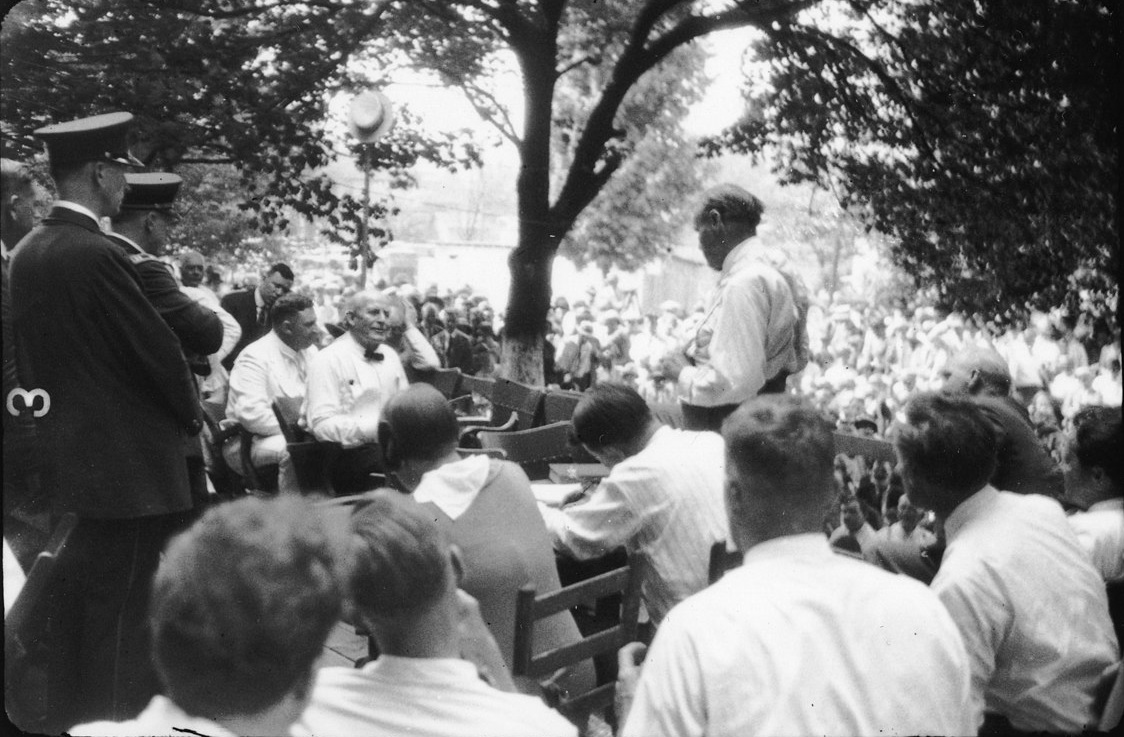
William Jennings Bryan (seated at left) being interrogated by Clarence Darrow, during the trial of the State of Tennessee v. John Thomas Scopes, July 20, 1925. That Monday afternoon, because of the extreme heat, Judge Raulston moved court proceedings outdoors. The session was held on a platform that had been erected at the front of the Rhea County Courthouse to accommodate ministers who wanted to preach during the time of the trial. Defense lawyers for Scopes (John R. Neal, Arthur Garfield Hays, and Dudley Field Malone) are visible seated to the extreme right. One of the men at left, with his back to the photographer, appears to be Scopes. The court reporters are seated at the table.
Photograph by Watson Davis via Wikimedia Commons.
We are again in another contentious period in America where battles over our culture and how we should live together are acrimonious. But there have been many points in our history that indicate we are only re-engaging a form of politics that is quintessentially American. One prominent past episode that occurred in Dayton, Tennessee during the summer of 1925 — the so-called “Scopes Monkey Trial” — has captured the American imagination like few legal proceedings ever have. Noted trial lawyer Clarence Darrow was part of the large legal team representing a 24-year-old substitute high school teacher, John Thomas Scopes, who was accused of violating the state’s Butler Act, which prohibited the teaching of evolution in a state-funded school. The celebrity co-prosecutor was William Jennings Bryan, the three-time Democratic presidential nominee, former Nebraska congressman, and Secretary of State to President Woodrow Wilson. Both Darrow and Bryan were prominent Progressive figures. Bryan, a left-wing evangelical and a fiery orator, is best known for his “Cross of Gold” speech at the 1896 Democratic National Convention.
The trial provided an opportunity for Darrow, whose reputation had been sullied by questionable tactics employed in the defense of radical labor leaders, to vindicate himself before a national audience. Chicago’s WGN radio station broadcast the trial nationwide and hundreds of reporters, some of them from overseas, covered the case. Geoffrey Cowan, author of the exhaustively-researched book The People v. Clarence Darrow, notes that Darrow achieved national notoriety, “won the support of Eastern sophisticates,” and “found new acceptance” as a result of the widely-publicized trial, especially his alleged humiliation of Darrow’s “old hero,” Bryan. This canard, which formed the dramatic crux of the 1960 movie Inherit the Wind, a highly-fictionalized depiction of the trial adapted from the 1955 play written by Jerome Lawrence and Robert E. Lee, is just one aspect of the popular mythology that surrounds the case.
Almost all of the “conventional wisdom” concerning the Scopes trial is false. Contrary to the impression created by Inherit the Wind and other popular accounts (including the sensational reportage of H. L. Mencken of The Baltimore Sun, one of the leading journalists of his day), the trial was not a fundamentalist inquisition, but an ill-conceived publicity stunt by Dayton businessmen who were trying to attract tourists to the small town — to put Dayton on the map. To generate a test case challenging the statute, the American Civil Liberties Union had offered to defend any teacher charged with violating the Butler Act, gratis. Dayton businessmen recruited Scopes to agree to serve as the defendant, even though he was unsure he had actually taught evolution. Nonetheless, Scopes volunteered to be charged. The trial — for a misdemeanor offense — was staged. Celebrity lawyers were solicited to participate for the sole purpose of increasing public interest in the case. The Baltimore Sun paid part of the defense’s expenses because it knew that the spectacle would sell newspapers, and it did. A lot of them.
I think it would be fair to say that H.L. Mencken had a passionate dislike for William Jennings Bryan, even after Bryan’s death a few days later:
It is the national custom to sentimentalize the dead, as it is to sentimentalize men about to be hanged. Perhaps I fall into that weakness here. The Bryan I shall remember is the Bryan of his last weeks on earth — broken, furious, and infinitely pathetic. It was impossible to meet his hatred with hatred to match it. He was winning a battle that would make him forever infamous wherever enlightened men remembered it and him. Even his old enemy, Darrow, was gentle with him at the end. That cross-examination might have been ten times as devastating. It was plain to everyone that the old Berserker Bryan was gone — that all that remained of him was a pair of glaring and horrible eyes.
But what of his life? Did he accomplish any useful thing? Was he, in his day, of any dignity as a man, and of any value to his fellow-men? I doubt it. Bryan, at his best, was simply a magnificent job-seeker. The issues that he bawled about usually meant nothing to him. He was ready to abandon them whenever he could make votes by doing so, and to take up new ones at a moment’s notice. For years he evaded Prohibition as dangerous; then he embraced it as profitable. At the Democratic National Convention last year he was on both sides, and distrusted by both. In his last great battle there was only a baleful and ridiculous malignancy. If he was pathetic, he was also disgusting.
Bryan was a vulgar and common man, a cad undiluted. He was ignorant, bigoted, self-seeking, blatant and dishonest. His career brought him into contact with the first men of his time; he preferred the company of rustic ignoramuses. It was hard to believe, watching him at Dayton, that he had traveled, that he had been received in civilized societies, that he had been a high officer of state. He seemed only a poor clod like those around him, deluded by a childish theology, full of an almost pathological hatred of all learning, all human dignity, all beauty, all fine and noble things. He was a peasant come home to the dung-pile. Imagine a gentleman, and you have imagined everything that he was not.
H/T to “WarEagle82” for the link.
July 18, 2019
QotD: “They might speak English, but they don’t speak Western”
But something happened to me last night, I had a kind of realization. It suddenly hit me WHY that is.
It’s because Harry Potter is literally all they collectively know.
Schools don’t teach history anymore.
They no longer teach the canon of Western literature.
They certainly don’t teach the Bible.So Millennials literally have no points of common reference. It’s not that they all just want to look like complete morons by infantilizing their political metaphor to the level of a children’s book, it’s that they have no other choice.
They’re literally bereft of the allegorical language of the West. I’m sure there’s some Harry Potter monster analogy I could use to explain it to them, how it’s like monsters have come along and literally stolen their ability to speak, their common language, and their birthright.
They can no longer express or understand the set of references we have from our past, our most prized stories, and our culture’s religious quotations. They can’t do Shakespeare, Milton, or even Mark Twain because they’ve never learned any of these while they were being taught Indonesian multicultural dancing and given participation awards. They don’t know what happened at Hastings in 1066, at Runnymede in 1215, or even at Sarajevo in 28th June 1914, because they were being given feminist diversity training instead of learning the history of their civilization. They certainly don’t know what “the least of these” refers to or where it comes from, as a recent event with a White House staffer proved.
They’ve lost the entire allegorical language of the West. They might speak English, but they don’t speak Western. To them, it’s like a foreign, dead, alien language. A set of stories they do not know.
RPGPundit, “Harry Potter and the way Millennial Leftists Don’t Even Speak Western Anymore”, The RPGPundit, 2017-02-02.
July 13, 2019
QotD: The severe spotlight deprivation (SSD) sufferer
I confronted a SSD sufferer recently. I was delivering a keynote. The questioner was not – and his ostentatiously displayed knowledge was as dated as his shiny silver suit. After, he approached me in the lunch room and stated: “It will be great to see how your career develops from here.”
I had published 17 books when he offered that comment. He had not. If I was any more developed, my breasts would occupy two time zones. But the mediocrity of SSD sufferers rarely allows facts to inform the movements of their restless tongues.
Tara Brabazon, “Fifty shades of conference feedback”, Times Higher Education, 2017-07-06.
July 10, 2019
Liberals: “vote for us, you ignorant, uneducated conservative plebians!”
Andrew Coyne sneaks in a literary quote from Chesterton on the eternal snobbery of the not-so-hidden class war in Canadian politics:
Democracy, in G. K. Chesterton’s careful definition, means government by the uneducated, “while aristocracy means government by the badly educated.”
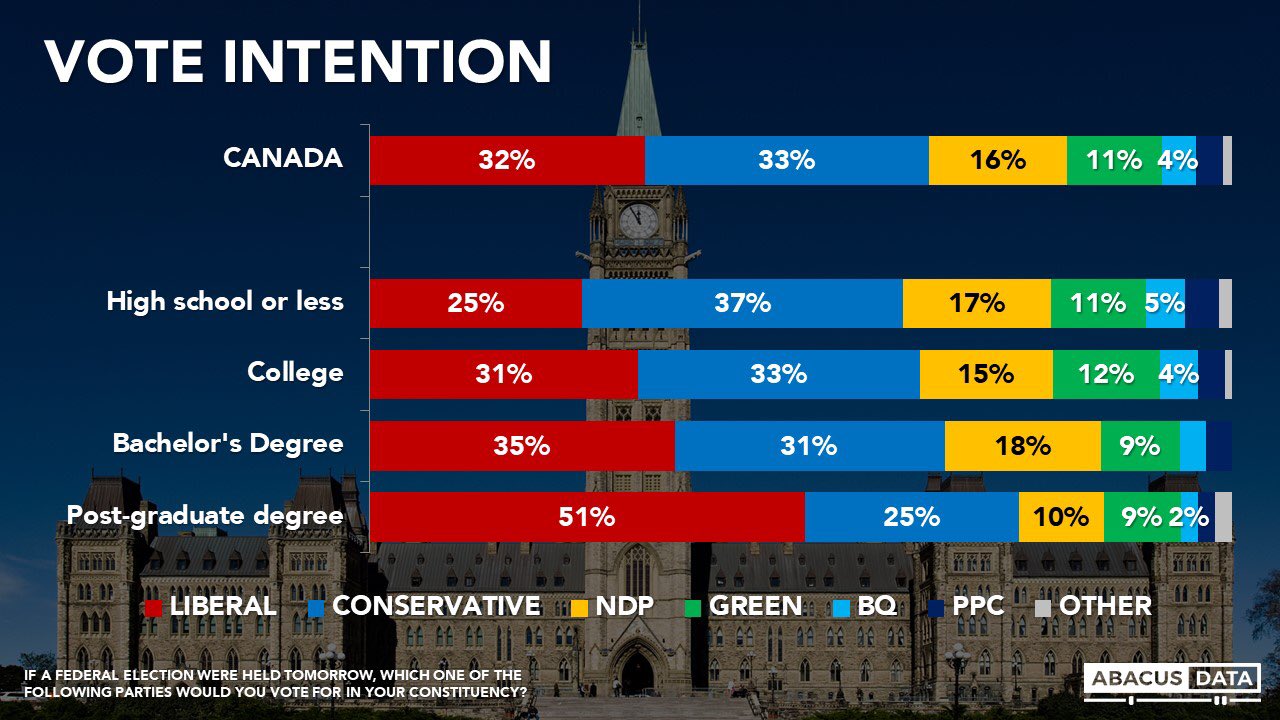
The enduring value of this distinction was suggested by the ruckus stirred up over the weekend by Amir Attaran, professor of law at University of Ottawa. Responding to a recent Abacus Data poll finding the Tories leading the Liberals by a wide margin among Canadians with a high school diploma or less, with the Liberals ahead among those with bachelor degrees or higher, the professor tweeted: “The party of the uneducated. Every poll says this.”
In the ensuing furor, Attaran tried to protest that he was just stating a fact, but the disdain in the tweet was clear enough to most. For their part, while some Tories quibbled with the data (just one poll, within the margin of error, misplaced correlation etc), most seemed less offended by the sentiment — every poll does show the less formal education a voter has, the more likely they are to support the Conservatives — than by the suggestion there was something shameful about it.
It was, in short, another skirmish in the continuing class war: class, now defined not by occupation or birth, as in Chesterton’s time, but by education. Conservatives, true to form, professed outrage at this arrogant display of Liberal elitism, while Liberal partisans protested that they were not snobs, it’s just that Conservatives are such ignorant boobs (I paraphrase).
The professor compounded matters by objecting, not only that he is not a Liberal, but that he is not an elite, since his parents were immigrants. And everyone did their best to be as exquisitely sensitive (“let us respect the inherent dignity of labour”) as they could while still being viciously hurtful (“not uneducated, just unintelligent”).
At the Post Millennial, Joshua Lieblein describes his initial reaction followed by sober second thoughts:
When I read the following condescending tweets from University of Ottawa professor Amir Attaran, my first thought was, “Well, somehow he wasn’t educated enough to predict this reaction. What did he expect?”
[…]
And then I realized that I wasn’t giving him enough credit. Professor Attaran knew exactly what to expect.
Professor Attaran wants you to read his unsolicited and deliberately insulting tweets. He wants you to talk about the tight links between the polling firm that provided him with his QUOTATION and the Liberal Party of Canada. He wants you to hurl all kinds of abuse at him.
Then, he and others will go through the pile of invective generated by this Sunday evening musing, pick out the most racist and inflammatory takes, and use them to justify the idea that facts are under assault, that minorities cannot speak out on issues of the day in Canada, that Conservatives don’t believe in freedom of speech, and that “right-wing mobs” exist and are being directed by CPC thought leaders.
It’s not like this is a new phenomenon, or something that’s new to Canada. Did you think all of Trudeau’s ridiculous behaviour was spontaneous? Sure, some of it is. The man is a certifiable moron. But we really should have guessed that we were being played for fools by the time he was doing shirtless photobombs of weddings.
July 7, 2019
Cancelling student loans would be a really, really bad economic move
Art Carden explains why cancelling outstanding student loan debt — despite its huge popularity on the campaign trail — would be a very bad idea:
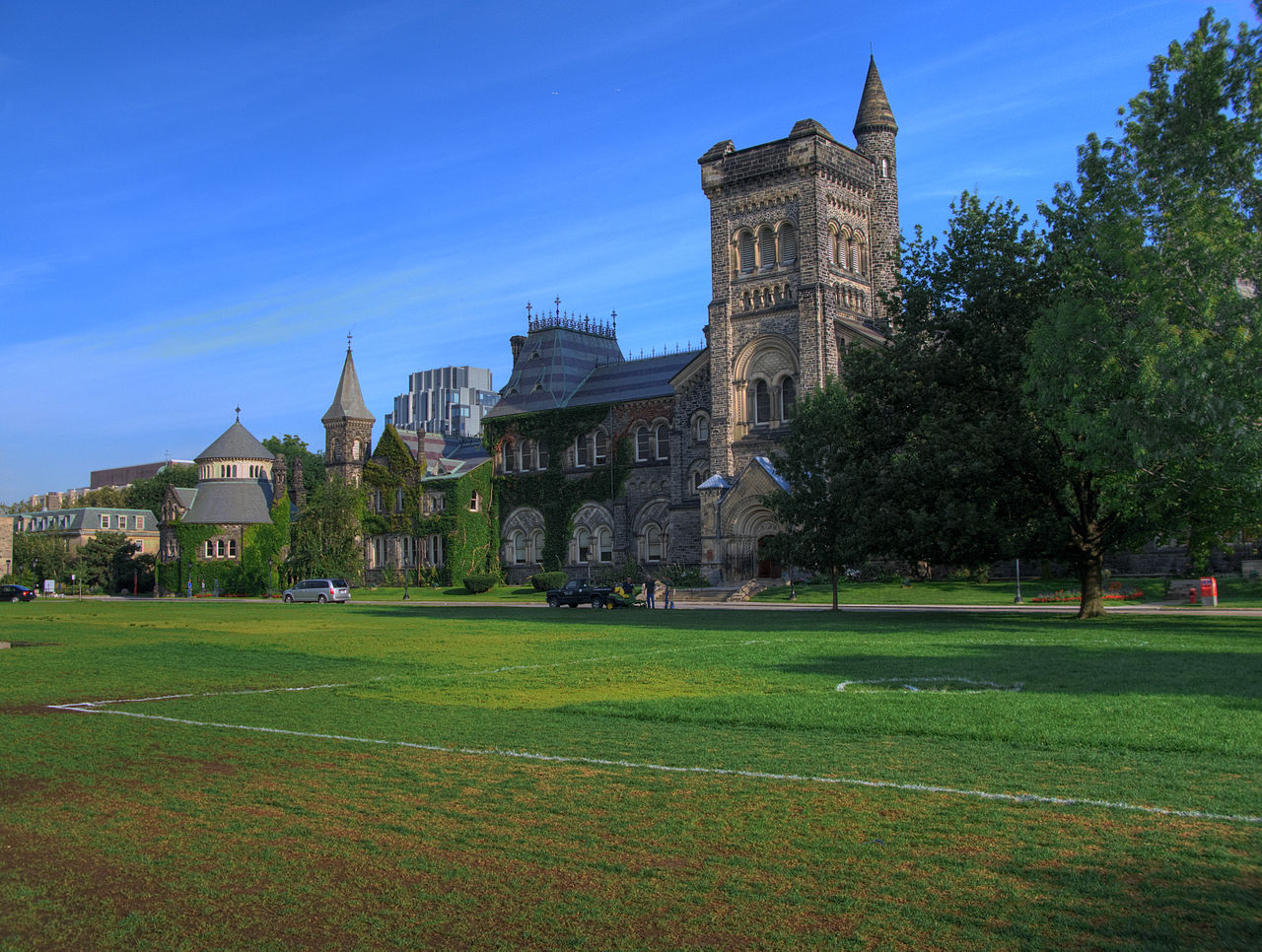
University College, University of Toronto, 31 July, 2008.
Photo by “SurlyDuff” via Wikimedia Commons.
It’s one of the rules of electoral success: advocate policies that concentrate the benefits on an easy-to-identify interest group (preferably one that is sympathetic in the public eye) and disperse the costs onto the entire electorate. It’s how we get Coke sweetened with corn syrup rather than actual sugar. It’s also how we get proposals to cancel student loans. As my AIER colleague Will Luther points out, the fact that two of the Democratic frontrunners have made debt cancellation such an important part of their campaigns suggests that the issue is going to be with us for a while.
But would it be a good idea to cancel student debt? And importantly, how does even the prospect of canceled student debt affect people’s incentives?
Regressive Tax
First, let’s consider the quality of the policy. A lot of commentators are pointing out that it’s fundamentally regressive, meaning that we’re basically taxing the poor to pay the rich. As economist Alexander William Salter puts it in the Dallas Morning News, it’s
a transfer of wealth to those with relatively high levels of expected lifetime income, at the expense of those with relatively lower levels of expected lifetime income.
The idea might have some merit, but it will make wealth and income inequality worse rather than better.
Even saying that the idea might have some merit is perhaps too charitable. In 2011, economist Justin Wolfers called it the “Worst. Idea. Ever.” in a Freakonomics post. Why? First, there’s the distributional effect. If we’re going to have policies that transfer wealth from one group to another, it doesn’t make much sense to transfer wealth from taxpayers generally to high-income college graduates. As Will Luther and so many others have pointed out, a college degree brings spectacular financial returns. As a group, college graduates aren’t “needy” by any reasonable definition.
July 6, 2019
QotD: How to learn
That fits the pattern of most modern schooling at all levels. Someone else decides what you should learn, tells you what you must do to learn it, and makes some attempt to make sure you follow his instructions. It is not a model I think highly of. A much superior model in my view, if you can pull it off, is to get someone to learn something primarily because he finds it interesting. The best way of doing that is to provide students with things to read that are worth reading on their own, not things they read only because they are ordered to. Not even things they read only because they think the labor of reading them will pay off in future benefit.
That view of education is why both children of my present marriage were unschooled. It is also why all of my nonfiction books, with the partial exception of Price Theory, were targeted at the proverbial intelligent layman. They can be, and sometimes are, used as textbooks, but they were written with the assumption that if the reader did not find a chapter worth finishing he was likely not to finish it.
David Friedman, “Thoughts on Literature, Economics and Education”, Ideas, 2017-05-01.
June 16, 2019
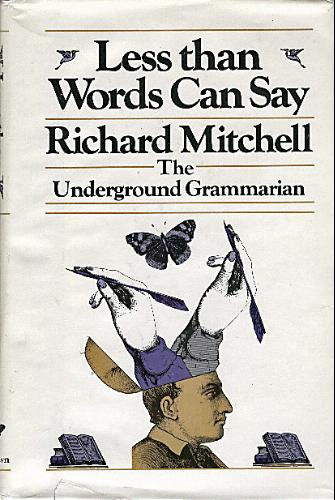
Encountering Richard Mitchell’s Less Than Words Can Say
In Quillette, Mark Andre Alexander recounts his first brush with “The Underground Grammarian”:
My first upper division English class shocked me when a dinosaur English professor, Dr. David Bell — a professor in Richard Mitchell’s mold, but not yet a curmudgeon — gave me my first C on a paper, busting my A-student self-image. That wake-up call helped me to see that, although I was published, I had much to learn about writing. Worse, in my first graduate course, Bell’s “Austen and Bronte,” I discovered that I had much to learn about reading, and that I lacked the acuity to appreciate Jane Austen’s clear, witty, and precise prose.
Not long before, I’d read Richard Mitchell’s first book, Less Than Words Can Say. I don’t recall how I stumbled upon him. I’d probably read some opinion column that referred to his work. In a publication announcement in the Underground Grammarian, Mitchell described it as “a melancholy meditation on the dismal consequences of the new illiteracy.”
He had wanted to title the book The Worm in the Brain, pointing to the dangers of administrative rhetoric. The publisher rejected that title as “too frightening and grisly,” But I knew I had found a fellow traveler when I read his Foreword:
Words never fail. We hear them, we read them; they enter into the mind and become part of us for as long as we shall live. Who speaks reason to his fellow men bestows it upon them. Who mouths inanity disorders thought for all who listen. There must be some minimum allowable dose of inanity beyond which the mind cannot remain reasonable. Irrationality, like buried chemical waste, sooner or later must seep into all the tissues of thought.
With that prophetic book, I first experienced the “cleansing fire [that] leaps from the writings of Richard Mitchell,” as George F. Will later described it.
Mitchell did title the first chapter “The Worm in the Brain,” in which he told the story of a colleague who would send him a note whenever there was some committee meeting. At first the note read something like, “Let’s meet next Monday at two o’clock, OK?” But when he aspired to become assistant dean pro tem, the simple, perfect prose changed. “This is to inform you that there will be a meeting next Monday at 2:00.” After achieving that appointment, the note read, “You are hereby informed that the committee on Memorial Plaques will meet on Monday at 2:00.” The worm in the brain had done its work.
I began to notice the worm in the brain during my everyday interactions with friends and colleagues at the university, especially the English professors. It often took the form of a label which created an image in the brain that prevented thought. One such professor, smart and engaging, returned a paper analyzing a passage in the U.S. Constitution. She gave the paper an A, but added, “I can’t help but feel that your argument is wrong, although I can’t explain why. I showed it to my husband, and he thought that it was a conservative argument.”
That statement invalidated the A, and I experienced my first taste of how subtly an abstract label can paralyze an otherwise thoughtful mind. Years later, while teaching at a business college, I saw a more pronounced form of the same phenomena. During a Business English class, I chatted with a bright student who volunteered for the NAACP. We would discuss all kinds of interesting topics, such as the similarities and differences between Martin Luther King and Malcolm X.
That is, until I noticed a change. She had stopped talking to me like a fellow human being and started talking at me like a white male. I stopped her and asked if she noticed what she had just done. She hadn’t, so I pointed out that she had shifted from talking to me to talking to an image inside her head. I told her that I would hold my hand up and block my face every time she did it. As the conversation proceeded, and I raised my hand, lowered it, and then raised it again, she became aware of the worm in her brain, a mental-emotional implant that prevented her from treating me as a colleague when certain topics were engaged.
Her implant was creating rubbish, of course, but it was insidious by nature because it disguised itself as something in the real world. Worms in the brain are like that.
QotD: Critical gender studies
But remember that the generic people we meaninglessly call “women” are beautiful and powerful and their arbitrary womanhood should be constantly celebrated. Women must band together and lift each other up. Women must be represented equally in all of our institutions. Women are truly wonderful, splendid, special creatures.
But there is nothing special about women. Literally anyone can be a woman. A woman is not anything in particular. A person with a penis can be a woman. A person with a vagina can be a woman. If a bucket of sand came to life and wanted to be a woman, it could be a woman. There is no aspect of womanhood that is ingrained or biological or inaccessible to males. And womanhood certainly has nothing at all to do with your body parts.
But if you don’t have a uterus then you shouldn’t be giving your opinion on women’s rights. No uterus, no opinion. That’s the motto. We’re tired of men making decisions about women’s bodies.
But there is no such thing as a woman’s body. Transwomen are women, too. A transwoman is just a much a woman as any other woman. There is absolutely no difference between the two and to suggest otherwise is the height of bigotry.
Matt Walsh, “Explaining Progressive Gender Theory To Right Wing Bigots”, The Daily Wire, 2019-05-14.
June 3, 2019
The state of US academia in juxtaposed tweets
American universities have problems, but the solutions they choose do not seem to be addressing those problems (screencapped, in case the tweet doesn’t load correctly):