
“We are a young nation,” declared Prime Minister Paul Martin. “Look into the face of Canada, and you will see the world.”
Well, maybe. But, more likely, if you looked into the face of Canada, you’d wonder why the old gal keeps lying about how old she is. “We are a young nation.” How old were you when you first heard a Liberal apparatchik drone about what a “young” nation we are? Maybe you were young yourself, and now, as the healthy glow of late middle-age fades from your cheeks, you’re wondering why you’re so old but your country is younger than ever. It’s like The Passport Photo of Dorian Gray.
For me, no sooner did Paul start burbling about what a young nation we are than the years fell away, like calendar leaves signalling flashback-time in an old movie — the sort Hollywood used to make before it discovered there was a young nation up north where you could make them a lot cheaper. Anyway, the years fell away, and suddenly I was a wee slip of a thing again and it was 1497 and on the windswept prow nice Mister Cabot was saying to me, “Aargh, Mark lad, is me eyes deceiving me or is that a big rock up ahead?”
No, hang on, that can’t be right. We’re a young nation. My mistake, it was 1997 and I was at the “Canada Day” festivities at the Old Port in Montreal. We’re a young nation with an old port, don’t ask me how that happens. And Lucienne Robillard, then our citizenship minister, was addressing a couple of dozen brand new Canadians: “Fifty years ago we were British subjects,” she said. “We forget how young a country we really are.” Mme Robillard forgets more than she realizes: it was only 20 years — 1977 — since the term “British subjects” was discreetly removed from Canadian passports. But what’s a decade or two when you’re shaving half a millennium off your age?
Isn’t there something deeply weird about an entire nation that lies about its age? Canada is, pace Mr Martin, one of the oldest countries in the world — the result of centuries of continuous constitution evolution. Even if one takes the somewhat reductive position that Canada as a sovereign entity dates only from the 1867 British North America Act or the 1931 Statute of Westminster, that would still make us one of the oldest nations in the world. We are, for example, one of the founding members of the United Nations, ahead of three-quarters of the present membership.
As George Orwell wrote in 1984, “He who controls the present controls the past. He who controls the past controls the future.” A nation’s collective memory is the unseen seven-eighths of the iceberg. When you sever that, what’s left just bobs around on the surface, unmoored in every sense. Orwell understood that an assault on history is an assault on memory, and thus a totalitarian act. What, after all, does it really mean when Mme Robillard and Mr Martin twitter about how “young” we are? Obviously, it’s a way of denigrating the past. Revolutionary regimes routinely act this way: thus, in Libya, the national holiday of Revolution Day explicitly draws a line between the discredited and illegitimate regimes predating December 1st, 1969, and the Gadaffi utopia that’s prevailed since. In Cambodia, the Khmer Rouge literally reset the clock, to “Year Zero.”
Mark Steyn, “Happy Dominion Day!”, The Western Standard, 2005-07-01 (reposted at SteynOnline, 2015-07-01).
July 1, 2017
QotD: Lying about our age on Canada Day
June 26, 2017
“Ah, the Comeau case. Schwisberg says it could change everything – knock down all the barriers”
It’s ridiculous that 150 years into Confederation, and we still don’t have free trade within Canada:
If you’re on vacation abroad somewhere this summer and find yourself explaining to people over dinner what makes Canada so unique and special, use the story about Gerard Comeau and his beer run back in 2012. There is no more Canadian story than that.
Comeau is a Canadian who, looking for the best bargain he could, drove to a Canadian town a few miles from his home in Canada, bought 14 cases of beer and three bottles of liquor from Canadian beer and liquor stores, then returned to his home. In Canada.
A squad of plainclothes Mounties with binoculars, it turned out, had him under surveillance, according to his lawyer. On his way home from the Canadian town to his Canadian home, he was intercepted and handed a ticket for $292.50 by uniformed Canadian officers who then seized all the alcohol he’d purchased.
His Canadian crime: his beer run had crossed one of Canada’s internal borders. He’d driven from New Brunswick into Quebec. As far as New Brunswick was concerned, that made him a smuggler.
Sixteen other people were charged that day in the same sting operation, but Comeau had more spine than most and fought the ticket. Some smart lawyers from Ontario and Western Canada got involved, and – my god, I love it when things like this happen – he won.
A New Brunswick judge ruled that the province’s law against importing alcohol from other provinces violated the Constitution Act, Sec. 121, which states: All Articles of the Growth, Produce, or Manufacture of any one of the Provinces shall, from and after the Union, be admitted free into each of the other Provinces.
The ruling shocked New Brunswick and most of the other provinces, which consider Sec. 121 to be one of the most horrible and un-Canadian sentences in the Canadian Constitution, something that should be ignored at all costs.
June 24, 2017
The Articles of Confederation – Lies – Extra History
Published on Jun 17, 2017
The Articles of Confederation gave the United States their name, but even beyond that, they exposed many of the issues that would underlie this new nation for the rest of its history. James Portnow interviews series writer Soraya Een Hajji about the Articles of Confederation!
June 22, 2017
The Netflix tax is dead (again) – “This thing was a turkey, and Trudeau was right to wring its neck.”
Chris Selley rejoices in the demise of the so-called “Netflix tax” proposal, but also pours scorn on yet another proposal to prop up Canadian print media organizations:
Justin Trudeau wasted little time last week rubbishing the Heritage Committee’s so-called “Netflix tax,” and no wonder. If you’re determined to raid people’s wallets to fund journalism they’d rather not pay for and Can-con programming they’d rather not watch, you’re far better off doing it shadily than with a shiny new tax on something people love. The sound bytes winging around in the idea’s favour were, in a word, pathetic: “it’s not a new tax, but an expanded levy!”; “we already tax cable, why not Internet?”; “we already subsidize magazines, why not newspapers?”
Good God, why any of it? This thing was a turkey, and Trudeau was right to wring its neck.
Newspaper publishers and union bosses remain undaunted in pursuit of unearned public funds, however. “Canada’s newspaper industry unites to advocate for Canadian Journalism Fund,” proclaimed a headline at News Media Canada, the publishers’ lobby group. They’re savvy enough to propose tying subsidies to employed journalists’ salaries — 35 per cent to a maximum of $30,000 per head — rather than just cutting cheques. That might fend off Executive Bonus Rage, but it won’t fend off sticker shock: the suggested eventual cost is a whopping $350 million a year.
As a taxpayer I would much rather subsidize Canada’s journalists than Canada’s legacy media companies — but I would sure as hell rather subsidize neither. The more beholden to government a country’s journalists, the less free its press. Magazine writers in this country know their publications get a top-up from Ottawa in the form of the Canadian Periodical Fund. That’s not ideal. But under News Media Canada’s proposal, we would know our jobs literally depended on government largesse. I’ll take a hard pass on that.
Publishers’ and union bosses’ claims of unanimous support notwithstanding, many unionized journalists, and many of your non-unionized friends here at the National Post, hate the idea. It risks narrowing Canada’s already remarkably narrow spectrum of acceptable ideas and arguments. It risks — no, guarantees — alienating the very consumers we need to attract. In the case of some legacy media outlets it would simply extend the runway for business models that everyone knows will never fly again. In any event, the sums being bandied about wouldn’t solve the crisis as a whole unless the solution was permanent and ever-greater government dependency. I’m amazed to see how many journalists, including some very nearly pensionable ones, support the idea.
June 20, 2017
The Guardian turns on Justin
Last week, Martin Lukacs savaged Justin Trudeau by way of contrast with British Labour leader Jeremy Corbyn in the pages of The Guardian, which must count as one of the most unexpected sources of criticism for our mediagenic PM:
Their depiction in the international media couldn’t be more different.
You know Justin Trudeau from the Buzzfeed photo-spread or the BBC viral video: the feminist prime minister of Canada who hugs refugees, pandas, and his yoga-mat. He looks like he canoed straight from the lake to the stage of the nearest TED Talk – an inclusive, nature-loving do-gooder who must assuredly be loved by his people.
Then there’s what the columns of trans-Atlantic punditry told you about Jeremy Corbyn: the rumpled, charmless leader of UK’s Labour party whose supporters are fringe lunatics and his stances out-of-date utopianism. If he dared run an election with his political program, he would just as assuredly be rejected by the electorate.
So far, so conventional … and then the gloves come off:
Trudeau’s coronation as a champion of everything fair and decent, after all, has much to do with shrewd and calculated public relations. I call it the Trudeau two-step.
First, he makes a sweeping proclamation pitched abroad – a bold pledge to tackle austerity or climate change, or to ensure the rights of refugees or Indigenous peoples. The fawning international coverage bolsters his domestic credibility.
What follows next are not policies to ambitiously fulfill these pledges: it is ploys to quietly evacuate them of any meaning. The success of this maneuver – as well as its sheer cynicism – has been astonishing.
In this manner, Trudeau has basically continued, and in some cases exceeded, the economic agenda of Conservative Stephen Harper: approved mega fossil fuel projects, sought parliamentary power grabs, cut-back healthcare funding and attacked public pensions, kept up the dispossession of Indigenous peoples, undermined the prospect of universal childcare, maintained tax loopholes for the richest, and detained and deported thousands of migrants.
Out of breath? He has also broken an electoral reform promise, initiated a privatization scheme that is a massive corporate handout, left un-repealed a Tory political spy bill, launched air strikes in Iraq and Syria despite pledging a withdrawal, and inked the largest-ever weapons deal with the brutal, misogynistic Saudi Arabian regime.
Not exactly what those who voted for “real change” were expecting? Before you answer, here’s something titillating to distract and disarm you: Justin and Barack Obama rekindling their progressive bromance at an uber-cool Montreal diner. Jeremy Corbyn has shown us the meaning of a politics of genuine hope: what Trudeau has deployed has only ever been a politics of hype.
Trudeau’s latest progressive posturing is over foreign policy. Last week his government announced, to wide-spread acclaim, a brave course for their military that is independent of the reviled US administration. Except they will boost wasteful military spending by more than $60bn, a shocking seventy percent budgetary increase, and are already entertaining new Nato missions — exactly as Donald Trump has demanded. The doublespeak seems to have escaped the navel-gazing pundits: this is utter deference masquerading as defiance.
I don’t think Justin’s fans on the left need to be too worried about all that mucho-macho military posturing … until the promised spending is actually in the budget, it’s just politico-military theatre for our American allies than anything that will make a material difference to the men and women of the Canadian Armed Forces. Once Trump is satisfied that Justin is doing his bidding, it can all be allowed to quietly go away (like the last government’s promises to beef up the armed forces and live up to our NATO commitments).
H/T to Ted Campbell for the link.
June 18, 2017
Sabres and Smoke: The War of 1812
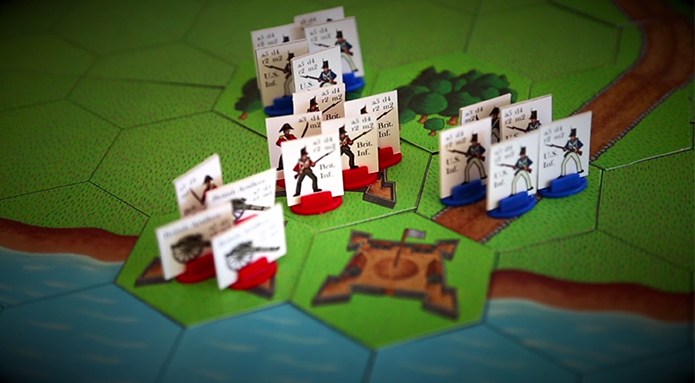
Last month, Military History Now profiled a new game (and new Ontario-based game company): unusually for today, it’s not a computer game, but a board wargame:
MHN: Tell us about the game.
Sheppard: Sabres and Smoke: the War of 1812 is a two-player light strategy board game that allows players to relive 16 of the War of 1812’s most important battles. From Queenston Heights to Fort York, players command either the British or American armies in battles that shaped the future of North America.
MHN: Tell us about Hand 2 Hand Entertainment. Who are you guys? How did you get started?
Sheppard: We are based near Toronto, Canada and have been working on Sabres and Smoke: The War of 1812 since July of 2016. I founded Hand 2 Hand Entertainment in 2016, the summer after I finished Grade 12, because I although I was lucky enough to find a summer job, there were no hours available. So, I decided to spend my time combining two things that I really enjoy: history and board games. I started by visiting battle sites from the War of 1812 and doing extensive research to make my game historically accurate. From there I created the battle scenarios and the game rules. Hand 2 Hand Entertainment spent the fall and winter designing Sabres and Smoke: The War of 1812, and preparing to launch a Kickstarter campaign in the summer of 2017. This summer, I am running the company out of the Propel Summer Incubator (PSI) program with the Propel Centre for Entrepreneurship at the University of Western Ontario.
[…]
MHN: The computer wargaming market is enormously popular; what can tabletop games offer that computers can’t?
Sheppard: This is an interesting question. I think there is a certain satisfaction to physically moving units on a battlefield in board games like this. Although you can look at units and terrain from a commander’s perspective in video games, doing it on a board feels more real. Players can look at the board in the same way Generals would have looked at maps when commanding real battles throughout history. I think this is what makes light strategy board games special.
June 16, 2017
Canada’s oldest wind farm shutting down but “if there is an incentive, we’d jump all over that”
The owner of the oldest operating wind farm in Alberta is desperately hoping for a big government subsidy to replace the old wind turbines at their Cowley Ridge facility:
The oldest commercial wind power facility in Canada has been shut down and faces demolition after 23 years of transforming brisk southern Alberta breezes into electricity — and its owner says building a replacement depends on the next moves of the provincial NDP government.
TransAlta Corp. said Tuesday the blades on 57 turbines at its Cowley Ridge facility near Pincher Creek have already been halted and the towers are to be toppled and recycled for scrap metal this spring. The company inherited the now-obsolete facility, built between 1993 and 1994, as part of its $1.6-billion hostile takeover of Calgary-based Canadian Hydro Developers Inc. in 2009.
“TransAlta is very interested in repowering this site. Unfortunately, right now, it’s not economically feasible,” Wayne Oliver, operations supervisor for TransAlta’s wind operations in Pincher Creek and Fort Macleod, said in an interview.
“We’re anxiously waiting to see what incentives might come from our new government. . . . Alberta is an open market and the wholesale price when it’s windy is quite low, so there’s just not the return on investment in today’s situation. So, if there is an incentive, we’d jump all over that.”
In February, TransAlta president and chief executive Dawn Farrell said the company’s plans to invest in hydroelectric, wind, solar and natural gas cogeneration facilities in Alberta were on hold until the details of the province’s climate-change plans are known.
June 14, 2017
Canada’s Next Auxiliary Oiler Replenishment Ship – Episode 3
Published on Jun 9, 2017
The third episode in a series about the construction and operation of the Royal Canadian Navy’s next naval support ship.
June 10, 2017
Canadian Special Operations Forces Command
 While we hear a lot about the special forces of some of our allies — US Navy SEALs, US Army Rangers and Delta Force, the British SAS and SBS — we generally hear very little about our own special forces. Some of that is natural: maintaining operational secrecy is very important, but long after the event, we still hear very little from official sources. A few years back, I posted a quick crib on the organization of Canada’s special forces, based on what was available at the time. Here, cribbed directly from the pages of Strong, Secure, Engaged [PDF], the new Canadian Defence Policy document, is a description of the role of the Canadian Special Operations Forces Command:
Special Operations Forces are small, highly skilled, adaptable, multi-purpose forces held at very high readiness levels. Special Operations Forces are employed in situations that pose an imminent threat to national interests, where the use of larger military forces is inappropriate or undesirable, in operational environments where access is limited, and against high-value targets.
These situations benefit from small, well-planned or precision tactical operations. Such activities include: domestic and international counter-terrorist response, discrete intelligence collection, surveillance and reconnaissance activities, specialized capacity building to assist allied host nation forces, and immediate reaction in response to emergent or imminent threats. Flexible, scaleable Special Operations Task Forces often play a role in longer-term military missions but the limited numbers of highly skilled individuals at the heart of such forces typically deploy for limited durations of time.
Canada’s Special Operations Forces structure is lean. It consists of a headquarters commanding Joint Task Force 2 (JTF 2) – Canada’s military counter-terrorism unit; the Canadian Joint Incident Response Unit (CJIRU) – Canada’s military Chemical, Biological, Radiological and Nuclear detection and response unit; the Canadian Special Operations Regiment; the Special Operations Aviation Squadron; and the Canadian Special Operations Training Centre.
At its core, Canada’s Special Operations Forces are focused on a cooperative joint, inter-agency, and multi-national approach to operations. In order to meet future challenges, the Canadian Special Operations Forces Command will continue this cooperation to support government decision-making in security situations, including counter-terrorism efforts. Additionally, the Canadian Special Operations Forces Command will support international peace and security missions, and contribute to and harness the ‘Global Special Operations Forces Network’ consisting of allied Special Operations Forces.
The lean nature and unique characteristics of Canada’s Special Operations Forces require sustained and tailored investment to ensure continuity and effectiveness over the long-term
June 9, 2017
The new Canadian defence policy – Strong, Secure, Engaged
 Unlike all the other issues that might have moved the Canadian government to finally address the weaknesses of the Canadian Armed Forces (including the immediate aftermath of 9/11, the high-tempo troop deployments to Afghanistan, escalating tensions in Ukraine and eastern Europe, and the rather embarrassing ongoing rusting-out of the RCN’s ships), Donald Trump appears to have been the trigger … and the first visible result (after Chrystia Freeland’s rather … muscular speech the other day) is the publication of Strong, Secure, Engaged [PDF].
It certainly says a lot of the right things, from personnel to equipment to training and deployment, but as always with a big government announcement, the devil will be in the details. From Defence minister Harjit Sajjan’s introduction:
The pages that follow detail a new vision for the Defence team for the coming decades. It is about our contribution to a Canada that is strong at home, secure in North America, and engaged in the world. In a rapidly changing and less predictable world, we recognize that the distinction between domestic and international threats is becoming less relevant. Therefore, we cannot be strong at home unless we are also engaged in the world.
The policy also includes a new framework for how we will implement that vision. “Anticipate, Adapt and Act,” sets out a way of operating that addresses the challenges we face today, and the ones that will emerge tomorrow.
Canadians take pride in their Armed Forces, and its members serve their country admirably every day. Whether it is responding to natural disasters, providing expert search and rescue, defending our sovereignty, or contributing to greater peace and security in the world, our military answers the call wherever and whenever it occurs
So, along with all the verbiage, what is the new policy going to mean for the Canadian Forces?
This is the most rigorously costed Canadian defence policy ever developed. It is transparent and fully funded. To meet Canada’s defence needs at home and abroad, the Government will grow defence spending over the next 10 years from $18.9 billion in 2016-17 to $32.7 billion in 2026-27.
June 7, 2017
“To rely solely on the U.S. security umbrella would make us a client state”
That’s Canadian Foreign Affairs Minister Chrystia Freeland with a statement that would cause the late Liberal PM Pierre Trudeau to throw her out of cabinet … because Canada has been relying solely on the US security umbrella since shortly after the elder Trudeau became Prime Minister in 1968. The interesting thing is that the federal government is reportedly going to announce significant new funds for the Canadian Forces in the wake of Donald Trump’s election to the presidency:
Foreign Affairs Minister Chrystia Freeland says Ottawa will forge its own path on the world stage because Canada can no longer rely on Washington for global leadership.
In a major speech setting the stage for Wednesday’s release of a new multibillion-dollar blueprint for the Canadian Armed Forces, Ms. Freeland rejected Donald Trump’s “America First” foreign policy and its dismissal of free trade, global warming and the value of Western alliances in countering Russian adventurism and the Islamic State.
While she did not mention the U.S. President by name, Ms. Freeland expressed deep concern about the desire of many American voters to “shrug off the burden of world leadership.”
[…]
Ms. Freeland said Canada has been able to count on the powerful U.S. military to provide a protective shield since the end of the Second World War, but the United States’ turn inwards requires a new Canadian approach to defend liberal democracies.
“To rely solely on the U.S. security umbrella would make us a client state,” she said. “To put it plainly: Canadian diplomacy and development sometimes require the backing of hard power.”
Giving Canada’s military “hard power” will allow it to meet global challenges, she said, listing North Korea, the civil war in Syria, the Islamic State, Russian aggression in the Ukraine and Baltic states and climate change as major threats to the world order.
“We will make the necessary investments in our military, to not only address years of neglect and underfunding, but also to place the Canadian Armed Forces on a new footing – with new equipment, training, resources and consistent and predictable funding,” she said.
Wednesday’s defence-policy review is expected to lay out the military’s priorities for future overseas deployments, and outline Ottawa’s 20-year plan for spending billions of dollars to upgrade warships and fighter jets, among other things.
Amazing. I didn’t think it would fall to Freeland to announce that we’re planning to stop being freeloaders on the US military…
QotD: Blame America
Canadians love to compare themselves to Americans, for all kinds of reasons — to congratulate themselves, to flagellate themselves, to comfort themselves when they’re somewhat embarrassed. The “meanwhile in Canada” genre of tweets is a bit of all three: in the midst of chaos in Washington, someone will oh-so-cleverly take note of a comparatively minor Canadian scandal. There is no charitable interpretation to be made of it: it’s either bragging, or it’s suggesting that we worry too much about Canada’s ostensibly piddling scandals — like, say, the prime minister’s chief of staff cutting a $90,000 cheque to a sitting Senator. That’s not Watergate, but it’s bonkers nonetheless.
The effect is both to confuse the conversation about any given issue and to absolve Canadians of any responsibility for it. The ultimate example was CBC Marketplace’s moronic attempt to sell racist t-shirts on Canadian streets and chalk up any interest to “the Trump effect.” But again, that was just an extreme manifestation of this unhealthy blame-America instinct — one we would do well to eradicate.
Chris Selley, “‘Canada’s Donald Trump’ was never on offer in the Conservative leadership race”, National Post, 2017-05-26.
June 1, 2017
Terence Corcoran – It was the fake Tories that did in Maxime Bernier
In the Financial Post, Terence Corcoran blames the supply management fans and other anti-free market types for Maxime Bernier’s loss in the federal Conservative leadership race:
On Monday, during a noon-hour Ontario CBC Radio show, the host opined that Maxime Bernier lost the Conservative leadership because of his “wild ideas,” as if the libertarian politician from Quebec had been offering conservatives options too crazy to contemplate.
Wild ideas? In the recent history of Canadian politics, no politician has been more grounded or sane.
[…] if accounts from the frontline are accurate, Bernier would have won the leadership were it not for vote-rigging infiltrators from the farmers’ unions and associated backers of supply management.
One source says that as many as 3,000 points went to Scheer, mostly in Quebec and Ontario, as a result of an organized campaign in which farmers temporarily joined the Conservative party and then cast votes against Bernier.
Bernier didn’t lose the leadership vote; it was stolen from him by a concerted campaign organized by members of Union des producteurs agricoles (UPA) and farmers in Ontario. Via Facebook, Quebec farmers and others were urged to join the Conservative party and vote for Andrew Scheer.
Three Quebec ridings tell the story. One is Beauce, Bernier’s home riding. Right off the bat, in the opening round of the ranked ballot, Scheer collected 46.63 per cent of the points against 47.5 per cent for Bernier. By the end of the final round, Scheer was at 51 per cent versus 48 for Bernier — in a riding where Bernier is a local hero among Conservatives and hardly anyone would even know Scheer’s name.
May 30, 2017
The unfriendly border
I’ve generally had little trouble crossing the US/Canadian border, but I’ve perhaps been quite lucky. An old friend of mine recently was turned back from the border crossing at Port Huron and had an exceptionally unpleasant time dealing with US officials:
On Wednesday May 10, I was denied entry into the USA.
I was attempting to travel to the International Congress for Medieval Studies at Kalamazoo MI.
I have attended this conference, presenting at organized sessions, since (at least) 2012.
One of these sessions was to be a combination demonstration / hands on. I had undertaken similar sessions there in 2013 and 2015.
I had booked a vendor’s table, selling objects made in Ontario at my studio, either by myself as the Wareham Forge, or by my partner as Elfworks Studio. I have done this since 2014.At ICMS 2017 I was intending to undertake the following:
– travel straight to and straight back from the event, a total of 5 days.
– setting up a vendor’s table to sell products made in Canada (all at my home studio), at a total combined value of $2450 US
– participate in an panel discussion session (#41)
– participate in a hands on workshop session (#224)I can not remain dispassionate about this whole episode.
Through this entire event, I made a deliberate attempt to keep my body language calm and unassertive. My hands folded in front of me, on steering wheel or visible on the desk. I attempted to keep my voice casual, calm and relaxed.
I do appreciate that some questions, some actions, are part of standard operations policy. I did attempt to make allowances for all this, never refusing to answer or follow instructions – as they were given.
I consider it extremely important to remember that I have decades of experience communicating to the general public. My spoken language skills are excellent.[…]
The Officer returns. I overhear a comment about ‘all his tools’. (12)
Over this conversation, I finally get asked ‘What all are you doing at this conference.’
I state that along with the vendor table, I will be participating in two academic sessions. One a panel discussion, one a workshop session where participants will be able to make cast pewter badges they can keep. I stress that I am not being paid for any of this.
Eventually, I get told that the goods will be released with no duties and allowed to pass importation.
‘But there is something else I can’t determine, so you will have to go to Immigration.’
Just what the potential problem may be is not given.Another, heavily equipped (tactical) Officer arrives.
‘I don’t think I need to put you in handcuffs for this, but I am required to put you under restraint’
Please put you hands behind your back, fingers interlaced.
He holds my hands with one of his, pushing up and forward so my weight is off balance on my toes. He is supporting me with his other hand on my upper arm.
This officer is polite and professional. I get escorted in this manner across an open parking area, through a public area at the front of the separate Immigration building. (13)
The Commercial Officer is accompanying as well, with my original invoice document in hand. He still has my car keys.
Dealing with customs at the border tends to be a tense moment for many travellers, even if they’re not in violation of any rule or regulation. Darrell’s account shows that the tension can be more than matched on the other side of the booth. It’s certainly soured him on the idea of visiting the US again.
May 29, 2017
Who the heck is Andrew Scheer?
I admit, I wasn’t really paying attention to the federal Conservative leadership race … I’d blithely assumed that Mad Max would win … so I didn’t pay much attention to the other candidates (other than my local MP, who was eliminated on the 12th ballot). So who is this new guy? Tom Flanagan thinks he’s the Tory version of our current “sunny ways” Prime Minister, god help us:
Andrew Scheer is the new Conservative leader, beating Maxime Bernier by the narrowest of margins, 51 per cent to 49 per cent. Mr. Bernier campaigned on an adventurous platform of economic libertarianism, including an end to supply management and corporate subsidies, and new approaches to equalization and to health-care funding. Mr. Scheer, in contrast, stressed continuity with past party policy. He positioned himself as the consensus candidate, the leading second or third choice.
Mr. Scheer is 38 years old, young for a political leader but not impossibly so. (Joe Clark became leader of the Progressive Conservatives at 37 and went on to beat Pierre Trudeau in the next election.) Though young, Mr. Scheer already has a lot of political experience. He has represented Regina-Qu’Appelle for 13 years and won five consecutive elections in his riding. He has also been Speaker of the House of Commons and House Leader of the Conservative Party under Rona Ambrose.
Mr. Scheer’s political roots are in Reform and the Canadian Alliance, but he followed Stephen Harper in abandoning the sorts of libertarian policies still favoured by Maxime Bernier. As leader, Mr. Scheer will continue to pursue Mr. Harper’s goals of lower taxes, balanced budgets, and closer cooperation with Canada’s international allies – things that all Conservatives agree on. Like Brad Wall, premier of his home province of Saskatchewan, he is vociferously opposed to the Liberals’ carbon tax and has promised to repeal it, though that may prove difficult to accomplish if and when he finally comes to office.
Oh, goody! He still supports market-distorting supply management and crony capitalist subsidies for “friends of the PM”. I’m sure he’ll fit in just fine in Ottawa — they’ll make room for him at the trough. Yay!


