Quotulatiousness

April 12, 2018

Alex Tabarrok profiled in the Washington Monthly

Filed under: Business, Cancon, Economics, Liberty — Tags: , , , — Nicholas @ 03:00

Alex Tabarrok is a friend-of-a-friend (does that make us “friends once removed”?) I’ve read lots of his blog posts and watched many of his videos, but I’ve never actually met him in real life, so this profile was quite interesting:

Tabarrok came by his libertarianism early. When he was growing up in Toronto, his family would debate political and ethical issues over dinner every night. One evening the Tabarroks were debating the moral value of rock and roll. “I said, ‘Well, look at this band, Rush: they even quote this philosopher Ayn Rand in their songs,’ ” he recalled recently. “My mother said, ‘Oh yeah, you’d probably like her,’ and I felt embarrassed because I was using this in an argument and I actually hadn’t read any Ayn Rand before.” Tabarrok thinks his mother probably regrets her suggestion to this day.

Tabarrok made his way to the U.S. for graduate studies at George Mason, returning there as a professor in 2002. He now directs its Center for Study of Public Choice and is the economics chair at GMU’s Mercatus Center, a research institute heavily funded by Charles Koch and cofounded by Richard Fink, a former Koch Industries executive. The center, which boasts ties to prominent right-wing groups like the American Legislative Exchange Council, funds research to promote free-market policy solutions and the rollback of regulations. (Mercatus is Latin for “market.”) The Wall Street Journal has called Mercatus “the most important think tank you’ve never heard of.”

A few years ago, Tabarrok got a new toy to play with. Until recently, there was never great data available for researchers who wanted to empirically study the effects of regulation. But, in 2014, two other Mercatus Center research fellows developed a new public-use database called RegData, which captures everything published in the Code of Federal Regulations each year. Measuring regulation has always been surprisingly tricky, because when an agency puts out a rule, it can contain any number of new individual legal requirements. RegData addresses that problem by scrubbing the Code for key words such as “shall,” “required,” and “may not.” The theory is that this more accurately measures the number of regulations than simply counting the total number of pages in the Code, as past studies tended to do. RegData also uses artificial intelligence techniques to predict which industry each regulation will affect. The upshot is that, for the first time, economists could more confidently measure federal regulations over time and by industry. In theory, that would make it easier to build the case that regulations were hurting the economy.

April 10, 2018

There’s a reason most people don’t take Canada seriously on energy issues

Filed under: Business, Cancon, Politics — Tags: , , , — Nicholas @ 03:00

Paul Wells reports on the most recent twist in the pipeline debate:

Jim Carr stood next to the Centennial Flame in front of Parliament’s Peace Tower and addressed a chilled knot of reporters and news cameras. An hour earlier Kinder Morgan had announced it was halting all non-essential spending on its Trans Mountain pipeline expansion project. If the company can’t find a way to proceed with the project, it will abandon it at the end of May.

Crunch time. Carr is the natural resources minister, generally reckoned as a heavyweight in the Trudeau cabinet. This project is basically the sum and totality of his political credibility packed into one long, narrow and increasingly hypothetical tube. And now it hung by a thread. The tube, I mean. Or his credibility. Or my metaphor. Anyway, he seemed to be taking it well.

“Thank you for coming to chat about pipelines,” Carr said, just as cool as you please. “We seem to spend a fair bit of time on that subject.”

The ennui. It burns. Carr summarized the state of play, more or less as I just did, and then read from prepared notes in French: “We expect the government of British Columbia to cease immediately all attempts to delay this project.” He did not repeat that sentence in English.

Instead he delivered a kind of analysis. “What we’re witnessing is the consequence of uncertainty. And in this case it’s uncertainty that’s generated by the government of British Columbia by threatening court action. Even if it doesn’t frame a question. Even if it doesn’t choose a court in front of which a question would be reviewed. And there are consequences in the threat of delay. Investor confidence is very important. It’s not only important for all of Canada, it’s also important for the province of British Columbia. And for a province that is as rich and has the abundance of natural resources that British Columbia has, the people of B.C. should know that this kind of uncertainty has consequences.”

This long succession of sentences could perhaps best be summarized as “C’mon, guys.”

[…]

This precinct is full of historical parallels, whether you want them or not. About 80 feet from where Carr was standing, on an October morning in 1970, Pierre Elliott Trudeau had run into another CBC reporter, Tim Raife, who wanted to know what he would do about the kidnapping of Quebec’s transport minister and the British trade commissioner. “Just watch me,” the prime minister said, and three days later he invoked the War Measures Act, which we all still argue about sometimes.

But Pierre Trudeau’s “Just watch me” established a precedent, not just for artful vagueness, but for follow-through. It’s a precedent honoured most often in the breach: generations of politicians have used “Just watch me” or its assorted variants, including “All options are on the table,” when what they really meant was “I have no clue” or “I’m crossing my fingers” or “Baby needs a new pair of shoes.”

So the temptation among other actors in a political drama, when a central figure pulls the just-watch-me, is to wait them out and not do their work for them by folding their cards prematurely. And sure enough, the rest of Sunday night played out according to a series of familiar scripts. Jason Kenney was apocalyptic. Rachel Notley was firm, including in her insistence that what she had seen so far from Ottawa wasn’t nearly satisfactory. And John Horgan, B.C.’s premier, was unapologetic. As some of my friends like to say, if nothing changes, nothing changes.

April 8, 2018

Premier Wynne’s crazy (high speed) train proposal

Filed under: Cancon, Economics, Politics, Railways — Tags: , , , , — Nicholas @ 03:00

I usually start any criticism of new railway line proposals with a disclaimer that I’m actually very pro-railways. I do so because it’s absolutely true and it kind of hurts me to shoot down these wonderful-sounding schemes just because they make no economic sense whatsoever. Last week, Jen Gerson found herself doing exactly the same thing while discussing the Ontario Liberal proposal for a new high speed passenger line:

It would be good to preface this column with a confession. I love trains. I loved taking trains while tooling about in Europe in my ‘20s. I would happily trade additional travel time to enjoy the comforts of a train in favour of airport security and an airline seat.

[…]

Train lovers like myself often like to lament the fact that Canada is the only G7 nation without a high-speed rail line, as if that fact makes us technologically backward — as opposed to merely sparsely populated.

But as Feigenbaum points out, there are only two high-speed rail lines anywhere in the world that make any money after factoring in build and operating costs: Tokyo to Kyoto, and Paris to Lyon. “There is another line in Japan that breaks even. All of the rest of the High Speed Rail projects in the world lose money and some lose a lot of money,” Feigenbaum says.

“In the North American context, you need at least 3 million people in each of the metropolitan areas [you’re serving]. You need incredibly high population density in both of these cities. You need very good inner-city transit systems and you need generally low rates of car ownership.”

Toronto qualifies as a reasonable high speed rail hub by this definition. Windsor does not.

And she doesn’t even mention the almost-universal cost overruns on major infrastructure projects like this, nor delays in obtaining equipment (especially if the winning bidder is Bombardier).

I swear I have squandered days of my life thinking about this train to Windsor and I’ve come to the conclusion that it is an onion of stupid. Every layer you peel away reveals some new and terrible aspect that doesn’t make any sense.

Fortunately, this is almost certainly just an election promise that will never actually go further than some lovely animations and perhaps a few physical scale models for politicians’ photo ops leading up to the vote. It will then probably disappear from the picture even if the Liberals get back into office.

April 7, 2018

Kevin Milligan on the Catch-22 that is the modern recycling situation

Filed under: Cancon, Economics, Environment, Government — Tags: — Nicholas @ 05:00

Most of us are aware that we “should” recycle (even though the economics of recycling are, for most items, mixed at best), but as Kevin Milligan points out, there are no universal standards for what can and can’t be recycled among municipalities:

April 3, 2018

Governments are like diapers – they need to be changed regularly and for the same reason

Paraphrasing an old joke in the headline, but as Andrew Coyne points out, it’s close enough to observed federal reality to qualify:

Is it inevitable that every government becomes what it once despised — a matter of the realities of power overtaking the dreams of opposition? Or do their broken promises, ethical lapses and abuses of power remain, in the end, choices, for which they can be held to account? Do governments turn to seed, or were they that way before they took office? Or is the problem not of any particular party at any particular time, but of a larger culture of cynicism and deceit, in which all parties share?

I do not know the answers to these questions. I only see the same pattern repeated in every government over the last several decades. The Mulroney government came to power promising to clean up the sodden mess left by the Trudeau Liberals (“you had an option, sir — you could have said no!”), only to indulge in its own orgy of patronage appointments and dubious ethics.

The Chretien Liberals were elected to clean up the mess left by the Mulroney Conservatives. Instead they ramped up a massive kickback scheme overseen by a parallel government of party officials and Liberal-friendly advertising executives — to say nothing of their shameless pork-barreling, habitual disdain for Parliament or the prime minister’s personal portfolio of shame.

The Harper government ran and won on a promise to break this pattern, even including the passage of a Federal Accountability Act among their “five priorities.” In power, they invented whole new ways to evade accountability and step on Parliament, while going back on nearly every principle they had ever held or promise they had ever made. Unsurprisingly, compromises on principle ended up begetting compromises on ethics, if only because, in the blur, people forgot which was which.

And now the Trudeau Liberals, again, dynastic succession being the surest sign of the democratic health of a polity. But then, Trudeau fils went to unusual lengths to stress how different he was, not only from his father but from pretty much every leader who went before.

March 25, 2018

Conscientious Objectors – Water – “Wastage” I OUT OF THE TRENCHES

Filed under: Cancon, Europe, History, Military, WW1 — Tags: , , , — Nicholas @ 04:00

The Great War
Published on 24 Mar 2018

Chair of Wisdom Time!

March 23, 2018

QotD: Canadian English

Filed under: Cancon, Quotations — Tags: — Nicholas @ 01:00

… everyone knows what Canadians are supposed to sound like: they are a people who pronounce “about” as “aboot” and add “eh” to the ends of sentences.

Unfortunately, that’s wrong. Like, linguistically incorrect. Canadians do not say “aboot.” What they do say is actually much weirder.

Canadian English, despite the gigantic size of the country, is nowhere near as diverse as American English; think of the vast differences between the accents of a Los Angeleno, a Bostonian, a Chicagoan, a Houstonian, and a New Yorker. In Canada, there are some weird pockets: Newfoundland and Labrador speak a sort of Irish-cockney-sounding dialect, and there are some unique characteristics in English-speaking Quebec. But otherwise, linguistically, the country is fairly consistent.

There are a few isolated quirks in Canadian English, like keeping the Britishism “zed” for the last letter of the alphabet, and keeping a hard “agh” sound where Americans would usually say “ah.” (In Canada, “pasta” rhymes with “Mt. Shasta”.) But aside from those quirks, there are two major defining trends in Canadian English: Canadian Raising and the Canadian Shift. The latter is known stateside as the California Shift, and it’s what makes Blink-182 singer Tom DeLonge sound so insane: a systematic migration of vowel sounds resulting in “kit” sounding like “ket,” “dress” sounding like “drass,” and “trap” sounding like “trop.” The SoCal accent, basically, is being replicated almost entirely in Canada.

But the Canadian Shift is minor compared to Canadian Raising, a phenomenon describing the altered sounds of two notable vowel sounds, that has much bigger consequences for the country’s identity, at least in the U.S. That’s where we get all that “aboot” stuff.

Dan Nosowitz, “What’s Going On with the Way Canadians Say ‘About’? It’s not pronounced how you think it is”, Atlas Obscura, 2016-06-01.

March 18, 2018

QotD: National flags

Filed under: Business, Cancon, History, Quotations — Tags: , , , — Nicholas @ 01:00

If you have never investigated or thought through this odd phenomenon of national anthems, it might not occur to you that it is not OK to tamper with the lyrics. There was a time not so long ago when national flag etiquette was fairly severe. Flags were seen as essentially military emblems, and their use was informed by military protocols. When flags started to be turned into clothing and ironic art in the 1960s, and were exposed to the demoralizing effects of marketed consumer kitsch in the 1970s, these developments were greeted with unease. Not so much in Canada, of course: our flag was invented as a marketing device in a time of consumerism, and it had not been used to soak up oceans of blood, so it lacks the sobering associations other flags have. It had a virgin birth. We are quite welcome to slap it onto a backpack or a truck bumper.

The point is that flags can now be visually remixed with near-total freedom by artists and designers and inserted into all sorts of contexts with relatively little discomfort. If you want to put Donald Trump in an editorial cartoon with a gore-oozing Stars and Stripes, no contemporary American will kick up too much fuss. Yet the taboos around anthems, as Remigio Pereira discovered, seem to have grown stronger. And even as someone who was instinctively furious with him, I am not quite sure how this happened, or why.

Colby Cosh, “Let’s talk about anthems”, National Post, 2016-07-14.

March 14, 2018

Ontario’s tax dollars at work

Filed under: Cancon, Economics, Government — Tags: , , — Nicholas @ 06:00

At Worthwhile Canadian Initiative, Frances Woolley shows the picture that will define Ontario politics for years to come:

In Ontario, public sector employees earn more than private sector employees. Many workers in the private sector earn the minimum wage, or only slightly above minimum wage. The peak of the public sector earnings distribution is much higher, at twenty-something dollars per hour, and there are a good number of public sector workers earning $40 or $50 an hour.

There are many things missing from this picture. Most importantly, it excludes highly-paid self-employed professionals, such as doctors, lawyers, and accountants, as well as entrepreneurs and business owners. It also excludes self-employed people in the trades, such as plumbers, electricians and contractors. The numbers are non-trivial: 13 percent of Ontario workers are self-employed. A good chunk of the upper part of the private sector earnings distribution is missing from the picture. On the other hand, the hourly wage distribution above excludes non-wage benefits that are more common in the public than the private sector, such as employer contributions to health insurance and pension plans.

Furthermore, the picture does not take into account the differences in the nature of work in the public and private sector. Many public sector jobs, such as nursing, social work, and teaching, require relatively high levels of skill and education. There are private sector jobs that require skill and education as well – but, as noted earlier, many of those jobs are carried out by self-employed professionals, so are not in the graph.

Even noting the exclusions, it’s striking that the old trade-off between public and private sector jobs — that civil servants got lower pay but better benefits and job security — has long since ceased to function. Civil servants, on the whole, now get higher pay than private sector workers, but have retained or even improved the benefits advantage over their private counterparts … and also still retain the job security that private workers can only dream of.

The navy we need versus the navy we’re willing to pay for

Filed under: Cancon, Military — Tags: , , , , — Nicholas @ 05:00

Ted Campbell recounts the ups and downs of the federal government’s plans for the Royal Canadian Navy over the last few decades:

A Chilean navy boarding team fast-ropes onto the flight deck of RCN Halifax-class frigate HMCS Calgary (FFH 335) during multinational training exercise Fuerzas Aliadas PANAMAX 2009.
US Navy photo via Wikimedia.

One of my old friends, commenting to another equally old friend on social media, said this: “Surely, the PM and his government must see the obvious — that as the oceans warm and the ice melts the Northwest Passage becomes navigable year round. He’s been sounding off about climate change ad nauseum so that would seem to be understood by him. As a teacher he must also know that European colonial powers sought a shortcut between east and west but were deterred by ice. That’s changed, which he acknowledges, and Canada’s claim of the.increasingly ice free Northwest Passage as sovereign territory is under threat. Absent Canada’s willingness, and any capability, to enforce it’s claim, Canada surrenders any legitimate right to ownership of the Northwest Passage and the resources in the territory it abuts. That a maritime nation bordered by three oceans needs a blue-water navy is axiomatic. And once the PM acknowledges that the Northwest Passage is about to become Canada’s Suez Canal he must recognize that it, too, needs to be protected and defended by the Royal Canadian Navy. But the navy can only do that if it has ships and sailors. If Canada doesn’t expend the effort to protect its shores and assert its claims someone else will.” Sound pretty sensible, doesn’t it? Climate change will, very possibly, open the Northwest Passage; it Canada cannot patrol and police those waters then others will exploit them; it’s the Navy’s job to patrol and police our waters … I have argued that the “constabulary fleet” that should do that ought not to be in the Navy, but that’s a different issue … for now.

[…]

Way back when ~ I’m working from memory and I’m happy to have these numbers corrected ~ the Royal Canadian Navy said, in a document called “Leadmark,” if my memory serves, that, in addition to infrastructure (headquarters, schools, dockyards, etc) it needed:

  • A fleet with global “reach” which meant more than a dozen “major combatants” (destroyers and frigates) plus four support ships so that, at any time, it could have one combat-ready task group in each of any two of the world’s oceans;
  • A coastal (three coasts) patrol fleet consisting of a mix of submarines and another dozen “minor combatants” (corvettes and mine hunters);
  • Organic air elements for those fleets;
  • Auxiliary and training vessels.

Circumstances changed over time but the Paul Martin government finally committed to new helicopters for the fleet and thanks to his decision and to the perseverance of the Harper government they are, finally, entering service, only 25 years after Jean Chrétien abruptly cancelled the Mulroney government’s signed contracts for (then) new shipborne helicopters.

[…]

What we, Canadians, do not have is a properly funded plan to build the real Navy that the country with the world’s longest coastline, that borders three oceans, needs and deserves.

Since I am pretty sure that, absent some catastrophic events, Prime Minister Trudeau has no interest in warships (or the Coast Guard) I can be fairly confident that while new ships will be built they will be too few in number for the jobs that need doing.

There are no votes in promising to rebuild the military. The Liberals will ignore it and the Conservatives would be wise to not make it much of a campaign issue … Canadians, an overwhelming majority of Canadians just don’t care. But the Conservatives need to get some first rate naval and shipbuilding people into a room and decide, for themselves, what the real costs are for what the Royal Canadian Navy really needs.

The expected warming of the Arctic Ocean and the potential opening of new shipping lanes through areas currently claimed by Canada should be a huge encouragement for the federal government to get serious about ensuring that the RCN, the Canadian Coast Guard and the RCMP are properly prepared and equipped to protect our sovereignty in this region. As in so many other climate change matters, however, the government loves to talk the talk but is manifestly uninterested in walking the walk. More new ships, submarines, helicopters, bases, and the military staff to crew/staff them would be a very expensive commitment that wouldn’t shore up votes in those critical marginal constituencies and would reduce the government’s ability so spend money in aid of getting re-elected (the Liberals are in power now, but the same sort of political calculus applies to the Tories as well).

Mr. Campbell is a Conservative and clearly harbours hopes that Admiral Andrew Scheer will be more willing to make the RCN a priority, but history does not support that hope. The last time (and possibly only time outside periods of declared war) that a Canadian government was serious about the military was before 1957. Canadians are hopelessly in love with the idea of being a peaceful nation and have never been willing to engage with that old Latin tag “Si vis pacem, para bellum

March 12, 2018

And the next premier of Ontario is likely to be … Doug Ford?

Filed under: Cancon, Politics — Tags: , , , , — Nicholas @ 03:00

Saturday’s Ontario Progressive Conservative leadership contest went down to the wire … and beyond, as voting glitches pushed the announcement of a winner beyond the time the party had rented the facility in Markham, so attendees had to go elsewhere to wait for the final result. In a disturbingly similar way to the last US presidential election, Christine Elliot won the popular vote, but the result hinged on the number of constituencies won, which went to Ford. Several of my (Liberal or NDP) friends on Facebook, who’d announced they’d joined the PCs explicitly to vote against Ford, were aghast at the result.

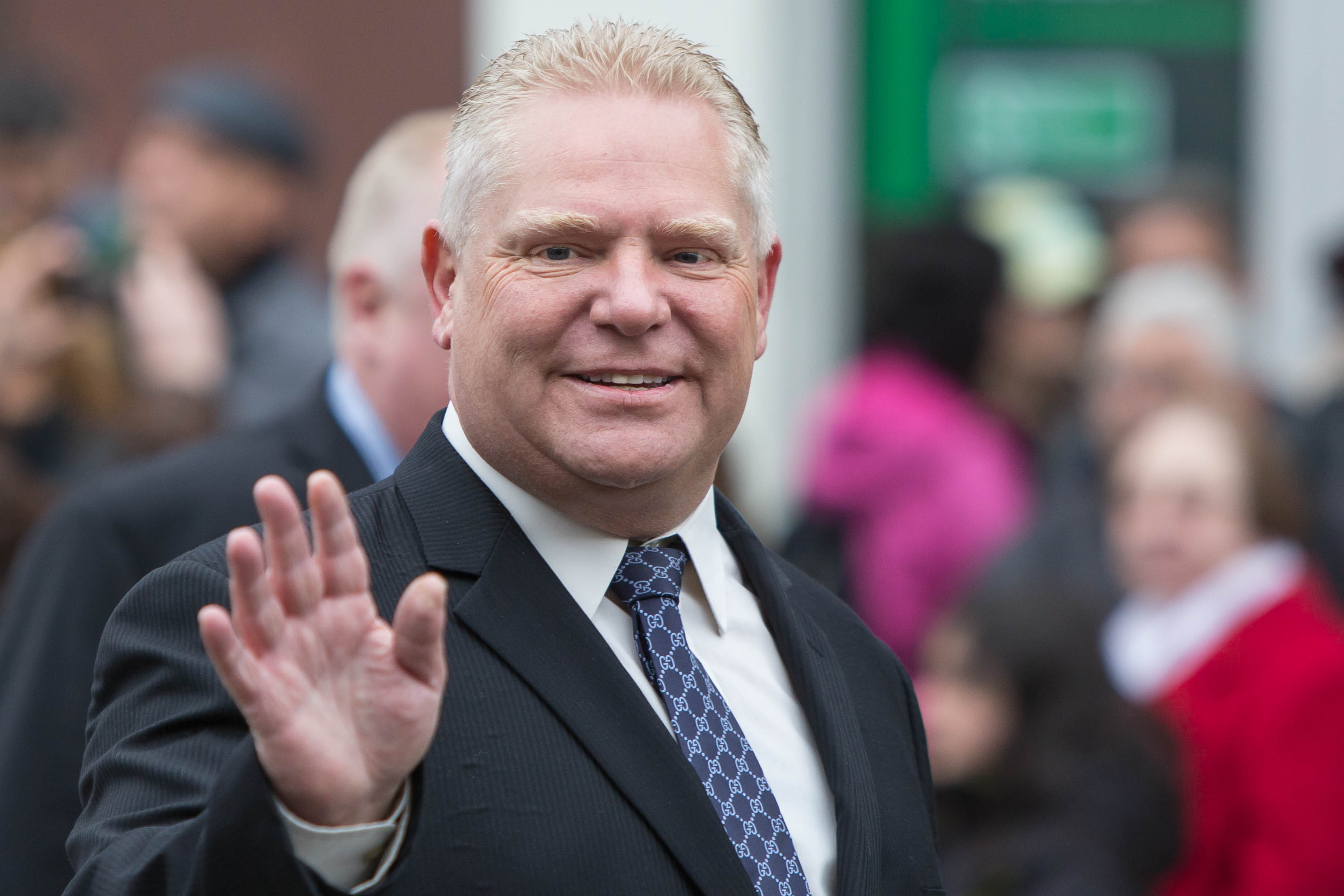
New Ontario Progressive Conservative leader Doug Ford at the 2014 Good Friday procession in East York.
Photo via Wikimedia.

In the National Post, Chris Selley reports on the three-ring circus:

In the end, maybe caucus had it right. If more than anything else Ontario’s Progressive Conservatives wanted to win on June 7 then maybe they should have stuck with interim leader Vic Fedeli. If the ultra-folksy MPP for Nipissing wasn’t the most compelling imaginable premier-in-waiting, he would certainly have cut a less divisive figure than Doug Ford, who was announced as the party’s new leader late Saturday night in a small room at a Markham conference centre.

“To the party members I say thank you. To the people of Ontario I say relief is on its way,” Ford told reporters and campaign workers. “And to Kathleen Wynne, I say your days as premier are numbered.”

That got a massive cheer, of course, but this is an outcome that many in the party consider a worst-case scenario. An Angus Reid poll released this week asked “soft” Tory voters whether each candidate would make them more or less likely to support the party: Ford’s net score (more likely minus less likely) was minus 27 per cent; Christine Elliott, who finished a very narrow second Saturday — her third failed shot at the position — was at plus 20.

Sticking with Fedeli would also have spared the party the hideous embarrassment of Saturday’s botched convention. Vote-counting dragged on for hours thanks to a chunk of ballots that had been allocated to the wrong ridings. A packed crowd of partisans was left in the dark for three hours, then told to hang tight for another 30 minutes, and then sent away into the night with no result. In lieu of a cascade of balloons, there was booing and hollering. Various Ford supporters, citing ostensibly conclusive media reports earlier in the day that Ford had won, alleged party elites were trying to steal it.

These were not the ideal circumstances in which to build unity, which was the stated purpose of the event. “You’ve been through a very tough couple of months — perhaps the toughest times in the history of the Progressive Conservative Party of Ontario,” Alberta United Conservative Party leader Jason Kenney told the crowd. “You’ve gone through weeks of anxiety and adversity. But I am certain that you will overcome this time of trial, and that this afternoon, with the election of your leader, you will emerge stronger, united and victorious in the election.”

“This afternoon,” he said. We were so young then.

The flow of votes from Allen to Ford was expected, but what I didn’t expect was the proportion of Mulroney votes that flowed to Ford instead of Elliot (I’d expected roughly 100% to Elliot, but a significant number went to Ford instead).

Perhaps the most surprising thing about the leadership campaign was how well Ford managed to stick to his talking points and not be baited into the kind of media spectacle his late brother seemed to specialize in. A tougher test awaits in the June provincial election, however. The Liberals and NDP have been gifted a full warehouse of attack ads, based on the Ford brothers’ chaotic and at times incoherent term in office in Toronto, but there may be a limit to the overall usefulness of this arsenal: rather like the US media attacking Trump during the last US election, we’ve probably heard it all before.

The circus may not be over yet, however, as reports on Sunday indicated that Christine Elliot is demanding an investigation into the election.

March 11, 2018

Polls begin to reflect public disillusionment with Trudeau after gaffe-filled India trip

Filed under: Cancon, India, Politics — Tags: , , — Nicholas @ 03:00

After all the PR blunders, it’s amazing that the Liberals are still riding as high in public opinion polls as they are:

By now it is clear the federal Liberals are in some difficulty with the public. Much excitement attended that Ipsos poll earlier this week showing them trailing the Conservatives for the first time, and by a not inconsequential margin: 38 to 33. But it’s not just Ipsos.

Forum Research, which gives the Tories a 12-point lead, may be an outlier, but Nanos’s latest four-week rolling poll shows the Liberal lead has shrunk to less than four points from eight points in December; Abacus Data, similarly, now has them just three points ahead, the narrowest margin they have found since the election.

Overall, the CBC’s Poll Tracker website now puts the two parties more or less level, based on a weighted average of the polls, at 36 per cent. Contrast that with the Liberals’ first year in office, when they maintained a lead of as much as 20 points, or even their second, when they led by eight to 10. Something is clearly up.

The reason is not hard to find, nor is it unusual: the prime minister’s personal approval rating has declined markedly. To be sure, he remains the Liberals’ chief asset: Nanos still shows 40 per cent of Canadians put Justin Trudeau as their preferred prime minister. Sixty per cent say he “has the qualities of a good political leader.”

[…]

The immediate explanation for the prime minister’s cratering appeal is the recent official visit to India, conceded on all sides to have been a disaster. There’s no doubt this has taken its toll — Ipsos finds more than twice as many Canadians of the view that the visit was “negative for Canada-India relations” than the contrary.

But if the India visit accelerated the decline, it is also true that the prime minister’s appeal has been fading for some time. The India trip may have crystallized certain perceptions of him, but the ingredients have been evident for a while. People do not form impressions of a leader’s character and abilities instantaneously, but only as the result of an accumulation of incidents and impressions.

The Tories’ pre-election attempts to discredit Trudeau as “just not ready” failed in the light of a long campaign in which he persuaded increasing numbers of Canadians that he was. I don’t imagine many would have said he was much of a deep thinker — his worst moments are almost always when he tries to pretend he is — but people gave him credit for sincerity, personal decency, idealism, and a native political ability that seemed to grow throughout the campaign.

But now? Asked to name the first quality that came to mind, I suspect increasing numbers might be more inclined to mention his cynicism.

March 9, 2018

Devil’s Brigade – WWII First Special Service Force

Filed under: Cancon, Europe, History, Italy, Military, USA, WW2 — Tags: , — Nicholas @ 02:00

farias615
Published on 24 May 2017

March 7, 2018

The reception Mulroney Sr. got shows how little “sizzle” the Conservatives can offer now

Filed under: Cancon, Politics — Tags: , , , — Nicholas @ 04:00

Chris Selley covered the recent Caroline Mulroney event featuring her father Brian:

Watching 79-year-old Brian Mulroney campaign for his daughter on Tuesday, I’d be hard-pressed to argue age matters at all.

The public-facing aspects of this leadership campaign have often been stilted, joyless and jittery, with Doug Ford carefully keeping his powder dry and Mulroney trying to build confidence without screwing up. Only Christine Elliott has often sounded passionate, confident and halfway credible all at once.

Mulroney père, on the other hand, waltzed into a packed banquet hall in Vaughan at noon on Tuesday like a conquering hero, to a standing ovation, and settled in behind the lectern like it was a favourite sweater and a mug of hot cocoa. When he was done, but for the greyer beards, the camera-wielding mob that escorted him out of the room might as well have had Justin Trudeau at its centre.

Mulroney regaled us with a smorgasbord of chucklesome anecdotes, bons mots and name-dropping. He cheerfully batted away several entreaties that he return to politics. He said he mooted the idea to Mila during Jean Chrétien’s infamous “I don’t know if I am in West, South, North or East Jerusalem” press conference in 2000.

“I think it’s a wonderful idea,” she supposedly replied, “and I know your new wife is really going to love the experience.” Much mirth!

Mulroney pooh-poohed the need for legislative experience in an aspiring premier — perhaps the biggest knock against his daughter — arguing he had none when he won the Tory leadership in 1983 and rampaged to a majority government, and suggesting he “want(s) no part of” the sort of experience that Kathleen Wynne and Co. have in spades.

“I knew Ontario when it was the driver of Confederation, the engine of Canada’s economy, a glorious leader in this country,” he prated, crediting the “strong, consistent and brilliant” leadership of Tory premiers John Robarts, Bill Davis and Mike Harris for “the large measure” of its success. “And now Ontario has been reduced to accepting equalization payments from Newfoundland and Labrador.”

[…]

Demonstrably, in Canada, you do not need a huge, room-filling personality to govern effectively. But if you haul out Brian Mulroney to campaign for you, you’re going to invite comparisons. And if you’re going to claim that the current government has literally laid waste to the province, a guy like Mulroney is liable to highlight just how modest the Conservatives’ proposals are to rebuild it all from scratch.

March 2, 2018

Canada’s foreign policies, in the wake of recent Prime Ministerial mis-steps

Filed under: Cancon, China, Government, India — Tags: , — Nicholas @ 03:00

Ted Campbell suggests that our current foreign policy goals have been seriously undermined by the — shall we say “disappointing” — outcomes of Prime Minister Trudeau’s Chinese and Indian trips:

[Former senior Canadian diplomat David] Mulroney begins by saying that: “The best that can be said about Prime Minister Justin Trudeau’s visit to India is that it may prompt a review, if not a complete rethinking of a Canadian foreign policy that appears to be seriously off the rails. We have some hard lessons to learn … [and] … At the very least, the Prime Minister’s debacle in India should encourage smart people in Ottawa to zero in on what isn’t working.” That’s good thinking. At the end of every major campaign, an especially after campaigns in which things go awry, good military commanders convene a board of senior officers to consider “lessons learned,” in the hope that they will not make the same mistakes next time. sadly, especially today, the lessons learned are all too quickly forgotten even if the analysis was rigorous enough in the first place.

“Most worrying,” David Mulroney says, “is a fundamental and puzzling failure at the level of policy implementation, something that appears to be compounded by the Prime Minister’s own impetuosity. Flying to India before the big meeting with Prime Minister Narendra Modi was in the bag, much like heading off to Beijing on a free-trade themed visit without any reasonable expectation that a deal was doable, exposes Mr. Trudeau to a degree of prolonged public skepticism that comes to define the visit itself.” In other words: Justin Trudeau goes off “half cocked” as we soldier say … not ready for action. That is, I suspect, in part because his team in the Prime Minister’s Office (PMO), was brilliant on the campaign trail in 2015 but is really unqualified to advice the leader of the government of the G7 nation; that poor quality of policy advice matters because Justin Trudeau was, and still is, to be sure, “just not ready” for the job he was handed. But his office campaign team wants to get and keep him in the public eye because that’s part of the 2019 campaign strategy … this time it failed because they really didn’t understand the business at hand.

[…]

But India is not just any country, as Mr Mulroney explains: “India isn’t our friend. It is a rising regional power beset with a range of domestic problems, including serious human rights issues. It takes a prickly approach to global issues that is often at odds with traditional Canadian policies in areas ranging from trade policy to nuclear disarmament … [and, he says] … The Indian diplomats I worked with could be wonderfully pleasant after the official day was done. But, for the most part, they brought a formidably ruthless precision to their pursuit of India’s interests in the world. While they might ultimately agree to grant Canada a concession, this was always a product of hard and often heated negotiations. They never conceded a point because they liked us or because we are home to a large Indo-Canadian community.” Further, he adds that “My experience with Chinese diplomats was entirely similar.” Although never at the same level as Mr Mulroney, I worked in the international arena as a senior officer, especially in one sector (global radio-communications which included arranging for the expansion of mobile communications in the 1990s. My Chinese and Indian colleagues were, indeed, fine men and women but they, just like me, were there ~ Geneva, a lot, but everywhere from Washington, London, Canberra and Tokyo to Beijing ~ defending their interests. “friendship,” even long standing alliances didn’t count for anything. Billions of dollars were at stake, profits and losses would hinge on how we ~ engineers and lawyers and businessmen and soldiers from dozens of countries ~ managed to slice up the radio spectrum to allow these new services to thrive. The Chinese and Indian delegates were just as professional, just as technically qualified, just as hard nosed as the Americans, Brits and Canadians.

“Long before the election of U.S. President Donald Trump,” David Mulroney says, “it should have been clear to us that the world is changing in ways that do not align with traditional Canadian views, interests and values. If we’re smart, the rise of countries like China and India can certainly contribute to our prosperity, and with hard work, we should be able to find common cause on important issues such as global warming … [but, he adds] … the rise of these assertive and ambitious Asian powers will almost certainly challenge global and regional security. Both will also continue to reject traditional Canadian notions about global governance and human rights, and neither will be particularly squeamish about interfering in Canadian affairs.” Sunny ways, feminism and being green don’t count for much; they are very certainly not a sound foundation upon which to build a foreign policy. We have to start thinking about our vital interests in the world ~ about what they are and about how we can and will protect and promote them: that’s the basis of a grand strategy. It was also the kind of thinking that Stephen Harper hated: he wanted to deal with issues incrementally, linking them together, sometimes, into a coherent web but never allowing them to become too important in and of themselves. That was bad enough but I’m persuaded that Justin Trudeau doesn’t think about those “big ideas” at all … because, I fear, they are, simply, quite beyond his comprehension.

« Newer PostsOlder Posts »

Powered by WordPress