Recently, over lunch, Mrs. Muros regaled me with tales of authors who treat their readers to several new novels a year. As she waxed rhapsodic on the subject of the people who put the “p” in “prolific”, I scribbled notes on a credit card receipt. “Why is it”, I wrote, “that these ink-strained Atalantas can fill several pages with reasonably readable prose in the time it takes me to assemble a simple Substack post?”
The answer, I mused, might have something to do with sex. All of the authors mentioned by My Yankee Sweetheart, after all, were fully paid-up members of the distaff half of humanity. Could it be that my words fail to flow like summertime honey because my brain has been pickled in androgens? Or, to be somewhat less of a bio-Calvinist, could it be that my refusal to engage in the formal study of literature — a policy which owed much to my belief that the subject was “for girls” — left me bereft of some of the most useful tools of the writer’s trade?
Later that day, as I ransacked back issues of obscure journals in the hope of finding an uncooperative fact, a warm yellow bulb of incandescent understanding appeared above my head. ‘Twas not the writing that slowed me down, I realized, but the research. Indeed, were it not for the pesky puzzle piece I was trying to find, my article would have been done and dusted well before The Love of My Life and I sat down to our midday meal.
Before it faded, my wee epiphany bore two sprogs. The elder of these reminded me that, like other forms of mass production, the prodigious productivity of the quill-drivers in question owed much to the avoidance of novelty. That is, they were able to write so much because, in effect, they made repeated use of familiar formulae, tried-and-true tropes, and recurring turns-of-phrase. The younger of my mind-sparks added that, in addition to taking up time that an writer might otherwise spend at the keyboard, the discovery of a new fact will often lead to a quest for fresh forms of expression.
So, to quote the immortal words of David Crowther, you pays your money and you takes your choice. You can write quickly, or you can say something new, but you can’t do both.
Bruce Ivar Gudmundsson, “The Price of Speed”, Extra Muros, 2024-05-21.
August 29, 2024
QotD: The Price of Speed
August 28, 2024
1974 – Britain’s nadir
In the second part of Ed West‘s appreciation of Dominic Sandbrook’s Seasons in the Sun, Britain was described as “sliding, sinking, shabby, dirty, lazy, inefficient, dangerous, in its death throes, worn out, clapped out, occasionally lashing out” by Margaret Drabble in her 1977 novel The Ice Age, and it certainly seems to fit the bill quite well:
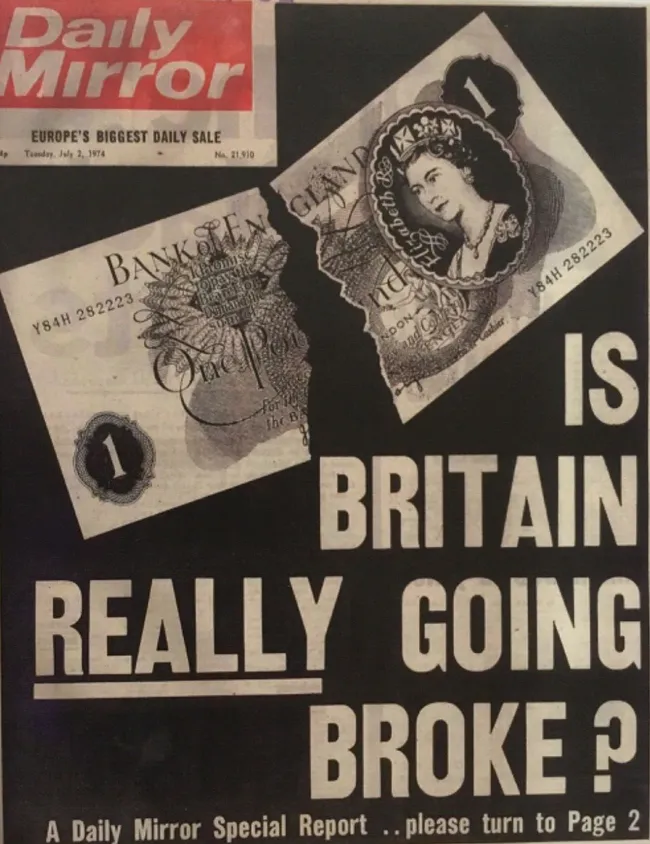
The Times reported in October of that year that London’s West End was in a “sorry state”, with parts of Shaftesbury Avenue and Charing Cross Road “in the sort of condition that, in Birmingham or Manchester, would qualify them for wholesale slum clearance”.
Journalist Clive Irving wrote that London had become “a semi-derelict slum”, a city blighted by “tacky porno shops, skin movies, pinball arcades, and toxic hamburger joints” while “behind neon facades the buildings are flaking and unkempt”.
The capital had lost a million and a half people since its peak in 1939, and would continue its decline for another decade. Whitehall Mandarin Ronald McIntosh declared that “London is evidently losing population quite heavily [and] services are steadily deteriorating, and nobody seems to have the least idea of how to deal with it”.
The country as a whole was haemorrhaging people, and in 1975 its population fell for the first time since records began. In the spring of 1974 applications for emigration to Canada went up 65 per cent, while New Zealand even felt compelled to put restrictions on people fleeing the old country.
Doctors in particular were leaving in droves, and recruitment agency Robert Lee International estimated that the number of professionals wanting to move abroad rose by 35% in just six months, from January and July 1975. Interest was keenest among engineers, accountants, scientists and teachers.
Many high earners were fleeing excessive tax rates, so punitive that even the Bond producer Albert R Broccoli left to make the iconic British movies elsewhere, and Moonraker would be filmed in France.
Gone were the days of the Swinging Sixties; instead, the London of George Smiley was “the city of the Sex Pistols and The Sweeney, not the Beatles and The Avengers; a city of tramps and hooligans, hustlers and muggers, the downtrodden and the disappointed, haunted by the deadly figure of the IRA bomber”.
Britain’s second city was in an even worse state. During Wilson’s first term Birmingham had been hailed as “the most go-ahead city in Europe”. Now the Times admitted it looked like a “large and chaotic building site”.
Travel writer Jonathan Raban described Southampton’s Millbrook estate as “a vast, cheap storage unit for nearly 20,000 people”. The country’s increasing problem with crime, hooliganism, graffiti and drug addiction meant that residents wouldn’t even hang their clothes in communal areas, for fear of theft.
The great architectural feats of the post-war era were beginning to look like a miserable failure, and none more so than the utopian social housing schemes, which had often entailed destroying closely-knit and organic communities in overcrowded and run-down – but rescuable – terraced housing.
Christopher Brooker visited Keeling House in Bethnal Green and found “its concrete cracked and discolouring, the metal reinforcement rusting through the surface, every available inch covered with graffiti”. Here was the story of modern Britain, “the bright, anticipated dream followed by a seedy, nightmarish reality”.
The National Theatre’s Peter Hall visited the New York Juilliard School and upon return home “found it depressing to compare it with our own already run-down, ill-maintained South Bank building”.
“The English apparently no longer care enough about material surroundings,” he wrote: “They even seem to take a positive pleasure in defiling them.”
H.R. McMaster dishes on Trump’s first term in office
In Reason, Liz Wolfe covers some of the head-scratchers former National Security Advisor H.R. McMaster revealed about working for Donald Trump:

Donald Trump addresses a rally in Nashville, TN in March 2017.
Photo released by the Office of the President of the United States via Wikimedia Commons.
What might a second Trump White House be like? In his new book, At War with Ourselves: My Tour of Duty in the Trump White House, Lt. Gen. H.R. McMaster, who served as national security adviser to Donald Trump (for one year), characterizes Oval Office meetings as “exercises in competitive sycophancy” where advisers would greet him with lines like “your instincts are always right” or “no one has ever been treated so badly by the press”.
Trump, meanwhile, would come up with crazy concepts, and float them: “Why don’t we just bomb the drugs?” (Also: “Why don’t we take out the whole North Korean Army during one of their parades?”)
This is one man’s account, of course. McMaster’s word should not be taken as gospel, and some of his frustration might stem from his dismissal, or his foreign-policy prescriptions being at times ignored by his boss. But it’s a somewhat revealing look behind the curtain at policy-setting in a White House helmed by an especially mercurial commander in chief, who “enjoyed and contributed to interpersonal drama in the White House and across the administration”.
It also shows how quickly Trump fantasies have percolated through the Republican Party, namely the “let’s just bomb Mexico to get rid of the cartels” line, which Trump has been toying with since roughly 2019 (or possibly more like 2017, after he chatted with Rodrigo Duterte, former president of the Philippines, who had promised to kill 100,000 drug traffickers during his first six months as president). A few years prior, in 2015, he had suggested that Mexico was sending rapist and drug-traffickers across the southern border, and that we’d need to build a wall between the two countries, but it wasn’t until nine American citizens were killed in Mexico that Trump trotted out the idea of declaring cartels foreign terrorist organizations and using military might to eradicate them.
Trump’s line from 2019 has now become standard fare, notes The Economist: The Republican primary debates included lots of tough talk on Mexico, specifically on the bombing front, with Florida Gov. Ron DeSantis claiming he’d send special forces down there on Day One. Right-wing think tanks have embraced the messaging, with articles headlined “It’s Time to Wage War on Transnational Drug Cartels”. Taking cues from other members of her party, Georgia Rep. Marjorie Taylor Greene asked why “we’re fighting a war in Ukraine, and we’re not bombing the Mexican cartels”. Whether it’s economic protectionism (10 percent across-the-board tariffs, with 60 percent tariffs imposed on Chinese imports) or Mexico-bombing, Trump has near-magical abilities to get other members of his party to accept something previously regarded as absurd.
August 27, 2024
Was 1974 the worst year in British politics or just the worst year so far?
I wasn’t in the UK in 1974 (although I did spend a couple of dystopian weeks there in January 1979), so I don’t know from personal experience just how bad things were, but as Ed West considers Dominic Sandbrook’s very informative social history Seasons in the Sun, he certainly helps make a strong case for it:
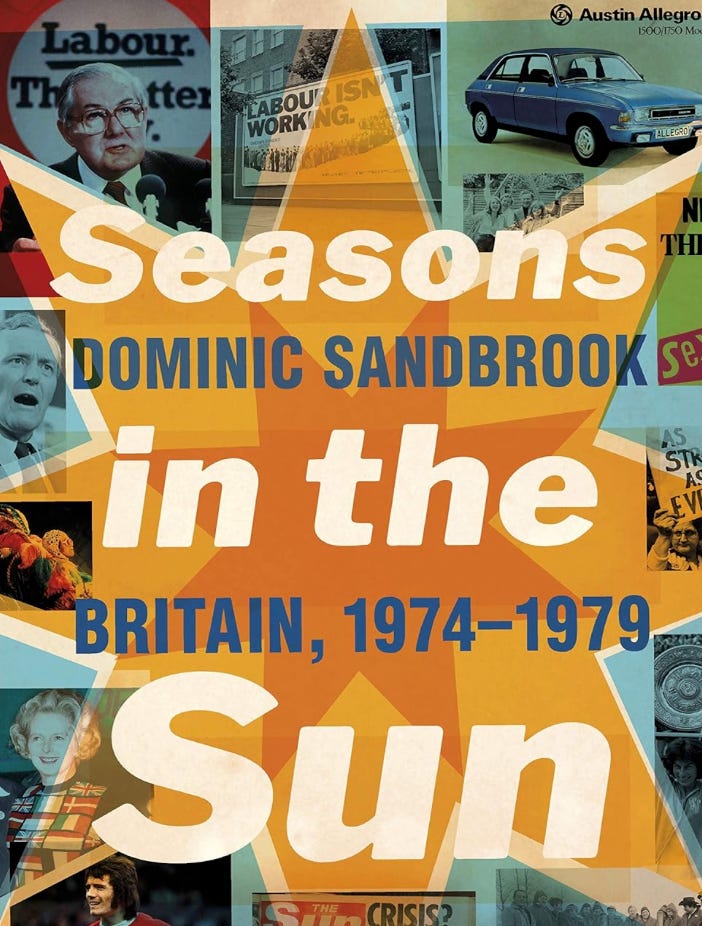
One of my favourite moments from reading Fever Pitch as a teenager was the passage where Nick Hornby and a friend bunk off school to watch Arsenal play West Ham, a game which was being held on a weekday afternoon because there wasn’t enough electricity for the floodlights. Britain was enduring a three-day week due to the energy crisis, and assuming the ground would be empty, Hornby is stunned to find it packed with 60,000 people, all skiving off work, and he recalls his hypocritical juvenile disgust at the idleness of the British public.
The scene encapsulates the comic crapness of that period, one that many of us have enjoyed laughing at with the recent Rest is History series on 1974. I began reading Sandbrook’s book Seasons in the Sun afterwards, from where the material for the series was drawn; the early chapters comprise a highly entertaining account of what he described on the podcast as “the worst year in British politics”. Reassuring, perhaps, for those of us inclined towards pessimism, although to paraphrase Homer Simpson, perhaps it was only the worst year so far.
Nineteen-seventy-four saw two elections, the first of which ended in a hung parliament, with Labour as the largest party, and the second with Harold Wilson winning with a majority of 3. These were fought between parties led by exhausted leaders who had run out of ideas, with a third, the Liberals headed by Jeremy Thorpe, soon to be notorious as a dog killer. Britain had declined from the richest country on the continent to one of the poorest in western Europe, and its economy seemed to be falling apart.
During his troubled four years in office Edward Heath had called a state of emergency several times, culminating in ration cards for petrol and power restrictions. In 1973 Heath had “told his Chancellor, Anthony Barber, to go for broke”, Sandbrook writes: “It was one of the greatest economic gambles in modern history: while credit soared and the money supply boomed, Heath hoped to keep inflation down through an elaborate system of wage and price controls”. By October that year, “his hopes were unravelling at terrifying speed”.
The “Barber boom” led to “house prices surging by 25 per cent in just six months, the cost of imports rocketing and Britain’s trade balance plunging deep into the red”. Yet just a week after Heath had published details of his “Stage Three” incomes policy, “the Arab oil exporters in the OPEC cartel announced a stunning 70 per cent increase in the posted price of oil, punishing the West for its support for Israel. It was a devastating blow to the world economy, but nowhere was its impact greater than in Britain.”
The stock market lost a quarter of its value in just a month, while by January 1974 share prices had fallen by almost half in under two years. Just before Christmas, the government cut spending by 4 per cent, and Labour’s Shadow Chancellor, Denis Healey, “warned his colleagues that Britain stood on the brink of an ‘economic holocaust'”. Nine out of ten people told a Harris poll that “things are going very badly for Britain” and nearly as many foresaw no improvement in the coming year. They turned out to be correct.
Amid trouble with the National Union of Mineworkers, in November 1973 “Heath announced his fifth state of emergency in barely four years. Floodlighting and electric advertising were banned; behind the scenes, the government began printing petrol ration cards. As the railwaymen voted to join the miners in pursuit of higher pay, it seemed that Britain was sliding into darkness. Offices were ordered to turn down their thermostats, while the BBC and ITV were banned from broadcasting after 10.30 at night. On New Year’s Day, with fuel supplies running dangerously low, the entire nation went on a three-day working week.” Happy days.
August 26, 2024
The craft of the historian, then and now
At Extra Muros, Bruce Ivar Gudmundsson contrasts the way historians used to research and write their books with the much more convenient, yet still imperfect methods of modern historians:
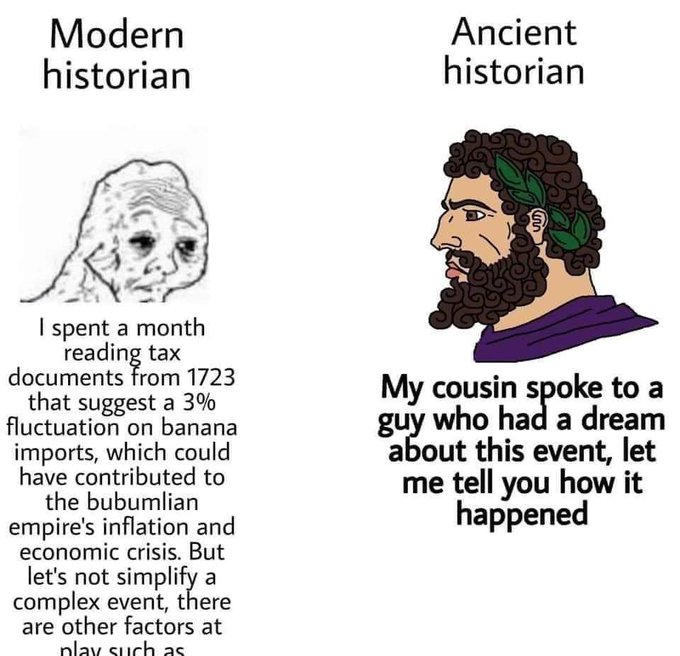
Another difference between ancient historians and their modern counterparts.
In days of yore, when visiting an archive required long journeys by sea, or, at the very least, a tiring trek o’er moor and mountain, considerate historians stuffed their works, with extensive excerpts from primary sources.1 Later, when trains, planes, and automobiles made it easier for people to visit the places where original documents could be found, these quotations shrank, eventually to the point where the word “citation”, which had once described the products of scholarly stenography, came to designate the label that enabled readers to locate the one-of-a-kind text in question.
No doubt, this development saved many trees from the woodman’s axe. At the same time, however, it changed the role played by historians. Rather than showcasing selections from the correspondence of old-timey movers and shakers, Clio’s children devoted most of the ink that they spilled to the explanation of texts that, despite the blessings bestowed by coal and petroleum, most readers would not be able to read.
Many a noble soul resisted the temptation to sacrifice verbatim reproduction on the altar of erudite interpretation. Realizing that readers might prefer a faithful facsimile of the real McCoy to a ponderous paraphrase, these saints of the scriptorium prepared primary sources for the press. However, rather rewarding these benefactors of the historically curious with condign praise, the denizens of the faculty lounge often dismissed them as “editors” and, in moments of especial cruelty, “antiquarians”.
In the fullness of time, the convenience provided by recent interpretations led many historians to prefer them to the relics of bygone bureaucracies. After all, reading a fresh-smelling, neatly-bound, clearly-printed, recently-written book asks less of a scholar than the deciphering of unfamiliar turns-of-phrase scribbled on the dusty, mite-bitten contents of cardboard boxes. Moreover, while the reader of a scholarly monograph often enjoys a wide choice of restaurants and coffee shops, and, at the very least, the delights of his own kitchen, the archival archaeologist must often make do with the decidedly institutional offerings of a ground-floor cafeteria.
Ostentatious reliance on recent interpretations also enables a scholar to exhibit his collegiality. “See”, the favorable footnote screams, “someone noticed your work and, marvelous to say, made use of it”. Conversely, failure to cite the work of a peer, let alone a scholar of superior standing, signals a degree of nonchalance bordering on contempt. “I am fully aware”, it says to the author of the unreferenced work, “that you poured your heart and soul, as well as a dozen years of your life, into your study, but I could not be bothered to type out its title, let alone turn a page to discover its date of publication”.
Finally, the making of new monographs out of the pieces of slightly older ones honors the founding fable of the research university, the myth of scholarly progress. The monograph still warm from the press, we presume, offers more in the way of insight and understanding than one that has been sitting on the shelf for decades. (If you wish to drive a dagger into the heart of an older academic, describe one of his earlier works, especially one that once made a splash in the kiddie-pool of his subfield, as “somewhat dated”.)2
Prejudice in favor of up-to-date interpretations creates a paradox. Historians, who exist to bring the past to life, favor interpretations created on the eve of now. The speakers for the dead (hat tip to Orson Scott Card) limit themselves to the thoughts of the living.
1. For a brief, and delightfully documented, description of the work of the paragon of this approach to the writing of history, Angelo Fabroni (1732-1803), see Anthony Grafton The Footnote: A Curious History (Cambridge: Harvard University Press, 1997) pages 82 and 83.
2. Ask me how I know!
August 25, 2024
Woke libraries
Frank Furedi on the already well-advanced plan to turn public libraries into safe spaces for progressive indoctrination:



In recent times, the Library has become the target of what I characterise in my new book, as The War Against The Past. The current project of dispossessing Western society of its historical legacy has gained a powerful influence over the institutions of culture. That is why the Library – a repository of the knowledge and wisdom gained through the past – has become the target of cultural vandalism.
The promoters of the culture war in the Library often justify their action on the ground that their target is not so much the past – but the “racist past”. This is the argument used by the Government backed supporters of a campaign in Wales who wish to reorganise libraries along the lines of anti-racist principles. These racially obsessed cultural warriors insist that Libraries throughout Wales must embrace the goal of becoming anti-racists if the devolved Labour government’s pledge to “eradicate” systemic racism by 2030 would be realised. To ensure that libraries and the “racist” buildings holding their collection are cleansed of the sin of “whiteness”, a £130,000 project designed to indoctrinate local librarians in “critical whiteness studies” has been devised.
The project of racial indoctrination pursued in Wales warns that staff training sessions will be necessary to ensure that libraries align with anti-racist principles. However, it insists that such training sessions should not take place in buildings with a “racist past”. From the standpoint of the authors of the document proposing “critical whiteness studies”, many buildings housing libraries must be avoided because they serve as symbols of racism. Do they presume that the buildings in question can contaminate members of the public with the racist plague? Or are they merely interested in tearing down the walls of racist buildings in order to rebuild them as temples to the doctrine of decolonization?
In a world, where the racialisation of every dimension of life has acquired its own imperative, it was only a matter of time before buildings became demonised as racist. There is now a veritable literature authored by academic racial entrepreneurs who insist that buildings can be racist. One enthusiastic social scientist supporting this thesis offers numerous “examples of buildings being racist”. The racialisation of building and the material properties used in their construction has acquired the character of a veritable fetish. “Concrete, steel and glass buildings are ‘racist'” is the title of one contribution on this subject.
The Welsh Government appears to be consumed by the quest of ridding its nations of racist buildings. As far back as 2021 it published an audit of all such buildings as well as, schools, streets, statues and pubs that it regarded as the product of Wales’ racist past. In effect almost any building, street name or pub whose name was linked with a historical figure was by definition racist. Gone are the days when a pub is allowed to call itself Admiral Nelson or the Duke of Wellington.
The policy of renaming a building, street or a statue is bad enough. What is far worse is when a library is forced to subordinate its book collection to the imperative of racialization. In the name of ridding the book shelves of their “whiteness” and “racist past”, a library becomes a target of officially sanctioned cultural vandalism.
Throughout the Anglosphere. Cultural vandalism is justified on the ground of settling scores with colonialism, racism or white supremacy. For example, school libraries in Australia have removed “outdated and offensive books on colonialism” from their collection[v]. The purge of a school library in Melbourne was guided by Dr Al Fricker, a Dja Dja Wurrung man and expert in Indigenous education with Deakin University. In the course of auditing all 7000 titles on its library shelves. Fricker showed little nostalgia towards the collection. He stated that some of the books removed were almost 50-year-old and were “simply gathering dust anyway”. He stated that “we wouldn’t accept science books being that old in the library, so why do we accept other non-fiction books to be that old, because nothing is static”.
There is something truly disturbing about the idea that a library ought to rid itself of old non-fiction books. In my discipline of sociology that would mean ridding libraries of the 19th century pioneers of the field. In effect the call to reject old non-fiction books constitutes the annihilation of the intellectual legacy of the social sciences and the humanities.
QotD: P.G. Wodehouse’s unique way to get letters delivered
“He was living in bachelor quarters in a tall, old-fashioned building in Queen’s Gate. His flat was on the fifth floor. There was no lift. I was travel tired and I toiled up the long staircase, pausing on the landings to pant. I found his door ajar and, entering, I found him writing a letter. He greeted me with a cheery ‘Hurrah, you’re here!’ and added, ‘Just a tick and I’ll get this letter off.’
“He shoved the letter in an envelope, stuck a stamp on it, then went over to the half-open window and tossed it out. ‘What on earth?’ I asked. ‘Has the joy of seeing me brought on some sort of mental lapse? That was your letter you just threw out of the window.’ ‘I know that. I can’t be bothered to go toiling down five flights every time I write a letter.’ ‘You depend on someone picking it up and posting it for you?’ ‘Isn’t that what you would do if you found a letter stamped and addressed lying on the pavement? All I can say is it works.’ ‘Well I wish you’d write me a letter while I’m here in London. I’d like to show it round in America – a bit of a score for good old England’.”
Bolton goes on: “It was the second day after moving into a fourth-floor flat in South Audley Street when my doorbell rang and I opened it to a rather stout individual somewhat out of breath. ‘Are you Mr Bolton? I have a letter for you.’ The envelope was in Plum’s handwriting.
“He said he was a taxi driver but refused a tip, accepting instead a bottle of Guinness. While he was drinking it, I phoned Plum. ‘I have your letter,’ I said. ‘What?’ said Plum in a slightly awed voice. ‘I only threw it out of the window 20 minutes ago.’ ‘You were right,’ I said. ‘It’s by far the quickest way to send a letter to a friend in London.’ ‘Yes, indeed. The GPO had better look to their laurels and keep an eye on their laburnums’.”
Of his friend, Bolton says: “He has one quality that is rare in our age. It is innocence. It carries with it a trusting belief in the goodness of heart of his fellow men. Suspicion and distrust have no place in his nature. The characters in his books share in it – even his villains are likely to succumb before a finger shaken by one of those bright-eyed, no-nonsense Wodehouse heroines.”
Alan Ashworth, “That reminds me: A final homage to Wodehouse”, The Conservative Woman, 2024-05-21.
August 24, 2024
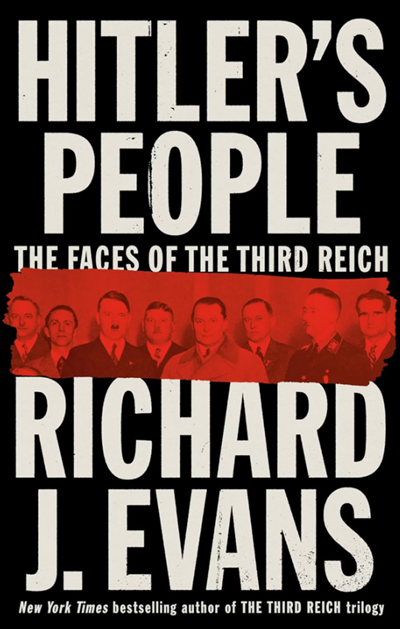
Hitler’s People by Richard J. Evans
In The Critic, Daniel Johnson reviews Richard Evans’ latest book on the history of Hitler’s Germany, Hitler’s People: The Faces of the Third Reich:
History records nothing more vile than Hitler and his henchmen. At the height of his power in 1942, Heinrich Himmler boasted that “the Führer has laid this very serious command [extermination of the Jews in occupied eastern Europe] upon my shoulders. No one can take it away from me.” By the end of the Third Reich, Hermann Göring had become a “voluptuary”, wearing lipstick and dressing in a toga, accompanied by a suitcase containing most of the world’s supply of the drug paracodeine. Joseph Goebbels, meanwhile, devoted his brief reign as Hitler’s successor to poisoning his six children.
The word “Nazi” has become synonymous with evil. Inevitably, therefore, it has also lost much of its original meaning — a case of Hegel’s “night in which all cows are black”. There is a danger that new generations will no longer know what made the Nazis and their crimes uniquely heinous.
Professor Sir Richard Evans has gathered a representative sample of “Hitler’s people”, ranging from the monstrous to the grotesque, into a single volume. It’s not a work of original research but a collective portrait of “the faces of the Third Reich”. Their unifying factor is the Führerprinzip — their unquestioning obedience to and adulation for Adolf Hitler.
Hero-worship in this, its most sinister form, is still with us. From Narendra Modi to Donald Trump, from Marine Le Pen to Jean-Luc Mélenchon, democracies are still menaced by demagogues. If we are honest, we have all felt the gravitational attraction of “charisma” — a secularised theological concept coined by Max Weber to denote the political authority exerted by an extraordinary individual. Evil often elevates the ordinary to the extraordinary.
Charisma in this sense is contemporaneous with the emergence of Hitler. His cult of charismatic leadership is indistinguishable from the ideology of National Socialism. Cults of this kind had already been prefigured in his day by those of Mussolini, Lenin and Stalin. But the case of Hitler, who cultivated the phenomenon in its most extreme form, remains the paradigm. Vladimir Putin, Xi Jinping and other contemporary despots are still in his debt.
Nazi Germany was indeed run by legions of little Hitlers, each demanding obeisance whilst lording it over their frequently competing or overlapping jurisdictions. The Third Reich was, in this sense alone, a diabolical reincarnation of the First, the Holy Roman Empire, with its patchwork of feudal domains. No medieval monarch, though, had the technological means to inflict such mayhem and misery upon humanity.
QotD: How did the Romans themselves view the change from Republic to Empire?
Overall the various Romans who contemplated reform were in a way hindered by the tendency of Roman elites to think in terms of the virtue of individuals rather than the tendency of systems. You can see this very clearly in the writings of Sallust – another Roman writing with considerable concern as the republic comes apart – who places the fault on the collapse of Roman morals rather than on any systemic problem.
We also get a sense of these feelings from the literature that emerges after Augustus takes power in 31, and here there is a lot of complexity. There is quite a lot of praise for Augustus of course – it would have been profoundly unwise to do otherwise – but also quite a lot of deep discomfort with the recent past, revealed in places like Livy’s deeply morally compromised legends of the founding of Rome or the sharp moral ambiguity in the final books of Vergil’s Aeneid. On the other hand, some of the praise for Augustus seems to have been genuine. There was clearly an awful lot of exhaustion after so many years of disruption and civil war and so a general openness to Augustus’ “restored republic”. Still, some Romans were clearly bothered by the collapse of the republic even much later; Lucan’s Pharsalia (65 AD) casts Pompey and Cato as heroes and views Caesar far more grimly.
We have less evidence for feeling in the provinces, but of course for many provincials, little would have changed. Few of Augustus’ changes would have done much to change much for people living in the provinces, whose taxes, laws and lives remained the same. They were clearly aware of what was going on and among the elite there was clearly a scramble to try to get on the right side of whoever was going to win; being on the wrong side of the eventual winner could be a very dangerous place to be. But for most regular provincials, the collapse of the Roman Republic only mattered if some rogue Roman general’s army happened to march through their part of the world.
Bret Devereaux, “Referenda ad Senatum: August 6, 2021: Feelings at the Fall of the Republic, Ancient and Medieval Living Standards, and Zombies!”, A Collection of Unmitigated Pedantry, 2021-08-06.
August 23, 2024
How to bind loose pages together: a simple method
Annesi Bindings
Published Mar 7, 2021This video demonstrates a very simple way of binding loose pages together. It is intended for people who have texts that they want to bind together, but who are looking for a better method than simply stapling, paper clips, or ring binding. The video is suitable for non-bookbinders and only requires minimal materials and PVA glue.
If you are looking for how to bind loose pages into a hardcover book, I demonstrate that in this video:
• How to Bind a Perfect-bound Book
August 20, 2024
Folk tale fictions about childbirth in “traditional cultures”
Jane Psmith finds that “everyone” has been doing certain “traditional” things during and after childbirth that she somehow wasn’t informed about until just a short while ago:
I just had a baby, which means I have once again been immersed in a sea of advice about how “traditional cultures” do things. And miraculously, every single kid, I discover some new practice I’ve never heard of but that apparently just everyone did until about five minutes ago. This time it was vaginal steaming. (Don’t Google, it’s exactly what it says on the tin.)
Which cultures, exactly? Oh, you know … the traditional ones, the ones whose folk wisdom is untrammeled by Western medicalization, where the pregnant woman is treated to the most nutritious foods, birth is a joyous event surrounded by supportive kin, the new mother puts her baby to the breast the minute he’s born, and she’s waited on hand-and-foot in bed for a month afterwards. So, you know, not the Ngongo of central Africa, who forbid women from eating meat, or the Netsilik Inuit or !Kung, both of whom send laboring women off to give birth in silent isolation, or any of the peoples from Fiji to northern Alberta who delay nursing for days … In fact, you might be excused if you began to suspect that the real measure of how “traditional” a culture is boils down to how much it resembles the practices of crunchy WEIRD people. You might even, if you had a nasty suspicious frame of mind, conclude that all this discussion of “traditional cultures” is just a disguised way of asserting our own preferences.
None of which is actually unique to the babies. (I’ve written about the babies before.) It’s not even unique to our era. The idea that we have been corrupted by civilization, that more primitive societies lead purer, nobler, more harmonious lives and enjoy access to truths and virtues we have lost, goes back millennia.1 And so, naturally, does the practice of using the supposed superiority of those other cultures as clubs to beat our own. Tacitus’ Germania, for instance, is a fun read if borderline useless as a source on the actual Germanic tribes — but it’s a wonderful guide to the angst of the early Empire and the pervasive fear that greed, luxury, and ambition had replaced the nobility, valor, and honor that had once characterized the Romans. Nowadays, of course, no one writes about the barbarians’ fides and virtus; instead you’ll get paeans to their idyllic existence lived in harmony with nature, their peaceful sense of community, and probably their joyful embrace of gender and sexual diversity. But either way, most of the books about small-scale societies are actually books about us and what the people writing the books think we lack.
Even professional anthropologists tend to assume that small-scale (this is a polite way of saying “primitive”) societies are more satisfying, meaningful, and fulfilling than complex ones. But in their case it goes hand in hand with another, allied assumption: that these societies have developed beliefs, practices, and institutions that work well for them. After all, the thinking goes, we know that people change their tools and their behavior when their environment changes, abandoning anything that no longer serves their needs and adopting new ways of life. Therefore, anything they haven’t abandoned must be somehow adaptive. Sure, these “primal communities” might do things that seem odd to us — things like torture, infanticide, ceremonial rape, cannibalism, and so forth — but they must serve some useful function or they wouldn’t have persisted. Thus, for example, the classic ethnography of the Navajo argues that their overwhelming fear of witchcraft, which led to pervasive anxiety, a hypochondriacal obsession with magical curing rituals, and of course regular violence perpetrated against suspected witches, actually had great benefits because it allowed the Navajo direct their stress and hostility at marginal members of the community and “keep the core of the society solid”.
The problem with this framework becomes obvious as soon as you mentally translate from some strange foreigners with funny (or no) clothes to, say, a business in the industrialized world. (Which can easily be larger than the kind of small-scale society that interests anthropologists.) No one would ever say, “Well, sure, the leadership of this company allows their mediocre employees to bully their highly productive peers out of the department so they do better in the stack ranking, but the company hasn’t gone bankrupt so it must be a savvy business move. Probably the solidarity created by banding together to surreptitiously delete someone else’s code enhances productivity more than losing a 10x engineer detracts from it …” But this is exactly what anthropologists (professional and armchair) are tempted to do when they set out to understand and explain another culture. Yes, sometimes apparently bizarre behavior contains a deep and hidden wisdom, but sometimes it’s just messed up.
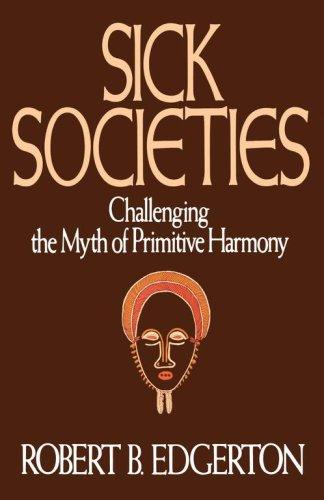
That’s the case the late UCLA anthropologist Robert Edgerton set out to make in Sick Societies: that some primitive societies are not actually happy and fulfilled, that some of their beliefs and institutions are inadequate or actively harmful to their people, and that some of them are frankly on their way to cultural suicide. The mere fact that people keep doing something doesn’t mean it’s actually working well for them, but just as the market can stay irrational longer than you can stay solvent, your society can stay dysfunctional longer than you can stay alive.
1. At least in the Occident. My informant tells me that the Noble Savage is a less common trope in, say, China. Maybe the Blue savages are just less noble.

August 19, 2024
Bret Devereaux on Nathan Rosenstein’s Rome at War (2004)
Although Dr. Devereaux is taking a bit of time away from the more typical blogging topics he usually covers on A Collection of Unmitigated Pedantry, he still discusses books related to his area of specialty:
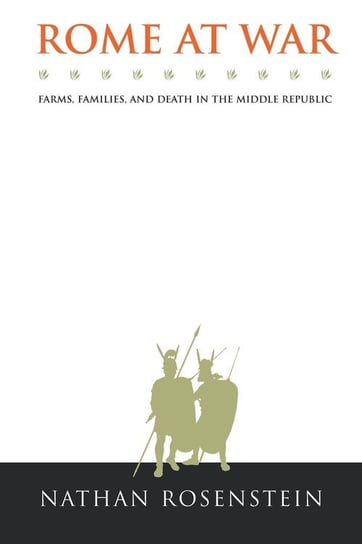
For this week’s book recommendation, I want to recommend N. Rosenstein, Rome at War: Farms, Families and Death in the Middle Republic (2004). This is something of a variation from my normal recommendations, so I want to lead with a necessary caveat: this book is not a light or easy read. It was written for specialists and expects the reader to do some work to fully understand its arguments. That said, it isn’t written in impenetrable “academese” – indeed, the ideas here are very concrete, dealing with food production, family formation, mortality and military service. But they’re also fairly technical and Rosenstein doesn’t always stop to recap what he has said and draw fully the conclusions he has reached and so a bit of that work is left to the reader.
That said, this is probably in the top ten or so books that have shaped me as a scholar and influenced my own thinking – as attentive readers can no doubt recall seeing this book show up a lot in my footnotes and citations. And much like another book I’ve recommended, Landers, The Field and the Forge: Population, Production and Power in the Pre-Industrial West (2003), this is the sort of book that moves you beyond the generalizations about ancient societies you might get in a more general treatment (“low productivity, high mortality, youth-shifted age profile, etc.”) down to the actual evidence and methods we have to estimate and understand that.
Fundamentally, Rome at War is an exercise in “modeling” – creating (fairly simple) statistical models to simulate things for which we do not have vast amounts of hard data, but for which we can more or less estimate. For instance, we do not have the complete financial records for a statistically significant sample of Roman small farmers; indeed, we do not have such for any Roman small farmers. So instead, Rosenstein begins with some evidence-informed estimates about typical family size and construction and combines them with some equally evidence-informed estimates about the productivity of ancient farms and their size and then “simulates” that household. That sort of approach informs the entire book.
Fundamentally, Rosenstein is seeking to examine the causes of a key Roman political event: the agrarian land-reform program of Tiberius Gracchus in 133, but the road he takes getting there is equally interesting. He begins by demonstrating that based on what we know the issue with the structure of agriculture in Roman Italy was not, strictly speaking “low productivity” so much as inefficient labor allocation (a note you will have seen me come back to a lot): farms too small for the families – as units of labor – which farmed them. That is a very interesting observation generally, but his point in reaching it is to show that this is why Roman can conscript these fellows so aggressively: this is mostly surplus labor so pulling it out of the countryside does not undermine these households (usually). But that pulls a major pillar – that heavy Roman conscription undermined small freeholders in Italy in the Second Century – out of the traditional reading of the land reforms.
Instead, Rosenstein then moves on to modeling Roman military mortality, arguing that, based on what we know, the real problem is that Rome spends the second century winning a lot. As a result, lots of young men who normally might have died in war – certainly in the massive wars of the third century (Pyrrhic and Punic) – survived their military service, but remained surplus to the labor needs of the countryside and thus a strain on their small households. These fellows then started to accumulate. Meanwhile, the nature of the Roman census (self-reported on the honor system) and late second century Roman military service (often unprofitable and dangerous in Spain, but not with the sort of massive armies of the previous centuries which might cause demographically significant losses) meant that more Romans might have been dodging the draft by under-reporting in the census. Which leads to his conclusion: when Tiberius Gracchus looks out, he sees both large numbers of landless Romans accumulating in Rome (and angry) and also falling census rolls for the Roman smallholder class and assumes that the Roman peasantry is being economically devastated by expanding slave estates and his solution is land reform. But what is actually happening is population growth combined with falling census registration, which in turn explains why the land reform program doesn’t produce nearly as much change as you’d expect, despite being more or less implemented.
Those conclusions remain both important and contested. What I think will be more valuable for most readers is instead the path Rosenstein takes to reach them, which walks through so much of the nuts-and-bolts of Roman life: marriage patterns, childbearing patterns, agricultural productivity, military service rates, mortality rates and so on. These are, invariably, estimates built on estimates of estimates and so exist with fairly large “error bars” and uncertainty, but they are, for the most part, the best the evidence will support and serve to put meat on the bones of those standard generalizing descriptions of ancient society.
August 18, 2024
A view of the near future – “What if calling someone stupid was illegal?”
Christopher Gage suspects that Lionel Shriver’s new book Mania didn’t require a lot of deep thinking about possible future trends, just a few glances at the headlines in British newspapers would provide all the inspiration necessary:
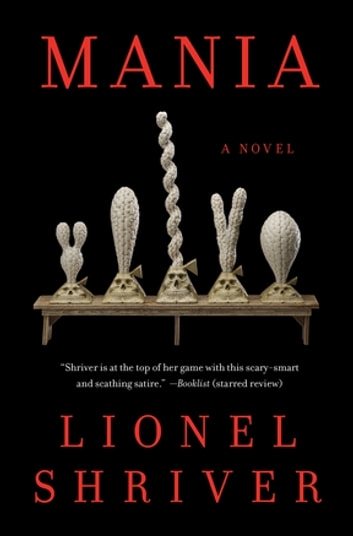
Lionel Shriver’s novel, Mania, asks “What if calling someone stupid was illegal?”
Set in an alternate timeline eerily flirtatious with our own, Mania depicts a world in which intelligence and competence, those oppressive agents of the modern bête noire — contrast — provoke outraged mobs.
The Mental Parity Movement demands a Khmer-Rouge-style Year Zero. To suggest the existence of differing abilities and competencies is to be “brain-vain”. In this final “great civil rights fight”, stupidity is euphemised as “alternative processing”. The mob cancels Frasier for brain vanity. After regulations prevent Pfizer from hiring qualified scientists, a toxic vaccine lays waste to millions.
The protagonist, a free-thinking academic named Pearson, cancels herself after she adds Dostoevsky’s The Idiot to her class syllabus. But the book is not the offending item. The word “idiot” is illegal. So too, is the “D-Word”. Pearson falls foul of social services after calling her seven-year-old daughter “dumb”. Her daughter grasses her up for this most heinous offence. For her crimes, Pearson endures a mandatory course entitled “Cerebral Acceptance and Semantic Sensitivity”.
Akin to our culture, mass neurosis devours that of Mania. The citizens scour the earth for evidence of the gravest offence: cognitive bigotry.
The Mental Parity Movement even renames “sage” — stripping the haughty herb of its sapiosexual swagger.
Mania imagines a world in which mediocrity is brilliance and where platitude is profundity. I suspect Shriver wasted little time on research. Turning on one’s television furnishes a commonplace book with a bottomless wealth of material.
This week, Harry and Meghan embarked on an unroyal tour of Colombia. On the agenda was a summit on misinformation and online harm. At this “responsible digital future” fandango, the former soap actress and the former royal spermatozoa relayed their fears. Essentially, hordes of toothless oiks with Wi-Fi often say nasty things online.
On stage, Harry adopted the pose of the modern soothsayer. His tieless open collar oozed Sicilian ease.
Speaking in Adverb English, Harry avoided anything as threatening or as harmful as a declarative sentence. Harry talks as if everything is a question as not to arouse predators. The Prince droned on, auditioning the Californication of his mother tongue. The same mother tongue Harry’s ancestors spread around the globe via what some may deign to be less than inclusive methods.
How can I put this in Mania-approved euphemism? Harry is minimally exceptional. Harry is to intelligent thought what lead pipes are to potable water.
August 15, 2024
Yet another revisionist history of World War II
In the latest anonymous review at Astral Codex Ten, the book to be considered is How the War Was Won by Phillips Payson O’Brien:
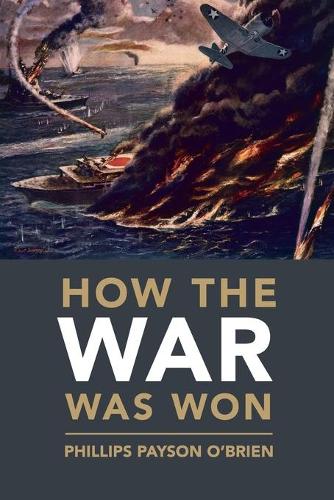
To a first approximation, there are a million books about World War II. Why should you care about How the War Was Won (hereinafter “HtWWW”) by Phillips Payson O’Brien?
- It provides a new, transformative view of the conflict by focusing on production of key goods and what affected that production instead of the ups and downs of battles at the front.
- That particular lens used can (and should) be applied outside of just World War II, and you can get a feel for how that might be done by reading HtWWW.
- I have lectured about World War II and read many, many books about it. I have never texted friends more excerpts of a book than this one.
I have some criticisms of HtWWW, but if the criticisms dissuade you from reading the book, I will have failed. These complaints are like tut-tutting Einstein’s penmanship.
The Wikipedia-Level Story of World War II (and O’Brien’s Counterargument)
To understand why O’Brien’s argument is so novel, you need to know the modern-day conventional understanding of the story of World War II. Here is my summary of the conventional narrative of World War II:
- Germany conquered Poland and France. It tried to bomb the UK into submission/maybe enable an invasion. That effort failed when Germany was defeated in the Battle of Britain, thanks largely to the plucky efforts of British airmen (memorably summarized by Winston Churchill: “Never in the field of human conflict was so much owed by so many to so few”.)
- Stymied in the West, Germany invaded the Soviet Union, won a bunch of crushing victories, but then got turned back at the gates of Moscow. The Soviets moved all of their factories east of the Ural Mountains and produced a vast tide of T-34 tanks that overpowered the Germans.
- The Germans suffered a catastrophic defeat at Stalingrad and a bloody strategic defeat at Kursk, after which the Soviets relentlessly pounded Germany to defeat.
- The US and the UK sent a lot of material help and eventually fought the Germans too, most notably in the D-Day invasion and the Battle of the Bulge. However, most of the fighting was done by the Soviets.
- It is very difficult to say how important the aerial bombing campaigns of the Western Allies were in defeating Germany. The Germans moved much of their production underground, insulating them from truly disastrous effects.
- The U.S. mostly fought alone against Japan, which won a series of impressive early victories (e.g., Pearl Harbor, the conquest of Singapore) until the decisive Battle of Midway, after which the vastly larger US industrial base outproduced Japan into oblivion.
- The US bombed the Japanese into submission by destroying Japanese cities, ultimately by dropping atom bombs on Hiroshima and Nagasaki.
By examining where the Axis focused their productive capacities and how the Allies disrupted those capacities, O’Brien challenges virtually every part of that narrative:
- The Battle of Britain was not a close-run thing. The fact that British fighter planes were flying over their own territory meant their attrition rate of pilots and aircraft were far lower than the Germans’.
- American and British bombing mattered far more to the war’s outcome than the battles of the Eastern Front, which consumed a much smaller portion of German expenditures.
- American and British airpower made German battlefield victories on the Western Front virtually impossible and dramatically limited the force Germany could bring to bear in the East.
- Japan (really, Japan plus the giant empire it conquered at the beginning of the war) was an industrial behemoth to rival the Soviet Union. However, the destruction of the Japanese merchant fleet by American air and sea forces wrecked Japan’s economy.
- The firebombing of Japanese cities and the atomic bombings of Hiroshima and Nagasaki had an ambiguous strategic effect. American air power played a much more important role in severing Japan from the natural resources it had conquered in the early part of the war.
August 13, 2024
Feelings … nothing more than (climate) feelings …
Have you been metaphorically beaten over the head about your climate sins? Your carbon buttprint? You know your very existence is a threat to Mother Gaia, right? Well, Katharina van Bronswijk is worried that you’ll stop listening to the neverending lectures about you and your evil externalities:
Climatism is a political programme bound to a broad social movement. Most of its momentum comes not from The Science or The Experts, but from diffuse cultural forces that we should probably try to understand, if only because they are driving our entire civilisation straight into the ground. Against all advice, I will therefore steer the plague chronicle into this ridiculous quagmire of leftoid green babble, with a look at our first lesson in Unlearnings, namely “Unlearn Repression”.
This superficial and disorganised essay is the work of an infuriating young woman named Katharina van Bronswijk. She’s a psychotherapist best known for her 2022 book, Climate in Our Heads. Fear, Anger, Hope: What the Ecological Crisis is Doing to Us. It belongs to that genre of inevitably unreadable monographs, in which the author herself appears on the cover, looking windswept, pioneering and undaunted:
“Climate feelings” are van Bronswijk’s niche in the extremely crowded enterprise of CO2-bothering. In “Unlearn Repression”, she argues that we should not suppress our negative feelings about climate change, but rather embrace them in constructive ways on behalf of the planet.
Now, van Bronswijk is the kind of deeply unoriginal person who just says the same things over and over. Everything she writes in “Unlearn Repression” flows directly from Climate in our Heads; she’s been digesting, reheating and reworking this same overboiled intellectual artichoke for almost two years now, through various media interviews and even in this English-language TEDx Talk. Throughout this woman’s work is the vague anxiety that the climatists have perhaps overdone it with doom and gloom, and that a lot of people have had enough of hearing about a climate apocalypse that never quite happens.
Van Bronswijk is naturally very dumb, but more than that she is painfully condescending, oblivious, verbose and just awash in litres of estrogen. I defy anyone to read her work and not come away from it a raging misogynist. This odious overpromoted schoolmarm belongs out of sight in a childcare centre teaching young children the alphabet. Perhaps she should also be in a choir, or part of a local environmental club dedicated to collecting litter in parks. That our society has denied van Bronswijk and so many others like her these proper outlets for their instincts and instead pushed them into public activism and intellectual production itself explains a great deal of what is wrong with the world.
“Unlearn Repression” opens with some autobiographical details, because of course everything van Bronswijk talks about is all about van Bronswijk. Like so many Germans of her generation, she was radicalised by school climate propaganda – specifically, by her teacher’s fateful screening of that classic propaganda film, An Inconvenient Truth:
Back then … I was happy for the welcome distraction of watching a film instead of doing normal lessons. But afterwards I was shocked and asked my mum for answers to all the questions and challenges. She didn’t have any solutions for me, how could she? I was alarmed and started to think about the impending consequences of climate change and what could be done about it. I found approaches in newsletters from NGOs and by reading up on animal and environmental protection … That was when my dream bubble burst and I realised: the world is unfair and, unlike all the Disney stories of my childhood, there will be no single hero*ine who saves the world. And there is no magical or technical miracle solution either.
Al Gore’s film so terrified the young van Bronswijk, that for a while she retreated into conspiratorial theories about why climate change is not happening, which qualifies our crayon psychotherapist to pronounce upon the psychology of those who deny the climate. This deeply evil and irrational movement is driven primarily by “white men”, because they “still enjoy most of the privileges in our society, and therefore have the most to lose”.