
World War Two
Published 11 Feb 2023It is crisis mode in the Korsun Pocket this week for the Axis troops surrounded, but they are also losing ground all over the Eastern Front this week, including the big prize of Nikopol. In Italy, it is a different story as the Germans play offense at Anzio, though with only small gains.
(more…)
February 12, 2023
German Desperation in Korsun Pocket – Week 233 – February 11, 1944
Comments Off on German Desperation in Korsun Pocket – Week 233 – February 11, 1944
February 10, 2023
When “Taffy 3” kicked the ass of the pride of the Imperial Japanese Navy
Chris Bray isn’t a milblogger, but I thought his summary of the Battle of Leyte Gulf was pretty darned good:
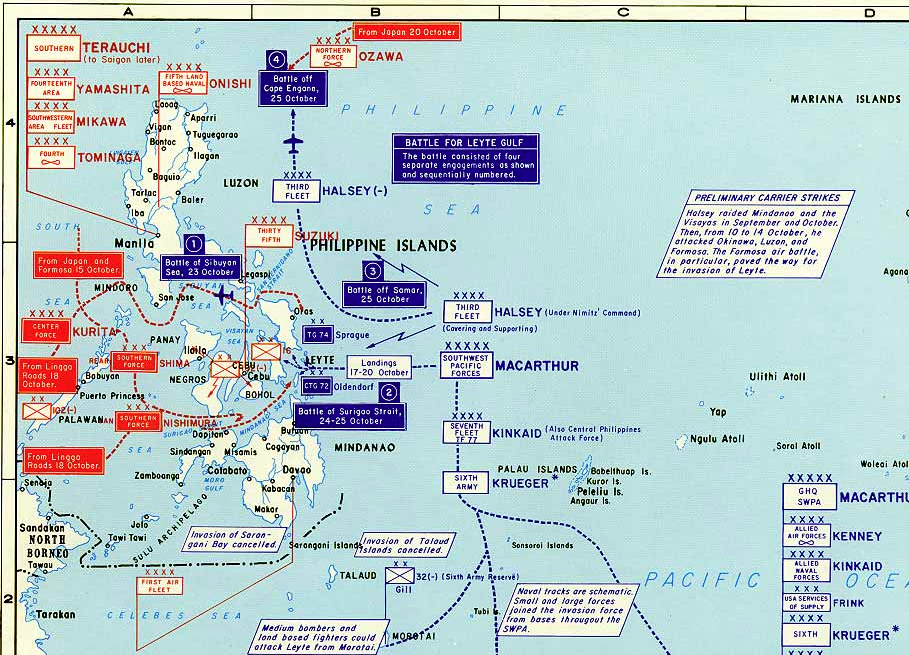
In October of 1944, US troops landing on Leyte Island in the Philippines were menaced from the sea by an enormous Japanese naval fleet that was divided into three separate attack forces.
Detail of the West Point Military Atlas: World War II: Asia-Pacific Invasion of Leyte, October 1944 map.
https://www.westpoint.edu/sites/default/files/inline-images/academics/academic_departments/history/WWII%20Asia/ww2%2520asia%2520map%252029.jpgSummarizing aggressively, the American ground forces were protected against an attack from the sea by the US Navy’s Third Fleet, commanded by Bull Halsey. But Halsey suddenly wasn’t there anymore, taking the bait of a decoy attack force [of de-planed Japanese carriers] and chasing it out into the sea. The Third Fleet’s departure uncovered Leyte Gulf, and the largest of the Japanese attack forces sailed in. Disaster became likely.
There were two American naval task forces in the path of the Japanese attack force, Taffy 2 and Taffy 3, but neither were meant for serious naval combat. They were supporting forces, designed to help the troops on the ground: a few escort carriers, a few lightly armed destroyer escorts, a very few destroyers. Aircraft on the American escort carriers were armed with 100-pound bombs to provide close air support to the infantry. The Japanese First Task Force had four battleships, eight cruisers, and eleven destroyers. One of the Japanese battleships was the Yamato, armed with 18-inch guns. The Japanese attack force sailed directly into contact with Taffy 3, which didn’t realize they were about to face the main Japanese attack force until they were already within range of its guns.
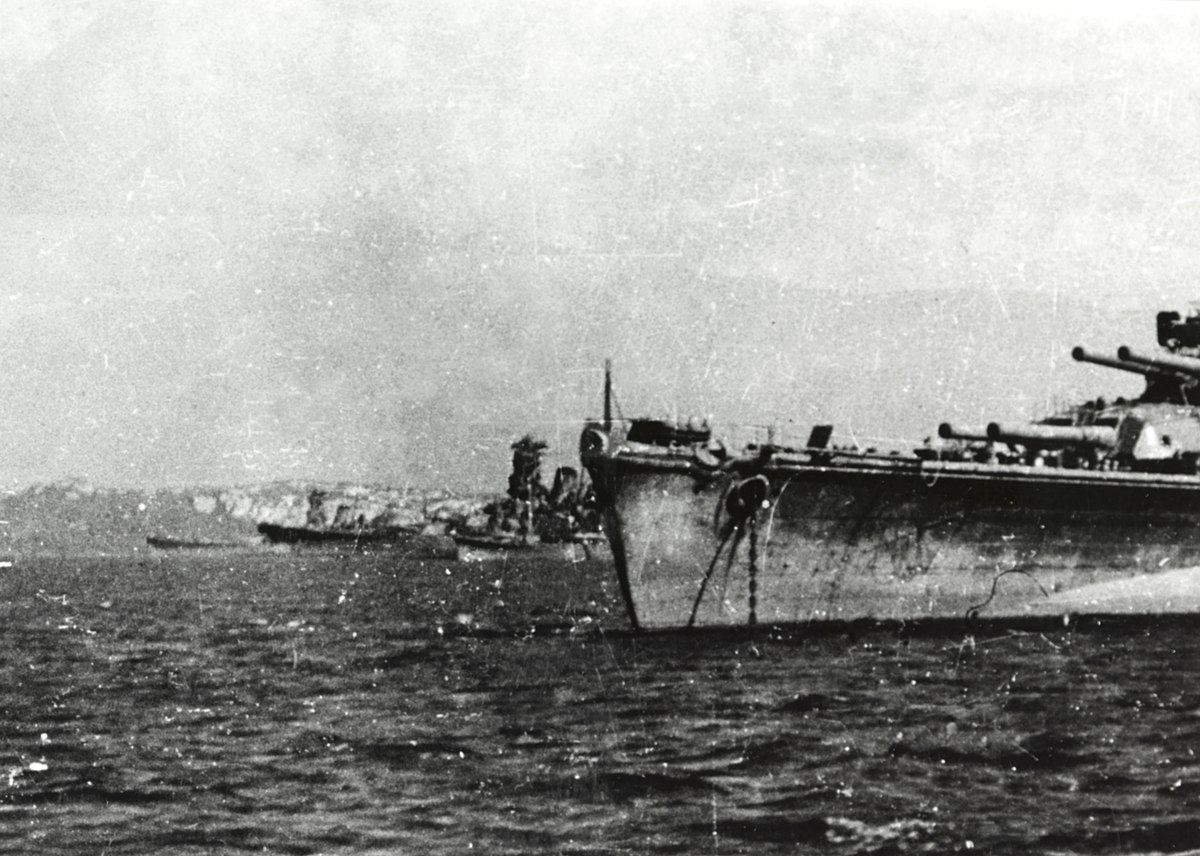
Imperial Japanese Navy ships at anchor in Brunei, Borneo shortly before the Battle of Leyte Gulf. Left to right, Musashi, Yamato, an unidentified cruiser, and Nagato.
Photo by Kazutoshi Hando from the US Naval History and Heritage Command collection.The commander of Taffy 3, Rear Admiral Clifton Sprague, saw immediately that his task force couldn’t survive the engagement, so he tried to salvage what he could: He ordered his destroyers and destroyer escorts to attack, to cover the hoped-for withdrawal of the escort carriers. The resulting battle is one of the best-known in naval history — and one of the least plausible, because Taffy 3 kicked the everloving shit out of that much larger Japanese attack force, compelling the Japanese to withdraw in the panicked belief that they’d sailed into the bulk of Halsey’s Third Fleet.
If you haven’t read [the late] James Hornfischer’s magnificent book about the battle, The Last Stand of the Tin Can Sailors, you should read it. The details are far beyond anything that could be summarized in a single short piece. But the battle was won by a remarkable combination of disciplined obedience, independent audacity, and a paradoxically disciplined disobedience — by men aggressively refusing to obey orders that threatened their cause.
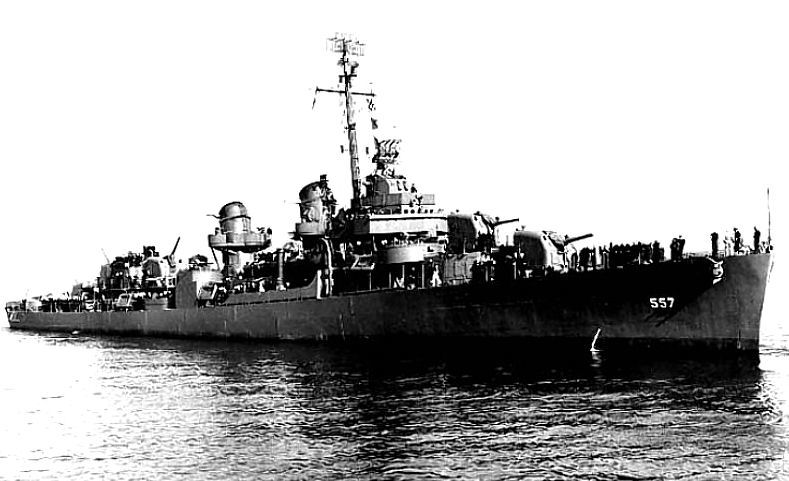
The Fletcher-class destroyer USS Johnston (DD-557), sunk in the Battle off Samar, 25 October, 1944.
US Navy photo with enhancement work by Wild Surmise via Wikimedia Commons.The battle began with one of the US Navy’s most famous moments. Before Sprague had time to order anyone to do anything, the captain of the Johnston, one of Taffy 3’s few destroyers, turned to attack the Japanese fleet. We have confused and contradictory accounts of the orders given by Cmdr. Ernest Evans, because the man who gave them, and most of the men who heard them, died soon afterward, but he is supposed to have said something like this:
1.) We’re under the guns of a much larger Japanese fleet.
2.) Survival is not to be expected.
3.) Hard left rudder, all ahead flank.
We’re all going to die; attack. The Johnston sank, and Evans died, but his first torpedo run blew the bow off a Japanese cruiser — setting the tone of the fight.
Comments Off on When “Taffy 3” kicked the ass of the pride of the Imperial Japanese Navy
February 5, 2023
Leningrad: NO STEP BACK! – Week 232 – February 4, 1944
World War Two
Published 4 Feb 2023The Allies begin a new operation in the Pacific this week: assaulting the Marshall Islands. They also make big attacks from their beachhead in Italy at Anzio, but these are called off after only a few days in the face of heavy enemy resistance. However, in the USSR there are several successes against the Axis, as they are pushed back both in the far north and the far south of the front, and still surrounded near Korsun.
(more…)
Comments Off on Leningrad: NO STEP BACK! – Week 232 – February 4, 1944
January 31, 2023
The Allied Flying Aces of World War Two – Documentary Special
World War Two
Published 30 Jan 2023Young, daring, and handsome, the Allied fighter aces of World War Two have captivated the public with their thrilling exploits. Join us as we take a look at the top scorers! Thanks to Curiosity Stream for sponsoring today’s video.
(more…)
Comments Off on The Allied Flying Aces of World War Two – Documentary Special
January 29, 2023
Anzio Begins – Allies Already Pinned Down – Week 231 – January 28, 1944
World War Two
Published 28 Jan 2023Some big news is the Allies amphibious offensive to hit the Germans behind their lines at Anzio in Italy, some other big news is that after nearly two and a half years, the Soviets have broken the siege of Leningrad and their twin northern offensives keep pushing back the enemy. Yet more big news is that the Soviets have managed to surround and cut off over 50,000 Axis troops near Korsun. This is one big week of action!
(more…)
Comments Off on Anzio Begins – Allies Already Pinned Down – Week 231 – January 28, 1944
January 23, 2023
Monte Cassino, the Battle Begins – Ep 230 – January 21, 1944
World War Two
Published 21 Jan 2023The Allies have reached the linchpin of the German defenses in Italy, but a first attack proves disastrous. It does, though, divert troops from where they soon plan to make landings behind enemy lines. Meanwhile in the USSR, the huge Soviet offensive in the north makes great gains against the stunned Axis forces.
(more…)
Comments Off on Monte Cassino, the Battle Begins – Ep 230 – January 21, 1944
January 21, 2023
When the SS Go Too Far – War Against Humanity 096
World War Two
Published 20 Jan 2023The internal conflict between Poland and the other United Nations Allies deepens as Churchill faces them with diplomatic defeat over Soviet land grab. In the Occupied Netherlands and Poland the Nazis continue their atrocities.
(more…)
Comments Off on When the SS Go Too Far – War Against Humanity 096
January 15, 2023
Time to Liberate Leningrad! – Ep 229 – January 14, 1944
World War Two
Published 14 Jan 2023Three Soviet Fronts launch major offensives to try and finally free Leningrad, under siege for nearly two and a half years now. The Soviets are, in fact, making attacks along most of the Eastern Front. In the South Pacific, the Allies step up their aerial assault to wreck Rabaul’s air power, thus neutralizing it as a base.
(more…)
Comments Off on Time to Liberate Leningrad! – Ep 229 – January 14, 1944
January 8, 2023
“Russians 27 miles from Poland!” – Ep 228 – January 7, 1944
World War Two
Published 7 Jan 2023That’s what the headlines say as the Red Army continues its advance in Ukraine. There are also plans afoot for a northern offensive to end the siege of Leningrad. There are also plans afoot for an Allied amphibious attack in Italy at Anzio. Both of these are set to go off within a couple weeks, so January promises to be full of active conflict.
(more…)
Comments Off on “Russians 27 miles from Poland!” – Ep 228 – January 7, 1944
January 1, 2023
Canadians Take Little Stalingrad – WW2 – 227 – December 31, 1943
World War Two
Published 31 Dec 20221943 reaches its end with no end in sight for the war. In Italy, the Canadians take Ortona after bloody close fighting, the US Marines advance on New Britain, and a new Soviet offensive makes huge gains in the USSR. This isn’t enough for the Allies, though, who have a big shake up in their European Command to help prepare for future attacks.
(more…)
Comments Off on Canadians Take Little Stalingrad – WW2 – 227 – December 31, 1943
December 25, 2022
Stalin’s Christmas Surprise – Major Offensives to Come – WW2 – 226 – December 24, 1943
World War Two
Published 24 Dec 2022Twas the night before Christmas and the war was grinding on. The Moro River Campaign continues in Italy with Canadian infantry pushing past the Gully and into “Little Stalingrad”. Generally, the Allied advance to Rome is turning into a stalemate though, but Winston Churchill still believes an amphibious landing is the way to break this. Joseph Stalin also has some pretty big plans to bring the USSR back to its pre-Barbarossa borders. In the Pacific, there is attrition over Rabaul and stalemate on Bougainville.
(more…)
Comments Off on Stalin’s Christmas Surprise – Major Offensives to Come – WW2 – 226 – December 24, 1943
December 23, 2022
A Jungle Miracle – War Against Humanity 092
World War Two
Published 22 Dec 2022Two escapes, one from the Nazis in Kovno (Kaunas) Lithuania, from the prison at Fort IX, and one from Japanese terror on Panay in the Philippines this week, will help to document the crimes of the Axis powers.
(more…)
Comments Off on A Jungle Miracle – War Against Humanity 092
December 18, 2022
A Super Bomber to Break Japan – WW2 – 225 – December 17, 1943
World War Two
Published 17 Dec 2022This war has now lasted as long as the Great War did, but there’s no signs of it slowing. The Soviets have three offensives going on on the Eastern Front, in Italy the Allies are attacking at San Pietro and over the Moro River, in the Pacific there are Allied landings on New Britain, but in Pacific Command, the big talk is all about a new super bomber.
(more…)
Comments Off on A Super Bomber to Break Japan – WW2 – 225 – December 17, 1943
December 11, 2022
An Amphibious Landing to take Rome? – 224 – December 10, 1943
World War Two
Published 10 Dec 2022There are plans afoot to hit the enemy from behind in Italy. Allied leaders are meeting again in Cairo to go over other plans, notably what to do about China and Burma. There is active fighting on two fronts in Italy too, though this week it doesn’t go particularly well for the Allies. Attacks in the USSR are unsuccessful for the Soviets, but do go well for the Germans, and there are Allied attacks by air in the Marshall Islands and over France.
(more…)
Comments Off on An Amphibious Landing to take Rome? – 224 – December 10, 1943
December 9, 2022
V-1: Hitler’s Deluded Revenge Plan – War Against Humanity 090
World War Two
Published 8 Dec 2022Japanese planes bomb Calcutta when it is still being crushed by the weight of the Bengali famine. Adolf Hitler and Albert Speer are obsessively trying to increase war production so Germany can begin launching its vengeance weapon against Britain. The wars of resistance continue across the Balkans with continued brutality and a new resistance force emerges in Italy.
(more…)
Comments Off on V-1: Hitler’s Deluded Revenge Plan – War Against Humanity 090


