Quotulatiousness

March 5, 2019

QotD: Modern architecture

Filed under: Architecture, Quotations, USA — Tags: , , — Nicholas @ 01:00

Now that I think about it, he said, spitballing for no particular reason, having a lot of art books of a certain sort is a political statement: if people suspects that your choice of subjects implies a rejection or at least a lack of interest in modernism or other cultures, they infer things.

My architecture books would be a rebuke to some, since they’re focused on particular eras and styles. I don’t have any books about other styles or cultures because I am not interested in them. At all. I know it’s a sign of a robust and well-rounded mind to be utterly fascinated by everything, but I’d rather spend the time knowing more about what I’m interested in. I mean, there’s no way I could begin to pretend I care as much about Japanese art as I do about Western art. I know it has its own complexities and meanings I don’t understand or recognize, but I simply don’t care.

Then again, my books are rebuke to my own culture, since the architecture and art they contain are better than the tiresome products of the contemporary art establishment. This remarkable article in Forbes – not recent, but recently discovered – contains some gas-inducing quotes about the function and purpose of modern architecture, and it’s basically this: the brightest minds of the profession believe it is the duty of the architect to startle, confront, unnerve, dissolve, destroy, and also whip out the willie to irrigate the fusty bourgeoisie notions like beauty and tradition.

The article discusses a piece that took modern architecture to the woodshed, where it said “look at this woodshed. It’s more humane than anything you design.” Someone wrote a defense, but had to be honest with himself:

    Yet Betsky then admitted, “All those critiques might be true.” They are irrelevant, he claims, since architecture must be about experimentation and the shock of the new. (Why this should be the case he does not say.) And sometimes designers must stretch technology to the breaking (or leaking) point: “The fact that buildings look strange to some people, and that roofs sometimes leak, is part and parcel of the research and development aspect of the design discipline.” Ever brave, he is willing to let others suffer for his art.

[…]

The ongoing project to unmoor Western Civ from its roots can only be enabled by people who believe the world has to be remade with its core memory wiped. I don’t share their hatred; why do I have to be forced to experience it, over and over again?

James Lileks, The Bleat, 2019-01-30.

March 3, 2019

Yet another “adventure” in modern architecture

Filed under: Architecture, Cancon, History — Tags: , , — Nicholas @ 05:00

Thread reader can’t piece together unrelated-by-Twitter-standards tweets, so here’s the rest of that thread in one go:

February 24, 2019

Another review of Curl’s Making Dystopia

Filed under: Architecture, Books, History — Tags: , , , — Nicholas @ 03:00

Having read a few reviews of James Stevens Curl’s recent Making Dystopia: The Strange Rise and Survival of Architectural Barbarism, I’m likely to add it to my booklist (when I have a budget for new books again, that is). Here, Michael Mehaffy shares his comments on the book:

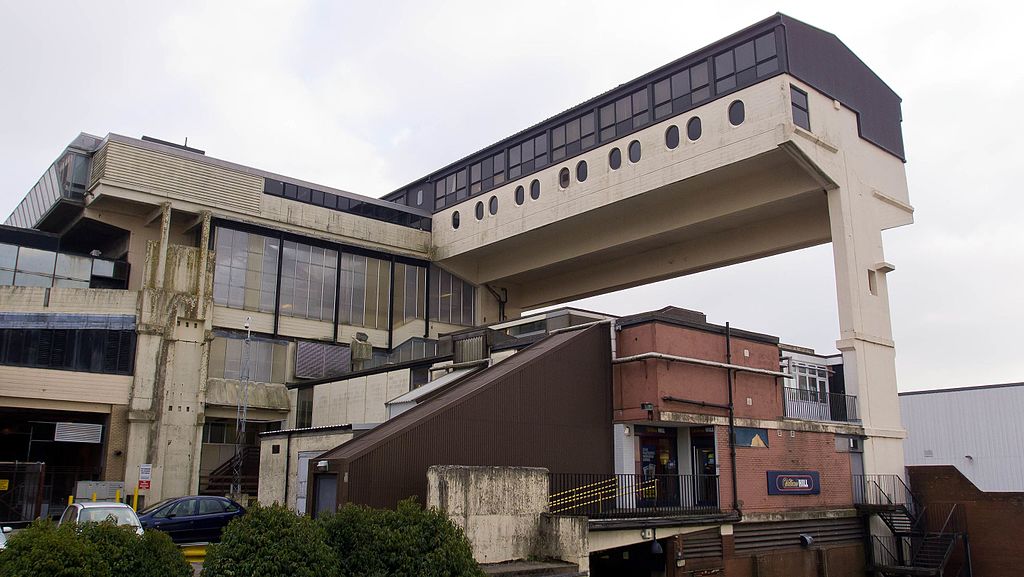
Cumbernauld Shopping Centre, voted as Britain’s most hated building in a Channel 4 poll.
Photo by Ed Webster via Wikimedia Commons.

For most reform-minded urbanists today, the complicity of architectural Modernism in the urban fiascoes of the last century is not in dispute. A representative (and seminal) criticism was Jane Jacobs’ withering 1961 attack, in The Death and Life of Great American Cities, in which she described Le Corbusier’s “wonderful mechanical toy” that “said everything in a flash, like a good advertisement” — but as to how a city actually works, it told “nothing but lies.” Jacobs’s work was of course a major inspiration in forming the Congress for the New Urbanism, along with the work of other reformists like Leon Krier, Christopher Alexander and Vincent Scully.

In fact, the 1996 Charter of the New Urbanism almost precisely inverts Le Corbusier’s 1933 Athens Charter: in place of the Modernists’ functional segregation, we would have mixed use; in place of their dominance of fast-moving vehicles (especially cars), we would have walkability and multi-modal streets; in place of wholesale demolition of historic districts and prohibition of historic styles, we would have preservation and renewal, and buildings that “grow from local climate, topography, history, and building practice.”

Yet in the last few decades, architectural Modernism has enjoyed a resurgence among some New Urbanists, as it has in the wider profession of architecture. For them, it’s reasonable to separate the urban mistakes of Modernism from its alleged architectural genius, which, as they see it, continues to offer inspiring building design ideas that can take their place happily within great new cities.

Of course, many critics would not agree — including many of the profession’s most prominent insiders. For them, the building-scale and urban-scale failures of Modernism have been of a piece, borne of a totalizing but defective theory of habitat, and even a dubious theory of architectural form itself. As the Post-Modernist Rem Koolhaas observed (in his 1995 book S,M,L,XL), “Modernism’s alchemistic promise, to transform quantity into quality through abstraction and repetition, has been a failure, a hoax: magic that didn’t work.” Nor was Koolhaas the first to attack the ideological foundations of Modernism. Similar criticisms came from earlier insiders like Sibyl Moholy-Nagy, wife of Bauhaus pioneer Lazslo, whose stinging 1968 essay on the Bauhaus labeled it “Hitler’s Revenge.” Its built works in the US carried, for her, “the browbeating symbolism of a negative ideology that was already bankrupt when the dying German Republic unloaded it on America.”

Yet for a movement that has been so frequently discredited, Modernism still has a curious grip on the profession even today. That’s because from the beginning, according to historian James Stevens Curl, the movement has been populated by “architectural bullies” who would stop at nothing to seize power, extinguish its competitors, re-write history, forbid all other styles (especially those with any ornament), and otherwise enforce a radical agenda — one that only seemed to offer all things alluring, progressive and historically inevitable. Beneath that marketable cover story, he says, the real agenda was an exhilarating quest for power and dominance, and especially later, for the wealth generated by a profitable industrialization of the human environment. Modernism sold, and no matter if it also sold out—cities, people, history, the future. For Curl, that approach was (and is) nothing less than “architectural barbarism.”

February 18, 2019

Modernism as “architectural PTSD”

Filed under: Architecture, Books, Europe, History — Tags: , , , — Nicholas @ 05:00

In Architect, the Journal of the American Institute of Architects, Witold Rybczynski reviews James Stevens Curl’s Making Dystopia: The Strange Rise and Survival of Architectural Barbarism:

The buildings in my neighborhood, Logan Square in downtown Philadelphia, fall roughly into two categories. There are those that offer visual pleasure, whether they are modest run-of-the-mill brick row houses or the rather grand Board of Education Building, an Art Deco-ish pile topped by busts of Sir Isaac Newton, Ben Franklin, and Alexander Graham Bell. “How nice that someone actually took the trouble,” I think as I walk by. And then there is the second category: utilitarian apartment slabs with unrelieved gridded façades, infill condo housing that looks as if it had been trucked in from the suburbs, a grim precast concrete retirement home that takes up a whole block. “I wish they hadn’t built that,” is my all too common reaction. The Board of Education Building dates from 1932. That’s the approximate cut-off date. Before the 1930s, the buildings are pretty good; after that, not so much. What happened?

The answer to that question is the subject of James Stevens Curl’s controversial new book, Making Dystopia: The Strange Rise and Survival of Architectural Barbarism (Oxford University Press, 2018). Curl is a British architectural historian, professor emeritus at De Montfort University in Leicester, and the author of more than 40 books, including the well-regarded The Victorian Celebration of Death (most recently updated in 2004) and The Oxford Dictionary of Architecture (1999). According to Curl, what happened was “architectural barbarism,” which is how he characterizes modern architecture. He does not mince words. Describing the emergence of the International Style in the 1920s, he writes: “It became apparent that something very strange had occurred: an aberration, something alien to the history of humanity, something destructive aesthetically and spiritually, something ugly and unpleasant, something that was inhumane and abnormal, yet something that was almost universally accepted in architectural circles, like some fundamentalist quasi-religious cult that demanded total allegiance, obedience, and subservience.”

[…]

Buildings like PSFS were not the result of the First World War, of course, but it was the war that opened the door to radical change — whether it was political (Nazism), economic (the New Deal), or architectural (Modernism). This, rather than Curl’s theory of a quasi-religious cult, is a more convincing explanation for the “strange rise” of modern architecture. As the title of his book suggests, the author assumes malevolence on the part of Gropius, Le Corbusier, et al., but what if the International Style was instead the result of a sort of postwar architectural PTSD?

[…]

The ultimate failure of modern architecture is not that it was incapable of producing beautiful works of individual art. There have been plenty of those, pace Professor Curl. The real drawback is that while the Modern Movement effectively suppressed an architectural language that had taken hundreds of years to evolve, it proved incapable of developing a successful substitute, the weak-kneed antics of Postmodernism notwithstanding. The strength of pre-modern architecture was that it provided a rich variety of modes of expression. It permitted complicated things to be said in complicated ways, and simpler things in simpler ways, analogous to the spoken language, which can be used to write drama and poetry or instruction booklets.

February 10, 2019

A debate on the impact of Brutalism on British cities

Filed under: Architecture, Britain, History — Tags: , , , , — Nicholas @ 03:00

In Prospect magazine, James Stevens Curl and Barnabas Calder disagree on how Brutalist architecture has influenced destroyed urban areas in so many British cities. This is Curl’s opening salvo:

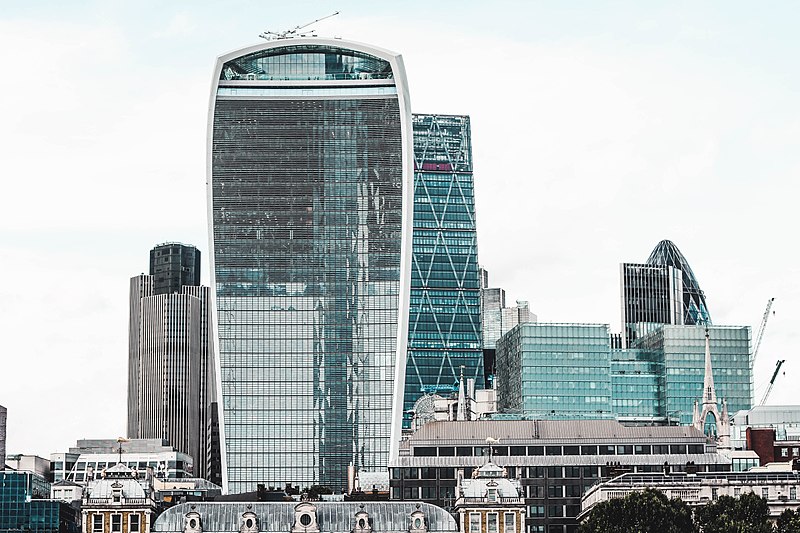
20 Fenchurch Street in London has been nicknamed the “Walkie-Talkie” due to its distinctive design.
Image by Toa Heftiba via Wikimedia Commons.

Visitors to these islands who have eyes to see will observe that there is hardly a town or city that has not had its streets — and skyline — wrecked by insensitive, crude, post-1945 additions which ignore established geometries, urban grain, scale, materials, and emphases.

Such structures were designed by persons indoctrinated in schools of architecture in ways that made them incapable of creating designs that did not cause immense damage and offend the eye, the sensibilities, and the spirit. Harmony with what already exists has never been a consideration for them, as it was not for their teacher: following the lead of “Le Corbusier” (as Swiss-French architect Charles-Édouard Jeanneret called himself), they have, on the contrary, done everything possible to create buildings incompatible with anything that came before. It seems that the ability to destroy a townscape or a skyline was the only way they have been able to make their marks. Can anyone point to a town in Britain that has been improved aesthetically by modern buildings?

Look at the more recent damage done to the City of London, with such crass interventions as the so-called “Walkie-Talkie” (which, through its reflectivity, has caused damage on the street below), or the repellent stuff inflicted on several cities by the infamous John Poulson and some of his bent cronies (from the 1950s until they were jailed in 1974). Quod erat demonstrandum.

How has this catastrophe been allowed to happen? A series of totalitarian doctrinaires reduced the infinitely adaptable languages of real architecture to an impoverished vocabulary of monosyllabic grunts. Those individuals rejected the past so that everyone had to start from scratch, reinventing the wheel and confining their design clichés to a few banalities. Today, form follows finance, when modern architecture is dominated by so-called “stars,” and becomes more bizarre, egotistical, unsettling, and expensive, ignoring contexts and proving stratospherically remote from the aspirations and needs of ordinary humanity. Their alienating works, inducing unease, are, without exception, inherently dehumanising and visually repulsive.

February 4, 2019

QotD: Brasilia and reconciling with Jane Jacobs

Filed under: Architecture, History, Quotations, USA — Tags: , , , , , , — Nicholas @ 01:00

Brasilia is interesting only insofar as it was an entire High Modernist planned city. In most places, the Modernists rarely got their hands on entire cities at once. They did build a number of suburbs, neighborhoods, and apartment buildings. There was, however, a disconnect. Most people did not want to buy a High Modernist house or live in a High Modernist neighborhood. Most governments did want to fund High Modernist houses and neighborhoods, because the academics influencing them said it was the modern scientific rational thing to do. So in the end, one of High Modernists’ main contributions to the United States was the projects – ie government-funded public housing for poor people who didn’t get to choose where to live.

I never really “got” Jane Jacobs. I originally interpreted her as arguing that it was great for cities to be noisy and busy and full of crowds, and that we should build neighborhoods that are confusing and hard to get through to force people to interact with each other and prevent them from being able to have privacy, and no one should be allowed to live anywhere quiet or nice. As somebody who (thanks to the public school system, etc) has had my share of being forced to interact with people, and of being placed in situations where it is deliberately difficult to have any privacy or time to myself, I figured Jane Jacobs was just a jerk.

But Scott has kind of made me come around. He rehabilitates her as someone who was responding to the very real excesses of High Modernism. She was the first person who really said “Hey, maybe people like being in cute little neighborhoods”. Her complaint wasn’t really against privacy or order per se as it was against extreme High Modernist perversions of those concepts that people empirically hated. And her background makes this all too understandable – she started out as a journalist covering poor African-Americans who lived in the projects and had some of the same complaints as Brazilians.

Her critique of Le Corbusierism was mostly what you would expect, but Scott extracts some points useful for their contrast with the Modernist points earlier:

First, existing structures are evolved organisms built by people trying to satisfy their social goals. They contain far more wisdom about people’s needs and desires than anybody could formally enumerate. Any attempt at urban planning should try to build on this encoded knowledge, not detract from it.

Second, man does not live by bread alone. People don’t want the right amount of Standardized Food Product, they want social interaction, culture, art, coziness, and a host of other things nobody will ever be able to calculate. Existing structures have already been optimized for these things, and unlesss you’re really sure you understand all of them, you should be reluctant to disturb them.

Third, solutions are local. Americans want different things than Africans or Indians. One proof of this is that New York looks different from Lagos and from Delhi. Even if you are the world’s best American city planner, you should be very concerned that you have no idea what people in Africa need, and you should be very reluctant to design an African city without extensive consultation of people who understand the local environment.

Fourth, even a very smart and well-intentioned person who is on board with points 1-3 will never be able to produce a set of rules. Most of people’s knowledge is implicit, and most rule codes are quickly replaced by informal systems of things that work which are much more effective (the classic example of this is work-to-rule strikes).

Fifth, although well-educated technocrats may understand principles which give them some advantages in their domain, they are hopeless without the on-the-ground experience of the people they are trying to serve, whose years of living in their environment and dealing with it every day have given them a deep practical knowledge which is difficult to codify.

How did Jacobs herself choose where to live? As per her Wikipedia page:

    [Jacobs] took an immediate liking to Manhattan’s Greenwich Village, which did not conform to the city’s grid structure.

Scott Alexander, “Book Review: Seeing Like a State”, Slate Star Codex, 2017-03-16.

February 2, 2019

QotD: Le Corbusier

Filed under: Architecture, Europe, History, Quotations — Tags: , , , , — Nicholas @ 01:00

So the early modern period is defined by an uneasy truce between states who want to be able to count and standardize everything, and citizens who don’t want to let them. Enter High Modernism. Scott defines it as

    A strong, one might even say muscle-bound, version of the self-confidence about scientific and technical progress, the expansion of production, the growing satisfaction of human needs, the mastery of nature (including human nature), and above all, the rational design of social order commensurate with the scientific understanding of natural laws

…which is just a bit academic-ese for me. An extensional definition might work better: standardization, Henry Ford, the factory as metaphor for the best way to run everything, conquest of nature, New Soviet Man, people with college degrees knowing better than you, wiping away the foolish irrational traditions of the past, Brave New World, everyone living in dormitories and eating exactly 2000 calories of Standardized Food Product (TM) per day, anything that is For Your Own Good, gleaming modernist skyscrapers, The X Of The Future, complaints that the unenlightened masses are resisting The X Of The Future, demands that if the unenlightened masses reject The X Of The Future they must be re-educated For Their Own Good, and (of course) evenly-spaced rectangular grids.

(maybe the best definition would be “everything G. K. Chesterton didn’t like.”)

It sort of sounds like a Young Adult Dystopia, but Scott shocked me with his research into just how strong this ideology was around the turn of the last century. Some of the greatest early 20th-century thinkers were High Modernist to the point of self-parody, the point where a Young Adult Dystopian fiction writer would start worrying they were laying it on a little too thick.

The worst of the worst was Le Corbusier, the French artist/intellectual/architect. The Soviets asked him to come up with a plan to redesign Moscow. He came up one: kick out everyone, bulldoze the entire city, and redesign it from scratch upon rational principles. For example, instead of using other people’s irrational systems of measurement, they would use a new measurement system invented by Le Corbusier himself, called Modulor, which combined the average height of a Frenchman with the Golden Ratio.

The Soviets decided to pass: the plan was too extreme and destructive of existing institutions even for Stalin. Undeterred, Le Corbusier changed the word “Moscow” on the diagram to “Paris”, then presented it to the French government (who also passed). Some aspects of his design eventually ended up as Chandigarh, India.

Scott Alexander, “Book Review: Seeing Like a State”, Slate Star Codex, 2017-03-16.

January 5, 2019

Leave the Strand Alone! Iconic Bookstore Owner Pleads With NYC: Don’t Landmark My Property

Filed under: Architecture, Books, Bureaucracy, Business, Government, USA — Tags: , , — Nicholas @ 04:00

ReasonTV
Published on 4 Jan 2019

Leave the Strand Alone! Iconic Bookstore Owner Pleads With NYC: Don’t Landmark My Property

More from the article at Reason:

If New York City moves ahead with a proposal to landmark the home of the Strand Book Store, it would be putting a “bureaucratic noose” around the business, says owner Nancy Bass Wyden. “The Strand survived through my dad and grandfather’s very hard work,” Wyden says, and now the city wants to “take a piece of it.”

Opened by her grandfather, Benjamin Bass, in 1927, the Strand is New York City’s last great bookstore — a four-story literary emporium crammed with 18 miles of merchandise stuffed into towering bookcases arranged along narrow passageways. It’s the last survivor of the world-famous Booksellers Row, a commercial district comprised of about 40 secondhand dealers along Fourth Avenue below Union Square.

On December 4, 2018, the New York City Landmarks Preservation Commission held a public hearing on a proposal to designate the building that’s home to the Strand as a historic site. If the structure is landmarked, Wyden would need to get permission from the city before renovating the interior or altering the facade.

“It would be very difficult to be commercially nimble if we’re landmarked,” Wyden tells Reason. “We’d have to get approvals through a whole committee and bureaucracy that do not know how to run a bookstore.”

Wyden’s outrage derives in part from her family’s decades of struggle to keep the business alive.

The Strand survived, she says, because of “my grandfather and my dad’s very hard work and their passion … Both worked most of their lives six days a week” and they “hardly took vacations.”

November 6, 2018

QotD: Architectural modernism

Filed under: Architecture, Books, History, Quotations — Tags: , , , , — Nicholas @ 01:00

In this scholarly, learned but also enjoyably polemical book, Professor Curl recounts both the history and devastating effects of architectural modernism. In no field of human endeavour has the idea that history imposes a way to create been more destructive, or more importantly destructive: for while we can take avoiding action against bad art or literature, we cannot avoid the scouring of our eyes by bad architecture. It is imposed on us willy-nilly and we are impotent in the face of it. Modern capitalism, it has been said, progresses by creative destruction; modern architecture imposes itself by destructive creation.

As Professor Curl makes clear, the holy trinity of architectural modernism — Gropius, Mies and Corbusier — were human beings so flawed that between them they were an encyclopaedia of human vice. They spoke of morality and behaved like whores; they talked of the masses and were utter egotists; they claimed to be principled and were without scruple, either moral, intellectual, aesthetic or financial. Their two undoubted talents were those of self-promotion and survival, combined with an overweening thirst for power.

Their intellectual dishonesty was startling and would have been laughable had it not been more destructive than the Luftwaffe. When they claimed to have no style because their designs were imposed on them by history, technology, social necessity, functionality, economy etc., and like Luther proclaimed they could do no other (which soon became the demand that others could do no other also), they remind me of the logical positivists who claimed to have no metaphysic. But if no given style or metaphysic is beyond the choice of he who has it, to possess a style or a metaphysic is inescapable in the activity of artistic creation or thought itself. And even my handwriting has a style, albeit a bad one.

In like fashion, as this book makes beautifully clear, the modernists were adept at claiming both that their architecture was a logical development to and aesthetic successor of classical Greek architecture and utterly new and unprecedented. The latter, of course, was nearer the mark: they created buildings that, not only in theory but in actual practice, were incompatible with all that had gone before, and intentionally so. Any single one of their buildings could, and often did, lay waste a townscape, with devastating consequences. What had previously been a source of pride for inhabitants became a source of impotent despair. Corbusier’s books are littered with references to the Parthenon and other great monuments of architectural genius: but how anybody can see anything in common between the Parthenon and the Unité d’habitation (an appellation that surely by itself ought to tell us everything we need to know about Corbusier), other than that both are the product of human labour, defeats me.

Theodore Dalrymple, “Architectural Dystopia: A Book Review”, New English Review, 2018-10-04.

October 27, 2018

The architecture of modern Paris

Filed under: Architecture, France, History — Tags: , , — Nicholas @ 04:00

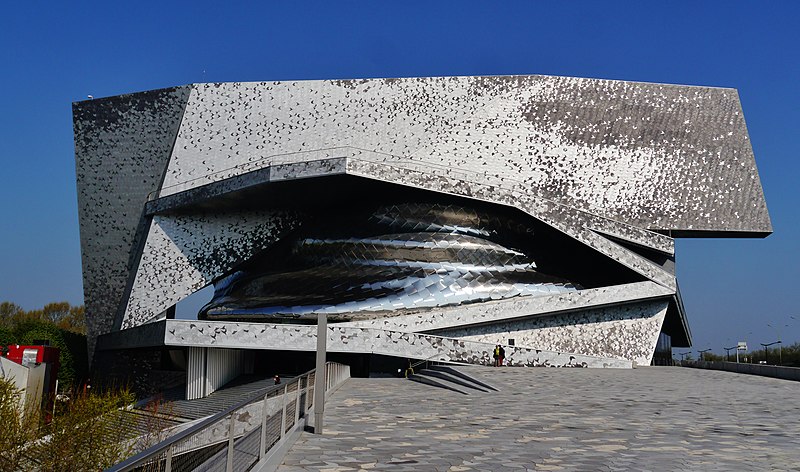
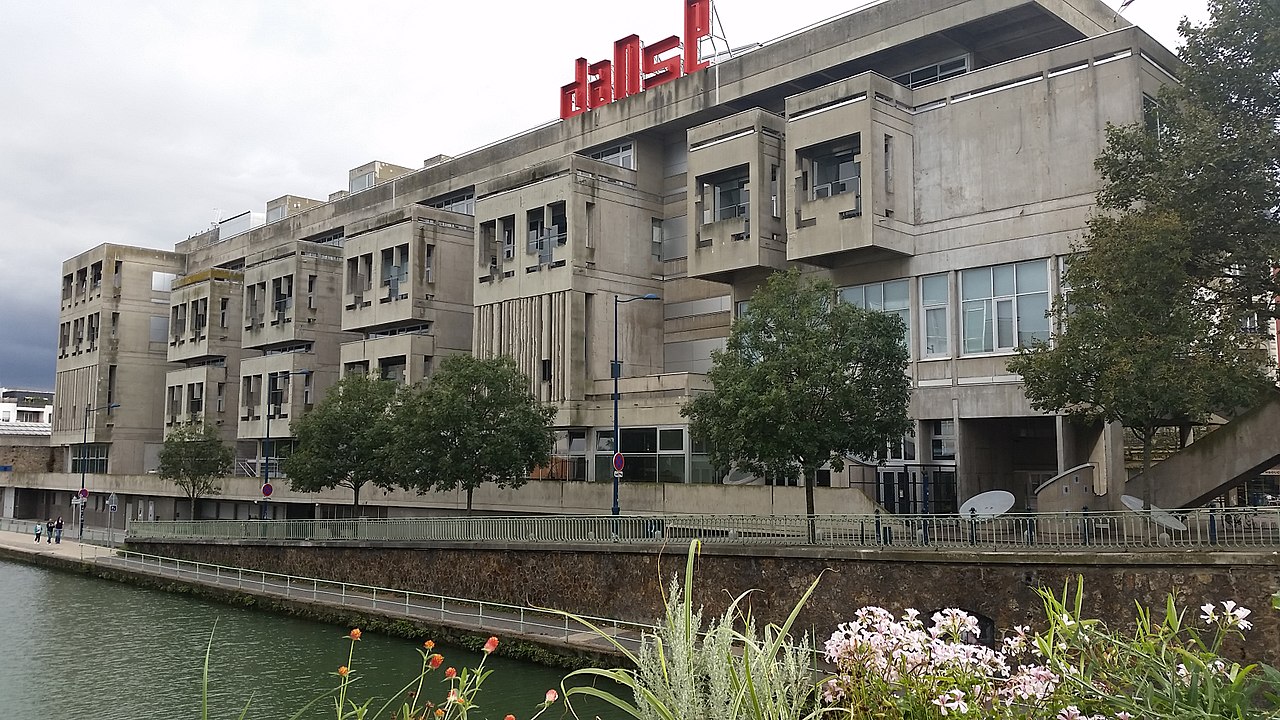
In the latest issue of City Journal, Theodore Dalrymple laments the degraded state of Parisian architecture, particularly the post-1945 monstrosities visible from the Boulevard Périphérique, celebrated in a recent New York Times article by David McAninch:

Philharmonie at the Parc de la Villette, Paris.
Photo by Zairon via Wikimedia Commons.

What is startling about McAninch’s description of his tour is its non-mention of what was perfectly obvious to my visitor on first glance, and which never fails to appall me each time I take the B.P., as regrettably often as I do: namely, that practically everywhere the eye looks beyond the confines of central Paris, it is greeted by a modernist mess of gargantuan proportions, and that every occasional building that is not a total eyesore was built before 1945. In other words, there has been a total and utter collapse of aesthetic ability, judgement, and appreciation in France, a country with one of the world’s greatest architectural heritages, extending back many centuries.

McAninch acts as a kind of handmaiden or praise-singer to this collapse, perhaps from fear of making an unequivocal judgment that might cause him to be labelled conservative, backward-looking, or naive. His article commences with a picture of the new philharmonic hall, built at a pharaonic cost, which resembles nothing so much as a vulgar Brobdingnagian silver lamé dress crumpled on the floor after a night of debauchery, as clear an example of modern architectural psychopathy as I know.

The article is full of equivocations, such as “I gazed in awe at some of the most ugly-beautiful Brutalist buildings I’d ever seen” and “I stared open-mouthed for a long while at the modular-looking Neo-Brutalist structure housing the Centre National de la Danse. Designed as a municipal building in 1972 by Jacques Kalisz, the gray concrete behemoth somehow radiated childlike exuberance and dystopian menace at the same time.”

The brutalist buildings at which the author stared in awe (horror would have been a more appropriate reaction) are not ugly-beautiful; they are just ugly, without any possible aesthetic qualification, and grossly dysfunctional, to boot. And anyone who can see childlike exuberance in the building by Jacque Kalisz is capable of seeing the milk of human kindness in a Nuremberg Rally.

The Centre national de la danse in Pantin (Seine-Saint-Denis), designed by Jacques Kalisz.
Photo by Cinerama14 via Wikimedia Commons.

October 16, 2018

Modernism and the “so-called international style … is the blight of Germany (and of almost everywhere else where it has been tried)”

Filed under: Architecture, Europe, History — Tags: , , , , , — Nicholas @ 05:00

Theodore Dalrymple on the awful concrete-and-glass monoliths of modern architecture, especially those designs by Le Corbusier, Mies van der Rohe, and Gropius:

The modernism and so-called international style that is the blight of Germany (and of almost everywhere else where it has been tried, which is almost everywhere in the world), and which the author of the article appears to think is apolitical, was hardly without its intellectual, ideological, and political foundations.

And what hideous intellectual, ideological, and political foundations they were! The great figures of modernism — great, that is, in the scope and degree of their baleful influence, not great in artistic or aesthetic merit — were from the first totalitarian in spirit. They were toadies to the rich and bullies to the poor; they were communists and fascists (not in the merely metaphorical sense, either), and by a mixture of ardent self-promotion, bureaucratic scheming, and intellectual terrorism managed to gain virtual control of the world’s schools of architecture. Just try saying in a French architectural school what is perfectly obvious, that Le Corbusier was not a genius except in self-advertisement, that his fascist ideas were repugnant, that he regarded humans in his cities much as we all regard bedbugs in beds, that during the Occupation he suggested deporting millions of people from Paris because he thought they had no business to be there, that his designs were incompetent, and that his constructions were instinct with and the very embodiment of his odious ideas, and see how far you get up the academic ladder! (How, incidentally, were the world’s most beautiful cities and buildings erected without the aid of architectural schools?) Anyone interested in the ideological foundations, as well as effects, of architectural modernism should read James Stevens Curl’s recently published Making Dystopia: The Strange Rise and Survival of Architectural Barbarism (Oxford), a magisterial and to me unanswerable account of one of the greatest aesthetic disasters to have befallen Europe in all its history. A single modernist building in a townscape is like a dead mouse in a bowl of soup, that is to say you cannot very well ignore it however splendid its surroundings may otherwise be.

Ah, you might protest, we have moved on from Mies van der Rohe et al., and so we have. (By the way, Professor Curl is very amusing on the opportunistic evolution of Mies van der Rohe’s name, as well as his equally opportunistic passage from being pro-Nazi to purely careerist refugee from Nazism.) Nonetheless two things need to be said about this supposed moving on from modernism to postmodernism and other isms: first that the damage, reparable only by demolition on a vast and inconceivable scale, has been done, and second that change is not by itself necessarily for the better. The capacity of eminent architects to spend vast sums of money to build aesthetic monstrosities fit to make Vitruvius weep is illustrated by the Whitney Museum in New York and the Philharmonie in Paris, the latter in particular of truly astonishing hideousness, that would have been almost comical had it not absorbed and wasted so much money, in the process becoming for many generations of the future as pleasing an aesthetic experience as a foreign body in the eye.

Philharmonie at the Parc de la Villette, Paris.
Photo by Zairon via Wikimedia Commons.

The mystery is how and why the patrons, those who choose the designs, stand for it. The key, I suppose, is to be found in Hans Christian Andersen — the Emperor’s New Clothes. The patrons are afraid to be thought by the architects not to understand: an accusation that Le Corbusier leveled decades ago at all those who did not approve of his plans to destroy old cities and cover the world with an ocean of raw concrete and a forest of almost identical towers. In other words, it is intellectual and moral cowardice that makes the world go round.

July 13, 2018

How It’s Made: Laminated Wood Beams

Filed under: Architecture, Technology, Woodworking — Tags: , — Nicholas @ 02:00

Al Hilli
Published on 25 Apr 2013

June 19, 2018

Detroit’s Michigan Central Station purchased by Ford

Filed under: Architecture, History, Railways, USA — Tags: , — Nicholas @ 05:00

In Trains News Wire, Kevin P. Keefe rounds up the news from last week about the purchase of Detroit’s imposing former Michigan Central Station:

The abandoned Michigan Central Train Station, as seen from Roosevelt Park in Detroit.
Photo by Albert Duce, via Wikimedia Commons

The news this week that the Ford Motor Co. has purchased Detroit’s crumbling but historic Michigan Central Station indicates a happy ending for one of America’s most notoriously neglected big-city train stations.

Ford purchased the building from the Manuel Moroun family, billionaire owners of a trucking and logistics empire, which includes the Ambassador Bridge linking Detroit with Windsor, Canada. A purchase price for the station has not been disclosed.

A Ford spokesman said the company would announce detailed plans for the site at a June 19 press conference and open house. It is presumed the project will include renovation of the passenger terminal and its 18-story office building. At a press conference Monday, Matthew Moroun, heir to the Moroun fortune, said Ford’s “blue oval will adorn the building.”

[…]

In Michigan Central Station, Ford is acquiring one of railroading’s great architectural monuments. Two firms designed the 1913 station: St. Paul, Minn.-based Reed & Stem, of New York’s Grand Central Terminal fame; and New York-based Warren & Wetmore, known for such hotels as the Biltmore and Ritz-Carlton in Manhattan.

When the station opened, the Michigan Central was already a subsidiary of the New York Central, but a proud and independent one. With its 19th century roots in Boston’s financial aristocracy, the Michigan Central wanted to build monuments of its own. In a sprawling two-part series in the August and September 1978 issues of Trains Magazine, authors Garnet R. Cousins and Paul Maximuke called it “the proud symbol of a mighty railroad.”

The station was also unusual by virtue of its connection to the Detroit River Tunnel Co., which carried the Michigan Central main line beneath the Detroit River just a mile east of the station, linking the railroad with its Canada Southern affiliate. The tunnel opened in October 1910. The long grade necessary for the tunnel necessitated Michigan Central Station’s location more than a mile west of downtown Detroit at the corner of Vernor Highway and Michigan Avenue.

In its heyday, Michigan Central Station was as vital as any in the Midwest. In 1929, the station saw more than 90 arrivals and departures each day. Ultimately the depot could boast a number of famous NYC trains, including the Mercury, Wolverine, and, at the top, the daily Twilight Limited, originally an all-Pullman parlor-car train to Chicago. The station thrived through the postwar streamliner era.

June 8, 2018

The spiritual and aesthetic brutality of Brutalist architecture

Filed under: Architecture, Britain, Government, History — Tags: , , , — Nicholas @ 03:00

In City Journal, Catesby Leigh looks at (and shudders at) some of the best-known examples of Brutalist architecture in the UK:

World War II left Britain in urgent need of rebuilding. The Blitz destroyed 200,000 homes and left another quarter-million uninhabitable. In the severely overcrowded urban slums, often blighted by industrial pollution, families lived without indoor plumbing, and they shared outdoor privies with neighbors. Others found shelter in temporary prefabricated homes produced by the aviation industry. In 1946, the government legislated the creation of new towns that, along with extensions of existing ones, would eventually be home to more than 2 million Britons. Aside from the new towns, a multitude of urban renewal and greenfield-development schemes emerged during the economically vigorous 1950s and 1960s. Housing “estates” erected by city and other local councils, mainly for lower-income residents, sprang up at a vertiginous rate, along with new office buildings, civic centers, shopping centers, parking garages, schools, hospitals, factories, and university buildings. Some 1.5 million prewar homes were demolished in the three decades following the war. Old urban centers were transformed: “Post-war Birmingham rebuilt itself in austere raw concrete, like Kuwait and Hanover and Manila,” Christopher Beanland enthuses in Concrete Concept: Brutalist Buildings Around the World. But by the late 1960s, it was obvious that most Englishmen weren’t keen on the idea of Birmingham looking like Kuwait and Hanover and Manila.

[…]

Park Hill, half-abandoned council housing estate, Sheffield, England
Photo via Wikimedia Commons

Many of the buildings that Harwood’s book covers make you wonder whether it is really about architecture at all. Consider Park Hill (1961), a huge council-housing estate containing nearly 1,000 duplexes and single-level flats that partially replaced a demolished slum overlooking downtown Sheffield — a crime-ridden precinct that, for all its problems, had housed a resilient community. Laid out as four long, interconnected slabs inflected so as to form an utterly antiurban, vermiculated footprint, Park Hill owed an enormous debt to the Unité d’habitation. At every third story, it featured elevated open-air “streets” or “decks” — the Corbusian fetish of the day — that ran indoors and out, connecting the slabs. As at the Unité, the imagery was nakedly industrial, with the apartments stashed in a “bottle-rack” grid of concrete that soon assumed a depressingly drab tincture and also proved prone to spalling. A ruthless rationalism likewise asserted itself in the level height maintained throughout the complex, which ranged from four to 13 stories, despite the irregular, sloping site. Park Hill was less a work of architecture than a huge, strange contraption inflicted on the urban skyline. Visual amenity, such as it was, came in the form of soft-hued brick within the concrete grid.

A typical deck in the Park Hill Flats, Sheffield.
Photo via Wikimedia Commons.

As with many postwar housing projects, Park Hill offered practical amenities that residents had never before enjoyed: indoor plumbing, hot water, mechanical heating, even a sophisticated garbage-disposal system. Harwood mentions that, Britain’s many council-housing catastrophes notwithstanding, Park Hill “stood firm.” This is not true. By 1979, less than 20 years after its completion, Park Hill was an urban basket case — riddled with graffiti, terrorized by hooligans, afflicted with irruptions of black mold and the terrible stench resulting from waste-disposal blockages. Deserted decks and stairways provided criminals with multiple escape routes.

[…]

Local journalist Peter Tuffrey’s Sheffield Flats, Park Hill and Hyde Park: Hope, Eyesore, Heritage — whose title might seem to play ironically off Harwood’s but for the fact that the book appeared two years earlier — allows us to study a map and old photographs of the slum that Park Hill and Hyde Park supplanted. What we see are blocks, courts, and alleys teeming with row houses and low-rise tenements — streetscapes displaying a human scale, much solid construction, and considerable dereliction, all to be swept away by the desolation of the Corbusian superblocks.

Harwood doesn’t trouble herself with the Hulme Crescents (1972), another assemblage of concrete slabs on the vermiculated, “streets-in-the-sky” plan that rose from the blank slate of a demolished Manchester working-class district where 90,000 people once lived — “the human engine-room of the Industrial Revolution,” as Lynsey Hanley calls it in her largely autobiographical and often engrossing Estates: An Intimate History. The Crescents, designed to house more than 13,000, were conceived in emulation of Bath, the gorgeous Georgian city. Things didn’t work out that way.

“Almost immediately, the estate’s infrastructure began to suffer from the same problems that beset Park Hill and Broadwater Farm [a troubled north London estate]: leaky roof membranes, infestations of vermin and insects, uncontrollable damp, deserted walkways, and an endemic feeling of isolation,” Hanley notes. “The flats were so expensive to warm that many tenants never turned the central heating on, and communal areas were so difficult to maintain that the [city] council could not cope. When a small child died after falling off the top-floor ‘access deck’ of one of the Crescents in 1974, families decamped to the outskirts, belatedly following the rest of old Hulme.” The Crescents’ descent into chaos did make it possible for an anarchic punk scene to flourish in an upper-level hangout known as The Kitchen. The party ended with the estate’s demolition during the 1990s.

[…]

Still, the folly of concentrating lower-income populations in tall buildings eludes her, just as it eluded the Tory government that, in 1956, introduced hugely generous subsidies for the construction of high-rises, relative to row houses and semidetached houses. Not only are tall buildings much more expensive to build and maintain than houses; they were not even essential to achieving the residential densities that postwar planners sought. Tall buildings are highly artificial and complex structures housing temperamental machines, like elevators, that require a heightened degree of maintenance, often by highly paid technicians rather than handymen with toolboxes and stepladders, as Hanley observes. Tall buildings also require an elevated degree of social discipline, as well as security features like intercom systems, closed-circuit TV, and doormen or concierges. The tower blocks and high-rise slabs at the Barbican Estate, the carefully developed, elaborately landscaped, intensely picturesque Brutalist “bankers’ commune” in the City of London, have been very successful. The appropriate synecdoche for the Barbican’s low-end counterparts, however, might well be a broken-down elevator littered with trash, defaced by graffiti, and reeking of urine.

November 7, 2017

Le Corbusier

Theodore Dalrymple could never be called a fan of Le Corbusier’s architecture:

The French fascist architect Charles-Édouard Jeanneret, better known as Le Corbusier, was another of this charmless ilk, though cleaner than Brecht (a Marxist, the latter’s decision not to wash was his tribute, albeit not a very flattering one, to the proletariat). Jeanneret’s inhumanity, his rage against humans, is evident in his architecture and in his writings. He felt the level of affection and concern for them that most people feel for cockroaches.

Like Hitler, Jeanneret wanted to be an artist, and, as with Hitler, the world would have been a better place if he had achieved his ambition. Had he been merely an artist, one could have avoided his productions if one so wished; but the buildings that he and his myriad acolytes have built unavoidably scour the retina of the viewer and cause a decline in the pleasure of his existence.

One of Jeanneret’s buildings can devastate a landscape or destroy an ancient townscape once and for all, with a finality that is quite without appeal; as for his city planning, it was of a childish inhumanity and rank amateurism that would have been mildly amusing had it remained purely theoretical and had no one taken it seriously.

A book has just been published — Le Corbusier: The Dishonest Architect, by Malcolm Millais — that reads like the indictment of a serial killer who can offer no defense (except, possibly, a psychiatric one). The author shares with me an aesthetic detestation of Jeanneret, and also of his casual but deeply vicious totalitarianism; but, unlike me, the author both has a scholarly knowledge of his subject’s life and writings, of which the perusal of only a few has more than sufficed for me, and is a highly qualified structural engineer. Mr. Millais is able to prove not only that Jeanneret was a liar, cheat, thief, and plagiarist in the most literal sense of the words, a criminal as well as being personally unpleasant on many occasions, but that he was technically grossly ignorant and incompetent, indeed laughably so. His roofs leaked, his materials deteriorated. He never grasped the elementary principles of engineering. All his ideas were gimcrack at best, and often far worse than merely bad. To commission a building from Jeanneret was to tie a ball and chain around one’s own ankle, committing oneself to endless, Sisyphean bills for alteration and maintenance, as well as to a dishonest estimate of what the building would cost to build in the first place. A house by Jeanneret was not so much a machine for living in (to quote the most famous of his many fatuous dicta) as a machine for generating costs and for moving out of. In the name of functionality, Jeanneret built what did not work; in the name of mass production, everything he used had to be individually fashioned. Having no human qualities himself, and lacking all imagination, he did not even understand that shade in a hot climate was desirable, indeed essential.

« Newer PostsOlder Posts »

Powered by WordPress