
I noticed in the mid-nineties the new buzzword was “the Information Elite,” a proposed new class that included, by definition, anyone in the media, no matter how low-level or rote/mechanical in their actual job function. And you know who couldn’t get enough of talking about the “Information Elite?” The media, of course! Because everytime they brought it up, and fretted about this new class distinction that might have harmful effects for sooociiiiety, they were of course flattering themselves by naming themselves “the Elite.”
While pretending to worry about this new class, of course they were all delighting inside. Who wouldn’t? The dirty little secret is that pretty much anyone wants to be “elite” in some way or another. So any cute new catchphrase putting you into some new elite is going to be, well, a little attractive.
Anyway, that’s how class distinctions harden, I’m pretty sure, at the lower levels of the class, among the more marginal/aspirational members of the purported class, because they want the class to exist, because they need for it it to exist — in order for them to belong to it.
The low-level line producer at MSNBC needs the fiction of the “Information Elite” as a class a hell of a lot more than, say, Steven Spielberg does. Steven Spielberg doesn’t really have to worry about his status or position in the pecking order. He has enough individual accomplishments that he has no need to inflate his ego with the accomplishments of other people, to whom he is connected only by his purported class.
Ace, “The Illusion of the “Professional” Class and the Rise of the Liberal Aristocracy”, Ace of Spades HQ, 2011-01-06
January 6, 2011
QotD: The “information elite”
Even Time Lords could get confused by this matchup
I can’t improve on The Register‘s take:
Doctor Who the 10th, David Tennant, is planning to get hitched to his fictional daughter Georgia Moffett, who also happens to be the real daughter of his fictional fifth incarnation.
Moffet is the real-life fruit of former Time Lord Peter Davison’s loins, and played Who offspring Jenny in 2008’s The Doctor’s Daughter. Davison and his future son-in-law Tennant appeared together in 2007’s Children in Need Doctor Who special Time Crash, well after Ms Moffet really existed, but before she was spawned as her soon-to-be husband’s television child.
Paradoxically, this means that Davison and Tennant came together as both individuals and the same person, while one was the father of the future daughter of the other.
January 2, 2011
Dave Barry’s 2010 review
Who better than Dave Barry to recount to us the manifold miseries we endured and depths of despair we plumbed:
Let’s put things into perspective: 2010 was not the worst year ever. There have been MUCH worse years. For example, toward the end of the Cretaceous Period, Earth was struck by an asteroid that wiped out about 75 percent of all of the species on the planet. Can we honestly say that we had a worse year than those species did? Yes, we can, because they were not exposed to “Jersey Shore.”
So on second thought we see that this was, in fact, the worst year ever. The perfect symbol for the awfulness of 2010 was the BP oil spill, which oozed up from the depths and spread, totally out of control, like some kind of hideous uncontrollable metaphor. (Or “Jersey Shore.”) The scariest thing about the spill was, nobody in charge seemed to know what to do about it. Time and again, top political leaders personally flew down to the Gulf of Mexico to look at the situation firsthand and hold press availabilities. And yet somehow, despite these efforts, the oil continued to leak. This forced us to face the disturbing truth that even top policy thinkers with postgraduate degrees from Harvard University — Harvard University! — could not stop it.
The leak was eventually plugged by non-policy people using machinery of some kind. But by then our faith in our leaders had been shaken, especially because they also seemed to have no idea of what to do about this pesky recession. Congress tried every remedy it knows, ranging all the way from borrowing money from China and spending it on government programs, to borrowing MORE money from China and spending it on government programs. But in the end, all of this stimulus created few actual jobs, and most of those were in the field of tar-ball collecting.
December 10, 2010
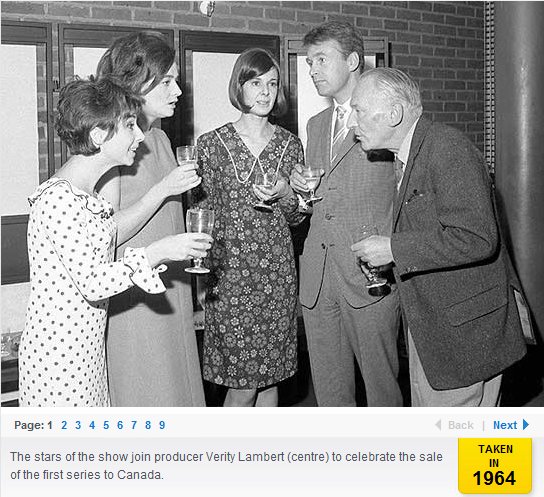
The people behind the original Doctor Who
A photo set on the BBC Archive shows some of the folks who made the original Doctor Who series:
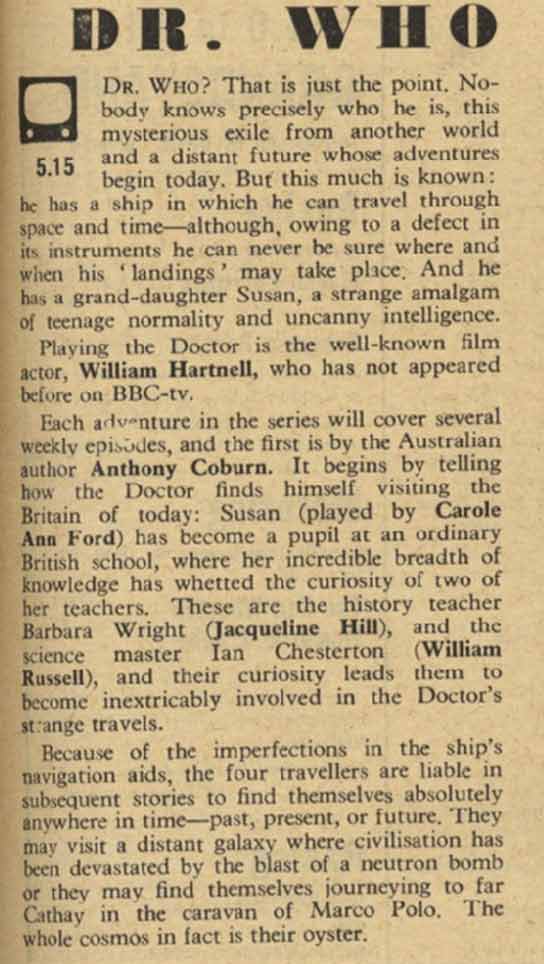
Also from BBC Archives, the Radio Times review of the first episode:
Also of interest, the original notes on creating a BBC science fiction series.
December 4, 2010
QotD: “Every futuristic vision that starts with a clean slate has a genocide or an apocalypse lurking in it”
Here’s a clip of HG Wells in 1943 predicting the demise of the newspaper, as people abandon print journalism in favor of using their telephones for up-to-the-minute news.
In one way, it’s very prescient — “using the telephone to get the news” isn’t so far off from what we do on the web today. But in another way, it’s exactly wrong (after all, it’s been nearly 70 years and there are still newspapers), And it’s wrong in a way that futurists are often wrong: it assumes a clean break with history and the positive extinction of the past. It predicts an information landscape that is reminiscent of the Radiant Garden Cities that Jane Jacobs railed against: a “modern” city that could only be built by bulldozing the entire city that stood before it and building something new on the clean field that remained. Every futuristic vision that starts with a clean slate has a genocide or an apocalypse lurking in it. Real new cities are build through, within, around, and alongside of the old cities. They evolve.
As Bruce Sterling says, “The future composts the past.” What happened to newspapers is what happened to the stage when films were invented: all the stuff that formerly had to be on the stage but was better suited to the new screen gradually migrated off-stage and onto the screen (and when TV was invented, all the “little-screen” stories that had been shoehorned onto the big screen moved to the boob-tube; the same thing is happening with YouTube and TV today). Just as Twitter is siphoning off all the stuff we used to put on blogs that really wanted to be a tweet.
Cory Doctorow, “Newspapers are dead as mutton – HG Wells, 1943 (No, they’re not)”, BoingBoing, 2010-12-03
November 27, 2010
November 21, 2010
He comes not to bury Twitter, but to praise it
Linked from one of Walter Olson’s Twitter updates, an interesting summary by Alan Rusbridger on the things that Twitter does for media folks:
I’ve lost count of the times people — including a surprising number of colleagues in media companies — roll their eyes at the mention of Twitter. “No time for it,” they say. “Inane stuff about what twits are having for breakfast. Nothing to do with the news business.”
Well, yes and no. Inanity — yes, sure, plenty of it. But saying that Twitter has got nothing to do with the news business is about as misguided as you could be.
Here, off the top of my head, are 15 things, which Twitter does rather effectively and which should be of the deepest interest to anyone involved in the media at any level.
There are lots of people who send Twitter updates on what they made for dinner, or what they’re watching on TV, but you don’t have to follow them. I’ve been amazed at how useful Twitter has been to me for keeping on top of what I think of as “blogfodder” items: things that I think my own readers would be interested in.
November 15, 2010
New on A&E: Psychics with Serious Mental Illnesses Hunting Hitler’s Ghost While Driving A Big Truck with Their Freakish Family
Another link from Chris Myrick: Bad move, A&E.
The A&E Channel has a new show coming up: Psychic Kids: Children of the Paranormal. Sounds awful already, doesn’t it? But it’s worse than you think: they’re looking for disturbed kids who think they’ve got magic powers, and then they’re flying in “professional psychics” to coach them in dealing with their awesome powers, i.e., indulge their delusions, get off on feeling superior to unhappy kids, and collect a paycheck for psychic child abuse.
They’re putting kids in the hands of a creepy skeevo like Chip Coffey, all for your entertainment.
This is quite possibly the most loathsome thing I’ve ever seen on TV, and my cable gives me access to the Trinity Broadcast Network, so that’s saying a lot.
Skepchicks are mobilizing the skeptic hordes. Call or write to A&E and let them know that their schlock has reached a new and despicable low.
November 6, 2010
The geeks are not the “elite”
Virginia Postrel looks at TV and what it reveals about popular culture:
American culture is experiencing one of those periodic waves of anti-elitism that have roiled and defined the country ever since Andrew Jackson’s day. Intellectuals, symbol manipulators, universities and people who think they’re so damned smart are out. Regular folks are in.
Yet “The Big Bang Theory,” the CBS sitcom featuring Sheldon and his three almost-as-elite geeky friends, is among the most popular shows on TV. Kicking off the network’s now-dominant Thursday-night lineup, it attracts about 15 million viewers a week. Now in its fourth season, it’s the top-rated Thursday-night program among adults 18 to 49 years old and those 25 to 54.
[. . .]
Something more is going on. Surveying the fall TV lineup for Harvard Business Review’s blog, the anthropologist and marketing consultant Grant McCracken suggests a trend behind the show’s success. “Our heroes used to be the people who stole lunch money,” he observes. “Increasingly, they are the people from whom it was stolen. This has got to have something to do with the rise of Silicon Valley and people like Bill Gates and Mark Zuckerberg.”
[. . .]
As anyone who has been abroad knows, American culture exists. But rather than a monolith, it’s best understood as a set of overlapping subcultures. Assume yours is the norm, the “real,” or the best expression of true Americanness and you miss a lot of important aspects of the culture as a whole, making it much less interesting and devaluing a lot of other people’s lives.
November 1, 2010
It’s not liberal bias: it’s statist bias
Radley Balko uses the media positions on California’s Proposition 19 as a proxy to determine the actual bias:
For the last few months, my colleague Matt Welch has been tracking the positions of California’s newspapers on Proposition 19, the ballot measure that would legalize marijuana for recreational use. At last count, 26 of the state’s 30 largest dailies (plus USA Today) had run editorials on the issue, and all 26 (plus USA Today) were opposed. This puts the state’s papers at odds with nearly all of California’s left-leaning interest groups, including the Green Party, the American Civil Liberties Union, the Service Employees International Union, and the National Association for the Advancement of Colored People; progressive publications such The Nation, Salon, and The Huffington Post; and a host of prominent liberal bloggers. According to a CNN/Time poll released last week, it also pits the state’s newspapers against 76 percent of California voters who identify themselves as “liberal.”
On this issue, the state’s dailies are also to the right of conservative publications such as The Economist and National Review, prominent Republicans such as former New Mexico Gov. Gary Johnson, a growing portion of the Tea Party movement, and even Fox News personality Glenn Beck. (Beck has said he favors marijuana legalization, although he has been typically schizophrenic on Prop. 19.) So who are the newspapers’ allies? Nearly all of California’s major elected officials are against the measure, and the No on Prop. 19 campaign has been funded mainly by contributions from various law enforcement organizations, including the California Police Chiefs Association, the prison guard union, and the California Narcotics Officers Association.
It’s telling that the loudest voices opposing pot legalization are coming from the mainstream media, politicians, and law enforcement. The three have a lot in common. Indeed, the Prop. 19 split illustrates how conservative critics of the mainstream media have it all wrong. The media — or at least the editorial boards at the country’s major newspapers — don’t suffer from liberal bias; they suffer from statism. While conservatives emphasize order and property, liberals emphasize equality, and libertarians emphasize individual rights, newspaper editorial boards are biased toward power and authority, automatically turning to politicians for solutions to every perceived problem.
October 22, 2010
Ever hear the phrase “the camera never lies”?
With Photoshop and other image manipulation tools, still photographs have become less and less dependable for preserving “reality”. It’ll be very soon that video will be just as undependable, but in real time:
The effect is achieved by an image synthesizer that reduces the image quality, removes the object, and then increases the image quality back up. This all happens within 40 milliseconds, fast enough that the viewer doesn’t notice any delay. As the camera moves, the system maintains the illusion through tracking algorithms and guesswork. It does seem to be thwarted by reflections though; a cell phone removed from a bathroom counter is still visible in the mirror.
I don’t think the mirror is the limitation in the video: either it’s currently limited to a single point of “invisibility” or the operator forgot to highlight the reflection for the program.
H/T to John Turner for the link.
October 12, 2010
Female characters in modern fiction
The Female Character Flowchart looks at “the one- and two-dimensional female characters we see over and over again in modern fiction.”
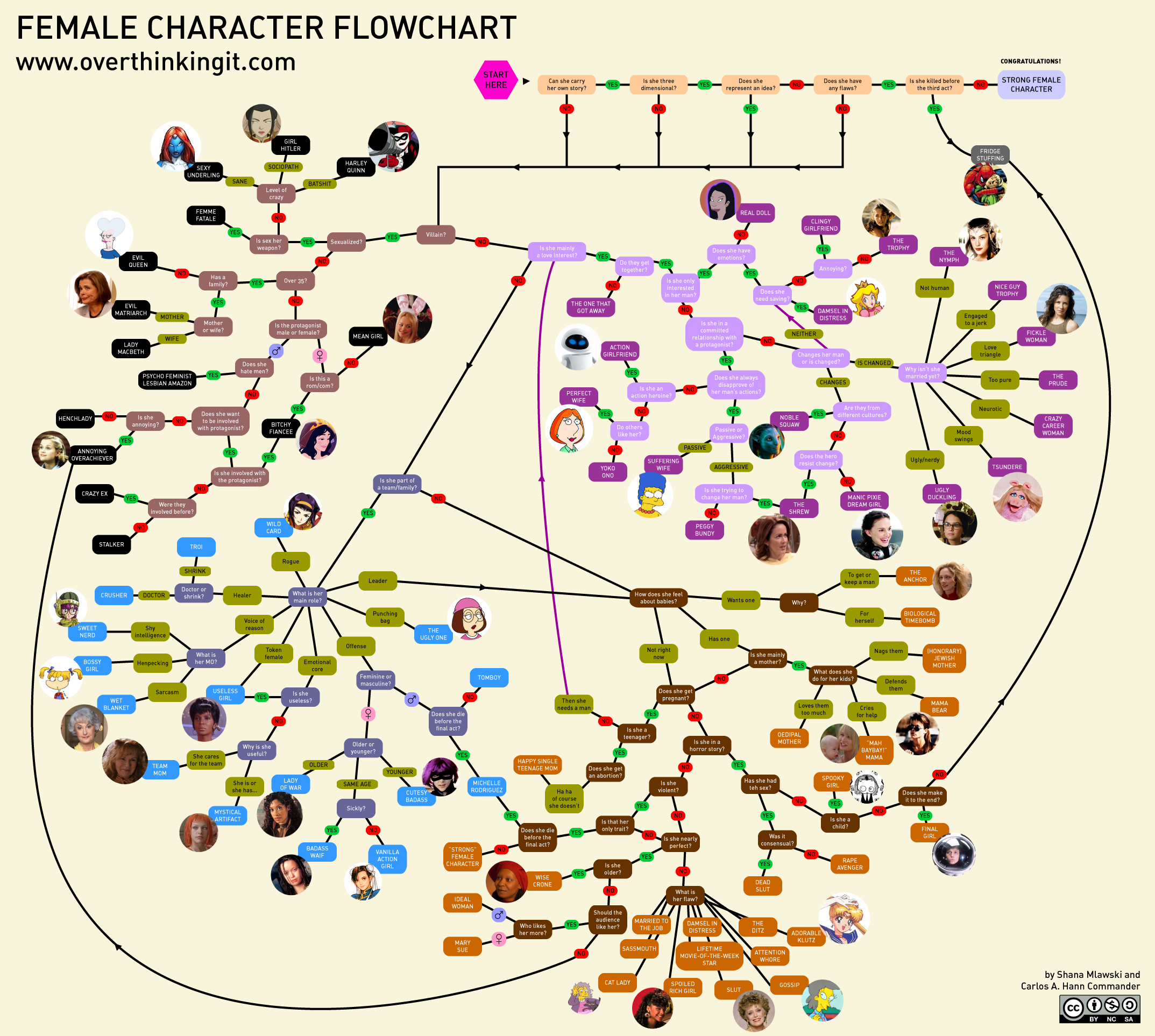
Click image to see full size flowchart
H/T to Royce McDaniels for the link.
Mitch Miller, drawing upon years of “men are simple/women are complicated” media memes, responded:
Wow! That’s a lot of female characters, considering that there’s only five male characters:
The Good Guy
The Bad Guy
The Good Bad Guy
The Bad Good Guy
and
The Sidekick
October 4, 2010
Winning the media war
Strategypage reports on the ongoing struggle by both the Taliban and the NATO/US forces to influence media coverage, both inside Afghanistan and in the outside world:
In Afghanistan, the Taliban have been very successful with the media, mainly because they give the media what they want, or an offer they can’t refuse. The Taliban know that the media loves stories where the underdog prevails, or where the powers-that-be screw up. Put out the right kind of disinformation, and the media will take it and run it as the truth. Or at least something that could, might or ought to be true somewhere.
The Taliban media people know what the Western and regional media want, and this is provided. For example, the Taliban have invented the idea that Western troops are causing most of the civilian deaths in the Taliban effort to regain control of Afghanistan. But the truth, which is published but not emphasized much, is that most of the civilians are killed by the Taliban, and the Western troops have been killing fewer and fewer civilians, even at the risk of more Western casualties. The Taliban regularly use civilians as human shields. Again, the media mentions that, but it’s something for the back pages. The headlines stress what the Taliban wants, mainly that they are winning, even when they are losing.
For a backwards, almost medieval group, the Taliban (or their non-Afghani advisors) have developed a talent for manipulating the international media coverage:
But you don’t have to bribe or threaten Western media. Just package your lies in an acceptable manner, and your message will be delivered. The Taliban are smart enough to constantly recast their press releases to suit the perceived needs of Western and regional media. All they have to do is note what stories editors are running, and work up new stuff with a Taliban angle. Thus while corruption has been an Afghan cultural problem for centuries, the Western media will swallow whole a Taliban press release suggesting that the Taliban are less corrupt (they aren’t) and this more attractive to the average Afghan (not according to opinion polls, or reports from American troops who deal with local Afghans every day.) But in the Western media, you survive by pushing what will sell, not what is actually happening.
October 3, 2010
Losing my “mass media” awareness
Elizabeth and I have been working through the DVD set of Castle season 2 over the last week (a couple of episodes per night, then off to our respective other activities). We got to the end of the last disc, watched the bonus features and briefly skimmed through the “sneak peak” offerings. All but one of the featured DVD sets was completely unknown to me (“Is that Sally Field?” “I didn’t know there was a mainstream sword-and-sorcery series” “Have you heard of this one either?”).
I’m going to have to hire an inveterate TV watcher to keep me posted on just the names of the current TV shows . . .
September 25, 2010
Colbert performance mocks the legislators who invited him
Mary Katharine Ham observes how this will play out during the remainder of the American election this year:
One wonders exactly what Democrats thought would come of this. A Roll Call story Thursday showed at least a few members of Congress were concerned that the event would become a side show (implying, rather frighteningly, that some thought it wouldn’t).
Now, they’ve managed to portray themselves, not just as fat and happy incumbents willing to irresponsibly throw our money at problems, but as fat and happy incumbents who hire a court jester with our money to entertain them while they irresponsibly throw our money at problems. That ought to be great for the party’s message this fall.
[. . .]
And, as Jim Geraghty notes, this allows every single Republican challenger to ask the incumbent Democrat he’s running against, “Can you justify this embarrassing use of our tax dollars, and the literal mockery that the Democratic Congress has become?”
[. . .]
The problem is not that a comedian made jokes in front of a Congressional committee. Colbert’s hilarious. The problem is that his appearance laid bare what voters suspect about Congress — that it’s just one really expensive joke.


