
H/T to LibertyIdeals for the link.
September 20, 2010
The first debate in the Delaware Senate race
I haven’t been following the Christine O’Donnell campaign, but this is quite funny:
[George Stephanopoulos] Good evening, ladies and gentlemen, and welcome to the first official debate of this election cycle. I’m George Stephanopoulos, and with me tonight are two candidates for the United States Senate, Delaware Democrat Chris Coons, and Republican Christine O’Donnell.
[Chris Coons] Hello George, it’s a pleasure to be here.
[Christine O’Donnell] YOUR VOICE IS THE PITIFUL WHINE OF GNATS, AND YOU REEK WITH THE STINK OF FEAR.
[George Stephanopoulos] Outstanding. The format tonight will be as follows: I’ll ask each of you a question, and you will have two minutes to respond. Your opponent will then have one minute in which to offer a rebuttal. Christine O’Donnell, the first question goes to you: The economic stimulus bill passed last year has been the topic of much discussion. Some argue that it gave the American economy a much-needed shot in the arm, while others claim that it’s effects have been marginal or even harmful. What is your opinion on this, and what, if anything, should we have done differently?
[Christine O’Donnell] JUST AS THE GODDESS CIRCE DID DECEIVE THE COMPANIONS OF ODYSSEUS INTO DRINKING OF THE ENCHANTED WINE, SO DID PRESIDENT OBAMA THROUGH HIS CUNNING DECEIVE THE AMERICAN PEOPLE. HE HAS BOUND OUR ECONOMY TO THE YOKE OF PUBLIC SPENDING, MUCH AS THE TRICKSTER GOD LOKI WAS BOUND BY ODIN TO THE ENTRAILS OF HIS SON, NARI, WHOSE SCREAMS WERE AS THE CRIES OF A THOUSAND DYING EAGLES.
It gets better from there. As they say, read the whole thing. H/T to Ace.
Comments Off on The first debate in the Delaware Senate race
September 15, 2010
Will Old Spice parodies be the Downfall of 2010?
H/T to Rob Beschizza for the link.
Comments Off on Will Old Spice parodies be the Downfall of 2010?
September 12, 2010
Taking the term “Space Opera” too literally
Get your tickets now for the first opera to be performed entirely in Klingon:
Die-hard “Star Trek” fans may want to dust off their Klingon dictionaries and take a transporter to Europe for the debut of the first opera ever to be completely sung in the invented science fiction language.
The opera, called “u,” kicks off a three-day run at the Zeebelt Theater today in The Hague, Netherlands. The title “u” is the Klingon word for “universe” or “universal.”
Tickets for the performances were still available as of Friday morning, according to Reuters.
Klingon, which is spoken by members of the fictional “Star Trek” warrior race of the same name, has evolved into a significant pop culture phenomenon since the American science fiction TV series first hit the airwaves in the late 1960s.
Fans worldwide adopted the alien dialect and made it one of the most popular constructed languages, opera organizers said.
Comments Off on Taking the term “Space Opera” too literally
September 8, 2010
When the guys who do Monster Truck ads meet religious fanatics
H/T to BoingBoing.
Comments Off on When the guys who do Monster Truck ads meet religious fanatics
September 7, 2010
The problem with knee-jerk reactions
Too often, they make you look like a jerk:
The CRTC has nixed the idea of “mak[ing] us all pay” for Fox TV News for now. But a CRTC under a compliant chairman could rubber-stamp whatever sort of licence Quebecor wanted, purely for political reasons, and the Fox News-ification of Canada would be unstoppable. Would that not be outrageous?
Yes. It would be outrageous. I’d sign a petition protesting it. But Ms. Atwood seems to accept this theory as fact. And it isn’t fact. Fact is that the petition is called “Stop ‘Fox News North’ ” and refers to its product as “hate media.” In a particularly astonishing Tweet on Thursday, Ms. Atwood revealed that she hadn’t even realized the Quebecor network wasn’t, in fact, to be called Fox News North! Had she done any due diligence whatsoever?
Anyone who supports Quebecor’s right to beam its product into our homes under reasonable commercial circumstances, as Ms. Atwood claims to, would do well not to sign that petition. It’s clearly opposed to the existence of Sun TV News, not just to the Prime Minister’s hypothetical meddling in the CRTC’s affairs. She’s far from the first celebrity to embarrass herself by blundering headlong and uninformed into politics (an urge that still baffles me). But she could at least own up to the gaffe. Surely it’s not a far-fetched idea that one’s signature beneath a block of text signifies approval of the foregoing.
Because I don’t watch much TV (except for NFL games), I must have missed the mass takeover of American TV by hate mongers. Yet another advantage of avoiding TV watching, I guess.
Comments Off on The problem with knee-jerk reactions
September 1, 2010
“The Stig” to be unmasked
As I mentioned a while back, the BBC went to court to try to prevent a book publisher from revealing the identity of Top Gear‘s mysterious race car driver “The Stig”. The court has ruled against the BBC. James May, one of the presenters on the show, had this to say:
“Obviously I’m now going to have to take some legal action of my own, because I have been the Stig for the past seven years, and I don’t know who this bloke is, who’s mincing around in the High Court pretending it’s him.”
Comments Off on “The Stig” to be unmasked
August 23, 2010
Unmasking “The Stig”
A court case will decide whether HarperCollins can publish a book that reveals the identity of Top Gear‘s anonymous driver:
Publisher HarperCollins is in a legal dispute with the BBC over a book that reveals the identity of Top Gear‘s The Stig, BBC News understands.
Both sides appeared in London’s High Court on Monday after the BBC confirmed it was trying to halt its publication.
The Stig regularly takes to the track on the BBC Two show, but never removes his helmet on screen.
The BBC says the publication of the book breaches contractual and confidentiality obligations.
HarperCollins declined to give any official comment.
The dispute comes amid suggestions from several newspapers speculating that the character’s true identity is former Formula Three driver Ben Collins, based on the financial reports of his company.
Comments Off on Unmasking “The Stig”
August 5, 2010
Examining DNA testing from the client’s point of view
Mary Carmichael is writing a multi-part series about DNA testing:
On July 22, Congress held a hearing on direct-to-consumer (DTC) genetic tests, services that analyze your DNA and interpret the results in exchange for a few hundred bucks — no doctor necessary. The hearing could have been a thoughtful national conversation about science, business, and ethics. Alas, it devolved instead into a series of gotcha moments, starring a General Accounting Office sting operation that came off like a cross between the ACORN videos and the world’s worst ad for snake oil.
Time and again, on tape, an undercover agent called up an unidentified testing company and asked an ill-informed question. (“Is it OK if I stop taking my cholesterol meds and instead take the nutritional supplements you sell? If I can manage to get hold of my fiancé’s saliva without him knowing, will you run it through your machines so I can surprise him with the ‘gift’ of his own data?”) And time and again, the phone rep sank to the occasion and made the company look awful. (Sure, lay off the pills and take our supplements! Of course we’ll analyze your fiancé’s spit without his permission even though that’s illegal, unethical, and weird!)
I listened to the tape several times the day it was released, despairing at the way people were taking advantage of gullible, albeit fictional consumers, which was clearly how the congressmen who held the hearing wanted me to react. Then I started to worry about something else. How much time did I even have left to decide whether I was going to take a test myself? Even before the hearing, the FDA had announced its plans to regulate all DTC genetic tests, possibly so heavily as to keep them off the market; the hearing was just the sort of thing that could push it to move faster. What if, by the time I finally decided if I wanted one of these tests, I couldn’t buy one anymore? My credit card was sitting next to my laptop. I did something that in retrospect seems a bit rash. There’s a DNA-collection kit on my desk now, taunting me — because although I bought the thing, I still can’t decide whether I actually want to use it.
The sheer volume of misinformation on DNA testing — combined with public belief in the amazing accuracy of DNA testing (probably induced by watching too many crime investigation TV shows) — leaves the legitimate companies in an awkward situation. The actual DNA self-tests don’t tell you what you might expect, and can tell you things you don’t want to know. Politicians jumping in now (at the prompting of bureaucrats who want more power to regulate) will only make the situation more confused.
H/T to BoingBoing for the link.
Comments Off on Examining DNA testing from the client’s point of view
July 29, 2010
QotD: You can’t beat the media
Stephen Harper is feeling some of that effect from the millions he put into “infrastructure” projects as part of Canada’s own stimulus plan. You will recall that Ottawa solicited proposals from local governments before handing over the money. Inevitably, a goodly number turned out to be . . . shall we say . . . not entirely crucial, leading to articles like this, pointing out that — oh dear — taxpayers were financing bocce courts via deficit spending. Not to mention sending money to rich people in good neighbourhoods! Even funding for the arts — which Harper was previously criticized for providing too little of — was thrown back in his face as a cheap attempt to correct his earlier gaffe. (If he hadn’t corrected the gaffe, of course, it could have been portrayed as a “continuing snub.” Don’t try to beat the media folks, you can’t win.)
So what’s the lesson here? Politicians should ignore the experts and do what makes people happy, even if it’s unlikely to have much long-term benefit? Politicians should never expect the public to appreciate their efforts unless there’s some kind of individual payoff? Politicians should stay out of the economy, because no one is ever satisfied anyway?
Pick any one of those. Just don’t run for president or prime minister if you want to be popular.
Kelly McParland, “Obama could save America and lose the election”, National Post, 2010-07-29
Comments Off on QotD: You can’t beat the media
Replacing one impossible ideal with another
Colby Cosh linked to this Guardian article, saying “I’m afraid she’s right. ‘Thin’ is something every girl can at least strive for. Only God can make Christina Hendricks.”
When it comes to the ideal female body-shape the pipe cleaner is out, the hourglass is in — or at least it will be if the new equalities minister, Lynne Featherstone, manages to chisel out her will on the perfect body image.
“In the autumn the minister will convene the first of a series of roundtable discussions with members of the fashion industry, including magazine editors, models and advertisers, to discuss how to boost body confidence among the young,” the Sunday Times reported yesterday.
One might think that one of the first steps to boost such confidence might be to abolish school weigh-ins and make puppy fat a normal rite of passage rather than the subject of a health warning via the National Child Measurement Programme. (Can any woman think of anything more likely to have produced a fear of being on the chunky side than turning up to school one morning and being plonked on a set of scales?)
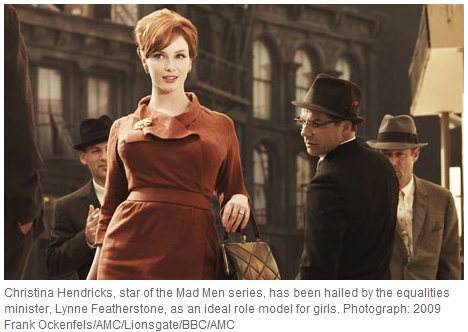
While I’m happy to have any excuse to post a photo of the delightful “YoSaffBridge”, this is another example of Nanny State thinking: (some) women have body image issues, therefore we must spring into action and fix it.
Rather than replacing the old impossible images with new impossible images (as the creative director of Harper’s Bazaar pointed out, the fashion industry exists to create the fantasy you’ll never live up to) an equalities minister should throw out all notions of obsessing about feminine beauty and concentrate on helping young girls think about the size of their achievements rather than the flatness of their navels, and the scale of their ambitions rather than — in Joanie’s case — the rather spectacular power of their bosoms.
Comments Off on Replacing one impossible ideal with another
An end to ASBOs in sight?
BBC News thinks that the much-maligned ASBO may be going away.
Home Secretary Theresa May has signalled the possible end of Asbos in England and Wales, saying it is “time to move beyond” the orders, first introduced by Labour 11 years ago.
They have been imposed on 10-year-old boys and 80-year-old women, used to sober up persistent drunks and mute noisy neighbours.
Of course, one of the more useful aspects of the ASBO has been to allow the media an easy way to find stories to run in the quiet times, like this one:
A 60-year-old man from Northampton was banned from dressing as a schoolgirl.
Peter Trigger’s Asbo stopped him from wearing skirts or showing bare legs on school days between 0830 and 1000 and 1445 and 1600.
The authorities acted after parents complained he was waiting near a primary school dressed in clothes similar to school uniform. He then breached this in December last year by bending over in front of his neighbours repeatedly.
You see, without the ASBO, reporters would have to dig up gems like that themselves, instead of having the local police blotter highlight the most newsworthy items for them.
I often wondered, when reading some of the weird and whacky things that people were hit with ASBOs over, why existing laws weren’t applied (lots of these violations were clearly against the law before ASBOs were created). The intent may have been to give judges more flexibility in sentencing, but in practice it appears to have created a “market” in unusual sentences and distorted the notion of equality before the law.
Comments Off on An end to ASBOs in sight?
July 26, 2010
The unwillingness to disbelieve
Mike Elgan debunks the latest “mind-crogglingly cheap computer for the masses” announcement:
“India unveils $35 computer for students,” says CNN.com. “India unveils prototype for $35 touch-screen computer,” reports BBC News. “India to provide $35 computing device to students,” says BusinessWeek.
Wow! That’s great! Too bad it will never exist. That this announcement is reported straight and without even a hint of skepticism is incomprehensible to me.
[. . .]
India itself doesn’t build touch screens. They would have to be imported from China or Taiwan. The current price for this component alone exceeds $35. Like touch screens, most solar panels are also built in China. But even the cheapest ones powerful enough to charge a tablet battery are more expensive to manufacture than $35.
Plus you need to pay for the 2GB of RAM, the case and the rest of the computer electronics. Even if you factor in Moore’s Law and assume the absolute cheapest rock-bottom junk components, a solar touch tablet with 2GB of RAM cannot be built anytime soon for less than $100.
More to the point, no country in the world can build a cheaper computer than China can. The entire tech sector in China is optimized for ultra-low-cost manufacturing. All the engineering brilliance in India can’t change that.
There’s also the point that government bureaucracies and university engineering departments are not designed for or experienced in the mass production techniques that any of these “ultra-cheap but powerful” computing initiatives all require. Have you ever heard of a government that could keep their hands (and political priorities) out of the critical decision of where this wonder device would be assembled, tested, packed, and distributed? The “industrial policy” wonks would need to get intensely involved in such a decision and the location would have to meet diverse electoral and financial requirements (note that the economics of the project won’t even make the top five priorities in the process).
Awarding the contract to just one area would be unthinkable: the benefits must be seen to be helping areas that elected the current government and emphatically not going to opposition ridings. The horsetrading over that alone would consume any possible price advantage such a scheme might have over ordinary computers and software bought commercially.
Comments Off on The unwillingness to disbelieve
You’d have to say that they’re still following his guidelines
In an issue of Granta several years back, Binyavanga Wainaina provided some highly detailed guidelines for western writers to use in their work about Africa. Based on the results, you’d have to say that his guidance has been taken to heart by most novelists, journalists, and television personalities:
Always use the word ‘Africa’ or ‘Darkness’ or ‘Safari’ in your title. Subtitles may include the words ‘Zanzibar’, ‘Masai’, ‘Zulu’, ‘Zambezi’, ‘Congo’, ‘Nile’, ‘Big’, ‘Sky’, ‘Shadow’, ‘Drum’, ‘Sun’ or ‘Bygone’. Also useful are words such as ‘Guerrillas’, ‘Timeless’, ‘Primordial’ and ‘Tribal’. Note that ‘People’ means Africans who are not black, while ‘The People’ means black Africans.
Never have a picture of a well-adjusted African on the cover of your book, or in it, unless that African has won the Nobel Prize. An AK-47, prominent ribs, naked breasts: use these. If you must include an African, make sure you get one in Masai or Zulu or Dogon dress.
In your text, treat Africa as if it were one country. It is hot and dusty with rolling grasslands and huge herds of animals and tall, thin people who are starving. Or it is hot and steamy with very short people who eat primates. Don’t get bogged down with precise descriptions. Africa is big: fifty-four countries, 900 million people who are too busy starving and dying and warring and emigrating to read your book. The continent is full of deserts, jungles, highlands, savannahs and many other things, but your reader doesn’t care about all that, so keep your descriptions romantic and evocative and unparticular.
Make sure you show how Africans have music and rhythm deep in their souls, and eat things no other humans eat. Do not mention rice and beef and wheat; monkey-brain is an African’s cuisine of choice, along with goat, snake, worms and grubs and all manner of game meat. Make sure you show that you are able to eat such food without flinching, and describe how you learn to enjoy it — because you care.
H/T to Gerard Vanderleun for the link.
Comments Off on You’d have to say that they’re still following his guidelines


