Quotulatiousness

March 14, 2012

The red meat of medical churnalism

Filed under: Food, Health, Media, Science — Tags: , , — Nicholas @ 11:38

Rob Lyons on the latest red meat scare from the medical press, who “churn out scary-sounding studies about steak and bacon faster than McDonald’s produces Big Macs”.

It’s official, it seems: red meat — particularly processed red meat — will be the death of you. ‘Small quantities of processed meat such as bacon, sausages or salami can increase the likelihood of dying early by a fifth, researchers from Harvard School of Medicine found. Eating steak increases the risk of early death by 12 per cent’, declared the Daily Telegraph yesterday. BBC1 Breakfast’s resident GP, Dr Rosemary Leonard, told millions of viewers the link was ‘very, very clear’.

[. . .]

The topline results were that, after adjustment for major lifestyle and dietary risk factors, there was a 13 per cent increase in the risk of death for each portion of red meat eaten per day and a 20 per cent increase in mortality for each portion of processed meat consumed per day. This is not the first study to suggest that eating meat is bad for you. But that might simply mean that this study shares many of the same problems that all the other studies have had.

However, before we get to the problems, here’s some brighter news. At the end of the study, the members of the two groups studied had, on average, reached the grand old age of 75. How many had died along the way? Less than 20 per cent. Those who started the study were four times more likely than not to reach 75. So, whatever your eating habits when it comes to eating red meat or processed meat, the most important lesson is that most people live a long time these days. ‘Early death’ is very much a relative concept.

The authors claim that 9.3 per cent of deaths in men and 7.6 per cent of deaths in women could be avoided by eating little or no red meat. To put that into some back-of-an-envelope statistical perspective: multiplying that 9.3 per cent by the 20 per cent who actually died shows that about 1.8 per cent of red-meat eaters would die by the time they were 75 because of their meat-eating habit. Even if that claim were absolutely accurate (and even the authors call it an estimate), would you really give up your favourite foods for decades on the slim possibility of an extra year or two of old age?

March 13, 2012

El Neil on Limbaugh’s “show of weakness”

Filed under: Liberty, Media, Politics — Tags: , , , , , , , — Nicholas @ 10:01

L. Neil Smith weighs in on the Rush Limbaugh “apology” to Sandra Fluke and the media feeding frenzy it perpetuated:

Please understand that I am not a conservative of any kind. As a more or less lifelong libertarian, and a proud, battle-scarred (and, I like to think, highly decorated) veteran of America’s 1960s Sexual Revolution (which actually began in the 1920s), I’m very much in favor of individuals finding joy, and generally doing whatever they desire with their own lives. Love (or whatever floats your boat) is such a rare commodity that they ought to revel in it whenever they can. What I am vehemently opposed to, however, is making other people pay for it.

But then, despite the basic truth behind what he’d said about her, Limbaugh decided — far more likely it was decided for him — to apologize.

John Wayne became famous, among other things, for declaring, in several of his movies, “Never apologize. It’s a sign of weakness.” Mark Harmon has said it, too, in the role of Leroy Jethro Gibbs of NCIS. And there’s a basic, Darwinistic truth in what they’ve both said, as illustrated by what happened next to the Formerly Fat Flumpus.

When his ideological enemies began screaming about what Limbaugh had said, if he’d told them to stick it where the sun don’t shine and break it off, their screaming would have subsided and finished with a whimper.

But the minute he apologized, the minute he rolled over on his back, sticking his paws in the air and exposing his belly, they fell on him like wolves. With the ladies and gentlemen of the evening who constitute our news media cheering them along, public figures called for removing him from the air the way they had Don Imus — and Imus, true to the sad, broken figure of Winston Smith he had become, joined in.

“Do it to Limbaugh!”

Meanwhile animals and barbarians of all kinds showered Limbaugh with death threats and other worst-wishes, and the Internet writhed like a pit of snakes with vile, anonymous accusations of every kind against him. Clearly free speech in this country is supposed to be reserved to the creatures who call themselves “progressives” because they’ve dirtied the word “liberal” to the point it can’t be used any more.

March 12, 2012

The hidden dangers of driving an antique BMW Isetta

Filed under: Europe, Germany, History, Media, Technology — Tags: , , — Nicholas @ 00:04

March 7, 2012

Perhaps the NFL doesn’t want too many people watching the 2009 NFC championship game right now

Filed under: Football, Media — Tags: , , , , , — Nicholas @ 00:03

I retweeted a post from the Daily Norseman yesterday to the effect that the NFL Network had, without warning, pulled a scheduled re-broadcast of the 2009 NFC championship between the New Orleans Saints and the Minnesota Vikings. Gregg Easterbrook perhaps explains why:

The Vikings-Saints NFC title game two years ago may have been where the Saints’ deliberate rule-breaking was worst. Immediately after that game, I wrote, “Saints players came after [Brett] Favre so hard — four times slamming him in ways that invited late-hit or roughing penalties, only two of which were called — Williams [seems to have] told his charges something along the lines of, ‘Pound Favre every time you can; we will take a couple of roughing flags in return for making an old guy worry about the next hit.'”

So did I do a good job by noting two years ago what is suddenly considered obvious? No, I did a terrible job. Yesterday I watched every New Orleans defensive snap of that game and found four, not two, instances in which unnecessary roughness should have been called against the Saints but was not. In retrospect, my column should have led with dirty play by the Saints. The four unnecessary roughness penalties that were not called:

  • On the game’s first snap, Favre handed off, turned away from the play and was hammered with a forearm to the chin by New Orleans linebacker Scott Fujita. Not only should a personal foul have been called — Fujita should have been ejected on the game’s first offensive snap. Instead, no call. Scott, were you paid for behaving like a street thug?
  • At 6:14 of the first quarter, after Favre released a pass he was hit with a forearm to the chin by safety Roman Harper. No flag. Roman, were you paid for delivering that cheap shot?
  • At 4:15 of the first quarter, Favre released a pass and then Darren Sharper slammed him in the chest with a foreman. No flag. Darren, were you paid for having low standards?
  • At 13:29 of the second quarter, Favre released a pass and then was hurled to the ground by Bobby McCray. No flag. Bobby, were you paid for doing something you should be ashamed of?

Reviewing the tape, another aspect of the game jumped out at me that I missed when watching live, and so far as I can tell, all sportscasters and commentators missed, too. Beginning midway through the first quarter, whenever Favre handed off, he immediately ran backward 10 yards — to get away from New Orleans late hits.

And the assistant coach who ran the bounty operation? What a piece of work he is:

Gregg Williams has a classy first name, but may be a man of twisted values. Monday on NPR’s “All Things Considered,” Mike Pesca dug up audio of Williams speaking after the Saints’ Super Bowl win. Williams says, “My whole life … I’ve been trying to get people to play nastier.” Can he seriously think lack of aggression is a problem in football? Williams also had this to say about his two sons’ youth football days: “I told their little league coaches my kids will play fast, they’re going to play nasty, they’re going to play tough. Tell the rest of the babies around them to speed up.”

What kind of a man boasts that his sons are nasty and denounces as “babies” 10-year-olds who want to participate in a sport safely? Williams needs to take a long look in the mirror — and by his distorted values, he has forfeited any claim to a leadership role.

The NFL has a bigger problem than figuring out how to discipline the New Orleans Saints players and coaching staff. Perhaps that is why no penalties have yet been announced. The bigger problem for the NFL is that they need to retain the aggression and the passion, yet clearly enforce and be seen to enforce the rules against deliberate attempts to harm other players. If they miss this opportunity, expect politicians (in an election year where media exposure is even more important than usual) to jump in and start trying to do it for them.

March 6, 2012

Nick Gillespie: Short memories and shorter tempers

Filed under: Humour, Media, Politics, USA — Tags: , , , — Nicholas @ 12:34

A very funny trip down a memory lane not quite in the same dimension as we currently occupy:

With Super Tuesday upon us like a plague of 24-hour locusts that threaten not just the GOP but the very fabric of the nation itself (a wool and Lycra blend explicitly forbidden in Leviticus, btw) which is being stripped more bare than the bride by her bachelors even or the dessert bar near closing time at a Golden Corral buffet, it’s as good a time as any to wonder:

Was it just four years ago that The New York Times was running stories about the deleterious effects of a long, drawn-out, bruising fight for the Democratic presidential nod?

[. . .]

Good god, how does the nation ever survive the primary process? Isn’t it a scientific fact that nobody has ever won the presidency after having gone through a difficult nominating race? Obama was forced to visit all 57 states (by his count) multiple times until he kept fainting on stage from exhaustion like that guy from the Black Crowes who used to be famous.

After all, hasn’t a poll just scientifically proved that the GOP is hurting its “brand” (you know: Depends-wearing, anti-government crackers who only leave their houses on the Medicare-purchased personalized motor scooters to cruise to the mailbox to pick up their Social Security checks and oil-company dividend checks) by not immediately appointing the candidate most likely to get smoked by Obama in November?

The only subgroup of Americans who have weaker memories than high school seniors (99 percent of whom contend that the War of 1812 was fought between the Crips and the Bloods over the last Cabbage Patch doll between 1983-1986) are political journalists, many of whom, you may recall, took Donald Trump and Herman Cain seriously.

March 5, 2012

New TV shows to “glamourize” archaeology

Filed under: History, Media, Science, USA — Tags: , , , — Nicholas @ 14:26

This sounds particularly dire, on multiple levels:

On 20 March, Spike TV will premiere a new show called American Digger, while a show called Diggers on the National Geographic Channel made its debut 28 February. Both shows “promote and glorify the looting and destruction of archaeological sites,” Society for American Archaeology (SAA) President William F. Limp wrote in a message posted earlier this week to the SAA listserv.

The premise of American Digger, which is being hosted by a former professional wrestler, was laid out in a recent announcement by Spike TV. A team of “diggers” will “scour target-rich areas, such as battlefields and historic sites, in hopes of striking it rich by unearthing and selling rare pieces of American history.” Similar locales are featured in National Geographic’s Diggers. In the second episode, set in South Carolina, Revolutionary War and War of 1812 buttons, bullets, and coins were recovered at a former plantation.

After viewing the first two episodes of Diggers, Iowa’s State archaeologist John Doershuk posted a review to the American Cultural Resources Association listserv, in which he lamented: “The most damaging thing, I think, about this show is that no effort was made to document where anything came from or discussion of associations — each discovered item was handled piece-meal.”

H/T to A Blog About History for the link.

March 1, 2012

The plight of Britain under austerity

Filed under: Britain, Economics, Government, Media — Tags: , , , , , — Nicholas @ 10:03

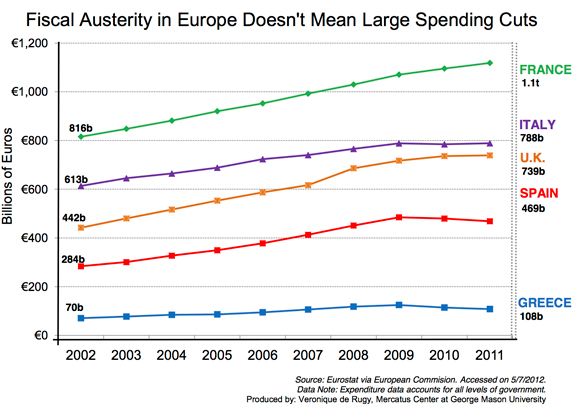
Vuk Vukovic wonders why the notion that the British government has imposed austerity still has any traction in the media:

The UK had the one of the strongest fiscal stimuli (relative to the size of its economy) in the world as a response to the crisis, during the premiership of Gordon Brown. The result was making the situation much worse with a rising public debt and the third highest budget deficit in the world behind only Greece and Egypt in 2011, and behind Greece and Iceland in 2010. This comparison is striking since these countries were doing much worse than the UK at the time and were countries with highly unstable economies – Iceland before the restructuring, Greece whenever, and Egypt after a year-long revolution which saw the downfall of a dictator and an inability to consolidate ever since.

So the argument of Keynesians is that this wasn’t enough, and that Britain is crippled with austerity. The media is supporting the former view as well. Britain is running the hardest austerity policy in Europe and this is resulting in terrible growth performance and the inability to start up the recovery. However, Britain is far from austerity. Yes, some painful cuts have been made, tuitions were rising, unions were hit, wages in the public sector are stagnant, a lot of public sector workers have been laid off, but what does the government do with this saved up money? It “invests” in credit easing, housing subsidies, the youth contract and infrastructural projects. On the other hand, it’s guiding private sector investment and centrally planning credit, it announces an increase of the minimum wage, abolishing of the default retirement age, more regulation after claiming to remove regulation, the 50p tax rate and so on. None of these policies are policies aimed at growth. They are all part of a Keynesian response to the crisis.

After all, if one would just observe the spending data for the UK, it is still increasing, both relatively (as percent of GDP) and absolutely.

“You keep using that word. I do not think it means what you think it means.” To call a situation where government’s share of GDP is rising as “austerity” requires a brand new definition for the word.

February 27, 2012

Goodbye and good riddance to the architect of “Canadian Content” media rules

Filed under: Cancon, Media — Tags: , , , , — Nicholas @ 10:28

Marni Soupcoff on the lasting legacy of former CRTC head Pierre Juneau, the mandatory “CanCon” ratio for TV and radio:

Former CBC and CRTC president Pierre Juneau died last week at the age of 89, and the requisite obituaries followed. Almost all of them congratulated Mr. Juneau on his most well-known achievement: having mandated minimum standards for Canadian content on radio and television. It is an unfortunate legacy.

The troubles with CanCon requirements are both moral and practical: It is not simply wrong to try to forcibly engineer a population’s taste in music in television. It is also impossible. People like what they like, and if what they like is Canadian, they will watch and listen to it even absent rules dictating that they must. If what they like isn’t Canadian, rules saturating the airwaves with all the Loverboy ditties in the world won’t make them tune in.

So even if you aren’t bothered by CanCon rules’ violation of freedom of expression, you should at least ask yourself how effective the regulations can possibly be — especially today. More and more people are selecting their music and television shows on their own, now, picking an episode from iTunes here, a free song download from a band’s webpage there. The idea that the nation’s culture can be shaped by mandating the nationality of prime-time content on TV networks and radio stations is as antiquated as it was flawed to start with. And we’re wasting money and time by continuing to force media outlets to comply.

And yes, my Cancon blog category is a backhand at the longstanding regulation.

David Friedman: The boy who cried wolf

Filed under: Media, Science — Tags: , , , , , , — Nicholas @ 09:15

Although it mentions the global warming debate, it’s really more about being skeptical in general:

A number of political commenters have compared the current Republican contestants unfavorably with Barry Goldwater. The current crop, we are told, are religious nutcases, or possibly pretending to be. Goldwater, on the other hand, was an intelligent and reasonable man, even if not on the right side of every issue.

I have been reading my parents’ autobiography, and recently got to the Goldwater campaign. Their description fits my memory. What we were being told then — by people almost none of whom could have done a competent job of explaining Goldwater’s positions or the arguments for them — was that he was a dangerous madman. There was even a piece by some large number of psychiatrists, none of whom had ever examined the candidate, explaining how crazy he was. And the TV ad with the little girl, the countdown, and the mushroom cloud.

[. . .]

I am not competent to judge the climate science behind global warming, but I am suspicious of orthodoxies pushed relentlessly in the popular media, orthodoxies that claim that everyone competent agrees on an urgent problem which requires drastic action immediately if not sooner. I remember when we were being assured that it was simply a scientific fact that overpopulation was the cause of poverty and a near term threat to our own well being, if not survival. Also when we were assured that the only way to get the poor countries of the world up to our level was central planning, if possible supported by generous foreign aid.

When I see news headlines about global warming having shrunk horses to the size of cats, along with a picture comparing a cat sized dog to a modern Morgan — you have to read down a bit to discover that the ancestral horses shrank to the size of cats from the size of dogs, from 12 pounds to 8 1/2 pounds, and spent tens of thousands of years doing it — I suspect that what I am seeing is driven at least as much by what people want other people to believe as by the evidence for believing it.

February 6, 2012

Brazil fights back against celebrity oppression

Filed under: Americas, Economics, Media — Tags: , , , — Nicholas @ 11:25

John Conroy on the recent backlash in Brazil against foreign celebrities using domestic issues as platforms for moralizing:

Film director James Cameron, responsible for Terminator, Titanic and, more recently, Avatar, has been working on a considerable side-project for a few years now. Cameron film fans shouldn’t get their hopes up, however. This side-project is more political than filmic. He has been trying to prevent the Brazilian government from constructing Belo Monte, the world’s third-largest hydroelectric dam, on the Xingu river which runs through the Amazonian rainforest.

[. . .]

But then something very curious happened. Another tribe of Brazilians, normally so fearful of being seen outside of their natural habitat, fought back. Geeky university students and their professors made a film with zero production values undermining every argument used by Cameron, the NGOs, the Kayapo and TV Globo. These are the myths they challenged:

  • The Indians will have nowhere to live. Actually, a student from Brasilia University who has done little else but study the impact of the project on indigenous lands responded that not one of the indigenous lands in the region will be flooded. There are 12 indigenous territories near the project in an area of 56,000 square kilometres with 2,200 indigenous people living on them. That’s two-and-a-half times the size of Wales. Thirty consultative meetings were held in tribal villages and recorded on video.
  • The dam and its reservoirs will flood and destroy 640 square kilometres of rainforest. Not exactly. The reservoirs will cover an area of 502.8 square kilometres of which 228 square kilometres are already within the body of the river itself.
  • The dam will starve the Xingu National Park of water. This is not true. The students displayed a map revealing that the park is in fact 1,300 kilometres up river of the dam.
  • For eight months of the year the region above the dam is nearly a desert making the dam inefficient and only capable of generating a third of its installed capacity. The implication here is that there is insufficient water to drive the turbines at full power. However, during the high-water period of the year, the river empties 28 million litres of water per second at the point of the turbines, creating an extraordinary potential energy generation of 11,233 megawatts (MW). Even at the river’s lowest levels in the month of October, it delivers 800,000 litres per second. The annual average energy production of Belo Monte will be 4,571MW, or 41 per cent of the potential generating capacity, not one third. This will power 40 per cent of Brazil’s entire residential energy consumption.

February 4, 2012

“Fake the oath” to become the new “Jump the shark”

Filed under: Cancon, Government, Media — Tags: , , — Nicholas @ 12:26

Chris Selley wonders why anyone outside the Ottawa media bubble would care about the Sun Media (or as Paul Wells usually spells it in his tweets, “Sun Meida”) faking the citizenship ceremony for a TV broadcast:

“Let’s do it. We can fake the Oath.” That is the universally accepted money quote, courtesy of a Sun News producer, to come out of this week’s fracas involving the fledgling cable news network, the Ministry of Citizenship and Immigration and a citizenship ceremony that wasn’t quite what it seemed. On Oct. 19, during Citizenship Week, Sun viewers were told they were watching 10 people become Canadian citizens. Instead they were watching 10 citizens, six of whom were federal bureaucrats, reaffirm their Canadian citizenship.

“Congratulations to all of the new Canadians here,” co-host Alex Pierson gushed. “Ten of you here at Sun News Network, finally Canadian citizens!”

“Fake the Oath” certainly has the ring of legend. I think it could be to the Canadian media what “jump the shark” is to situation comedy. An example: “Oh for God’s sake, [insert media outlet], a talking dog on YouTube is news now? You guys have finally faked the Oath!”

But having gone through the documents behind this story, which were obtained by Canadian Press through Access to Information, I’m struggling to understand the amount of coverage this story got. Well, OK, I sort of understand it: Pointing and laughing at Sun Media is a national pastime among journalists and liberals these days. What I can’t figure out is how this matters.

In praise of Her Majesty the Queen

Filed under: Britain, Cancon, History, Media — Tags: , , , — Nicholas @ 11:33

Conrad Black goes full monarch in his latest column:

The Queen has an outstanding record of absolutely unblemished service, through tumultuous changes and always having to endure suggestions of impending obsolescence — not just of the monarchy itself, but of its various separate functions, especially the ambiguous positions of head of the Commonwealth and supreme governor of the Church of England.

The 1950s were a constant round of independence ceremonies, mainly for countries that had a very rocky start and little aptitude for premature emancipation from unfashionable colonials status. This made for ever larger and more incongruous Commonwealth meetings, as the shared British traditions that supposedly united the “British Dominions, realms and territories beyond the seas” frayed and became always more threadbare except, perhaps, among the former so-called “white Dominions.”

In this present time of glaring, intrusive, nasty media, it is hard to imagine the proportions of the Queen’s achievement in serving 60 years, every one of them as one of the most prominent and publicized people in the world, without one gaffe, one embarrassing photograph, one injudicious utterance or slip on a banana peel, literal or metaphoric.

[. . .]

Queen Elizabeth II has personified the British middle-class virtues: moderation, unflamboyant consistency and unflappable reliability. It hasn’t always been exciting, and in satirical magazines such as Private Eye and on the BBC, she has paid a price for that and was lampooned for decades for stiff formality and stilted phrases — “My husband and I,” etc.

February 3, 2012

Walter Kirn profiles Gingrich

Filed under: Media, Politics, USA — Tags: , , — Nicholas @ 09:50

A new column in GQ on the 2012 presidential race:

There are some things you don’t know you want until you get them and some that you don’t know you don’t until they’re yours. Take perfection. Now that Republicans have found in Romney pretty much all the qualities they’ve clamored for in modern presidential candidates—an aura of personal and public decorum, a record of civic-minded accomplishment backed by a record of fierce free-market self-enrichment, all wrapped up in a senior-edition beach bod and a profile fit for a gold coin—they don’t seem as wild for them as as they once were. Sure, they’re proving willing to accept Mitt (largely on the assumption that others will like him, which is how social-climbing teens choose prom dates) but what many of them now lust for in their hearts, as do certain non-Republicans who’ve caught the fever despite themselves, is something they never imagined tolerating, let alone secretly, irresistibly craving: a primordial walking gargoyle of pre-monogamous political id. Newt Gingrich, who seems to inhabit a middle state between swamp thing and statesman, frog and prince, is an arresting specimen in his own right, but as the fascination of a party whose base holds that man was created in God’s image without any scaled or beaked transitional versions, he’s an unaccountable astonishment.

He’s also an unshakable addiction. Like a drunken traveling salesman who hits on a freaky new sexual position during a night of Motel Six carnal fumbling, Newt has managed to put his stubby finger on a collective pleasure center—some undiscovered orgasmic political ganglia—that will require quadrennial stimulation from here on out. Whether he wins even one more delegate hardly matters in the screwy new scheme of things. As a style, as an archetype, he’s already prevailed, changing forever the nature of the game and earning the love of everyone who’s felt the game becoming sclerotic recently, the way games do when the money grows enormous, the press coverage relentless, and the players remain the same. Just as JFK and Reagan accustomed Americans to a higher standard of dashing glamor in Oval Office types, Newt has habituated a numbed electorate to a new level of effervescent perversity. He’s probably unelectable, it’s true. He’s entirely unforgettable, that’s truer. He has opened a process that’s routinely disparaged as a mere horse race, shallow and routine, to a whole new animal: the bred-for-mayhem Georgia kicking mule.

February 2, 2012

Repost: A tribute (of sorts) to Wiarton Willie

Filed under: Cancon, Humour, Media — Tags: , , , — Nicholas @ 00:01

John Scalzi, several years ago, wrote a tribute to Wiarton Willie, who was in the news in an unaccustomed way at the time:

To tell you the truth, the most disturbing thing is not that the groundhog died — certainly this animal earned his eternal rest — but that his handlers couldn’t think of anything better to do but tell a festival crowd that he had croaked. Those kids in the crowd will be forever traumatized. Groundhog Day will no longer be a happy time, but a constant reminder of death and mortality in the bleak midwinter. 10 years from now, I expect that Wiarton, Canada will become the new North American epicenter of dark, gothic teenage poetry.

Lying frozen in the snow
The groundhog soul resides far below
Gone to a place of doom and gray
Now winter will always stay.
Die Groundhog Die!
Mommy and Daddy Lied!

But wait, there’s more:

Now, on to the groundhog Wiarton Willie, who, as you know from yesterday’s entry, died before Groundhog Day and whose body was photographed lying in state in a dinky little pine coffin. Or was it? Now news comes from the sordid little burg of Wiarton, Canada, that the rodent corpse in the coffin was not Wiarton Willie at all, but a stuffed stand-in. The real Willie was apparently found so decomposed that the gelatinous remains were unsuitable for public display. So the town elders found a stuffed groundhog that just happened to be lying around (apparently the body of a previous “Wiarton Willie,” who was no doubt poisoned by the current, and now rotting, Willie in an unseemly palace coup), plopped it into that Barbie coffin, and presented the remains to a horrified public. Here’s the groundhog you’ve all been waiting for! And he’s dead! Winter for the next ten years!

The people of Wiarton meant well, I’m sure. But I’m having serious doubts as to their combined mental capacity. First off, the real Willy was found in a state of advanced decomposition, which means he had been dead for weeks. Weeks. How could that happen? This rodent is the cornerstone of Wiarton’s entire tourism economy for the month of February, and no one bothers to check on him from time to time? Did they just stick him in a cage after last Groundhog Day and then forget to feed him? Every kid in the world had a hamster they forgot to feed, but you’re usually, like, five at the time. These were actual adults. They say he was hibernating when he died. Sure he was. I used that excuse about the hamster.

January 30, 2012

Rick Mercer: Liberal Optimizer Strips

Filed under: Cancon, Humour, Politics — Tags: — Nicholas @ 09:04

« Newer PostsOlder Posts »

Powered by WordPress