Kings and Generals
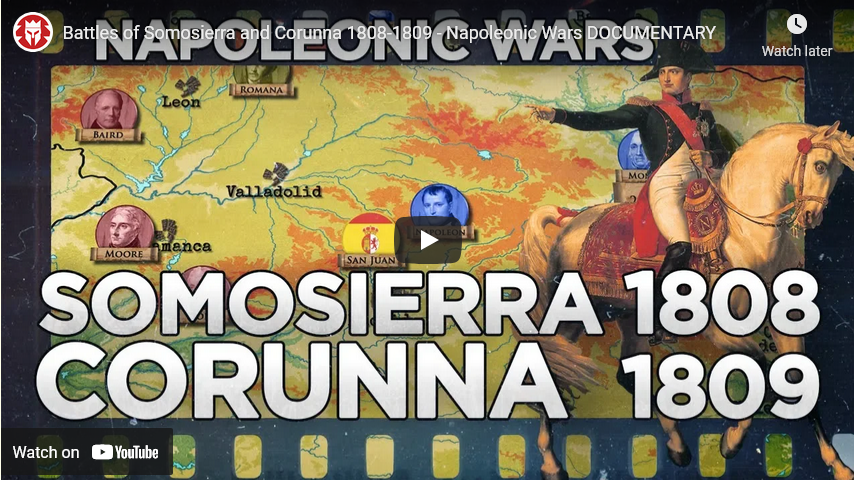
Published 17 Feb 2019We are continuing our historical animated documentary series on the Napoleonic Wars with another episode on the Peninsular War, covering the battles of Somosierra and Corunna. Napoleon attempted to take back Madrid and crush the British resistance led by General Moore.
This script was researched and written by Everett Rummage. Check out his brilliant Age of Napoleon podcast – http://bit.ly/2vC3cIE In our opinion, it is the best podcast on the Napoleonic era.
Support us on Patreon: http://www.patreon.com/KingsandGenerals or Paypal: http://paypal.me/kingsandgenerals
We are grateful to our patrons and sponsors, who made this video possible: https://drive.google.com/open?id=1Jlq…
This video was narrated by Officially Devin (https://www.youtube.com/user/OfficiallyDevin)
Machinimas were made on NTW3 mod for Napoleon Total War by Malay Archer (https://www.youtube.com/user/Mathemed…)
✔ Merch store ► teespring.com/stores/kingsandgenerals
✔ Podcast ► Google Play: http://bit.ly/2QDF7y0 iTunes: https://apple.co/2QTuMNG
✔ Twitter ► https://twitter.com/KingsGenerals
✔ Instagram ► http://www.instagram.com/Kings_GeneralsProduction Music courtesy of Epidemic Sound: http://www.epidemicsound.com
#Documentary #Kingsandgenerals #Napoleon
March 27, 2021
Battles of Somosierra and Corunna 1808-1809 – Napoleonic Wars
March 20, 2021
Iron cannon, improved celestial navigation techniques, and “race-built” galleons
In the latest Age of Invention newsletter, Anton Howes considers some of the technological innovations which helped English sailors to overcome powerful adversaries of the Spanish and Portuguese navies in the late 1500s and early 1600s:

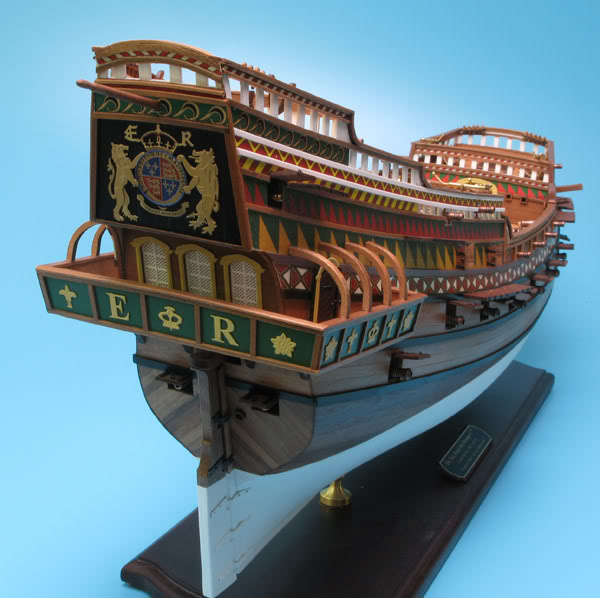
Stern view of a model of the Revenge as an example of a race-built galleon, 1577.
Image from modellmarine.de
Apart from the adoption and refinement of celestial navigation techniques, however, English seafaring capabilities also benefited from some more obvious, physical changes. In 1588, for example, on the eve of the Spanish Armada, a senior Spanish officer believed that the English had “many more long-range guns”. By the 1540s, medieval ironmaking techniques involving the blast furnace had gradually spread from Germany, to Normandy, and thence to the Weald of Sussex and Kent. Whereas in the first half of the sixteenth century England had typically imported three quarters of its iron from Spain, by 1590 it had not only quintupled its consumption of iron but was also almost entirely self-sufficient. And by allowing England to exploit its plentiful domestic deposits of iron, the blast furnace resulted in it producing many more cheap cannon.
Iron guns were in many ways worse for ships than those of bronze. They were heavier, prone to corrosion, and more likely to explode without warning. Bronze guns, by contrast, would first bulge and then split, but in any case tended to last. When the British captured Gorée off the coast of Senegal in 1758, they found a working English-made bronze cannon that dated from 1582. Yet iron was only 10-20% the price of bronze. Although the Royal Navy for decades continued to prefer bronze, cheap, medium-sized cannon of iron proliferated, becoming affordable to merchants, pirates, and privateers — a situation that was unique to England.
English ships were thus especially well-armed, allowing them to access new markets even when they sailed into hostile waters. They were soon some of the only merchants able to hold their own against the latest Mediterranean apex predator, whether it be the Spanish navy, Algeria-based corsairs, or Ottoman galleys. And they were able to insert themselves, sometimes violently, into the inter-oceanic trades — all despite the armed resistance of the Spanish and Portuguese, who had long monopolised those routes. In the 1560s, John Hawkins tried a few times to muscle in on the transatlantic Portuguese and Spanish trade in slaves. With backing from the monarch and her ministers, he captured Portuguese slave ships, raided and traded along the African coastline himself, and then sold slaves in the Spanish colonies of the Americas, sometimes having to attack those colonies before the local governor would allow them to trade. (The attempt was ultimately unsuccessful, as Hawkins’s privateering fleet was all but destroyed in 1568 and the English were not involved in the slave trade again for almost a century.)
The English hold over the hostile markets was only threatened during times of peace on the continent, when their ships’ defensiveness no longer gave them a special advantage. The Dutch usurped English dominance of the trade with Iberia and the Mediterranean, for example, during the Dutch Republic’s truce with Spain 1609-21. Their more efficient ships, especially for bulk commodities — the fluyt invented at Hoorn in the late 1580s — were cheaper to build, required fewer sailors, and were easier to handle. But these advantages only made them competitive when the risk of attack was low, as they were hardly armed. When wars resumed, the English had a chance to regain their position.
Finally, the English acquired a few further advantages when it came to ship design. Thanks to the shipwright Matthew Baker, who had been on the trial voyage Cabot dispatched to the Mediterranean, England experienced a revolution in using mathematics to design ships. Baker’s methods, seemingly developed in the 1560s, allowed him to more cheaply experiment with new forms, and by the 1570s these began to bear fruit. The old ocean-going carracks and galleons, with their high forecastles and aftercastles, became substantially sleeker. Taking inspiration from nature, Baker designed a streamlined, elongated hull modelled below the waterline upon a cod’s head with a mackerel tail. Above the waterline, too, he lowered the forecastle and set it further back, as well as flattening the aftercastle.
Starting in 1570 with his prototype the Foresight, and more fully developed in 1575-77 with the Revenge, these razed or “race-built” galleons gave the English some significant advantages. Drake even chose the Revenge as his flagship to battle the Spanish Armada in 1588, and to lead an ill-fated reprisal invasion of Portugal the following year. The higher castles of carracks and old-style galleons were suited to clearing an enemy’s decks with arrows and gunfire, as well as to defend against boarders. They were designed for combat at close quarters, in which height was an advantage. They were floating fortresses, their imposing height known to inspire terror. The race-built galleons, by contrast, by making the ship less top-heavy, could have longer and lower gundecks, with more of the ship’s displacement devoted to ordnance — especially useful when taking advantage of the cheaper but heavier cannon made of iron. Rather than killing an enemy ship’s sailors and soldiers, the race-built galleons were optimised for blasting through its hull. What they lost in “majesty and terror”, they made up for with overwhelming firepower. They aimed to sink.

February 10, 2021
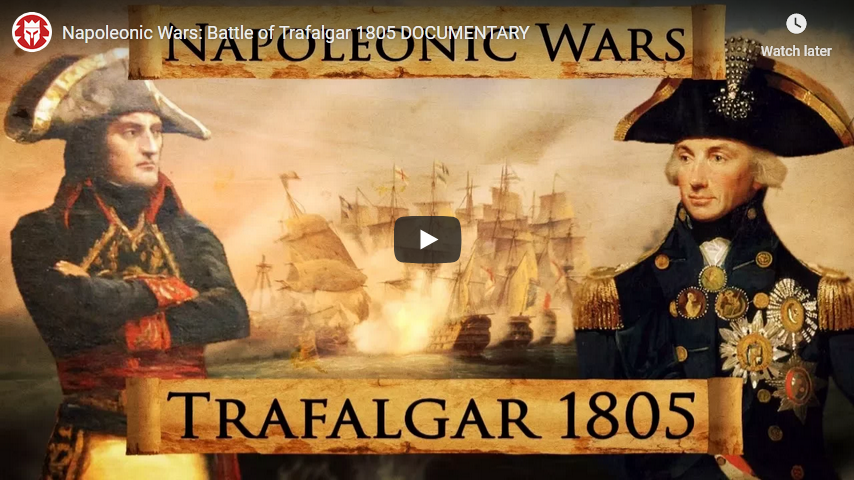
Napoleonic Wars: Battle of Trafalgar 1805
Kings and Generals
Published 5 Nov 2017Napoleon Bonaparte fought all his battles on land, but no other battle influenced his military and political decisions as the battle of Trafalgar that was fought in 1805 off the coast of Spain between the allied Franco-Spanish fleet lead by the admirals Pierre-Charles Villeneuve and Federico Gravina and the Royal Navy of the United Kingdom commanded by the admirals Horatio Nelson and Cuthbert Collingwood. This is our first video on the War of the Third Coalition and second video in this series. We hope to have much more and cover all the Napoleonic Wars.
Support us on Patreon: http://www.patreon.com/KingsandGenerals or Paypal: http://paypal.me/kingsandgenerals
We are grateful to our patrons, who made this video possible: Koopinator, Daisho, Łukasz Maliszewski, Nicolas Quinones, William Fluit, Juan Camilo Rodriguez, Murray Dubs, Dimitris Valurdos, Félix Gagné-Dion, Fahri Dashwali, Kyle Hooton, Dan Mullen, Mohamed Thair, Pablo Aparicio Martínez, Iulian Margeloiu, Chet, Nick Nasad, Jeyares, Amir Eppel, Thomas Bloch, Uri Sternfeld, Juha Mäkelä, Georgi Kirilov, Moe Mia, Daniel Yifrach, Brian Crane, Muramasa, Gerald Tnay, Hassan Ali and Richie Thierry.
This video was narrated by good friend Officially Devin. Check out his channel for some kick-ass Let’s Plays. https://www.youtube.com/user/Official…
The Machinimas for this video are created by one more friend – ltflak. Check out his channel for some great Let’s Plays and Machinimas: https://www.youtube.com/user/ltflak
✔ Twitch ► https://www.twitch.tv/nurrrik_phoenix
✔ Twitter ► https://twitter.com/KingsGenerals
✔ Instagram ► https://www.instagram.com/nurrrrrik
✔ Steam ► http://steamcommunity.com/id/nurrrikInspired by: BazBattles, Invicta (THFE), Epic History TV, Historia Civilis and Time Commanders
Machinimas made on the Napoleon Total War
Production Music courtesy of Epidemic Sound and Total War Napoleon: http://www.epidemicsound.com
Songs used:Epidemicsound:
“Slaves” – Gunnar Johnsén
“At The Front” – Johan Hynynen
“Battle Ostinato 3” – Valdemar HansenTotal War Napoleon:
Richard Beddow – “Corsica, Humble Beginnings”
Ian Livingstone – “The Battle At Arcole”
Richard Beddow – “HMS Victory”
Richard Beddow – “The End”
January 23, 2021
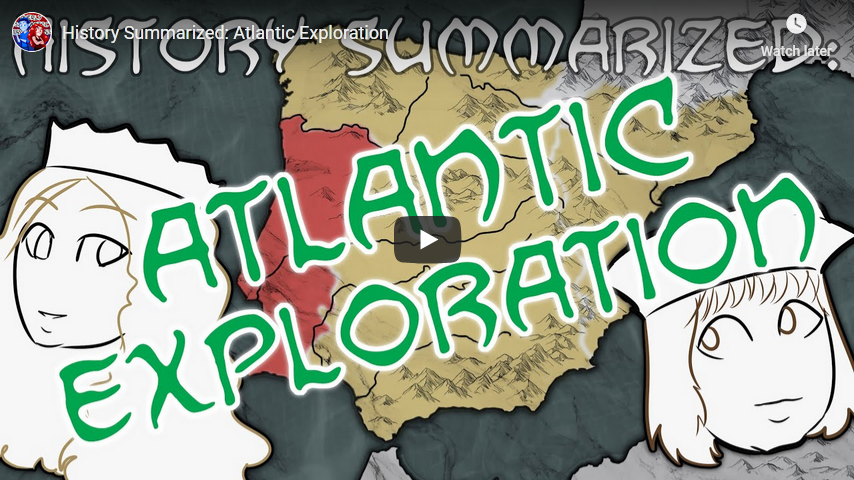
History Summarized: Atlantic Exploration
Overly Sarcastic Productions
Published 22 Jan 2021So you just conquered Iberia, and you’re wondering where to go from here? It’s a more common conundrum than you might think. Consider: a big wooden floaty house that goes splish-splash in the Atlantic Ocean. Anyway, this is a video about Portuguese and Spanish (erm, Castilian) exploration in the Atlantic during the 1400s. Please note my deliberate decision to Nope on out at the turn of the 1500s.
This topic was requested by our longtime patron Antonio Juarez! Thank you Antonio for supporting our work and helping to provide entertaining educational content.
SOURCES & Further Reading: Ornament of the World by Maria Rosa Menocal; lectures from Great Courses Plus “1571: Spain, Portugal Encircle the Globe” by Donald J. Harreld, “Renaissance and Exploration: New Horizons” by Jennifer McNabb, “Portugal’s Great Leap Forward” by “Vejas Gabriel Liulevicius”
TRACKLIST: “Scheming Weasel (faster version),” “Monkeys Spinning Monkeys”, “Local Forecast – Elevator” Kevin MacLeod (incompetech.com)
Licensed under Creative Commons: By Attribution 4.0 License
http://creativecommons.org/licenses/b…Our content is intended for teenage audiences and up.
PATREON: https://www.Patreon.com/OSP
PODCAST: https://overlysarcasticpodcast.transi…
DISCORD: https://discord.gg/osp
MERCH LINKS: http://rdbl.co/osp
OUR WEBSITE: https://www.OverlySarcasticProductions.com
Find us on Twitter https://www.Twitter.com/OSPYouTube
Find us on Reddit https://www.Reddit.com/r/OSP/
December 19, 2020
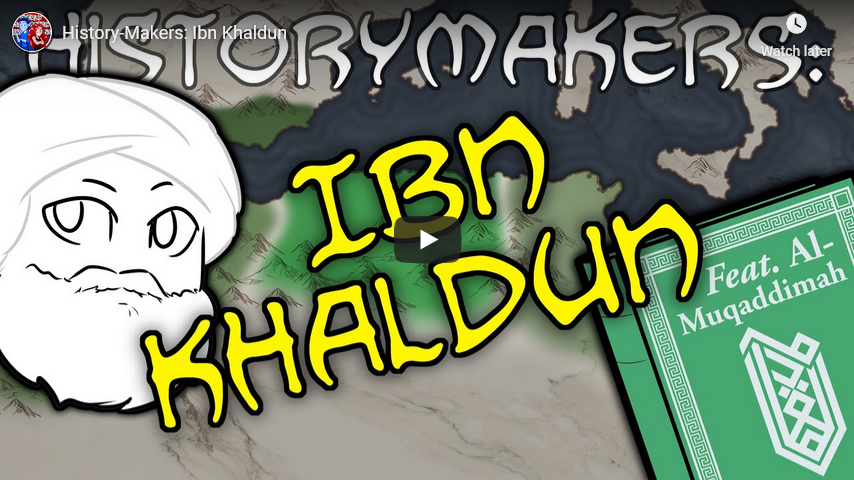
History-Makers: Ibn Khaldun
Overly Sarcastic Productions
Published 18 Dec 2020Big thanks to our friend Al-Muqaddimah for his help with this video. The look of this video’s maps is an homage to his wonderful mapmaking style. For more Islamic History, check out his channel here: https://www.youtube.com/channel/UCf0O…
From the coast of Tunisia across the Straits of Gibraltar, over the Atlas Mountains, and east to the Nile of Egypt, Ibn Khaldun had certainly seen history at work. That experience came in handy as he wrote The Muqaddimah, a genre-defining masterwork of Historiography — not just retelling the events of the past, but explaining their causes and effects through the lens of human behavior and sociology.
SOURCES & Further Reading: Ibn Khaldun: An Intellectual Biography by Irwin, The Muqaddimah
This video was edited by Sophia Ricciardi AKA “Indigo”. https://www.sophiakricci.com/
Our content is intended for teenage audiences and up.
PATREON: https://www.Patreon.com/OSP
PODCAST: https://overlysarcasticpodcast.transi…
DISCORD: https://discord.gg/osp
MERCH LINKS: http://rdbl.co/osp
OUR WEBSITE: https://www.OverlySarcasticProductions.com
Find us on Twitter https://www.Twitter.com/OSPYouTube
Find us on Reddit https://www.Reddit.com/r/OSP/
November 24, 2020
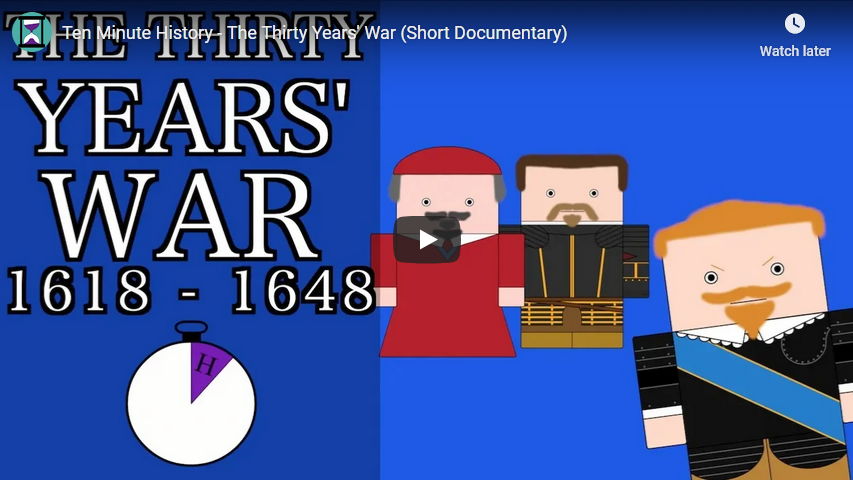
Ten Minute History – The Thirty Years’ War
History Matters
Published 30 Sep 2018Twitter: https://twitter.com/Tenminhistory
Patreon: https://www.patreon.com/user?u=4973164Special Thanks to the following Patrons for their support on Patreon:
Chris Fatta
Joshua
Mitchell Wildoer
Mason Cox
William Foster
Thomas Mitchell
Perry Gagne
Shaun Pullin
Anon
Spencer Smith
Matt M
RbjThis episode of Ten Minute History (like a documentary, only shorter) covers the outbreak of the Bohemian Revolt which was what would eventually spiral out of control into the Thirty Years’ War. The revolt was crushed fairly quickly but sparked intervention by Denmark, who didn’t do too well, and later Sweden who did very well. Both of these were aided by France who decided to get directly involved in 1635. By 1648 the Holy Roman Empire lay in ruins, with Austria and Spain struggling to pay for the war and rebuild the Habsburg Empire. This war saw the rise of Sweden and France but most importantly saw the foundations of modern diplomacy built.
Recommended books:
Mark Greengrass – Christendom Destroyed: Europe 1517-1648. Does a great job of outlying the theological currents in Europe at the time and how all of the religious changes led to the Thirty Years’ War.
Peter H. Wilson – Europe’s Tragedy: A New History of the Thirty Years’ War. The go-to text for the war; incredibly detailed and honestly can’t be beat for the topic. 100% recommend.
September 30, 2020
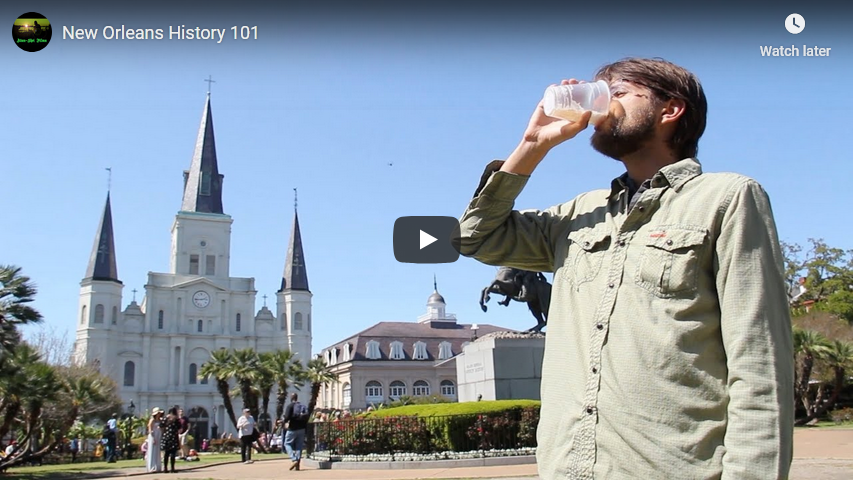
New Orleans History 101
Atun-Shei Films
Published 2 Apr 2019A brief crash course in the history of the city, from the founding in 1718 to the 20th century.
Support Atun-Shei Films on Patreon ► https://www.patreon.com/atunsheifilms
#NewOrleans #Louisiana #AmericanHistory
Watch our film ALIEN, BABY! free with Prime ► http://a.co/d/3QjqOWv
Reddit ► https://www.reddit.com/r/atunsheifilms
Twitter ► https://twitter.com/alienbabymovie
Instagram ► https://www.instagram.com/atunsheifilms
Merch ► https://atun-sheifilms.bandcamp.com
August 11, 2020
August 7, 2020
July 25, 2020
Did Jerónimo de Ayanz y Beaumont invent the steam engine a century before Newcomen?
In his latest Age of Invention newsletter, Anton Howes investigates Spanish claims that Jerónimo de Ayanz y Beaumont beat Newcomen by a hundred years in the quest to harness steam power:

Screenshot from “Savery’s Miners Friend – 1698”, a YouTube video by Guy Janssen (https://www.youtube.com/watch?v=Dt5VvrEIj8w)
The Spanish claimant in question is one Jerónimo de Ayanz y Beaumont, a late-sixteenth-century aristocrat and military engineer from Navarre, who from 1597 served as the administrator of the royal mines, and who invented a whole host of devices, from diving equipment and mine ventilation systems, to various improvements to mills, pumps, and furnaces. Thanks to the work of historian and engineer Nicolás García Tapia, whose biography of Ayanz came out in 2010, we now know quite a bit about this interesting inventor. The work was published in Spanish, and quite understandably was widely covered in the Spanish press. So although Ayanz has not quite become a household name in Spain just yet, he does now seem to be fairly well-known by the local “well actually” brigade (a shadowy international movement of which I am, to most people’s annoyance, a long-serving member). “Thomas Newcomen/Thomas Savery invented the steam engine you say? Well actually, I think you’ll find it was Ayanz a century earlier” — I had a quick google and discovered there were hundreds of comments to this effect.
But, actually, the story is a bit more complicated than that. The devil, as always, is in the detail, and unfortunately the press claims about the technology have become widely and erroneously repeated, apparently ignoring Tapia’s careful historical work. I even spotted a recently-published encyclopaedia of inventions that repeated the errors.
So what, exactly, did Ayanz invent? The key fact is that in 1606 he obtained a 20-year monopoly from the king of Spain for the use of over fifty different inventions, including two steam-related devices. One of these was related to getting rid of deadly mine gases, which had killed one of his friends and collaborators, and had almost killed Ayanz too. His solution was a steam injector — essentially, a steam boiler with a narrowing pipe sticking out of it, which would inject the steam into a larger air pipe. The pressurised steam, upon flowing up into the air pipe, created a powerful sucking effect behind it, thus rapidly drawing deadly gases out of the mine. (A bit like at the start of this video).
It was the second steam-powered device, however, that has become famous as Ayanz’s steam engine. Just like the inventions of Thomas Savery and Thomas Newcomen about a century later, it was designed to pump the water out of mines. Ayanz formed a partnership in 1608-11 to reopen the silver mines of Guadalcanal in Spain, which had been abandoned due to flooding, and seems to have tried to implement the engine there: he obtained rights to cut down nearby trees for firewood, for example, and exploited nearby copper, which would have been essential for making boilers and pipes. As for whether he actually got it to work, we don’t know for sure. Sadly, he died only a few years after starting the project.
But the devilish detail is in how his engine worked. Specifically, all the multiplying errors seem to have arisen from a misinterpretation, by the press, of Tapia’s statement that the engine was “very similar” to that of Thomas Savery. There are, certainly, some important similarities. Both engines, for example, exploited the expansionary force of steam. In both, steam from a boiler was piped into a water tank, forcing that water up a narrow pipe — what we might call a pushing effect. And both engines used two tanks, which alternated so that the engine would pump continuously. While one tank and was being refilled with mine water, the other would be have the steam pushing the water out, and then vice versa. So far so good. Indeed, due to the two water tanks, drawings of Ayanz’s and Savery’s devices look very similar side by side.
July 21, 2020
Spanish Republican Exiles – Nazi Colonialism & Hitler + Mussolini ≠ ❤️ – WW2 – OOTF 014
World War Two
Published 16 Jul 2020What did Spanish Republicans do during the Second World War? How would the Axis have divided Africa? And did Hitler plan to keep Mussolini around after the war? Find out as Indy and the Chair of Infinite Knowledge answer three more intriguing questions in this episode of Out of the Foxholes!
Join us on Patreon: https://www.patreon.com/TimeGhostHistory
Or join The TimeGhost Army directly at: https://timeghost.tvSubmit your own question for Out of the Foxholes here: https://community.timeghost.tv/c/Out-…
Follow WW2 day by day on Instagram @World_war_two_realtime https://www.instagram.com/world_war_two_realtime
Between 2 Wars: https://www.youtube.com/playlist?list…
Source list: http://bit.ly/WW2sourcesHosted by: Indy Neidell
Written by: Rune Væver Hartvig
Director: Astrid Deinhard
Producers: Astrid Deinhard and Spartacus Olsson
Executive Producers: Astrid Deinhard, Indy Neidell, Spartacus Olsson, Bodo Rittenauer
Creative Producer: Joram Appel
Post-Production Director: Wieke Kapteijns
Research by: Rune Væver Hartvig
Edited by: Karolina Dołęga
Sound design: Marek Kamiński
Map animations: Karolina DołęgaVisual Sources:
Bundesarchiv
US Holocaust Memorial Museums
Library of Congress Geography and Map Division
Nasjonalbiblioteket from Norway
Icons from The Noun Project by: Milinda Courey, Eucalyp, Luis Prado, Gan Khoon Lay, DonBLC, Pavel N and Rigo PeterMusic:
“Deviation In Time” – Johannes Bornlof
“Superior” – Silver Maple
“Underlying Truth” – Howard Harper-BarnesArchive by Screenocean/Reuters https://www.screenocean.com.
A TimeGhost chronological documentary produced by OnLion Entertainment GmbH.
July 15, 2020
When The Dutch Ruled The World: Rise and Fall of the Dutch East India Company
Business Casual
Published 14 Sep 2018Thanks to Cheddar for sponsoring this episode! Check out their video on the iconic ad campaign that saved Old Spice here: https://chdr.tv/youtu8b4a6
⭑ Subscribe to Business Casual → http://gobc.tv/sub
⭑ Enjoyed the vid? Hit the like button!Follow us on:
► Twitter → http://gobc.tv/twtr
► Instagram → https://gobc.tv/ig
► LinkedIn → https://gobc.tv/linkedin
► Reddit → https://gobc.tv/reddit
► Medium → https://gobc.tv/medium
June 24, 2020
Napoleon’s Great Blunder: Spain 1808
Epic History TV
Published 16 Jan 2019In 1808, Napoleon’s rivalry with Britain led to an ill-fated intervention in Portugal and Spain, that sparked a nationalist revolt against the French. At Bailén Napoleon’s Empire suffered its first major defeat, and though Napoleon himself then arrived in Spain to reassert French military dominance, he could not prevent the escape of Sir John Moore’s small British army, after its defensive victory at Corunna on 16 January 1809. The British army would return, under new leadership, to play a major part in his downfall.
Get early access and a vote on future topics by supporting us on Patreon: https://www.patreon.com/epichistorytv
With thanks to HistoryMarche, check out his channel here: https://www.youtube.com/channel/UC8MX…
Find Osprey books on the Napoleonic Wars here:
https://ospreypublishing.com/Great books about the Napoleonic Wars (as an Amazon Associate I earn from qualifying purchases):
The Napoleonic Wars http://geni.us/R5ZI9c
Corunna 1809 http://geni.us/IHLD
Peninsular War Atlas http://geni.us/S6Na84z
Napoleon the Great http://geni.us/NqMW#EpicHistoryTV #NapoleonicWars #Napoleon
All music from Filmstro https://www.filmstro.com/
Get 20% off an annual license with this exclusive code:EPICHISTORYTV_ANNThanks to The 95th Rifles Battle Re-enactment and Living History Society: https://www.95thrifles.com/
June 6, 2020
Pope Fights 3 — The Italian Wars: History Summarized
Overly Sarcastic Productions
Published 5 Jun 2020It’s time for a POPE FIIIIIIIIIIIIGHT!!!!! Gather ’round and listen to a tale of the utter nonsense that is the Renaissance Papacy. We’ll look at the Pontifical careers of Rodrigo Borgia, Julius II, Leo X, and Clement VII.
SOURCES & Further Reading: Rome: A History In Seven Sackings by Kneale, A History of Venice by Norwich.
This video was edited by Sophia Ricciardi AKA “Indigo”. https://www.sophiakricci.com/
Our content is intended for teenage audiences and up.PATREON: https://www.Patreon.com/OSP
MERCH LINKS: https://www.redbubble.com/people/OSPY…
OUR WEBSITE: https://www.OverlySarcasticProductions.com
Find us on Twitter https://www.Twitter.com/OSPYouTube
Find us on Reddit https://www.Reddit.com/r/OSP/
May 9, 2020
The Battle of Trafalgar – Admiral Nelson’s Moment
IT’S HISTORY
Published 13 May 2015It was the defining moment of the British naval history and let the groundwork for their naval superiority over the next century. Horatio Nelson’s brilliant battle tactics let to a decisive victory over Napoleon’s French Navy. Find out all about the famous Battle of Trafalgar with Indy on IT’S HISTORY.
» The Complete Piracy-PLAYLIST: http://bit.ly/PiratePlaylist
» ALL EPISODES of Battlefields: http://bit.ly/BattlefieldsOfHistory
» JOIN OUR COMMUNITY FOR MORE HISTORY KNOWLEDGE!
Follow us on Twitter: http://twitter.com/thehistoryshow
Your photos on Instagram: https://instagram.com/itshistorychannel» SOURCES
Videos: British Pathé (https://www.youtube.com/user/britishp…)
Pictures: mainly Picture Alliance» ABOUT US
IT’S HISTORY is a ride through history – Join us discovering the world’s most important eras in IN TIME, BIOGRAPHIES of the GREATEST MINDS and the most important INVENTIONS.» HOW CAN I SUPPORT YOUR CHANNEL?
You can support us by sharing our videos with your friends and spreading the word about our work.» CAN I EMBED YOUR VIDEOS ON MY WEBSITE?
Of course, you can embed our videos on your website. We are happy if you show our channel to your friends, fellow students, classmates, professors, teachers or neighbors. Or just share our videos on Facebook, Twitter, Reddit etc. Subscribe to our channel and like our videos with a thumbs up.» CAN I SHOW YOUR VIDEOS IN CLASS?
Of course! Tell your teachers or professors about our channel and our videos. We’re happy if we can contribute with our videos.» CREDITS
Presented by: Indy Neidell
Based on the script by: Daniel Hungerford
Directed By: Daniel Czepelczauer
Director of Photography: Markus Kretzschmar
Music: Markus Kretzschmar and Daniel Czepelczauer
Sound Design: Bojan Novic
Editing: Markus KretzschmarA Mediakraft Networks original channel
Based on a concept by Florian Wittig and Daniel Czepelczauer
Executive Producers: Astrid Deinhard-Olsson, Spartacus Olsson
Head of Production: Michael Wendt
Producer: Daniel Czepelczauer
Social Media Producer: Hendrik Sontheim
Social Media Manager: Florian Wittig and Laura PaganContains material licensed from British Pathé
All rights reserved – © Mediakraft Networks GmbH, 2015