Quotulatiousness

January 8, 2024

Royal Navy to retire their only two LPDs?

Filed under: Britain, Military — Tags: , , , — Nicholas @ 05:00

Sir Humphrey comments on the recently reported “leak” about several Royal Navy ships:

In an “inspired” leak that seems to fit the Yes Minister definition of a “Confidential Security Briefing”, the Daily Telegraph is reporting that the Royal Navy is to pay off two Type 23 frigates, HMS Argyll and Westminster early in order to find crew for the Type 26 frigates. Assuming this is true, this means that since 2010 the Royal Navy escort fleet will have been cut by 40%. Meanwhile the Times is reporting that the Royal Navy will mothball both LPD’s and no longer have an active amphibious assault ship command platform. This represents a 100% cut to the active assault ship force. The reasons given in both cases seem to boil down to the line that this is about providing sailors to crew the Type 26 frigate. It doesn’t seem to be linked to the rumoured huge budgetary challenges facing the MOD this financial year, which could equally be responsible for this decision.

There are different ways that this information can be interpreted depending on how you look at it. For starters we need to ask the question, why these two ships? The Type 23 force is elderly, with the ships intended for an original 18-year life span, worked hard in the North Atlantic and replaced quickly. They have all been extended in service for up to twice their original design life, while repeated delays to order the Type 26 has meant they are working far harder, and far longer than ever anticipated.

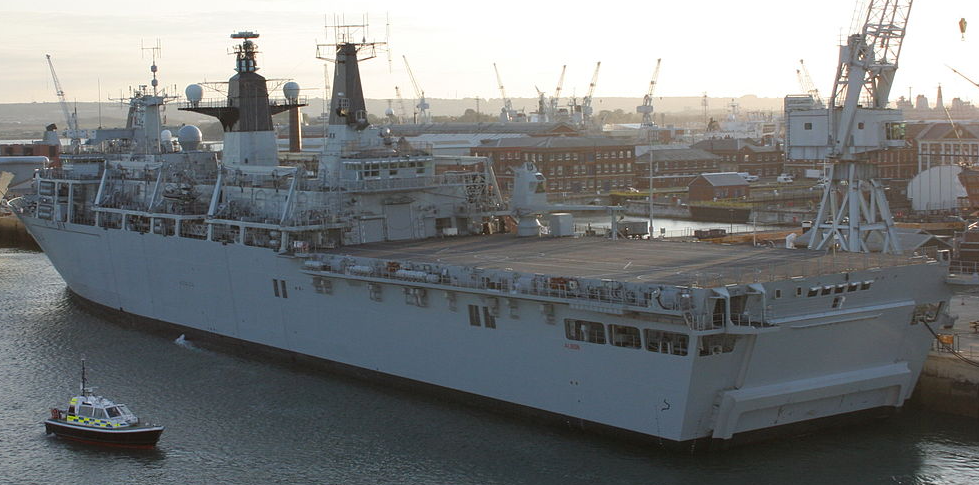
HMS Albion docked at Portsmouth, 26 July 2029.
Detail of a photo by David Crochet via Wikimedia Commons.

These are ships designed 40 years ago, with the original Type 23 design dating back to the early 1980s. It is no exaggeration to say that there is almost certainly no one left in active regular service who was serving when the Type 23 design was first conceived. This means the design reflects the 1980s equipment and capabilities and standards – be it in the structure of the messes (large mess decks for junior sailors) or the internal wiring and machinery. While still capable, be in no doubt that these are elderly ships with all the many challenges that this brings. To make up for the many and varied delays to the Type 26, the RN has funded life extension work to the force for some years, fitting new missiles, guns and sonar equipment over time. The modern Type 23 is a far cry from its original design in equipment and capability, but it is still at its heart a 1980s warship.

Westminster had gone into refit in 2022 to begin the process of extending her life out to the late 2020s. The refit for Westminster would have cost around £100m to provide a further 4-5 years of service. while HMS Argyll had undergone the life extension process which would have seen a planned decommissioning in the late 2020s (the precise dates are not clear anymore due to the “odd” MOD decision to currently no longer provide this information on the grounds of operational security).

The LPD force by contrast is in a different position. The two ships Albion and Bulwark were built to replace the venerable Fearless class in the mid 2000s. For most of their career one has been in reserve while the other has been active, the same pattern as occurred with Fearless and Intrepid, where the latter spent years in increasingly poor state in reserve. The timing for this decision makes sense operationally as Albion has come to the end of her commission and was due to pay off into reserve, while Bulwark is still being regenerated in refit and hasn’t yet gone to sea. It would be possible to put both ships in reserve and free up a reasonable amount of sailors in the process.

The question is what is the impact on the fleet itself? Currently the RN probably has a requirement for 19 escort ships – “probably” is used as the MOD has refused to provide a statement on target force numbers in the two most recent Defence Reviews, so this is an assessment based on the 2015 Defence Review. That we have to rely on a near decade old defence review to guess how many escorts the RN plans to have speaks volumes for the manner in which the MOD engages with the taxpayer.

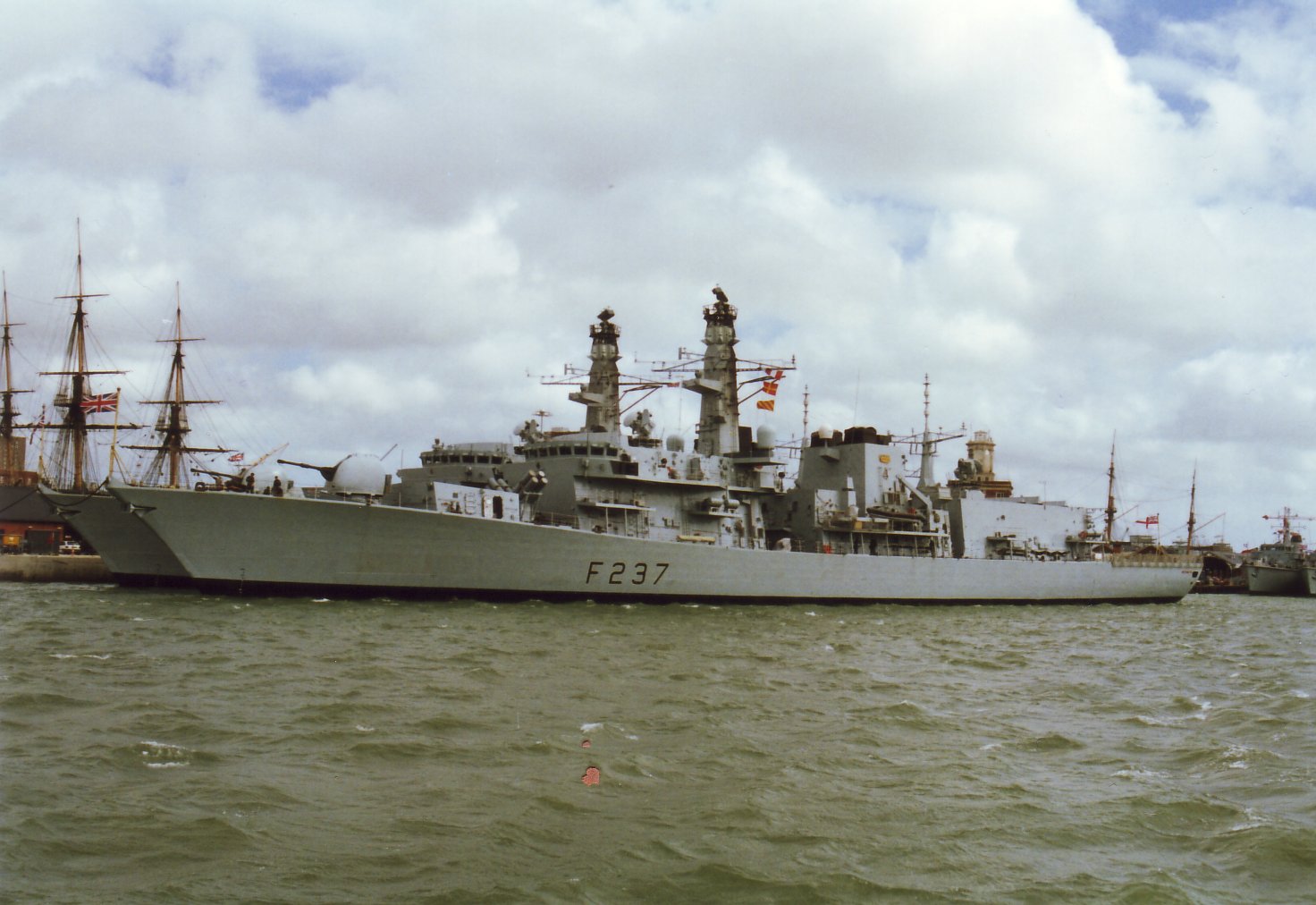
HMS Westminster (foreground) and HMS Iron Duke, Type 23 frigates of the Royal Navy, in the naval base of Portsmouth, August, 2000.
Image via Wikimedia Commons.

December 7, 2023

Canada is great at gesturing on the international stage … far less so in doing anything substantive, especially militarily

Filed under: Cancon, Government, Military — Tags: , , , — Nicholas @ 05:00

In The Line, Harrison Ruess channels his inner Star Trek geekiness to illustrate the Kobayashi Maru situation the Royal Canadian Navy (and the rest of the armed forces) find themselves in:

Canada is, and has been for some time, caught between two irreconcilable positions. We don’t want to spend any money on the military but also continue to prioritize how important and influential we want to be in the world (“Canada is back”, etc).

Friends, either of these things is possible. We just can’t do both at the same time.

So let’s have an honest conversation and decide which road we want to go down, commit to it, and then do the best we can in whichever adventure we choose. Talking, domestically and internationally, about how determined Canada is to make a positive impact in the world, while not investing in the systems to give our words weight, sets both Canadians and our allies up for disappointment. The old adage that it’s best not to over-promise and under-deliver should be remembered. We seem to aspire to the reverse.

If Canadians really don’t want to invest in our military, then we need to be honest about the consequences of those decisions. It means a more inwardly focused Canada, less able to support our allies, with fewer seats at big tables, less able to respond to emergencies or disasters, and likely less able to help our own. Given our unstable world, I would not personally advocate for this road, but there is a case to be made for it. So if you are someone who thinks this is the right path, then make your case honestly. Explain why you think it’s swell that our navy will need to launch under-equipped vessels, or not launch them at all. Defend your ground. But stop trying to sell Canadians a fable that we can have a shell of an armed forces while at the same time having increased global influence and impact.

On the other hand, if we do think Canada has a positive role to play — and even a responsibility — in trying to bring some order to the world, help those who need it, and ultimately protect our own interests, then we need a military, and a military budget, strong enough to meet the demands of the task. This includes procurement budgets, maintenance budgets, budgets to offer competitive wages, and budgets to sustain missions, both training and the real deal.

Proponents of this position need to do a much better job of explaining why this is the best path to both improving the lives of Canadians and stabilizing our destabilized world. Then our governments must pursue and defend this road, even when defence isn’t top of the polling priority list — which it never is.

The current status-quo doesn’t work. It’s dishonest. And most importantly, it hurts Canadians and our awareness of what our country is — or isn’t — capable of doing. Kudos to V.Adm. Topshee for, in not so many words, trying to explain the impact of this reality on the navy.

Having a capable, equipped military costs money — starting with perhaps the NATO-agreed upon two per cent of GDP. That’s the cost of doing business as a serious, mature, supposedly globally oriented country. Are we that? Do we even want to be?

December 6, 2023

Halifax Explosion: Minute by Minute

Filed under: Cancon, History, WW1 — Tags: , , , — Nicholas @ 02:00

Terra Incognita
Published 5 Dec 2017

100 years ago, the Canadian port city of Halifax was struck by one of the largest non-nuclear explosions in history. How did it happen?
(more…)

October 20, 2023

Look at Life – Oil Aboard (1963)

Filed under: Britain, History, Middle East — Tags: , , — Nicholas @ 02:00

Classic Vehicle Channel
Published 18 Apr 2020

The oil industry and the manufacture of fuel.

October 18, 2023

Why the Canadian Surface Combatant (CSC) program will cost so much more than equivalent US or British ships

Filed under: Business, Cancon, Military — Tags: , , , , , — Nicholas @ 03:00

In The Line, Philippe Lagassé outlines the Canadian Surface Combatant (CSC) program — the next-generation front-line combat ships for the Royal Canadian Navy intended to replace the current Halifax-class frigates and the already retired Iroquois-class destroyers:
Building warships is an expensive business, especially if you’re getting back into it after a few decades. Take the Canadian Surface Combatant (CSC). Fifteen CSCs will be built at Halifax’s Irving Shipbuilding to replace Canada’s current frigates and decommissioned destroyers. According to a 2022 study by the Parliamentary Budget Officer (PBO), the CSC acquisition will cost $80.2 billion. Given that defence inflation is well above regular inflation, and that regular inflation is running hot, that number isn’t going to go down.

Canada’s CSC will be a variant of the Type 26 Global Combat Ship originally designed for the Royal Navy. The Canadian variant includes significant changes to the original Type 26 design, notably to the combat systems. With the estimated per unit cost of each ship topping $5.6 billion, the National Post‘s John Ivison warns that the CSC is out of control. Ivison notes that the United States Navy (USN) acquired its Constellation-class frigates for $1.66 billion. Why, he understandably asks, is Canada paying so much for the CSC, and to what end?

The Canadian government always views major military purchases for the Canadian Armed Forces primarily as regional economic development projects and always attempts to get all or at least a major part of the construction done in Canada. To most people this sounds sensible: big military equipment acquisitions mean a lot of money being spent, so why shouldn’t most of that money be spent inside Canada? The answer, in almost every case, is that it will be significantly more expensive because Canadian industry doesn’t regularly produce these ships/planes/helicopters/tanks, so a lot of money will need to be spent to construct the factories or shipyards, import the specialized equipment, hire and train the workforce, etc., and no rational private industry will spend that kind of money unless they’re guaranteed to be repaid (plus profit).

Ordinary items for the Canadian military like clothing, food, non-specialized vehicles (cars, trucks, etc.) may carry a small extra margin over run-of-the-mill stuff, but it will generally be competitive with imported equivalents. Highly specialized items generally won’t be competitively priced exactly because of those specialized qualities. The bigger and more unusual the item to be purchased, the less economic sense it makes to buy domestically.

There are also the conflicting desires of the elected government (who generally want to target the spending to electoral districts or regions that benefit “their” voters), the permanent bureaucracy (who want to ensure that programs last a long time to ensure jobs within the civil service), and the military procurement teams (who have a tendency to over-optimistically estimate up-front and long-term costs because they want to get the procurement process underway … it’s tougher to stop something already in-process than one that still needs formal approval).

Once there’s a budget and capabilities are identified, the requirements for individual projects are prepared. It’s here that the comparison with lower cost, off-the-shelf alternatives runs into difficultly. The USN has lots of different types of ships that do lots of specific things. The above-mentioned Constellation-class is one of many different types of warships that the USN will sail, each with specific mission sets and roles. The Canadian military has only been directed to acquire fifteen CSCs, but the government expects the CAF to do a variety of missions at sea — not as many as the USN, of course, but still a good number. Canada has other military ships, including the Arctic Offshore Patrol Vessels (AOPS) also being built by Irving, but the CSC will be Royal Canadian Navy (RCN)’s primary expeditionary platform. Canadian defence planners, therefore, need those 15 ships to be capable of undertaking various missions and roles. Compounding this challenge are technological changes and the ever-evolving threat. The requirements for the CSC need to be continuously updated, and in some cases expanded, to keep pace with these developments, too.
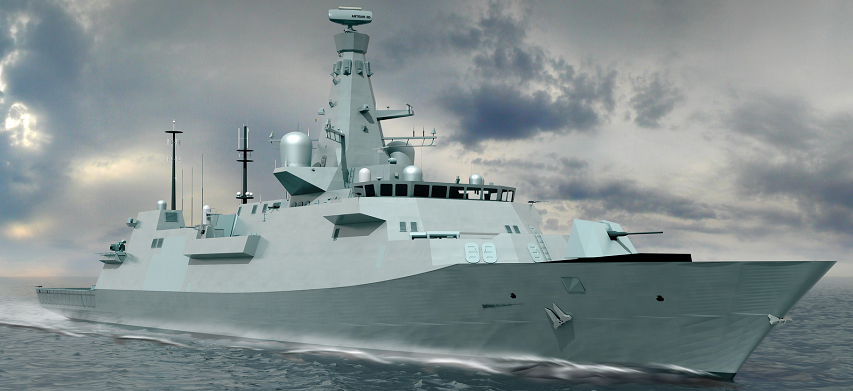
An artist’s rendition of BAE’s Type 26 Global Combat Ship, which was selected as the Canadian Surface Combatant design in 2019, the most recent “largest single expenditure in Canadian government history” (as all major weapon systems purchases tend to be).
(BAE Systems, via Flickr)

On purely economic grounds, it would often make sense to add Canada’s order on to existing US, British, or other allied military orders to benefit from the economies of scale … but pure economic benefits don’t rank highly on the overall scale of importance. There’s also the understandable desire of the government to buy fewer items with wider capabilities as the government’s requirements for the military change with time and circumstance.

Were Canadian defence planners too cavalier in their requirements and design modifications? Maybe. Looking at it from their perspective, though, we should appreciate that they thinking about capabilities for a ship that Canada will use until the 2100s.

Doubts about the CSC are going to keep multiplying. The per unit costs can only increase so much before people start seriously discussing reducing how many of them will be built. You can be sure that some within government are already asking “Why 15? Why not 12?” Serious concerns are also being raised about whether the defence budget can afford to maintain CSC and keep them technologically up to date after the fleet is introduced. Given the CAF’s personnel recruitment troubles, moreover, it’s unclear if the RCN will have enough sailors to operate the full fleet. The first CSC that hits the water, furthermore, will have all sorts of kinks and problems that will need to be sorted out. That’s standard for first ships off the line, but you can be sure that every failing will be met with handwringing and charges of incompetence.

To address these concerns, the government must let DND/CAF better explain what the CSC is designed to do and why it needs to do it. Simply telling Canadians that it’s the right ship isn’t enough when it’s easy to point to lower-cost alternatives. As well, the government needs to be far more transparent about estimates of costs and what’s driving them. Political and public support for the CSC shouldn’t be taken for granted, and growing concerns about the program can’t be simply brushed away.

August 28, 2023

Why Britain Advanced Before Other European Nations | Thomas Sowell

Filed under: Britain, Economics, History, Law, Technology — Tags: , , , — Nicholas @ 02:00

Thomas SowellTV
Published 17 Dec 2021
(more…)

August 27, 2023

QotD: Getting food to market in pre-modern societies

Filed under: Economics, Europe, Food, History, Quotations — Tags: , , , , — Nicholas @ 01:00

The most basic kind of transport is often small-scale overland transport, either to and from the nearest city, or in small (compared to what we’ll discuss in a moment) caravans moving up and down a region […]. The Talmud, for instance, seems to suggest that much of the overland grain trade in Palestine under the Romans was performed with itinerant donkey-drivers in small caravans – and I do mean small. Egyptian tax evidence suggests that most caravans were small; Erdkamp notes that 90% of donkey caravans and 75% of camel caravans consisted of three or less animals. These sorts of small caravans don’t usually specialize in any particular good but instead function like land-based cabotage traders, buying whatever seems likely to turn a profit at each stop and stopping in each town and market along the way. Some farmers might even do this during the off season; in Spain, peasants often worked as muleteers during the slow farming season, moving rents and taxes into town or to points of export for their wealthy landlords and neighbors.

Truly long-distance bulk grain transport overland wasn’t viable for reasons we’ve actually already discussed. There is simply nothing available in the pre-modern period to carry the grain overland that doesn’t also eat it. While moving grain short distances (especially to simply fill capacity while the main profit is in other, lower-bulk, higher value goods) can be efficient enough, at long distance, all of the grain ends up eaten by the animals or people moving it.

The seaborne version of this sort of itinerant, short-distance trade is called cabotage. Now today cabotage has a particular, technical legal meaning, but when we use this word in the past, it refers not to the legal status of a ship but a style of shipping using small boats to move mixed cargo up and down the coast. In essence, cabotage works much the same as the small caravans – the merchant buys in each port whatever looks likely to turn a profit and sells whatever [is] in demand. By keeping a mixed cargo of many different sorts of things, he protects against risk – he’s always likely to be able to sell something in his boat for a profit. Such traders generally work on very short distances, often connecting smaller ports which simply cannot accommodate larger, deeper-draft long-distance traders. Such cabotage trading was the background “hum” of commerce on many pre-modern coastlines and might serve to move grain up or down the coast, although not very much of it. Remember that grain is a bulk commodity, and cabotage traders, by definition, are moving small volumes.

But when it comes to moving large volumes, the sea changes everything. The fundamental problem with transporting food on land is that the energy to transport the food must come from food, either processed into muscle power by porters or animals. But at sea, that energy can come from the wind. So while the crew of a ship eats the food, the ship can be scaled up without scaling up the food requirements of the crew or the crew itself. At the same time, sea-transit is much faster than land transit and that speed is obtained from the wind without further inputs of food. It is hard to overstate how tremendous a change in context this is. Using the figures from the Price Edict of Diocletian, we tend to estimate that river transport was five times cheaper than land transport, and sea-transport was twenty times cheaper than land transport. So while the transport of bulk goods like grain on land was limited to fairly small amounts moving over short distances – say from the farm to the nearest town or port – grain could be moved long distances en masse by sea.

Now the scale and character of long-distance transport is heavily impacted by the political realities of the local waterways. If the seas are politically divided, or full of pirates, it is going to be hard to operate big, slow vulnerable grain-freighters and still make a profit after some of them get seized, pirated or sunk. But when we have periods of political unity and relatively safe seas, we see that this sort of transport can reach quite impressive scale. For instance the port regulations of late Hellenistic and Roman Thasos – itself a decent sized, but by no means massive port – divided its harbor into two areas, one for ships carrying 80-130 tons of cargo and one for ships 130+ tons (those regulations are SEG XVII 417). A brief bit of math indicates that the distribution of free grain in the city of Rome – likely less than a third of the total grain demands of the city – required the import, by sea of some 630 tons of grain per day through the sailing season. The scale of grain shipment in the back half of the Middle Ages (post-1000 or so) was also on a vast scale, with trade-oriented Italian cities exploding in population as they imported grain (Genoa being particularly well known for this, but by no means alone in it); with that came the reemergence of truly large grain-freighters.

Bret Devereaux, “Collections: Bread, How Did They Make It? Part IV: Markets, Merchants and the Tax Man”, A Collection of Unmitigated Pedantry, 2020-08-21.

August 11, 2023

The Weirdest Boats on the Great Lakes

Railroad Street
Published 5 May 2023

Whalebacks were a type of ship indigenous to the Great Lakes during the late 1890s and mid 1900s. They were invented by Captain Alexander McDougall, and revolutionized the way boats on the Great Lakes handled bulk commodities. Unfortunately, their unique design was one of the many factors which led to their discontinuation.
(more…)

August 8, 2023

Up close with Royal Marines landing craft

Filed under: Britain, Military — Tags: , — Nicholas @ 02:00

Forces News
Published 12 Jul 2022

Specialists in small craft operations and amphibious warfare, 47 Commando (Raiding Group) Royal Marines are preparing for overseas training in the Netherlands.

Briohny Williams met up with the marines and found out more about their landing craft.
(more…)

August 2, 2023

How Shipping Containers Took Over the World (then broke it)

Filed under: Business, Economics, History, Railways, USA — Tags: , , , , — Nicholas @ 02:00

Calum
Published 5 Oct 2022

The humble shipping container changed our society — it made International shipping cheaper, economies larger and the world much, much smaller. But what did the shipping container replace, how did it take over shipping and where has our dependance on these simple metal boxes led us?
(more…)

July 10, 2023

Echoes of War: Accounts of Operation Husky and the Allied Landings in Sicily

Filed under: Britain, Cancon, History, Italy, Military, USA, WW2 — Tags: , , , , — Nicholas @ 04:00

OTD Military History
Published 9 Jul 2023

On July 9/10 Allied forces launched Operation Husky, the invasion of Sicily. This video presents accounts from various Allied military personnel who were there that day.
(more…)

June 21, 2023

Scuttling of the German High Seas Fleet at Scapa Flow, Orkney, 21 June 1919 in the Great War

Filed under: Britain, Germany, History, Military, WW1 — Tags: , , — Nicholas @ 02:00

CEFRG (Canadian Expeditionary Force Research Group)
Published 3 Apr 2020

The German High Seas Fleet decided to sink as many of its own ships as possible to prevent them from falling into Allied hands. In total, 52 of 74 ships were sabotaged to keep them from Britain, France, Italy and the USA. Most of these nations wanted a share for their navies, and knowing she could not have them all to herself, Britain wanted the ships scrapped to prevent other nations from gaining naval superiority.

On the morning of 21 June 1919, the British fleet left Scapa Flow for exercises, and Rear Admiral Sydney Freemantle, commander of the 1st Battle Squadron guarding the ships, planned to return two days later to board and seize the ships.

Already occupying Germany west of the Rhine, the Allied Powers expected Germany to accept all articles of the Treaty of Versailles by 23 June, and threatened to occupy territory east of the Rhine if all demands were not met. German Rear Admiral Ludwig von Reuter, following orders he had received after the breakdown of negotiations, seized the opportunity with the British fleet having just left the harbour, gave the order to scuttle all ships as his crews opened seacocks, torpedo tubes and portholes to flood them, and once again hoisted the flag of the Imperial German Navy.

The final battle casualties of the Great War occurred on this day, with nine German sailors killed and sixteen wounded by the British during brawls when they refused to help save the ships. For his part, von Reuter was imprisoned along with 1,800 of his men, but was released the following year. Upon his return to Germany, he was praised as the man who had preserved the honour of the German High Seas Fleet (in typical fashion, Freemantle had angrily accused von Reuter of having behaved without honour).

Of the 52 ships scuttled in 1919, seven remain at the bottom of the sea today. They are registered under the Ancient Monuments and Archaeological Areas Act 1979, and provide some of the best shipwreck diving in Europe.

(more…)

June 14, 2023

The sinking of Norwegian frigate HNoMS Helge Ingstad in 2018

Filed under: Europe, Military — Tags: , , , — Nicholas @ 05:00

CDR Salamander must follow Norwegian court cases more closely than I do … which is “not at all” in my case. Oddly, I was just thinking about the loss of HNoMS Helge Ingstad last week, and here’s follow-up information from the appeals process:

HNoMS Helge Ingstad, a Fridtjof Nansen-class frigate commissioned in 2009.
Photo detail via Wikimedia Commons.

The court case against the officer of the watch (vaktleder) and its appeals has brought the issue back to the front in Norway.

In yesterday’s Forsvarets Forums article (remember to translate it), retired Norwegian naval officer with multiple command tours, Hans Petter Midttun, outlines a must read wire brushing of the entire “optimal manning” concept.

You will see that his view of what it caused to the Norwegian Navy’s nightmare is a direct parallel of that happened to the US Navy in that horrible month of 2017; too much to do with too little people with too thin training.

Let’s dive in;

    The Ministry of Defense (FD), the Defense Staff (FST) and the Norwegian Navy (SST) have, in my opinion, knowingly or unknowingly breached the prerequisites for proper operation of the frigates.

    My claim is rooted in 23 years of frigate competence. I have held most of the operational positions in the frigate force. This includes the positions as ship commander at KNM Narvik and KNM Roald Amundsen, as well as a period at the Navy’s competence center and two periods as staff officer for the “shipowner”.

That is the extended way of saying, “I know you because I am you“. He’s raising his voice here because it is personal and he wants to go on the record that there are causes to this mishap much deeper than just the one officer on trial.

    In light of the extensive changes that lay before the Armed Forces in 2004, we considered it crucial to describe the assumptions on which the staffing concept was based. It was not a new concept. It just hadn’t been described before. It had been developed as a consequence of continuous efficiency measures in the 90s.

    One of our main messages was:

    The Lean Manning Concept was not chosen because it was operationally smart. It was chosen because it enabled the Navy to man and sail (at the time) a balanced structure. It was an absolute minimum crew that could only work if all the prerequisites were met.

The last part — here on the Front Porch we describe that as “exquisite“. Everything — and everyone — has to work just right to make the formula work.

It doesn’t work that way outside the briefing room. Never does.

    During a five-year period, the crew sailed one year less than what Nato considered necessary to maintain the operational level (for a frigate with a larger crew). But in addition, the crews never reached more than a maximum of 80 percent of their expected combat power. This meant that each year the training activity started at a lower level than the previous year.

You design minimum manning — and you get 80% of the minimum. It might work for awhile in peace — but it unquestionably won’t work in combat. Exactly the stew that contributed to the McCain & Fitzgerald collisions. Senior leaders try to convince everyone that 9-to-11 month deployments are a “new normal” and humans can do 100-hr work weeks for weeks to months on end with no downside. Just sadistic malpractice.

HNoMS Helge Ingstad after grounding, 13 November 2018. Immediately after the collision, the ship was run ashore to prevent it sinking, but she slowly slid down and eventually was almost completely underwater.
Photo via The Drive.

May 24, 2023

The American flagship of Standing NATO Maritime Group 2 (SNMG2)

Filed under: Europe, Military, USA — Tags: , , — Nicholas @ 03:00

CDR Salamander has thoughts on the state of the current flagship of Standing NATO Maritime Group 2 (SNMG2), USS James E. Williams … unhappy thoughts:

One of the most high profile alliance units is Standing NATO Maritime Group 2 (SNMG2).

Consisting of a half dozen or so destroyers and frigates from assorted alliance members, it cruises about refining how we work together, conducting exercises, and showing the flag around the Mediterranean and Atlantic as time and livers allow. It is also an opportunity for nations to show their allies their professionalism.

Really, for a Sailor of any nation, it is some of the best duty you can find this side of BALTOPS … but I digress. We’ll return to BALTOPS at the bottom of the post.

Because of its high profile and extended operations with alliance nations, the ships we assign to SNMG2 don’t just represent the USA as any warship that “shows the flag” does, but it imprints on the mind of military and civilian leaders in Europe the quality of the US Navy and by extension, the nation it serves.

Our opponents in the world will also see it as an indication of our general health, morale, and the respect we show our friends.

I had an interesting seat as a junior officer. A little more than a month after reporting to my first sea duty command, I found myself with a front row seat to not just Desert Shield/Storm, but to the last year or so of the Soviet Union. I then watched from the Mediterranean and Atlantic the slow decay of the now Russian naval forces through the 1990s. A common refrain was as we got a close look at them was, “Did you see the condition they’re in?

Looks matter. With ships, even more than people, the external manifestations of poor condition are a warning of significant problems inside the skin of the ship

The Arleigh Burke-class Flight IIA guided missile destroyer USS James E. Williams (DDG 95) as it was leaving Toulon, France, May 22, 2023. Yes, the ship named after a Boatswain’s Mate First Class looks like that. I am sorry BM1, we tried.
Photo from https://twitter.com/WarshipCam/status/1660740976942501893.

SNMG2 decided to honor the United States Navy by having one of its destroyers be its flagship. That’s right kiddies; that rusting eyesore is the flagship of SNMG2.

The US Navy decided that this was the warship they wanted to represent the US Navy and the nation it serves. This was an act of commission – of intent – as conscious of an act as that which ensured that in the last few years that warship was not manned, trained, equipped, or maintained at a level which would allow for basic maintenance. Even as she got ready to get underway, no one stopped her. No one tried a last minute fix. The whole evolution has an ambiance of, “Who cares. Send her.

Don’t think the insult isn’t properly understood, if not to Congress and the American people, but to our friends and competitors. Don’t think this isn’t the talk of allied wardrooms.

May 23, 2023

The Diamond Princess – the “worst case virus mill” during the Covid-19 pandemic

Filed under: Health — Tags: , , , , , — Nicholas @ 03:00

Dr. Todd Kenyon looks at the data from the situation onboard the Diamond Princess early in the pandemic:

Diamond Princess is a cruise ship owned and operated by Princess Cruises. She began operation in March 2004 and primarily cruises in Alaska during the summer and Asia in the winter along with Australia cruises. Diamond Princess and Sapphire Princess were both were built in Nagasaki, Japan by Mitsubishi Heavy Industries.
Photo by Bernard Spragg, NZ via Wikimedia Commons.

The Diamond Princess cruise ship departed Japan on January 20, 2020. Five days later a passenger disembarked, later became ill and tested positive for SARS-CoV-2 infection. On board this ship were 3,711 persons, of which 2,666 were passengers (median age of 69) and 1,045 were crew (median age of 36). Nearly half (48%) of the passengers were said to have underlying disease(s). Passengers and crew began testing positive with some becoming ill, but the passengers were not quarantined in their cabins until Feb 5. Until that time they had been engaging in a variety of typical social activities including shows, buffets and dances. Once quarantined (confined to cabins), most passengers shared cabins with 1 to 3 other passengers. Cabins used unfiltered ventilation and the crew continued their duties and mixed with passengers. Evacuation began in mid February and was completed by March 1.

A total of 712 individuals (19%) tested positive via PCR, and as many as 14 passengers were said to have died, though there are differing opinions as to how many of these deaths should be attributed to Covid. Except for one person in their late 60s, all deaths occurred in those over 70. Not one crew member died. Half of the deaths occurred several weeks after leaving the ship, so it is unclear if they actually died from infections caught onboard. Three ill passengers were given an experimental treatment of Remdesivir once hospitalised on shore; apparently all survived.

The Diamond Princess was termed a “virus mill” by one expert while another remarked that cruise ships are perfect environments for the propagation and spread of viruses. The quarantine procedures inflicted much duress on an already frail passenger base and may have done more harm than good. There was panic and confusion both among passengers and crew, and densely packed passengers sharing unfiltered ventilation were only allowed out of cabins every few days for an hour. Meanwhile the crew continued to prepare meals and mix with passengers, but otherwise were kept confined below the waterline in their cramped multi-resident quarters. Some passengers ignored the quarantine entirely. The so-called “Red Dawn” email discussions among government researchers in early 2020 described the DP as a “quarantine nightmare”. The DP was also termed by this group as representative of a large elderly care home (passengers). Based on all these observations, the DP event should provide a nearly worst case scenario for the first wave of Covid. The question is, how did New York City (NYC) fare versus this “worst case”, and what can we learn from the comparison?

We can start by looking at the infection rate on the DP: 25% of those over 60 and 9% of those under 60 were reportedly infected. On the DP, the case fatality rate (CFR) for those over 60 was 2.6%. This assumes that all 14 deaths of passengers were caused by a Covid-19 infection contracted while on the DP. On the other hand, the CFR for those under 60 years of age was 0.0%, since none in this age bracket died.

Diamond Princess mortality (scaled) compared to New York City all cause mortality. DP week 1 = first week quarantine imposed while NYC week 1 = first week of lockdown orders (week 12, 2020). DP fatalities are scaled based on relative populations of individuals over 65. It is unclear whether the DP fatalities at the tail end of the curve are attributable to C19 infection contracted months prior on the DP. NYC data: www.mortality.watch

« Newer PostsOlder Posts »

Powered by WordPress