
Tasting History with Max Miller
Published 18 Oct 2024A tart with apricot jam topped with a vanilla cookie-like filling, and toasted meringue
City/Region: Carpathia | United Kingdom | United States of America
Time Period: 1903 | 1912The menu from the last meal aboard RMS Carpathia before it docked in New York, carrying the survivors of the Titanic, lists Pouding Hamilton as one of the dessert options. After a fruitless search of my late 19th- and early 20th-century cookbooks, I finally found one recipe for it in a newspaper from 1903.
Honestly, I don’t know why there isn’t more mention of this tart. It’s delicious. The texture has kind of a wonderful crumbly shortcrust quality to it, and it’s not too sweet. It’s reminiscent of a vanilla cookie with jam, and you could really swap out the apricot jam for any flavor you like. I could see this being a great dessert for the holidays.
Hamilton Pudding –
Line a pie dish with a good short crust and cover the bottom with a layer of apricot jam; then fill up with the following mixture: Cream three ounces of butter with the same quantity of caster sugar, then add the yolks of two well beaten eggs and the white of one. Sift in by degrees three ounces of flour and flavor with a few drops of vanilla essence. Bake in a moderate oven and when nearly cooked beat the remaining white of egg to a stiff froth and lay it on top in tough lumps. Return the pudding to the oven till it is slightly browned.
— The Gazette, York, Pennsylvania, Sunday, August 9, 1903.
March 4, 2025
The Titanic Survivors Arrive in New York – Hamilton Pudding
February 25, 2025
Surviving the Titanic – Dining on Carpathia
Tasting History with Max Miller
Published 15 Oct 2024Purée Crécy (Creamy carrot and potato soup)
Beautifully vibrant carrot and potato soup garnished with homemade croutons and chervil
City/Region: Carpathia | United Kingdom | France
Time Period: 1903 | 1912While I don’t know if this is the exact soup that was served to the Titanic survivors once they were on board the Carpathia, the captain, Arthur Rostron, ordered for coffee, tea, and soup to be readied for the survivors. The menu from the last meal served aboard the Carpathia before it docked back in New York on April 18th lists Potage Crécy as one of the soups, so if this wasn’t the soup that was first served to survivors, it was at least in the Carpathia‘s repertoire.
Dishes featured on the channel rarely make it into my rotation, but this is one of them. It’s simple, quick, and has such a wonderfully rich, buttery, creamy texture and flavor. I was really surprised at how developed the flavors were after such a short cook time, and while it’s carrot-forward, there’s a little of the potato and the butter and cream are so delicious. A high-quality butter can really make the difference in this.
Smooth, rich, creamy. A perfect fall and winter soup.
Stew the carrots in butter with onions as for Purée Crécy but replace the thickening of rice with 250g potatoes and moisten with 1 litre water; season with salt. When cooked pass through a fine sieve and adjust the consistency with 2 dl very fresh cream; pass through a fine strainer at the last moment and add 150g butter. This soup does not now require any further simmering or skimming. Garnish with chervil and small Croutons of bread fried in butter.
— Le Guide Culinaire by Auguste Escoffier, 1903.
February 24, 2025
“Camouflage” – and a History of Military Deception – Sabaton History 129 [Official]
Sabaton History
Published 22 Oct 2024Today’s episode is about a song that is not a Sabaton original, but a cover they did of Stan Ridgway’s “Camouflage” from 1986. The story itself is easy enough to understand if you follow the lyrics, but it inspired us to do an episode not about the song, but about camouflage itself; its history, how it works, how it’s supposed to work, and even its limitations.
(more…)
February 16, 2025
Bismarck’s Final Battle – The Bismarck Part 4
World War Two
Published 15 Feb 2025It is the end for the Bismarck; crippled by airstrikes, there is no hope of salvation. As the British battleships close in, Admiral Gunter Lutjens gives a final Sieg Heil, readies his guns, and prepares to meet his destiny.
(more…)
February 2, 2025
HMS Hood – Death in 17 Mins – The Bismarck Part 2
World War Two
Published 1 Feb 2025On May 24, 1941, the Kriegsmarine‘s mighty battleship Bismarck goes head to head with the Royal Navy’s HMS Hood. Seventeen minutes later, just one of the steel titans is left afloat and 1,400 men are dead.
Special thanks goes to the HMS Hood Association, to learn more about HMS hood visit hmshood.org.uk
(more…)
January 27, 2025
The Bismarck‘s First Adventure – The Bismarck Part 1
World War Two
Published 26 Jan 2025At 02:00 on May 19, 1941, Germany’s most powerful battleship ever sets sail. Bismarck will sail out into the North Atlantic, evade the Royal Navy and tear apart Britain’s Atlantic convoys. At least that’s the plan … pretty soon things start to go wrong.
(more…)
January 18, 2025
Buying military surplus is often a bargain, but buying new military equipment is usually a financial black hole
 The Canadian government has — since at least 1968 — always viewed major equipment purchases for the Canadian Armed Forces first and foremost as “regional economic development” projects which channel federal dollars into
 vote-rich areas in need of jobs or to reward provinces and regions for their support of the party in power. This virtually always requires getting all or most of the manufacturing/construction/assembly done in Canada.
To most people this sounds sensible: big military equipment acquisitions mean vast sums of taxpayer money, so why shouldn’t as much of that money as possible be spent in Canada? The answer, in almost every case, is that it will usually be VASTLY more expensive because Canadian industry doesn’t regularly produce these exotic, spendy items, so new factories or shipyards will need to be built, all kinds of specialized equipment will need to be acquired (usually from foreign sources), companies will need to hire and train new workforces, etc., and no rational private industries will spend that kind of money unless they’re going to be guaranteed to be repaid (plus handsome profits) — because CAF equipment purchases come around so infrequently that by the time the current batch need to be replaced, the whole process needs to start over from the very beginning. It would be like trying to run a car company where every new model year means you shut down the factories, fire the workers, destroy the tools and jigs and start over from bare ground. Economic lunacy.
Items like clothing, food, non-specialized vehicles (cars, trucks, etc.) may carry a small extra margin over run-of-the-mill stuff, but it will generally be competitive with imported equivalents.1 Highly specialized items generally won’t be competitively priced exactly because of those specialized qualities. The bigger and more unusual the item to be purchased, the less economic sense it makes to buy domestically. As a rule of thumb, if the purchase will require a whole new manufacturing facility to be built, it’s almost certainly going to be cheaper — and usually faster — to just buy from a non-domestic source.
How much more do Canadian taxpayers have to shell out? Carson Binda has some figures for current procurement boondoggles:
Take the new fleet of warships being built for the Royal Canadian Navy – the River Class Destroyers. The Canadian River Class is based on the British Type 26 Frigates.
The Brits are paying between $1.5 and $2.2 billion in Canadian dollars per ship. Meanwhile, Canada is paying upwards of $5.3 billion per ship, according to the Parliamentary Budget Officer.
That means we’re paying double what the Brits are, even though we are copying their existing design. That’s like copying the smart kids’ homework and still taking twice as long to do it.
If we paid the same amount per ship as the British did for the 15 ships of the River Class, we’d save about $40 billion in procurement costs. That’s twice as much money as the federal government sends to Ontario in health-care transfer payments.
[…]
Prime Minister Justin Trudeau’s government bungled F-35 fighter jet procurement is another example of taxpayers losing out on military procurement contracts.
In 2010, the Harper government announced plans to buy 65 F-35 fighter jets for an inflation-adjusted cost of $190.8 million per unit.
The Liberal government canceled that procurement when it came to power. Fast forward to 2023 and the Trudeau government announced the purchase of 88 F-35s at an inflation-adjusted cost of $229.6 million per unit.
That massive increase in cost was totally avoidable if the Liberals would have just kept the Harper-era contract.
[…]
Because so much budget is wasted overpaying for big ticket items like ships, jets and trucks, soldiers aren’t getting the basics they need to keep Canadians safe.
The defence department bureaucrats can’t even figure out how to buy sleeping bags for our soldiers. National Defence spent $34.8 million buying sleeping bags that were unusable because they were not warm enough for Canadian winters.
Recently, Canadian soldiers sent to Ottawa for training had to rely on donated scraps of food because the military wasn’t able to feed them. Soldiers have gone months without seeing reimbursements for expenses, because of bureaucratic incompetence in our cash-strapped armed forces.
1. Note, however that during the 1980s, the Canadian army wanted to buy Iltis vehicles that were built in Germany at a $26,500 cost per unit. Getting the work done under license in Canada by Bombardier more than tripled the per-vehicle cost to $84,000.
December 16, 2024
The Price of Victory by N.A.M. Rodger
In The Critic, Phil Weir reviews the final volume in N.A.M. Rodger’s three-book study of the history of the Royal Navy:
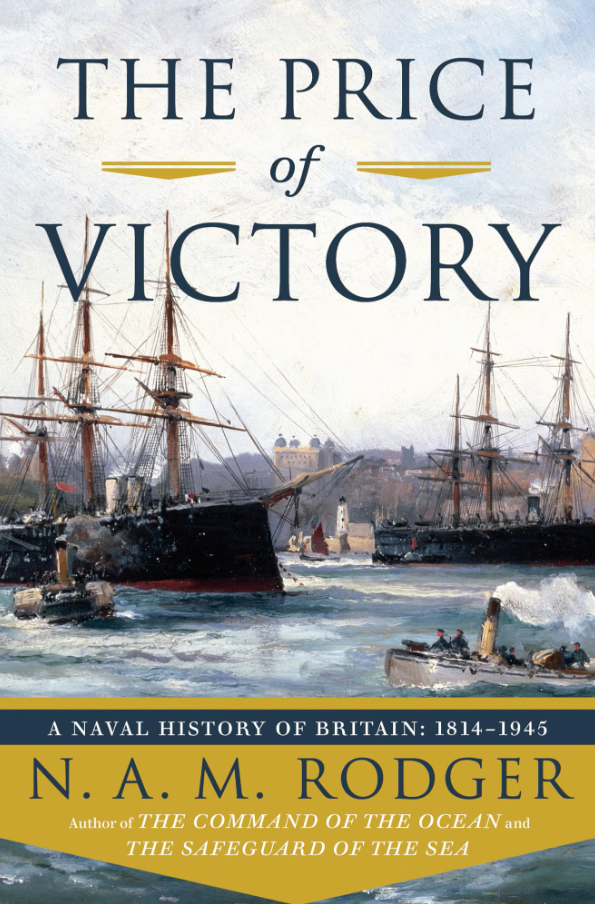
This October a major scholarly achievement was realised with the publication of The Price of Victory, the third and final instalment of N.A.M. Rodger’s great trilogy on the naval history of Britain from 660 AD to 1945. It has been an odyssey, albeit one that to complete took more than three times longer than Homer’s hero took to journey home.
The first volume, Safeguard of the Sea, was published back in 1997, some six years after Rodger had left his job as Assistant Keeper of the Public Records at the then Public Records Office to join the National Maritime Museum. Having moved to Exeter University, he completed the second volume, Command of the Ocean, covering the period from 1649 to 1815, in 2004.
Mindful of the fates of others who have attempted grand, multi-volume naval histories of Britain, Nicholas Rodger, now aged 74, was known to quip that one of his key aims was to become the first historian to live to see it completed. What he describes as “an exciting episode of brain surgery” delayed the completion of the final volume for several years, and left achieving this a closer-run thing than was — one suspects — entirely comfortable.
To the immense relief of all, Rodger recovered to complete his great work, and it has, emphatically, been well worth the wait. The Price of Victory is, like its predecessors, a most substantial work in both physical and scholarly senses.
At the outset of his task, Rodger aimed to create “not a self-contained ‘company history’ of the Royal Navy, but a survey of the contribution which naval warfare with all its associated activities has made to national history”. In doing so, he sought to link naval warfare “to political, social, economic, diplomatic, administrative, agricultural, medical, religious and other histories which will never be complete until the naval component of them is understood”.
He has succeeded handsomely, firmly entwining naval and naval-related matters into the core fabric of the history of the British Isles. The Price of Victory is a worthy conclusion to an epic series that will both stand in its own right and, as he hopes, serve as a baseline for future scholarly endeavours.
The vast, polyglot erudition underpinning Rodger’s prose wears no disguise. Yet, for all its great length and the density of knowledge each page imparts, The Price of Victory is, like its two preceding volumes, a lively read, leavened with the author’s dry wit.
December 6, 2024
The Halifax Explosion | A Short Documentary | Fascinating Horror
Fascinating Horror
Published Feb 23, 2021“On the 6th of December 1917 two ships collided in the mouth of Halifax Harbour in Nova Scotia, Canada …”
► Suggestions: hello@fascinatinghorror.co.uk
MUSIC:
► “Glass Pond” by Public Memory#Documentary #History #TrueStories
December 4, 2024
Admirals belatedly realize it might be useful to be able to reload those fancy missiles at sea
CDR Salamander has been banging this drum for a long, long time, but it appears that the US Navy is finally acknowledging that being able to reload the (many) Vertical Launch System (VLS) missile cells on ships somewhere other than a fully functional naval base would be more than a nice-to-have capability:
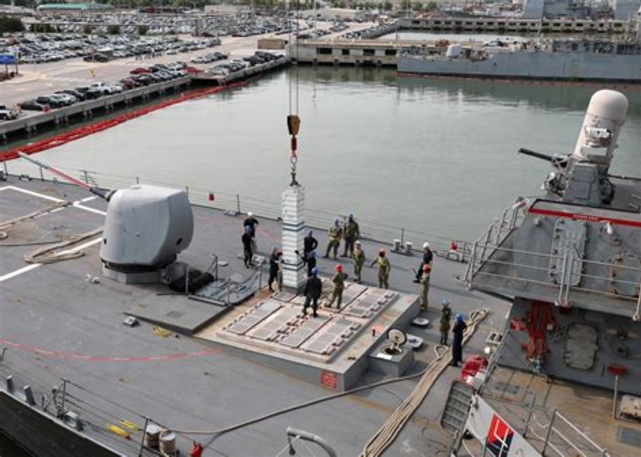
Reloading a VLS cell on a US Navy ship in port.
Photo attributed to defunct website defense-aerospace.com.
If you have made the horrible error of not reading every post here, over at the OG Blog and listening to every Midrats, then you may be new to the issue of being able to reload our warships’ VLS cells forward.
Slowly … a bit too slowly … Big Navy has decided that those people in the 1970s (who still remembered fighting a contested war at sea) might have been right all along. With SECNAV Del Toro’s encouragement, we continue to try to find a way to get the surface force a capability to reload forward.
There is plenty of room on the bandwagon and we’re glad to hoist everyone onboard the reload/rearm party-bus. If you need to catch up, the issue continues to break above the background noise, and WSJ has a very well produced article on it that requires your attention.
However, I got a little bit of an eye twitch at this pull-quote:
Until recently, the Navy didn’t feel much need for speed in rearming its biggest missile-firing warships. They only occasionally launched large numbers of Tomahawk cruise missiles or other pricey projectiles.
Now, Pentagon strategists worry that if fighting broke out in the western Pacific — potentially 5,000 miles from a secure Navy base — destroyers, cruisers and other big warships would run out of vital ammunition within days, or maybe hours.
Seeking to plug that supply gap, Del Toro tasked commanders and engineers with finding ways to reload the fleet’s launch systems at remote ports or even on the high seas. Otherwise, U.S. ships might need to sail back to bases in Hawaii or California to do so — putting them out of action for weeks.
Yes, I am going to do this, and you’re coming along for the ride.
In the name of great Neptune’s trident … THIS IS NOT A NEW REQUIREMENT!!!
My first “… shit, we need to be able to do this …” was during the DESERT FOX strikes against Iraq in 1998. I cannot remember if it were USS Stout (DDG 55) or USS Gonzalez (DDG 66) that we put Winchester on TLAM by the third day … but except for the ships we left on the other side of the Suez (who we would put to good use later), the rest of our TLAM ships and submarines were about done.
The fact we threw away an ability to reload/rearm forward was an old story inside the surface Navy when I picked it up in the last years of the previous century. We had a clunky erector set like contraption that was hard to use and took up VLS cell space, but instead of finding a better way, we just chunked the whole idea, slid in our Jesus Jones CD, and figured we had ownership of the seas until the crack of doom.
There is nothing “until recently” about this. Not to get off topic, but the real story here is why time and again this century’s senior leadership decided it was “too hard” or “too dangerous” while they were in full knowledge not just of the operational experience demanding this capability, but what we discovered over and over again in wargames.
December 3, 2024
Canadian Armed Forces: Can the RCN Really Stop Russia and China in the Arctic?
Esprit de Corps Canadian Military Magazine
Published 2 Dec 2024Vice Admiral Angus Topshee recently told the National Post that the Canadian Navy is able to defend our Arctic waterways against China or Russia … without help from our allies (aka the US Navy). It is time to target just what the heck the Admiral is talking about!
November 28, 2024
Town-class destroyers – Guide 400
Drachinifel
Published Aug 3, 2024The Town class destroyers, old Wickes, Clemson and Cadwell class vessels of the US Navy, transferred to the British Royal Navy and others, are today’s subject.
(more…)
November 13, 2024
Anglo-German Dreadnought Arms Race – Anything you can build I can build better!
Drachinifel
Published Nov 17, 2021Today we take a whistlestop tour behind the driving forces and outcome of the Anglo-German Naval Arms Race that led up to WW1.
November 10, 2024
WW2 in Numbers
World War Two
Published 9 Nov 2024World War II wasn’t just the deadliest conflict in history — it was a war of unprecedented scale. From staggering casualty numbers to military production and economic costs, this episode breaks down the biggest statistics that defined the global conflict.
(more…)
August 22, 2024
Abandoned Manitoba 2: Port Nelson, Manitoba’s Forgotten Seaport on Hudson Bay
Manitoba Historical Society
Published May 6, 2024The Abandoned Manitoba 2 video series by Graham Street, Shaun Cameron, and Gordon Goldsborough visits ghost towns, vacant buildings, and other historic sites from Manitoba’s past. Join us as we explore back roads to places that tell great stories about how things used to be, and how we have ended up where we are today.
In this video, we tour an abandoned seaport at the mouth of the Nelson River on Hudson Bay. Construction started in 1912 and stopped before the work was completed. It never resumed. Instead, all attention moved to Churchill where, in 1929, a deep water seaport opened. We explore the crumbling remains at Port Nelson, including an artificial island a half mile offshore, a rotting 17-span railway bridge, and a broken dredge.


