Quotulatiousness

February 13, 2015

Britain’s next defence review

Filed under: Britain, Military — Tags: , , , — Nicholas @ 08:01

Think Defence looks at the 2015 iteration of the British defence review process:

There is a pre defence review ritual that everyone with an interest indulges in. It starts with a few gentle discussions on Great Britain’s ‘place in the world’, the scale of our global ambition and obligations as a G8 regional power with a seat with our name on at the UN.

After a suitable period has elapsed the discussion then veers into areas of risk and threat but even during this phase the mood is still good natured.

Phase 3 gets heated because it is the first stage at which money is usually involved and therefore consideration of how the diminishing cake is sliced up between the services.

It is during this phase that negotiations and backroom deals kick in and the inevitable ‘test the water’ leaking to sympathetic journalists.

The final phase happens when it is all over and then as the implications of actual decisions made become clearer the bitterness sets in which can last for decades (see moving Australia and CVA01 for a good example).

If you start with the money and define a fixed budget you still get into the same argument and all that happens then is people tend to shape the first phases so that, oh look, my answer was right all along.

Start with risks and threats and the answers will always have to be tempered by the time it comes back around to budgets. Each review is rapidly made redundant by ‘events dear boy’ and the cycle starts again.

There are no easy answers and to think so is rather foolish, if there was an easy method, everyone would be doing it.

[…]

The ‘punching above our weight’ theme needs to be ruthlessly struck from the vocabulary because not only does it lead to illogical equipment decisions and hollowed out forces it fundamentally results in the talk loud small stick foreign policy that we seem unable to wean ourselves off.

You can only get away with this for so long until others start to realise you are bluffing and I believe this is where we are now, even our allies are starting to realise that our big talk isn’t backed up, despite having the worlds most advanced x or y, they are of little practical value if you only have a handful. Fur coat and no knickers could be an apt description of much of the UK’s defence capabilities, as painful as it may be for us all to recognise, and so I think there is a fundamental need to reassess ‘our place’.

February 9, 2015

Admiral Grace Hopper – the programmer who logged the very first real “bug”

Filed under: History, Technology, USA — Tags: , , , — Nicholas @ 04:00

Not all women can code … but neither can all men. Pretending that because all women can’t code means no women can code is an exercise of idiots that is easily dismissed by the very existence of Admiral Grace Hopper, USN:

The First "Computer Bug" Moth found trapped between points at Relay # 70, Panel F, of the Mark II Aiken Relay Calculator while it was being tested at Harvard University, 9 September 1947. The operators affixed the moth to the computer log, with the entry: "First actual case of bug being found". (The term "debugging" already existed; thus, finding an actual bug was an amusing occurrence.) In 1988, the log, with the moth still taped by the entry, was in the Naval Surface Warfare Center Computer Museum at Dahlgren, Virginia, which erroneously dated it 9 September 1945. The Smithsonian Institute's National Museum of American History and other sources have the correct date of 9 September 1947 (Object ID: 1994.0191.01). The Harvard Mark II computer was not complete until the summer of 1947.

The First “Computer Bug” Moth found trapped between points at Relay #70, Panel F, of the Mark II Aiken Relay Calculator while it was being tested at Harvard University, 9 September 1947. The operators affixed the moth to the computer log, with the entry: “First actual case of bug being found”. (The term “debugging” already existed; thus, finding an actual bug was an amusing occurrence.) In 1988, the log, with the moth still taped by the entry, was in the Naval Surface Warfare Center Computer Museum at Dahlgren, Virginia, which erroneously dated it 9 September 1945. The Smithsonian Institute’s National Museum of American History and other sources have the correct date of 9 September 1947 (Object ID: 1994.0191.01). The Harvard Mark II computer was not complete until the summer of 1947.

January 20, 2015

A tight squeeze indeed

Filed under: Americas, Military, USA — Tags: , — Nicholas @ 07:42

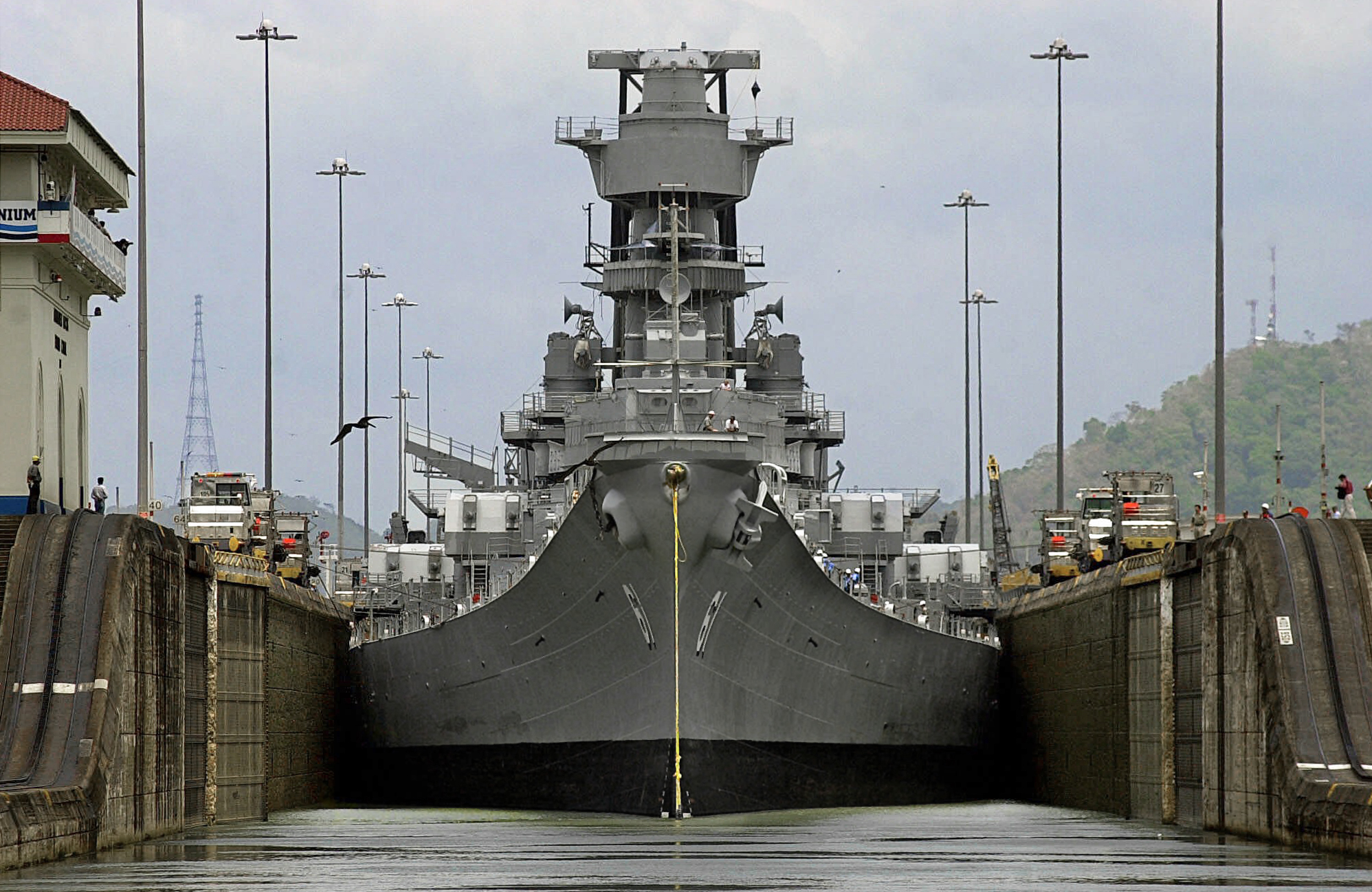
The USS Iowa crosses the Panama Canal at Miraflores Lock near Panama City, Panama Wednesday, March 28, 2001.  At 108.2 feet wide, the Iowa-class battleships are the largest vessels ever to scrape their way through the 110-foot-wide locks of the canal. They were designed so that they could just fit through the waterway. (AP Photo/Tomas Munita)

The USS Iowa crosses the Panama Canal at Miraflores Lock near Panama City, Panama Wednesday, March 28, 2001. At 108.2 feet wide, the Iowa-class battleships are the largest vessels ever to scrape their way through the 110-foot-wide locks of the canal. They were designed so that they could just fit through the waterway. (AP Photo/Tomas Munita)

H/T to Tyler Rogoway, who has a few other photos of Iowa-class battleships moving through the Panama canal.

December 18, 2014

Admiral Grace Hopper

Filed under: History, Military, Technology, USA, WW2 — Tags: , , , — Nicholas @ 00:04

The US Naval Institute posted an article about the one and only Admiral Grace Hopper earlier this month to mark her birthday:

The typical career arc of a naval officer may run from 25-30 years. Most, however, don’t start at age 35. Yet when it comes to Rear Adm. Grace Hopper, well, the word “typical” just doesn’t apply.

Feisty. Eccentric. Maverick. Brilliant. Precise. Grace Hopper embodied all of those descriptions and more, but perhaps what defined her as much as anything else was the pride she had in wearing the Navy uniform for 43 years. Ironically, Rear Adm. Grace Hopper — “Amazing Grace” as she was known — had to fight to get into the Navy.

Grace Brewster Murray was born into a well-off family in New York on Dec. 9, 1906. She could have followed what many of her peers did during those times: attending college for a year or two, getting married then devoting their lives to their families and volunteer work.

Instead, Grace’s path would be less traveled. Encouraged to explore her innate curiosity on how things worked, a 7-year-old Grace dismantled all of the family’s alarm clocks trying to put them back together again. Rather than banishment from the practice, she was allowed one to practice on.

[…]

When she joined the WAVES in December 1943, Lt. j.g. Grace Hopper was 37 years old. Williams noted that after graduating at the top of her class of 800 officer candidates in June 1944, Hopper paid homage to Alexander Wilson Russell, her great-grandfather, the admiral who apparently took a “dim view of women and cats” in the Navy and laid flowers on his grave to “comfort and reassure him.”

Hopper was sent to the Bureau of Ordnance Computation Project at Harvard University under the guidance of Howard Aiken. The Harvard physics and applied mathematics professor helped create the first Automatic Sequence Controlled Calculator (ASCC), better known as Mark I. He ran a lab where design, testing, modification and analysis of weapons were calculated. Most were specially trained women called computers. “So the first ‘computers’ were women who did the calculating on desk calculators,” Williams said. And the time it took for the computers to calculate was called “girl hours.”

What happened next put Hopper on a new path that would define the rest of her life, according to a passage in the book Improbable Warriors: Women Scientists in the U.S. Navy during World War II also by Williams.

On July 2, 1944, Hopper reported to duty and met Aiken.

“That’s a computing engine,” Aiken snapped at Hopper, pointing to the Mark I. “I would be delighted to have the coefficients for the interpolation of the arc tangent by next Thursday.”

Hopper was a mathematician, but what she wasn’t was a computer programmer. Aiken gave her a codebook, and as Hopper put it, a week to learn “how to program the beast and get a program running.”

Hopper overcame her lack of programming skills the same way she always tackled other obstacles; by being persistent and stopping at nothing to solve problems. She eventually would become well-versed in how the machine operated, all 750,000 parts, 530 miles of wire and 3 million wire connections crammed in a machine that was 8-feet tall and 50-feet wide.

December 12, 2014

The Naval Battle At The Falkland Islands – The Death of Maximilian von Spee I THE GREAT WAR Week 20

Filed under: Britain, Europe, Germany, History, Military, WW1 — Tags: , , , , — Nicholas @ 07:23

Published on 11 Dec 2014

Near the far away Falkland Islands the story of the German East Asia Squadron is coming to an end: in a naval battle nearly the entire squadron sunk and Maximilian von Spee dies together with over 2000 German seamen. Meanwhile, the war of attrition is still going on in Europe and Austria-Hungary has to learn that their conquest of Belgrade is not putting a lid on the Serbian resistance.

December 7, 2014

QotD: December 7, 1941 – the truth is stranger than fiction

Filed under: History, Japan, Quotations, USA, WW2 — Tags: , , — Nicholas @ 00:01

I watched Tora! Tora! Tora! recently. That movie is supposed to be the most historically accurate and truthful ever made about the attack on Pearl Harbor. It was an entertaining and informative movie packed with good performances and some of the most spectacular plane crashes and stunts on an airfield I’ve ever seen.

And at the same time, the sequence of events that led up to the Japanese attack were almost inconceivable. The level of incompetence, stupidity, bad luck, mistake-making, and almost deliberate failure to let the Japanese attack be so successful defies imagination. This was one of those legendary sequences where truth is stranger than fiction.

When the radar crew (which stayed longer than their night shift required) spotted the incoming Japanese planes, they were mistaken for B-17s being delivered to the airbase and the radar station was told “yeah? Well don’t worry about it.”

When intelligence services using cracked Japanese codes figured that an attack was imminent, they were unable to radio Hawaii about it because the atmospheric conditions were bad. So they sent a telegram, which was shelved for eventual delivery because it wasn’t marked “urgent.”

On and on it went, delays, mistakes, confusion, circumstances, almost a perfect set of events that if you read about them in a book you’d complain was too contrived and unbelievable. That would never happen! you’d cry and close the book in disgust.

But that’s what really happened.

Christopher Taylor, “TORA TORA 9-11”, Word Around the Net, 2014-09-10.

November 15, 2014

Another hidden ecological disaster from the Cold War

Filed under: Europe — Tags: , , , , , — Nicholas @ 00:03

I’d heard that the Soviet navy had dumped some potentially hazardous nuclear wastes in the Arctic, but I didn’t realize just how much they’d dumped:

While Russia’s nuclear bombers have recently set the West abuzz by probing NATO’s air defenses, a far more certain danger currently lurks beneath the frigid Arctic waters off Russia’s northern coast — a toxic boneyard for Soviet nuclear ships and reactors whose containment systems are gradually wearing out.

Left to decay at the bottom of the ocean, the world is facing a worst case scenario described as “an Arctic underwater Chernobyl, played out in slow motion,” according to Thomas Nilsen, an editor at the Barents Observer newspaper and a member of a Norwegian watchdog group that monitors the situation.

According to a joint Russian-Norwegian report issued in 2012, there are 17,000 containers of nuclear waste, 19 rusting Soviet nuclear ships and 14 nuclear reactors cut out of atomic vessels at the bottom of the Kara Sea.

Soviet nuclear waste in the Arctic

The K-159 went down in 2003 while it was being towed to the town of Polyarny — home of Russia’s primary shipyard used for servicing and decommissioning nuclear powered vessels — for dismantling. Nine sailors died trying to keep it afloat when a storm hit, ripping off makeshift pontoons welded to the side to ensure the porous rusting hull didn’t sink en route. Estimates place around 800 kilograms of spent uranium fuel aboard the K-159, according to Bellona.

Soviet nuclear submarine K-159 before she sank

“Unfortunately, to my knowledge, there are currently no concrete plans to raise [radioactive] objects, and potentially raising the submarine is a Russian responsibility,” said Ingar Amundsen, head of the section for international nuclear issues at the Norwegian Radiation Protection Authority (NRPA), a governmental body tasked with keeping watch over the nuclear threats in the Arctic.

November 14, 2014

HMAS Sydney versus SMS Emden, 9 November 1914

Filed under: Australia, Germany, History, Military, WW1 — Tags: , — Nicholas @ 00:03

Last Sunday was the 100th anniversary of the first major naval victory of the Royal Australian Navy, when Australian light cruiser HMAS Sydney fought against one of the Kaiser’s most effective commerce raiders, SMS Emden in the Indian Ocean:

November 9 is when the light cruiser HMAS Sydney met the light cruiser SMS Emden in action in the Indian Ocean, dispatching a surface raider that had taken a heavy toll on Allied merchant and naval shipping since the guns of August rang out. R. K. Lochner chronicled Emden’s exploits in the late 1970s, dubbing her “the last gentleman of war.” Lochner awarded the cruiser this title to acknowledge skipper Karl von Müller’s and his crew’s scrupulous fidelity to the laws of cruiser warfare. The Germans’ enemy paid homage to Emden’s gallantry as well. Two days after the engagement, for instance, the London Daily News saluted the “resourceful energy and chivalry” displayed by the raider’s crewmen throughout their voyage. That, of course, was an era when knightly conduct was in decline on the high seas, yielding to unrestricted submarine warfare. Striking without warning, as U-boats commonly did in the Atlantic, left mariners and passengers scant prospects of escaping an attack.

SMS Emden underway in 1910 (via Wikipedia)

SMS Emden underway in 1910 (via Wikipedia)


The battle, then, helped mark the passing of an age. Emden had remained behind at the onset of war, after the German East Asian Squadron quit Southeast Asia to return home. Hers was not destined to be a prolonged cruise. Cut off from logistical and maintenance support, Captain Müller had to forage for coal and stores. The cruiser coped with this hand-to-mouth existence — for a while — and in the process sank or captured twenty-five merchantmen, destroyed two Allied men-of-war at Penang, and bombarded the seaport of Madras, along the seacoast of British India. That’s quite a combat record. It’s especially noteworthy when compiled by seafarers who were unsure where they could refuel next — if anywhere at all — and were sure that equipment that suffered a major breakdown would never be repaired for want of spare parts and shipyard expertise.
The light cruiser HMAS Sydney steams towards Rabaul. The Australian Naval & Military Expeditionary Force (AN&MEF), which included HMAS Sydney, HMAS Australia, HMAS Encounter, HMAS Warrego, HMAS Yarra and HMAS Parramatta, seized control of German New Guinea on 11 September 1914 (via Wikipedia)

The light cruiser HMAS Sydney steams towards Rabaul. The Australian Naval & Military Expeditionary Force (AN&MEF), which included HMAS Sydney, HMAS Australia, HMAS Encounter, HMAS Warrego, HMAS Yarra and HMAS Parramatta, seized control of German New Guinea on 11 September 1914 (via Wikipedia)


No ship can keep going for long without putting into port or tapping resources from nearby fuel or stores ships. Heck, U.S. Navy commanders — like their counterparts in other fleets, no doubt — get antsy when the fuel tanks drop to half-empty or hardware fails at sea, hampering performance or reducing redundancy in the propulsion plant or other critical machinery. And that’s in a navy accustomed to having logistics vessels steaming in company to top off the tanks, replenish stores, or transfer or manufacture spares when need be. Imagine being altogether alone in some faraway region — at risk of running out of some vital commodity or suffering battle damage and finding yourself dead in the water. Such loneliness and doubt were constant companions to Emden officers and men during the fall of 1914.

It takes extraordinary pluck to seize the offensive amid such circumstances. And yet the Germans did. In November, nonetheless, Sydney found Emden in the Cocos (Keeling) Islands, where Müller had decided to attack a communications station that was aiding the hunt for his raider. Like so many naval actions, it was a chance encounter. The station got off a distress call, and Sydney — which happened to be in the vicinity while helping escort a convoy transporting Australian and New Zealand troops to Europe — responded to it. Emden gave a good account of herself, landing several punches before Sydney’s heavier main guns began to tell. Hopelessly outgunned, Müller ultimately ordered his vessel beached on North Keeling Island to save lives. Of the crew, 134 seamen fell while 69 were wounded and 157 were captured.

November 11, 2014

In memoriam

Filed under: Britain, History, Military, WW1, WW2 — Tags: , , — Nicholas @ 00:02

A simple recognition of some of our family members who served in the First and Second World Wars:

The Great War

  • A Poppy is to RememberPrivate William Penman, Scots Guards, died 1915 at Le Touret, age 25
    (Elizabeth’s great uncle)
  • Private David Buller, Highland Light Infantry, died 1915 at Loos, age 35
    (Elizabeth’s great grandfather)
  • Private Walter Porteous, Northumberland Fusiliers, died 1917 at Passchendaele, age 18
    (my great uncle)
  • Corporal John Mulholland, Royal Tank Corps, died 1918 at Harbonnieres, age 24
    (Elizabeth’s great uncle)

The Second World War

  • Flying Officer Richard Porteous, RAF, survived the defeat in Malaya and lived through the war
    (my great uncle)
  • Able Seaman John Penman, RN, served in the Defensively Equipped Merchant fleet on the Murmansk Run (and other convoy routes), lived through the war
    (Elizabeth’s father)
  • Private Archie Black (commissioned after the war and retired as a Major), Gordon Highlanders, captured at Singapore (aged 15) and survived a Japanese POW camp
    (Elizabeth’s uncle)
  • Elizabeth Buller, “Lumberjill” in the Women’s Land Army in Scotland through the war.
    (Elizabeth’s mother)
  • Trooper Leslie Taplan Russon, 3rd Royal Tank Regiment, died at Tobruk, 19 December, 1942 (aged 23).
    A recently discovered relative. Leslie was my father’s first cousin, once removed (and therefore my first cousin, twice removed).

In Flanders fields the poppies blow
Between the crosses row on row,
That mark our place; and in the sky
The larks, still bravely singing, fly
Scarce heard amid the guns below.

We are the Dead. Short days ago
We lived, felt dawn, saw sunset glow,
Loved and were loved, and now we lie
In Flanders fields.

Take up our quarrel with the foe:
To you from failing hands we throw
The torch; be yours to hold it high.
If ye break faith with us who die
We shall not sleep, though poppies grow
In Flanders fields.

Lieutenant Colonel John McCrae, MD Canadian Army Medical Corps (1872-1918)

November 10, 2014

A critical view of the Zumwalt class of destroyers

Filed under: Military, Technology, USA — Tags: , , , — Nicholas @ 00:03

James R. Holmes makes the case that the latest class of US Navy destroyers are already obsolete:

BATH, Maine (Oct. 28, 2013) The Zumwalt-class guided-missile destroyer DDG 1000 is floated out of dry dock at the General Dynamics Bath Iron Works shipyard. The ship, the first of three Zumwalt-class destroyers, will provide independent forward presence and deterrence, support special operations forces and operate as part of joint and combined expeditionary forces. The lead ship and class are named in honor of former Chief of Naval Operations Adm. Elmo R. "Bud" Zumwalt Jr., who served as chief of naval operations from 1970-1974. (U.S. Navy photo courtesy of General Dynamics/Released)

BATH, Maine (Oct. 28, 2013) The Zumwalt-class guided-missile destroyer DDG 1000 is floated out of dry dock at the General Dynamics Bath Iron Works shipyard. The ship, the first of three Zumwalt-class destroyers, will provide independent forward presence and deterrence, support special operations forces and operate as part of joint and combined expeditionary forces. The lead ship and class are named in honor of former Chief of Naval Operations Adm. Elmo R. “Bud” Zumwalt Jr., who served as chief of naval operations from 1970-1974. (U.S. Navy photo courtesy of General Dynamics/Released)

Hie thee hence, sea fighters, to peruse Information Dissemination‘s take on the U.S. Navy’s Zumwalt-class destroyer. Pseudo-pseudonymous pundit “Lazarus” gives a nifty profile of the newfangled vessel. That’s worth your time in itself. Though not in so many words, moreover, he depicts the attention-grabbing DDG-1000 stories of recent weeks and months as a red herring. Sure, Zumwalt features a “tumblehome” hull that makes the ship look like the second coming of USS Monitor. (This is not a compliment.) The hull tapers where it should flare and flares where it should taper. Zounds!

Yet more than cosmetics occasions commentary. Some navy-watchers voice concern about tumblehome hulls’ seakeeping ability in rough waters. Others question their ability to remain buoyant and stable after suffering mishaps or battle damage. That’s a worry in a “minimum manned” ship that relies on automated damage control. (The very idea of automated firefighting and flooding control, and sparsely populated fire parties, sits poorly with this former fire marshal.) In any event, time will tell whether the naval architects got it right.

Even if problems do come to light, Zumwalt would be far from the first fighting ship to undergo modifications to remedy problems baked into her design. The flattop USS Midway, for example, underwent repeated change over her long life — including to correct such maladies. Plus ça change.

Zumwalt‘s secondary armament has made headlines as well. The navy recently opted to substitute lesser-caliber 30-mm guns for the 57-mm guns originally envisioned to empower the ship to duel small boats and light surface combatants. The smaller mount evidently meets performance parameters for close-in engagements that its bigger counterpart misses. This too is a controversy that, in all likelihood, will be settled once sea trials put the ship through her paces. Tempest, meet teapot.

November 9, 2014

A Canadian Mistral (or two)? Not likely say the experts

Filed under: Cancon, France, Military, Russia — Tags: , , , , — Nicholas @ 10:07

Remember those palmy days of summer, when the French helicopter carrier Mistral visited Canadian waters for a joint exercise with the Canadian Army? I half-joking referred to it as Canada “kicking the tires” … but the idea hasn’t gone away completely. In the Ottawa Citizen, David Pugliese reported earlier last week that the International Business Times had run an article about it.

Halifax, Nova Scotia. FS Mistral (L-9013) is an amphibious assault ship, and lead ship of her class. She was commissioned in 2006. She features a landing craft dock, and helicopter facilities. Photo: Halifax Shipping News

Halifax, Nova Scotia. FS Mistral (L-9013) is an amphibious assault ship, and lead ship of her class. She was commissioned in 2006. She features a landing craft dock, and helicopter facilities. Photo: Halifax Shipping News

The deal is worth $1.6 billion to $1.8 billion (different figures are out there) to the French. The Russians are interested in three of the ships. The French haven’t proceeded yet with the sale to Russia because of the situation in Ukraine.

But how probable is it that Canada would buy the Mistral-class ships?

Earlier this year, the Royal Canadian Navy was looking at buying surplus U.S. Navy supply ships. But that is not going to happen, RCN commander Vice Admiral Mark Norman told Defence Watch. What is being examined is the purchase of a commercial oiler (maybe).

The RCN is in dire need of an oiler/supply ship……not, at this point, an amphibious assault ship. So if there is an extra billion dollars or more around, the focus might be on acquiring an oiler/supply fleet to replace the decommissioned AORs.

Mistral-class ships are capable of carrying 16 helicopters, landing barges, up to 70 vehicles and 450 soldiers. They also come equipped with a hospital.

Canadian shipyards could also be expected to oppose such a purchase. There would be little for them (except maybe in-service support) in such an acquisition and they could argue that such a purchase would undermine the National Shipbuilding Procurement Strategy.

In September, I called the idea of Canada buying the Mistrals as the maritime equivalent of “pie in the sky”, despite a passionate article in the US Naval Institute News pushing the idea. They even showed what a Canadian Mistral would look like:

Mistral-class ship, ‘Sevastopol’ configured as a NATO/Canadian Navy ship. CASR Image

Mistral-class ship, Sevastopol configured as a NATO/Canadian Navy ship. CASR Image

So, on the surface, the idea isn’t likely to go anywhere for practical and economic reasons. But, a couple of days later Pugliese posted another article on the Mistral debate, responding to criticism from University of Ottawa professor Roland Paris:

If the Paris had actually read the articles in question he would have found out that the stories arose not from Hugh Segal’s comments from May but from the fact that the delegation led this week by French President François Hollande to Canada contained a significant contingent of the country’s defence industry representatives, including those from Mistral shipbuilder DCNS. That group included the firm’s diplomatic adviser.

In addition, sources have told Defence Watch that the delegation did indeed try to interest Canada in Mistral-class ships, as well as the FREMM class frigates.

Will they succeed with Mistral? Like I have mentioned a number of times at Defence Watch, including in the posting cited by Paris, the answer is likely no.

[…]

France, over the last two years, has embarked on a significant push into Canada to promote its defence products, particularly in the naval arena. With $35 billion on the table for shipbuilding who can blame them?

There was a specific reason a Mistral-class warship sailed across the Atlantic this summer to take Canadian soldiers on board for amphibious exercises. And it wasn’t about any close relationship between the French and Canadian militaries, although that might have played a minor role.

No, the French are interested in selling. They want to sell Canada warships, warship designs, and naval equipment like that on board the Mistral-class and the FREMM frigates. That is the reason the FREMM ship Aquitaine also visited Canada.

Personally, I’d love to see the RCN acquire a pair of Mistral-class ships, but they would not come cheap, they wouldn’t create a lot of jobs in Nova Scotia, Quebec, or British Columbia (and therefore wouldn’t be useful for gathering votes from those provinces), and they’d require the government to fully equip them … helicopters are extra. And we all know how the Canadian government can’t manage to say the word “helicopter” without wasting millions of dollars, never mind actually buying any.

November 1, 2014

November 1, 1914 – The Battle of Coronel

Filed under: Americas, Britain, Germany, Military, Pacific, WW1 — Tags: , — Nicholas @ 12:20

A hundred years ago today, the Royal Navy lost the Battle of Coronel to Vice Admiral Graf Maximilian von Spee’s squadron of armoured and light cruisers off the coast of Chile. Rear Admiral Sir Christopher Cradock was killed along with 1,570 men when HMS Monmouth and HMS Good Hope were sunk. Public reaction was furious: blame was cast on the Admiralty and especially on the First Lord of the Admiralty, Winston Churchill. The British public fiercely believed that any British ship was more than a match for any foreign vessel, and losing two ships while inflicting no serious damage on the enemy was scandalous.

In the Plymouth Herald, Tristan Nichols explains why Plymouth in particular took the news so badly:

TODAY the figure is hard to comprehend. On November 1, 1914, just months after the start of World War One, the Royal Navy lost two warships and nearly 1,600 lives in the South Atlantic.

The outcome of ‘The Battle of Coronel’, as it would become known, sent shockwaves across Britain, not least Plymouth.

HMS Monmouth was one of the two British cruisers involved in the battle 40 nautical miles off the coast of Chile.

She was Devonport-based and Plymouth-manned.

And every one of the 735 men on board the cruiser died on the cold and stormy seas.

Hundreds more were lost on the other Royal Navy vessel, the Portsmouth-based HMS Good Hope.

The German squadron saw just three men injured during the battle.

The build-up, battle, and ultimate demise of the 4th Cruiser Squadron during that fateful day reads like a film script.

Rear Admiral Sir Christopher (Kit) Cradock led the Royal Navy squadron to hunt down and destroy the feared German East Asia Squadron.

Both sides had reportedly only been expecting to meet a solitary cruiser – but fate would play its hand.

Rear Admiral Cradock, leading two British armoured cruisers, was up against two German armoured cruisers, and a further three light cruisers.

He was reportedly given orders to engage with the enemy, despite outlining his concerns at being outnumbered and outgunned.

According to the history books the two British armoured cruisers were inferior in every respect.

Follow orders he did, and it led to a devastating outcome for the proud British squadron.

It’s not quite as clear that Cradock followed all of his orders, as Churchill had specifically instructed him to keep the old battleship HMS Canopus with his squadron at all times until a modern armoured cruiser, HMS Defence, was able to join him (Defence, however, had been recalled part-way to the Falklands). Instead, Cradock had detached Canopus to defend the coaling station in the Falkland Islands before crossing into the Pacific, headed toward Valparaiso. Without Canopus, Cradock was totally out-gunned by von Spee’s ships.

Wikipedia reports a Canadian connection with the battle:

The Coronel Memorial Library at Royal Roads Military College, now Royal Roads University in Victoria, British Columbia, Canada was named in honour of the four Canadian midshipmen who perished in HMS Good Hope at the Battle of Coronel.

Update: The Royal Canadian Navy is marking the anniversary.

The Royal Canadian Navy (RCN) will mark the Battle of Coronel on November 1st. This battle saw the first Canadian military casualties of the First World War, and the first ever casualties in the history of the RCN. RCN personnel serving today salute the following shipmates from the past:

  • Midshipman Malcolm Cann, 19, of Yarmouth, Nova Scotia;
  • Midshipman John V. W. Hatheway, 19, of Fredericton, New Brunswick;
  • Midshipman William Archibald Palmer, 20, of Halifax, Nova Scotia; and
  • Midshipman Arthur Wiltshire Silver, 20, of Halifax, Nova Scotia.

All four RCN midshipmen died in the Battle of Coronel, which took place on November 1, 1914 off the coast of central Chile near the city of Coronel.

October 26, 2014

A bit of perspective on the damage to China’s aircraft carrier

Filed under: China, Military, Pacific — Tags: , , — Nicholas @ 12:40

At The Diplomat, James R. Holmes talks about the recent accident on board the Chinese carrier Liaoning:

Reports of Chinese aircraft carrier Liaoning’s death — or debilitating wounds — are greatly exaggerated. The flattop suffered some sort of steam leak that prompted her crew to stop at sea and conduct repairs before resuming operations. The news comes from Robert Beckhusen of War Is Boring, who relays a Sina.com story that Liaoning suffered a “steam explosion” following “a leak in ‘the machine oven compartment to the water pipes.’”

Beckhusen denies that PLA Navy leaders will decommission the flattop because of mechanical problems. (By raising the possibility, though, he seems to imply they might.) He does speculate that the accident will force the navy to relegate her to training duty.

Would an engineering casualty represent a setback unseen in the annals of naval history? Hardly. All sea services have been there, done that, and will likely find themselves there again. It’s doubtful such travails will induce PLA Navy officials to overreact, demoting Liaoning from whatever plans they have in mind for her. China’s first aircraft carrier is probably destined to serve as a training platform in any event — a ship used to groom China’s first generation of naval aviators, flight-deck crewmen, and air-group commanders. She will remain such despite minor hardware problems belowdecks.

Indeed, if suffering zero engineering casualties were the standard for maritime competence, the briny main would be empty of shipping. Think about what going to sea involves. A warship is a metal box largely encased in an environment hostile to metal — namely seawater and salt air. And it’s a box packed with machinery, flammables and explosives of various sorts, and human bodies. In such surroundings, rare is the seaman without a hair-raising tale to tell about fires or floods, equipment failures, and sundry mishaps.

I could spin a few such yarns myself. One involves a pipe springing a pinhole leak. And spraying fuel. On a steaming boiler. While crewmen are loading ammunition. At anchor. In rough weather. And that was a good-luck ship for the most part. Murphy’s Law — a.k.a. s*#t happens — is an iron law of marine engineering, and of seafaring writ large. When it does happen, you fix the damage, learn whatever lessons there are to learn, and move on.

October 13, 2014

The Royal Navy’s “weirdest” ship

Filed under: Africa, Britain, Health, Military — Tags: , , , — Nicholas @ 10:31

David Axe on what he describes as the weirdest ship in the Royal Navy:

Royal Fleet Auxiliary vessel RFA Argus pictured supporting Operation Herrick in Afghanistan (via Wikipedia)

Royal Fleet Auxiliary vessel RFA Argus pictured supporting Operation Herrick in Afghanistan (via Wikipedia)

The British Royal Navy is deploying the auxiliary ship RFA Argus to Sierra Leone in West Africa in order to help health officials contain the deadly Ebola virus.

If you’ve never heard of Argus, you’re not alone. She’s an odd, obscure vessel — an ungainly combination of helicopter carrier, hospital ship and training platform.

But you’ve probably seen Argus, even if you didn’t realize it. The 33-year-old vessel played a major role in the 2013 zombie movie World War Z, as the floating headquarters of the U.N.

[…]

The 575-foot-long Argus launched in 1981 as a civilian container ship. In 1982, the Royal Navy chartered the vessel to support the Falklands War … and subsequently bought her to function as an aviation training ship, launching and landing helicopters.

Argus’ long flight deck features an odd, interrupted layout, with a structure — including the exhaust stack — rising out of the deck near the stern.

Weirdly, the deck’s imperfect arrangement is actually an asset in the training role. Student aviators on Argus must get comfortable landing in close proximity to obstacles, which helps prepare them for flying from the comparatively tiny decks of frigates and other smaller ships.

RFA Argus photographed off the coast at Devonport (via Wikipedia)

RFA Argus photographed off the coast at Devonport (via Wikipedia)

October 12, 2014

Finnish research vessel harassed by Russian navy ships

Filed under: Europe, Military, Russia — Tags: , , , , — Nicholas @ 12:29

Uutiset reports on a Finnish marine research ship’s run-ins with the Russians in the Baltic Sea:

Finnish research vessel SS Aranda near Turun Linna

Finnish research vessel SS Aranda near Turun Linna (via Wikipedia).

The Russian Navy has twice interfered in the movements of the Finnish Environment Institute (SYKE) marine research vessel Aranda in international waters. According to SYKE, the two incidents occurred in August and September, when Aranda was conducting research for the Swedish Meteorological and Hydrological Institute off the coast of Sweden. In both incidents, the Russian warship attempted to prohibit the research vessel from accessing a sampling location in international waters east of the Swedish island of Gotland.

In the first incident on August 2, the Russian warship made radio contact with Aranda and urged it twice to change course. The Aranda initially obeyed the request, but at the second warning, the ship’s crew replied that it would not deter and intended to stop at the research point as planned. At this time, the crew of the Aranda observed a submarine moving along the surface of the water.

The second incident on September 2 saw a Russian helicopter approach Aranda several times. After this, a nearby Russian warship took a course directly towards the ship’s stern, passing the boat in very close proximity. The Aranda maintained its course and speed throughout the incident.

« Newer PostsOlder Posts »

Powered by WordPress