Published on 1 Mar 2013
Here’s also an older post covering the technological challenges faced by the Royal Navy in the post-Napoleonic era, and some of the reasons for all those “weird” ship designs in the Victorian era.

Published on 1 Mar 2013
Here’s also an older post covering the technological challenges faced by the Royal Navy in the post-Napoleonic era, and some of the reasons for all those “weird” ship designs in the Victorian era.
Published on 6 Apr 2017
Learn more about Guam in WW1: www.visitguam.com/smscormoranguam/
The Island of Guam was on the other end of the world when the US declared war on Germany in 1917. However, they had been involved in the global conflict for years already. When the Germans lost their colonies in the Pacific, the German merchant raider SMS Cormoran II had no other choice but to seek refuge in the then neutral Arpor Harbour, Guam. For months the German crew around Adalbert Zuckschwerdt stayed on the island and became a kind of sensation. But that all changed on April 6, 1917.
Due to a long-standing aversion to calling certain kinds of vessels by their most appropriate name, the Japanese Maritime Self-Defence Force (because Japan’s constitution prohibits the country having a “navy”, post-1945) commissioned their latest “destroyer” last week:
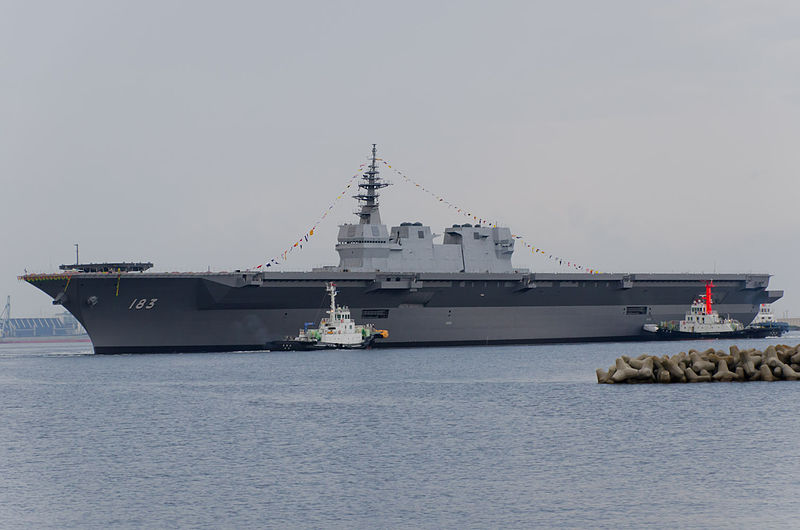
JS Izumo DDH-183, sister-ship of the just-commisioned JS Kaga DDH-184, both helicopter-equipped destroyers, officially.
I know what you’re thinking … “That doesn’t look like a destroyer to me” … but that’s what Japan officially designates ships like this to be, so that’s what they’re called. Strategy Page has more:
On March 22nd Japan put into service a second 27,000 ton “destroyer” (the Kaga, DDH 184) that looks exactly like an aircraft carrier. Actually it looks like an LPH (Landing Platform Helicopter) an amphibious ship type that first appeared in the 1950s. This was noted when Izumo, the first Japanese LPH was launched in 2012 (it entered service in 2015). The Izumos can carry up to 28 aircraft and are armed only with two 20mm Phalanx anti-missile cannon and launcher with sixteen ESSM missiles for anti-missile defense.
LPHs had no (or relatively few) landing craft but did carry a thousand or more troops who were moved ashore using the dozen or more helicopters carried. The first American LPH (the USS Iwo Jima) was an 18,400 ton ship that entered service in 1961, and carried 2,000 troops and twenty-five helicopters. Until Izumo showed up, several nations operated LPHs, and Britain and South Korea still do. The U.S. retired its last LPHs in the 1990s, but still have a dozen similar ships that include landing craft (and a well deck in the rear to float them out of) as well as helicopters. A few other nations have small carriers that mostly operate helicopters but carry few, if any troops.
The Izumos are the largest LPHs to ever to enter service. It differs from previous LPHs in not having accommodations for lots of troops and having more powerful engines (capable of destroyer-like speeds of over fifty-four kilometers an hour). Izumo does have considerable cargo capacity, which is intended for moving disaster relief supplies quickly to where they are needed. Apparently some of these cargo spaces can be converted to berthing spaces for troops, disaster relief personnel, or people rescued from disasters. There are also more medical facilities than one would expect for a ship of this size. More worrisome (to the Chinese) is the fact that the Izumo could carry and operate the vertical take-off F-35B stealth fighter, although Japan has made no mention of buying that aircraft or modifying the LPH flight decks to handle the very high temperatures generated by the F-35B when taking off or landing vertically. The Chinese are also upset with the name of this new destroyer. Izumo was the name of a Japanese cruiser that was a third the size of the new “destroyer” and led the naval portion of a 1937 operation against Shanghai that left over two-hundred-thousand Chinese dead. The Chinese remember all this, especially the war with Japan that began unofficially in 1931 and officially in 1937.
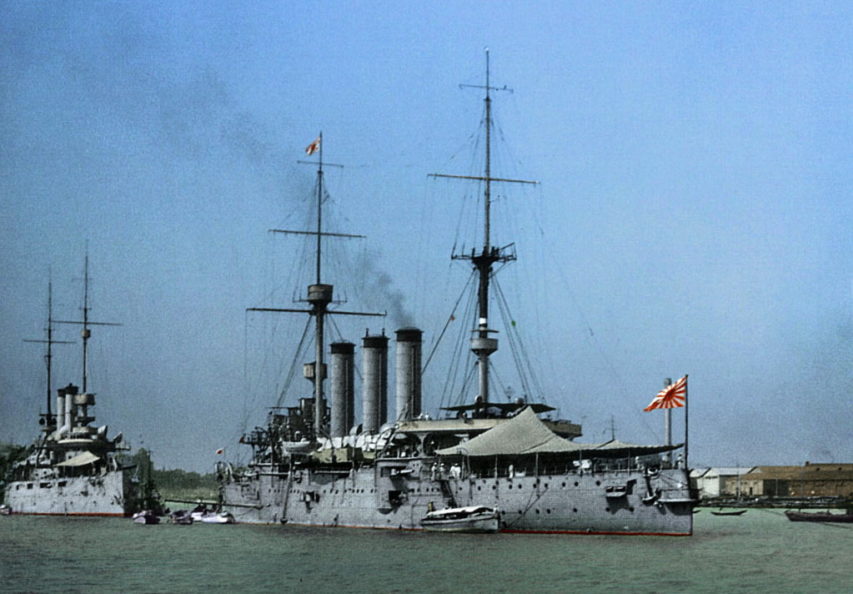
IJNS Izumo at anchor 1932 (Colourized), via Wikimedia
Charles Stross speculates on a few ways that Il Donalduce could trigger the end of Britain’s nuclear-armed ballistic missile submarines:
Working hypothesis #1: Donald Trump is an agent of influence of Moscow. Less alarmingly: Putin’s people have got blackmail material on the current President and this explains his willingness to pursue policies favourable to the Kremlin. Russian foreign policy is no longer ideologically dominated by communism, but focusses on narrow Russian interests as a regional hegemonic power and primary oil and gas exporter.
Clearly, it is not in Russia’s geopolitical interest to allow a small, belligerent neighbor to point strategic nuclear missiles at Moscow. But this neighbor’s nuclear capability has a single point of failure in the shape of the resupply arrangements under the 1958 UK-USA Agreement. Donald Trump has made no bones about his willingness to renegotiate existing treaties in the USA’s favor, and has indicated that he wants to modernise and expand the US strategic nuclear capability. Existing nuclear weapons modernization programs make the first goal pointless (thanks, Obama!) but he might plausibly try to withdraw British access to Trident D-5 in order to justify commissioning four new US Navy SSBNs to carry the same missiles and warheads.
(Yes, this would break the “special relationship” between the USA and the UK for good — but remember, this is Donald Trump we’re talking about: the original diplomatic bull in a china shop who decapitated the state department in his first month in office.)
Trump could present this as delivering on his promise to expand the US nuclear capability, while handing his buddy a gift-wrapped geopolitical easter egg.
Working hypothesis #2: Let us suppose that Donald Trump isn’t a Russian agent of influence. He might still withdraw, or threaten, British access to Trident as a negotiation lever in search of a better trade deal with the UK, when Theresa May or her successor comes cap-in-hand to Washington DC in the wake of Brexit. It’s a clear negative sum game for the British negotiating side — you can have a nuclear deterrent, or a slightly less unpalatable trade deal, but not both.
In this scenario, Trump wouldn’t be following any geopolitical agenda; he’d just be using the British Trident renewal program as a handy stick to beat an opponent with, because Trump doesn’t understand allies: he only understands supporters and enemies.
As for how fast the British Trident force might go away …
Missiles don’t have an indefinite shelf-life: they need regular servicing and maintenance. By abrogating the 1958 agreement, or banning Royal Navy warships from retrieving or delivering UGM-133s from the common stockpile at King’s Bay, POTUS could rely on the currently-loaded missiles becoming unreliable or unsafe to launch within a relatively short period of time — enough for trade negotiations, perhaps, but too short to design and procure even a temporary replacement. It’s unlikely that French M51 missiles could be carried aboard Dreadnought-class SSBNs without major design changes to the submarines, even if they were a politically viable replacement (which, in the wake of Brexit, they might well not be).
Uploaded on 20 Jul 2010
Apparently the Royal Navy’s long unbroken tradition of glorious victories had a few setbacks after all, like the 1667 Battle of Chatham, which a flotilla of Dutch sailing vessels will be commemorating this June:
The Dutch are preparing to invade English seas with a fleet of 90 vessels after a previous expedition boarded the Royal Navy’s flagship and stole the Royal Coat of Arms from her.
In a celebration of Dutch Admiral De Ruyter’s 1667 raid on Chatham Dockyard, which resulted in English flagship HMS Royal Charles being boarded and ransacked by Dutch sailors, their modern-day civilian counterparts are planning a memorial cruise to Chatham.
The raid is known in British naval history as the Battle of Chatham, and formed part of the endless naval scrapping of the middle of the last millennium which eventually forged Britain’s 19th century dominance of the high seas.
In the battle, the numerically superior Dutch fleet sailed right up the River Medway into Chatham, Kent, and generally caused mayhem amongst the laid-up English warships moored there. The English fleet, starved of money and manpower, could not afford to put to sea in numbers despite wreaking havoc on the Dutch in the previous year.
Amongst other booty, the Dutch made off with the English royal coat of arms from fleet flagship HMS Royal Charles, which adorned the warship’s stern. The ornate carving can be viewed in the Netherlands’ Rijksmuseum today.
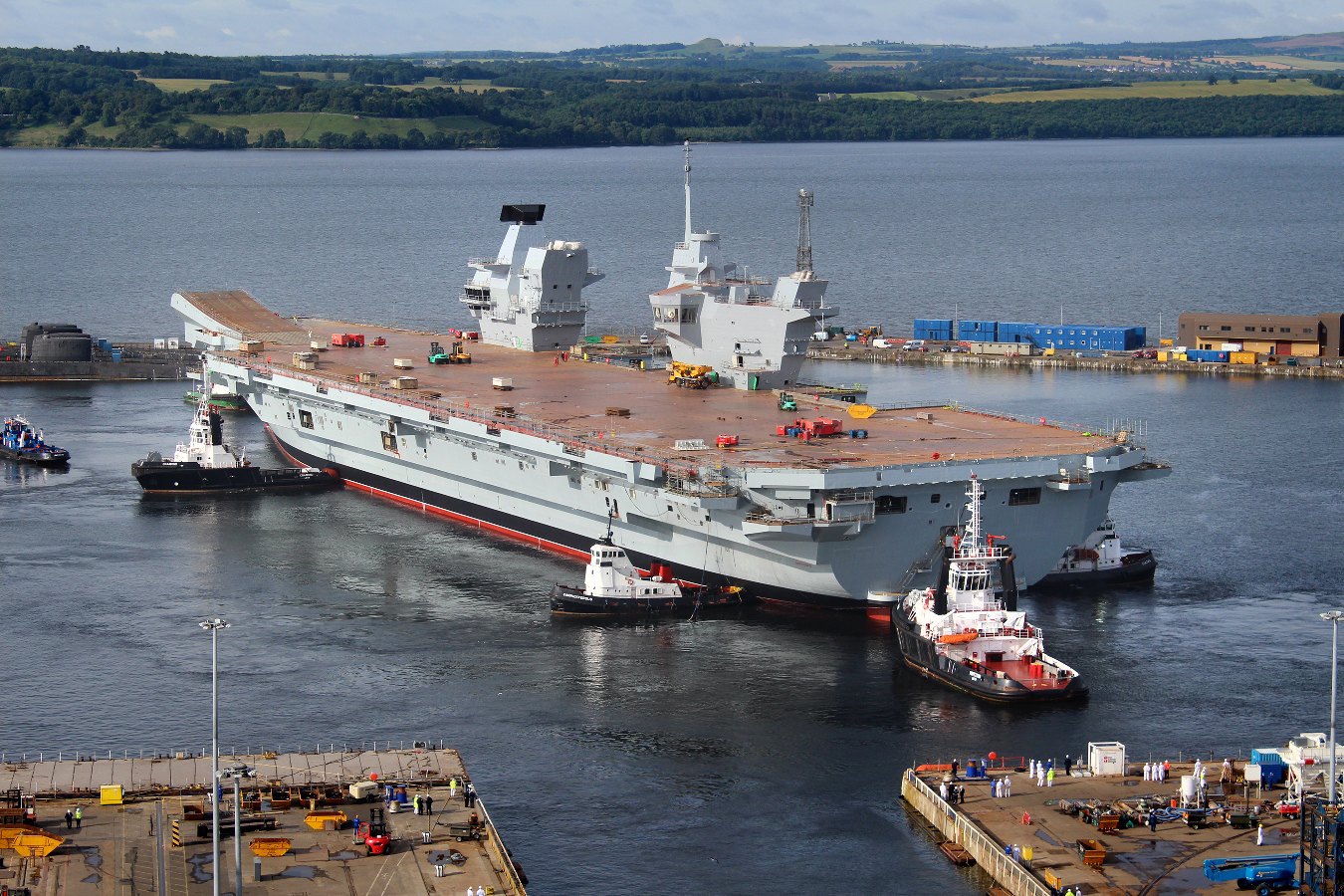
The Royal Navy’s largest ever warship HMS Queen Elizabeth is gently floated out of her dock for the first time in Rosyth, Scotland in July 2014. In an operation that started earlier that week, the dry dock in Rosyth near Edinburgh was flooded for the first time to allow the 65,000 tonne aircraft carrier to float. It then took only three hours to carefully manoeuvre HMS Queen Elizabeth out of the dock with just two metres clearance at either side and then berth her alongside a nearby jetty. Teams continued to outfit the ship and steadily bring her systems to life in preparation for sea trials in 2016. The dock she vacated will be used for final assembly of her sister ship, HMS Prince of Wales.
Source: Wikimedia.
The Royal Navy’s newest aircraft carrier is scheduled to be brought into commission in May this year:
The first new Royal Navy aircraft carrier in thirty years is nearing sea trials. After a brief absence from the world of fixed-wing naval aviation the Royal Navy’s brand new flattop HMS Queen Elizabeth and its sister ship, Prince of Wales, will soon sail the seas, their decks full of new F-35 Joint Strike Fighters. The result will be the most powerful “Senior Service” in generations.
The Royal Navy was one of the first naval warfare forces to explore the nascent world of naval aviation. HMS Argus, commissioned in September 1918, was arguably the first aircraft carrier with a full-length flight deck. The UK was one of the major aircraft carrier powers throughout World War II, and continued to operate carriers in the postwar period.
By 1982, the Royal Navy had committed to building three Invincible-class carriers. Somewhat scaled back from earlier ships, and dwarfed by the U.S. Navy’s Nimitz-class carriers, the Invincible class was more suited to antisubmarine warfare duties against the Soviet Navy, keeping the sea lines of communication between North America and Europe clear in the event of World War III. The Invincibles could sail with a complement of up to twenty-two aircraft, typically a mixture of Sea Harrier fighters and Sea King helicopters.
The 1982 Falklands War demonstrated the shortcomings of relying upon such small carriers. HMS Invincible, along with the older HMS Hermes, struggled to provide early warning and combat air patrol over the UK task force sent to reclaim the islands, and were unable to prevent Argentine air power from sinking six friendly warships and supply ships and damaging another nine.
In 2007, despite the general downturn in the size and scope of the navy, plans were announced in 2007 to construct two brand-new aircraft carriers. Each would be stocked with brand-new F-35 Joint Strike Fighters and helicopters, and would be up more than three times larger than their predecessors by displacement. The carriers, Queen Elizabeth and Prince of Wales, would be the largest warships ever built by the UK, bigger even than the World War II battleship HMS Vanguard.
Unfortunately, in order to free up funding for the new carriers the older ships had to be retired, and decommissioning of the Invincible class carriers and their Sea Harrier jets during the 2010s was a huge blow to the Fleet Air Arm. The three warships were broken up for scrap, and the remaining Harrier jets, which by now included RAF Harriers, were purchased by the U.S. Marines to provide spare parts for their own fleet of AV-8B Harriers.
In The Register, Gareth Corfield relays reports that the Royal Navy has no submarines currently available for sea duty:
None of the Royal Navy’s seven attack submarines are deployed on operations at the moment, according to reports, which potentially threatens the security of Britain’s nuclear deterrent.
The Sun reported this morning that six of the seven boats are in maintenance – except for the seventh, HMS Astute, which is still undergoing sea trials.
Her sister Astute-class boat, HMS Ambush, is still undergoing repairs after ramming a civilian tanker in 2016 while hosting wannabe sub captains undergoing the Perisher submarine command course.
The main uses of attack submarines, as distinct from the four Vanguard-class boats that carry the UK’s Trident nuclear deterrent, are twofold.
As their name suggests, attack submarines can be used to attack the enemy – or, in the modern world’s uneasy peace with Russia, trail their submarines and naval vessels around the high seas, gathering vital intelligence on their sound signatures and electronic emissions for later analysis.
Attack submarines can also be used as escorts for other vessels, using their advanced sensors to sweep the seas for hostile ships such as Russia’s infamous intelligence-gathering trawlers, as well as doing secret squirrel tasks such as dropping off Special Forces in remote shore locations. British attack boats also deploy on intelligence-gathering missions into the seas around Russia and have chased Russian submarines away from Britain’s territorial waters.
Published on 13 Apr 2014
Full title reads: “Helensburgh. Goodbye To A Great Ship”.
Helensburgh, Scotland.
LV Battleship HMS Duke of York in the breakers yard at Helensburgh. LV Looking down on the bows. GV Duke of York in the breakers yard. LV Looking at the massive guns on the foredeck. CU Broken life-belt from the Duke of York. LV Panning shot showing lifeboats lying amongst other rubble on the deck. CU One of the lifeboats.
Library shots. GV Duke of York putting to sea during her hey-day. SV White ensign flying from the mast. GV Panning shot as the Duke of York puts to sea, name can be seen on the stern. GV Duke of York at full steam sailing between two other ships. LV Head on shot as the Duke of York ploughs through the sea.
Shots in breakers yard. GV Elevated shot looking down over the foredeck gun turrets. SV Massive guns. GV Elevated shot of a man with an acetylene cutter cutting away at the base of a gun turret for scrap.
LV Interior shot of a Hungarian refugee working on the bridge during the breaking operations. GV Scrap metal lying in the breakers yard. SV Panning shot of same. SV Man with acetylene cutter cutting through thick girder. LV Section of the battleship being loaded onto railway trucks. GV Looking across the breakers yard to the Duke of York in the background.
Published on 30 Jan 2017
During World War 1, German submarines were a major thread to shipping routes of the Entente everywhere. The Royal Navy and and her allies had to come up with defence mechanisms against the silent hunters. They deployed flying boats and airships to spot the enemy U-Boats, harassed them with depth charges and mines. But the most effective measure against them proved to be the convoy.
Published on 13 Oct 2015
Covering some of the same territory is my post on British battleship design from the end of the Napoleonic era to the 1880s.
Even though Kratman is retired Army, he seems positive about the Mattis appointment … under certain circumstances:
I don’t have really strong personal feelings against the idea of retired Marine General James Mattis becoming Secretary of Defense. He’s got to be a step up from the now normal western approach to defense, which is to put a broad-smiling woman or metrosexual in charge, keep the name, but make the office’s mission to be the secretary of political correctness, inclusivity, social justice, gender neutrality, gender integration, straight male moral castration, Muslim terrorist infiltration assistance, and pretty much anything but defense. Moreover, assuming Mattis takes the job, he’s a better man than I am; I wouldn’t take it without a fistful of signed but undated pardons and a liberal supply of ammunition. I think he – or anyone – purporting to fix Defense needs to shoot some people. No, not fire, not counsel, not yell at; shoot. Otherwise, the bureaucracy in the five-sided puzzle palace, the Navy Annex, and the various high rises in the area leased by the various services, will obfuscate, delay, deny, lie…whatever it takes to keep nothing from changing, especially their own power. Hmmm…did I say “some people”? Let me rephrases; he’s going to need to shoot a lot of people and probably will need a large rucksack full of signed but undated pardons, plus a graves registration unit, not too well trained, to truck the bodies to the Potomac and dump them.
Excuse me a moment, but the idea of a very large number of bureaucrats, in and out of uniform, being summarily shot and then having their bodies unceremoniously dumped in the Potomac to float out to sea has given me the schadenboner of all schadenboners…I need a bit to let it subside.
Ah, all better…well mostly better…now. At least I can continue with the column.
Published on 10 Dec 2016
Indy sits in the Chair of Wisdom again to answer your questions about World War 1. This week we talk about naval battles in the Baltic Sea and the use of tanks on other fronts than the Western Front.
Published on Nov 28, 2016
The second installment of the documentary following the build of Canada’s new Auxiliary Oiler Replenishment Ship. Episode 2 follows the journey of Davie, its workers and partners from May to November 2016 as they build the largest ship that will operate in the Royal Canadian Navy fleet.
Published on Sep 27, 2016
There are penguins on your doorstep, spectacular scenery, and, of course, a place that’s rich in history. That’s a good side of the unusual British forces posting to the Falkland islands. The bad side is the icy gale-force winds, freezing conditions, and limited roads and connectivity. For more, visit http://frces.tv/B2P3uR.
H/T to Ghost of a Flea for the link.



Powered by WordPress